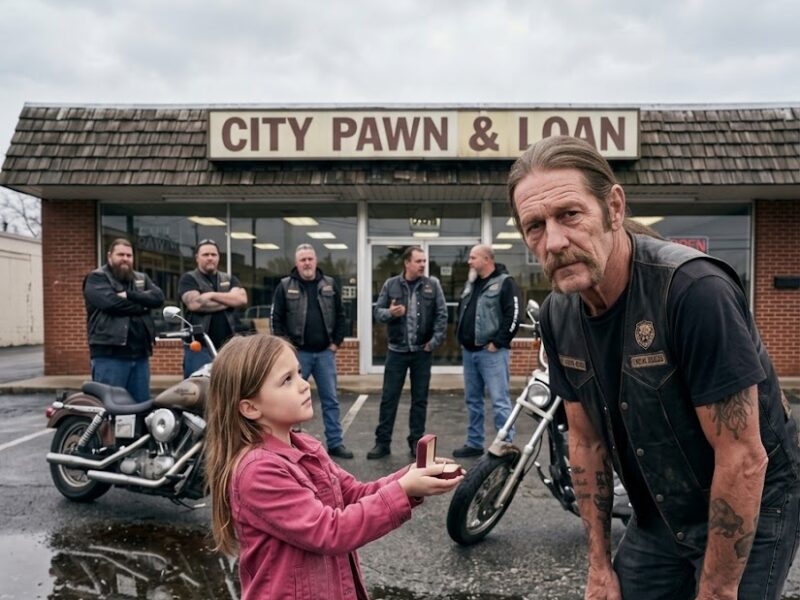
A Little Girl Tried to Pawn Her Mother’s Ring—Then 400 Bikers Arrived to Bring It Home
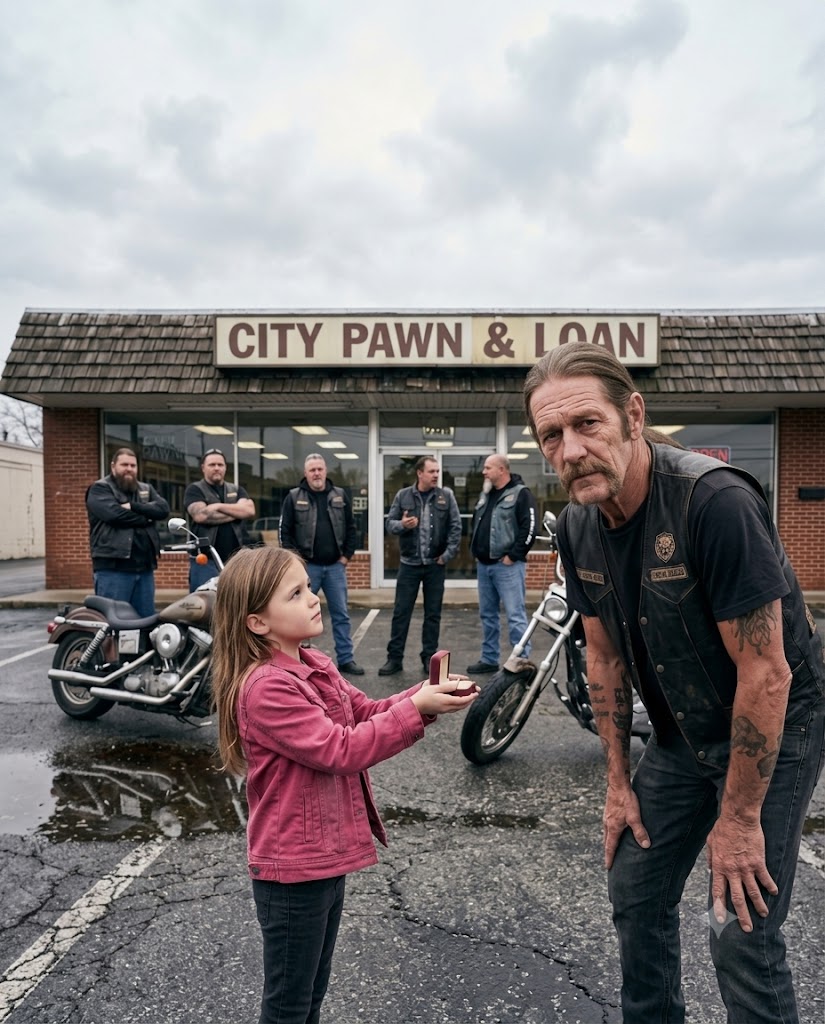
She left it here this morning, the woman behind the counter said, and she said it the way people say things they expect no one to act on.
Garrett Dunn heard those words through the open door of the pawn shop on Mosquite Flats Road and felt them land somewhere below his ribs in the place where old wrongs settle and stay.
He was fifty-three years old.
He had not cried since the winter his daughter stopped breathing.
He was not crying now, but he stood very still in the doorway with his hand on the frame, and the August heat pressed against his back like a flat iron, and he listened to what came next.
A little girl was standing at the glass counter with both hands pressed flat on the surface, and she was looking up at the woman with an expression that had no business being on a seven-year-old face.
Steady.
Resolved.
The kind of look that comes from having already done the hard part of deciding.
In her right hand, she held a small gold band set with a pale stone.
Not alexandrite, not anything expensive.
Just a ring that mattered.
She set it on the glass with one careful click and said, “I want to make sure you give me enough to keep the lights on.”
Four hundred bikers were about to hear those words.
None of them was ready for what they felt when they did.
The reason she was there alone at nine in the morning in a pawn shop on a cracked asphalt road in the high desert was the part nobody in that parking lot was prepared for yet.
Garrett Dunn stepped back from the doorway and walked to his motorcycle, and the soles of his boots on the concrete made the only sound for a moment.
He sat down on the bike.
He did not start it.
He stared at the handlebars and breathed.
The July heat shimmered off the blacktop in long flat waves.
The scrub beyond the lot was silver-gray in the early light, and a single hawk turned slow circles above the ridgeline without moving its wings at all.
He pulled out his phone.
He typed eleven words into the group thread for the Ash Creek Riders.
He pressed send.
Then he put the phone in his vest pocket, got off the bike, and went back inside.
The town of Malow Creek sat forty miles east of Flagstaff on a state highway that most people used only as a passage between somewhere and somewhere else.
It had a feed store, a diesel pump, a diner called Peavey’s that opened at five and closed at two, three churches, a school that served two grades in one classroom during years when enrollment ran thin, and a population that fluctuated between six hundred and eight hundred depending on the season and the price of copper.
The Ash Creek Riders had been using the parking lot behind Peavey’s as a staging point for mountain runs since the chapter was founded seventeen years ago, when Garrett Dunn and five other men decided they would rather organize a club than keep riding alone and angry through a landscape that seemed to want them to stay that way.
Garrett was the last of the six still in the saddle.
Three had moved on to other states, to families that needed them in different places.
One had died of a stroke in his sleep at fifty-one, which Garrett still considered an outrage, even though he understood intellectually that the heart does what it does without consulting anyone’s plans.
And one, a man named Phil Auster, had stopped riding the year after his youngest son enlisted and came home changed in ways that made the road feel too open.
Garrett understood that, too.
The Ash Creek Riders now ran sixty-four members in the active chapter and had a network of associated riders across three counties who responded when the chapter put out a call.
The patch on their vests was a circle of orange and black with a hawk in the center, wings folded, watching.
The colors had been chosen by vote on a Friday night in a Flagstaff garage with a single overhead bulb and a cooler of cheap beer, and no one had suggested changing them since.
Garrett had been president for eleven of the club’s seventeen years.
He was not a large man in the way that made people think of size first.
He was broad through the shoulders and thick through the neck, and his beard was the color of iron filings, and his hands were the hands of a man who had rebuilt engines and poured concrete and held other people’s weight for three decades.
When he walked into a room, people noticed the stillness before they noticed anything else.
Not stillness like calm.
Stillness like a thing that has decided.
He had come into Malow Creek that morning alone, something he rarely did anymore, because he had wanted an hour without voices.
The Ash Creek Riders were running a charity poker run the following weekend, and there were questions he needed to ask the Peavey’s owner, a woman named Deb Myrtto, about whether she could accommodate the lunch stop.
He had been planning to spend twenty minutes in the diner, drink one cup of coffee, shake hands, and ride back to Ash Creek before noon.
He had stopped at the pawn shop because a yard sale sign on the chain-link fence caught the edge of his vision, and he slowed down without thinking, as he sometimes did, because he looked for particular kinds of old tools, the way some people look for particular kinds of birds.
He had not expected to hear a child’s voice through an open door.
He had not expected eleven words to change the next six days of his life.
He went back inside.
The pawn shop was called Hardwick’s, and it smelled of motor oil and old cloth and the particular metallic sweetness of things that had passed through many hands.
Fluorescent tubes ran the length of the ceiling, and one of them buzzed with a sound like a trapped insect.
The woman behind the counter was named Vicky Hardwick, and she was in her mid-fifties, and her face held the practiced neutrality of someone who had learned long ago that the stories attached to the objects people brought in were rarely any of her business.
She was not unkind.
She was just correctly boundaried in a way that the job required.
She was looking at the little girl with the ring on the counter, and her expression had slipped from neutral into something else, something with concern in it, and she was working out what to say when Garrett walked back through the door.
The little girl did not turn around.
She was still looking at Vicky.
Her name, Garrett would learn in the next ten minutes, was Petra Linky.
She was seven years old and in the second grade at the two-classroom school on the eastern edge of Malow Creek.
She had brown hair and two braids that were not quite even, which meant she had done them herself or had done them with help that was not fully paying attention.
She was wearing a blue cotton shirt washed pale and jeans with a frayed hem and shoes that had been white once.
Her backpack was on the floor beside her right foot, and it had a small felt patch sewn onto the front flap, a sunflower, and the stitching was uneven in the way that children’s stitching is when they are learning.
The ring on the glass counter was a size six yellow gold set with a pale green stone in a simple four-prong setting.
It was not worth much in the calculus of Hardwick’s, maybe sixty, seventy dollars on a good day.
Garrett stood three feet behind Petra and looked at the ring and then looked at the back of the child’s head and did not say anything yet.
Vicky looked at him over Petra’s shoulder with an expression that was asking him something without words.
He gave a small shake of his head.
Not yet.
“How much can you give me for it?” Petra said again, with the patience of someone who had already asked once and was content to ask as many times as necessary.
“Sweetie,” Vicky said, and then stopped because there was no good next sentence.
“It belonged to my mom,” Petra said.
“She doesn’t know I have it, but the electricity is getting cut today and she cried about it last night when she thought I was asleep and I know where she keeps her ring because she doesn’t wear it since her hands got swollen.”
Vicky Hardwick put both hands flat on the counter on either side of the ring and looked at it.
The fluorescent tube buzzed.
Outside, the heat pressed down on Mosquite Flats Road, and the hawk turned another circle above the ridge.
Garrett Dunn crouched down until he was at eye level with the back of Petra’s head, and then he said quietly, “Hey.”
She turned around.
She looked at him the way children look at strangers who are not threatening, which is to say, she assessed him in about a second and a half and found him acceptable.
She looked at his beard and his vest and the Ash Creek Riders patch and the hawk in the center.
“Is that a real hawk?” she said.
“It’s a patch,” he said.
“But the hawk is real. We see them out where we ride.”
She considered this.
“My mom likes birds,” she said.
Garrett nodded.
“What’s your name?”
“Petra.”
“Garrett,” he said.
He did not put out his hand because she had not offered hers, and he had long ago learned that the way you hold space for a child is the way you hold space for anyone who has had reason to be careful.
You let them decide the geometry.
“Petra,” he said, “I’m going to take care of the electricity.”
She stared at him.
“You don’t know where we live.”
“You can tell me,” he said, “or you cannot tell me, and I’ll figure something else out. But either way, that ring goes home with you today.”
Petra looked at the ring on the counter.
Then she looked back at him.
“She’s going to be so mad,” she said.
Not afraid.
Just reporting a fact.
“Yeah,” Garrett said.
“She probably will be. And then she’ll be something else.”
He stood up and looked at Vicky Hardwick, and Vicky was already reaching under the counter for a paper bag to put the ring in.
The buzzing fluorescent tube went quiet for a moment, as if it too was listening to what had just been decided, and then it started again.
Garrett Dunn was standing outside Hardwick’s with Petra Linky sitting on the curb beside his motorcycle when he called Deb Myrtto at Peavey’s.
He did not explain very much.
He said he had a situation and he needed to know who ran the accounts at the Malow Creek Electricity Cooperative, which served the rural stretches east of town.
Deb said, “Jim Puit, and he eats breakfast here every Tuesday and Thursday, and today’s Tuesday, so he’s in the back corner right now.”
Garrett said, “Can you put him on?”
There was a pause and the sound of a diner moving around itself.
Cups and plates and a grill and three conversations happening at once.
And then a man’s voice said, “This is Jim.”
Garrett explained the situation in four sentences.
Jim Puit said the procedure for emergency reconnection required a signed authorization from the account holder and payment of the outstanding balance plus a reconnection fee.
Garrett said, “What’s the balance?”
Jim Puit said, “A hundred and sixty-two dollars, and the reconnection fee is forty-five.”
Garrett said, “Two hundred and seven.”
Jim said, “Plus tax.”
Garrett said, “Plus tax.”
Then he said, “Jim, I need this done today before noon.”
There was a long pause.
Jim Puit said, “You understand I can’t just override the procedure.”
Garrett said, “I understand that completely.”
Another pause.
Jim said, “Bring me the payment and I’ll personally walk the authorization paperwork through.”
Garrett said, “Give me forty minutes.”
He ended the call and looked down at Petra, who was drawing a shape in the dust on the parking lot with the toe of her shoe.
“I need your address,” he said.
She told him.
He put it in his phone.
Then he called his road captain, a man named Felix Soto, fifty years old, who had been with the Ash Creek Riders for nine years and who had the particular gift of making large, complicated things happen quickly and without drama.
“I sent you eleven words this morning,” Garrett said.
“I need you to turn it into action.”
Felix said, “Already started.”
Garrett said, “How many?”
Felix said, “By tonight, more than you need.”
Garrett said, “Call it in with the whole network. Whatever we can get.”
Felix paused.
“Is this what I think it is?”
Garrett said, “A seven-year-old walked into a pawn shop with her mother’s ring to pay the electric bill.”
The silence on the line lasted four seconds.
Felix Soto said, “Give me two hours.”
Garrett put the phone in his pocket.
Petra was still drawing in the dust.
“What are you drawing?” he said.
“A horse,” she said.
It did not look much like a horse.
It looked like the shape a horse makes when you are seven and drawing from memory and the dust is not quite cooperating, which meant it looked exactly right.
He sat down on the curb next to her.
He had not sat on a curb since he was maybe thirty-five.
The concrete was hot through his jeans.
A truck went by on Mosquite Flats Road, trailing a column of dust that drifted through the chain-link fence and made Petra blink.
“Does your mom know where you went?” he said.
Petra said nothing, which was its own answer.
He pulled out his phone again and held it toward her.
“Call her,” he said.
“Tell her where you are and tell her a person is bringing the ring back.”
Petra looked at the phone.
“She’s going to cry,” she said.
“Yeah,” Garrett said.
“People do that when they find out someone is taking care of them.”
Petra took the phone.
He stood up and walked to the edge of the lot and looked at the ridge, and the hawk was still there.
Or a hawk was turning in the thermal above the gray scrub, patient and unhurried, waiting on nothing in particular and missing nothing.
He could hear Petra’s voice behind him, small and careful, saying, “Mom, Mom, listen. I’m okay.”
He kept his eyes on the hawk.
He had a daughter once.
She would have been twenty-six this fall.
He had been on the road when it happened.
He did not stay on the road after.
He had come back and stayed and made the club a reason to be somewhere, which was not the same as a reason to be alive, but was sufficient most days, and had grown into something close to the other thing over time.
He had carried that for fifteen years.
He was still carrying it, but standing in a pawn shop parking lot in Malow Creek with a hawk overhead and a seven-year-old girl calling her mother to say she was okay, the weight of it shifted, just slightly, the way a heavy thing shifts when someone reaches over and takes a corner of it without being asked.
He breathed.
He did not look at the ridge.
He turned around and went back to the curb and sat down next to Petra again and waited for whatever came next.
What came next was a white pickup truck with a cracked left tailgate and a child seat in the back, driven too fast into the parking lot and stopped with the kind of abruptness that means someone’s hands were shaking.
The woman who got out of the truck was named Clare Linky.
She was thirty-four years old.
She had Petra’s brown hair and Petra’s steadiness in the eyes, except that steadiness was currently fighting hard against something that had clearly been coming up since she heard her daughter’s voice on the phone.
She went straight to Petra and went down on one knee and held Petra’s face in both hands and looked at her the way mothers look at children they were afraid of losing, which is to say with the kind of thoroughness that counts every feature twice.
Then she sat back on her heels and took a breath that sounded like it had been held for some time.
She looked up at Garrett.
He was standing three feet away with his hands at his sides.
“She had my ring,” Clare said.
Not accusatory.
Just establishing the facts.
“She was trying to sell it,” Garrett said.
“To pay your electric bill.”
Clare Linky closed her eyes for two seconds.
Then she opened them and looked at Petra.
“Petra Anne,” she said.
Petra said, “It was the only thing I could think of.”
Clare looked at Garrett again.
Her eyes were the color of creek water, gray-brown and clear and working hard.
“You stopped her,” she said.
“Vicky Hardwick stopped her,” Garrett said.
“I was just standing in the door.”
Clare looked at the ring in the paper bag in Petra’s hand, which Petra was holding with the care you give something you nearly gave away and are now never letting go of again.
“She told me on the phone that a person was going to fix the electricity,” Clare said.
“That’s already in motion,” Garrett said.
“How?”
Garrett said, “I talked to Jim Puit at the co-op. He’s walking the paperwork through today.”
Clare said, “He told her about Jim Puit and the two hundred and seven dollars.”
Her face shifted through several things quickly and settled on a tight, precise dignity.
That told him she had practice accepting help and did not always find it easy.
“I will pay that back,” she said.
“I know you will,” he said.
He meant it.
That was all he said about it.
She stood up from her crouch and looked at the motorcycle and the patch and the hawk and then back at him.
“Who are you?” she said.
“Garrett Dunn. Ash Creek Riders. We run out of Ash Creek, ride through this area a fair amount.”
She nodded slowly.
“You just happened to stop.”
“I have a gift for being in the wrong place,” he said.
“That occasionally turns out to be the right one.”
It was not quite a joke, but it was close enough that the corner of her mouth moved.
Then she looked at the ridge and the hawk still up there, still circling.
“My daughter likes birds,” she said.
“She told me,” he said.
“Also horses.”
Clare looked down at the dust drawing.
Something moved through her face that was not quite a smile and not quite grief.
Something between those two things that has no clean name.
“She draws them everywhere,” she said quietly.
She picked Petra up and settled her on her hip, and Petra put her arms around her mother’s neck, and the ring in the paper bag stayed in Petra’s hand.
Garrett watched them and felt the old weight shift again.
That subtle redistribution of something carried too long alone.
He said, “I have some people coming this evening. I want to explain something to you before they get here so it doesn’t scare you.”
Clare looked at him over the top of her daughter’s head.
“How many people?” she said.
He told her.
She was quiet for a moment.
Then she said, “That’s a lot of people.”
“Yes,” he said.
“It is.”
She looked at him for a long time with those clear gray-brown eyes.
“Why?” she said, and the word was simple, and it carried everything.
Garrett Dunn looked at the ridge.
The hawk had dropped lower, riding the warm air close above the scrub now, close enough that you could see the shape of its wings holding the curve of the wind.
“Because your daughter walked into a pawn shop alone,” he said, “and tried to do a hard thing, and nobody should have to do a hard thing alone.”
Clare Linky did not answer, but her arms tightened around her daughter, and Petra pressed her face against her mother’s shoulder and held the paper bag with the ring in it against her mother’s back.
And the three of them stood in the parking lot for a moment in the August heat, with the hawk overhead and the dust settling from the truck’s arrival, and the world held still.
Felix Soto arrived at two in the Ash Creek Riders van with two members in the cab and three in the back and a phone that had not stopped ringing since morning.
He had the build of a man who had spent his forties doing physical work and his fifties doing organizational work that required the same kind of strength applied differently.
His beard was black going gray at the jaw.
His vest was worn smooth at the shoulders.
He parked behind Peavey’s, which Deb Myrtto had agreed to keep open an extra two hours on no notice at all, because Deb Myrtto had been watching the Ash Creek Riders come through Malow Creek for years and had long since formed her own views about what they were.
The members with Felix were a man named Roy Cafferty, sixty years old, a retired contractor who managed the chapter’s emergency fund with the scrupulous attention of someone who had once been broke enough to know what accounting meant, and a man named Augusto Veila, fifty-five, who drove a flatbed truck for work and had the gift of coordinating large numbers of people without raising his voice, and three newer members whose names Garrett knew but whose characters he was still measuring, which was not a judgment so much as an ongoing observation.
The seven of them stood in Peavey’s parking lot in the late afternoon light, which came in low and gold from the west and turned the dust hanging in the air to copper, and Garrett told them what he knew about Clare Linky and Petra Linky in the way he always told things, which was to say with facts in order and no decoration.
Roy Cafferty said, “What’s the full picture financially?”
Garrett said he did not have full visibility, but from what Clare had told him, two months behind on the electric, one month behind on rent, a medical bill from the spring that was in collections, and a job at the feed store that paid eleven dollars an hour and currently had her at thirty hours a week because the owner had reduced staff for the slow season.
Roy wrote numbers on a folded piece of paper with a mechanical pencil.
Felix said, “The network is responding. I’ve got confirmed contacts from three counties.”
Garrett said, “How many confirmed as of now?”
Felix looked at his phone.
“As of two o’clock, two hundred and eighty-four.”
Augusto said, “It’ll be over three hundred by tonight.”
Garrett looked at the piece of paper in Roy’s hand and then at the western light and then at his own hands for a moment.
He said, “I want it done right. Not just the immediate crisis. I want her stable.”
Roy said, “Then we need to know the numbers.”
Garrett said, “I’ll talk to her tonight.”
Felix said, “There’s something else.”
He showed Garrett his phone.
The eleven words Garrett had texted that morning had been forwarded through the network, and someone had photographed Petra’s dust drawing of the horse in the parking lot before it got scuffed out, and it was moving around the connected community of riders and former riders and their families in the way that images sometimes move when they hit something true.
The photograph showed a child’s rough outline in the pale dust of a parking lot, a shape that was almost a horse next to a motorcycle’s front tire and a small paper bag with a ring in it and nothing else.
Felix said, “People want to do something.”
Garrett said, “Tell them to come tomorrow evening. Peavey’s lot. Tell them what this is for. Tell them the little girl tried to sell her mother’s ring.”
Felix said, “Do I tell them how many we expect?”
Garrett said, “Tell them I’ll be standing there when they arrive.”
That apparently was sufficient.
Roy Cafferty refolded his paper and put his mechanical pencil away and said, “I need to make three phone calls.”
He went to the far end of the parking lot and stood with his back to the group and started talking.
Augusto Veila went inside to talk to Deb Myrtto about logistics.
Felix sat down on the tailgate of the van and looked at his phone and worked.
Garrett stood in the gold light and thought about Petra Linky pressing that ring down on the glass counter with one careful click.
And he thought about his daughter, who had been three years old the last time he saw her alive, and who had been reaching toward something on a high shelf, and who had made a sound that meant she wanted it.
And he thought about the ways in which a small hand reaching for something becomes the image by which an entire life is organized if you let it.
And how the only choice available to a person carrying that image is whether they let it paralyze them or let it move them.
He had been paralyzed for two years.
Then he had built a club.
Then he had been president.
Now he was standing in a parking lot in Malow Creek, Arizona, with the numbers growing on Felix’s phone, and a hawk somewhere above the ridge he couldn’t see anymore because the light had changed, and something in him that had been shut for fifteen years was considering whether to open.
The riders began arriving the following evening at five o’clock, when the sun was still an hour above the ridge and the heat had dropped from brutal to merely fierce.
They came in ones and pairs and groups from Ash Creek and from Flagstaff and from the high country north of Williams and from communities Garrett knew by name but rarely visited.
They came on bikes of every kind, touring machines and stripped-down cruisers and older models that had been kept running by the sheer stubbornness of their owners.
They wore vests and helmets and riding gear, and they pulled into Peavey’s lot in an order that organized itself without being directed, because people who ride together develop an instinct for formation that operates below conscious thought.
By six o’clock there were one hundred and seventy in the lot and overflowing down the road.
By six-thirty there were two hundred and sixty.
By seven, when the light went amber and long and the shadows of the bikes stretched east across the blacktop in parallel lines, there were four hundred and eleven.
Deb Myrtto had set up a folding table at the back door of Peavey’s with a coffee urn and a water cooler and stacks of paper cups, and she moved back and forth along it with the efficiency of someone who had been feeding large numbers of people for thirty years and found the number did not change the method.
People left cash on the folding table.
They left it in envelopes and in folded bills and in one case in a small glass jar with a handwritten label that said simply, “For the girl.”
Roy Cafferty stood at the table with his folded paper and his mechanical pencil and recorded every amount and thanked every person with a nod and a handshake.
The atmosphere in the lot was not loud.
That was the thing about it that seemed to surprise the few Malow Creek residents who had come out of their houses to look.
It was quiet in the way that large bodies of water are quiet, which is to say it was not quiet at all if you listened for what was in it, but it was not the noise anyone expected.
There was low conversation.
There were greetings between people who hadn’t seen each other in months.
There was the particular sound of cooling engines settling and ticking in the early evening.
There was no rowdiness.
There was no performance.
Four hundred and eleven people had come because a seven-year-old girl had tried to sell her mother’s ring.
And they had all heard about it through a chain of phone calls and forwarded messages and that one photograph of a dust drawing.
And they were here to say what they were going to say in the only language that actually meant anything, which was presence and money and the willingness to make a long drive on a weeknight.
Clare Linky arrived at six with Petra on her hip, and the lot was already more than half full, and she stopped at the entrance and looked at it.
Garrett was beside her.
He had walked her from her house three blocks over because she had called him at four in the afternoon and said she didn’t think she could walk in alone, and he had said, “Then I’ll be there at five forty-five.”
He had been there at five forty.
She looked at the rows and rows of bikes and the people moving between them in the amber light, and she said nothing for a long time.
Petra looked too.
She was taking it in with the same gravity she had used at the glass counter.
That settled, assessing patience.
Then she said, “Is this all because of me?”
Garrett said, “Every single one.”
She looked at the lot again.
She looked at the hawk patch on Garrett’s vest.
“How many?” she said.
He told her.
She turned that number over with the seriousness of a child doing arithmetic that matters.
“That’s a lot of people,” she said, which was exactly what her mother had said the day before.
And Garrett thought that there were things a person carries in their blood that cannot be named, only recognized.
“It is,” he said.
Clare Linky had her hand at her mouth.
Her eyes were bright.
She was not going to cry in the parking lot of Peavey’s Diner in front of four hundred and eleven people, and Garrett respected that completely, and he positioned himself slightly to her left so that if she needed a moment, the crowd’s line of sight was partially interrupted.
A man near the front of the group, a veteran member named Darnell Case, sixty-two years old, who had been riding with the Ash Creek network since before the chapter was formally organized, saw Garrett arrive with Clare and Petra, and he turned and said something to the men beside him in a low voice.
The message moved through the crowd the way messages move through a crowd that is paying attention.
People turned.
They did not shout or applaud.
They stood.
All four hundred and eleven of them, as far as Garrett could see, stood and turned to face the small woman and the small girl at the entrance to the lot.
And the amber light lay across all of them, and the evening was very quiet for a moment in the way that only a very large number of people being deliberately still can produce.
Then Darnell Case stepped forward and said, “We heard about your daughter.”
Clare said, “She heard about yours,” and her voice did not break, though the effort of it was visible in her jaw.
Darnell looked at Petra.
Petra looked back.
“Young lady,” Darnell said.
“What you did for your mother was about the bravest thing I’ve heard of this year.”
Petra considered this with the gravity it deserved.
“I didn’t want her to cry anymore,” she said.
Darnell Case, who had ridden hard roads for forty years and buried two friends and put his own son through two deployments without weeping in company, made a sound then that was not quite a word.
He pressed his lips together and nodded and stepped back, and the amber light held everyone there for one more moment.
All four hundred and eleven of them and the cooling bikes and the coffee urn and the paper cups and the little girl with the paper bag still in her hand.
Roy Cafferty came to Garrett at eight-fifteen with the folded paper and a number on it that Garrett looked at twice.
Four hundred and eleven people had left between them eleven thousand two hundred and forty dollars on Deb Myrtto’s folding table.
Roy had the accounting tight and clean because Roy always did.
Garrett took the paper and looked at it in the last light of the evening and thought about a ring on a glass counter and a click that had cost a child everything she was willing to give.
The money went first to the electric cooperative, the two hundred and seven dollars plus tax paid by Roy in person to Jim Puit on Wednesday morning, and Jim Puit took it and processed the reconnection paperwork himself and had the power restored at Clare Linky’s address by eleven that morning as he had promised.
The medical bill in collections, four hundred and eighty-one dollars, was settled in full by Roy on behalf of the Ash Creek Riders Emergency Fund, which then submitted the receipt to the chapter for reimbursement from the collected amount.
The two months of back rent, eight hundred and forty dollars, was paid directly to the landlord, a man named Howard Guest, who received the payment with an expression that was defensive at first and then became something that wanted to be grateful but was not sure it had earned the right.
A savings account was opened in Clare Linky’s name at the community credit union in Flagstaff with an initial deposit of six thousand dollars.
And Felix Soto sat with Clare at a table in the credit union for two hours on Thursday afternoon, helping her understand the account structure and the monthly budgeting worksheet that Roy had put together for her.
The remaining funds went into a secondary holding in the chapter’s emergency account designated specifically for Clare Linky’s household, available for named expenses at her request and with her authorization, with no condition attached except that she asked.
Clare asked twice in the following year.
Both times were for Petra.
Once for school supplies in September and once for a medical visit in February that turned out to be nothing serious.
She did not ask a third time, not because the offer was withdrawn, but because by the following spring she had accepted a full-time position at the feed store after the owner, who had been gently educated by several members of the Ash Creek Riders on the general subject of community responsibility, restored her hours and then expanded them.
Petra Linky went back to school in the fall with the same worn backpack and the sunflower patch on the front, except that the stitching had been redone with thread in a brighter yellow and there was a new patch beside it, smaller, an orange and black hawk with its wings folded, watching.
Clare had sewn it on herself.
She told Garrett about it on the phone in August, a year after the morning at Hardwick’s, and she said Petra had asked her to put the hawk right next to the sunflower because Petra had explained, with seven-year-old precision, “They’re both from outside and they’re both real.”
Garrett was sitting on the step of his garage in Ash Creek when Clare told him that, and he was quiet for a moment, and then he said, “She’s right.”
The Ash Creek Riders formalized the Emergency Household Fund the following spring, naming it the Linky Fund in a chapter vote, sixteen to zero, with two absences, and committed a portion of every poker run and charity event to it.
By the second year, it had assisted four other families in the network’s territory in amounts ranging from two hundred to three thousand dollars, and the chapter was working with an attorney in Flagstaff on the paperwork to establish it as a named nonprofit, which would take another year and a half but would eventually be done.
On the first anniversary of the night at Peavey’s lot, the Ash Creek Riders held a gathering that they called informally the 411, and four hundred and twenty-seven people came, because word had grown, and Deb Myrtto opened the diner for dinner service and covered the cost of the first round of coffee herself, and Petra Linky drew a chalk horse on the blacktop of the parking lot, a real horse this time, recognizable and sure-lined, because she had been practicing all year.
The chalk horse was six feet long and she drew it from memory and it was good.
Someone photographed it before the evening foot traffic erased it, and the photograph lives on the chapter’s wall in the Ash Creek clubhouse, framed in plain wood next to a photograph of the dust drawing from the pawn shop parking lot.
The two drawings, one uncertain, made in grief and dust with the toe of a child’s shoe, one confident, made in color on clean ground because a year had passed and the ground was different now.
Garrett Dunn stood at the edge of the parking lot that night and watched four hundred and twenty-seven people move in the warm light of a summer evening, and he thought about the hawk that had been circling the ridge the morning this began.
And he thought about his daughter reaching for something on a high shelf.
And he thought about the way a hard thing becomes a bearable thing not through forgetting but through the accumulation of other people around the weight of it, until the weight is distributed and the carrying becomes possible.
He was not healed.
He would tell you plainly that was not the word.
But he was reachable, which was different, and which was on most days enough.
The click of a gold ring on a glass counter is not a sound anyone was supposed to hear.
But you hear the sounds that find you.
And what you do with what you’ve heard is the only measure that ever counted for anything.
Four hundred and eleven people heard it on a weeknight in August.
And they came.
And the hawk on a child’s backpack watched everything, wings folded, missing nothing.









