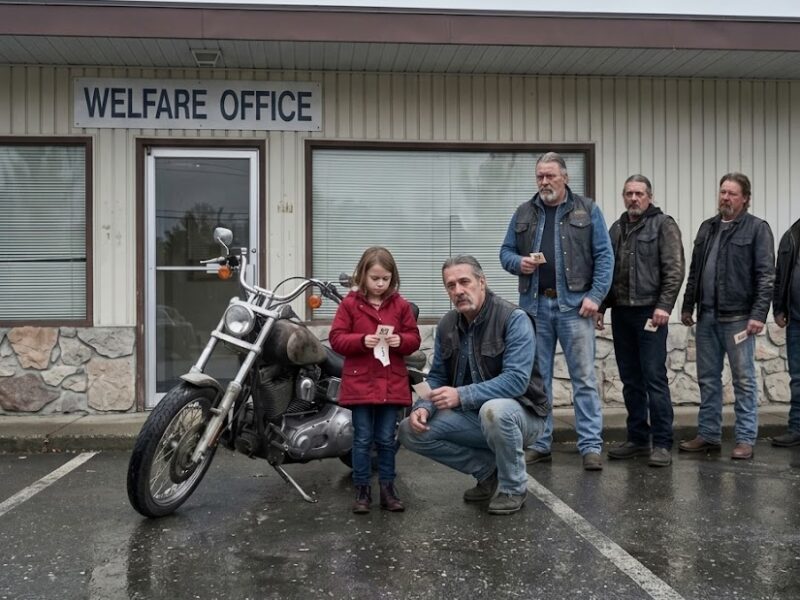
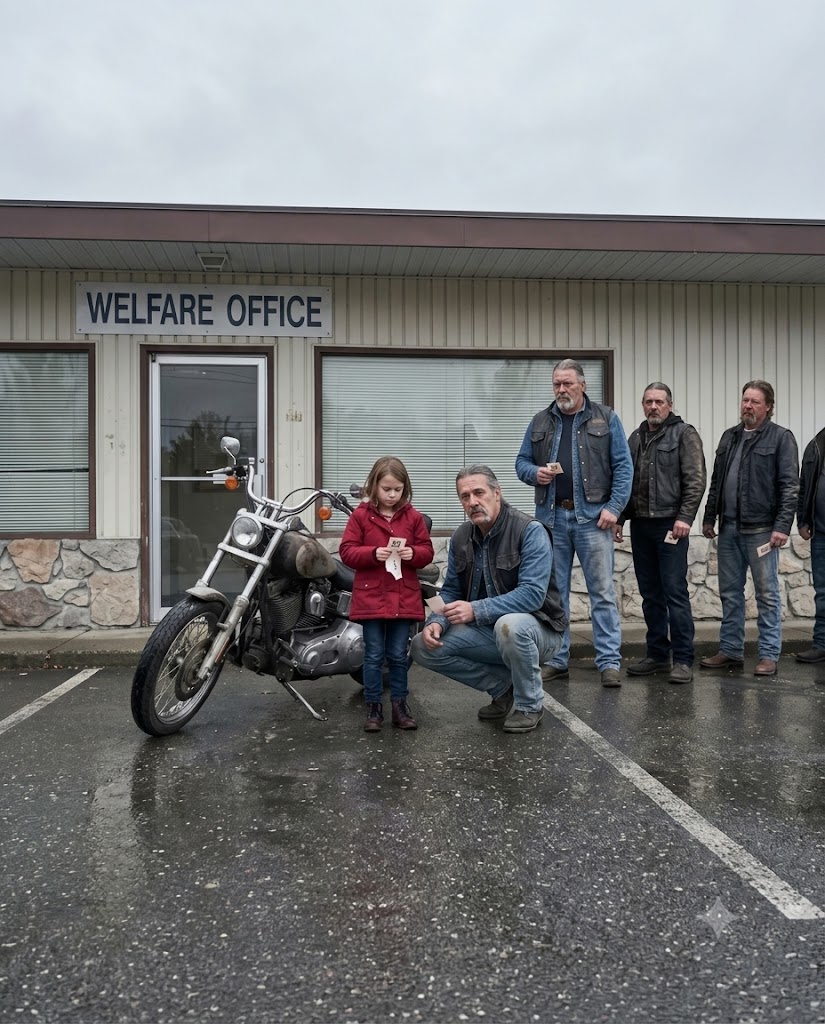
A little girl took a number at the welfare office and waited all day. Nobody called her name. Nobody even looked at her. Then the doors opened — and 450 bikers walked in, took numbers, and sat down beside her.
Part 1
The line started forming before the sun came up over Navajo Boulevard, and by the time the intake clerk unlocked the glass door at the Yavapai County Welfare and Human Services Office, there were 450 men in leather cuts standing in a silence so complete you could hear a hawk working a thermal two hundred yards away.
They had come from seven states and three time zones, some of them riding through the night with frost still silvering their handlebars, and every single one of them had taken a number from the dispenser by the door.
Not one of them complained about the wait.
That was the part the woman behind the intake desk would tell her husband about that night, sitting at her own kitchen table with her hands wrapped around a mug of coffee she had forgotten to drink, and she would say it the way you say something you are still trying to understand.
She had worked for the county for 31 years.
She had never seen anything like it.
The first rider through the door that morning was a man named Corbin Stall, 54 years old, wide through the chest and narrowed by wind, with hands that had torqued engine bolts and hauled brush and dug two graves in his time.
He took number 461 from the dispenser and folded it once and put it in the pocket of his cut, and then he stepped aside and held the door for the next man, and the next, and the next, until the waiting room was full and the parking lot was full and Navajo Boulevard itself was beginning to look like a river of chrome and black leather and iron-gray beards.
Nobody asked why they were there.
They already knew.
—
Part 2
One year earlier, almost to the day, a 7-year-old girl had walked 11 blocks from the Desert View Motel on Route 87 to that same concrete building and taken number two from the dispenser at 4:57 in the afternoon, 23 minutes before the office closed.
Her name was Ren Castillo.
She was wearing a dress that had been washed so many times the pattern on it was a suggestion of a pattern, faded to the color of old lavender, and on her feet were sneakers with Velcro closures because the laces had broken and been replaced with kitchen twine.
She had a small brown paper bag in her lap that held her supper, and she had not eaten it because she was saving it for her mother.
She sat down in a molded plastic chair against the far wall, and her feet did not touch the floor, and she held her number flat in her right hand, pressed against the paper bag, and she looked at the door with the steady, patient attention of someone who had decided not to look away until the right thing happened.
The office closed at 5:15.
Ren did not leave.
The overnight security contractor, a woman named Phyllis Odum who was in her middle 60s and wore a lanyard with six different access cards, called Child Protective Services and was told someone would be sent.
That was at 6:00 in the evening.
By midnight, no one had come.
By sunrise, Ren Castillo had been sitting in that chair for 14 hours, and she had not lost her place in line, and she had not let go of the number, and she had not stopped watching the door.
—
Part 3
Corbin Stall was alone in the yard behind the Ash Creek Writers Chapter Hall on the edge of Winslow, Arizona, when his phone buzzed with a message from Dee Ferris, the club’s road captain.
The message said only: “You need to come to the county welfare office on Navajo Boulevard right now. Bring whoever you can reach and tell nobody else why.”
Dee Ferris was not a man who dramatized.
Corbin read the message twice, set down his coffee, and went to find his keys.
He pulled into the parking lot at 6:49 in the morning and found Dee standing outside the glass front door with his arms crossed and his jaw set in the specific way it set when Dee was working to keep something off his face.
Dee was 44, ex-Army, built like a man who had been useful for a long time, and his hands when he uncrossed them were not quite steady.
Corbin killed the engine and got off the bike and looked through the glass door into the waiting room, and what he saw inside stopped him the way a step into empty air stops you.
Complete and instantaneous.
A child was sitting in a molded plastic chair against the far wall.
She was small enough that her feet did not touch the floor, and she was wearing a dress faded to the color of old lavender, and on her feet were sneakers with Velcro closures because the laces had broken and been replaced with kitchen twine.
She was sitting with a small brown paper bag on her lap held with both hands, and she was looking at the door with the steady, patient attention of someone who had decided not to look away until the right thing happened.
In her right hand, pressed flat against the paper bag, was a small square of perforated paper.
The number two.
The office would not open for another hour and 11 minutes.
—
Part 4
Corbin knocked on the glass, and Phyllis Odum crossed the room and cracked the door four inches.
She took in Corbin the way people always took in Corbin, the mass of him, the beard that was iron gray and substantial, the patch on his cut that said Ash Creek Writers above a red hawk in silhouette.
She started to say something that was going to be a refusal.
Then Dee said, “We’re not coming in. We just want to know if the child is all right.”
Phyllis Odum looked back at the girl.
She looked at Corbin.
She said, “She came in at sunset yesterday. Said she didn’t want to miss her number. Said her mama was sick and couldn’t come herself.”
She pulled the door three inches wider, which was not an invitation, but was something.
“The office manager let her stay because nobody could figure out what else to do with her. We called Child Protective Services and they said they’d send someone.”
She glanced at the clock over the door.
That was six hours ago.
Corbin said, “What’s in the bag?”
Phyllis Odum said, “Her supper. She wouldn’t eat it. She said she was saving it for her mama.”
Corbin Stall was not a man who moved quickly through emotion.
He processed things the way the desert processed water, slowly, in stages, taking in what it could and leaving the rest to evaporate.
But something happened in him in that moment that did not follow the usual order.
It landed in his sternum and it landed hard.
The reason was 13 years old and had lived in him unresolved for all of that time.
He had a daughter named Clara.
She had been 8 years old when the fever came, and she had survived it, but the winter she spent recovering in the hospital had been the winter her parents’ marriage had come apart.
Corbin had spent so much time on the road in the years before that, chasing something he could not have named, that by the time he understood how badly he was needed at home, the chance to be needed there was gone.
Clara was 21 now and lived in Prescott, and they talked by phone on her birthday and sometimes on his.
He had never fully found a language for what he owed her.
He looked through the gap in the door at a small girl sitting very straight in a molded plastic chair, holding a paper bag with her mother’s supper in it, and he recognized something he had no right to recognize, and it cost him.
He took a breath that was audible, even in the open air.
He looked at Dee.
He said, “Go get a breakfast sandwich from that gas station on Marble Street, nothing spicy, and call everybody.”
Dee said, “How many is everybody?”
Corbin said, “Everybody.”
—
Part 5
He knocked on the glass again.
Phyllis Odum opened the door.
He said, “Can I come in and sit with her? Just sit. I won’t speak first.”
Phyllis Odum looked at him for four long seconds.
Then she opened the door all the way.
Corbin Stall ducked his head at the frame and came inside.
The waiting room smelled of industrial cleaner and old paper and the faint sweetness of someone’s coffee going cold.
He crossed the linoleum to the row of chairs against the far wall, and he sat down two seats away from the girl, not one, because one would have been presumptuous.
He put his hands on his knees.
He looked at the window opposite and not at her.
She looked at him for a while.
Then she looked back at the door.
After three minutes, she said, “Are you a biker?”
He said, “Yes.”
She said, “My uncle was a biker. He smelled like motor oil.”
He said, “I probably do, too.”
She thought about this.
She said, “It’s okay. I like that smell.”
She adjusted the paper bag on her lap and looked at the door again.
He let the quiet settle.
Then she said, “My name is Ren.”
He said, “I’m Corbin.”
She said, “Are you waiting for something, too?”
He said, “Yes.”
She said, “What are you waiting for?”
He said, “I’m waiting to see if I can help.”
She considered that for a long time.
She looked at her number, the small square of paper pressed flat under her palm.
Then she looked at him.
She said, “My mama has number two. I’ve been keeping it for her.”
That was when his hands, flat on his knees, tightened the way hands tighten around the thing they are most afraid of losing.
—
Part 6
Her name was Ren Castillo.
She was 7 years old.
Her mother was Daniela Castillo, 31, a home health aide who had worked for a placement agency in Flagstaff until a diagnosis eight weeks before had made driving 140 miles a day impossible.
The diagnosis was a thing Corbin would not learn the name of until later, and even then he would not repeat it in the telling because it belonged to Daniela and not to him.
What Ren had been able to explain in the way children explain things, plain and slant and devastatingly accurate, was that her mama had started sleeping in the day, and that the money had gotten quiet, and that the case worker who was supposed to help them had not called back in three weeks.
Ren had heard her mama say the night before last that she did not know what they were going to do.
And Ren had decided, with the absolute executive authority of a 7-year-old, that she would go and get a number at the place where you go when you don’t know what to do, and that she would hold that number until somebody helped them.
She had walked 11 blocks from the motel room where they were staying.
She had arrived at 4:57 in the afternoon, 23 minutes before the office closed.
She had taken number two.
The office had closed at 5:15.
She had refused to leave.
She had told the closing staff that she did not want to lose her place because her mama needed help and Ren was going to make sure she got it, and her voice when she said it had been so matter-of-fact and so terrifyingly serious that nobody had been able to make her go.
—
Part 7
Dee came back with a breakfast sandwich wrapped in foil and a small orange juice and set them on the chair beside Ren without a word because Corbin had texted him.
She looked at the food.
She looked at Corbin.
He said, “It’s for you, not your mama’s bag.”
She said, “I’m not very hungry.”
He said, “You were here all night.”
She said, “I slept a little.”
He said, “Can I ask you something?”
She nodded.
He said, “Does your mama know you’re here?”
Ren was quiet for a moment.
She said, “I left her a note.”
Then very quietly, “I said, ‘I went to get help.'”
Outside the glass door in the parking lot, Dee Ferris was on his phone, and 41 members of the Ash Creek Writers were waking up to messages that said: “Come now, Navajo Boulevard. Bring your cut. Bring your patience and tell nobody why until you get here.”
By 7:20, the parking lot held nine bikes.
By 7:40, it held 22.
They parked in a row against the far curb, and they stood in the cold morning sun with their hands in their pockets and their breath making white shapes in the air, and they did not ask questions because Dee had said Corbin would explain it.
And when Corbin said he would explain something, you waited.
—
Part 8
When the office manager, a man named Thomas Reeve, who was 48 years old and had been running the Winslow welfare intake office for 11 years, pulled into the parking lot at 7:55 and counted 22 motorcycles and what appeared to be 31 large men in leather cuts standing in a loose formation near his entrance, he sat in his car for a full 90 seconds before he got out.
His hand went to his phone.
Somebody near the back of the formation saw it and said quietly and without heat, “He’s calling somebody.”
Corbin was still inside.
He knew what the parking lot looked like.
He had planned it.
He stood up, told Ren he would be right back, and went to the door.
He opened it, and he looked at Thomas Reeve across the parking lot, and he said in a voice that carried without effort, “Mr. Reeve, my name is Corbin Stall. I’m the president of the Ash Creek Writers. We are not here to cause any trouble. We are here because there is a 7-year-old girl inside your building who has been waiting since yesterday afternoon to get help for her sick mother. She has number two. We would like to make sure she gets to use it.”
Thomas Reeve looked at the formation of men.
He looked at the door.
He said, “She’s been in there all night.”
It was not a question.
He already knew.
Corbin said, “Yes, sir.”
Thomas Reeve put his phone back in his pocket.
He said, “Give me five minutes to open up.”
—
Part 9
He went to the door.
He went in.
He stopped when he saw Ren.
He crouched down in front of her the way a man crouches when he wants to be at eye level with someone smaller.
And he said, “Is your name Ren?”
She said it was.
He said, “I’m Thomas. I’m sorry nobody helped you yesterday. We’re going to fix that today.”
She looked at him with the measuring gravity of a child who has been let down enough times to check before she believes.
And then she held up her number.
She said, “I have number two.”
Thomas Reeve said, “You’re first.”
What happened next happened in the way that large things often happen, not in a single motion, but in a series of small decisive ones.
Thomas Reeve opened his office and called his senior intake coordinator, a woman named Lise Peralta, who arrived at 8:10 and sat down with Ren, and a cup of warm cocoa, and a legal pad, and began gently and methodically to build the file that Daniela Castillo had not been able to build because she had been too sick to come in.
Corbin, at Lise Peralta’s request, stepped outside to give them privacy.
He stood with his men in the parking lot in the October sun and he told them briefly what he knew.
Thirty-one men listened.
When he was done, a man called Hasp, who was the club’s treasurer and who almost never volunteered for anything that required paperwork, said, “What do we need?”
Corbin said, “I don’t know yet. I know she’s at the Desert View Motel on Route 87, and I know her mama is sick, and I know the case worker assigned to their file has not called back in three weeks.”
Hasp said, “I’ll find the case worker.”
A man named Burch Connelly, who was the club’s youngest member at 26 and who had grown up in foster care, said, “I know somebody at the state DHS office in Flagstaff.”
He was already dialing.
A man they called Trooper, real name Ellis Partardo, who had done 18 years as a county road inspector before his knees gave out and who knew every supervisor and middle manager in a four-county radius, said, “I’ll find out who’s above the case worker.”
Nobody was asked to do these things.
They were simply done the way a machine that has been running together for long enough responds to a problem, each part finding its function without instruction.
—
Part 10
By 9:00, Lise Peralta had enough information to open an emergency intake file for Daniela Castillo.
By 9:20, she had determined that the family qualified for emergency rental assistance, emergency medical support navigation, and a food bridge allocation that should have been processed six weeks prior.
By 9:35, she was on the phone with a supervisor in Flagstaff, her voice level and very precise, explaining that a case flagged for expedited review three weeks ago had not been actioned, and that a 7-year-old child had spent the night alone in a government waiting room as a direct consequence.
She did not raise her voice.
She did not need to.
Outside, Corbin Stall sat on the front step of the concrete building with his elbows on his knees and his coffee long cold in his hand.
And he was thinking about Clara.
He was thinking about the winter she was eight and the motel room he had slept in instead of the hospital room he should have been in and the specific texture of that regret, which was not sharp anymore but was dense the way old scar tissue is dense, something you feel more in certain kinds of cold.
A shadow fell across him.
He looked up.
Ren was standing in the doorway in her faded lavender dress with her paper bag under one arm and her number two still flat in her palm.
She said, “The lady is making phone calls.”
He said, “Good ones.”
She looked at the parking lot full of motorcycles.
She looked at the men standing around them in the thin morning light.
She said, “Did all those people come because of me?”
He said, “Every one of them.”
She was quiet for a moment.
Then she said, “How many?”
He said, “Thirty-one right now. More coming.”
She looked at them again.
She said, “That’s a lot of help.”
He said, “You needed a lot of help.”
She sat down on the step beside him, not two seats away, but right beside him, the way children sit when they have decided to trust something.
She still had the paper bag.
He did not ask about it.
—
Part 11
By 10:15 that morning, the Ash Creek Writers had 41 members in or around the Yavapai County Welfare and Human Services Office parking lot, plus seven affiliated riders from a neighboring club out of Holbrook, who had heard from Burch Connelly’s contact and ridden down without being asked, and 11 additional men who were not members of any club, but were the kind of men who show up when they hear a child spent the night alone in a waiting room.
Fifty-nine men total.
They had organized into three working groups without anyone calling it that.
The first group was managing phone calls and paperwork navigation with Thomas Reeve’s grudging assistance.
The second group had driven to the Desert View Motel on Route 87, where Daniela Castillo had been located by Hasp in 20 minutes of methodical phone work, and they were now sitting with her in the motel parking lot, so she was not alone, and so she knew her daughter was safe.
The third group was running a coffee and food operation from a truck bed because it was approaching noon and nobody had eaten anything except Ren, who had finally agreed to eat half the breakfast sandwich on the condition that they saved the other half for her mama.
Trooper had found the case worker’s direct supervisor, a regional manager named Sandra Ochoa, at the Flagstaff DHS office, and had explained the situation to her in a voice that was extremely quiet and extremely clear.
And Sandra Ochoa had said she would be in Winslow by 2:00.
The case worker had called back by 10:47.
It was the first time Daniela Castillo’s file had been touched in 22 days.
—
Part 12
Then the obstacle arrived.
His name was Raymond Castillo.
He was Daniela’s older brother by nine years.
And he arrived at the Desert View Motel at 11:30 in a truck that he parked across two spaces, and he informed the six Ash Creek riders sitting in the motel lot that they had no business being there and that family matters were family matters and that he had a right to speak to his sister without an audience.
He was not wrong about any of this.
He had a legal and human right to see his sister and to object to strangers camping outside her door.
Dee Ferris, who was managing the motel contingent, acknowledged this without argument.
He said, “You’re right. We’ll give you and your sister privacy. We’re just going to stay in the lot because her daughter is at the welfare office and we want to make sure Daniela knows someone is here.”
Raymond Castillo said his sister didn’t need strangers deciding what she needed, that he had been trying to get Daniela to come stay with his family in Holbrook for two months and she had refused, and that whatever these men thought they were doing, they were making things worse by getting involved in something they didn’t understand.
He looked at the motel door and then at Dee and then at the cluster of motorcycles.
He said, “She’s my sister.”
It came out different than the rest of it, quieter.
And Dee, who had 18 years of reading what people meant underneath what they said, looked at Raymond Castillo for a long moment and said, “I know. She’s lucky to have you.”
That was all.
Raymond went inside.
He stayed for 40 minutes.
When he came out, he sat on the tailgate of his truck and he was quiet.
And after a while, he said to Dee, “What are you all actually doing?”
Dee explained it.
The file, the case worker, the supervisor coming from Flagstaff, the food bridge, the rental assistance.
Raymond Castillo listened.
He said, “She never told me it had gotten that bad.”
Dee said, “She probably didn’t want you to worry.”
Raymond looked at his hands.
He said, “She’s my little sister.”
Dee said, “We know.”
Nobody said anything for a while.
Then Raymond Castillo stood up and said, “What do you need me to do?”
That was how it went from 59 to 60, which was not the number that mattered.
The number that mattered came later.
—
Part 13
Sandra Ochoa arrived at the Winslow office at 1:53 in the afternoon, which was seven minutes earlier than she had promised.
She was a compact woman in her mid-50s with reading glasses on a chain around her neck and a briefcase that was clearly not decorative, and she walked through the parking lot of motorcycles and men without breaking stride, which was the first thing that made Corbin Stall respect her.
She went inside and she asked to speak with Lise Peralta and Thomas Reeve, and then she asked to see the Castillo file, and she sat at a desk and read it for 22 minutes without speaking to anyone.
Ren had fallen asleep in the waiting room, curled in the plastic chair with her paper bag tucked under her head like a pillow, and Sandra Ochoa looked at her once before she opened the file, and she did not look away from the file after that.
When she was done reading, she sat it down.
She said, “Who has been handling this account at the regional level?”
The coordinator who answered her had the information.
She listened to it.
She said, “That’s not acceptable.”
Then she picked up her phone and made four calls in sequence, and each call was brief and each call ended with a yes on the other end.
And after the fourth call, she stood up and she said to Lise Peralta, “The rental assistance will be processed as an emergency disbursement by end of business today. The medical navigation referral will be initiated before I leave this building. The food bridge allocation will be backdated to the original eligibility date.”
She paused.
She looked at the file one more time.
She said, “Twenty-two days.”
It was not a question.
It was a judgment.
She went to find Thomas Reeve to sign the emergency authorizations.
—
Part 14
Corbin Stall was standing near the window when this happened.
He had heard most of it.
He looked at Ren asleep in the chair, at the paper bag under her head, and he thought about what it had cost her to sit in that chair all night, a 7-year-old alone in a fluorescent-lit room, holding a number and not losing her place.
And the weight of that thought moved through him like the first cold of October moving through desert rock, deep and settling and permanent.
He went outside.
He stood in the parking lot.
The October sun was getting low and western, throwing long amber light off the chrome of 59 motorcycles, and it looked from where he stood like something being lit on purpose.
He called Dee.
He said, “It’s moving. Bring Daniela in and bring Raymond.”
Dee said, “She’s not strong enough to drive.”
Corbin said, “She doesn’t need to drive. She needs to be here.”
He heard Dee say something to someone near him.
And then Dee said, “She’s asking if Ren is okay.”
Corbin said, “Tell her Ren’s been holding her number all day. Tell her nobody took her place.”
Daniela Castillo arrived at the welfare office at 3:17 in the afternoon in the passenger seat of Raymond’s truck with Raymond driving and Dee following on his bike.
She was thin in a way that had come on recently, and you could see it in how her clothes fit, and she moved slowly from the truck to the door with Raymond’s arm through hers.
She was 31 years old and she looked like someone who had been carrying something very heavy for a very long time alone.
She came through the glass door.
Ren woke up.
The paper bag fell off the chair.
Ren did not stop to pick it up.
She crossed the room at a run, and Daniela Castillo caught her daughter with both arms and held on.
And the room, which contained at that moment Thomas Reeve and Lise Peralta and Sandra Ochoa and Corbin Stall and Phyllis Odum and two intake clerks and Raymond Castillo, went absolutely quiet.
Nobody looked away.
—
Part 15
Corbin Stall, standing near the window with the amber afternoon light coming in across his right shoulder, felt his jaw work.
He looked at his hands.
After a long moment, Ren pulled back enough to look at her mother’s face.
She held up the number two, still flat and uncreased, pressed between her thumb and first finger.
She said, “I kept it. I didn’t lose your place.”
Daniela Castillo closed her eyes.
She said, “I know, mija. I know you did.”
Then she held her tighter, and the room let out the breath it had been holding all day.
Sandra Ochoa processed the emergency authorizations in the next 40 minutes.
The rental assistance bridge covered three months at the Desert View Motel, buying time for a more stable placement to be arranged.
The medical navigation referral connected Daniela with a case coordinator at Flagstaff Medical Center who specialized in exactly the diagnosis she carried.
The food bridge was activated for 12 weeks.
Raymond Castillo signed documents as a family contact.
And when the last page was signed, he looked across the desk at Thomas Reeve and said, “Why didn’t any of this happen six weeks ago?”
Thomas Reeve said, “It should have.”
That was the most honest thing said in the room all day, and everyone in it knew it.
Outside in the parking lot, the number had grown.
Word had traveled the way word travels in a community where everyone knows everyone’s frequency.
By 4:00, there were 93 riders in that lot.
By 5:00, there were 141.
They were not there to be seen.
They were there because Dee Ferris had sent a message that said a little girl kept her mama’s number all night, and the Ash Creek Writers are making sure it means something. Come if you can.
And the kind of people who ride high desert roads in October came because that is the kind of people they are.
—
Part 16
Corbin Stall stood at the door when Daniela and Ren came out, Raymond close behind them, and the 141 men in the parking lot did not make noise and did not perform.
They simply stood.
Ren came through the door first, holding her mother’s hand, and she saw the lot full of motorcycles and men, and she stopped.
She had seen 59 men that morning.
She had asked Corbin how many and he had said more coming.
Now she counted, or tried to, and gave up after a while, and looked up at Corbin, who was standing at the door.
She said, “How many now?”
He said, “One hundred forty-one.”
She looked at them all.
She said, “Are they all here for my mama?”
He said, “They’re all here because you were.”
She thought about this.
Then she said, “My mama’s going to need to say thank you to a lot of people.”
A man near the front of the formation, hearing this, turned to the man next to him and said something that made the other man’s shoulders shake, and it moved through the lot like a wave, quietly, and for one moment the parking lot full of hard men in leather cuts on a failing October afternoon sounded almost like laughter.
—
Part 17
In the weeks after, the Ash Creek Writers did not leave the case alone.
Hasp, who knew spreadsheets the way a surgeon knows tools, set up an account he called the Ren Fund, after the child who had started it.
And the 141 riders who had been in that lot each put in what they could, and what they could amounted to $11,400 by the end of the first two weeks.
This paid for three months of rent outright, for medication co-pays and transport to Flagstaff, and once for a week of professional home care so that Daniela could rest without worrying that Ren would come home from school to an empty, quiet apartment.
Raymond Castillo, who had arrived in that motel lot as an obstacle and left it as something else, coordinated with the family in Holbrook, and by January, Daniela and Ren had moved to a small house on the edge of Raymond’s property, close enough that Ren could see her uncle’s kitchen light from her bedroom window.
The caseworker situation was reviewed at the regional level at Sandra Ochoa’s insistence, and two procedural failures were formally documented.
Sandra Ochoa sent a letter to Corbin Stall addressed to the Ash Creek Writers Chapter in Winslow that said, among other things, that the presence of his club had created the conditions for an outcome that the system alone had failed to produce, and that she intended to say so in the formal review.
Corbin read the letter once, folded it, and put it in the fireproof box he kept under his bunk next to a photograph of Clara at 8 years old in a hospital bed, making a face at the camera that was pure defiance, pure survival.
He looked at the photograph for a while.
He put the box away.
—
Part 18
The following October, the Ash Creek Writers held their first annual welfare office run.
They called it the Number Two Run, and they asked every rider who came to take a number when they arrived and hold it no matter how long the wait, because that was what Ren Castillo had done.
The first year, 450 riders came from seven states.
They took numbers and they stood in line and they raised $43,000 through registration and collection for a fund that paid emergency first and second month deposits for families in crisis across three counties.
Thomas Reeve came and stood outside his building in the October sun and watched 450 motorcycles fill every surface of the parking lot and the two adjoining lots and most of Navajo Boulevard, and he shook Corbin Stall’s hand at the end of it and could not quite manage a complete sentence, which Corbin understood and honored with silence.
Ren Castillo came to the first run with her mother and her uncle.
She was 8 years old.
She stood near the registration table in new sneakers with actual laces, and she watched the riders come in and each one take their number, and at some point a man came up and handed her his number two and said he had specifically pulled it from the machine and he thought she should have it.
She held it up and looked at it, and then she carefully put it in the pocket of her jacket.
Somebody took a photograph.
In the photograph, 450 men stand behind one small girl in a jacket pocket holding a number, and the autumn light is coming in gold off the high desert, and every one of them is looking at her.
—
Part 19
Corbin Stall turned 54 that October.
He had spoken to Clara by phone two days before the run, and the conversation had gone longer than usual.
And at the end of it, she had said, “I heard about what you did in Winslow.”
He had said, “Ren did it. We just showed up.”
Clara was quiet for a moment.
Then she said, “You should have called me.”
He did not know exactly what she meant by that.
He knew it was the most important sentence she had said to him in years, and that it contained both an accusation and a door, and that the door was open.
He said, “I’ll call you next time.”
She said, “Okay.”
And that was where they left it, which was further than they had gotten in a long time.
He ended the call and sat with it for a while, sitting outside the chapter hall in the October evening, watching the light go off the desert in long horizontal bars, the creosote sharp and alive, the hawk, or one very like it, working the last thermal before dark.
He thought about a little girl sitting straight in a plastic chair with a paper bag on her lap and a number two in her hand, refusing to lose her place through an entire long night alone.
He thought about what that required, what it cost, what it meant to hold on to something when every instinct and every hour of darkness said to let it go.
He did not believe a 7-year-old had known what she was doing.
He believed she had done it anyway.
That was the thing about the ones who did not let go.
They did not always know why they were holding on.
They just knew the place in line belonged to someone who needed it, and they were not going to be the reason it was lost.
—
Part 20
Four hundred fifty men had taken numbers that October, the year after, because one girl had taught them what a number was worth.
The sound of 450 engines turning over in a parking lot on Navajo Boulevard in the high desert morning was the loudest thing in three counties.
And it sounded to anyone who knew what it meant like a door being held open.
The line started forming before the sun came up over Navajo Boulevard, and by the time the intake clerk unlocked the glass door at the Yavapai County Welfare and Human Services Office, there were 450 men in leather cuts standing in a silence so complete you could hear a hawk working a thermal two hundred yards away.
They had come from seven states and three time zones, some of them riding through the night with frost still silvering their handlebars, and every single one of them had taken a number from the dispenser by the door.
Not one of them complained about the wait.
That was the part the woman behind the intake desk would tell her husband about that night, sitting at her own kitchen table with her hands wrapped around a mug of coffee she had forgotten to drink, and she would say it the way you say something you are still trying to understand.
She had worked for the county for 31 years.
She had never seen anything like it.
The first rider through the door that morning was a man named Corbin Stall, 54 years old, wide through the chest and narrowed by wind, with hands that had torqued engine bolts and hauled brush and dug two graves in his time.
He took number 461 from the dispenser and folded it once and put it in the pocket of his cut, and then he stepped aside and held the door for the next man, and the next, and the next, until the waiting room was full and the parking lot was full and Navajo Boulevard itself was beginning to look like a river of chrome and black leather and iron-gray beards.
Nobody asked why they were there.
They already knew.
One year earlier, almost to the day, a 7-year-old girl had walked 11 blocks from the Desert View Motel on Route 87 to that same concrete building and taken number two from the dispenser at 4:57 in the afternoon, 23 minutes before the office closed.
Her name was Ren Castillo.
She was wearing a dress that had been washed so many times the pattern on it was a suggestion of a pattern, faded to the color of old lavender, and on her feet were sneakers with Velcro closures because the laces had broken and been replaced with kitchen twine.
She had a small brown paper bag in her lap that held her supper, and she had not eaten it because she was saving it for her mother.
She sat down in a molded plastic chair against the far wall, and her feet did not touch the floor, and she held her number flat in her right hand, pressed against the paper bag, and she looked at the door with the steady, patient attention of someone who had decided not to look away until the right thing happened.
The office closed at 5:15.
Ren did not leave.
The overnight security contractor, a woman named Phyllis Odum who was in her middle 60s and wore a lanyard with six different access cards, called Child Protective Services and was told someone would be sent.
That was at 6:00 in the evening.
By midnight, no one had come.
By sunrise, Ren Castillo had been sitting in that chair for 14 hours, and she had not lost her place in line, and she had not let go of the number, and she had not stopped watching the door.
Corbin Stall was alone in the yard behind the Ash Creek Writers Chapter Hall on the edge of Winslow, Arizona, when his phone buzzed with a message from Dee Ferris, the club’s road captain.
The message said only: “You need to come to the county welfare office on Navajo Boulevard right now. Bring whoever you can reach and tell nobody else why.”
Dee Ferris was not a man who dramatized.
Corbin read the message twice, set down his coffee, and went to find his keys.
He pulled into the parking lot at 6:49 in the morning and found Dee standing outside the glass front door with his arms crossed and his jaw set in the specific way it set when Dee was working to keep something off his face.
Dee was 44, ex-Army, built like a man who had been useful for a long time, and his hands when he uncrossed them were not quite steady.
Corbin killed the engine and got off the bike and looked through the glass door into the waiting room, and what he saw inside stopped him the way a step into empty air stops you.
Complete and instantaneous.
A child was sitting in a molded plastic chair against the far wall.
She was small enough that her feet did not touch the floor, and she was wearing a dress faded to the color of old lavender, and on her feet were sneakers with Velcro closures because the laces had broken and been replaced with kitchen twine.
She was sitting with a small brown paper bag on her lap held with both hands, and she was looking at the door with the steady, patient attention of someone who had decided not to look away until the right thing happened.
In her right hand, pressed flat against the paper bag, was a small square of perforated paper.
The number two.
The office would not open for another hour and 11 minutes.
Corbin knocked on the glass, and Phyllis Odum crossed the room and cracked the door four inches.
She took in Corbin the way people always took in Corbin, the mass of him, the beard that was iron gray and substantial, the patch on his cut that said Ash Creek Writers above a red hawk in silhouette.
She started to say something that was going to be a refusal.
Then Dee said, “We’re not coming in. We just want to know if the child is all right.”
Phyllis Odum looked back at the girl.
She looked at Corbin.
She said, “She came in at sunset yesterday. Said she didn’t want to miss her number. Said her mama was sick and couldn’t come herself.”
She pulled the door three inches wider, which was not an invitation, but was something.
“The office manager let her stay because nobody could figure out what else to do with her. We called Child Protective Services and they said they’d send someone.”
She glanced at the clock over the door.
That was six hours ago.
Corbin said, “What’s in the bag?”
Phyllis Odum said, “Her supper. She wouldn’t eat it. She said she was saving it for her mama.”
Corbin Stall was not a man who moved quickly through emotion.
He processed things the way the desert processed water, slowly, in stages, taking in what it could and leaving the rest to evaporate.
But something happened in him in that moment that did not follow the usual order.
It landed in his sternum and it landed hard.
The reason was 13 years old and had lived in him unresolved for all of that time.
He had a daughter named Clara.
She had been 8 years old when the fever came, and she had survived it, but the winter she spent recovering in the hospital had been the winter her parents’ marriage had come apart.
Corbin had spent so much time on the road in the years before that, chasing something he could not have named, that by the time he understood how badly he was needed at home, the chance to be needed there was gone.
Clara was 21 now and lived in Prescott, and they talked by phone on her birthday and sometimes on his.
He had never fully found a language for what he owed her.
He looked through the gap in the door at a small girl sitting very straight in a molded plastic chair, holding a paper bag with her mother’s supper in it, and he recognized something he had no right to recognize, and it cost him.
He took a breath that was audible, even in the open air.
He looked at Dee.
He said, “Go get a breakfast sandwich from that gas station on Marble Street, nothing spicy, and call everybody.”
Dee said, “How many is everybody?”
Corbin said, “Everybody.”
He knocked on the glass again.
Phyllis Odum opened the door.
He said, “Can I come in and sit with her? Just sit. I won’t speak first.”
Phyllis Odum looked at him for four long seconds.
Then she opened the door all the way.
Corbin Stall ducked his head at the frame and came inside.
The waiting room smelled of industrial cleaner and old paper and the faint sweetness of someone’s coffee going cold.
He crossed the linoleum to the row of chairs against the far wall, and he sat down two seats away from the girl, not one, because one would have been presumptuous.
He put his hands on his knees.
He looked at the window opposite and not at her.
She looked at him for a while.
Then she looked back at the door.
After three minutes, she said, “Are you a biker?”
He said, “Yes.”
She said, “My uncle was a biker. He smelled like motor oil.”
He said, “I probably do, too.”
She thought about this.
She said, “It’s okay. I like that smell.”
She adjusted the paper bag on her lap and looked at the door again.
He let the quiet settle.
Then she said, “My name is Ren.”
He said, “I’m Corbin.”
She said, “Are you waiting for something, too?”
He said, “Yes.”
She said, “What are you waiting for?”
He said, “I’m waiting to see if I can help.”
She considered that for a long time.
She looked at her number, the small square of paper pressed flat under her palm.
Then she looked at him.
She said, “My mama has number two. I’ve been keeping it for her.”
That was when his hands, flat on his knees, tightened the way hands tighten around the thing they are most afraid of losing.
Her name was Ren Castillo.
She was 7 years old.
Her mother was Daniela Castillo, 31, a home health aide who had worked for a placement agency in Flagstaff until a diagnosis eight weeks before had made driving 140 miles a day impossible.
The diagnosis was a thing Corbin would not learn the name of until later, and even then he would not repeat it in the telling because it belonged to Daniela and not to him.
What Ren had been able to explain in the way children explain things, plain and slant and devastatingly accurate, was that her mama had started sleeping in the day, and that the money had gotten quiet, and that the case worker who was supposed to help them had not called back in three weeks.
Ren had heard her mama say the night before last that she did not know what they were going to do.
And Ren had decided, with the absolute executive authority of a 7-year-old, that she would go and get a number at the place where you go when you don’t know what to do, and that she would hold that number until somebody helped them.
She had walked 11 blocks from the motel room where they were staying.
She had arrived at 4:57 in the afternoon, 23 minutes before the office closed.
She had taken number two.
The office had closed at 5:15.
She had refused to leave.
She had told the closing staff that she did not want to lose her place because her mama needed help and Ren was going to make sure she got it, and her voice when she said it had been so matter-of-fact and so terrifyingly serious that nobody had been able to make her go.
Dee came back with a breakfast sandwich wrapped in foil and a small orange juice and set them on the chair beside Ren without a word because Corbin had texted him.
She looked at the food.
She looked at Corbin.
He said, “It’s for you, not your mama’s bag.”
She said, “I’m not very hungry.”
He said, “You were here all night.”
She said, “I slept a little.”
He said, “Can I ask you something?”
She nodded.
He said, “Does your mama know you’re here?”
Ren was quiet for a moment.
She said, “I left her a note.”
Then very quietly, “I said, ‘I went to get help.'”
Outside the glass door in the parking lot, Dee Ferris was on his phone, and 41 members of the Ash Creek Writers were waking up to messages that said: “Come now, Navajo Boulevard. Bring your cut. Bring your patience and tell nobody why until you get here.”
By 7:20, the parking lot held nine bikes.
By 7:40, it held 22.
They parked in a row against the far curb, and they stood in the cold morning sun with their hands in their pockets and their breath making white shapes in the air, and they did not ask questions because Dee had said Corbin would explain it.
And when Corbin said he would explain something, you waited.
When the office manager, a man named Thomas Reeve, who was 48 years old and had been running the Winslow welfare intake office for 11 years, pulled into the parking lot at 7:55 and counted 22 motorcycles and what appeared to be 31 large men in leather cuts standing in a loose formation near his entrance, he sat in his car for a full 90 seconds before he got out.
His hand went to his phone.
Somebody near the back of the formation saw it and said quietly and without heat, “He’s calling somebody.”
Corbin was still inside.
He knew what the parking lot looked like.
He had planned it.
He stood up, told Ren he would be right back, and went to the door.
He opened it, and he looked at Thomas Reeve across the parking lot, and he said in a voice that carried without effort, “Mr. Reeve, my name is Corbin Stall. I’m the president of the Ash Creek Writers. We are not here to cause any trouble. We are here because there is a 7-year-old girl inside your building who has been waiting since yesterday afternoon to get help for her sick mother. She has number two. We would like to make sure she gets to use it.”
Thomas Reeve looked at the formation of men.
He looked at the door.
He said, “She’s been in there all night.”
It was not a question.
He already knew.
Corbin said, “Yes, sir.”
Thomas Reeve put his phone back in his pocket.
He said, “Give me five minutes to open up.”
He went to the door.
He went in.
He stopped when he saw Ren.
He crouched down in front of her the way a man crouches when he wants to be at eye level with someone smaller.
And he said, “Is your name Ren?”
She said it was.
He said, “I’m Thomas. I’m sorry nobody helped you yesterday. We’re going to fix that today.”
She looked at him with the measuring gravity of a child who has been let down enough times to check before she believes.
And then she held up her number.
She said, “I have number two.”
Thomas Reeve said, “You’re first.”
What happened next happened in the way that large things often happen, not in a single motion, but in a series of small decisive ones.
Thomas Reeve opened his office and called his senior intake coordinator, a woman named Lise Peralta, who arrived at 8:10 and sat down with Ren, and a cup of warm cocoa, and a legal pad, and began gently and methodically to build the file that Daniela Castillo had not been able to build because she had been too sick to come in.
Corbin, at Lise Peralta’s request, stepped outside to give them privacy.
He stood with his men in the parking lot in the October sun and he told them briefly what he knew.
Thirty-one men listened.
When he was done, a man called Hasp, who was the club’s treasurer and who almost never volunteered for anything that required paperwork, said, “What do we need?”
Corbin said, “I don’t know yet. I know she’s at the Desert View Motel on Route 87, and I know her mama is sick, and I know the case worker assigned to their file has not called back in three weeks.”
Hasp said, “I’ll find the case worker.”
A man named Burch Connelly, who was the club’s youngest member at 26 and who had grown up in foster care, said, “I know somebody at the state DHS office in Flagstaff.”
He was already dialing.
A man they called Trooper, real name Ellis Partardo, who had done 18 years as a county road inspector before his knees gave out and who knew every supervisor and middle manager in a four-county radius, said, “I’ll find out who’s above the case worker.”
Nobody was asked to do these things.
They were simply done the way a machine that has been running together for long enough responds to a problem, each part finding its function without instruction.
By 9:00, Lise Peralta had enough information to open an emergency intake file for Daniela Castillo.
By 9:20, she had determined that the family qualified for emergency rental assistance, emergency medical support navigation, and a food bridge allocation that should have been processed six weeks prior.
By 9:35, she was on the phone with a supervisor in Flagstaff, her voice level and very precise, explaining that a case flagged for expedited review three weeks ago had not been actioned, and that a 7-year-old child had spent the night alone in a government waiting room as a direct consequence.
She did not raise her voice.
She did not need to.
Outside, Corbin Stall sat on the front step of the concrete building with his elbows on his knees and his coffee long cold in his hand.
And he was thinking about Clara.
He was thinking about the winter she was eight and the motel room he had slept in instead of the hospital room he should have been in and the specific texture of that regret, which was not sharp anymore but was dense the way old scar tissue is dense, something you feel more in certain kinds of cold.
A shadow fell across him.
He looked up.
Ren was standing in the doorway in her faded lavender dress with her paper bag under one arm and her number two still flat in her palm.
She said, “The lady is making phone calls.”
He said, “Good ones.”
She looked at the parking lot full of motorcycles.
She looked at the men standing around them in the thin morning light.
She said, “Did all those people come because of me?”
He said, “Every one of them.”
She was quiet for a moment.
Then she said, “How many?”
He said, “Thirty-one right now. More coming.”
She looked at them again.
She said, “That’s a lot of help.”
He said, “You needed a lot of help.”
She sat down on the step beside him, not two seats away, but right beside him, the way children sit when they have decided to trust something.
She still had the paper bag.
He did not ask about it.
By 10:15 that morning, the Ash Creek Writers had 41 members in or around the Yavapai County Welfare and Human Services Office parking lot, plus seven affiliated riders from a neighboring club out of Holbrook, who had heard from Burch Connelly’s contact and ridden down without being asked, and 11 additional men who were not members of any club, but were the kind of men who show up when they hear a child spent the night alone in a waiting room.
Fifty-nine men total.
They had organized into three working groups without anyone calling it that.
The first group was managing phone calls and paperwork navigation with Thomas Reeve’s grudging assistance.
The second group had driven to the Desert View Motel on Route 87, where Daniela Castillo had been located by Hasp in 20 minutes of methodical phone work, and they were now sitting with her in the motel parking lot, so she was not alone, and so she knew her daughter was safe.
The third group was running a coffee and food operation from a truck bed because it was approaching noon and nobody had eaten anything except Ren, who had finally agreed to eat half the breakfast sandwich on the condition that they saved the other half for her mama.
Trooper had found the case worker’s direct supervisor, a regional manager named Sandra Ochoa, at the Flagstaff DHS office, and had explained the situation to her in a voice that was extremely quiet and extremely clear.
And Sandra Ochoa had said she would be in Winslow by 2:00.
The case worker had called back by 10:47.
It was the first time Daniela Castillo’s file had been touched in 22 days.
Then the obstacle arrived.
His name was Raymond Castillo.
He was Daniela’s older brother by nine years.
And he arrived at the Desert View Motel at 11:30 in a truck that he parked across two spaces, and he informed the six Ash Creek riders sitting in the motel lot that they had no business being there and that family matters were family matters and that he had a right to speak to his sister without an audience.
He was not wrong about any of this.
He had a legal and human right to see his sister and to object to strangers camping outside her door.
Dee Ferris, who was managing the motel contingent, acknowledged this without argument.
He said, “You’re right. We’ll give you and your sister privacy. We’re just going to stay in the lot because her daughter is at the welfare office and we want to make sure Daniela knows someone is here.”
Raymond Castillo said his sister didn’t need strangers deciding what she needed, that he had been trying to get Daniela to come stay with his family in Holbrook for two months and she had refused, and that whatever these men thought they were doing, they were making things worse by getting involved in something they didn’t understand.
He looked at the motel door and then at Dee and then at the cluster of motorcycles.
He said, “She’s my sister.”
It came out different than the rest of it, quieter.
And Dee, who had 18 years of reading what people meant underneath what they said, looked at Raymond Castillo for a long moment and said, “I know. She’s lucky to have you.”
That was all.
Raymond went inside.
He stayed for 40 minutes.
When he came out, he sat on the tailgate of his truck and he was quiet.
And after a while, he said to Dee, “What are you all actually doing?”
Dee explained it.
The file, the case worker, the supervisor coming from Flagstaff, the food bridge, the rental assistance.
Raymond Castillo listened.
He said, “She never told me it had gotten that bad.”
Dee said, “She probably didn’t want you to worry.”
Raymond looked at his hands.
He said, “She’s my little sister.”
Dee said, “We know.”
Nobody said anything for a while.
Then Raymond Castillo stood up and said, “What do you need me to do?”
That was how it went from 59 to 60, which was not the number that mattered.
The number that mattered came later.
Sandra Ochoa arrived at the Winslow office at 1:53 in the afternoon, which was seven minutes earlier than she had promised.
She was a compact woman in her mid-50s with reading glasses on a chain around her neck and a briefcase that was clearly not decorative, and she walked through the parking lot of motorcycles and men without breaking stride, which was the first thing that made Corbin Stall respect her.
She went inside and she asked to speak with Lise Peralta and Thomas Reeve, and then she asked to see the Castillo file, and she sat at a desk and read it for 22 minutes without speaking to anyone.
Ren had fallen asleep in the waiting room, curled in the plastic chair with her paper bag tucked under her head like a pillow, and Sandra Ochoa looked at her once before she opened the file, and she did not look away from the file after that.
When she was done reading, she sat it down.
She said, “Who has been handling this account at the regional level?”
The coordinator who answered her had the information.
She listened to it.
She said, “That’s not acceptable.”
Then she picked up her phone and made four calls in sequence, and each call was brief and each call ended with a yes on the other end.
And after the fourth call, she stood up and she said to Lise Peralta, “The rental assistance will be processed as an emergency disbursement by end of business today. The medical navigation referral will be initiated before I leave this building. The food bridge allocation will be backdated to the original eligibility date.”
She paused.
She looked at the file one more time.
She said, “Twenty-two days.”
It was not a question.
It was a judgment.
She went to find Thomas Reeve to sign the emergency authorizations.
Corbin Stall was standing near the window when this happened.
He had heard most of it.
He looked at Ren asleep in the chair, at the paper bag under her head, and he thought about what it had cost her to sit in that chair all night, a 7-year-old alone in a fluorescent-lit room, holding a number and not losing her place.
And the weight of that thought moved through him like the first cold of October moving through desert rock, deep and settling and permanent.
He went outside.
He stood in the parking lot.
The October sun was getting low and western, throwing long amber light off the chrome of 59 motorcycles, and it looked from where he stood like something being lit on purpose.
He called Dee.
He said, “It’s moving. Bring Daniela in and bring Raymond.”
Dee said, “She’s not strong enough to drive.”
Corbin said, “She doesn’t need to drive. She needs to be here.”
He heard Dee say something to someone near him.
And then Dee said, “She’s asking if Ren is okay.”
Corbin said, “Tell her Ren’s been holding her number all day. Tell her nobody took her place.”
Daniela Castillo arrived at the welfare office at 3:17 in the afternoon in the passenger seat of Raymond’s truck with Raymond driving and Dee following on his bike.
She was thin in a way that had come on recently, and you could see it in how her clothes fit, and she moved slowly from the truck to the door with Raymond’s arm through hers.
She was 31 years old and she looked like someone who had been carrying something very heavy for a very long time alone.
She came through the glass door.
Ren woke up.
The paper bag fell off the chair.
Ren did not stop to pick it up.
She crossed the room at a run, and Daniela Castillo caught her daughter with both arms and held on.
And the room, which contained at that moment Thomas Reeve and Lise Peralta and Sandra Ochoa and Corbin Stall and Phyllis Odum and two intake clerks and Raymond Castillo, went absolutely quiet.
Nobody looked away.
Corbin Stall, standing near the window with the amber afternoon light coming in across his right shoulder, felt his jaw work.
He looked at his hands.
After a long moment, Ren pulled back enough to look at her mother’s face.
She held up the number two, still flat and uncreased, pressed between her thumb and first finger.
She said, “I kept it. I didn’t lose your place.”
Daniela Castillo closed her eyes.
She said, “I know, mija. I know you did.”
Then she held her tighter, and the room let out the breath it had been holding all day.
Sandra Ochoa processed the emergency authorizations in the next 40 minutes.
The rental assistance bridge covered three months at the Desert View Motel, buying time for a more stable placement to be arranged.
The medical navigation referral connected Daniela with a case coordinator at Flagstaff Medical Center who specialized in exactly the diagnosis she carried.
The food bridge was activated for 12 weeks.
Raymond Castillo signed documents as a family contact.
And when the last page was signed, he looked across the desk at Thomas Reeve and said, “Why didn’t any of this happen six weeks ago?”
Thomas Reeve said, “It should have.”
That was the most honest thing said in the room all day, and everyone in it knew it.
Outside in the parking lot, the number had grown.
Word had traveled the way word travels in a community where everyone knows everyone’s frequency.
By 4:00, there were 93 riders in that lot.
By 5:00, there were 141.
They were not there to be seen.
They were there because Dee Ferris had sent a message that said a little girl kept her mama’s number all night, and the Ash Creek Writers are making sure it means something. Come if you can.
And the kind of people who ride high desert roads in October came because that is the kind of people they are.
Corbin Stall stood at the door when Daniela and Ren came out, Raymond close behind them, and the 141 men in the parking lot did not make noise and did not perform.
They simply stood.
Ren came through the door first, holding her mother’s hand, and she saw the lot full of motorcycles and men, and she stopped.
She had seen 59 men that morning.
She had asked Corbin how many and he had said more coming.
Now she counted, or tried to, and gave up after a while, and looked up at Corbin, who was standing at the door.
She said, “How many now?”
He said, “One hundred forty-one.”
She looked at them all.
She said, “Are they all here for my mama?”
He said, “They’re all here because you were.”
She thought about this.
Then she said, “My mama’s going to need to say thank you to a lot of people.”
A man near the front of the formation, hearing this, turned to the man next to him and said something that made the other man’s shoulders shake, and it moved through the lot like a wave, quietly, and for one moment the parking lot full of hard men in leather cuts on a failing October afternoon sounded almost like laughter.
In the weeks after, the Ash Creek Writers did not leave the case alone.
Hasp, who knew spreadsheets the way a surgeon knows tools, set up an account he called the Ren Fund, after the child who had started it.
And the 141 riders who had been in that lot each put in what they could, and what they could amounted to $11,400 by the end of the first two weeks.
This paid for three months of rent outright, for medication co-pays and transport to Flagstaff, and once for a week of professional home care so that Daniela could rest without worrying that Ren would come home from school to an empty, quiet apartment.
Raymond Castillo, who had arrived in that motel lot as an obstacle and left it as something else, coordinated with the family in Holbrook, and by January, Daniela and Ren had moved to a small house on the edge of Raymond’s property, close enough that Ren could see her uncle’s kitchen light from her bedroom window.
The caseworker situation was reviewed at the regional level at Sandra Ochoa’s insistence, and two procedural failures were formally documented.
Sandra Ochoa sent a letter to Corbin Stall addressed to the Ash Creek Writers Chapter in Winslow that said, among other things, that the presence of his club had created the conditions for an outcome that the system alone had failed to produce, and that she intended to say so in the formal review.
Corbin read the letter once, folded it, and put it in the fireproof box he kept under his bunk next to a photograph of Clara at 8 years old in a hospital bed, making a face at the camera that was pure defiance, pure survival.
He looked at the photograph for a while.
He put the box away.
The following October, the Ash Creek Writers held their first annual welfare office run.
They called it the Number Two Run, and they asked every rider who came to take a number when they arrived and hold it no matter how long the wait, because that was what Ren Castillo had done.
The first year, 450 riders came from seven states.
They took numbers and they stood in line and they raised $43,000 through registration and collection for a fund that paid emergency first and second month deposits for families in crisis across three counties.
Thomas Reeve came and stood outside his building in the October sun and watched 450 motorcycles fill every surface of the parking lot and the two adjoining lots and most of Navajo Boulevard, and he shook Corbin Stall’s hand at the end of it and could not quite manage a complete sentence, which Corbin understood and honored with silence.
Ren Castillo came to the first run with her mother and her uncle.
She was 8 years old.
She stood near the registration table in new sneakers with actual laces, and she watched the riders come in and each one take their number, and at some point a man came up and handed her his number two and said he had specifically pulled it from the machine and he thought she should have it.
She held it up and looked at it, and then she carefully put it in the pocket of her jacket.
Somebody took a photograph.
In the photograph, 450 men stand behind one small girl in a jacket pocket holding a number, and the autumn light is coming in gold off the high desert, and every one of them is looking at her.
Corbin Stall turned 54 that October.
He had spoken to Clara by phone two days before the run, and the conversation had gone longer than usual.
And at the end of it, she had said, “I heard about what you did in Winslow.”
He had said, “Ren did it. We just showed up.”
Clara was quiet for a moment.
Then she said, “You should have called me.”
He did not know exactly what she meant by that.
He knew it was the most important sentence she had said to him in years, and that it contained both an accusation and a door, and that the door was open.
He said, “I’ll call you next time.”
She said, “Okay.”
And that was where they left it, which was further than they had gotten in a long time.
He ended the call and sat with it for a while, sitting outside the chapter hall in the October evening, watching the light go off the desert in long horizontal bars, the creosote sharp and alive, the hawk, or one very like it, working the last thermal before dark.
He thought about a little girl sitting straight in a plastic chair with a paper bag on her lap and a number two in her hand, refusing to lose her place through an entire long night alone.
He thought about what that required, what it cost, what it meant to hold on to something when every instinct and every hour of darkness said to let it go.
He did not believe a 7-year-old had known what she was doing.
He believed she had done it anyway.
That was the thing about the ones who did not let go.
They did not always know why they were holding on.
They just knew the place in line belonged to someone who needed it, and they were not going to be the reason it was lost.
Four hundred fifty men had taken numbers that October, the year after, because one girl had taught them what a number was worth.
The sound of 450 engines turning over in a parking lot on Navajo Boulevard in the high desert morning was the loudest thing in three counties.
And it sounded to anyone who knew what it meant like a door being held open.









