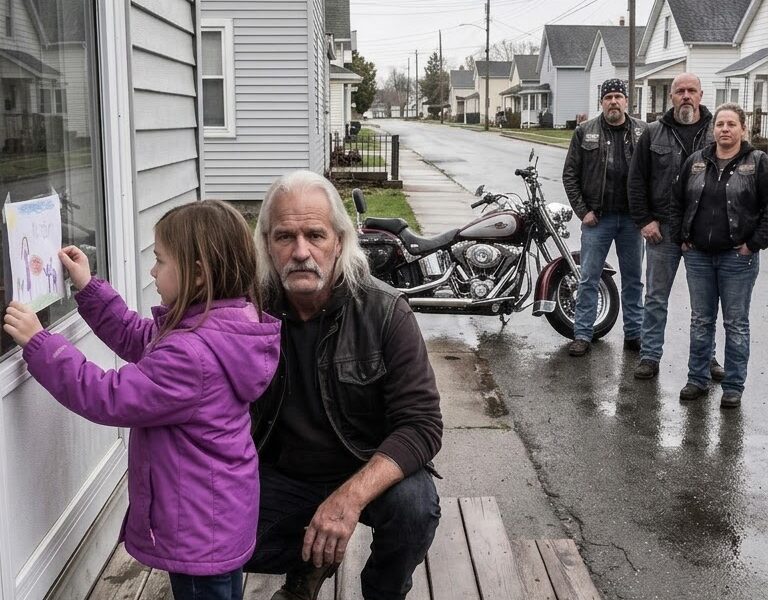
A little girl taped the same drawing to the same window every Friday. Nobody looked. Nobody stopped. Then 350 bikers read what was really on that paper—and everything changed.
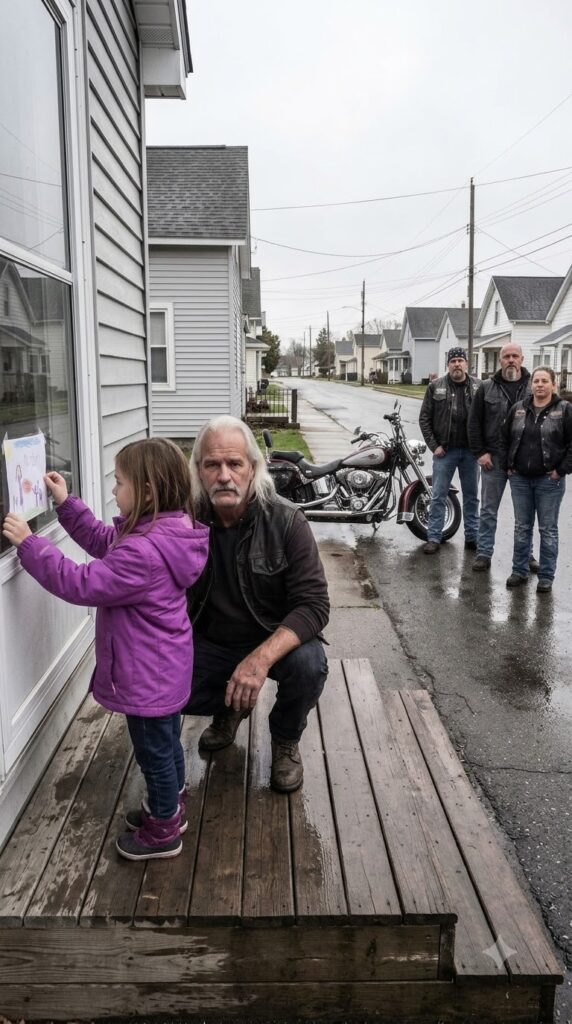
The paper was still warm from her hands when Garnet Lucier pulled it off the glass.
He stood six feet two inches of road-worn desert, fifty-four years old, with a beard the color of ash over charcoal and knuckles that had been broken and reset so many times they no longer fully straightened.
He held the drawing at arm’s length in the flat November light and read what was written across the bottom in a child’s careful block letters, and the breath went out of him the way it does when something small lands exactly on the bruise you forgot was there.
Around him, forty-seven men on idling motorcycles waited without being told to wait.
One hundred twelve additional riders were already on their phones before he said a word.
By the time the sun crossed noon that day, three hundred fifty Ash Creek riders knew the girl’s name.
What nobody was ready for was the reason she had been taping that same drawing to that same window every single Friday for eleven weeks.
The paper, the window, the letters at the bottom.
That was where it ended and also where it began.
—
The Friday started the way all Fridays started in November at the high edge of the Mogollon Rim country, with cold that came off the scrub flats before sunrise and sat in the air like something that had made up its mind.
Garnet Lucier was already at the pump outside a travel stop on the state highway six miles east of Ash Creek proper when the sky was still the color of old iron, and he was not there by accident.
He was there because he was always somewhere before anyone else was, because that was what it meant to be the last founding member of the Ash Creek Riders still in the saddle.
The club had started with nine men and a shared set of wrenches in a metal building on the edge of the scrub, and the years had taken most of them in the ordinary ways that years take men, until Garnet was the one who held the thread.
He was president not because he ran anything loudly, but because he was the person every other rider looked at when they did not know what to do, and he had the particular quality of always knowing.
His hands showed the arithmetic of his life clearly.
The right knuckle of his index finger had a seam of scar tissue from a press that had slipped in a shop he no longer owned.
The left palm carried a burn the shape of a comma from an exhaust pipe that caught him when he was thirty-one and tired.
He wore a vest that was older than some of his members and a cut that had patches on top of patches in places, layers of the club’s history pressed into the leather like sediment.
His face was not a kind face by first impression.
It was wide and heavy through the jaw, with eyes set deep under a brow that by default looked like it was making a judgment.
Women who worked the diners along his regular circuit had learned to look past the brow to the eyes themselves, because the eyes were another matter, but that learning took time, and first impressions in small highway towns almost never allowed for time.
He filled his tank, recapped the spout, and got back on the bike without going inside because he had a thermos, and he had learned decades ago that starting cold was less trouble than starting warm and then stopping.
The route he rode on Fridays was a loose rectangle of two-lane state highway and county blacktop that covered roughly eighty miles and passed through four small communities, none of them the kind of place that showed up on lists of destinations.
These were service towns built for the people who lived there and not for anyone else, with a post office and a dollar store and a diner and a school and the particular dignity of places that know they are not impressive and have stopped caring.
He liked them for exactly that reason.
He had been riding this rectangle on Fridays since before the club had a formal name, and by now the gas station attendants knew his bike by sound, and the counter at Pel’s Diner on the north leg kept his usual mug on a hook that no one touched on Fridays until he sat down.
The woman who ran the dollar store in Coyote Flats gave him a nod from behind the register that meant the same thing every week without either of them ever saying what the thing was.
Continuity.
He rode for continuity.
He rode because the land in the high desert looked different at motorcycle height than it did from a truck cab, lower and more specific, the gravel and the ironwood and the frozen creek beds, and the way the first sun hit the pale limestone faces on the eastern bluffs and made them go briefly gold before everything settled back into tan and gray.
He was somewhere in the middle of the north leg, the sun just clearing the ridge to his right, when he came through the bend and saw the girl.
—
She was standing on the sidewalk in front of a building that had been a pharmacy and then nothing and then a temporary election office and was currently a nothing again, its windows papered over from the inside with brown craft paper going soft at the edges.
She was small, seven or eight years old, with dark hair pulled into two uneven braids and a jacket that was not warm enough for the temperature and boots that had been resold at least once, the new rubber a different shade from the uppers.
She was facing the building’s front window, and she was pressing a piece of paper flat against the glass with both palms, smoothing it the way someone smooths a letter they have written and are afraid to send.
She had tape.
She worked carefully.
She did not turn around when Garnet’s bike came through the bend.
And she did not turn around when he downshifted.
And she did not turn around when he stopped.
He sat on the idling machine and watched her for a moment.
She smoothed the paper once more, pressing the corners down with her thumbs.
Then she stepped back, looked at what she had done, and folded her hands in front of her like someone waiting for church to start.
He switched the bike off.
The sound the engine made as it died was a series of ticking contractions, metal cooling in the cold air, and in the silence after it, he could hear the wind coming off the flat land to the west, and he could hear nothing else.
The girl still had not turned around.
He swung his leg over and stood and looked at the window.
The drawing was in pencil and crayon, a house with a peaked roof and a tree beside it, and three figures of different heights standing in front.
The tallest one colored with a brown pencil, the middle one with a red crayon, the smallest one with whatever color she had used for herself.
Across the bottom, in letters drawn with great care, it said: “We are still here. Please look at the window, Daddy.”
He read it twice.
He was not sure he was still breathing when he finished reading it the second time.
“Is this your drawing?”
The question came out quieter than he intended, which was already quiet, because with children he had always instinctively pulled his voice down to the register that did not startle.
She turned around.
She looked at him the way children look at large men they have not been warned about, without the managed weariness that adults develop, just direct assessment, taking in the beard and the vest and the size of him and finding something in the accounting that satisfied her, because she nodded.
“I do it every Friday,” she said.
“He drives past on Fridays. He used to.”
Garnet looked back at the window.
The drawing was centered as precisely as a seven-year-old could manage it, which was more precisely than most people gave children credit for.
He looked at her.
“How many Fridays?”
She thought about it.
“Eleven,” she said.
“This is the eleventh.”
He did not say anything for a moment because there was nothing to say that would be adequate, and he knew it.
He crouched down to her level, which was the work of a man whose knees had ridden eighty thousand miles in the desert cold, slow and deliberate, until he was looking at her face directly.
“Where’s your mama?”
She pointed down the block at the diner whose sign was dark because it did not open until seven and it was 6:43.
“She’s getting the coffee on,” the girl said.
“She knows I come here. I always come here first on Fridays.”
Garnet nodded slowly.
“What’s your name?”
“Ren,” she said.
“Ren Tally.”
He told her his name.
The full name.
Because children deserved full names.
And she repeated it carefully, as if she were storing it somewhere reliable.
“Garnet,” she said.
“Is that a rock?”
He almost smiled.
“It’s a kind of mineral,” he said.
“Red, mostly.”
She looked at the drawing on the window again, then back at him.
“Do you think he’ll see it?”
He was quiet for four full seconds.
The wind pushed a dry leaf across the sidewalk between them.
“I think,” Garnet said, “that more people are going to see it than you were counting on.”
—
He did not go into the diner immediately.
He stood at his bike and took his phone out of his vest pocket and called Boon Raxter, his road captain, who picked up on the second ring the way he always did, and Garnet told him what he had seen in twelve sentences.
Boon was quiet for a moment and then said, “What do you need?”
Garnet looked at the window, at the drawing taped carefully to the inside of the glass, the three figures standing in front of their house.
“Find out what happened to a man named Tally,” he said.
“Northern Arizona, Ash Creek corridor. Has a daughter named Ren, seven or eight years old. Find out where he is and what happened and call me back in thirty minutes.”
He paused.
“Don’t call until you know something real.”
He hung up and stood with the phone in his hand in the cold morning and looked at the drawing from the outside, from the street, the way a person driving past would see it.
He understood why she had put it there.
From the street, in a moving vehicle, it was a child’s picture taped to a window.
The words at the bottom were too small to read from a car doing twenty-five.
You had to stop.
You had to get off the bike.
You had to crouch down.
Nobody was doing any of that.
Nobody except a man who had come around a bend on a cold Friday morning running a rectangle through the high desert because he believed in the continuity of familiar roads.
He went into the diner.
—
Her name was Stella Tally and she was thirty-one years old and she had the particular composition of a woman who had been managing alone for long enough that managing had become the only face she showed.
She was behind the counter with a rack of coffee mugs when Garnet came through the door, and she stopped when she saw him, the way people always stopped when they saw him for the first time.
The size of him and the vest and the brow doing their usual work, and he waited for the assessment to finish.
It took her about four seconds.
Then she set the mugs down.
“She’s at the window,” Stella said.
Not a question, not an accusation, just a statement with all the morning’s weight packed into it.
“Yes,” he said.
He sat at the counter.
She poured coffee without asking, which was the right instinct, and he wrapped both hands around the mug and let it warm the scarring on his left palm.
“She’s done it every Friday,” Stella said.
She was not crying.
She was somewhere past the register where crying lives and into the quieter territory beyond it.
“Eleven weeks,” Garnet said.
She looked at him.
“She told you.”
“She told me. She also told me her daddy used to drive past on Fridays.”
Stella set the coffee pot down.
She gripped the counter edge with both hands, not for balance exactly, more the way a person grips something when they are choosing their words carefully.
“Marcus was driving a supply route,” she said.
“Fridays he’d come through here on his way back up to Flagstaff. He’d honk. She’d run to the window.”
She stopped.
“He’s been in county since September. There was an incident. He wasn’t at fault, but he was there and someone had prior and they needed a third count.”
She looked at Garnet steadily.
“He doesn’t know she’s doing it. He doesn’t know about the drawing. They have supervised calls twice a week and she hasn’t told him because she doesn’t want him to feel bad.”
Garnet set his mug down.
The diner was quiet except for the coffee maker finishing its cycle.
Through the front window, he could see Ren on the sidewalk across the street, still standing with her hands folded, her breath making small clouds in the cold.
“What county?” he said.
Stella told him.
Garnet pulled out his phone and called Boon back twelve minutes ahead of schedule and gave him the name of the county and the name Marcus Tally and told him to get as specific as he could as fast as he could.
Then he drank his coffee and did not say anything for a while.
And Stella Tally stood behind the counter of her not-yet-open diner with her hands loose at her sides, and the silence between them was not uncomfortable.
It was the silence of two people who understood the same thing without needing to perform the understanding.
—
Boon called back in twenty-two minutes.
He had a case number, a facility name, a hearing date, and the name of the supervising case officer.
He also had something Garnet had not anticipated: a notation in the record that said Marcus Tally had a documented work history and no prior criminal record and had been remanded pending a sentencing hearing that had been continued twice, most recently rescheduled to a date that was now four weeks away.
The notation said “continued due to scheduling conflict, court calendar.”
Four weeks.
Eleven Fridays in.
Ren Tally had been taping her drawing to that window for eleven weeks, one for every Friday her father had not come through, and she had four more weeks at minimum to go.
Garnet looked at his hands on the countertop.
He was thinking about a different child in a different window, a different set of Friday mornings, a story he had not told anyone in the club in full and did not intend to tell now.
He was thinking about the particular helplessness of waiting for a system to finish its grinding when the thing it was grinding was a life that belonged to someone else.
He had been on the wrong side of that helplessness once.
He had not been able to do anything then.
He was sitting in a diner in the high desert on a cold Friday morning with a full phone and a club of three hundred fifty riders and a case number and a hearing date.
And the difference between then and now was the kind of difference that arrives quietly and asks you what you are going to do with it.
“Pull everyone in,” he told Boon.
“Full assembly. The Ash Creek Chapter House, two o’clock.”
There was a beat on the line.
“All of them?”
“All of them,” Garnet said.
“Pass it down.”
—
Stella Tally came to the door of the diner when she heard the bikes assembling at two o’clock, not from the chapter house, which was four miles east, but because the sound carried across the flat land with a clarity that the cold amplified.
She could not see them from the diner, but she could hear them, the separate engines collecting into a low common register, like a weather system choosing a direction.
Ren heard it, too.
She was sitting at a table with a grilled cheese sandwich that she was eating with methodical care, and she looked up when the sound started and said, “That’s a lot of motorcycles.”
“Yes,” Stella said.
“How many?” Ren asked.
Stella looked at her daughter and thought about how to answer.
“A lot,” she said.
“More than you were expecting.”
Ren went back to her sandwich, apparently satisfied.
She took another precise bite.
“Garnet has a lot of friends,” she said.
It was not a question.
Stella looked out the window at the empty street and the drawing taped to the window across it, visible even from here if you knew where to look.
“Yes,” she said quietly.
“He does.”
—
At two o’clock and seven minutes, Garnet Lucier stood at the front of the chapter house with three hundred fifty Ash Creek riders arranged in rows and spillover and loose congregations against every wall, the room loud with the residual heat of that many bodies and that many engines recently shut down.
They ranged from twenty-two to sixty-eight years old, and they came from welding shops and long-haul routes and roofing crews and one veterinary practice and one retired sheriff’s office and several categories of employment that were not discussed at chapter meetings.
They were not collectively the kind of group that moved fast on sentiment.
They were the kind of group that moved fast on need, on a specific shape of problem they recognized, and Garnet had been around long enough to know the difference and to know which one he was working with today.
He told them about Ren Tally in four minutes, which was all the time it required: the case number, the hearing date, the drawing, the eleven Fridays.
He did not editorialize.
He described what he had seen and what Boon had found and what Stella had told him.
And he read the words from the bottom of the drawing from memory, because he had read them twice on that sidewalk and they had not moved from the place where they had landed.
“We are still here. Please look at the window, Daddy.”
Nobody in the room made a sound when he read it.
The silence was not the silence of a crowd withholding judgment.
It was the silence of three hundred fifty people arriving at the same conclusion at the same speed.
Decker Marsh, who had ridden with the club for nineteen years and ran a two-bay shop in Ash Creek proper, raised his hand and said, “What do we need?”
And that was the whole of the debate.
—
They divided into four working groups before the hour was out.
The first was legal, led by a member named Phil Orvado, who had worked as a paralegal for eleven years before an accident changed the course of what he did with his hands, and who still kept current enough to know which questions to ask a family law attorney and which calls to make to which county offices.
The second was logistical, led by Boon Raxter, and its job was to establish contact with the facility, verify visitor protocols, and determine whether any member of the club could be present at the rescheduled sentencing hearing as a community witness in support of Marcus Tally’s character and circumstances.
A process that required navigating a set of administrative channels that existed specifically to be navigated by people who were patient and specific and willing to be told no four times before the fifth answer was different.
The third group was what Decker Marsh called the practical side, which meant the family.
Stella Tally’s diner had been running on the edge of what was sustainable since September, when Marcus stopped driving the route, and the arithmetic of a service-town diner with one income removed was not complicated.
The third group’s job was to make sure the arithmetic changed.
The fourth group had one job, which was Ren, and it had one member, chosen by acclamation, which was Garnet, which was not something he had asked for or expected and which he accepted without saying much because there was no adequate way to argue with three hundred fifty people who had decided something quietly and all at once.
—
Phil Orvado got the name of the right attorney before five o’clock that same day: a woman in Flagstaff named Dana Kesler who worked family and criminal-adjacent cases and who, when Phil called her and laid out the case number and the continuance record and the specifics of Marcus Tally’s involvement in the incident, said, “That continuance is the third. There’s a time provision that applies.”
She did not sound excited about it the way a person sounds when they are performing competence.
She sounded the way someone sounds when they have looked at a set of facts and recognized a door.
“It won’t move things by months,” she said.
“But it moves them.”
She agreed to review the case file over the weekend.
Phil told her a club of three hundred fifty riders stood ready to appear as community character witnesses in whatever format the court could accommodate, and there was a pause on Dana Kesler’s end of the line that lasted three seconds, which Phil Orvado later described to Garnet as the sound of an attorney recalculating the weight of something.
“Three hundred fifty,” she said.
“That’s a number.”
“It is,” Phil said.
“We can do it in shifts if the court needs it smaller.”
She said she would call on Monday.
—
Boon Raxter’s group hit the first wall on Saturday morning, which was the facility’s visitor protocol, which stated that community visitors not designated as family required a processing period of fifteen to thirty business days, depending on classification.
Boon listened to the full protocol read by a duty officer who delivered it with neither apology nor pleasure, the way a person delivers a rule they did not write and do not especially agree with but are required to enforce.
When the duty officer finished, Boon said, “Is there a supervisor I can speak to about a community outreach classification?”
The duty officer said there was, and the supervisor was not available until Monday.
And Boon said he would call Monday, and he did.
And the supervisor’s name was Lieutenant Crew, and Lieutenant Crew was the kind of official who started every conversation with procedure and qualifiers, and who, when Boon explained that the community interest in Marcus Tally’s case included a formal support presence at the sentencing hearing and a verifiable record of community character that the defense attorney was already compiling, said, after a pause, “You said three hundred fifty.”
“Yes,” Boon said.
“Ash Creek Riders, Northern Arizona. We have a chapter house on record with the county.”
Lieutenant Crew was quiet for four seconds.
“I’ll flag the file,” he said.
“That’s not a promise about the protocol.”
“Understood,” Boon said.
“I appreciate the flag.”
He hung up and called Garnet and said the word “flag.”
And Garnet said, “Good. Stay on it.”
—
The third group moved faster, which was the nature of practical problems versus procedural ones.
By the following Wednesday, the Ash Creek Riders had organized what Decker Marsh called a business outreach program for the Tally family, which in practice meant that seventeen members had eaten at Stella’s diner that Monday in two rotating groups, leaving tips that Stella initially refused and then accepted when Decker sat at her counter and explained plainly that the money was already committed and she could put it in a jar for Ren’s college fund if she did not need it for anything more immediate.
Which made Stella look at the jar of sugar on the counter for a moment before she said, “She wants to be a veterinarian.”
Decker looked at the jar, too.
“Then it’s a start,” he said.
Four other members sourced a winter coat in Ren’s size, red with a hood, which was left at the diner without ceremony early on Tuesday, a bag on the counter when Stella unlocked the door at 6:30.
And Ren found it and put it on and wore it straight through to the end of the school day and came home still wearing it and told her mother it was warmer than anything she had ever had on, which Stella repeated to Garnet when he came by the diner on Wednesday morning.
And Garnet looked at his coffee mug and said, “Good.”
—
He had also, in those same three days, returned to the empty building with the papered windows every morning at 6:30, which was when Ren came to put up her drawing.
She did not put up a new one Wednesday.
She taped the original back up, which she had apparently been taking home each Friday and keeping flat under something heavy and bringing back.
He understood why.
It was the same drawing.
It needed to be the same drawing.
He brought her hot chocolate from the diner in a paper cup on Wednesday morning, and she accepted it with both hands and drank it standing in front of the window and said, “It’s crooked.”
Meaning the drawing.
And he said, “I can fix that.”
And she handed him two additional pieces of tape from her coat pocket.
And he straightened it and stepped back and she assessed it and said, “Better.”
They stood there in the cold for a few minutes, and she told him about the veterinarian plan, and he told her about the time he had helped deliver a colt at a ranch two miles south of the chapter house, which was not a skill he had expected to develop and which had been one of the more useful surprises of his life in the high desert.
She laughed at the part where he said the colt had stepped on his foot before it had been standing for thirty seconds.
It was the first time he had heard her laugh, and it went into him like light through a gap he had not known was still open.
—
What Garnet had not told anyone, not Boon, not Decker, not any of the three hundred fifty, was the particular shape of his own private debt to this situation.
He had a daughter.
Had is the word that fits.
She was twenty-three now, living in Tucson, working as a radiology technician, and she was fine in all the ways that count, which was the outcome of her mother’s extraordinary effort during the four years when Garnet had been most absent.
Not physically absent, but the other kind, the kind where a person is in the room and the room is still empty.
He had missed things.
He had missed a school play where she had a speaking part.
And he had missed the first time she rode a bicycle without anyone holding on.
And he had missed a parent conference that had apparently been important in a way he had only understood years later.
He had not missed those things because he was cruel or because he did not love her.
He had missed them because he was the kind of man who expressed care through motion and proximity and silence and who did not, at thirty-eight and thirty-nine and forty, have the language for what a child needed when what she needed was not a problem to be solved but a presence to be present.
His ex-wife, a calm and precise woman named Ruth, had told him once without anger that Ren Tally’s father being taken away from his daughter was a tragedy, and Garnet being present when his daughter needed him was a choice, and those were different kinds of absence, but the hole they left behind was the same shape.
He thought about that on the cold mornings at the window.
He thought about it when Ren handed him the tape and trusted him to straighten the drawing.
He was not capable of going back and standing in the audience at the school play.
He was capable of standing on this sidewalk in this cold with this child’s hot chocolate warming his hand, and he thought that perhaps what a person does with the chances they are given late is the only accounting that remains available to them.
—
Dana Kesler called Phil Orvado on Monday as promised, and on Tuesday she filed a motion citing the third continuance and requesting an expedited hearing date under a provision that Phil had not known existed and that Kesler explained to him in three sentences, each one cleaner than the last.
The provision applied when a defendant had been held pending sentencing for longer than a specific threshold and when the continuances were court-initiated rather than defense-initiated, which was the case here.
The motion also attached a letter signed by three hundred forty-seven members of the Ash Creek Riders, because three members were out of state and not reachable in time, attesting to Marcus Tally’s character as a father and a community member based on the accounts of Stella Tally, verified by contact with neighbors, the school, and three individuals in the county who had worked with Marcus professionally.
Garnet had signed the letter last and had not written anything on it except his name and his chapter title, because the letter had already said what needed saying, and adding to something that was already complete was a quality of the people who needed the credit more than they needed the outcome.
The motion went to the court on a Tuesday and the court acknowledged receipt on a Thursday and the expedited hearing date came back the following Monday morning, which was three and a half weeks ahead of the previously scheduled date.
Phil called Garnet when he got the date and read it out loud, and Garnet sat with it for a moment and said, “Who do I talk to about the hearing room?”
Phil said, “Kesler says the court can accommodate a limited gallery.”
Garnet said, “How limited?”
Phil said, “She’s working on it.”
He said, “Tell her we’ll take whatever the room holds. The rest will be outside.”
—
The morning of the hearing was December, and the light came in low and gold from the east, the kind of light that the high desert reserves for mornings that matter, a flat, direct illumination that put every edge in relief and made the pale limestone faces on the bluffs go briefly brilliant before settling into the ordinary day.
The courthouse in the county seat was a two-story building with a parking lot that had been designed for county business traffic and not for three hundred fifty motorcycles.
And the sheriff’s deputy who came out when the bikes began pulling in saw the scale of it and went back inside and came back with two more deputies and a look on his face that was somewhere between alarm and something else he had not named yet.
Garnet pulled in first and shut his bike down and walked to where the deputy was standing and told him who they were and why they were there and that they had arranged with the court clerk to have forty-two members seated in the gallery and the remaining three hundred eight outside in orderly rows, which was what Boon had coordinated with the clerk’s office over the preceding four days.
And the deputy looked at him for a moment and looked at the bikes still pulling in row behind row and said, “Is that all going to fit?”
And Boon, standing just behind Garnet, said, “We measured.”
The deputy looked at the lot again.
Then he put his radio away.
“All right,” he said.
“Keep the aisle clear.”
They kept the aisle clear.
—
Inside the courtroom, in the gallery’s forty-two seats, sat forty-two members of the Ash Creek Riders in their cuts, boots on the floor, hands on their knees, the collective size of them making the room feel smaller than it was built to be.
And the court reporter looked at them once and went back to her machine, and the bailiff counted them twice and apparently decided they were an acceptable number because he did not say anything.
Dana Kesler was at the defense table looking at her papers with the composure of someone who had been in enough courtrooms to know that composed was the only useful posture.
Marcus Tally was brought in by a corrections officer and seated at the defense table, and he was thin in the way of a man who has been worried for months and eating around the worry.
And he looked at the gallery and saw forty-two men in leather cuts and stopped moving for a moment, the way a person stops when they are trying to locate the context for something their eyes are seeing.
He looked at Dana Kesler.
She leaned over and said something to him quietly.
He looked at the gallery again.
His eyes moved across the rows and found Garnet in the third seat on the left side, and Garnet held his gaze for a moment and gave him a nod that was small and direct and meant, “We know.”
—
The hearing took one hour and seventeen minutes.
The prosecution had no objection to a time-served plus supervised release arrangement given the defendant’s lack of prior record and the nature of his participation in the original incident.
The judge reviewed the community character letter and noted the signatures and said, “Three hundred forty-seven.”
And the courtroom was quiet, and the judge said it again, as if confirming the number was real.
Garnet looked at his hands.
—
Ren Tally did not come to the courthouse.
She was in school, which was where Stella and Garnet had agreed she should be, because the outcome of a hearing is not a thing to place a child inside until the outcome is certain, and the uncertainty was real until it was not.
Stella got the call from Dana Kesler’s office at 11:47 in the morning, and she set the coffee pot down and stood very still at her counter for a moment, and then took her apron off and walked out from behind the counter and sat down at a table by the window, the window that faced across the street, and looked at the drawing taped to the glass of the empty building.
“We are still here. Please look at the window, Daddy.”
She was still sitting there when Garnet came through the door forty minutes later, and she looked up at him and he said, “He’s out. Processing takes until four.”
She put her face in her hands.
Not from grief.
The other kind of not from grief.
He went behind the counter and poured himself coffee and gave her two minutes and then poured her a cup as well and set it on the table beside her and sat down across from her and did not say anything else, because there was nothing else that needed saying and he understood that.
The drawing on the window was visible from where they sat, the house and the tree and the three figures, and the light through the glass in the afternoon was the particular quality of December light in the high desert, pale and clean and long.
—
Ren came out of school at 3:15.
Stella was outside to meet her, which was not something Stella usually did, and Ren looked at her mother’s face and said, “Did something happen?”
Stella crouched down and said, “Something good.”
She told her simply and briefly, the way you tell a child a true thing without architecture or preamble, and Ren listened with her hands at her sides.
And when Stella finished, she said, “Is he coming home?”
And Stella said, “He is.”
Ren looked down the street in the direction of the empty building.
“I should go take the drawing down,” she said.
“He’ll know now. He’ll look.”
Stella held her daughter’s face in both hands for a moment.
“Let’s leave it up a little longer,” she said.
Ren thought about this and then nodded, apparently deciding it was reasonable, and took her mother’s hand, and they walked to the diner together in the December cold.
—
Marcus Tally came home on a Saturday, because processing ran long, and Stella decided Saturday was a better day anyway, a day with no particular obligation attached to it.
Garnet was not there when Marcus arrived, because that morning was not his morning.
He was on the rectangle, running his Friday route a day late, coming through the north leg in the early light when the bluffs were going gold to the east.
He passed the empty building.
The drawing was still in the window.
He slowed and looked at it from the street, from the distance a person in a moving vehicle would see it, and this time he could read the letters at the bottom.
He could read them because he was looking.
He went slow enough to read them, and then he was past, and the building was behind him, and the road was open and straight ahead, and the cold air came off the flat land, and the sky above the rim was the color of something just beginning.
—
Three weeks after the hearing, the Ash Creek Riders held their winter assembly and added a new organizational item by formal vote, which carried three hundred fifty to zero, which was the only margin Garnet had ever seen on anything that mattered.
The item established what the official record called the Tally Accord, which in practice was a commitment by the club to maintain contact with county family services, school district liaison offices, and the legal aid clinic in Flagstaff, with the specific purpose of identifying situations where a family had fallen into the gap between what the institutions could do and what the situation needed.
It was not a dramatic thing on paper.
It was a phone number and a point of contact and a willingness to show up.
In its first year of operation, it produced four documented cases of support, two of them involving children waiting for something they could not name out loud.
The club stitched a new patch that went on the left sleeve below the rocker, a small rectangle of red thread on black felt with a single letter W in the center, which stood for what it stood for, and which every member knew, and which was never explained to anyone who asked, because the people who needed to know already knew.
Garnet wore his on the left sleeve of the same cut he had always worn, and it sat below the patches that were older than some of his members, and it was the newest thing on the oldest leather, and it looked like it had always been there.
—
He drove past the empty building every Friday for the rest of that winter.
The drawing came down sometime in January, when Marcus Tally came back to the route and drove past on a Friday and stopped and got out and went to the window and read it, which Ren had known he would do because she had designed it for exactly that moment.
And she was watching from across the street with her mother.
And Marcus Tally stood at the window of the empty building with his hand flat against the glass where her palms had been.
And then he turned around and she ran across the street and he caught her and held her, and the cold air made steam of their breath together, which rose and disappeared into the flat white sky above the high desert.
Garnet was not there for that moment.
He heard about it from Boon, who heard it from Decker, who heard it from Stella, who described it in three sentences that Decker could not repeat without his voice changing register.
—
What Garnet did for the rest of that winter was what he did every Friday, which was ride the rectangle and pass through the communities that nobody put on lists and stop at the diner and drink his coffee from the mug on the hook and look out the window at the street where the empty building stood, with its papered windows and its ordinary face and its particular history that most people driving past would never suspect.
He looked every time.
He always slowed down to look.
Not because the drawing was still there.
Because looking was the thing.
Because the whole point, the thing Ren Tally had understood at seven years old that grown people spent their lives forgetting, was that someone on the other side of the glass had put something there for you.
Had pressed it flat with both palms and smoothed the corners down and stood back and waited.
And what they needed from you was not a solution and not a miracle, but only the willingness to stop and be close enough to read what it said.
Three hundred fifty men had stopped.
A courtroom had gone quiet.
A judge had said a number twice.
And a girl in a red coat had run across a cold street toward the proof that stillness, patient and plainly worded, is sometimes the loudest thing in the world.
And the ones you would least expect to hear it are the ones who slow down first.









