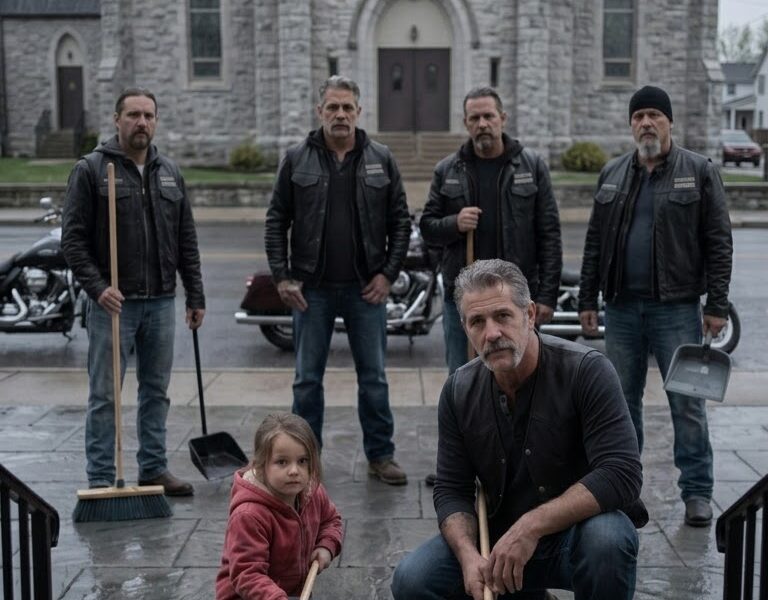
A little girl swept the same church steps every Friday before dawn. Nobody asked why. Nobody helped. Then one Friday, she arrived to find 400 bikers already sweeping.
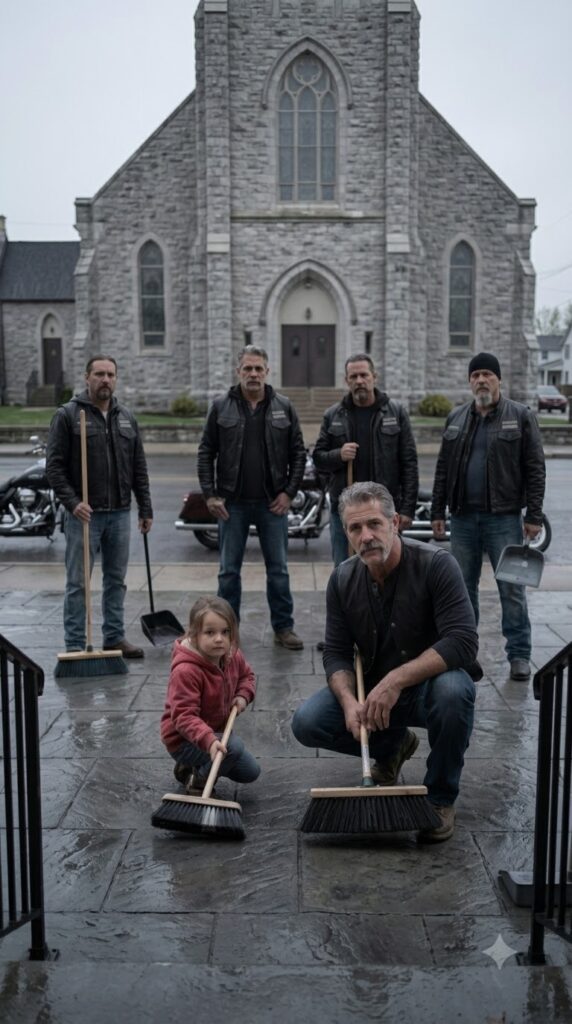
The broom was already moving when Garrett Lond noticed it.
He stood at the corner of Sycamore and First with a cup of gas station coffee going cold in his fist, watching the thin line of bristles scrape against the bottom step of Calvary Cross Church.
His first thought was that he had miscounted the days somehow, that it was already Friday and he had lost a whole Thursday to the road.
It was not Thursday.
It was Friday, 4:51 in the morning, and the broom belonged to a girl who could not have been more than eight years old.
She wore a green coat one size too large, a coat with the collar folded up to her ears and the cuffs rolled back so her hands could find the handle.
She swept with the particular focus of someone who had done this many times before.
Not hurrying, not performing, just working the grit off the first step and moving to the second.
The way a person does when the job belongs to them and they have long since stopped thinking about whether anyone is watching.
Garrett watched.
He did not move.
Behind him, on the cracked asphalt of the lot beside the feed store, four hundred motorcycles stood in rows, and not one engine was running.
The girl did not know about the four hundred motorcycles.
She did not know about Garrett Lond, fifty-three years old, president of the Ash Creek Riders, a man whose face had been described in three counties as the kind of face that makes you check the lock on your truck.
She did not know that the Ash Creek Riders had been there since three in the morning, assembling in the dark with the quiet efficiency of people who had spent decades learning to move without waking anyone.
She did not know that the church steps behind her were already clean.
She found out when she reached the third step and the bristles came up dry.
She stopped.
She looked at the concrete beneath her feet, then at the broom, then at the concrete again.
She crouched down and pressed one palm flat to the step.
It came up without a trace of dust or leaf matter or the fine red grit that blows in off the high desert and settles on everything in this part of northern Arizona by Thursday night without fail.
The step was clean.
All of them were.
Eight steps brushed to bare stone with the cracks between them cleared by something narrower than her broom.
She stood back up slowly and looked out at the parking lot, and that was when she saw them.
Four hundred men and women in leather standing without a word, holding their breath in the dark.
Garrett Lond set his coffee down on a fence post and waited for her to run.
She did not run.
She looked at the broom in her hands and then back at the steps, and she said, “You already did it.”
It was not a question.
It was not an accusation.
It was the plain inventory of a child who had arrived to find her work finished, and she said it the way she might have said it is raining or the door is open.
Garrett Lond felt something move in his chest that he had not felt move in a long time.
—
The high desert around Clover Junction, Arizona, holds heat until about two in the morning and then releases it all at once.
By five on a November Friday, the temperature along Sycamore Street could turn a man’s beard to wire.
The sky above the church was the particular black of a sky that is just beginning to consider the idea of morning, with one band of dark purple along the eastern hills and a hard white star sitting just above it.
The light from the single lamp over the church door fell straight down and pooled on the steps, and the girl stood in that pool with her green coat and her broom and her expression of calm bewilderment.
And the Ash Creek Riders looked back at her from the dark.
Garrett Lond had been riding out of the high desert for twenty-nine years.
He had seen a lot of things that required him to stand still and say nothing until he was sure he understood what he was looking at.
He stood still now.
His name was Garrett Lond.
He was fifty-three years old, six-foot-two, two hundred and thirty pounds of a man who had spent three decades on a motorcycle and before that a decade swinging a framing hammer, and his hands showed all of it.
The knuckles widened, the palms mapped with old cuts, the right thumb bent at an angle from a break that never set clean.
He had a beard that had been gray since his early forties, worn full and kept off his collar, and a face that a woman in a Flagstaff diner had once described to her friend, not knowing he could hear her, as the kind of face that has seen the thing it cannot forget.
She had not been wrong.
He wore a cut that had the Ash Creek Riders patch on the back and the president’s rocker below it.
And above the left breast pocket, stitched in red thread that his road captain’s wife had put there six years ago, a small broom.
The girl on the steps had not seen the broom yet.
She was still looking at her own.
“You already did it,” she said again.
And then after a pause that lasted exactly as long as it takes a child to decide that an adult can be trusted with a real question, she said, “How did you know?”
Garrett picked up his coffee and walked to the edge of the lot.
He stopped where the asphalt met the sidewalk, eight feet from the bottom step, and he crouched down so that his eyes were closer to level with hers.
He said, “We saw you last week.”
The girl considered this with the gravity of someone cross-checking a figure.
She nodded once, as if this was a satisfactory accounting, and then she looked back at the steps.
“I was going to do the rail too,” she said.
“The left one is loose.”
Garrett Lond said, “We know.”
Behind him in the dark, a man named Dicks Callaway reached into the left saddlebag of his Heritage and produced a wrench.
—
The girl’s name was not Ara.
The girl’s name was Kora Britain, and she was eight years old and three-quarters, which she would have told you mattered.
She lived with her grandmother, Nell Britain, in the yellow house on Mesquite Lane, four blocks from Calvary Cross, and she had been sweeping those steps every Friday before dawn for eleven months.
She had started in January, the week after her grandmother’s hip surgery, when Nell could no longer make the walk to the church and back to supervise the cleaning that she had done herself every week for thirty-one years.
The church had a custodial budget, a fact that the church’s treasurer, a careful man named Morris Weld, would have cited immediately if asked.
The budget was forty dollars a week, and it was supposed to cover the steps and the entryway floor and the two bathrooms.
It did not, as a practical matter, cover any of those things with any consistency, because Morris Weld believed in fiscal prudence, and the person he had contracted was a seventeen-year-old from the next town who came when it suited him and whose definition of done did not match.
Nell Britain’s definition of done, which was the definition Kora had inherited whole.
Nell’s definition of done meant you could eat off it.
Kora had been meeting that standard on the steps since the second Friday in January, alone before dawn, using the push broom that lived in the closet under the coats in Nell’s front hall.
Nell did not know Kora was doing it.
She thought the custodian had improved.
The Ash Creek Riders had been riding past Calvary Cross every Friday morning for eleven years because their charter route out of Clover Junction toward the Mogollon Rim ran up Sycamore and past the church, and they left the lot by the feed store at 5:30, and Sycamore was their first three minutes of pavement.
They had been riding past the church at 5:30.
Kora had been sweeping at five, which is how it was that for nine of her eleven months, she had finished before they came through, and they had never known she was there.
What changed was that in October, her grandmother’s physical therapist shifted Nell’s morning schedule, which shifted the household’s morning schedule, which shifted the one window of time Kora could be out of the house without Nell noticing.
And so in the first week of October, Kora arrived at the steps at 4:45 instead of 4:15.
And on that Friday morning at 5:27, with three steps still to go, she heard the first engine come around on First Street, and she pressed herself against the church door until the sound passed.
One of the riders near the back of the line, a woman named Petra Soliss, who rode sweep and whose job was to watch what the others missed, looked back and saw the green coat and the broom.
She noted the time.
4:58.
She noted the location.
She said nothing until they were clear of downtown, and she pulled alongside Garrett on the highway and held up two fingers to ask for a word.
And when he rolled back his throttle and let the formation stretch, she told him what she had seen.
Garrett had ridden out the next thirty miles without speaking.
Then he said, “How old?”
Petra said, “Seven or eight.”
He said, “Every week?”
She said, “The broom was in her hand like she owned it.”
He said nothing more.
At the next fuel stop, he called his road captain, a man named Bud Trestler, and said four words.
“Friday before five. Church.”
Bud had been riding with Garrett for nineteen years, and he did not need more than that.
—
The thing about the Ash Creek Riders that the people of Clover Junction, who had never stopped to look, did not know, was that the club ran a facilities day twice a year, spring and fall, where every member with a useful trade skill showed up to whatever property or institution needed the work, and they stayed until it was done.
Garrett had started that practice in the second year of the club’s existence.
Not because it was good for the club’s reputation, though it turned out to be, but because the man who had taught him to ride had told him that a club is what it does when nobody is watching.
The facilities days were not publicized.
They were not photographed for the web.
They simply happened.
And the people who benefited from them sometimes did not know who had done it until they found a card tucked under a doormat with the Ash Creek Riders contact number and the words, “If anything else needs doing.”
Nell Britain had found one of those cards under her doormat two years ago after her front porch railing was replaced and repainted.
She had kept it in the kitchen drawer with the important things.
She had never called the number because she had never needed to.
That was about to change, though Nell did not know it yet.
And neither did Kora, who was standing on the clean steps of Calvary Cross Church in the half dark, watching a very large man in leather crouched down to her eye level with a wrench in his extended hand, as if offering it for inspection.
Dicks Callaway had passed the wrench to Garrett without being asked, the way longtime road partners transfer tools by feel and by habit.
And Garrett was holding it out to Kora, not because he needed her permission to fix the railing, but because he understood instinctively, in the way that people who have lost small children understand things, that you ask first.
You always ask first.
“The left rail,” he said.
“May we?”
Kora looked at the wrench.
She looked at the railing.
She said, “It wobbles when my grandma holds it.”
Garrett said, “It won’t after today.”
The girl gave a single decisive nod and stepped aside to let Dicks Callaway pass.
And Dicks went to work on the rail with the particular economy of a man who has been fixing things with his hands his whole life.
And the sound of the wrench turning in the bracket was the only sound on Sycamore Street for twenty seconds.
Then Kora said, “There’s also a crack in the step at the bottom. Water gets in.”
Garrett said, “We brought epoxy.”
She seemed to accept this as the appropriate level of preparation.
She sat down on the top step, rested the broom across her knees, and watched Dicks Callaway with the focused attention of someone taking notes.
The sky to the east was moving from black to the color of old pewter, and the star above the hills had gone pale.
Four hundred people stood in the parking lot across the street and did not make a sound.
—
The question Kora had asked, “How did you know?” was the simple question.
The one underneath it, the one she did not ask, the one Garrett had been carrying since Petra Soliss told him about the green coat and the broom, was why a child of seven or eight was doing this alone in the dark.
He had not yet asked it.
He had learned at a cost he did not discuss that you do not ask the underneath question first.
You fix the railing, you fill the crack, you let the light come up.
The answers find their own way out if you are patient and you do not loom.
He was patient.
He did not loom.
He sat on the step below Kora with his coffee, which was fully cold now and which he drank anyway, and he waited for the sky to decide what color it was going to be.
At 5:43, when the eastern hills had gone from pewter to a flat pale rose and the lamp over the church door had dimmed to the color of old tea, Kora said, “My grandma can’t walk here anymore.”
She said it to the broom handle, not to Garrett.
“Her hip is different now. She did the steps for a long time.”
Garrett said, “How long?”
Kora said, “Since before I was born.”
He said, “That’s a long time.”
She said, “Thirty-one years. She told me.”
She turned the broom handle in her fingers slowly, the way a person turns something they are thinking about.
“She doesn’t know I’m here,” she said.
Then she added quickly, in the tone of someone heading off an objection, “I leave after she goes back to sleep. I’m back before she’s up.”
Garrett looked at the step between his boots.
He said, “Does she know the steps are clean?”
Kora said, “She thinks it’s the custodian.”
A pause.
“The custodian isn’t very good.”
Garrett said, “No.”
The girl looked at him sidelong with one of those looks children deploy when they are checking whether an adult is telling the truth or managing them.
Whatever she found in his face appeared to satisfy her, because she looked back at the steps and said, “I didn’t want her to worry about it.”
The wrench stopped.
Dicks Callaway stood up and tested the railing with both hands, pressing left, right, down.
It held.
He pressed again.
It held.
He looked at Kora and said, “Try it.”
She gripped the rail with both hands and shook it.
Nothing moved.
She shook it again.
She let go and said, “Okay.”
Dicks Callaway put the wrench in his jacket pocket and stepped back.
And there was in his face, beneath the beard and the road tan, the expression of a man who has completed a small and necessary thing and is satisfied with this.
Behind Garrett he heard the sound of boots on pavement, the careful sound of a large number of people moving with deliberate quiet, and he knew without turning that the front rank of the Ash Creek Riders had crossed the street and was forming up on the sidewalk.
He turned.
They were there.
Not four hundred, not all at once, but thirty or forty of the closest standing on the sidewalk with their hands in their jacket pockets, close enough for Kora to see their faces.
She looked at them.
She looked at the patch on Garrett’s chest, the small red broom, and something changed in her expression.
Not alarm.
Something closer to recognition.
She pointed at the patch and said, “That’s a broom.”
Garrett said, “It is.”
She said, “Why do you have a broom?”
He said, “We put it there to remember something.”
She waited.
He said, “A girl who used to sweep the steps of a school every morning before anyone else arrived.”
Kora said, “What happened to her?”
He said, “She grew up.”
It was not the full truth, but it was the truth he could say on a church step at 5:45 in the morning with the light coming up.
And Kora accepted it with the frank practicality of a child who knows that adults abbreviate.
She stood up.
She looked at the steps, all eight of them, clean and dry, the crack in the bottom one filled and level, the left rail solid, the wrought iron of it dark against the pale stone.
She looked at the lot where the motorcycles waited in their rows.
She said, “There are a lot of you.”
Garrett said, “Four hundred.”
She said, “Do you come here every Friday?”
He said, “We ride through here every Friday. This is the first time we stopped.”
She was quiet for a moment.
Then she said, “I’m here every Friday.”
He said, “We know.”
She seemed to think about what this meant, what the geometry of it was, the two Fridays overlapping in the dark for eleven months with neither knowing about the other.
And Garrett could see her working it through, the small engines of her reasoning turning behind her eyes.
Finally, she said, “So you saw me in October?”
He said, “The third Friday.”
She said, “I was late that day.”
He said, “We know.”
She looked at the broom in her hands.
She said, “I got here at 4:45.”
He said, “We know.”
She said, “What time did you get here today?”
He said, “Three.”
She repeated it carefully.
“Three.”
He said, “We wanted to make sure it was done before you arrived.”
She looked at the broom again, and then she did something that Garrett Lond had not predicted and would not forget.
She held the broom out to him.
Not as a surrender and not as a gift.
The way you hand something to a person you have decided to trust with it.
He took it.
He held it in both hands, the way you hold something that has been given carefully, and he did not break eye contact with her.
And she said, “I’ll tell her it was you.”
He said, “You don’t have to.”
She said, “She’ll want to know someone is watching.”
The words came out of her small and certain as a nail going home.
Someone is watching.
Garrett Lond looked at the broom in his hands, and the cold moved through the back of his jacket, and the pale rose was spreading along the hills, and somewhere in the rows of parked bikes, a man cleared his throat and did not finish the sound.
—
The story of the small red broom stitched above the left breast pocket of every Ash Creek Rider’s cut was not a story Garrett told often.
He had told it twice in twenty-nine years of riding.
Once to Bud Trestler on a roadside outside Sedona in the second year of the club, and once to Petra Soliss when she was voted in and asked him what the broom meant.
Both times he had told it without editing, because he believed that the truth of a thing is either worth the full weight of it or it is worth nothing.
The truth was this.
His daughter Maya had been nine years old when she started sweeping the steps of the elementary school on Copper Street in Flagstaff every morning before the custodian arrived, because she had decided in the absolute and unilateral way of nine-year-olds that the school should be clean when people got there, and she was not willing to wait for an adult to make this happen.
He had not known she was doing it.
She left before he was up, before he and her mother were up, and she was back at the breakfast table by 7:15, and she never mentioned it.
He found out from her third-grade teacher, who mentioned it at a conference the way you mention something you assume the parent already knows.
And the look on Garrett’s face told the teacher that he did not know.
And the teacher said the other children had started calling Maya the Step Girl.
She had been doing it for four months.
He had asked Maya why that night at dinner, and she had considered the question with the gravity of someone being asked to explain gravity itself, and she had said, “Because someone should.”
He had not had an answer to that.
He had not had many answers to Maya in the years that followed, through her teenage years, the years that wore the marriage down to a clean break, the years that wore Garrett down to the shape he was now.
And then the years after her accident at twenty-two, the long years when he relearned how to be in the world without a reason that was entirely his own.
He had put the broom patch on his cut eight months after the funeral.
And when Bud asked him why, he had told him the story.
All of it.
And Bud had said nothing for thirty seconds and then had said, “We should all have one.”
They did now.
Every member of the Ash Creek Riders wore the small red broom.
They wore it for Maya.
Most of them had never met her.
And all of them knew what she had meant by it.
Because someone should.
Kora Britain had said, “I’ll tell her someone is watching.”
And the words had landed on the same place in Garrett’s chest where the broom lived, and he had felt the two things touch each other in the dark before the dawn, the old grief and the new morning, and the feeling was not pain.
That surprised him.
He would not have predicted that it would not be pain.
He held the broom for another moment, and then he handed it back.
She took it.
She held it across her chest with both hands, the bristles to the left, and she looked at the steps one more time with the satisfied proprietary gaze of someone looking at work that is done.
Then she looked at Garrett Lond and she said, “I should get back before she wakes up.”
He said, “Go on.”
She went down the eight steps, past the bottom one with its filled crack, past the left rail that no longer moved, and she turned left on the sidewalk, and then she stopped and turned back.
She said, “Will you come next Friday?”
He said, “We ride through every Friday.”
She said, “I get here at 4:45.”
He said, “We’ll be here at three.”
She turned and walked away down Sycamore Street in her green coat that was too large, carrying the push broom at her side with the handle angled back, and she did not look back, and she went the four blocks to Mesquite Lane and the yellow house and let herself in the back door.
The Ash Creek Riders stood on the sidewalk and in the lot and did not speak for a long time.
The sky was full rose now, and the star was gone.
Garrett Lond stood at the bottom of the eight clean steps with his hands in his jacket pockets and his cold coffee forgotten on the fence post, and he looked at the small red broom on his chest, and he thought about his daughter, who had swept the steps of a school in Flagstaff for four months without telling anyone.
And he thought about Kora Britain, who had swept the steps of a church for eleven months without telling anyone.
And he thought about all the dark mornings between those two things, and the thought had a quality of light in it that the ones before it had not had, not for a long time.
Bud Trestler came to stand beside him.
He said nothing.
They stood together looking at the church, and then Bud said, “4:45.”
Garrett said, “Three.”
Bud said, “I’ll make the calls.”
He pulled his phone from his jacket and walked back into the lot.
There were things that needed doing, and there were people to do them.
That was the sum of it.
That had always been the sum of it.
—
The following Friday, the Ash Creek Riders arrived at Calvary Cross Church at three in the morning, which was not different from the week before.
What was different was that there were four hundred and eleven of them.
Eleven riders who had heard the story in the course of the week had ridden in from Prescott and Cottonwood and one from as far as Williams.
Because the kind of story that explains why a broom is stitched on a cut is the kind of story that travels fast among people who understand what the broom means.
They swept the steps.
They checked the railing.
They found that the upper right anchor bolt on the church’s address sign had pulled loose from the mortar, and they fixed it.
They found that the gutter above the east entrance had separated at the joint and was directing water toward the foundation, and Dicks Callaway made a phone call, and by 4:30 a man with a ladder and a tube of gutter sealant arrived and fixed that too.
By 4:44, the steps and the landing and the iron railings and the address sign and the gutter were all in the condition they would have been in if the church had a custodian who understood Nell Britain’s definition of done.
At 4:45, Kora Britain came around the corner of Sycamore and First in her green coat with her broom, and she saw the four hundred and eleven motorcycles in the lot, and she walked to the bottom of the steps and stood there for a moment.
Then she sat down on the bottom step and put the broom across her knees and waited, the way she had every Friday for eleven months, for the work to be done.
Garrett Lond walked across the street and sat on the step beside her, and they sat there together in the dark, not speaking, while the sky went from black to purple to the particular flat pewter that comes just before the rose.
At 5:15, Nell Britain’s kitchen light came on in the yellow house on Mesquite Lane.
Kora stood up and looked in that direction.
She said, “I have to go.”
Garrett said, “Okay.”
She said, “She’s going to see the light is on in the kitchen and she’s going to know I was out.”
He said, “What will you tell her?”
Kora said, “I’ll tell her the truth.”
She said it with the absolute equanimity of a child who has decided that a thing she has done is not a thing to be ashamed of.
She picked up her broom.
She said, “Can you come with me?”
It was not what he had expected.
He said, “To your grandmother’s?”
She said, “She’s going to want to meet the people who are watching.”
He thought about Nell Britain, a woman he had never met, who had swept these steps for thirty-one years, and whose hip had changed the shape of her mornings, and who had believed for eleven months that the custodian had finally improved.
He thought about what it meant to receive something you had given for thirty-one years, to have it given back while you were sleeping.
He stood up and looked at Bud Trestler, who was leaning against the fence post where the cold coffee had been, and Bud said, “Go on.”
Garrett went.
—
He walked the four blocks beside Kora Britain, who carried her broom and did not say much, and the sound of four hundred idling engines starting up behind them on Sycamore was the sound of the Friday morning run beginning.
The sound that ran through this part of the high desert every Friday at 5:30.
And it rolled down the street and up through the cold air and faded toward the rim, and Kora walked through the sound of it without flinching, as if it were simply the sound of the morning beginning.
Nell Britain was in her kitchen in a flannel robe and slippers when Garrett knocked.
She came to the door and opened it and looked at Kora, and then she looked at Garrett Lond, and whatever she had been about to say to Kora, she did not say.
She looked at the patch on his chest, the small red broom.
She looked at it for a long time, and then she looked at her granddaughter, and Kora said, “They were already there, Grandma. They fixed the rail.”
Nell Britain’s hand went to the doorframe and held it.
She was a woman of about seventy, square-shouldered and direct, with the quality of someone who has not been easily surprised in a long time and is being surprised now.
She said, “All of them?”
Kora said, “Four hundred and eleven.”
Nell was quiet for a moment.
Then she looked at Garrett and said, “You’d better come in.”
He went in.
He stood in her kitchen, which smelled of coffee and the old wood of a house that had been a home for a long time.
And Nell Britain put a cup in front of him without asking, and he drank it, and it was hot.
He told her about Maya in the same kitchen where he would tell it three more times in the following year.
Once to Morris Weld, the church treasurer.
Once to the pastor, who had not known about either woman’s work.
And once to a woman from the local paper who had heard the story secondhand and asked if she could hear it firsthand.
He told it the same way each time, without editing.
Nell Britain listened with her hands around her own cup and her eyes on the window, and when he finished, she said, “She would have known what to do with a broom.”
Garrett said, “She always did.”
Nell said, “Kora didn’t tell me.”
He said, “No.”
Nell looked at her granddaughter, who was sitting at the table with her coat still on, watching them with the alert composure of a child who has set something in motion and is waiting to see where it goes.
Nell said, “You should have told me.”
Kora said, “You would have worried.”
Nell said, “I would have.”
She said it without argument, as if this were simply a true thing, and Kora nodded once, the same decisive nod she had given Dicks Callaway about the railing.
The nod that meant the accounting was correct.
Garrett Lond finished his coffee and stood up and put on his jacket.
He said to Nell, “The steps will be done before she gets there. Every Friday.”
Nell said, “She doesn’t need to go at all now.”
Garrett said, “She’ll go.”
Nell looked at Kora.
Kora was looking at the broom, which she had leaned against the wall by the door, and her expression said what Nell already knew, which was that the going was not about the sweeping.
The going was about the steps being clean when the first people arrived, about the work being done in the dark before the morning, about the unspoken agreement between a person and a place that says, “I will take care of you because someone should.”
Nell Britain understood this in the way that a person understands a thing they have practiced for thirty-one years.
She said, “She’ll go.”
Garrett said, “Then we’ll be there.”
He moved to the door.
Kora said, “The right rail might need tightening next month. Dicks said so.”
Garrett said, “We’ll look at it.”
She said, “Okay.”
He went out.
—
The morning was full light now, the road gone and the sky a clean hard blue above the high desert scrub, and the street was empty of engines because the Ash Creek Riders were long north on the highway toward the rim.
Four hundred and eleven of them riding through the November cold in the particular formation that Bud Trestler had been maintaining for nineteen years, spaced and steady and moving together like a thing that has learned what it is.
Garrett walked back to where his bike waited in the feed store lot, and he swung onto it and sat for a moment in the cold and the blue light.
The broom was still in the lot, the push broom Kora had left leaning against the fence post before she walked home.
And he looked at it and he thought that someone had left it there by accident.
And then he understood that she had left it there on purpose.
The way you leave something with someone you plan to see again.
He rode north.
The rim was still an hour away.
The broom stayed in the lot.
—
Three weeks later, Morris Weld sent a letter to the address on the Ash Creek Riders contact card.
The letter was one page, single-spaced, in the careful hand of a man who took written words seriously.
It acknowledged in the formal language of institutional accounting that the church’s custodial contract would not be renewed and that the funds previously allocated to that contract, forty dollars per week, two thousand and eighty dollars per year, would be held in a dedicated account under the name of the Calvary Cross Maintenance Reserve, to be drawn upon for materials and equipment as needed, with the Ash Creek Riders listed as the named stewards of the account.
The letter had a postscript that was not in the formal language of institutional accounting.
It said, “I have been treasurer of this church for eleven years. I did not know. I am sorry I did not know.”
Garrett read the letter twice at the kitchen table of his house outside town, with the morning coming through the east window and the coffee going cold in its cup again.
And then he folded it and put it in the left breast pocket of his cut.
The pocket above the broom.
—
The spring came in dry and then relented in March, and the Fridays accumulated.
Four hundred and eleven became four hundred and nineteen when eight more riders petitioned the club in February, citing the broom as the reason.
The reason had to be explained to each of them, and Garrett explained it, and each of them listened the way people listen when they are hearing a thing that costs the teller something to say.
The steps of Calvary Cross Church were clean every Friday before dawn.
The crack in the bottom step had been filled in November and had held through the winter without reopening.
The left rail was tight.
The right rail had been tightened in December, as Dicks Callaway had predicted.
The gutter above the east entrance had held through the March storms.
Nell Britain’s kitchen light came on at 5:15 every Friday morning.
And at 4:45 every Friday morning, Kora Britain arrived at the steps with her broom and sat on the bottom step and kept company with the dark until the sky decided what color it was going to be.
—
In April, the pastor of Calvary Cross, a man named Father Donald Crest, came down to the steps at 4:30 on a Friday to see for himself.
And he stood in the lot with the Ash Creek Riders for forty-five minutes in the cold and watched the girl arrive and sit and wait and watch the sky.
And he did not speak, and the riders did not speak to him, because he was watching what they watched and there was nothing to add to it.
When Kora stood up at 5:15 to go back to Nell’s, Father Crest walked across the street and introduced himself.
Kora shook his hand.
He said, “I’ve been meaning to come down for a while.”
Kora said, “It’s cold.”
He said, “Worth it.”
She said, “Yes.”
He looked at the steps and the rail and the address sign and the gutter, all of them in better repair than they had been when he arrived at the parish seven years ago, and he said, “Is there anything the church can do?”
Kora thought about this with the gravity she brought to all such questions.
She said, “Hot chocolate would be good.”
Father Crest looked at Garrett.
Garrett said nothing.
Father Crest said, “I’ll bring it next week.”
Kora nodded, the single decisive nod, and went home.
He brought it the next week, a thermos of it, enough for four hundred and nineteen people.
He had not thought about the math.
He stood in the lot at 3:15 in the morning holding a thermos of hot chocolate for four hundred and nineteen riders.
And the rider nearest him, a woman named June Castillo, who was six feet tall and had been riding sweep for the Ash Creek Riders for three years, took the thermos gently from his hands and said, “We’ll share it.”
She poured a cup and handed it to the rider on her left, and it went down the line, each person taking a small amount and handing it on, and the thermos came back to Father Crest nearly empty, and he held it and looked at the quiet rows of leather and chrome, and he said very quietly, to no one in particular, “I didn’t know what I had here.”
June Castillo said, “Most people don’t.”
The thermos kept coming back every Friday, refilled.
By summer, it was two thermoses.
The Ash Creek Riders brought their own cups.
—
In June, Nell Britain came herself.
Her therapist had cleared her for the walk on level ground, four blocks at a pace she chose, with one rest if she needed it.
She arrived at five, which was later than Kora and earlier than the first light.
And Garrett saw her coming from half a block away, the careful gait of someone who has relearned the geometry of her own steps, and he went to meet her on the sidewalk.
She took his arm without ceremony, in the way of someone who needs the assistance and is not troubled by needing it.
And he walked her to the steps, and she sat beside Kora on the bottom step.
And the two of them, the woman of seventy and the girl of eight and three-quarters, sat together with the broom between them and watched the sky go through its colors.
And Garrett Lond stood at the bottom of the steps and looked at them and felt the thing in his chest that had moved on the first morning move again, but differently.
The way something moves when it has found the place it was trying to reach.
Nell reached into the pocket of her coat and produced a card.
She held it out to Garrett.
It was the Ash Creek Riders contact card, the one that had been under her doormat two years ago.
The one she had kept in the kitchen drawer with the important things.
The edges were soft from handling.
She said, “I should have called.”
He said, “You didn’t need to.”
She said, “I needed to.”
She pressed it into his hand and folded his fingers around it with both of hers, the gesture of a woman returning something she has held for safekeeping.
And she said, “Thank you for watching.”
He held the card.
He looked at it.
He said, “Someone should.”
Kora looked up from the step and said, “That’s what you said before.”
He said, “It’s what I always say.”
She said, “Why?”
He said, “Because a girl I knew told me.”
The sky to the east was going from pewter to rose, and the one hard star above the hills was fading, and four hundred and nineteen people stood in the lot across the street with their cups of hot chocolate and their breath making small clouds in the morning cold, and nobody spoke, and the light came up over Clover Junction the way it comes up over any desert town.
Slowly and then all at once, filling the spaces between things.
—
They counted four hundred and nineteen riders that morning.
They would count four hundred and twenty-seven the following spring when the word had traveled further and eight more had petitioned and been voted in.
The number would be stated at the annual meeting every February, read aloud from the roll before any other business as a matter of record.
The church steps were clean every Friday.
The rail was tight.
The crack at the bottom held.
Kora Britain arrived every Friday at 4:45 with her broom and sat on the bottom step and watched the sky work through its colors.
And the Ash Creek Riders arrived every Friday at three in the morning and swept before she got there.
Because that was what they had said they would do, and because a thing that has been said by four hundred people in front of a child is a thing that holds.
The small red broom sat above the left breast pocket of every one of their cuts, and it meant what it had always meant, and now it meant one thing more, which was the particular quality of attention that a girl of eight pays to a set of stone steps in the dark.
The way she holds a broom like something she owns.
The way she says someone should and means it is already happening, it is being done.
Look at the steps, look at how clean they are.
—
You think you know what a group of people is by the way they look coming toward you in the early morning dark.
The leather and the chrome and the sound they make as a collective body moving along your street.
You check your lock.
You step back from your window.
You make the judgment that the surface is the sum.
But there is a child sitting on a church step with a broom across her knees at 4:45 in the morning who has not made that judgment.
Who has made instead the simpler and more accurate observation that the steps were already clean when she got there, and that someone had been there first, and that the someone was four hundred and nineteen people who wanted to make sure the work was done before she arrived, because they had learned from a girl they never met that someone should.
And so they did.
And the broom that was a mark of grief became a mark of watching, and the watching became the tending.
And in the cold blue mornings of a desert winter, the steps of Calvary Cross Church stood clean and solid and ready for the people coming.
Swept before dawn by the same hands that had learned to hold everything that mattered.
With the same care you give a thing that has been given to you by someone who will not come back.
—
Garrett Lond rode north that morning with the card in his pocket and the cold coffee finished and the broom patch over his heart, and he thought about the geometry of it.
How a girl in Flagstaff and a girl in Clover Junction had never met and never would, and yet had done the same thing in the same dark for the same reason, and how the space between them was not empty but full.
Full of four hundred and nineteen people who had learned to show up before dawn.
Full of a thermos of hot chocolate that kept coming back.
Full of a church treasurer who had written a letter he did not have to write.
Full of a grandmother who had kept a card in a drawer with the important things.
The rim was an hour away, and the sun was fully up now, and the highway ran straight and pale through the scrub, and Garrett Lond opened the throttle and let the cold air move through him.
Behind him, in the lot by the feed store, the push broom leaned against the fence post where Kora had left it.
It would be there next Friday.
It would be there every Friday.
Because that was the agreement, and the agreement held.
—
Six months later, in October, a man from the Arizona Republic drove up from Phoenix to write a story about the Ash Creek Riders and the girl who swept the church steps.
He spent a Friday morning in the lot with his notebook and his camera, and he watched the riders arrive at three and the girl arrive at 4:45 and the sky go through its colors, and he interviewed Garrett and Bud and Dicks Callaway and June Castillo and Petra Soliss and Father Crest.
He tried to interview Kora, but she was eight and three-quarters and had better things to do than talk to a reporter from Phoenix, so she said, “You should ask my grandma,” and went inside.
He interviewed Nell Britain at her kitchen table, and she told him about the thirty-one years and the hip surgery and the card in the drawer, and he wrote it all down.
And at the end of the interview, he asked her what she thought about the whole thing, the four hundred and nineteen riders and the small red broom and the girl who swept the steps.
And Nell Britain thought about it for a moment, and then she said, “It’s not about the sweeping.”
The reporter waited.
She said, “It’s about the showing up.”
He wrote that down too.
The story ran on a Sunday, above the fold, with a photograph of the church steps at dawn and a photograph of the small red broom on Garrett Lond’s cut.
And the story brought more riders, and more letters, and more people who wanted to know what the broom meant.
And Garrett told them, the same way he had always told it, without editing.
Because the truth of a thing is either worth the full weight of it or it is worth nothing.
And the weight of this thing was four hundred and nineteen people showing up in the dark, and a girl of eight and three-quarters who had taught them how, and a broom that had become a promise.
—
The following February, at the annual meeting, the roll was read aloud.
Four hundred and twenty-seven names.
And after the roll, Garrett Lond stood up and said what he said every year, which was nothing about the numbers and nothing about the miles and nothing about the club.
He said, “We show up because someone should.”
And four hundred and twenty-seven people in a rented hall in Clover Junction, Arizona, nodded once, the same decisive nod, and went home to sleep before Friday.
—
The steps of Calvary Cross Church were clean every Friday before dawn.
The rail was tight.
The crack at the bottom held.
Nell Britain’s kitchen light came on at 5:15.
Kora Britain arrived at 4:45 with her broom.
And the Ash Creek Riders arrived at three and swept before she got there, and then they stood in the lot and watched the sky go through its colors with her.
Because that was what they had said they would do.
Because a thing said by four hundred people in front of a child is a thing that holds.
Because someone should.
And someone always did.
—
Long after the story had traveled and the numbers had grown and the small red broom had become a thing that people in three counties recognized, Garrett Lond still rode past the church on Fridays.
He still arrived at three.
He still swept the steps before the girl got there.
And on the mornings when the sky went from black to purple to pewter to rose, and the star above the hills faded, and the light came up over Clover Junction the way it comes up over any desert town, slowly and then all at once, he stood at the bottom of the eight clean steps and looked at the small red broom on his chest and thought about Maya.
And he thought about Kora.
And he thought about the space between them, which was not empty but full.
Full of four hundred and twenty-seven people who had learned to show up in the dark.
Full of a thermos of hot chocolate that kept coming back.
Full of a grandmother who had kept a card in a drawer with the important things.
Full of the particular quality of attention that a girl of eight pays to a set of stone steps in the dark.
The way she holds a broom like something she owns.
The way she says someone should and means it is already happening.
It is being done.
Look at the steps.
Look at how clean they are.









