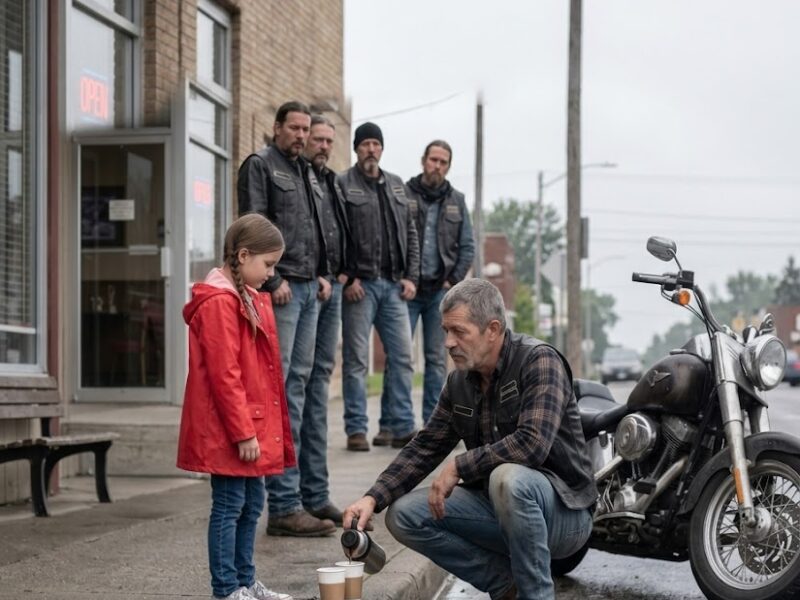
A little girl set two paper cups on the curb every Sunday morning. Nobody knew why. Nobody asked. Then one Sunday, 400 bikers showed up—and filled them both.
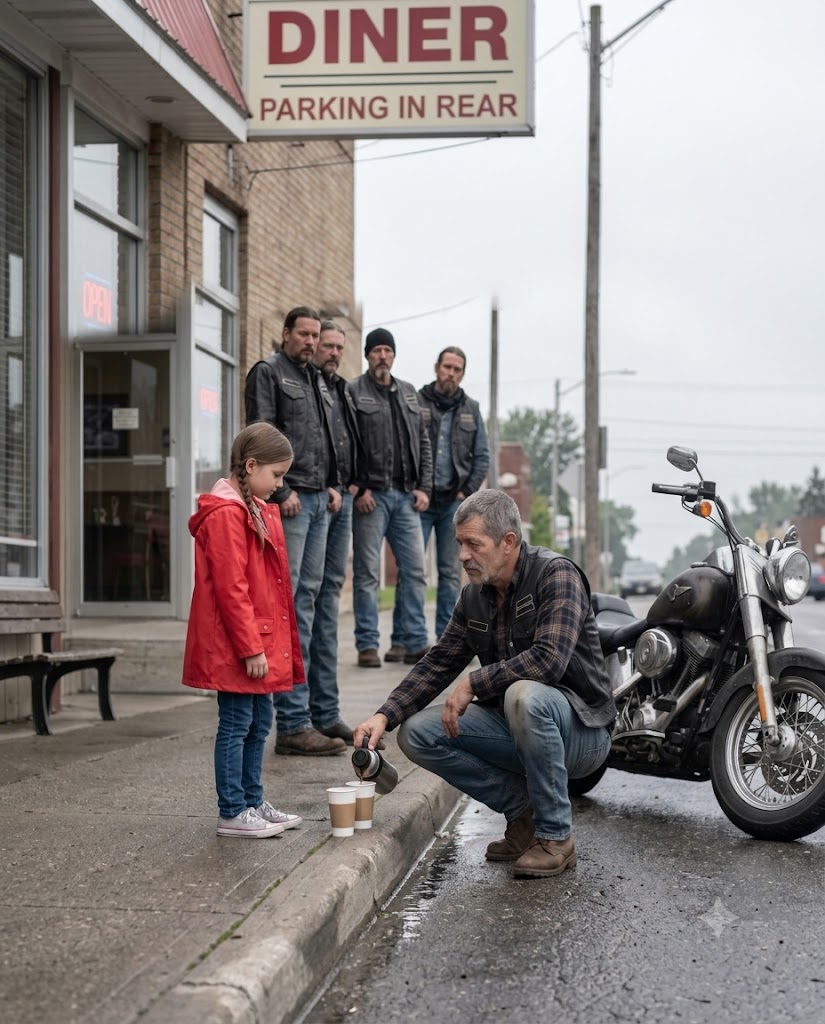
Eleven Sundays.
That was how many times she had done it before anyone thought to ask why.
Eleven Sundays, the same curb, the same hour, the same two paper cups set side by side on the cracked asphalt at the corner of Mosquite and Broken Drum Road in Clover Flats, Arizona.
And each time she had sat down behind them, cross-legged in the dust, and waited.
The cups were never very clean.
They were the kind that came in a sleeve of fifty from the grocery store on Route 9, white with a faint blue rim.
And whoever first noticed them had assumed they belonged to a lemonade stand that had not yet opened.
Nobody stopped.
The corner was not the kind of corner where people stopped.
It was four miles outside the last traffic light in Clover Flats, on a stretch of state highway that narrowed to a single lane at the wash crossing and smelled of sage and diesel in the distance.
The only traffic on a Sunday morning at a quarter past seven was the occasional rancher’s truck and once a week without fail the column of motorcycles that came north out of the desert and passed through town on the way back from wherever the Ash Creek Riders went when they rode at dawn.
Four hundred of them.
Four hundred motorcycles.
Four hundred riders.
And not one of them had stopped.
Not yet.
The girl set her cups on the curb and sat behind them and waited, and the sound of the engines swept past her like a weather event.
And when the road was quiet again, she picked the cups up and carried them home.
Nobody knew what the cups were for.
That was the part nobody was ready for.
The morning Gareth Solen first noticed her was not the eleventh Sunday.
It was the twelfth, which meant he had been riding past for three months already, once a week, never looking right, the way a man who has driven a road ten thousand times stops seeing the edges of it.
He was fifty-seven years old and he was not a man who invited looking.
He stood six foot and a half in his boots, carried two hundred and forty pounds of it across a chest that had been broken and reset twice, and wore a beard that had gone fully gray eight years ago and had not been trimmed since his daughter’s wedding, which was itself five years past.
His hands on the bars were the color of old saddle leather and twice as thick.
He had been president of the Ash Creek Riders for fourteen years.
The last of the four men who had founded the club in a bar in Flagstaff with a pool cue, a cocktail napkin, and a dispute about dues.
The other three were gone in ways that ranged from slow to sudden, and Gareth had not spoken about any of them to anyone in recent memory.
The club called him Gareth, and that was all.
He had a last name on his license and a patch on his back, and not much else that required a word.
He came north every Sunday at the front of the column because that was where the president rode and because there was nowhere he wanted to be more than moving through desert air at first light.
The ride had started four years ago as a loop, sixty-one miles out and sixty-one miles back.
No destination, no schedule except the turnaround and the return.
It left the compound at 5:45 and came back through Clover Flats at 7:10 or thereabouts, and the only constants were the hour and the number.
Four hundred riders, give or take a few who were laid up or working, but always at least four hundred.
He had never counted them the way other people counted.
He felt them the way you feel a change in barometric pressure in the chest, in the collarbone, in the small muscles behind the ears.
He knew when someone was missing, and he knew when someone new had joined, and he had not once in fourteen years failed to bring every one of them home.
It was the light that made him see her on that twelfth Sunday.
October had pushed into the high desert the way it does in Arizona, not with cold exactly, but with a quality of morning light that is more like brass than gold.
Low and flat and specific, the kind of light that throws a long shadow from a very small thing.
He came around the curve at Mosquite and Broken Drum at 7:16, and the light hit the corner at exactly the angle that made those two white cups blaze on the asphalt as if someone had set two small lanterns at the edge of the road.
And then he saw her behind them.
Seven years old, maybe eight, small even for that, wearing a green jacket that was one size too large and a pair of boots that had been resold at least once and possibly twice.
She was sitting cross-legged with her hands in her lap and her chin level, and she was watching the column come toward her the way you watch a train when you are not sure whether it is going to stop.
He pulled the throttle back.
Behind him, four hundred engines adjusted to him the way water adjusts to a stone, and the whole column slowed without a signal.
He pulled to the shoulder and stopped, and the gravel cracked under his boots when he stepped off, and he walked to the curb and looked at her and at the cups.
They were empty, both of them.
Clean inside, no residue, no liquid, just two clean white cups with a faint blue rim placed exactly twelve inches apart on the cracked edge of the road.
He crouched down so that his face was at her level.
The beard got there first, and he watched her eyes assess it the way a child assesses something unfamiliar.
Not afraid, just measuring.
He waited.
She said, “I saved you both a spot.”
He looked at the cups.
He looked at her.
He said, “What goes in them?”
She said, “I don’t know yet.”
And that was the complete and entire answer, and it raised the back of his neck in a way that fourteen years of road had not managed to do.
He did not ask anything else.
Not yet.
He stood up and looked back at the column and saw four hundred engines idling and four hundred visors watching him.
And he held up a hand that meant five minutes.
He went back to the girl.
Her name was Nora.
He got that much in the first sixty seconds, along with the information that she was eight years old, that she lived in the blue house behind the horse property two roads over, and that she had been setting the cups out every Sunday morning since July because her grandmother had told her that if you put something out for the thing you are waiting for, the waiting goes faster.
He said, “What are you waiting for?”
She looked at the cups and she looked at him and she said, “I’ll know when it gets here.”
He said, “Every Sunday?”
She said, “7:15.”
He said, “We come through at 7:16.”
She said, “I know.”
Her chin did not waver.
Neither did her hands.
He got back on his bike and he rode.
But the cups stayed with him the whole sixty-one miles back to the compound, white with a faint blue rim, clean inside.
He did not tell the club that night.
He told one person, a man named Duff Carrick, who was fifty-one years old and served as secretary and also as the nearest thing Gareth had to a confessor, in that Duff was capable of listening to a thing for a long time without deciding what it meant.
They sat on a tailgate in the compound yard, and Gareth described the cups and the green jacket and the answer she had given about not knowing what went in them.
And Duff listened and looked at the sky for a while and said, “You going to stop again next week?”
Gareth said, “Already planning on it.”
Duff said, “Good.”
That was the whole conversation.
Gareth spent the following six days not thinking about the girl, which he knew was itself a kind of thinking.
He serviced his bike on Tuesday, rode a hundred miles alone on Thursday to check a stretch of road the club used for the winter rally, and on Saturday drove to the grocery store on Route 9 and stood in the household aisle for three minutes before putting a sleeve of paper cups in his cart, white with a faint blue rim, fifty in the sleeve.
He did not know what he intended to do with them, and he did not try to figure it out.
He put them in the cab of his truck and drove home.
Sunday came in cold and white, the first morning of the year that called for a second jacket layer.
The sky was the color of an old nickel at 5:45 when the column formed at the compound gate.
Forty-seven riders that week, which was high for October.
They went south into the desert and turned at the sixty-one-mile mark where a dry creek crossed under the highway at a place called Drowned Horse Flat and came back north in the early light.
And Gareth took the curve at Mosquite and Broken Drum at 7:14, two minutes early because he had pushed the pace without realizing it.
She was there, green jacket, resold boots, cross-legged in the dust, the cups on the curb in front of her, empty, twelve inches apart.
She had one additional item this week, a thermos, green plastic, sitting between her knees.
And when Gareth stepped off his bike and crouched down, she looked at it and said, “It’s cocoa. My mom made it.”
She said, “If you were going to keep stopping, she ought to send something.”
He said, “I’ve only stopped once.”
She said, “Mom saw you slow down before that.”
He looked at the thermos.
He looked at the cups.
He reached into the inside pocket of his jacket and brought out two paper cups, white with a faint blue rim, and set them on the curb beside hers.
She stared at them for a moment.
Then she said, “You knew what goes in them.”
He said, “I had a guess.”
She poured from the thermos.
The cocoa steamed in the October air, and she filled both cups, and she pushed one toward him, and he took it, and they sat at the curb together while four hundred engines idled on the shoulder of Broken Drum Road and said nothing.
When the cup was empty, she took it back from him and set it beside hers and looked at both of them side by side and said, “That’s two.”
He said, “That’s two.”
She said, “Next week it’s three.”
He said, “You planning on company?”
She said, “I’m planning on you bringing some.”
Her voice was entirely matter of fact.
He thought he had misheard and then he was certain he had not.
And he put his hands on his knees and looked at her for a moment before standing up.
He said, “Three cups is a lot of cocoa.”
She said, “My mom has a big pot.”
He got back on his bike and thought about what it meant to be eight years old and entirely certain about things and whether he had ever been that and when exactly he had stopped.
He told Duff on the tailgate that evening.
Duff listened to the whole thing, including the part about the two cups he had brought from the grocery store and the part about her saying, “Next week it’s three.”
When Gareth finished, Duff looked at the compound for a moment, at the rows of bikes and the bunkhouse roof and the flag on the pole by the gate, and he said, “She expects you to bring someone.”
Gareth said, “That’s what I heard.”
Duff said, “Who do you have in mind?”
Gareth said, “Nobody specific.”
Duff said, “Then it’ll be whoever’s close enough to see your face right now.”
Gareth said, “What does my face look like?”
Duff said, “Like a man who lost something he’s been carrying so long he forgot it was gone.”
That was the night Gareth told the club.
Not all four hundred at once.
He stood at the edge of the fire pit in the compound yard where maybe thirty members were sitting after a late dinner, and he told them about Nora and the curb and the thirteen Sundays and the two cups and what she had said about waiting for the thing you were waiting for, and how her mother had sent cocoa.
He told it the way he told most things, which was in a straight line with no ornament.
And when he was finished, nobody said anything for a moment.
And then a woman named Petra Lusk, who ran the club’s emergency fund and had seen thirty winters in the high desert, said, “Does she know why she’s waiting?”
Gareth said, “No.”
Petra said, “Does she know who she’s waiting for?”
Gareth said, “I think she does now.”
The fire went quiet and somebody put another piece of wood on it and Duff said from the back, “So, are we going or not?”
And that was the whole vote.
The next Sunday was the fourteenth, and Gareth brought two riders with him to the curb.
Duff and a man named Claude Esper, who was sixty-two and the oldest working member, and who had a granddaughter somewhere in New Mexico he had not seen in six years for reasons he did not discuss.
Claude had brought a second thermos.
Nora had brought five cups.
She looked at the three of them and counted the cups she had set out and said, “I thought there might be more of you.”
Gareth said, “There are.”
She looked at the column on the shoulder and said, “All of them.”
He said, “They stayed on the road.”
She considered this and said, “Next week.”
He said, “Next week.”
On the fifteenth Sunday, Nora set out forty cups.
On the sixteenth, the curve at Mosquite and Broken Drum held something that stopped the first rancher’s truck to pass through.
At 7:30, the driver sat with his engine off and his window down, watching what had assembled on the shoulder.
Four hundred motorcycles parked in a line that ran from the intersection back past the wash crossing and out of sight around the curve to the south.
And at the front of it, at the curb, a girl in a green jacket and a man with a gray beard sitting together with paper cups, and behind them, standing in the gravel in patient rows, two hundred and sixty-one members of the Ash Creek Riders who had walked up from their bikes to be close enough to matter.
The cups could not hold four hundred servings of cocoa.
That had been obvious to everyone except apparently Nora, who had arrived that morning with her mother, Lena, and a stockpot of cocoa on a folding table borrowed from the community center, two boxes of cups, and the calm expression of someone who had simply planned ahead.
Lena was thirty-one years old, worked dispatch at the fire station in Clover Flats, and had the look of a person who had stopped being surprised by her daughter some time ago and had moved on to a position of watchful accommodation.
She poured, the members lined up, they took their cups, and stood in the gravel shoulder in the low October light and drank, and the column stretched back around the curve, and the engines ticked as they cooled in the morning air.
It was Duff who noticed the envelope first.
It was sitting under Nora’s folded hands in her lap, and she was holding it the way a person holds something they intend to produce at a specific moment.
A plain white envelope, sealed, no writing on the outside.
When the last cup had been poured and the last member had found a place to stand and the gravel had gone still, Nora looked at the envelope and looked at Gareth and said, “This is the part I was waiting to show you.”
Gareth said, “All right.”
She held it out.
He did not open it immediately.
He turned it over in his hands.
It was not thick.
One or two pages inside, maybe.
The seal had been done carefully, pressed flat.
The kind of careful that means the thing inside matters.
He said, “You want me to open it now?”
She said, “That’s why I brought it.”
He looked at Duff, who looked at the sky.
He ran his thumbnail under the seal.
Inside was a single sheet of paper folded twice, and inside the folded paper was a photograph.
He looked at the photograph first.
It was a picture of a motel room wall, the kind of photograph taken from close up where the thing being photographed fills the whole frame.
On the wall was a drawing done in crayon on a piece of notebook paper taped at the corners.
The drawing showed a road and a column of shapes that were clearly meant to be motorcycles, rendered the way an eight-year-old renders things, with large wheels and small riders and a sky that was all one color.
At the front of the column was one shape larger than the others.
At the side of the road was a girl with a green jacket and two cups.
The cups were colored in blue rim, white body, and they were the most detailed things in the drawing.
More detailed than the bikes, more detailed than the road.
Two cups side by side, colored with the kind of focus a child applies to the things that matter most.
He unfolded the letter.
It was written in a hand that slanted left, which was not Nora’s, and it read as follows.
He read it once quietly, and then he read it aloud because Duff was watching him, and so were two hundred and sixty-one other people, and reading it aloud seemed like the only honest thing.
The letter said that the person writing it was Nora’s father, whose name was Tom, and that Tom had been a long-haul driver for eleven years, and that eight months ago he had been diagnosed with a condition in his spine that would stop him working within the year, possibly sooner, and that he had not known how to tell Nora this, except that one morning in July, she had come into his room where he was lying down, and she had asked him what he was waiting for, and he had said he was waiting for things to be different, and she had said she knew how to do that, and she had left the room, and the following Sunday morning he had heard the front door open at 7:00 and he had gotten up and gone to the window and seen her walking up Broken Drum Road with two paper cups in her hands.
He had not told her to stop.
He had watched her go every Sunday since.
He could not explain what she thought the cups would accomplish, and he suspected she could not either, and he had come to believe that this was not a flaw in the plan but the plan itself.
The letter said that he was writing from the room because walking to the corner was not possible today and that he wanted whoever found the cups to know that his daughter was not lost or unsupervised or in need of intervention.
He said that she was the bravest person he had ever known and that he was grateful to the road for sending someone who stopped.
The letter was dated the Sunday before this one, which meant Tom had written it the morning Gareth had first stayed at the curb for more than five minutes.
Gareth folded it back along its creases.
The gravel was very quiet.
He looked at Nora and said, “Does your dad know you brought this today?”
She said, “I told him last night that it was time.”
He said, “Is he at home right now?”
She said, “He’s at the window.”
Gareth looked up Broken Drum Road.
The blue house was visible from the corner, two roads over if you knew where to look, and he did not know where to look until Nora pointed, and then he saw it.
A second-story window with the curtain pulled back and a figure behind it that did not move.
He raised his hand.
The figure at the window raised one back.
Behind Gareth, without instruction or signal, two hundred and sixty-one members of the Ash Creek Riders raised their hands at the same time.
Four hundred of them, counting the ones still on the bikes.
Four hundred hands lifted toward a second-story window in a blue house two roads over where a man lay watching the thing his daughter had built.
Claude Esper turned away from the column and wiped his face with the back of his hand and looked at the sky and did not say anything.
Duff said something very quiet that Gareth did not catch.
Petra Lusk had her hand pressed flat against her sternum, the way you press down on something that is trying to rise.
Gareth held the drawing in his hands for a long moment, the blue-rimmed cups careful and precise, and then he folded it back into the envelope.
He set the envelope on the curb between the two cups that Nora had already placed there before any of this began, and he left it there, and he sat back on his heels, and the October morning sat on all of them like a hand laid gently on a shoulder.
What happened in the weeks that followed was not dramatic, which is to say it was not loud and it did not happen all at once.
It happened the way things happen when a large number of people who are good at logistics turn their attention to a single problem.
Petra Lusk made a phone call on the Monday after the sixteenth Sunday, and by Tuesday she had spoken to the club’s attorney, a man named Roy Estz, who had handled the Ash Creek Riders’ affairs for nine years and who was not easily surprised.
And Roy had said that what the club could do legally and without complication was substantial.
By Thursday, Petra had a number.
The club’s emergency fund held reserves that had been accumulated over fourteen years of rally fees, dues, and a standing monthly collection that Gareth had instituted after the death of the second founding member, a man named Stan, who had left a family without a plan.
The reserves were not endless, but they were enough to do the specific and practical things that Tom’s situation required.
A consultation with a specialist at the hospital in Flagstaff, which Roy arranged by calling in a debt from a doctor he knew.
A mortgage suspension negotiated with the bank in Clover Flats, which required three phone calls, two of them from Gareth personally.
And a mechanical inspection of Tom’s truck, because Tom’s truck was his primary asset and it had not been maintained in two years and the front axle needed work.
The axle was the one Gareth did himself on a Saturday morning in the driveway of the blue house, lying on his back in the dust with his boots sticking out from under the chassis while Nora sat on the porch steps and watched.
She had brought a cup of coffee for him, which she balanced on the porch rail, and every twenty minutes or so she would say in a voice that was offering information rather than asking a question, “It’s getting cold.”
He would say, “I know.”
She would say, “You can stop and drink it.”
He would say, “In a minute.”
This exchange repeated four times exactly.
The coffee was cold by the time he drank it, and he drank it completely.
Tom came out to the porch in the late morning, moving carefully, holding the rail.
He was thirty-four years old, and he looked older than that in the way that people look older when something is using up more energy than they have to spend.
He watched Gareth work for a while and then he said, “You don’t have to do that.”
Gareth from under the truck said, “Axle needed doing.”
Tom said, “I know. I just meant you don’t have to.”
Gareth said, “I know what you meant.”
There was a pause in which the wrench turned through two full rotations.
Then Tom said, “She’s been going to that corner since July.”
Gareth said, “Thirteen weeks before I stopped.”
Tom said, “Eleven before you slowed down.”
Gareth stopped turning the wrench.
He lay under the truck and looked up at the chassis above him for a moment.
He said, “You saw that?”
Tom said, “Every week.”
Another pause.
Then Tom said, “She told me you brought cups the second time.”
Gareth said, “I had a guess.”
Tom said, “She said the same thing.”
And Gareth heard in Tom’s voice the exact same quality that had been in Nora’s eight-year-old voice on that first Sunday, which was the quality of someone who has been waiting for the right thing and has recognized it when it arrived.
He finished the axle by 2:00 in the afternoon.
He stood up and wiped his hands on a rag and drank the last cold inch of coffee and looked at the truck and at the house and at Nora, who had moved from the porch steps to the fence post and was sitting on the top rail with her boots hooked through the lower one.
He said, “Should hold.”
She said, “Good.”
He said, “Your dad have everything he needs for tonight?”
She considered this with the gravity she applied to all logistical questions and said, “We need bread.”
He drove to Route 9 and bought bread and a second sleeve of cups, white with a faint blue rim, and brought them back.
The seventeenth Sunday was the last one that felt provisional.
After that, the curb at Mosquite and Broken Drum Road became a fixed point on the Ash Creek Riders’ weekly loop, written into the route as formally as the turnaround at Drowned Horse Flat.
Lena had the folding table and the stockpot.
The column pulled off the highway in an order that had been worked out over several weeks.
The front third parked on the shoulder south of the corner, the back third on the shoulder north, and the middle came to the curb in rotating groups of forty so that the road was never fully blocked.
But every rider across the full four hundred had a Sunday morning within the month when they stood at the corner with a cup in their hands.
The number was stated at every club meeting.
Four hundred riders, four hundred cups over the course of the month, forty at the corner on any given Sunday.
The math was exact.
Nora approved of exactness.
She had begun keeping a tally on a piece of notebook paper she folded into her jacket pocket, and she would show it to Gareth some Sundays and not others, and the Sundays she showed it were the ones where the number had gone up.
Tom’s appointment at the Flagstaff hospital came on a Tuesday in November, six weeks after the sixteenth Sunday.
Roy Estz drove him because Lena was on shift and because Roy had a reason to be in Flagstaff that day and because Gareth had asked him to.
The specialist’s name was Dr. Yianz Curo and she was precise and careful and did not soften things unnecessarily, which Tom later said was what he had needed most.
What she told him was that the condition was real and serious and progressive, but that there was a specific intervention, a course of treatment that was not guaranteed but that had a documented record in cases like his, and that the window for it was open but not wide.
The paperwork for the intervention ran to thirty-eight pages.
Roy read all thirty-eight.
He flagged eleven items that required action, and he took action on nine of them before they left the parking garage.
The other two required a week.
He got them both.
What Gareth knew of all this, he knew in pieces, because Roy reported to Petra and Petra reported to Gareth, and Gareth was not a man who asked for detail unless detail was required for a decision.
He received the information that the treatment was proceeding, and he received it on a Sunday morning at the curb while Nora poured from the stockpot and forty riders stood in the gravel, and he received it from Petra, who said simply, “Curo says the window’s open.”
He said, “Good.”
Petra said, “Roy says thank you for the introduction.”
Gareth said, “I never met Roy’s doctor.”
Petra said, “Roy knows that. He means thank you for the introduction to the problem.”
Gareth looked at the cups and looked at Nora and said, “That wasn’t me.”
Petra looked at him and looked at the girl and said, “No, I know.”
The winter came down hard on Clover Flats in December, which it does in the high desert, with a specific kind of cold that has no moisture in it and smells of juniper and iron.
The Sunday rides continued because the Ash Creek Riders had ridden in worse and the route was known and the road was clean and the column was four hundred strong.
Nora wore a second jacket over the green one.
Gareth wore his heaviest liner and did not say anything about the cold because the cold was just weather and weather was not an excuse for anything.
The cups steamed harder in December.
The riders held them with both hands.
It was in the second week of December that Gareth brought the drawing back.
He had kept it in the envelope inside his jacket pocket for six weeks, which he had not told anyone.
And on that Sunday morning, he took it out and unfolded it and set it on the curb beside the cups and said to Nora, “I think this belongs at your house.”
She looked at it for a moment, the crayon road and the crayon column and the two careful cups.
She said, “My dad drew it.”
Gareth said, “I know.”
She said, “He drew it the first week you slowed down.”
Gareth said, “Before I stopped.”
She said, “He said he could tell you were going to.”
Gareth said, “He had more confidence than I did.”
She picked up the drawing and held it against her chest and looked out at the column on the shoulder and said, “He wants to come out here.”
Gareth said, “When he’s ready.”
She said, “Maybe in the spring.”
Gareth said, “We’ll be here.”
She said, “Every Sunday.”
He said, “7:16.”
She said, “I know.”
The December light was the color of old bone, low and flat and exact, and it lit the cups on the curb the way it had lit them on the twelfth Sunday, as if they were the only things in the landscape worth illuminating.
Spring in the high desert announces itself not with warmth but with smell.
First the dust changing, then the sage coming back, then a quality in the early morning air that is not quite green but is the smell of green returning.
On the fourth Sunday of March, which was the thirty-first Sunday since the twelfth one, when Gareth had first stopped, Tom, Nora’s father, walked to the corner of Mosquite and Broken Drum Road on his own two feet.
He walked slowly and he walked with a cane that he held in his left hand and did not lean on heavily, which Lena later said was because he was not willing to lean on it in front of four hundred people, and Gareth later said was understandable, and Nora later said was unnecessary because the cane was just a cane.
He arrived at the curb at 7:12, four minutes before the column came around the bend, and Nora was already there with the cups, and she handed him one and kept one, and they stood together at the edge of the road.
When the column came around the curve, Gareth cut the throttle back, and the whole front of the column slowed with him, and he pulled to the shoulder and stepped off and walked to where Tom was standing and put out his hand.
Tom took it.
They did not say anything immediately.
The weight of the handshake was enough.
Nora set a third cup on the curb and filled it from the stockpot and handed it to Gareth.
And he stood at the curb with them and drank.
Behind him, the column had pulled to the shoulder, and the riders were parking and walking forward in their rotating groups of forty, and the gravel crunched in the March morning, and the cups steamed, and the desert opened wide in all directions under a sky that had gone soft blue, the kind of blue that is not the sky of crisis but the sky of the day after the last hard night.
Two years later, the Ash Creek Riders designated the curb at Mosquite and Broken Drum Road as the official start and end point of the Sunday loop, which meant the sixty-one miles to Drowned Horse Flat and the sixty-one miles back were measured from that corner and not from the compound gate.
The marker they used was a short post set in concrete at the edge of the gravel, painted white, on which someone had mounted a small wooden bracket that held two cups, white with a faint blue rim, renewed weekly.
The post had no plaque.
The only writing on it was done by hand in permanent marker in letters that slanted left, which was how Gareth knew Tom had written it and not Nora.
It said, in full, “Saved you both a spot.”
The column passed it at 7:16 every Sunday on the way out and at 7:16 on the way back.
And whoever was riding point would tap the bracket with one hand as they passed.
Four hundred riders, one tap each, the sound of it accumulating into something that was not quite silence and not quite music but was recognizably its own thing.
On the Sunday the marker was installed, Nora was ten years old.
She wore the green jacket.
It fit her better than it had in October two years before, which meant she was growing into something, the jacket or the world or both.
She set two cups on the curb that morning the way she always did, and she filled them, and she gave one to Gareth and kept one.
And they sat at the corner in the March light the way they had sat at the corner in the October light and the December light and the spring light, the light changing above them and the road unchanged beneath them, and the column stretched back around the curve in both directions, four hundred of them, the number real and constant and spoken aloud at every meeting and written in Nora’s tally and carved into the distance in the sixty-one miles of desert road.
They rode together every week.
He did not know what he had been waiting for in the years before the twelfth Sunday.
He knew it now.
He had been waiting for someone to put out a cup and hold a spot and believe with the complete and unhurried certainty of an eight-year-old that the right thing would eventually slow down and stop.
The engines ran and the light moved and the cups were filled.
That is what a road is if you ride it long enough.
Not the miles behind you, not the miles ahead, but the cup on the curb where someone who knew you were coming set a place and waited.









