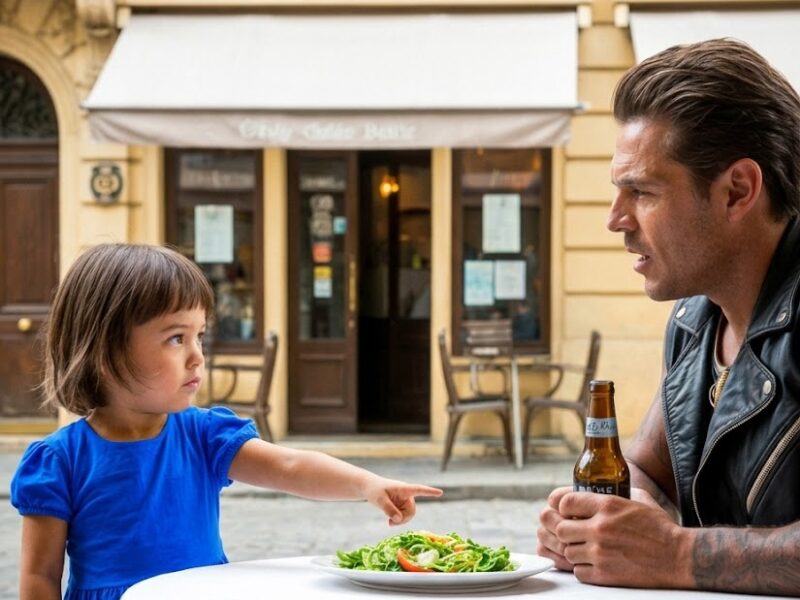
A little girl screamed, “Don’t drink that!” — and a tough biker almost ignored her, until he saw it with his own eyes.
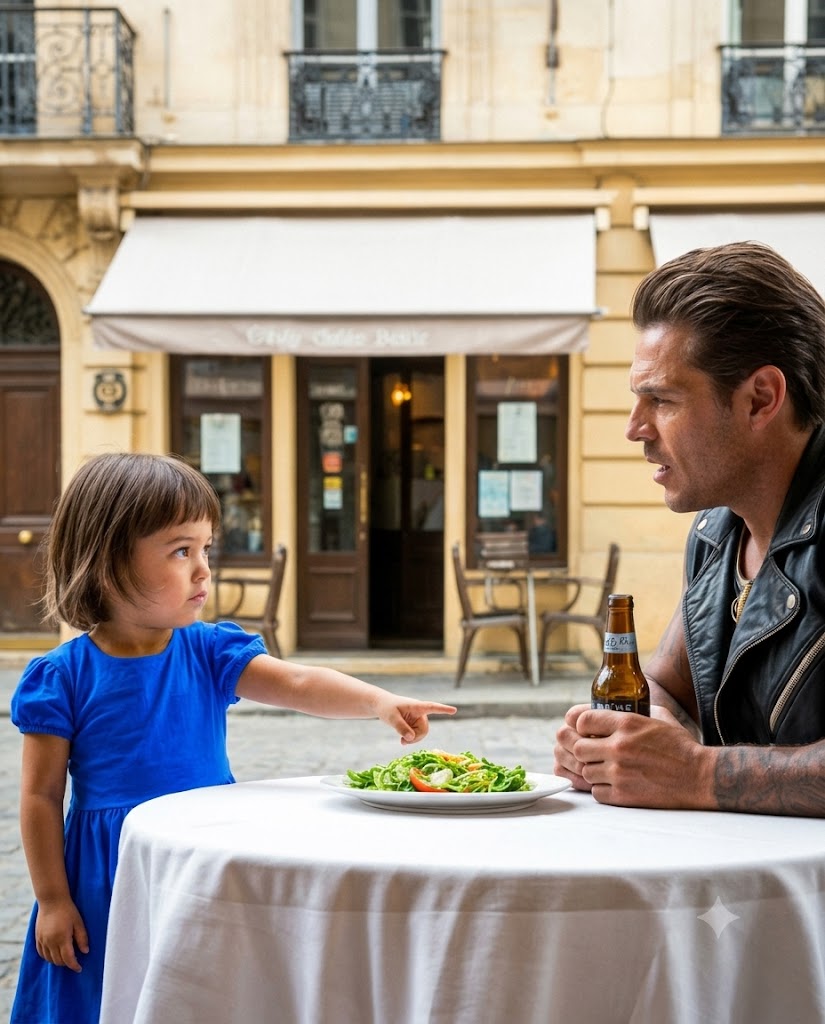
The rumble of motorcycle engines shook the windows of Copper Ridge Roadhouse, a weathered tavern that sat like a fortress at the edge of the desert highway.
Chrome gleamed under the harsh afternoon sun as rows of bikes lined the gravel lot, their owners gathering inside for the annual Brotherhood Run, a tradition older than most of the riders themselves.
The air smelled of leather, motor oil, and the mesquite smoke drifting from the outdoor grill.
This wasn’t a place for the timid.
The patched leather vests, the scarred knuckles, the hard eyes that had seen too much—they all told the same story.
These men had earned their respect the difficult way, through loyalty, sacrifice, and an unbreakable code that outsiders would never fully understand.
At the center of it all sat Marcus “Reaper” Cain, a mountain of a man whose reputation stretched across three states.
His vest bore patches that chronicled decades on the road—President of the Desert Snakes chapter, a brotherhood forged in fire and sealed with blood.
His beard was gray now, streaked with white, and deep lines carved his weathered face like roads on a map.
He had survived prison, betrayals, wars—both literal and metaphorical.
Nothing rattled him anymore.
Or so he believed.
But that belief was about to shatter, destroyed by the desperate voice of a seven-year-old girl who would appear out of nowhere with terror in her eyes and words that would save his life.
—
The roadhouse buzzed with rough laughter and clinking glasses.
Bikers traded stories, slapped backs, and toasted fallen brothers.
The jukebox played old rock anthems that everyone knew by heart.
Reaper sat at the head table with his closest brothers, men who had ridden beside him through hell and back.
The bartender, a grizzled veteran named Lou, who had served this crowd for twenty years, brought over a fresh pitcher of beer and a bottle of whiskey.
“Reaper, as usual.”
The amber liquid caught the light as Lou poured it into a glass, sliding it across the scarred wooden table with practiced ease.
Reaper nodded his thanks, reaching for the glass, ready to make a toast to the brothers who couldn’t be here—the ones who had fallen over the years.
But before his fingers closed around the glass, a small shape burst through the open door, moving with frantic urgency.
Conversations stuttered.
Heads turned.
Every set of eyes in the roadhouse locked onto the intruder.
A tiny girl in a bright blue dress, her light brown hair cut in a practical bob that framed her small face, her bare feet leaving dusty prints on the floor.
She was out of breath, chest heaving, eyes wide with panic.
She looked completely out of place in this den of leather and steel, like a sparrow that had flown into a lion’s cage.
Her name was Sophie Martinez, though nobody there knew it yet.
For the past two weeks, she had been living in a nightmare that no child should ever know.
Her father had disappeared, swallowed by the desert after a truck breakdown on a lonely stretch of highway.
Her mother, desperate and searching, had left Sophie with a neighbor who turned out to be worse than a stranger.
The woman was cruel, barely feeding her, locking her in a shed at night.
Three days ago, Sophie had escaped, slipping out through a loose board and running into the vast emptiness of the desert landscape.
She had survived on water from irrigation ditches and scraps she found behind gas stations.
She was hungry, exhausted, and terrified.
But she was also remarkably observant—a trait her father had always praised her for, telling her that noticing details would serve her well in life.
—
If you believe in the power of observation, in trusting your instincts, and in the courage it takes to speak up when something feels wrong, then pause for a moment.
Like, comment, share, and subscribe to Bike Diaries.
Tell us in the comments where you’re watching from today, because this story will remind you that heroes come in all sizes—and sometimes the smallest voices carry the most important messages.
—
Just minutes before she burst into the roadhouse, Sophie had been hiding behind the dumpster in the back alley, searching for food.
Anything to quiet the gnawing hunger in her stomach.
That’s when she saw him.
A thin man with nervous movements and darting eyes—someone who clearly didn’t belong in this place.
He had crept toward the back entrance of the roadhouse, checked over his shoulder repeatedly, then slipped inside through the kitchen door.
Sophie’s instincts screamed danger.
She had learned to read people during her time on the streets, to distinguish between those who might help and those who meant harm.
This man moved like someone doing something terrible.
Curiosity and concern pushed her closer.
She crept to the kitchen window, filthy and cracked, and peered inside.
What she saw made her heart pound so hard she thought it might burst from her chest.
The man pulled a small vial from his jacket, uncapped it with shaking hands, and emptied its contents into a whiskey bottle sitting on the counter.
A bottle with a distinctive label that Sophie had seen the bartender carrying just moments before.
The man’s face twisted with hatred as he muttered something under his breath—words Sophie couldn’t quite hear, but understood in their venom.
Then he slipped back out the way he came, vanishing into the maze of back alleys before anyone noticed.
Sophie didn’t know who that whiskey was for.
She didn’t know what was in that vial.
But every instinct her father had taught her—to pay attention, to trust what she saw, to speak up when something was wrong—told her that someone was about to get hurt badly.
She thought about staying hidden, about protecting herself the way she had learned to do.
But her father’s voice echoed in her mind, telling her that good people don’t walk away when they can help.
She gathered what little courage she had left and ran.
—
She burst through the front door, past the shocked faces, past the wall of leather and muscle, straight toward the biggest man in the room—because somehow she knew, with a certainty she couldn’t explain, that he was the target.
“Don’t drink that.”
Her voice cracked with desperation, high and clear in the sudden silence.
She pointed at the glass in front of Reaper with a trembling finger.
“Don’t drink it, please.”
The roadhouse erupted.
Men stood, chairs scraped, voices rose in confusion and anger.
Who was this kid?
How did she get in here?
Several bikers moved toward her—not threateningly, but firmly, ready to escort her out.
This was no place for children, especially not frightened little girls interrupting their gathering.
Reaper himself stared at her with a mixture of surprise and irritation, his thick eyebrows drawn together.
He wasn’t used to being interrupted, much less by someone who barely reached his belt buckle.
But something made him pause.
Maybe it was the raw fear in her eyes—fear that wasn’t directed at him or his brothers, but at that glass of whiskey.
Maybe it was the way she wasn’t begging or crying or looking for attention.
She was warning him—genuinely, desperately trying to protect him from something.
Her entire body shook, not from cold, but from the sheer effort of finding the courage to speak.
She looked like she had been through hell—her blue dress torn at the hem and stained with dirt, her knees scraped and bleeding, her face smudged with grime.
Yet here she stood, in a room full of dangerous-looking men, shouting at their president to save his life.
Reaper held up a massive hand, silencing the room instantly.
His brothers stopped moving, waiting.
He had led them for fifteen years, and they trusted his judgment absolutely.
He leaned forward, his weathered face level with Sophie’s, and spoke in a voice that was surprisingly gentle despite its gravelly depth.
“Why?”
He asked simply.
“Why shouldn’t I drink it?”
Sophie’s words tumbled out in a rush, tripping over each other.
She told him about the man in the alley, about watching through the window, about the vial and the whiskey bottle.
Her sentences were fragmented, jumbled by fear and exhaustion, but the core message was clear.
Someone had poisoned that drink.
She described the man as best she could—thin, nervous, wearing a dark jacket with grease stains, a tattoo on his neck that looked like a scorpion.
She even remembered the way he moved—quick and jerky, like someone who knew he was doing something wrong.
The description hit Reaper like a fist.
He knew exactly who she was talking about.
Danny Vickers—a prospect who had been rejected from the club six months ago after failing to prove his loyalty.
The kid had taken it badly, making threats, vowing revenge.
The club had written him off as all talk, just another wannabe who couldn’t handle rejection.
They had been wrong.
—
Reaper looked at the glass in front of him—the amber liquid that suddenly seemed sinister.
Then at the frightened child who had risked everything to warn him.
He made a decision.
He picked up the glass carefully, holding it away from himself, and called out to Lou.
“Get this tested. Now. And lock down the back entrance. Nobody leaves until we figure this out.”
The roadhouse exploded into action.
Two brothers ran to secure the exits.
Others pulled out phones, calling contacts in law enforcement and medical examinations.
Lou grabbed the glass with a bar towel, his face pale, realizing what might have happened if Sophie hadn’t intervened.
The whiskey bottle was retrieved from behind the bar, still half full, and set aside as evidence.
Within minutes, the local sheriff arrived, lights flashing, followed by an ambulance and a hazmat team from the county.
The sheriff—a man named Tom Harris, who had worked with the Desert Snakes on community safety initiatives before—took one look at the scene and immediately understood the gravity of the situation.
The testing was quick and damning.
The whiskey contained enough antifreeze to kill a man of Reaper’s size twice over.
The sweet taste would have been masked by the whiskey’s burn, and by the time symptoms appeared—organ failure setting in—it would have been too late.
The coroner would have ruled it organ failure, maybe a heart attack brought on by years of hard living.
Nobody would have suspected murder.
Vickers had almost pulled off the perfect crime.
Almost.
—
The police immediately issued an APB for Danny Vickers.
He was found three hours later at a motel forty miles away, packing his bags, preparing to run.
The evidence was overwhelming.
Security footage from a gas station showed him buying antifreeze that morning.
His fingerprints were on the bottle.
When confronted, he broke within an hour of questioning, confessing everything—his hatred, his planning, his conviction that killing Reaper would prove he was tough enough for the club.
He had been catastrophically wrong.
He would spend the next twenty years in prison contemplating that mistake.
—
If this story has touched your heart, please take a moment to like, share, and subscribe to Bike Diaries.
We bring you stories that prove heroism comes in all forms—that courage isn’t measured by size or age, and that sometimes the smallest voices carry the most important messages.
Tell us in the comments: Have you ever noticed something important that others missed?
Your story might inspire someone else.
—
Back at the roadhouse, as police finished collecting evidence and statements, Reaper knelt down in front of Sophie.
The little girl had collapsed into a chair, the adrenaline finally wearing off, leaving her shaking and small.
He studied her face, seeing past the dirt and fear to the incredible courage underneath.
This child had saved his life when she could have easily stayed hidden, stayed safe.
“What’s your name, kid?”
His voice was soft, almost tender—a tone his brothers rarely heard.
“Sophie,” she whispered.
“Sophie Martinez.”
“Sophie Martinez,” he repeated slowly, letting the name settle.
“That’s a good, strong name. Where’s your family, Sophie?”
The story came out in pieces, each one breaking Reaper’s heart a little more.
Her missing father.
Her cruel, temporary guardian.
Her escape and desperate survival.
She spoke quietly, factually, as if recounting someone else’s life.
She had learned not to expect help, not to trust that adults would listen or care.
But this man—this giant with the scary patches and the gray beard—he listened to every word.
He didn’t interrupt.
He didn’t dismiss her.
He heard her.
When she finished, Reaper stood and turned to his brothers.
His voice carried across the now-quiet roadhouse, resonating with authority and emotion.
“This little girl saved my life today. She risked everything to warn a stranger. That takes more guts than anything I’ve seen in a long time. We owe her. We owe her everything.”
The response was immediate and unanimous.
These men—often judged harshly by society—understood debt and honor better than most.
Within an hour, they had mobilized their considerable resources.
Phone calls were made.
Contacts were activated.
The Desert Snakes had connections that spanned law enforcement, social services, private investigators, and search and rescue teams.
Finding one missing truck driver in the desert became their mission, their purpose, their way of repaying an unpayable debt.
Sophie was given food—real food, more than she could eat.
Burgers, fries, fresh fruit that tasted like heaven after days of scraps.
The bikers’ wives and girlfriends arrived, bringing clean clothes, a warm blanket, gentle words, and softer touches than Sophie had felt in weeks.
A doctor who rode with the club examined her scrapes and bruises, treating them with careful hands while talking to her about motorcycles and the open road, distracting her from the sting of antiseptic.
For the first time in weeks, Sophie felt safe.
She fell asleep in a booth wrapped in a leather jacket that smelled like smoke and freedom.
While around her, dangerous-looking men worked tirelessly to find her father.
—
The search took less than a day.
A private helicopter, funded by the club’s emergency reserve, spotted the disabled truck in a remote canyon fifteen miles off the main highway.
Miguel Martinez was found alive—dehydrated and injured, but alive.
He had broken his leg in the initial breakdown and had been unable to walk for help.
He had survived on rainwater and the supplies in his truck, rationing carefully, waiting for rescue that he feared would never come.
When they told him his daughter had orchestrated his rescue—that she had been alone and surviving and fighting to find help, that she had saved a man’s life in the process—he broke down completely.
The reunion happened at the county hospital two days later.
Sophie was brought in by Reaper himself, riding on the back of his massive Harley, her small arms wrapped around his waist, a helmet that was three sizes too big bouncing on her head.
She had been terrified at first—the roar of the engine overwhelming—but Reaper had talked her through it, explaining the controls, the feeling of the road, the freedom that came with two wheels and open highway.
By the time they arrived, she was smiling.
Really smiling, for the first time in weeks.
Miguel Martinez was in a hospital bed, his leg in a cast, IV lines running into his arm, his face bruised from his ordeal.
When Sophie ran into the room, he reached for her with tears streaming down his weathered face.
They held each other and cried, releasing weeks of fear and pain and desperate hope.
Reaper stood in the doorway, watching, feeling something shift in his chest.
Something that had been hardened by years of rough living suddenly softening.
He had saved lives before—pulled brothers out of burning buildings and bloody fights.
But this felt different.
This felt like he had been given a chance to be part of something pure, something good.
—
The legal system moved quickly.
The neighbor who had neglected Sophie was arrested and charged with child endangerment.
Child services, working with the club’s legal contacts, ensured that Miguel retained custody once he recovered.
The Desert Snakes set up a fund to help the family get back on their feet, covering medical bills, replacing the truck, and providing a small house to rent until they could find stability.
It wasn’t charity.
It was honor.
It was repaying a debt that could never truly be repaid.
On the day Miguel was released from the hospital, the club threw a gathering at the roadhouse.
This time, Sophie walked in through the front door as an honored guest, wearing new clothes, her hair brushed and shining, her father beside her on crutches but standing tall with pride.
The bikers cheered, raising glasses of soda and water in her honor.
No whiskey today.
Nobody was touching whiskey for a while.
Reaper presented Sophie with a gift.
A small leather vest, child-sized, custom-made overnight by one of the brothers who worked in leather, with a patch on the back that read: “Honorary Member, Desert Snakes, Saved the President.”
She put it on with solemn pride, and the room erupted in applause.
These hard men—criminals and rebels and outcasts—showed her more genuine love and respect than many people receive in a lifetime.
—
Years later, Sophie would tell this story to her own children.
She would explain how paying attention saved a life, how speaking up despite fear changed everything, how heroes come in unexpected forms.
She would show them the vest, carefully preserved in a frame on her wall, and tell them about the day a little girl stopped a biker from drinking poison.
She would tell them about trust, about instincts, about the courage it takes to do the right thing when you’re terrified.
And Marcus “Reaper” Cain, who would ride for another fifteen years before finally retiring, would carry a small photo in his wallet.
It showed a tiny girl in an oversized helmet sitting on his bike, grinning at the camera with pure joy.
On the back, in careful, childish handwriting, it read: “Thank you for listening. Love, Sophie.”
He had faced down rival gangs, survived prison riots, and stared death in the face more times than he could count.
But he always said that the bravest thing he ever did was listen to a seven-year-old girl who told him not to drink that whiskey.
And the smartest thing he ever did was believe her.
—
Thank you for watching.
If this story reminded you to trust your instincts, to speak up when something feels wrong, and to never underestimate the power of paying attention, please share it.
Subscribe to Bike Diaries for more stories that prove heroes are everywhere, courage comes in all forms, and sometimes the smallest person in the room has the biggest impact.
Tell us in the comments: What would you have done in Sophie’s place?
—
The rumble of motorcycle engines had long faded from Copper Ridge Roadhouse, but the story of the little girl in the blue dress never did.
It became legend among the Desert Snakes—a tale told to new prospects, to visiting chapters, to anyone who needed reminding that strength wasn’t always about muscle and might.
Sometimes it was about a seven-year-old girl with scraped knees and a trembling voice, standing in a room full of men who could have crushed her without a thought, and saying the words that changed everything.
“Don’t drink that.”
Three words.
That was all it took to rewrite the future.
That was all it took to save a life, to reunite a family, to remind a hardened man that goodness still existed in the world.
The whiskey bottle sat on a shelf behind the bar for years afterward—empty, sealed in clear resin, a permanent reminder of how close they had all come to losing everything.
Lou would point to it sometimes, when newcomers asked about the strange decoration.
“That bottle almost killed our president,” he would say.
“A little girl saved him. Tiny thing. Barefoot. Braver than anyone in this room.”
And the newcomers would laugh, thinking it was a joke.
Until they saw the photo behind the bar—a little girl in an oversized helmet, grinning on the back of Reaper’s Harley.
Until they heard the story from someone who had been there.
Until they understood that sometimes the smallest voices carried the most important messages.
—
Sophie Martinez grew up knowing she had done something extraordinary.
But she never thought of herself as a hero.
She thought of herself as someone who paid attention, who trusted her instincts, who spoke up when something felt wrong.
Her father had taught her that.
And she had passed it on to her own children, and her grandchildren, and anyone who would listen.
“Notice things,” she would tell them.
“Trust what you see. And when something feels wrong, don’t stay silent. You never know whose life you might save.”
The leather vest hung on her wall until the day she died—a small, child-sized relic of a day that changed everything.
Her grandchildren would touch it reverently, asking for the story again and again.
And Sophie would tell them, her voice soft with memory, about the man with the scorpion tattoo, the vial in the kitchen, the glass of whiskey that almost became a murder weapon.
She would tell them about Reaper—the giant with the gray beard and the gentle eyes—and how he had knelt down to her level and listened.
Really listened.
And she would tell them about the moment she burst through that door, terrified and exhausted and certain she would be ignored.
“How did you do it, Grandma?” her granddaughter asked once.
“How did you find the courage?”
Sophie smiled, thinking of her father’s voice in her head, telling her that good people don’t walk away when they can help.
“I just remembered,” she said, “that staying silent was the same as letting someone get hurt. And I couldn’t live with that.”
—
Marcus “Reaper” Cain retired from the club on his sixty-fifth birthday.
He had ridden millions of miles, buried too many brothers, and seen more of the world than most people could imagine.
But the thing he was proudest of had nothing to do with motorcycles or territory or respect.
It was the photo in his wallet—worn now, creased at the corners, the colors faded from years of being carried close to his heart.
A little girl in an oversized helmet, grinning at the camera.
“Thank you for listening. Love, Sophie.”
He had faced down death more times than he could count.
But listening to a seven-year-old girl had been the bravest thing he ever did.
And believing her had been the smartest.
—
The story of Sophie and Reaper spread far beyond Copper Ridge Roadhouse.
It was told at biker gatherings across the country, shared around campfires and bar counters and hospital beds.
It became a reminder that courage wasn’t about size or strength or age.
It was about doing the right thing, even when you were scared.
It was about speaking up, even when no one seemed to be listening.
It was about trusting your instincts, even when everyone else said you were wrong.
And it was about the power of paying attention—of noticing the details that others missed, of seeing the danger that others overlooked.
Sophie had noticed.
Sophie had spoken up.
And because of that, a man lived, a family was reunited, and a legend was born.
—
The roadhouse still stands at the edge of the desert highway, weathered and worn but still standing.
The chrome still gleams under the harsh afternoon sun.
The engines still rumble, shaking the windows.
And inside, on a shelf behind the bar, a whiskey bottle sits sealed in resin—a reminder of the day everything almost ended, and the little girl who made sure it didn’t.
If you ever find yourself in that part of the country, stop by.
Order a drink—something non-alcoholic, if you know what’s good for you—and ask about the bottle.
Ask about the girl.
Ask about the day the smallest voice in the room saved the biggest man.
And remember, as you listen to the story, that heroes come in all forms.
Sometimes they’re seven years old.
Sometimes they’re barefoot and scared and exhausted.
Sometimes they’re the last person you’d expect to change your life.
But if you listen—really listen—they just might save it.
—
Thank you for reading.
If this story reminded you of the power of observation, the importance of trusting your instincts, and the courage it takes to speak up, please share it with someone who needs to hear it.
Subscribe to Bike Diaries for more stories that prove heroes are everywhere, courage comes in all forms, and sometimes the smallest person in the room has the biggest impact.
And tell us in the comments: What would you have done in Sophie’s place?
Would you have stayed hidden?
Would you have spoken up?
Would you have trusted your instincts, even when you were terrified?
Your story might inspire someone else.
Your voice might be the one that saves a life.
—
The desert wind still blows across Copper Ridge Roadhouse, carrying the scent of mesquite smoke and motor oil and freedom.
The bikes still line the gravel lot, chrome gleaming under the sun.
The men still gather inside, trading stories and slapping backs and toasting fallen brothers.
But something changed that day—something subtle, something permanent.
A little girl walked into a den of lions and walked out a hero.
A hardened man listened to the smallest voice in the room and lived to tell the tale.
And somewhere, in a frame on a wall, a child-sized leather vest hangs as a testament to the power of paying attention.
“Honorary Member, Desert Snakes, Saved the President.”
Seven words.
One little girl.
One moment of courage that changed everything.
—
The rumble of motorcycle engines shook the windows of Copper Ridge Roadhouse, just as it always had.
But now, whenever someone raised a glass to toast the fallen, they also raised a glass to the living—to the little girl who had saved their president, to the courage that came in the smallest package, to the reminder that heroes don’t always look like heroes.
Sometimes they look like a seven-year-old girl in a blue dress, barefoot and terrified, bursting through a door and saying the words that changed everything.
“Don’t drink that.”
And sometimes, if you’re lucky enough to listen, those words will save your life.
—
**THE END**









