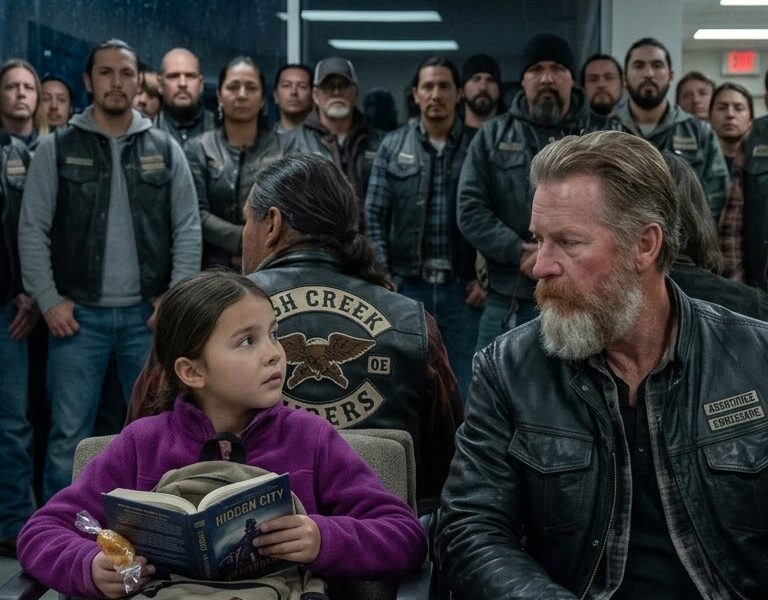
A little girl sat alone in the hospital lobby every night at eight. Nobody knew why. Nobody asked. Then one night, 450 bikers filled every chair at seven—and everything changed.
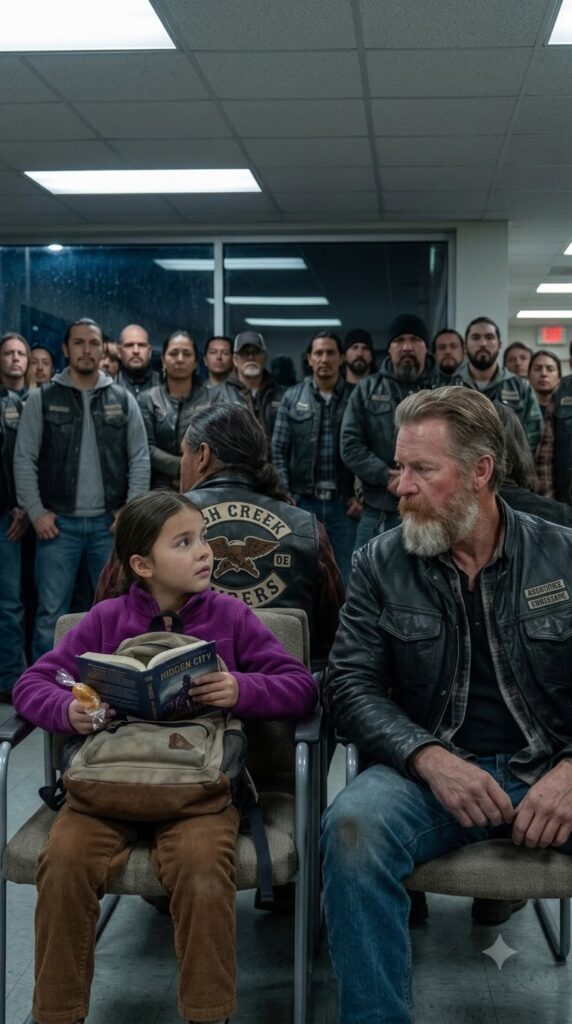
The parking lot of Flagstaff Regional Medical Center held 450 motorcycles on a Tuesday night in October, engines cold, kickstands down in rows that stretched from the emergency bay to the far edge of the visitor lot.
Not one of those riders had come there to be healed.
Garrett Ly Mak had come because of a child. He was 53 years old, 230 pounds of high desert gristle, his beard the color of a burned-out brush fire, gray at the root and red at the tips.
His knuckles cracked from 30 years of wrenches and wind. The Ash Creek Riders patch on his back was so faded from sun that the eagle’s wings had gone the color of old bone.
He had not been inside a hospital voluntarily in 11 years. Standing at the entrance under the pale fluorescent wash of the awning, he pushed through the glass door and did not look at his hands.
The lobby was already full. Every chair was taken, and the clock above the admitting desk read 7:14 in the evening, which was 46 minutes before the little girl was supposed to arrive.
He found a spot near the far window and stood there with his arms at his sides, and he thought about what one of his youngest members had said two nights ago, and he could not improve on it.
So he said nothing, and he waited, and outside the automatic doors, the parking lot kept filling.
—
The morning it started was a Monday in the third week of October. Garrett knew it was a Monday because the Ash Creek Riders held their chapter meeting every Sunday evening.
On Monday mornings, he always woke up earlier than was reasonable, his mind still running through whatever had been decided the night before, sorting it the way a man sorts hardware after a job, checking that every piece went where it was supposed to go.
The high desert scrub outside Ash Creek ran flat and brown at that hour, the greasewood silver in the low-angle light, the sky a hard cold blue that would soften to nothing by noon.
He had driven his pickup into Flagstaff for brake pads and SAE 30-weight oil, taking the long way along State Route 89 because he was not in a hurry, and because the road opened up past the Sunset Crater turnoff in a way that still, after 30 years, made the inside of his chest feel larger.
Garrett was the last of the four founding members still riding. The other three were spread across the flat and finite arithmetic of consequence.
One dead at 51 from a heart that quit without warning. One off a bike and into a wheelchair. One relocated to Tucson with a second wife who had conditions about the club.
And the club’s opinion of the club was that conditions were a private matter and none of their business. What remained of the founding was Garrett, the patch, the territory, and the Sunday meetings.
He served as club president, not because anyone had ever voted with particular enthusiasm, but because the job required someone who could hold a silence long enough for the room to fill it, and in that discipline, he had no equal in Ash Creek.
He parked behind the auto parts store on Leroux and walked in through the back the way he always did because parking was better and because the counter staff had stopped startling at his size about four years ago, which felt like an appropriate measure of mutual comfort.
He came out 20 minutes later with a paper bag of parts and was cutting across the hospital’s visitor lot on his way back to the truck, not thinking about anything in particular, when he noticed the girl.
She was sitting on the low concrete planter that ran along the east face of the building, the one where the dayshift smokers gathered at 6:00 and noon and 3:00. The smokers were gone. It was 9:40 in the morning.
The autumn sun still climbing and throwing long shadows from the entrance canopy across the asphalt. The girl was seven years old, though Garrett did not know that yet.
What he knew was that she was small and alone and sitting very still in a way that children do not sit unless they have been sitting for long enough that stillness has stopped feeling strange.
She wore a fleece jacket the color of old cantaloupe orange going to yellow at the seams and a pair of brown corduroy pants with the left knee worn shiny and boots that were one season too light for the temperature.
She had a backpack on her lap instead of her back and she was holding it with both hands the way a person holds something they are not going to put down.
She was not crying. She was watching the entrance doors open and close.
Garrett stopped. He did not plan to stop, but his legs made the decision before his head caught up, which was something he had learned to trust about himself after a long time of not trusting it.
He stood with the paper bag of brake pads in one hand and looked at the girl and the girl looked back at him and neither of them spoke for a moment.
He was aware of how he looked. He was always aware of how he looked. The beard, the patch, the size, the boots, the particular quality of stillness that people tended to read as menace when it was actually just how he stood when he was thinking.
A woman coming out of the entrance with a paper coffee cup saw him looking at the child and slowed down. Garrett did not move and did not look at the woman. He looked at the girl.
“You waiting for somebody,” he said. Not a question, more like a statement offered gently in the shape of a question.
The girl looked at him for another moment with clear, unsurprised brown eyes. “My grandma,” she said. “She’s on the third floor.”
The woman with the coffee cup had stopped moving entirely. She was holding her phone in her other hand and her thumb was doing something deliberate with the screen and Garrett knew what she was doing and did not blame her for it and also did not look away from the girl.
“You come here every day,” he said.
The girl shook her head. “Every night,” she said. “At 8:00, that’s when I’m allowed on the floor.”
She said it plainly, the way a child reports a rule they have accepted, even if they have not agreed with it. “But the bus gets here at 9:40 in the morning,” she added, as if this part required explaining. “So I wait.”
Garrett looked at her for a moment. Then he set his paper bag down on the planter beside her and sat next to it, which put him at roughly her eye level, which was the point.
The concrete was cold through his jeans. He was aware that he probably looked like something between a boulder and a thundercloud from the street. He sat anyway.
“How long you’ve been doing this?” he said.
“Since the second week of September,” the girl said. She thought about it. “Forty-one days.”
She had counted.
He looked at his hands for a moment. Eleven years ago, he had been in a hospital standing in a hallway on the second floor, and there had been a child involved then, too, and the outcome had been different from what he had tried to make it.
And that was not a thread he was going to follow right now in this parking lot in the October light. He pulled it back. He looked at the girl.
“What’s your grandma’s name?” he said.
“Rose,” the girl said. “But everybody calls her Rosie.”
She said it with a small brief wait, the way you say a name that belongs to someone who has been yours for a long time.
Garrett nodded. He reached into the pocket of his cut and found what he usually kept there, which was a gas receipt and a flat piece of butterscotch candy in cellophane, both of which he examined and then held up.
“You want this?” he said.
The girl looked at the candy. “Yes, please,” she said with the precision of a child who has been taught that please is not optional.
He held it out and she took it and put it in the front pocket of her backpack without unwrapping it, which told him she was saving it. He did not ask why.
The woman with the coffee cup and the phone had moved on.
He stood up from the planter and picked up his bag of brake pads. “What’s your name?” he said.
“Kora,” she said.
He nodded once. “I’m Garrett.”
He did not offer his hand because she was seven years old and it was not that kind of introduction.
He walked back to his truck and sat in the cab for four minutes without starting the engine. And then he drove back to Ash Creek.
—
He did not tell anyone that night. He needed to think about what he had seen before he said it out loud because saying it out loud was going to start something and he wanted to understand what he was starting before it started.
The Ash Creek Riders had 14 full members and three prospects. And when Garrett brought something to the table, it moved through the chapter the way water moves through cracked rock, finding the low places first and then spreading to everything.
He had built the club that way on purpose, and he was not careless with it.
He drove back out to Flagstaff on Tuesday morning and parked in the visitor lot and sat in his truck with the engine off and a large coffee from the gas station on Route 89.
At 9:38, the Regional Transit Authority bus from Ash Creek pulled up to the stop on Birch Avenue and Kora got off it. She had the same backpack. She had added a knit hat that she pulled off as soon as she got through the hospital’s front door because the lobby was warm.
Garrett watched through the glass. She went to the same concrete planter and sat down in the same posture, the bag on her lap, and settled in to wait. She had a book this time. She read it with complete concentration and did not look up when people walked past.
He went in at 10:00 and sat two seats down from her on the planter, and she looked at him and said, “Hi, Garrett,” as if this were a scheduled thing, as if they had agreed to meet here at 10:00 in the morning, and he was not unusual, but simply punctual.
He said, “Hi, Kora.”
He had brought a second coffee in case, but she was too young for coffee, so he drank that one, too. He asked her about the book and she told him it was about a girl who discovers a hidden city inside a mountain and that it was the third one in a series and the second one was better but this one was pretty good.
He asked her about her grandmother. Rose Adakai, she said, had been on the third floor of Flagstaff Regional since September 15th, which was a Thursday.
She had fallen in her kitchen and broken her hip and then had pneumonia on top of that and then something with her heart that Kora described with careful imprecision as “a rhythm problem,” which he understood to mean an arrhythmia, probably atrial fibrillation, common in women in their 70s recovering from orthopedic trauma.
He was not a medical person but he had spent enough time around enough injury and 30 years of riding that he had accumulated a working knowledge.
“Do you have family who comes?” he said.
“My mom comes on weekends,” Kora said. “She works the dinner shift.”
She did not explain this further. He did not push. He understood the arithmetic of a dinner shift and a bus schedule and a hospital visiting rule and a second-grade classroom and the seam where they all pressed against each other and left a seven-year-old on a cold concrete planter for nine hours.
He asked who she ate lunch with.
“There’s a cafeteria,” she said, “but it closes at 2:00.”
He asked what she did after 2:00.
She looked at him with great patience. “I read,” she said.
He drove back to Ash Creek at noon. And that night, he called a table meeting for 7:00 Sunday, which was one day earlier than usual, and he did not say why.
—
The Ash Creek Riders held their meetings in the back room of a building on Cinder Road that had been a feed supply warehouse before Garrett bought it outright in 2014 with money from the sale of his father’s place east of Williams.
The room had a long table made from two doors laid on sawhorses and covered with a sheet of plywood and folding chairs around it and a whiteboard on the north wall that still had a hand-drawn map from a poker run two years ago in one corner that no one had erased because it had been a good run.
Garrett stood at the head of the table on Sunday night and told them what he had seen. He was not a long-winded man. He used approximately 150 words and then he sat down.
The room was quiet for about four seconds.
Then Dennis Ruiz, who had been riding with Garrett since 2003 and who served as road captain and who had a daughter of his own who was nine, said, “How far is the bus ride?”
“Forty minutes each way,” Garrett said.
“She does it alone,” said Ruiz. It was not a question either.
“Yes,” said Garrett.
One of the prospects, a young man named Kyle Ferris, who was in his second year of prospecting and who almost never spoke at table unless addressed, said quietly, “How long until her grandmother gets out?”
Garrett looked at him. “I don’t know,” he said. “I asked the admitting desk. They won’t tell me. HIPAA. I’m nobody.”
Ferris nodded and looked at the table.
Vince Aoya, the treasurer, who was 48 and built like a wood stove and had been a paramedic for 11 years before his back went, said, “What’s the visiting rule?”
“Third floor is trauma and recovery,” Garrett said. “Visiting hours are 2 to 4 and 8 to 10. The evening shift is the one the girl does. She gets there at 9:40 on the bus. She waits in the lobby and at 8 she goes up.”
“That’s a 10-hour wait,” Aoya said.
“Most days,” Garrett said. “The cafeteria closes at 2. After that, she reads.”
Aoya looked at the table. He picked up a pen and set it down. He said, “She’s seven.”
“Yes,” Garrett said.
A man named Leonard So, who was 61 and the club’s oldest active member and who had a manner so quiet that some people assumed he was simply not paying attention when he was in fact paying more attention than anyone, said, “Who knows she’s doing this?”
“Her mother,” Garrett said. “The hospital staff, presumably. The bus driver, maybe.”
“Anybody doing anything?” So said.
“Not that I could see,” Garrett said.
So nodded very slightly.
The room went quiet again, but this was a different kind of quiet. The kind that happens when a decision is already made and everyone knows it and no one needs to say so.
Dennis Ruiz said, “We should be there at 7, not 8.”
Seven. One hour ahead of the girl’s allowed time on the floor so that she would never walk into an empty lobby, so that there would already be people there, already settled, already making the space something other than a fluorescent waiting room where a child sat alone with a book and saved a piece of butterscotch candy for later.
Garrett looked at Ruiz. Ruiz shrugged, which was as close as he got to a speech.
“Every night,” Garrett said.
“Every night,” Ruiz confirmed.
Leonard So looked at the whiteboard with the old poker run map and said, with something near to dryness, “That’s going to be a lot of people in a hospital lobby.”
“Yes,” said Garrett. “That’s the point.”
—
He did not sleep easily that night. Not because the decision troubled him, but because decisions of a certain size had a way of lifting him out of sleep after two or three hours and setting him in a chair in the dark with whatever was underneath the decision, the real thing, the one he did not say at the table.
He sat in the chair in the kitchen of the small house he kept at the edge of the Ash Creek property, and he did not turn on the light. The refrigerator hummed. Outside the window, the high desert was perfectly dark except for a ridge of stars that ran from the edge of the roof across to the southeast.
Scorpius already sinking. Orion not yet up.
Eleven years ago in November, not October. There had been a hospital and a child, and Garrett had been too far away to matter. His younger brother’s daughter, her name was Petra, she was eight years old, and Garrett had been in Nevada when the call came and had driven through the night and arrived six hours after he needed to arrive.
He had stood in a corridor on the second floor of a hospital in Prescott, and the doctor had already told his brother, and his brother’s face had already finished its worst work, and Petra was alive, but it had been very close, and the distance between alive and not alive was a corridor in a hospital and the specific arithmetic of ours.
He had never ridden to Prescott fast enough to undo the six hours. He had never found a way to make it arithmetic that worked differently. Petra was 19 now, in college in Tucson, studying education, and she was fine. She was whole.
But the corridor in Prescott still had a place in him that had not closed.
He understood, sitting in the dark kitchen, that Kora was not Petra. He understood that what he was arranging was not an act of repair so much as an act of presence, of showing up on time, which was the thing he had not done once and had been practicing ever since.
He went back to bed at 4:00 and slept until 6:00 and drove into Ash Creek in the pre-dawn with the heat on and the stars still visible and the greasewood smelling of cold and the faint distant cedar that came down off the San Francisco Peaks when the wind was right.
—
Dennis Ruiz made the calls on Monday. He had a way on the phone that was matter-of-fact and complete without being aggressive, a tone that came from having dispatched riders for long runs for 12 years and knowing that riders did not need persuasion so much as information and logistics and an exact departure time.
He started with the 14 full members and three prospects of Ash Creek proper and then he went to the four other Ash Creek Riders chapters, because the club had grown in the years since Garrett and the original three had founded it and now ran from Flagstaff east to Winslow and south to the edge of the Mogollon Rim.
Every chapter had a road captain and every road captain had a phone and most of them had picked up for Ruiz before and knew that if he was calling midweek there was a reason.
By Tuesday evening he had confirmed 72 riders from Ash Creek proper and the surrounding chapters. By Wednesday he had 98.
The word had spread because it always did. Because the thing about a community that the wider world persistently misread was that it communicated faster through trust than through any platform or announcement.
The Ash Creek Riders trusted each other with information the way craftsmen trust the straightness of a level, as a matter of habit and professional necessity.
By Thursday morning the number was 140. By Thursday night, 217.
Garrett stopped keeping track by name and started keeping track by number and then stopped keeping track entirely and told Ruiz that whatever number arrived was the right number and they would arrange themselves accordingly.
Ruiz, who had been doing logistics since before Garrett gave it a name, simply said, “We’re going to need the south and west sections of the visitor lot.”
Garrett said, “I’ll talk to the hospital.”
—
He drove to Flagstaff on Thursday afternoon, not the long way this time, and went into the administrative offices and asked to speak to whoever handled facility coordination.
He was shown to a woman named Patricia Holt, who was the patient services director and who had worked at Flagstaff Regional for 19 years, and who looked at Garrett when he walked through her office door with the particular polite neutrality of someone rerouting a first impression in real time.
He sat in the chair across from her desk, and he told her what he was planning. He told it plainly.
A seven-year-old girl named Kora had been coming to this hospital every day since September 15th to visit her grandmother on the third floor. She arrived on the bus at 9:40 in the morning and she waited in the lobby until 8:00 in the evening because that was when visiting hours began on the recovery floor.
And she did this alone.
And the Ash Creek Riders intended to be in that lobby at 7 every evening so that the girl would not be alone.
The number might be large, he said. He wanted to coordinate so that it was not disruptive to other patients and families.
Patricia Holt looked at him for a moment. She picked up a pen. “How large?” she said.
“I don’t know exactly,” Garrett said. “Wednesday I had 217 confirmed.”
Patricia Holt set the pen down. She picked it up again. “That’s a lot of people in a lobby,” she said.
“Yes,” Garrett said. “We’ll be quiet and we’ll be respectful and we’ll leave if you tell us to leave. I’m here because I’d rather know the rules than break them by accident.”
She looked at him for what he estimated was six or seven seconds.
“The lobby capacity is technically 212,” she said. “If you exceed that, we’ll need to use the atrium and the east corridor.”
“That’s fine,” he said. “I’ll let my road captain know.”
She wrote something on a notepad. “The girl,” she said. “Kora.”
“Yes.”
“She comes in through the main entrance.”
“Yes. Off the bus. 9:40.”
Patricia Holt looked at her notepad for a moment. “She’s a sweet kid,” she said quietly, and it was the first thing she had said that was not logistical, and it cracked the professional surface of her face just slightly, enough that Garrett could see something older and more tired and more human underneath.
He nodded. He stood up.
At the door, she said, “Mr. Mak.”
He turned.
“The third floor charge nurse,” she said. “Her name is Delgado. Sandra Delgado. If you speak to her before 7 on the first evening, it might be useful.”
He did not ask her to be more specific. He understood that she was telling him something about the way a rule might move if the right person applied it thoughtfully.
He said, “Thank you, Ms. Holt,” and went back out through the lobby and into the cold October afternoon.
—
He found Sandra Delgado on the third floor at 5:30 on Friday afternoon, the day before the first evening was to happen. She was a compact woman in her 40s, with the bearing of someone who had been the person in charge of difficult situations for long enough that authority had stopped being a posture and become simply how she stood.
She had dark hair with gray at the temples and reading glasses on a cord around her neck. And she looked at Garrett with neither alarm nor easy welcome, just assessment, the way a person looks at a forecast they are not sure they trust.
He told her the same thing he had told Patricia Holt with the same plain economy.
Delgado listened without interrupting. When he was done, she said, “The girl. Kora Adakai.”
“Yes,” he said.
“Her grandmother Rose. Room 314.”
“Yes.”
Delgado looked down the corridor and then back at him. “The rule on visiting hours exists for patient rest,” she said. “I want you to understand that it is a real rule and it is there for a real reason.”
“I understand,” he said.
She looked at him steadily. “7:00 is technically outside recovery visiting hours,” she said. “8 is when the floor opens for the evening.”
“I know,” he said. “We’re not asking to go to the floor.”
“I understand what you’re asking,” she said.
She took her glasses off the cord and put them on and then took them off again, which he understood to be a thinking gesture rather than a vision one.
“A child sitting in a lobby from 9:40 in the morning until 8 at night,” she said. “Forty-one days.”
He did not ask how she knew the count. He suspected Kora had told her at some point during one of the visits, the way Kora told anyone who asked a factual question plainly and precisely, because the facts were not distressing to her. They were simply the facts.
“Yes,” he said.
Delgado put her glasses on the cord. She said, “If a child were to accompany an adult to the third floor at 7:45 rather than 8, for the purpose of settling in before the official visiting period, that would be a discretionary accommodation within my authority as charge nurse.”
She said it in the way an official says something they are not officially saying, and he respected it completely.
He said, “I understand,” and he meant it.
She nodded once.
—
He took the elevator back down to the lobby. Outside the main entrance, the parking lot was darkening in the early October evening, 5:48 by his phone, the sky going the deep arterial red that the high desert produced at that hour in fall when the angle was right and the air was clear.
He stood there in it for a moment with his hands at his sides and thought about a corridor in Prescott and a Tuesday evening and 450 motorcycles that were not yet in the lot but were coming.
—
They came on that first Monday evening like a weather system.
The sun set at 6:23. Garrett had checked because October was running the light out of the evenings fast and he wanted to know how dark the lot would be when the bulk of the riders arrived.
He was there at 6, alone, standing by the east planter where Kora sat every day. She was inside the lobby by that hour, in one of the chairs near the window, reading the third book in the series about the hidden city. She saw him through the glass and raised a hand in greeting, a small serious wave, and he raised one back.
By 6:30 the first cluster of bikes came off Milton Road. A group of nine from the Winslow chapter, led by a man named Curtis Brighorse, who was the road captain down there, riding a dark red machine that had accumulated the particular beauty of something maintained over many years by the same hands.
By 6:45, there were 63 bikes in the south lot and more turning in from Beaver Street.
By 7:10, the lobby was full.
Two hundred and twelve people in folding jackets and riding boots and vests with patches that meant nothing to the people at the admitting desk and everything to each other. And they were without exception quiet.
Not performed quiet, not the held-breath quiet of people trying to be inconspicuous, but the genuine and somewhat remarkable quiet of a large group of people who understood why they were there and what it required of them.
They brought the autumn with them on their jackets, the cold, dry smell of high desert October, of engines and cedar, and the faint smoke that hung over the scrub when the wind came down from the north.
They filled the chairs and lined the walls and sat on the windowsills and stood in the atrium and the east corridor as Patricia Holt had arranged. And they spoke in low voices, two-word sentences, short exchanges, the way people speak in a place where the point is not conversation but presence.
Kora looked up from her book. She looked at the lobby. She looked at it for a long time.
Then she looked at Garrett, who was sitting two seats down from her because that was where he sat, and she said, “Are they all here for the same reason?”
“Yes,” he said.
She looked at the lobby again. A man named Ruiz was standing against the far wall talking quietly to Leonard So. A young prospect named Ferris was holding a paper cup of coffee he had gotten from the machine and standing with his back very straight, the way young men stand when they are trying to demonstrate that they understand a situation.
There were women riders, too. Four from the Flagstaff chapter and three from Williams, who had ridden down together, and a grandmother with her own patch, who had been riding since she was 26, and who had heard about Kora from the Williams road captain and driven her truck rather than her bike because of the cold.
“There are a lot of them,” Kora said.
“Four hundred and fifty,” Garrett said, because that was the number Ruiz had given him in the parking lot 20 minutes ago, counting off the last arrivals from the overflow sections.
Kora absorbed this with the literal attentiveness she brought to all factual information. “My grandma would like that,” she said. “She likes when people show up.”
He did not answer that one because there was nothing to add.
—
At 7:45, Sandra Delgado appeared at the elevator and walked across the lobby to where Garrett sat with Kora and said in a voice that was professionally calm and entirely voluntary, “Miss Adakai, if you’d like to come up to 314 now, I think your grandmother is awake, and it would be fine to sit with her a little early this evening.”
Kora stood up very quickly, which was the first time Garrett had seen her move fast. And then she stopped and looked at him.
“Are you coming?” she said.
He shook his head. “Third floor is for family,” he said. “I’ll be down here.”
She looked at him for a moment. Then she reached into the front pocket of the backpack and produced the butterscotch candy, still in its cellophane, and held it out to him.
He took it because she was offering it and because refusing would have been wrong.
She turned and walked with Sandra Delgado to the elevator and the doors closed and Garrett sat in the lobby with 450 people and a piece of butterscotch candy in his palm and he did not speak for a while.
Dennis Ruiz appeared at his shoulder after a moment and said nothing, which was what was called for, and the two of them stood there in the quiet lobby with all of that enormous and deliberate company around them.
And outside the tall windows, the parking lot was full of dark machines standing in rows in the October night, and the high desert sky above them was a deep and total blue.
—
They came back every evening, not 450 every time because that had been a first-night gathering, a momentum of calling and word and the particular force a new thing has before it becomes a schedule.
But 31 riders showed up on Tuesday and 47 on Wednesday. And by the end of the second week, the evening count had settled at between 60 and 80, which filled the lobby comfortably and left room for other families and did not trouble Patricia Holt’s capacity concerns.
Dennis Ruiz built a rotation because Ruiz built rotations the way other men breathed, and the rotation covered every evening through the end of October and into November, assignments distributed across the chapters with times and names and backup contacts posted to a group channel that the chapter officers monitored and that Garrett checked every morning over coffee.
The hospital cafeteria closed at 2. This had been bothering Garrett since Tuesday of the first week, when he had asked Kora again what she did about food after 2, and she had said she usually had something in her bag. A granola bar, a piece of fruit, sometimes crackers. And that the vending machines were in the basement and took quarters.
On the following Monday, he brought a canvas bag with a sandwich and an apple and a thermos of hot cider that he got from the farm stand on Route 89, which sold cider by the gallon in October. The apples came from an orchard south of Williams that had been there since his father’s time.
Kora received the thermos with great seriousness and inspected the apple and said the sandwich was the right kind, which he understood to mean she did not have objections to it.
Within three days, other riders had started doing the same thing. By the end of the second week, Vince Aoya had organized what he called a lunch logistics plan, which was not formally named and not official, but which meant that someone from the chapter always brought food to the morning rotation, because they had also started covering the mornings in smaller numbers, two or three people stopping in, not every day, but often enough that Kora had started knowing their names and their bikes.
Kora knew the bikes by sound before she knew some of the riders by face, which she mentioned to Garrett one morning with what he identified as satisfaction, the way a person is satisfied when they discover they have learned something without intending to.
—
The autumn pressed on. The light went out of the evenings earlier each week. On October 24th, the temperature at 7 in the evening dropped below 40, and the lobby regulars started arriving in heavier gear, the winter liners in, the heated vests, the neck gaiters in club colors that the Williams chapter favored.
Kora had acquired a heavier jacket by then, a dark green fleece that her mother had brought on a Saturday, and she wore it over the cantaloupe-colored one, which made her look approximately twice as wide as she was, and she did not seem to mind.
Rose Adakai came home from Flagstaff Regional on November 14th, a Thursday. She had been there 60 days. Her hip was stabilized. The arrhythmia was managed with medication and a monitoring plan. The pneumonia was resolved.
Sandra Delgado, who had by that point developed a working relationship with Garrett that was professional in form and had become something warmer in substance, called him on Wednesday evening to let him know so that he could let the rotation know.
It was, she said, a good outcome.
He said he was glad.
She said, “You should know. Mrs. Adakai knows what you’ve been doing.”
He said, “I imagine Kora told her every night.”
Delgado said, “She knew your names. Most of them. All the regulars. She knew the number.”
He said, “450.”
“That’s the one,” Delgado said.
There was a pause. “Mr. Mak,” she said.
He waited.
“I’ve been a charge nurse for 16 years,” she said. “I’ve seen a lot of things happen in lobbies. I’ve never seen anything like this.”
He said, “The girl sat there alone for 41 days.”
“I know,” she said, with something in her voice that was not quite guilt and not quite grief, but lived in the country between them. “I know she did.”
He did not press it. She was doing her job and the job had rules and the rules had not been wrong, only insufficient.
“Thank you for calling,” he said.
“Thank you for what you did,” she said. And she meant it absolutely.
And he heard it and he said good night.
—
On the morning Rose Adakai went home, the dayshift rotation, seven riders from the Ash Creek chapter, was in the lobby when the discharge was processed at 10:15.
Garrett was not there. He had decided that the discharge was for family and he was not family, and he sent Ruiz and So and Aoya and four others because he trusted them to make the right amount of presence and the right amount of absence.
What he heard afterward from Ruiz was that Rose Adakai had come down in a wheelchair with Kora walking beside her, holding her hand. And when Rose came through the elevator and saw the riders in the lobby, she had stopped the wheelchair and looked at them for a long time.
She was a small woman with white hair and the particular dignity of someone who has been very ill and has come through it and knows the full weight of what that means.
She looked at the riders and they looked at her. Then she said in a voice that was rougher than it used to be, but entirely her own, “My granddaughter told me every one of your names.”
Ruiz had said, “She’s good with names.”
Rose had said, “She gets it from me.”
And then after a moment, she had said, “Thank you for keeping her company,” which was not quite what they had been doing, or was more than what they had been doing, depending on how you measured it.
Ruiz had said, “Ma’am,” which was the only adequate thing to say.
They watched her go out through the doors and into the November morning, Kora holding the chair on one side and a hospital transport volunteer on the other, and the automatic doors opened into the gray cold day and closed again, and the lobby was just a lobby.
—
At the next Sunday meeting, Leonard So proposed that the chapter establish what he called a sitting fund, a small monthly reserve from club dues designated for situations where a family was spending time at a medical facility and needed something practical. Food, a bus pass, a gas card.
He proposed it in 30 words and then sat down. It passed without a single dissenting voice.
The following spring, the Ash Creek Riders would begin what they called the First Evening Ride, an annual gathering in early October timed to the anniversary of that first night. The rule being that anyone who had ever sat in that lobby or any lobby for the same reason was welcome, and the number did not matter, and the only requirement was that you came at 7 rather than 8, because the whole point was to be there before the person who needed you arrived.
The first year, 450 people came. They had counted.
—
There is a story that gets told about bikers in this country. A story about noise and danger and surfaces that cut the light wrong and people who do not belong in certain places.
And it is not an entirely invented story, which is what makes it so useful to the people who need it.
But the story is incomplete by half. And Kora Adakai could tell you where it fails, because she sat in a hospital lobby for 41 days and on the 42nd day she walked in and found the chairs already full.
Four hundred and fifty people had come at 7:00 so that she would not have to sit at 8:00 alone. And they came back every night after that. And what they brought with them when they came through the door was not noise. It was the particular warmth of people who have decided to show up.
You know what that warmth feels like? It is the thing you remember years later when you can no longer remember the exact shape of the room or the number of chairs or the name of the charge nurse who looked the other way at 7:45.
But you remember that you walked in and the room was not empty. And you remember it the way you remember warmth after cold, which is to say, you remember it in the body first before you remember it in the mind.
—
Garrett Lyle Mak drove home to Ash Creek that November on the two-lane road in the dark, the headlight cutting the scrub ahead of him, a piece of butterscotch candy in his jacket pocket, and for the first time in 11 years, he did not think about a corridor in Prescott.
He thought about the road and the dark and the fact that there was somebody on a third floor somewhere going home soon and that he had been where he needed to be and that this time he had been there an hour early and that an hour is enough.
—









