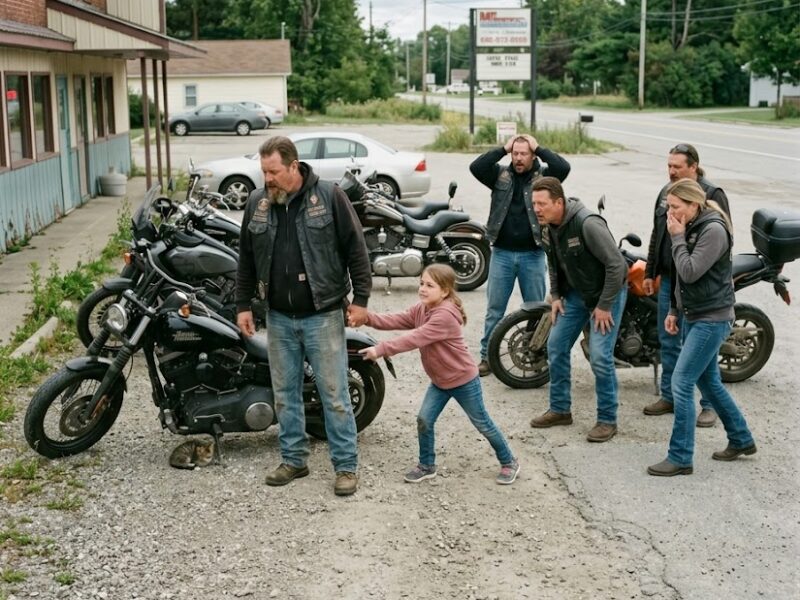
A Little Girl Pulled a Biker From His Motorcycle and Pointed Beneath It—500 Riders Froze When They Saw Why
## Part 1
A five-year-old girl stands barefoot in the middle of a mountain road.
Behind her, nothing—no parent, no car, no explanation. In front of her, five hundred motorcycles thundering through the Smoky Mountains in a column that stretches for a quarter mile.
The lead rider hits the brakes. Five hundred engines go silent.
The girl walks straight to him, grabs his leather vest with both hands, and pulls him off his bike. Then she points at the ground—at a crumpled photograph lying on the asphalt.
A woman in a hospital bed. Tubes, machines, closed eyes.
The rider picks it up. His hands are shaking. What he sees next will change everything.
—
The Iron Ridge Motorcycle Club’s annual Smoky Mountain charity rally began the way it had begun for nineteen consecutive years—with the sound of five hundred engines turning the pre-dawn silence of Gatlinburg, Tennessee, into something that felt less like noise and more like a geological event.
Mason Briggs stood in the staging lot behind the Riverside Motor Lodge at 5:40 in the morning, watching the column form. Motorcycles arrived in clusters of three and five and twelve, rolling off Highway 441 and down the access road with their headlights cutting through the thin September fog that clung to the Smoky Mountains like gauze on a wound.
Harleys and Indians and custom builds from every corner of the Southeast, ridden by men and women in leather and denim who had woken before dawn because a patch on their vest meant something beyond decoration.
He had been road captain for eleven years. The job was simple in description: plan the route, lead the ride, keep five hundred motorcycles moving in formation through thirty-six miles of mountain highway without anyone dying. And relentlessly complex in execution.
Every year he stood in this lot at this hour and felt the same thing—a low hum in his chest that was part responsibility, part pride, and part the particular loneliness of a man who had spent his life leading formations but couldn’t figure out how to keep his own family together.
The divorce had been finalized twenty-six months ago. His ex-wife, Karen, had moved to Knoxville with their daughter, Lily, and a new husband who worked in pharmaceutical sales and owned a house with a two-car garage and a lawn that looked like it had been cut with surgical instruments.
Mason saw Lily every other weekend, which meant he saw her enough to remember exactly what he was missing, and not enough to feel like her father. He didn’t talk about it.
The club knew the way a family knows—through silences and slight adjustments. Through the way Holt stopped asking about weekends and started asking about the bike. Through the way Shelby left a plate of food at his workbench on rally prep nights without comment.
They knew, and they gave him the dignity of not making him say it.
“Column’s forming up,” Holt said, walking over with two cups of gas station coffee. He handed one to Mason without asking if he wanted it.
Holt Kendrick had never asked a man if he wanted coffee. He simply provided it—the way he provided direction and structure and the quiet assurance that someone was in charge. An offering that required no response beyond acceptance.
Mason took the cup. “How many we got?”
“Four eighty-seven confirmed. Stragglers still coming in. We’ll hit five hundred.”
Five hundred riders. Five hundred engines.
The annual Smoky Mountain Rally raised money for children’s medical care in Sevier County. Last year, they had delivered a check for forty-seven thousand dollars to the East Tennessee Children’s Hospital. This year, Holt wanted fifty.
Not out of greed, but out of the mathematical certainty that there were always more children who needed help than there was money to help them.
The route ran from Gatlinburg through the Great Smoky Mountains National Park along Newfound Gap Road, climbing to five thousand feet before descending into Cherokee and looping back through Bryson City and across the Foothills Parkway. Thirty-six miles of mountain road lined with families who brought lawn chairs and American flags and children who waved at the thundering column like it was a parade summoned from some louder, more magnificent version of the world.
By 6:30, the lot was full. Motorcycles stood in rows so tight that walking between them required turning sideways. The air smelled of exhaust and coffee and hickory smoke from the breakfast tent where volunteers served biscuits and gravy to riders who had driven through the night from as far as Birmingham and Charlotte and Louisville.
Mason mounted his bike—a 2019 Road King in matte black, the same bike he’d ridden for seven years. The same bike Lily had sat on at age four with a helmet that swallowed her entire head, laughing so hard she hiccuped.
He pushed that memory down the way he pushed most memories down. Not roughly, but carefully. The way you fold something you want to keep but can’t look at every day.
At 7:00, Holt raised his fist. Five hundred engines roared.
Mason pulled out first. The column followed.
They moved through downtown Gatlinburg in the thin morning light, past the tourist shops and pancake houses and the candy stores with their windows full of taffy machines pulling sugar into ropes. Families lined the sidewalks. Children pointed. A woman in a rocking chair on the porch of an antique shop raised a coffee mug in salute.
Mason led them onto Newfound Gap Road, and the mountains opened up.
The Smokies in September were a study in controlled fire. The hardwoods had just begun to turn—maples going scarlet at their edges, hickories shifting to gold, the ridge lines painted in a gradient that ran from deep green to amber to the pale blue of distance. Mist filled the valleys like milk poured into bowls of stone.
The road climbed in long, sweeping curves, and five hundred motorcycles moved through it like a river of chrome finding its way toward higher ground.
It was nine miles into the ride, just past the Chimney Tops overlook, that Mason saw the girl.
—
She was standing in the road. Not on the shoulder, not on the gravel edge—in the road. Dead center of the right lane, fifty yards ahead, small enough that at first his mind refused to process her as a person.
She looked like a bundle of cloth someone had dropped. A faded blue shape against the gray asphalt, motionless, her bare feet planted on the yellow center line as though she had been placed there by something that wanted the world to stop.
Mason’s hand hit the brake. His arm went up—the closed fist signal that rippled backward through the column like a shockwave. Five hundred riders decelerating in sequence, the thunder of engines dropping to a growl, then a mutter, then silence.
He stopped twenty feet from her. She didn’t move.
Mason killed the engine and swung his leg over the bike in one motion. Behind him, the column had compressed—five hundred motorcycles idling in a line that stretched back around the curve and out of sight. Riders craning their necks. The CB radios crackling with the same question repeated in sixteen different voices.
*What’s going on up front?*
He walked toward her slowly.
She was five, maybe six. Hair tangled and unwashed, falling past thin shoulders. A blue sundress that had once been someone else’s—faded at the seams, two sizes too large, the hem brushing her ankles. No shoes. Her feet were dirty and scratched, the soles darkened by asphalt, the left heel bearing a raw pink abrasion that said she had been walking for a long time on surfaces that weren’t meant for bare skin.
Her face was sunburned across the nose and cheeks, a scatter of freckles standing out against the flush. Her eyes were green—enormous, unblinking—locked onto Mason with an intensity that didn’t belong on a child’s face.
There was no fear in those eyes. There was something else, something he couldn’t name immediately but would later recognize as the expression of a person who has made a decision so large that everything else has become irrelevant.
She was holding something against her chest with both hands. A piece of paper, crumpled and soft from being gripped too long.
“Hey,” Mason said. He crouched, one knee on the asphalt, bringing himself to her eye level. “Hey there. Are you okay? Are you hurt?”
She didn’t answer. She looked at him. At his vest. At the Iron Ridge patch on his chest, the eagle and mountain emblem stitched across his back. And something shifted in her expression.
Recognition—not of him, but of what he represented.
Then she moved.
She stepped forward, grabbed the front of his leather vest with both small hands, and pulled. It wasn’t a strong pull. She weighed less than forty pounds, and Mason weighed two hundred thirty. But it was so sudden, so deliberate, so charged with purpose that he stumbled forward a half step before catching himself.
She pulled him downward, toward the ground, with the singular intensity of a child who has one chance to be understood and knows it.
“Whoa. Hey, easy.”
She released his vest. She pointed at the ground.
Mason looked down.
The photograph lay on the asphalt between them. It had fallen from her hands when she grabbed him. A 4×6 print, creased down the middle, the corners soft and rounded from being carried in small fingers for what looked like days.
The image was slightly overexposed, taken under fluorescent hospital lighting, and it showed a woman lying in a bed. The woman was thin, dark-haired, eyes closed, tubes running from her arms to machines that flanked the bed like sentinels. A hospital gown that made her look smaller than she was.
And on the nightstand beside her, facing the camera as though it had been placed there intentionally, a framed photograph of a little girl in a blue dress. The same little girl standing barefoot on a mountain road.
Mason picked up the photograph. His hands, which had held handlebars steady at ninety miles an hour and never shaken, trembled.
“Is this your mama?” he asked.
The girl nodded.
“Where is she?”
“The hospital.” Her voice was small, raw—the voice of someone who had been carrying silence like a physical weight and had just set it down. “She won’t wake up. They said she might not wake up.”
Behind Mason, Holt had dismounted and was walking forward. Shelby was already off her bike, moving with the quick, purposeful stride of a woman whose years in the emergency room had taught her that the first sixty seconds of any crisis determine its trajectory.
“Honey,” Shelby said, kneeling beside Mason, her voice warm and steady and calibrated to the exact frequency that frightened children respond to. “My name is Shelby. Can you tell me your name?”
“Ren.”
“Ren. That’s a beautiful name. Ren, where did you come from? Where do you live?”
Ren pointed back down the road, south toward the Glades community that sat in the valley below the park entrance. Three miles of mountain road, minimum. Three miles barefoot, uphill, at dawn, alone.
“I walked,” Ren said. “Mrs. Edna was sleeping. I heard the motorcycles. I came to find the motorcycle people.”
“The motorcycle people,” Holt repeated quietly. He was standing behind Mason now, his arms at his sides, his face unreadable except for a muscle in his jaw that was working the way it worked when Holt Kendrick was deciding what kind of man he was going to be in the next five minutes.
“Someone told me,” Ren said. “At the hospital. A nurse. She said the motorcycle people help everyone. She said if I ever needed help, I should find the motorcycle people.”
Mason looked at the photograph in his hand. A woman dying in a hospital bed. A child who had walked three miles barefoot through the mountains to find strangers on motorcycles because a nurse had told her they help everyone.
He looked up at the column behind him. Five hundred riders idling on a mountain road, watching. Five hundred men and women in leather and patches who had driven through the night to raise money for children they had never met.
And one of those children had come to find them.
“Shelby,” Mason said, his voice low and controlled—the voice of a man who has found his purpose standing barefoot on asphalt. “Call Lanti Medical. Find out who this woman is and what room she’s in. Holt, we need to clear this road and get this child somewhere safe.”
“I’m not going back,” Ren said.
Everyone looked at her.
“I’m not going back without help. I promised Mama I would bring help.”
Mason Briggs—a man who had lost his daughter to a courtroom and a pharmaceutical salesman, who had spent twenty-six months measuring the distance between himself and the person he used to be—looked at a five-year-old girl who had walked through the mountains alone to keep a promise.
And he said the simplest, truest thing he had said in years.
“You don’t have to go back alone, Ren. We’re coming with you.”
—
## Part 2
They moved her off the road first.
Shelby wrapped Ren in a fleece-lined jacket that swallowed her like a blanket and carried her to the grassy shoulder where the overlook parking area offered shade and a bench. Ren sat with her legs pulled up, the photograph back in her hands, watching the bikers with the alert stillness of a wild animal that has decided—tentatively—to trust.
The rally paused. Five hundred riders, the largest formation in the event’s nineteen-year history, idled on Newfound Gap Road while their road captain knelt on the shoulder talking to a child. And not one of them complained.
The CB radios carried the story backward through the column in fragments. *Little girl. Barefoot. Walked three miles. Her mother. Hospital. Photograph.*
By the time the information reached the last rider a quarter mile back, the story had acquired the compressed emotional density of a parable. And men who had not cried in decades felt something shift behind their ribs.
Shelby’s phone call reached Lanti Medical Center at 7:22 a.m. It took four minutes and three transfers to reach the ICU nursing station, where a charge nurse named Beverly confirmed what the photograph had already told them.
Darla Callaway, age thirty-one, admitted nine days ago. Severe mitral valve deterioration. Her heart valve was failing. She needed surgical repair, and she needed it before she collapsed.
Shelby held the phone away from her ear so Mason and Holt could hear.
“She was working two jobs,” Beverly said. “Housekeeping at the Mountain Lodge and evenings at the Suds and Spin laundromat on East Parkway. She collapsed during a shift. Ambulance brought her in. She’s been in and out of consciousness since Tuesday.”
“Insurance?” Holt asked.
“None. She applied for Medicaid three times. Denied twice. Third application still pending. The hospital is covering acute stabilization, but the surgery—the valve repair—requires a specialist. The closest qualified surgeon is at Vanderbilt in Nashville. The estimated cost is north of ninety thousand dollars.”
The number hung in the mountain air like a physical object.
“What about the girl’s father?” Mason asked.
“No father listed on any paperwork. The emergency contact is an Edna Marsh—the neighbor, I’m guessing. Ms. Callaway listed her as temporary guardian, but there’s no legal documentation. If the state gets involved before the mother recovers, the child goes into the system.”
Mason looked at Ren. She was peeling a piece of bark from the bench. Methodical. Focused. The way children focus on small tasks when the large ones are too enormous to contemplate.
She hadn’t asked for food. Hadn’t complained about her feet. Hadn’t cried. She had walked three miles through the mountains in the dark, found five hundred strangers, pulled one of them off his motorcycle, and delivered her message.
She was five years old.
“There’s more,” Shelby said, her voice dropping. “Beverly says the girl has been coming to the hospital. Walking two and a half miles from the Glades along the highway shoulder. She showed up four times in the last week. The nurses have been giving her food from the cafeteria and letting her sit with her mother. Security tried to contact the neighbor—Mrs. Marsh—but the woman is seventy-four with severe arthritis. She can barely get to her own mailbox.”
“So this child has been walking five miles round trip to sit next to her unconscious mother in a hospital,” Holt said. It was not a question.
“And today she walked three miles in the opposite direction to find us,” Mason said.
Silence. The kind of silence that arrives when a group of people simultaneously understands that the world contains a problem they cannot walk away from and remain the people they believe themselves to be.
Holt pulled Mason aside. They stood at the edge of the overlook, the Smokies spreading out below them in layers of blue and green, the morning mist still clinging to the valleys.
“The rally fund has thirty-one thousand from pre-registrations and sponsor contributions,” Holt said. “We’ll raise more on the ride—the auction, the donations at the checkpoints. Last year we cleared forty-seven. Even if we hit fifty, that’s not ninety thousand. And the rally money is committed to the children’s hospital.”
“I know.”
“So we need another way.”
“I know that, too.”
Holt studied Mason’s face the way he studied everything—carefully, without hurry, looking for the structure beneath the surface. “You’re going to want to handle this personally.”
“Yes.”
“Because of Lily.”
Mason didn’t flinch. He didn’t confirm or deny. He looked at the mountains and said, “Because she walked three miles barefoot to find us, Holt. Because a nurse told her we help everyone. And if we don’t, then every patch on every vest in that column is just decoration.”
Holt nodded once. “Then we help everyone. Take your bike. Take Shelby. Take whoever you need. The rally continues—I’ll lead the column. But by the time we reach the finish line, I want a plan. Not a hope. A plan.”
Mason returned to the bench where Ren sat. He crouched in front of her again. She looked at him with those green eyes—measuring, testing, the way she had tested him on the road. And he understood that this child had been testing every adult she had encountered for a long time, and most of them had failed.
“Ren,” he said, “I’m going to take you to see your mama. Is that okay?”
She nodded.
“And then we’re going to help her. I don’t know exactly how yet, but I’m going to figure it out. Do you believe me?”
Ren studied his face for a long time. Then she reached out and touched the Iron Ridge patch on his vest—the eagle and the mountain stitched in black and silver thread.
“The nurse said the motorcycle people always keep their promises.”
“She was right,” Mason said. “We do.”
—
Mason drove to Lanti Medical Center with Ren sitting in the cab of Shelby’s pickup truck, buckled into a booster seat that Shelby kept behind the passenger seat for her grandniece. Shelby drove. Mason followed on his bike.
By the time they reached the hospital parking lot, Mason had made fourteen phone calls.
The first was to Dale Krenshaw, the club’s treasurer—a former accountant who had traded spreadsheets for a Sportster and a leather vest but never lost his ability to move money with precision. “I need a separate fund,” Mason told him. “Not the rally fund. A dedicated account. Callaway Medical Fund. Set it up before noon.”
The second through seventh calls went to charter presidents across the Southeast. Iron Ridge chapters in Knoxville, Chattanooga, Asheville, Johnson City, Bristol, and Maryville. The conversation was the same each time: *A child walked three miles barefoot. Her mother is dying. We need ninety thousand dollars, and we need it now.*
The eighth call went to a man Mason hadn’t spoken to in four years. His older brother, Reed Briggs, a cardiac surgeon at Vanderbilt University Medical Center in Nashville.
The call lasted eleven minutes. Reed listened without interrupting, asked three clinical questions, and said, “Send me her records. I’ll review them tonight. If the valve is what you’re describing, I may be able to operate at reduced cost through the hospital’s charity care program. But I need to see the imaging first.”
The ninth through fourteenth calls built a network that would, within seventy-two hours, stretch across six states and involve more than two thousand people.
But Mason didn’t know that yet. At this moment, walking through the sliding glass doors of Lanti Medical Center with a barefoot child holding his hand, he knew only that he had made a promise, and that breaking it was not an option.
The ICU was on the third floor. Beverly Chen, the charge nurse, met them at the elevator. She was forty-six, compact, efficient, with the particular steadiness of a woman who had spent twenty years watching people arrive at the worst moments of their lives and had learned that the most useful thing she could offer was competence delivered without drama.
“She’s had a better morning,” Beverly said, walking them down the corridor. “She was conscious for about forty minutes around six. Asked about Ren. We told her the neighbor was watching her.”
“Does she know Ren’s been coming here alone?”
Beverly hesitated. “She suspects. But she’s been too weak to do anything about it. The guilt is—” She paused, choosing her words. “The guilt is making her worse. She knows she can’t protect her daughter from a hospital bed, and the knowing is costing her energy she doesn’t have.”
Room 314.
The door was open. Darla Callaway lay in the bed exactly as the photograph had captured her. Thin, pale, dark auburn hair spread across the pillow. Tubes and monitors framing her like the machinery of a life being held together by technology and stubbornness.
Her eyes were closed. The cardiac monitor beeped in a rhythm that was steady but slower than it should have been, each beat carrying a faint irregularity that Beverly’s trained ear tracked without conscious effort.
Ren released Mason’s hand and walked to the bed. She didn’t run. She didn’t cry. She walked with the careful, deliberate steps of a child who has visited this room many times and knows exactly which tile to step on, which side of the bed to approach, where to stand so the tubes aren’t in the way.
She placed one small hand on her mother’s forearm—gently, precisely, in a gap between the IV line and the blood pressure cuff—and said, “Mama, I brought help.”
Darla’s eyes opened.
They were green, like Ren’s. Glassy, unfocused for a moment, then sharpening as they found her daughter’s face. Her lips moved. The word came out as a whisper.
“Baby.”
“Mama, I found the motorcycle people. They came. Just like the nurse said.”
Darla’s eyes moved past Ren and found Mason standing in the doorway. A large man in leather, tattoos on his arms, road dust on his boots, standing in a hospital room with the tentative stillness of someone who understands that he is on sacred ground.
“Who—” Darla started.
“My name is Mason Briggs. I ride with the Iron Ridge Motorcycle Club. Your daughter found us on the road this morning.” He paused. “She walked a long way to find us.”
Darla’s face crumpled. Not from pain—the monitors would have spiked—but from the particular agony of a mother who discovers that her child has done something impossibly brave and impossibly dangerous because she, the mother, could not do what mothers are supposed to do.
“She walked—how far?”
“About three miles. Through the mountains. Barefoot.”
Darla closed her eyes. A tear ran down her temple into her hair. Her hand found Ren’s and held it weakly, with fingers that didn’t have the strength to squeeze but had enough to hold on.
“I’m sorry,” Darla whispered. “I’m so sorry, baby. I should have—I should have done something. I should have called someone.”
“You were in a hospital bed,” Mason said. “You couldn’t call anyone. But your daughter could walk. And she did.”
—
## Part 3
Shelby entered the room and took over with the quiet authority of someone who has managed crisis professionally.
Within twenty minutes, she had Darla’s full medical history from Beverly, had photographed the relevant documents with Darla’s verbal consent, and had sent everything to Reed Briggs at Vanderbilt via secure email.
She had also called Edna Marsh, who answered on the seventh ring—breathless and panicked because she had woken up to find Ren gone and had been searching the neighborhood for an hour.
“She’s safe,” Shelby told the old woman. “She’s at the hospital with her mother. We’re bringing her home this evening, and someone from the club will stay with you both tonight.”
Meanwhile, on Newfound Gap Road, five hundred motorcycles were completing the rally route under Holt’s command.
At every checkpoint—the Chimney Tops overlook, the Newfound Gap summit, the Mingus Mill rest stop, the finish line at the Riverside Lot—Holt told the story. He kept it short because short is what sticks.
*A five-year-old girl walked three miles barefoot through the mountains this morning to find us. Her mother is dying in a hospital bed. She has no father, no insurance, and no one. She found us because a nurse told her the motorcycle people help everyone. So today, we help everyone.*
At each checkpoint, riders who had planned to donate twenty dollars donated a hundred. Riders who had planned to donate a hundred donated five hundred. A retired contractor from the Knoxville chapter wrote a personal check for five thousand dollars and handed it to Holt with hands that shook.
“My granddaughter is five,” he said. That was all he said.
By the time the column reached the finish line at two in the afternoon, the rally had raised sixty-three thousand dollars—sixteen thousand more than any previous year. And the Callaway Medical Fund, which Dale Krenshaw had established at 11:47 a.m., had already received an additional fourteen thousand in online donations from riders who had heard the story through the club’s phone tree and social media channels.
Seventy-seven thousand dollars. Thirteen thousand short.
Reed Briggs called Mason at four o’clock.
“I reviewed her imaging. The mitral valve is severely deteriorated but repairable. Replacement isn’t necessary, which is the good news. I can perform the surgery at Vanderbilt through the charity care program. The hospital will cover sixty percent of the facility costs. My fee is waived.”
“Waived?”
“She’s thirty-one years old, Mason. She has a five-year-old daughter who walked three miles barefoot to find help. I’m not charging this woman for her life.”
The remaining out-of-pocket cost—anesthesia, post-operative care, transportation, medications—came to nineteen thousand dollars.
The fund had seventy-seven.
For the first time in months, the math was on their side.
—
The surgery was scheduled for October 14th—twenty-six days after Ren Callaway walked into the path of five hundred motorcycles and pulled a stranger off his bike.
In those twenty-six days, the world around Ren and her mother changed with the slow, irreversible certainty of a river changing course.
It didn’t happen all at once. It happened the way real change always happens—in small, deliberate actions performed by people who decided that someone else’s crisis was their responsibility.
Shelby coordinated the logistics with the precision of a military campaign. A rotation of club members—never fewer than two, never the same pair twice in a row—stayed at Edna Marsh’s house around the clock, ensuring Ren was fed, bathed, clothed, and transported to and from the hospital to visit her mother.
They fixed the leaking roof on Edna’s back porch. They replaced the water heater that had been producing lukewarm water for six months. They stocked the refrigerator every three days with groceries purchased from a fund that Shelby managed separately from the medical account because food and surgery were different problems, and she believed in solving each one with its own budget.
Ren received her first pair of new shoes on September 17th—twelve days after the rally.
A rider’s wife named Patricia drove to the outlet mall in Pigeon Forge and returned with three pairs: sneakers, rain boots, and a pair of sandals, all in the correct size. Because Shelby had traced Ren’s foot on a piece of cardboard and texted the measurements to Patricia with the instruction: *Get her shoes that fit. Not almost. Not close enough. Shoes that fit.*
When Patricia delivered them, Ren sat on Edna’s porch and put on the sneakers with the reverence of someone receiving a gift she hadn’t known she was allowed to want. She tied the laces slowly, clumsily, with the determined concentration of a child who has taught herself things that other children learn from parents.
And then she stood up and walked to the end of the driveway and back, testing them, feeling the difference between pavement through rubber soles and pavement through bare skin.
“They don’t hurt,” she said.
And the simplicity of the statement cracked something open in Patricia’s chest that took the rest of the afternoon to close.
—
Mason visited every day.
He told himself it was logistics—coordinating with Shelby, checking on the fund, monitoring Darla’s condition before the transfer to Nashville. But the logistics took thirty minutes, and he stayed for three hours.
He sat on Edna’s porch with Ren while she drew pictures with crayons that a club member’s daughter had donated. He listened while she described the drawings—always the same subject, always a motorcycle, always a figure standing next to it with arms outstretched, always a smaller figure reaching up.
“That’s you,” she told him one afternoon, pointing at the larger figure.
“How do you know it’s me?”
“Because you’re the one who stopped.”
—
On October 12th—two days before the surgery—Mason drove Darla and Ren to Nashville in a rented SUV. Shelby followed in her truck.
Holt had arranged accommodation: a club member’s sister owned a furnished apartment near the Vanderbilt campus and offered it free of charge for as long as needed. The apartment had two bedrooms, a kitchen with a functioning stove, and a window that overlooked a small park where a maple tree had turned the precise shade of red that September gives to Tennessee before it lets go.
Darla Callaway had been conscious and improving for two weeks—strong enough to sit up, to eat solid food, to hold her daughter without her arms shaking. She had spoken with Mason only twice, once in the hospital and once on the phone. And both times she had struggled with the same question that every person who has been rescued struggles with.
How to accept help without feeling diminished by the need for it.
In the car on the way to Nashville, with Ren asleep in the back seat and the mountains scrolling past the windows in their slow October burning, Darla said, “I don’t know how to repay this.”
“You don’t repay it,” Mason said. “You pass it on. Someday someone’s going to need help, and you’re going to be the one who gives it. That’s how it works.”
“Is that what the club believes?”
“It’s what I believe. The club just gives me five hundred people to believe it with.”
—
The surgery lasted four hours and eleven minutes.
Reed Briggs repaired the mitral valve using a minimally invasive technique that required three small incisions and a level of precision that justified every year of his training.
Mason sat in the waiting room with Ren on the chair beside him, her new sneakers swinging above the floor, her hand holding the same crumpled photograph she had carried on the mountain road—now flattened and placed inside a clear plastic sleeve that Shelby had provided because some things deserve protection.
At 2:47 p.m., Reed walked into the waiting room. He was still in his surgical cap, his face carrying the controlled expression of a surgeon who has good news but has learned never to deliver it carelessly.
“The repair was successful. The valve is functioning. She’s going to need six to eight weeks of recovery, cardiac rehabilitation, and ongoing monitoring. But the prognosis is excellent. She should make a full recovery.”
Ren looked up at Mason. “Does that mean Mama’s going to be okay?”
“Yeah, Ren. That means Mama’s going to be okay.”
Ren didn’t cheer. She didn’t jump up. She sat very still for a moment, processing the information the way she processed everything—carefully, completely, with the seriousness of a child who has learned that the world does not always keep its promises and must therefore verify each one before trusting it.
Then she slid off the chair, walked to Mason, and wrapped her arms around his leg. She pressed her face against his knee and held on.
She didn’t cry. She held on.
Mason placed his hand on top of her head—on those tangled auburn curls, the same color as her mother’s. And he stood there in a hospital waiting room in Nashville, Tennessee, with a five-year-old girl holding his leg and a crumpled photograph in a plastic sleeve on the chair behind them.
And he understood something he had been trying to understand for twenty-six months.
Losing Lily had not made him less of a father. It had made him a father without a child to hold.
And now, standing in this waiting room, he was holding one. Not his—not by blood, not by law, not by any document or decree. But held nonetheless. Present nonetheless. Enough nonetheless.
—
## Part 4
Three weeks after the surgery, Darla Callaway walked out of the rehabilitation center under her own power.
She was thinner than before, and she tired easily, and the scar tissue beneath her collarbone would remind her for the rest of her life how close she had come to leaving her daughter alone in the world.
But she walked. And Ren walked beside her in sneakers that fit, holding her mother’s hand with the quiet ferocity of someone who has learned that the people you love can be taken from you—and has decided that the appropriate response is to hold on tighter.
The Iron Ridge Motorcycle Club’s annual rally had raised sixty-three thousand dollars. The Callaway Medical Fund had raised an additional thirty-one thousand from donations that continued to arrive for weeks after the story spread through the riding community.
The total—ninety-four thousand dollars—covered every cent of Darla’s medical expenses, her rehabilitation, three months of rent on a small apartment in Gatlinburg, and the establishment of a modest emergency fund that Shelby administered with the same fierce competence she brought to everything.
—
On the first Saturday in November, Mason rode to Gatlinburg.
He parked his bike in front of the apartment. Darla and Ren had moved into a clean, furnished two-bedroom on the second floor of a building on River Road, within walking distance of the elementary school where Ren had been enrolled and was, according to her teacher, quiet, remarkably self-sufficient, and absolutely determined to learn everything at once.
Ren was waiting on the steps. She was wearing the sneakers. She had a piece of paper in her hand.
“I drew you something,” she said.
Mason took the paper.
It was a crayon drawing, more detailed than her earlier ones—evidence of three weeks of practice and the particular focus of a child who has decided that art is the language she will use to say the things she cannot say with words.
It showed a road, mountains on both sides, a long line of motorcycles stretching to the edge of the paper. And at the front of the line, a large figure crouching next to a small figure, both of them looking at something on the ground between them.
A photograph.
Below the drawing, in the careful, uneven handwriting of a five-year-old who was learning to form letters with the same determination she had used to walk three miles through the mountains, were four words:
*You stopped for me.*
Mason folded the drawing carefully and placed it inside his vest, against his chest, in the pocket where he kept nothing else.
He would carry it there for years—through rides and rallies and the slow, ongoing work of rebuilding a relationship with his daughter Lily, who would eventually ask about the drawing and hear the story and understand that her father was the kind of man who stopped.
He looked at Ren. “You know why I stopped?”
She shook her head.
“Because you were standing in the road, and you were brave enough to ask for help. That’s the hardest thing a person can do, Ren. Not walking three miles. Not pulling a stranger off a motorcycle. *Asking.* Standing in front of five hundred people and saying, ‘I need you.’ That’s the bravest thing I’ve ever seen anyone do.”
Ren considered this. Then she took his hand and led him up the stairs to the apartment, where Darla had made coffee and the morning light came through the window and landed on the kitchen table in a warm rectangle that looked, if you were the kind of person who noticed such things, exactly like a place where someone might sit down and stay.
Mason sat down.
He stayed.
—
And on Newfound Gap Road, at the nine-mile marker just past the Chimney Tops overlook, the asphalt still held the faint scuff marks where a five-year-old girl had planted her bare feet and refused to move.
The exact spot of ground she had pointed at. The ground she had stood on. The ground where five hundred strangers had learned that the smallest person on the road can carry the largest truth.
That we are only as strong as the help we are willing to give.
And only as brave as the help we are willing to ask for.
Five hundred angels saw why.
Because she showed them.









