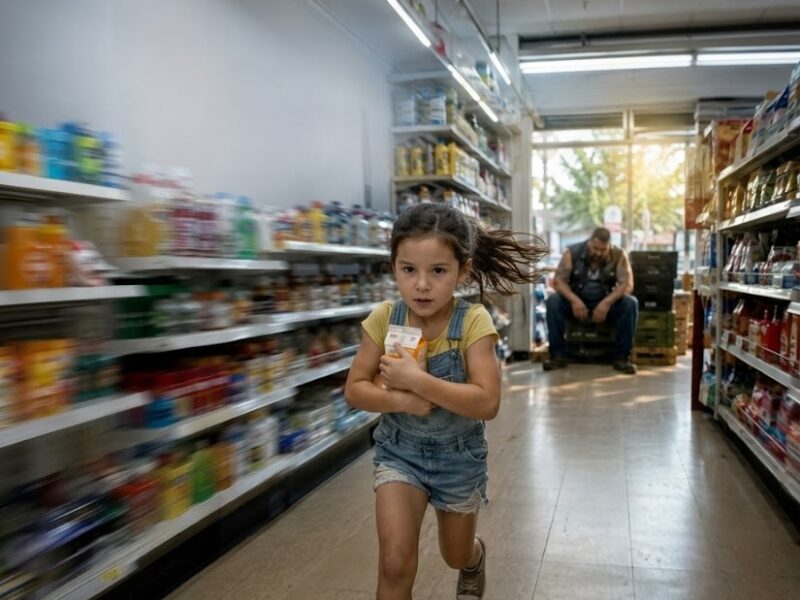
A little girl noticed a Hells Angel’s hands shaking at a diner. While everyone else looked away, she ran to get him juice. She knew what nobody else did.
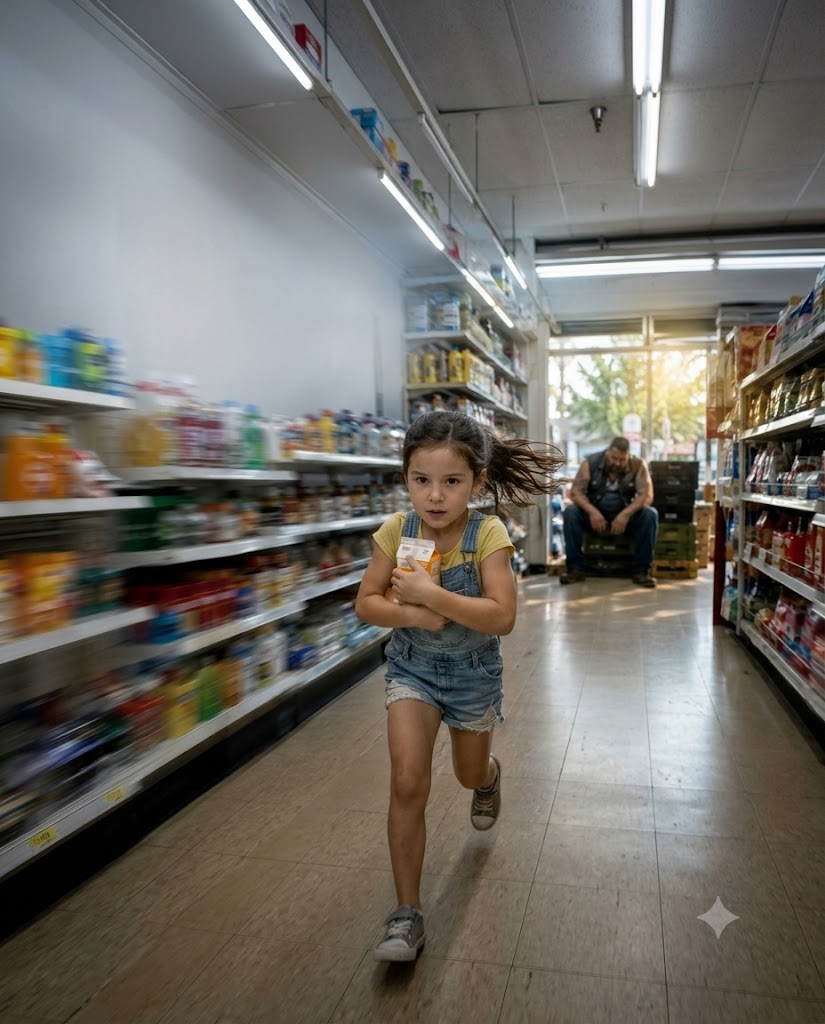
Every hand in that store had already decided what he was. Every eye that flicked toward the leather vest and the ink on his forearms had already decided what he was. Every mother who steered her cart a little wider around him had already decided what he was. The verdict was already in.
Another drunk, another addict, another reason to keep walking. Thirty-one years riding into that same corner store and not one person had ever asked him a real question. Sixty-eight years old and nobody in that town knew what those same shaking hands used to be able to do. Only the smallest person in the building hadn’t decided anything at all.
She just saw someone who needed help. What she didn’t know yet was how much that help would end up giving back. The bell over the door at Miner’s Corner Market rang the same thin, tired chime it always did, and Ruby Sutton barely noticed it anymore, except on the mornings her mother let her pick the juice.
It was a Tuesday in early October, the kind of Kurdelene morning where the fog still sat low over Lake Kurdelene, and the air smelled like wet pine and diesel from the boats down at Independence Point. Ruby was seven, all elbows and knees, with dark hair her mother never had time to braid properly, wearing denim overalls with a hole worn through one knee. She held her mother’s hand loosely as they came down the cereal aisle, because Carrie Sutton believed a seven-year-old should be allowed to wander two feet in either direction, no more.
Carrie worked the overnight intake desk at Coutini Health, and this was their ritual after her shift ended at seven, a stop at Miner’s Corner on Sherman Avenue before the walk home. Ruby got to choose one small thing, and Carrie got a cup of the burnt gas station coffee that somehow still tasted better than anything she made at home. Milt Coyle had owned the store for eleven years, a heavy-set man with reading glasses perpetually pushed up on his forehead. He knew Ruby well enough to keep a roll of grape bubble tape behind the register for her, even though her mother pretended not to know about it.
That morning, there was a man sitting on a stack of plastic milk crates just inside the entrance, near where the light came in gold and low through the front windows. He was big in the way that made the doorway look smaller. Sixties, gray-bearded, wearing a leather cut with patches Ruby didn’t understand, and tattoos that ran up both forearms in faded blue-green ink, the kind that told you a person had been wearing them a long time. His motorcycle was parked crooked out front, a big black machine still ticking as it cooled.
He sat with his elbows on his knees and his head down. And his hands, Ruby noticed his hands first before she noticed anything else about him, were shaking. Not the kind of shaking a person does when they’re cold. Ruby knew what cold shivering looked like. She did it every morning waiting for the bus. This was different. A kind of jerking, uneven tremor that made his fingers twitch and curl like they were trying to escape from the ends of his hands. He kept pressing them flat against his thighs, like he was trying to hold them still by force, and they wouldn’t hold.
“Mama,” Ruby said, tugging Carrie’s sleeve. “That man’s hands are shaking really bad.”
“Don’t stare, baby,” Carrie said quietly, already angling their cart a little wider around the end of the aisle, the way she angled it around anything she didn’t have time to figure out before her coffee. “Let’s get your juice.”
But Ruby had already decided something in the quick, uncomplicated way seven-year-olds decide things. Two weeks earlier, the school nurse had come to her second-grade class with a laminated poster of a stick figure sweating and shaking. The nurse had explained in the careful voice adults use when they think children can’t handle information that sometimes a person’s blood sugar gets too low, and their hands shake, and their body needs sugar fast. And juice is one of the quickest ways to help.
Ruby had thought about that poster every day since, mostly because the stick figure’s eyes had been drawn crooked, and it had made her laugh at an inappropriate moment. Now, here was a real person, hands shaking exactly the way the poster had shown, sitting by himself, while everyone in the store found some reason to be somewhere else. Milt Coyle behind the register kept glancing over at the man and then away, his jaw working like he was chewing on a decision. An older woman near the bread rack had already abandoned her half-full basket by the end cap and walked out without buying anything. Nobody said a word to the man on the crates. Nobody offered him so much as a glance that wasn’t sideways.
Ruby let go of her mother’s hand.
“Ruby,” Carrie said in the sharp half-whisper she used in public.
But Ruby was already three steps down the aisle, past the cereal toward the cold case at the back, where the juice cartons sat sweating against the glass. She grabbed the first one her hand found, orange, the good kind in the paper carton with the twist cap, the kind her mother bought when Ruby had a fever, and hugged it against her chest like it might get away from her.
“Ruby Anne Sutton,” Carrie hissed, catching up in three long strides. “What are you doing?”
“He needs juice, Mama. His hands are shaking. That means his sugar’s low. Mrs. Puit from the nurse’s office said—”
“Baby, we don’t know that man. We don’t know what’s wrong with him.”
“That’s why I have to give it to him,” Ruby said with the flat, unassailable logic of a child who has not yet learned that adults sometimes let strangers suffer out of politeness. “Nobody else is.”
Carrie opened her mouth to argue, glanced once toward the front of the store, toward the big man with the shaking hands and the leather vest, toward Milt’s uneasy face behind the register, toward the closed, careful expressions of everyone else in that store who had already decided the way people decide about men like that. And she found she didn’t have a good enough reason to say no. Not one she’d be proud of anyway.
“Stay where I can see you,” she said instead, which was as close to permission as Ruby needed.
Ruby walked back up the aisle, past the abandoned basket by the bread rack, past Milt Coyle’s watchful, uncertain eyes, straight toward the man on the milk crates, the orange juice carton clutched against her overalls like the most important thing she had ever carried. She stopped in front of him, close enough to see the sweat at his hairline despite the cool morning, close enough to see how hard he was working just to keep his hands still.
“Mister,” she said, “you should drink this. It’ll help.”
The man looked up slowly, and for a moment, Ruby thought she’d made a mistake. The way his eyes moved, like it cost him something to focus them on her. Up close, he smelled like leather and engine oil, and underneath that, like the cold morning air. His beard was more gray than not, trimmed close, and there were deep lines fanned out from the corners of his eyes that made Ruby think of her own grandfather, even though this man looked nothing like him.
“That’s so,” he said. His voice came out rougher than she expected, but not unkind. He cleared his throat.
“You’ve got low blood sugar,” Ruby said, holding the carton out further. “The nurse showed us a poster. Shaky hands means you need sugar. This is orange juice. It’s got sugar in it.”
Something moved across the man’s face. Not quite a smile, not quite anything Ruby had a name for. He looked at the carton in her hands for a long moment, and then at his own hands, which were still twitching against his thighs, no matter how hard he pressed them down.
“I appreciate that, little miss,” he said carefully. “I surely do. But I’m not diabetic. Wish it was that simple.”
“Oh,” Ruby said, deflating slightly, though she didn’t lower the juice. “Then why are your hands doing that?”
“Ruby,” Carrie had caught up, standing a few feet back, one hand hovering near her daughter’s shoulder without quite landing on it. The way a parent stands when she’s still deciding whether to apologize or to pull her kid away. “I’m sorry, sir. She doesn’t usually—”
“She’s fine,” the man said. And there was something almost grateful in the way he said it, like it had been a long time since anyone had let his hands be a normal enough thing to ask about out loud. “Kids ask the questions grown folks are too polite to.”
That was when the bell over the door rang again, sharper this time, and Deputy Glenn Akaman walked in, thumbs already hooked in his duty belt, the particular unhurried walk of a man who’d been called about a situation and expected to find one. Milt must have phoned it in. Ruby would think about that later, how her polite, nervous store owner, a man who kept bubble tape behind the register for her, had picked up the phone the second a tattooed biker sat still for six minutes in his store, and hadn’t picked up the phone once in eleven years for the men who came in reeking of whiskey at nine in the morning.
“Everything all right over here?” Deputy Akaman said, and though he was looking at Carrie when he said it, his eyes kept sliding to the man on the crates, to the shaking hands, to the leather vest, cataloging him the way Ruby had once watched a customs officer catalog a suitcase.
“Everything’s fine, Deputy,” the man said, straightening a little, and Ruby noticed how carefully he did it, like straightening cost him something, too. “Just having a conversation with a young lady about nutrition.”
“You got somewhere to be?” Akaman asked, and it wasn’t really a question about geography.
“I do, actually. Home.” The man reached for a cane hooked over the edge of the milk crate. Ruby hadn’t noticed it before, tucked in the shadow, and used it to push himself upright, slow and deliberate, his hands still trembling at his sides even as the rest of him steadied. He was tall, standing up, taller than Ruby had guessed, and it seemed to change something in the room. The way Akaman’s posture shifted a half inch backward.
“Name?” Akaman said, pen already out.
“Desmond Tally,” the man said. “You want my whole life story, Deputy? Or is the name enough for whatever report you’re about to write that I haven’t done anything to deserve?”
Akaman’s jaw tightened, but he wrote the name down and said nothing else useful. Just told Desmond to have a good one in the flat voice cops use when they mean the opposite, and went to have a low conversation with Milt near the register that Ruby couldn’t hear but could feel the shape of anyway.
Desmond Tally looked down at Ruby again, and this time the almost-smile made it the rest of the way onto his face.
“You still want me to take that juice?” he asked.
“Yes,” Ruby said, because as far as she was concerned, nothing that had just happened changed the fact that his hands were still shaking.
He took it from her, careful, his fingers trembling around the carton in a way that made the paper crinkle, and he twisted the cap with visible effort, using both hands, and a kind of patient concentration Ruby would only understand much later. He drank some, mostly, Ruby suspected, because refusing a seven-year-old’s gift in front of her seemed like a crueler thing to do than drinking juice he didn’t need.
“Thank you,” he said. “That’s about the kindest thing anybody’s done for me in this store in three years.”
“What’s wrong with your hands, though?” Ruby asked, because she was seven, and the question hadn’t gone anywhere just because the sheriff had shown up.
Desmond looked at her for a long moment, weighing something. Behind him, through the front window, Ruby could see three more motorcycles pulling into the lot, engines cutting off one by one, men climbing off them in leather like his, and she felt her mother’s hand finally land on her shoulder, gently pulling her back half a step.
“That,” Desmond said, “is a longer story than we’ve got time for this morning. But I’ll tell you this much. It’s not something I did to myself, and it’s not something anybody can catch off me, and it’s got nothing to do with what you’re thinking, which I’d guess is somewhere between drunk and in trouble.” He said it without any bitterness, just a tired kind of honesty. “It’s got a name, just not one most folks in this town would know how to spell.”
One of the men from outside pushed through the door, younger, maybe fifty, with a road captain’s patch on his vest and a face that went instantly wary at the sight of Akaman’s cruiser out front.
“Dez, you good?”
“I’m good, Merl,” Desmond said. “Made a friend.”
Merl Dunn looked at Ruby like he wasn’t sure what to do with the information, then nodded slowly. The way men nod when they’ve decided not to ask.
“We still on for Friday?” Merl asked, lower, like it wasn’t really meant for anyone but Desmond.
Something flickered behind Desmond’s eyes. Worry, maybe, or something closer to dread. And his hand tightened on the cane.
“We’re still on,” he said, though it didn’t sound entirely certain.
Ruby didn’t know what Friday meant yet, but she filed it away the way she filed away everything that felt important and unexplained, the way children do, certain that eventually the world would circle back and make it make sense.
It became a habit, though neither Ruby nor Carrie ever called it that out loud. Twice more that week, and then again the following Tuesday, Ruby found an excuse to linger near the milk crates by the door at Miner’s Corner. And twice more Desmond Tally was there, sitting in the same gold morning light, his hands trembling against his thighs no matter how hard he tried to still them. Ruby brought him juice each time, orange, then apple, then once a carton of chocolate milk she’d talked her mother into buying specifically for that purpose. And each time he accepted it with the same careful, grateful patience, and each time he told her a little more, in the small sideways way old men tell children things they’ve never told adults.
She learned that his hands hadn’t always shaken. That three years ago they’d been steadier than anyone’s, steadier than a surgeon’s, he said once, with a strange half-laugh that Ruby didn’t understand the punchline of. She learned that he lived alone in a house up toward Fernon Lake, that his wife Irene had passed six years back, and that he had a workshop out behind the house that he hadn’t opened the door of in eight months. “Not since these,” he said, holding up one trembling hand, “decided to quit listening to me.” She learned, without quite being told directly, that something was coming on Friday that scared him more than Deputy Akaman ever could.
What Ruby didn’t know, what nobody in Kurdelene outside of Desmond’s closest circle knew, was that word had started moving through town the way word does in a place small enough that everyone shops at the same three grocery stores. Milt Coyle, unable to keep a story to himself any better than he could keep his hands off the phone, had mentioned to a regular customer that that biker with the shakes had been hanging around his store. And the regular customer had mentioned it to her sister, who worked the front desk at the Fort Sherman Community Hall, and by the following Monday the story had transformed, the way stories do, from a man with trembling hands into a man who was clearly using something, and probably not someone you want handling equipment around children.
Which mattered because Friday was the harvest benefit. Every October for eleven years, the Fort Sherman Community Hall had hosted a fundraiser for the children’s music program at the elementary schools, a potluck, a silent auction, and a concert on the hall’s one prized possession. A battered but beloved 1920s upright piano that had been donated decades ago and that every child in the district learned their first scales on. Desmond’s motorcycle club, the Panhandle Riders, had sponsored the event’s parking and security for six years running, a quiet arrangement that raised eyebrows exactly once the first year and then simply became part of how the town did things.
This year, three days before the benefit, the hall’s director, a sharp, precise woman named Dorothy Kessner, who had taught piano to half of Kootenai County at some point in the last four decades, called Merl Dunn to say apologetically but firmly that given some concerns raised by community members, the club’s involvement this year might need to be reconsidered.
Merl relayed this to Desmond over coffee at the clubhouse on Thursday morning, and Desmond sat with it a long moment, his hands wrapped around the mug, not because it warmed them but because holding something heavy sometimes helped briefly to slow the tremor.
“They think I’m using,” Desmond said finally. It wasn’t a question.
“Dorothy didn’t say that. She didn’t have to.”
Desmond set the mug down harder than he meant to, coffee sloshing over the rim. “Three years I kept my mouth shut about this because I didn’t want anybody looking at me different. Turns out staying quiet got me looked at worse.”
There was a version of that Friday where Desmond simply didn’t show up. Where he let the club sponsor the parking lot from a distance and stayed home in the house up by Fernon Lake with the workshop door still closed. The way he’d been quietly choosing to disappear from things for months now, ever since the diagnosis had turned three fingers into a hand he no longer fully recognized. It would have been easier. Nobody would have blamed him, not out loud.
But he kept thinking about a seven-year-old girl in denim overalls who’d walked straight up to the scariest-looking man in a room and handed him a juice box because she’d decided with total and uncomplicated conviction that he needed help and that she was the one to give it. He kept thinking about how long it had been since anyone in this town had looked at him and seen something other than a warning.
Friday afternoon, he drove out to the Fort Sherman Community Hall himself, alone, an hour before the benefit was set to open, and let himself in through the side door with the key Dorothy Kessner had given the club years ago and apparently hadn’t yet found the nerve to ask back. The old upright piano sat on the small stage under the hall’s ancient stage lights, lid open, and even from the doorway, Desmond could hear that something was wrong with it. A flat, muddy quality to the notes someone had been idly playing, a couple of keys that stuck, and one that didn’t sound at all.
Dorothy was standing over it with her hands on her hips and an expression of controlled panic that Desmond recognized from thirty years of watching people discover that a piano is a machine and machines break.
“The Kowalski’s grandson was supposed to open tonight with the Chopin piece he’s been practicing since June,” Dorothy said, not quite looking at Desmond as he approached, like she hadn’t fully decided how to greet him. “And half this keyboard won’t hold a tune. We called a technician in Spokane. He can’t get here until Monday.”
Desmond looked at the piano the way another man might look at an old friend lying in a hospital bed. He set his cane against the stage and, without entirely meaning to, reached toward the keys and stopped, his hand hovering an inch above middle C, trembling so hard the shadow of it wobbled against the wood. Dorothy watched his hand shake. For the first time since he’d walked in, she really looked at him. Not at the vest, not at the ink, not at whatever version of him the town had assembled out of rumor. And something in her face shifted.
“Desmond,” she said slowly. “How long has it been since you could hold a hand steady over a keyboard?”
“Three years next month,” Desmond said. He hadn’t said it out loud to anyone outside his doctor’s office in all that time. Saying it in the hall with the broken piano between them and the benefit due to open its doors in less than an hour felt like setting something heavy down that he’d been carrying so long his arms had forgotten what it was to be empty.
“You tuned this piano.” Dorothy said it wasn’t a question either.
“Fourteen years ago. I remember the invoice. You wouldn’t let me pay you full price because you said the kids’ program needed the difference more than I did.”
“They tuned half the pianos in this county at one point,” Desmond said. “Concert hall in Spokane. Church organs clear out to Sandpoint. Nobody asked what a man who looked like me was doing with tools that delicate. Long as the work came out right, suited me fine. I never wanted the credit anyway. I just wanted my hands doing the one thing they were built to do.”
He looked down at those hands now, trembling against the stage lights, and for the first time, let the whole truth come up and out.
“It’s called Huntington’s disease,” he said. “Diagnosed three years ago, though the doctor in Spokane figures it had been working on me a good while before that. It’s in the nerves. The part of your brain that tells your body how to move smooth and steady starts losing that ability piece by piece. Doesn’t happen all at once. Started as a twitch in my left pinky I told myself was nothing. Now some days I can’t hold a coffee cup without both hands on it.” He flexed his fingers, watched them refuse to hold entirely still, even at rest. “It’s not contagious. It’s not from drinking or drugging or anything this town’s decided about me without asking. It’s genetic. My mother had it, though nobody had a name for it back then. They just said she’d gone strange in her last years, and folks kept their kids away from our porch, same as they’ve been keeping them away from mine. There’s no cure. There’s medicine that helps some, slows some of it down, and I take what they give me, but there’s no version of this where my hands go back to what they were.”
Dorothy Kessner was quiet for a long moment. Behind them, the hall’s side door opened and Merl Dunn came in with two other Panhandle Riders, Chip Hardesty, twenty-nine and still a little in awe of Desmond, and a heavy-set man named Otto Puit, who ran security most years. All three of them stopped short at the sight of Desmond standing over the open piano, exposed in a way none of them had ever seen him.
“Dez,” Merl said carefully. “We heard Dorothy might be pulling us from tonight. Came to talk her out of it.”
Chip Hardesty hung back near the door, hands jammed in his jacket pockets, looking between Desmond and the broken piano like he couldn’t decide which one troubled him more. He’d prospected into the Panhandle Riders eighteen months ago, mostly because Desmond had been the only member who’d taken the time to teach him how to true a wheel instead of just laughing at him for bending one, and he still hadn’t gotten comfortable seeing the older man’s hands shake without something to say about it.
“She doesn’t need talking out of anything,” Desmond said. “I was about to tell her the whole reason she should let us stay.” He turned back to the piano. His hands wouldn’t hold steady enough to press a single key with confidence, let alone tune eighty-eight of them by feel and ear the way he once had. That skill, thirty years built and three years gone, wasn’t coming back tonight or any night after. But there was another way to do it, one he’d been avoiding because it meant admitting out loud what he’d lost.
“Chip,” Desmond said, “you’ve got steady hands and no idea what to do with them yet. That’s about to change. Dorothy, you’ve got the ear, even if you tell me it’s rusty. Between the three of us, I can tell you exactly what’s wrong with this instrument and exactly how to fix it. I just need somebody else’s hands to do it.”
It took forty minutes. Desmond stood over the open piano, calling out corrections by ear alone. That string’s flat, tighten the pin a quarter turn, feel for the give, not the number. While Chip Hardesty, sweating with concentration, turned the tuning hammer under Desmond’s direction, and Dorothy played each note after every adjustment, calling back what she heard. More than once, Chip overcorrected, and Desmond caught it before the note even finished ringing. His ear a half second ahead of everyone else’s in the room, undamaged and exact, even while his own fingers still trembled uselessly at his sides.
“How do you even hear that?” Chip muttered, easing the pin back a hair. “Sounded fine to me.”
“Wasn’t listening to the note,” Desmond said. “Listening to what it was trying to be and wasn’t quite reaching. Different thing. Took me twenty years to learn the difference and about a week to teach you the start of it. So don’t feel bad.”
Word spread through the hall as the first guests arrived, and found the club’s motorcycles already lined up neat in the lot, exactly as they had been every October for six years, and found, too, a small crowd gathering near the stage to watch a shaking old biker teach a piano back to itself through someone else’s hands. A few of the same faces who’d crossed the street from him outside Miner’s Corner stood at the edge of that crowd now, saying nothing, watching the tuning hammer turn under Desmond’s low, patient direction, and something in their posture had gone quiet and uncertain in a way it hadn’t been a week before.
At exactly 6:47 p.m. that Friday, October the ninth, with the hall two-thirds full and the Kowalski boy standing nervous in the wings in his good shirt, Desmond struck the final note himself. Pressed it down slow, using his whole forearm braced against the fallboard to steady the single finger, and held it there while it rang clean and true through the room. Deputy Glenn Akaman was there too, off duty, standing near the back with his arms crossed the way he’d stood in Miner’s Corner Market weeks earlier, until he heard Dorothy Kessner in front of half the town explain exactly whose hands had built the sound the Kowalski boy was about to play Chopin into. Akaman’s arms slowly uncrossed. He didn’t say anything, but when Desmond made his way down off the low stage afterward, cane in one hand, Akaman was the one who reached out and steadied his elbow on the step. An unnecessary gesture that both men understood wasn’t really about balance.
“Didn’t know,” Akaman said low, just to him.
“Wasn’t yours to know,” Desmond said. “Wasn’t hiding it out of shame. Just didn’t figure this town had earned it.”
Akaman nodded slowly and for once had nothing official left to say. The Kowalski boy played his Chopin piece without a single missed note, and the applause that followed was the kind that goes on a beat longer than it needs to, the way it does when a room has decided, together, to be a little kinder than usual.
Ruby Sutton was there with her mother, tucked into a folding chair near the back. And when the applause started, she stood up on the seat despite Carrie’s hand on her sleeve, craning to see over the row in front of her, because she’d recognized the shaking man from the milk crates standing near the piano, and wanted more than anything to understand what she was watching. Afterward, in the crowded, warm confusion of the reception, Desmond found her, or she found him, weaving between adults’ legs with the same unbothered directness she’d shown crossing the store toward him weeks before.
“You fixed the piano,” she said. It wasn’t quite a question.
“Had some help,” Desmond said. “Turns out that’s usually how the good stuff gets done.”
“Is that the sugar thing? Is that why your hands shake?”
“No, little miss. Remember I told you it had a name most folks around here wouldn’t know how to spell. It’s called Huntington’s disease. It’s not going away and it’s not something juice fixes.” He crouched slowly, joints protesting, so he was closer to her eye level, hands still trembling loose at his sides. “But you know what you did do that first morning? You were the only person in that whole store who looked at a stranger who scared everybody else and decided he might just need something. Didn’t wait to find out if you were right. Just brought the juice.”
“My mom says you’re not supposed to talk to strangers,” Ruby said matter-of-fact.
“Your mom’s not wrong,” Desmond said, and glanced up to find Carrie a few feet away, watching them with an expression that had softened considerably over the past month. “But I’d guess she’s also figured out I’m not much of a stranger anymore.”
Carrie managed a small, tired smile. “He’s brought Ruby home a slice of pie from the benefit table every week. He’s stopped by the store since.” She told the small cluster of parents near her, half explaining, half bragging, the way people do once they’ve decided a story reflects well on them. “Wouldn’t have believed it a month ago.”
Dorothy Kessner announced before the evening ended that the Panhandle Riders’ arrangement with the community hall would continue, parking, security, and starting the following spring, a standing invitation for Desmond Tally to teach a Saturday workshop for any kid in the district who wanted to learn what a piano sounded like from the inside. Hands or no steady hands required, because, as Dorothy put it, in front of the whole room, the ear doesn’t shake, and neither does knowing what you’re listening for.
Desmond didn’t correct her. He let the applause happen, because refusing it in front of Ruby, who was watching him with the same open, unembarrassed attention she’d given him in the cereal aisle, seemed like exactly the wrong lesson to teach a seven-year-old who’d just spent a month learning that some of the most useful people in a room are the ones everyone else has already decided to walk around.
Later that night, after the hall had emptied and the folding chairs were stacked, and Dorothy had locked the side door behind the last of the volunteers, Merl Dunn and Chip Hardesty walked Desmond out to his bike. The three of them quiet in the way men are quiet when something has shifted between them that none of them has the right words for yet.
“You should have told us,” Merl said finally. Not unkindly, just tired. “Three years, Dez. We’re your club. We’d have carried some of that.”
“Didn’t want carrying,” Desmond said. “Wanted to keep riding as long as I could be Desmond and not Desmond who’s sick. Guess I see now those didn’t have to be two different men.”
“They’re not,” Chip said with the blunt certainty of someone young enough to still say true things out loud without embarrassment. “You’re the same guy who taught me to true a wheel. Just also happens to be the guy who fixed that piano tonight without touching a single key himself. That’s not two people. That’s just you doing what you always did, different way.”
Desmond didn’t have an answer for that right away. And for once he let the silence sit instead of filling it, which Merl would tell people later was the first time in three years he’d seen Desmond let anything sit unfixed and unexplained.
The following week, the club voted, without much discussion, to start rotating riders through the ride to Spokane for Desmond’s appointments, so he’d never again have to drive those two hours alone with hands that couldn’t always be trusted on a highway on his own. Three weeks later, on a gray Tuesday morning, with the fog still low over the lake, Ruby and Carrie made their usual stop at Miner’s Corner Market before school. Desmond wasn’t there. Merl had mentioned he had a doctor’s appointment in Spokane that ran long some mornings now. But when Ruby wandered back toward the cold case out of habit, she found that Milt Coyle had already set a carton of orange juice on the counter near the register, unprompted, the paper carton sweating faintly in the store’s warm light.
“For when he comes in,” Milt said, not quite meeting her eyes, embarrassed in the particular way of a man who’d once picked up a phone he shouldn’t have and was still working out how to make that right. “Man’s got enough people watching him funny. Figured somebody ought to be watching out for him instead.”
Ruby nodded, satisfied, and went to go find her mother in the coffee line, already thinking about what she’d tell her class at show-and-tell. She told them the following Monday, standing in front of twenty-two second graders with a printed photograph her mother had taken at the benefit. Ruby, arms crossed, standing next to a tall man in a leather vest with his hand resting lightly on an old upright piano. She told them about the shaking hands in the juice box and the school nurse’s poster with the crooked-eyed stick figure and how she’d been wrong about the reason but right about the important part, which was that somebody needed help and almost nobody had been willing to find out what kind.
“My teacher says that’s called not judging a book by its cover,” Ruby announced to the class with the flat authority of someone repeating a phrase she’d heard exactly once and had already decided was true. “But I think it’s more like you have to actually go read the book. Looking at the cover different isn’t the same as reading it.”
Her teacher, standing at the back of the room, didn’t correct her either.
Deputy Glenn Akaman still stopped by Miner’s Corner most mornings, but Milt Coyle noticed the cruiser now idled a beat longer in the lot whenever Desmond’s motorcycle was already parked out front. Like Akaman was making sure of something before he came inside. Not trouble this time, just a nod through the window. The particular small courtesy of a man still working out how badly he’d misread someone.
Desmond’s workshop door out behind the house by Fernon Lake stayed open now. He couldn’t do the close work anymore with his own two hands, but he found over that winter that teaching Chip Hardesty and three of the kids from Dorothy’s Saturday workshop to hear what he heard was its own kind of steady work, one that didn’t ask anything of his hands at all. Some Saturdays, Ruby rode along in Carrie’s car to sit on an overturned crate in the corner of that workshop and watch, absolutely certain, the way only a seven-year-old can be, that she’d been right about him from the very first morning, even if she’d gotten the reason wrong.









