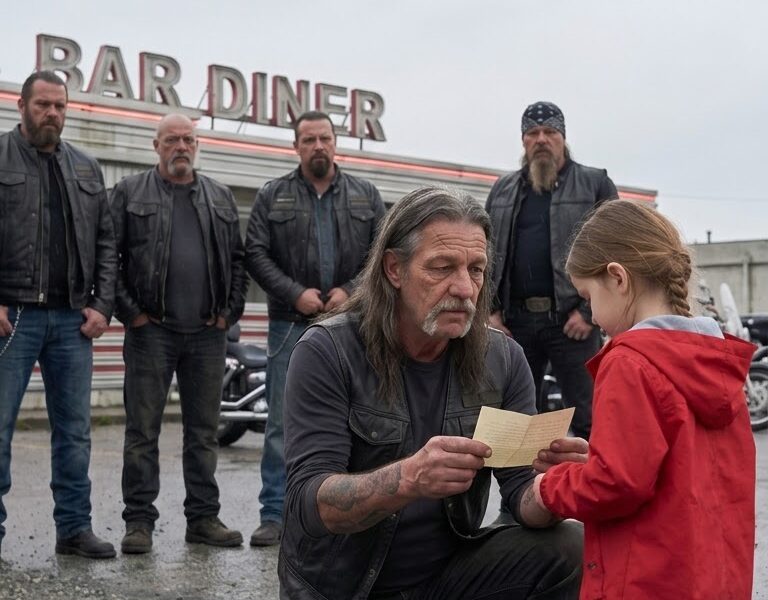
A little girl left the same note under the diner’s napkin holder every Monday. Nobody read it. Nobody looked. Then 450 bikers read it—and everything changed.
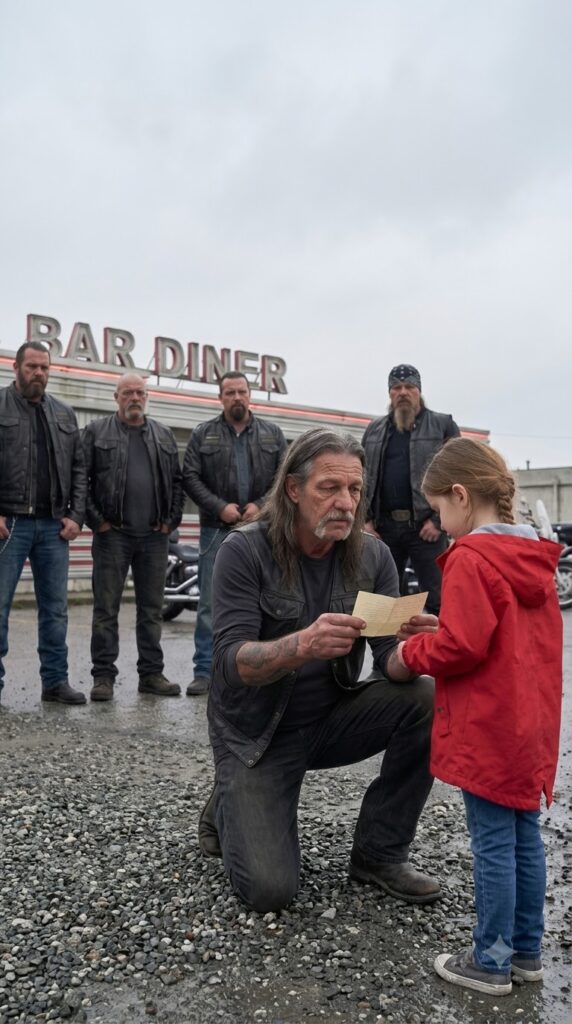
The Monday morning light came through the east window of the Desert Fork Diner like it had for fourteen weeks, pale and thin, the color of old paper.
Pam Shrier had worked the Monday shift for six years, and she had never once seen a child leave behind anything but a half-eaten biscuit or a crayon drawing of a dog.
This was neither.
The note was nine sentences long, folded along its creases, pressed under the napkin holder with the flat of a small palm, the way you press something into the ground to make sure it stays.
When she finally read it, she had to sit down on an overturned crate in the storage room and press her knuckles against her mouth.
—
Garrett Dune first walked through the door of the Desert Fork at fifty-seven years old, and the high desert was doing what it did in early November, which was to lie flat under a sky the color of old iron.
He rode in from the north off the 49 that connected Pharaoh Junction to the reservation land and three towns beyond it, and the headlight of his bike cut through the gray air and swept the empty parking lot in one slow arc before he stopped.
The kickstand went down with the sound of metal on gravel that had been his morning alarm for thirty years.
He was a large man, not tall but wide and dense in the way of someone who had done physical work since adolescence and had never stopped, and the beard that covered the lower half of his face was iron gray and thick enough to shelter sparrows.
There was a crescent scar below his left eye from a road incident twenty years prior, and a knuckle on his right hand that sat slightly wrong from a break that had healed without setting.
He wore the cut of the Ash Creek Riders over a canvas jacket, the president’s patch worn thin at the edges from a decade and a half of that same jacket.
The stitching on the back panel showed a creek bed with ash trees on either side, which was the symbol the club had chosen when they voted on it in a garage in Prescuit nineteen years ago.
Garrett was the only one of the four founders still riding.
He did not think about that if he could help it.
—
He went inside because it was cold and because the diner had decent coffee, and because the Monday morning run to check the stretch of Secondary Road between Pharaoh Junction and the Granite Formation locals called the Elephant had become over eight years of riding it something close to a ritual.
He sat at the counter and ordered coffee and watched the cook flip something on the grill and listened to the sound of the heater ticking in the ceiling.
He felt, as he usually felt in the first few minutes of sitting down somewhere warm, the particular stillness of a man with no pressing obligation and nowhere urgently to be.
Then a girl walked in through the diner’s side door.
She was small, with a coat slightly too large, the cuffs folded back twice, and her hair was braided in two plaits that had gone a little loose the way braids go when they have been done the night before and slept on.
She carried her school bag on one shoulder, and in her other hand, held carefully, was a folded piece of notebook paper.
She was not accompanied by anyone.
—
She went directly to the booth by the east window, the one that got the first morning light, and she sat down and took the folded piece of paper and slid it under the napkin holder at the center of the table.
She pressed it flat with her small palm, the way you press something into the ground to make sure it stays.
Then she sat with her hands folded on the table and looked at the window.
Garrett watched her from the counter and did not look away, and neither did Pam Shrier, who had come out of the kitchen with a coffee pot in her hand and had stopped mid-step.
The girl sat for four minutes.
Garrett counted them.
Then she picked up her school bag, stood, pushed the chair in neatly, and walked back out the side door.
Pam stood at the edge of the kitchen pass-through until the door swung shut, and nobody in the diner said anything.
—
Garrett looked at the napkin holder in the booth by the east window, and he could see the corner of the folded paper sticking out beneath it, pale against the Formica.
He set down his coffee cup and got up and went to the booth and stood there, and after a moment he picked up the paper and unfolded it and read what was on it.
He read it twice.
The coffee went cold on the counter behind him while he stood there and read a third time what a child had written in careful pencil letters on a torn piece of notebook paper, and the morning light came through the east window and lit the page, and the diner heater ticked, and there was no other sound at all.
He looked at Pam.
“How long has she been doing this?” he said.
Pam set the coffee pot down on the nearest table.
“Thirteen weeks before today,” she said. “Every Monday, same booth, same time, 7:15 on the dot.”
Garrett looked at the note in his hand.
He said, “Has anyone ever answered her?”
Pam shook her head once.
She said, “I didn’t know who to tell.”
—
Garrett folded the note along its original creases and put it in the inner pocket of his canvas jacket against his chest, and he laid a twenty on the counter for the coffee and the kindness it had cost Pam Shrier to carry this alone for thirteen weeks.
He walked out to his bike in the iron-gray morning and sat on it for a long time without starting the engine.
The cold came through the jacket, and he let it.
He was thinking about a room he had not let himself think about in four years.
He was thinking about a letter that had also been folded carefully and also left somewhere quiet and also not answered in time.
He started the engine and rode south away from the 49 toward the Granite Elephant and beyond it to the place where the Ash Creek Riders kept their meeting hall in a converted equipment barn off the county road.
The exhaust trail went straight and thin in the cold air behind him until the road bent, and he was gone.
The note folded against his chest moved with his breathing all the way there.
—
The meeting hall smelled of oil and sawdust and the particular warmth of a cast-iron stove that had been burning since before anyone arrived.
Garrett rode in at 8:20, and there were already eleven bikes in the yard, which on a Monday morning meant the Tuesday planning session had been moved up for reasons he hadn’t been told, or else the cold had driven people in early, or both.
He kicked the stand down and went through the side door, and the conversation that had been running dropped by half a register, the way conversation always dropped when Garrett came into a room.
Not from fear exactly, though there was some of that, but from the particular gravity that long authority generates without ever having to announce itself.
He went to the stove and poured coffee from the blackened pot that lived there and turned to face the room.
Fourteen men were present.
He knew every one of them by face and by the work their hands had done and by the specific way each one of them looked when something had gone wrong.
He said without preamble, “I need everyone on the property for a 6:00 meet tonight. Pass the word.”
—
One of the men, a forty-year-old named Cody Fisk who had ridden with the club for twelve years and who was the one Garrett trusted most with logistics, said, “All hands are the core.”
Garrett said, “All hands. Pharaoh Junction chapter, Decker Ridge chapter, all of them.”
Cody looked at him without expression and took out his phone.
Devon RWS, who sat on an overturned crate near the window and who had the longest tenure in the club after Garrett himself, said, “What is it?”
Garrett reached into his jacket and took out the folded note and set it on the workbench in the center of the room.
He did not unfold it.
He said, “A little girl has been leaving this in a diner in Pharaoh Junction every Monday morning for fourteen weeks. 7:15 every Monday morning, booth by the east window. Nobody answered her.”
The room was quiet.
Devon looked at the note on the bench and did not touch it.
Garrett said, “Tonight I’ll read it to everyone. Then we decide what we do.”
Nobody asked what it said.
—
That was the thing about the Ash Creek Riders that Garrett had always valued above their fierceness and above their reputation, which was considerable.
When he told them something mattered, they believed him first and asked questions later.
By 9:00 that morning, Cody Fisk had made forty-one phone calls, and the word was out across both chapters.
By noon, the men coming in from Decker Ridge had texted to confirm.
By 3:00 in the afternoon, there were more bikes parked in the equipment barn’s yard than had been there on any weekday since the spring run four years ago, and the ones who arrived earliest stood in the cold rather than crowd the hall, their breath making small clouds in the November air.
They waited the way men wait when they know they are waiting for something that matters.
—
Garrett spent the afternoon at the desk in the small office off the hall’s east wall, doing the one thing that almost nobody in Pharaoh Junction knew he did.
When he needed to think something through clearly, he wrote it out.
Not the note, which he had memorized by the second reading, but his own words in his own hand in the leather-covered log that had been sitting on that desk since the club’s first year.
He was trying to put on paper what he understood about the child’s situation, and what he did not understand, and what would need to happen, and in what order.
He wrote for two hours.
The handwriting was careful and not what anyone who had only ever seen Garrett Dune on a motorcycle would expect.
His mother had been a schoolteacher in Flagstaff, and she had made him practice letters every evening after dinner until the age of fifteen, and he had resented it until about ten years later, when he understood what she had actually been teaching him.
Which was not penmanship, but the discipline of putting a thought into words before acting on it.
He wrote for two hours, and at the end he folded the paper into his log and closed the cover and sat looking at nothing in particular for a while.
—
Then he got up and went back out into the hall because it was four to six and the room was full.
Sixty-three men present in one room.
The cast-iron stove put out heat in waves.
Someone had set up chairs in rows, which was unusual and which meant someone, probably Cody, had correctly anticipated that standing would be wrong for this.
Garrett went to the front of the room and stood there and looked at the faces.
Some of them he had known since he was in his thirties.
Some of them had started riding before Garrett had, though none of them had ridden with the Ash Creek Riders as long.
He took the note from his jacket and unfolded it carefully on the workbench and smoothed it flat.
He said, “I’m going to read this once. Then I want silence, not commentary, not questions, just silence for thirty seconds. Then we’ll talk.”
The room gave him its full attention.
—
He picked up the note and read it aloud.
The girl’s handwriting was careful and printed rather than cursive, and it had the look of letters formed by someone who understood that legibility was a form of politeness.
The note said, “My name is Dileia and I am 8. My mom works here on Saturdays. She has been crying when she thinks I am asleep. She doesn’t want me to know, but I know. We live with my uncle now because we couldn’t pay the rent on our other place and my uncle has a dog named Porter. And Porter is nice. My mom is scared about something with a paper. I don’t know who reads these notes, but I think maybe you could help because grown-ups read things that are left in diners. I don’t have money, but I am a good helper and I can do a lot of things. Please, Dileia.”
Garrett set the note down.
The room held its thirty seconds.
Nobody looked at the ceiling or at their hands.
They looked at the note.
—
Then Hatch Morales, who was fifty-two and who had a daughter of his own who was twelve, said quietly, “What’s her last name?”
Garrett said, “I don’t know yet.”
Hatch said, “What’s the paper?”
Garrett said, “I don’t know yet, but I’m going to find out.”
The room was quiet again.
Then Cody Fisk said from the back row without drama, “Tell us what you need.”
And that was the meeting.
It lasted nine more minutes.
By the end of it, Garrett had four men with specific assignments and sixty-three men who had given their word to be available by Saturday morning.
By the time the hall emptied and the last bike had cleared the yard and the stove had settled into its low overnight burn, Garrett was alone at the workbench with the note and a piece of paper on which he had written three names and three phone numbers and a list of things he needed to know before Friday.
The cold pressed against the barn walls, the iron of the stove ticked.
He put his hand flat on Dileia’s note, not to read it again, but to keep it still, as though it might try to leave.
—
Pam Shrier answered on the second ring when he called her at 8:20, and she had, in fact, been thinking about this since 7:15 that morning, and she had some of what he needed already.
Dileia’s full name was Dileia Voss.
Her mother was Sandra Voss, twenty-nine, who had been waitressing at the Desert Fork on Saturdays for four months, who had moved in with her brother Marcus at the end of August when the rental on her previous apartment in Winslow had been terminated.
She had, as Pam understood it from the ordinary geography of diner conversation, been fighting something with a court date attached to it.
Pam did not know the specifics.
She knew that Sandra Voss was quiet in the way of someone who had gotten very used to holding a thing in her mouth without chewing it, and that when she worked she was efficient and did not complain, and that the other Saturday staff liked her.
She knew that Dileia sometimes came in on Sandra’s closing shift and did homework at the end booth table while her mother rolled silverware and restocked the condiment trays, and that nobody had minded because Dileia did the same thing there she did everywhere.
Which was to be unobtrusive to the degree that you almost forgot she was present, and then suddenly remembered with a start that you had not in twenty minutes heard a single sound from her corner.
Garrett wrote all of this down.
—
He thanked Pam Shrier, who had had the instinct for fourteen weeks that something was wrong and who had not known where to put the instinct, and he told her she had done right by calling him and not having that thought overheard by someone with worse judgment.
She was quiet on the phone for a moment, and then she said, “She’s a real good little kid.”
Garrett said, “I know.”
He drove out to Marcus Voss’s property the following morning, Tuesday, not to the house itself but to the end of the unpaved approach road where it met the county road.
He sat on his bike in the thin early morning light and looked at the situation from the outside, which was a property of medium disrepair, a double-wide on a concrete pad with a fenced yard and a black pickup in the drive.
There was a dog run along the east side that was probably Porter’s domain.
Nothing alarming in what he could see, but the way a thing looked from the outside had long since stopped being Garrett’s primary measure of anything.
—
He rode back to town and went to the county courthouse on Mineral Street, which opened at 8:00, and he asked at the clerk’s window for anything attached to the name Sandra Voss.
That was a matter of public record because court filings in Arizona are, depending on their nature, accessible to any adult who walks in and asks.
What the clerk gave him after seventeen minutes and some searching through the computer that sat at an angle on her desk was a petition number and a case type.
The case type was a custody modification proceeding.
The petitioner was listed as a man named Dale Torrance, who was Dileia’s father.
The scheduled hearing date was December 8th, which was three and a half weeks away.
Garrett drove from the courthouse directly to the office of a woman named Rosalyn Furer, who practiced family law from a converted Victorian house on the edge of Pharaoh Junction’s small residential district.
She had on two previous occasions, unrelated to the club, demonstrated that she was one of those lawyers who understood that procedure and justice did not always sit in the same chair, and who had the gift of knowing when to prioritize which.
He sat in her waiting room for forty minutes while she finished with another client.
—
When she came out and saw him, her expression did not change, but she held the inner door open without asking him to explain himself, because she had known Garrett Dune well enough for long enough to know that when he showed up uninvited and early, it was not for a social call.
She said, “Coffee?”
He said, “Please.”
She brought two mugs from the narrow kitchen and sat across from him at the meeting table and listened while he told her what he had.
He put Dileia’s note on the table between them, unfolded, and she read it without touching it.
When she finished, she was quiet for a moment before she said anything professional.
What she said first was not professional.
She said, “How old?”
Garrett said, “Eight.”
Rosalyn Furer pressed her lips together and looked at the ceiling and then looked back at the table.
—
Then she picked up her pen and her legal pad and said, “Tell me about the case number.”
He gave it to her.
She wrote it down.
She said, “Modification proceedings are not always what they look like. He could be seeking primary custody for legitimate reasons or for leverage. The difference matters for what Sandra can do. Do you know if she has representation?”
Garrett said he did not know.
Rosalyn said, “She needs to know that she can have it, and what kind of representation matters here, and that the hearing date is real and it does not wait for anyone.”
Garrett said, “Can you reach out to her?”
Rosalyn said, “Not without her initiating contact, but you can tell her I exist.”
Garrett said, “I’ll tell her.”
He picked up Dileia’s note from the table and folded it back along its creases and put it in his jacket.
Rosalyn Furer watched him do this with the expression of someone who was updating quietly and without ceremony an opinion they had held for some time.
She said, “Where’d you find this?”
Garrett said, “She left it in a diner for fourteen Mondays.”
Rosalyn looked at the table and said nothing.
Then she said, “Fourteen.”
Garrett said, “Same time, same booth, same fold on the paper.”
Rosalyn said, “She kept trying.”
Garrett said, “She kept trying.”
—
They sat with that for a moment.
Then Rosalyn said, “I have a colleague in Flagstaff who handles these pro bono when the situation warrants it. Before I call him, I need Sandra Voss to call me.”
Garrett said, “She’ll call you by tomorrow evening.”
He did not know this for certain yet, but he knew how he was going to get there, and he knew the distance, and he had learned long ago that the most important thing about a deadline was not whether you were certain of the outcome, but whether you were willing to move toward it regardless.
He drove to the Desert Fork.
It was 9:40 in the morning, and the Tuesday rush was over, and the diner held three customers, all at the counter, and Pam was wiping down the pass-through with a cloth that had been white in a previous life.
He sat at the counter and told Pam what he needed, which was for Sandra Voss to have his phone number before her Saturday shift, framed not as trouble but as help that had been offered and was being passed along.
Pam said, “I’ll do it tomorrow when I see her picking up Dileia from school.”
Garrett said, “Wednesday.”
Pam said, “Wednesday. I’ll make sure she has it before she knows who it’s from, because if she knows upfront, it’ll take her an extra day to decide.”
Garrett said, “Fair.”
—
He drank the coffee she put in front of him.
It was good coffee.
It had always been good coffee at the Desert Fork, which was one of the reasons the Monday ritual had lasted eight years.
He looked at the booth by the east window.
The napkin holder sat in the center of the table, and there was nothing beneath it now.
The light through the east window had moved to midday position, and the Formica table showed every scratch and ring and the particular shine of a surface that had been cleaned many thousands of times.
He thought about a child pressing a folded piece of paper under that napkin holder with her small palm, pressing it flat so it would stay, making sure the words did not leave before someone had a chance to find them.
He finished the coffee and set some money on the counter and left.
—
That afternoon, in the equipment barn off the county road, he sat at the desk in the small office and made the phone call to Cody Fisk that started the machine turning.
He did not say the word emergency.
He said, “I need a Saturday that looks like a normal Saturday from the outside and feels like a different thing entirely on the inside.”
Cody said, “How many bikes?”
Garrett said, “Every bike we can reach by Friday night.”
Cody did not ask why or what for.
He said, “I’ll count what we have and call you by Thursday morning.”
Garrett said, “Tell them to bring their kids if they have them.”
Cody was quiet a moment, then he said, “Got it.”
The machine started turning.
—
Sandra Voss called Garrett’s number on Wednesday evening at 7:43.
He was in the equipment barn going over the route logistics with Devon RWS when the call came in, and he stepped outside into the cold to take it.
She identified herself by first name only, which was practical.
He did not give her his full name yet either, which was also practical.
He said, “I know about the hearing on December 8th.”
She was quiet for long enough that he could hear her breathing, and behind her breathing the small sounds of a domestic evening, a television at low volume, what might have been Porter the dog moving across a hard floor.
She said, “Pam said you might be able to help.”
He said, “I can point you toward a lawyer who takes these cases at no cost when the situation warrants it. I think yours warrants it, but you’d have to call her yourself and tell her what’s been happening, and you’d have to do it before Friday, because after Friday the timing gets tight.”
Sandra Voss said, “Is this because of the notes?”
Garrett did not answer immediately.
—
He stood in the cold outside the barn and looked at the sky, which was clear tonight and salted with stars at the elevation of the high desert.
He said, “Your daughter wrote nine sentences and put them somewhere someone might find them for fourteen weeks in a row.”
Sandra said nothing.
He heard her exhale long and slow, the way you exhale when something you have been carrying shifts its weight to a different part of your body.
She said, “She didn’t tell me.”
Garrett said, “She was trying to take care of something without worrying you.”
Sandra said, “She’s eight years old.”
Garrett said, “Yes.”
There was a long pause.
He waited it out.
She said, “He’s trying to say I’m unstable because I moved because I’m with my brother.”
Garrett said, “A good lawyer will know what to do with that. The moving is documented, and the reason is documented, and the home she’s in now is stable, and the dog is named Porter.”
He said this last part without thinking, and from the other end of the phone Sandra Voss made a sound that was not crying but was adjacent to it.
She said, “How do you know about Porter?”
He said, “Your daughter mentioned him. She said he was nice.”
Sandra said, “He is.”
She sounded for a moment very young.
—
Garrett stood in the cold and waited.
Then she said, “Okay, give me the lawyer’s number.”
He gave her Rosalyn Furer’s number, and Sandra Voss said she would call in the morning, and Garrett said that was good and that she should tell Rosalyn he had sent her.
And that was the end of the practical part of the conversation.
Before she hung up, she said, “Why are you doing this?”
It was a direct question and it deserved a direct answer.
He said, “Because she kept trying. Fourteen Mondays. She didn’t stop.”
Sandra said, “That’s just how she is.”
Garrett said, “I know.”
He went back inside.
Devon RWS looked at him across the workbench and said nothing, because he had known Garrett long enough to know that the right thing was often to say nothing.
The logistics continued.
—
By Thursday morning, Cody Fisk called with his count, and the count was higher than Garrett had expected.
Word had moved through the network the way it always moved, which was fast, and with the particular amplification that comes when people understand that a thing matters without needing to be told why it matters.
The Decker Ridge chapter had confirmed forty-one bikes.
The Pharaoh Junction chapter had sixty-three.
There were riders coming from the high grassland chapter up near the Utah border and from the southern chapter that rode out of the valley below the canyon rim.
By Friday afternoon, when Cody updated the count, the number was 412 with more calling in to ask if there was still room.
Garrett said there was always room.
The number settled by Friday night at 450.
Four hundred fifty bikes.
—
He told Cody to confirm them and to send the route and the time and the specific address and the one instruction that Garrett had been thinking about since Wednesday night, which was this: no engines during the last block.
The last block was ridden silent or walked, bikes pushed if need be, and that instruction was passed along exactly as stated, and not one person questioned it.
They knew by then that Garrett Dune did not ask for quiet unless quiet was the point.
Saturday morning came in clear and cold, a winter sky so blue it looked painted.
The Desert Fork Diner opened at 6:00 as it always did, and Sandra Voss arrived for her shift at 6:45, and Dileia came with her because it was Saturday and there was no school and the arrangement with Marcus’s schedule meant he could not watch her until noon.
Dileia sat in the end booth table, the one she usually used on closing nights, with a book open in front of her, wearing a red wool sweater that had seen better winters, and her hair in the same two braids.
She was not in the east window booth.
That booth was empty.
—
Garrett arrived at the diner at 7:00, not on his bike.
He parked around the block and came in on foot, which was deliberate, and he sat at the counter, and Pam Shrier brought him coffee and did not look at her watch because she was doing the same thing Garrett was doing, which was watching the clock without appearing to watch it.
Sandra Voss moved through the morning rush with the efficiency Pam had described, taking orders and running plates and working the coffee around the room in that particular rhythm that experienced diner workers develop.
She had not yet looked directly at Garrett, though he was aware that she had identified him, because the moment she came through the kitchen pass-through for the first time and saw him at the counter, her hands had done the involuntary thing that hands do when a body is startled but the face is keeping its composure.
Which was to grip the coffee pot handle a quarter inch tighter for three seconds and then let it go.
He did not acknowledge it.
—
At 7:15 exactly, the side door of the diner opened.
Dileia came through it.
Everyone at the counter, including two men who had not been there a moment before and who were wearing canvas jackets with the creek and ash tree patch on the back, went still.
Dileia went directly to the east window booth.
She sat down.
She took from her coat pocket a folded piece of notebook paper.
She set it on the table.
She reached over and put it under the napkin holder, pressing it flat with her small palm.
Garrett was watching her from the counter.
She looked up and their eyes met, and he held her gaze, and after a moment he got up from the counter and walked to the booth and stood at the end of it.
Dileia looked up at him.
—
He was a large man.
He had a gray beard and a scar below his eye, and he wore a leather cut with a club patch, and he was not, by any reasonable definition of the word, an unthreatening presence to an eight-year-old child.
He was aware of this.
He crouched down so that his eye level was closer to hers, which put one knee on the diner floor and which was not comfortable.
He said, “My name is Garrett. Are you Dileia?”
She said, “Yes.”
He said, “I read your notes.”
She looked at him for a moment without speaking.
He could see her assessing him in the way that children assess adults, which is more accurate than adults tend to give them credit for.
She said, “All of them?”
He said, “All fourteen.”
She said, “Did you bring help?”
He said, “I’m working on it.”
—
She reached out and put her small hand on top of the note under the napkin holder and then looked at him again.
She said, “You can have this one, too.”
He said, “Thank you.”
He reached over and she lifted her hand and he took the note out from under the napkin holder and put it in his jacket pocket.
He stood up.
He said, “Would you like some hot chocolate while you wait?”
She said, “I’m not supposed to ask for things.”
He said, “I know. I’m offering.”
She thought about this seriously.
She said, “Okay, yes, please.”
He went back to the counter and told Pam, who already had her hand on the milk steamer, and he returned to the counter stool and sat and looked at the clock on the diner wall and then at the window in the empty parking lot outside.
The blue winter sky sat on top of Pharaoh Junction like a weight made of light.
Inside his jacket pocket, fifteen notes folded along their original creases pressed against his ribs, one for each week, counting the one from today.
—
At 7:48, the first sound came from the direction of the highway.
Not an engine.
The engines had been cut at the turn onto the block as instructed, and what reached the diner first was the low rolling sound of tires on cold asphalt.
Dozens of tires, and then more dozens.
A sound that was not identifiable as any single thing but was instead the accumulated pressure of many heavy objects moving in coordinated silence in the same direction.
The diner fell quiet.
The two men in canvas jackets at the counter stood up without a word and went to the windows.
Pam sat down the coffee pot.
The three customers who had been mid-conversation stopped mid-sentence and turned to look through the plate glass of the diner’s front windows.
The street outside filled.
—
Bikes came in from the north end of the block first, ridden at walking speed and then simply pushed.
Men with one hand on the handlebars walked their machines to the curb and parked them and came to stand with their arms crossed or their hands in their jacket pockets or just standing, because there are only so many ways a person can stand when they are part of something they believe in, and not all of them require any particular posture.
They kept coming.
More from the south end of the block.
More from the side street that ran west along the diner’s other wall.
The parking lot filled and then the street filled and then the sidewalk on the far side of the street filled.
And the number of men standing in the morning cold outside the Desert Fork Diner grew from dozens to more than a hundred to something that required a different kind of counting than most of the people in the diner had the habit of doing.
—
Sandra Voss stood in the pass-through between the kitchen and the front room, and she had one hand pressed flat against the door frame, and she was looking at the street and not moving.
Dileia had turned around in her booth and was kneeling on the seat with her arms on the back of the bench, looking through the east window at the yard and the street filling with silent men.
Her hot chocolate sat on the table behind her, half finished, and she had forgotten it.
Garrett came to stand beside her booth.
He said, “That’s because of you.”
Dileia turned around and looked at him.
She said, “All of them?”
He said, “Four hundred fifty.”
She turned back to the window.
Garrett watched her watch them arrive.
—
He reached into his jacket pocket and he took out all fifteen notes and he looked at them in his hand, folded along their creases.
He thought about fourteen Mondays of pressing a piece of paper under a napkin holder in the hope that a grown-up would find it and act.
He thought about the specific faith that requires, which is not the faith of someone who has been given reasons to believe in people, but the faith of someone who has decided to believe in them anyway, which is a harder and more valuable thing.
He looked at the notes in his hand and he thought about his brother.
He had not let himself think about his brother in three days, which was as long as he ever managed to go without it.
His brother’s name had been Colin, and he had been forty-four years old when he died, and he had left a letter folded carefully in a place where he assumed it would be found, and it had been found seventeen days too late.
The letter had said things that Garrett had spent four years since reading and rereading in the particular way you return to words that came too late to be answered, looking for the thing you could have done differently.
—
He held Dileia’s fifteen notes in his hand and stood in the diner while 450 men filled the street outside in the cold, clear morning, and he understood in the sternum the way you understand things that cannot be argued with that he had not been able to answer Colin’s letter, but he had answered these.
And that this was not the same thing and would never be the same thing, but that it was something, and that something sometimes was the only word there was for what you could do with what you carried.
His jaw worked once.
He closed his hand around the notes and put them back in his pocket.
Outside, the crowd held, still and enormous and quiet, a landscape of canvas and leather and gray and black against the blue winter sky.
And the street in front of the Desert Fork Diner had become something that Pharaoh Junction, Arizona had never been before, which was the kind of place that 450 people chose to be at once because a child had kept asking for eight.
—
Rosalyn Furer arrived at 8:00 on foot, which meant she lived close enough to walk and had walked anyway in the cold because she had known what she would find and had wanted to see it clearly.
She came through the front door and looked at the diner and looked at the crowd in the street and then looked at Garrett, who was standing at the end of Dileia’s booth.
She said, “Which one is Sandra?”
Garrett pointed.
Rosalyn went to the pass-through where Sandra was still standing with her hand on the doorframe and introduced herself by name and occupation and said two sentences that Garrett could not hear.
Sandra Voss looked at the street and back at Rosalyn and nodded.
They went to a booth in the back and sat down, and Rosalyn opened her bag and took out a legal pad and a pen, and that was the beginning of the work that would occupy the next three weeks.
—
The crowd in the street stayed for a long time, not because they had been told to stay, but because the particular feeling of being part of something that matters is not easily surrendered.
The men of the Ash Creek Riders, and the riders from Decker Ridge, and the High Grassland chapter, and the Valley chapter had ridden sometimes three hours in the cold dark of Friday night to be there at 7:48 on a Saturday morning, and being there meant something that leaving quickly would have undercut.
They stood in the street and they talked to each other the way men talk when they are waiting together in cold weather, in low voices and with the ease of people who share a language.
And the sound of it came through the diner’s plate glass as a steady, warm murmur, like something geological, like water in stone.
A man named Hatch Morales came inside at 8:15 and went to Dileia’s booth and sat across from her, and they talked for twelve minutes about Porter the dog and whether dogs understood that doors were arbitrary and why Saturday morning cartoons had gotten worse.
At the end of the conversation, Dileia said without apparent transition, “Are all those men out there because of my notes?”
Hatch said, “Every single one of them.”
Dileia looked out the window at the street.
She said, “I thought maybe two people would come.”
Hatch said, “You undersold it a little.”
—
Dileia considered this with the gravity that eight-year-olds bring to being told they have underestimated something.
She said, “I will try to count them.”
Hatch said, “Four hundred fifty.”
Dileia said, “That’s a lot.”
Hatch said, “That’s the point.”
She turned back to the window and looked at the street, and Hatch looked at his hands on the table for a moment and then he looked at the ceiling, because some moments require looking at the ceiling, and then he was fine.
At 9:00 Garrett went outside.
He stood on the diner step and looked at the street, and the crowd, which had been loosely distributed across half a block, tightened without anyone giving a signal, the way crowds tighten when they understand that something is about to be said.
He was not a man who gave speeches.
Fourteen years as president of the Ash Creek Riders had required him to speak in front of the membership more times than he could count, but speech had never been the primary instrument of his authority, and he had always trusted plainness over architecture when the moment was real rather than performed.
He reached into his jacket pocket and he took out the fifteen folded notes and he held them up so the crowd could see them.
—
He said, “These are fifteen weeks of a child asking for help. I’m going to read the last one.”
He unfolded the note from that morning and read it aloud.
His voice was not trained for carrying over distance, but the street was quiet and the cold air was still, and the words went where they needed to go.
When he finished, he folded the note back along its creases.
He said, “In three weeks there is a hearing. Between now and that hearing, the child and her mother need to know that they are not alone in this. What happens in a courtroom is for lawyers. What happens on this street is for us.”
He said, “We’re going to do three things. The first is a fund. Whatever people can put in this morning before they leave. The second is a roster. Names and phone numbers of anyone with a skill that might be useful. Legal knowledge, social services experience, anything. The third is that on the morning of December 8th, whoever can be there will be there outside the courthouse, not inside, because the inside is not ours, but outside.”
He held up the fifteen notes one more time.
He said, “She left these every Monday, fourteen times before anyone answered. We’re the answer.”
—
The crowd was quiet for a moment and then it moved, not dramatically but with the purposeful distributed motion of a large number of people who all know what they are going to do next and are starting to do it.
Cash came out of jacket pockets.
Cody Fisk appeared from somewhere with a clipboard and a legal pad.
Men lined up to put names and numbers and skills on the list.
Garrett went back inside and stood at the counter, and Pam poured him coffee without being asked, and he stood with the coffee and watched the street through the plate glass.
After a while, Dileia appeared at his elbow, her hot chocolate restored to full and steaming by Pam, and she stood beside him and also watched the street.
The two of them side by side at the counter window.
The large man with the gray beard and the scar and the small girl in the red sweater with the braids that had gone loose overnight.
She said, “The one with the red helmet is nice.”
Garrett said, “That’s Devon. He’s been riding since before I have.”
Dileia said, “That’s a long time.”
Garrett said, “Long time.”
—
She drank her hot chocolate.
She said, “Did you read all my notes?”
He said, “All of them.”
She said, “Even the one where I wrote about Porter being afraid of the vacuum cleaner?”
He said, “Especially that one.”
She was quiet for a moment.
Then she said, “I wasn’t sure anyone would find them.”
Garrett said, “I know.”
She said, “But I kept leaving them anyway.”
He said, “I know. That was the right thing to do.”
She looked at her hot chocolate.
She said, “My mom is crying.”
Garrett looked across the diner to the back booth where Sandra Voss and Rosalyn Furer were sitting, and he could see from the angle that Sandra had her hand pressed flat on the table, and her eyes were bright, and that she was doing the particular thing that people do when they are crying but do not want to be crying in a professional conversation.
Which was to keep her chin lifted and her voice level and to nod at intervals.
He said, “Good crying or worried crying?”
Dileia said without hesitation, “Good crying. I know the difference.”
He said, “I believe you.”
—
The fund raised $9,412 that morning in cash before the last bike left the street.
Cody Fisk’s roster filled four pages.
The hearing date was December 8th.
It was a Tuesday, which meant the Monday before was the fifteenth Monday since Dileia had begun leaving notes.
And on that Monday at 7:15, Dileia came through the side door of the Desert Fork and went to the east window booth and sat down.
She did not take a note from her pocket.
She sat with her hands folded on the table and looked out the window at the street, which was empty and ordinary in the winter morning light, gray-gold and cold.
After a moment, Garrett, who was sitting at the counter as he had been sitting at the counter every Monday for eight years, picked up his coffee and walked to the booth and sat down across from her.
She looked at him.
He said, “No note today.”
She said, “I don’t need to leave one anymore.”
He said, “No.”
She said, “Because you already read them.”
He said, “All fifteen.”
—
She looked at the napkin holder in the center of the table where the notes had gone each week and she put one finger on the chrome base of it.
Then she said, “Are they going to take me away from my mom?”
He looked at her.
He said, “Rosalyn says no. She says the case is not as strong as it looked and that the documentation of the last four months shows a stable home.”
Dileia said, “With Porter?”
Garrett said, “With Porter.”
She nodded once, the way someone nods when they have been worrying about a thing for a long time and the thing has finally been put somewhere they can leave it.
She said, “Okay.”
He drank his coffee.
She sat with her hands folded.
Outside the window, the gray-gold light moved across the parking lot and touched the chrome of Garrett’s parked bike and made it briefly bright.
She said, “Will you come to the courthouse tomorrow?”
He said, “We’ll be there.”
She said, “How many?”
He said, “Most of them.”
She said, “Four hundred fifty.”
He said, “Most of four hundred fifty.”
She looked at the window.
She said, “I want to see that.”
He said, “You will.”
—
The hearing on December 8th lasted three hours and fourteen minutes.
Rosalyn Furer appeared for Sandra Voss, and the colleague from Flagstaff appeared as co-counsel, and Rosalyn had filed in the weeks prior a documentation package that included lease agreements, utility records, Dileia’s school attendance record for the fall semester, which was perfect, a letter from the principal, a letter from Marcus Voss, a letter from Pam Shrier, and a notarized statement from a child welfare assessor who had visited the home on November 22nd and whose language was precise and whose conclusions were unambiguous.
The judge was a woman named Honorable Clara Steed, and she had been on the bench in Yavapai County for seventeen years, and she had seen modification proceedings used as instruments of financial pressure before.
She had a particular expression that she deployed when she understood what she was looking at, which was no expression at all, which was more effective than any expression could have been.
The petitioner’s case, which had looked on paper like a concerned father seeking stability for his daughter, looked somewhat different once the documentation was entered and once Rosalyn began asking procedural questions about the timing of the petition relative to Sandra’s change in employment status and residence.
The petitioner’s counsel objected twice.
The objections were noted and ruled on within thirty seconds each time.
—
Outside the courthouse on Mineral Street in the cold morning air, there were 381 motorcycles parked in an arrangement that occupied every available curb on three surrounding blocks, and 381 men standing in the cold.
They were quiet and they did not block any entrance or any sidewalk, and when the court deputies came out to look, they found nothing to address, because there was nothing to address.
The Ash Creek Riders and their affiliated chapters understood the difference between presence and pressure and had calibrated this correctly from the beginning.
Dileia stood at the courthouse window on the second floor during the recess and looked at the street and counted until she gave up counting and just looked.
The hearing concluded at 1:14 in the afternoon.
The modification petition was denied.
Judge Steed made no statement beyond what the ruling required, but the ruling itself was four paragraphs long, and the fourth paragraph, in language that was formal and measured and left nothing ambiguous, addressed the nature of the documentation before the court and the stability of the child’s current environment and the absence of credible evidence that any change served the child’s welfare.
—
Rosalyn Furer read the paragraph aloud in the hallway to Sandra and then read it again when Sandra asked her to.
Sandra Voss sat on a bench in the courthouse hallway and cried the way she had not cried since August, which was thoroughly.
Dileia sat beside her and held her hand and looked at the middle distance with an expression of patience that was beyond her years and completely characteristic of who she was.
Garrett stood at the end of the hallway and said nothing.
Rosalyn caught his eye once and gave him the smallest possible nod.
He nodded back.
That was the whole of that exchange.
—
The fund did not close when the hearing ended.
It grew.
Cody Fisk set it up through a community foundation that had a fiscal sponsorship arrangement, which was not a phrase that would have meant anything to most of the men who contributed to it, but Cody had the skill for this kind of thing and had done the research and the paperwork himself.
He brought it to Garrett in December, and Garrett signed where indicated without reading every clause, which was the extent of his trust in Cody’s competence, and which Cody received as he always received Garrett’s trust, as the thing that mattered most in the world.
The fund raised by the end of January a total of $22,080.
This covered four months of rent in a unit in Pharaoh Junction proper that Sandra Voss moved into in February, so that Dileia could stay in the same school where her attendance record was perfect and where the principal knew her by name and had written a letter on her behalf without being asked twice.
—
The Ash Creek Riders held a vote at the February meeting, the first meeting of the calendar year.
What they voted on was whether to make the first Saturday of December a permanent date on the club calendar, a ride and a gathering in Pharaoh Junction, not called anything official, just a date that meant something.
The vote was 63 to 0 in the Pharaoh Junction chapter and carried at identical margins in both other chapters.
Cody Fisk stitched a small additional emblem onto the back panel of his cut below the creek and ash tree symbol, which was a folded piece of paper, simple and white, no bigger than a thumb.
He did not announce it or explain it.
Several other members noticed it and asked, and he told them, and by March there were forty-one of those small white paper emblems stitched onto the cuts of men who had been there on the Saturday morning in November.
By the following year’s December ride, there were 207.
—
Dileia turned nine in April.
She did not leave a note anywhere.
She did not need to.
She knew where to find the answer now.
And the answer, it turned out, was the same on a Tuesday as on a Monday.
The same in spring as in November.
The same whether you needed something small or something that required 381 bikes and seventeen years of institutional knowledge about the difference between presence and pressure.
She came to the December ride the following year and stood with her mother on the sidewalk outside the Desert Fork and watched 450 bikes roll silent down the last block and park.
She had her hair in two plaits and a different coat now, this one the right size, and she held in her hand the one note she had brought with her, the one she had written at home the night before.
Not because she needed to leave it anywhere, but because she had thought overnight that someone should probably have it and that it should be kept.
—
Garrett was the one who took it from her when she held it out.
He unfolded it and read it there on the sidewalk in the December light, which was the same cold, clear blue it had been a year before, the kind of light that does not hide anything.
The note had one sentence.
It said, “Thank you for reading.”
He folded it along its creases and put it in his jacket pocket with the same care he had put the others there, against his chest, where it rode with his breathing.
He looked at Dileia.
She looked at him.
He said, “I’ll keep it.”
She said, “I know.”
—
They stood together on the sidewalk in the cold blue morning, and the street around them held 450 men who had learned, or always known, that the most dangerous thing you could put under a napkin holder was a child’s honest question.
And that the only answer worth giving was the kind you showed up for in numbers, in silence, on a cold December morning.
Because some things are not said with words, but with the accumulated weight of people who chose to be somewhere instead of anywhere else.
And the sound of that, the specific sound of 450 engines cut to silence one block out, so the first thing a child heard was not the roar but the quiet arrival, was the same sound it had been the year before and would be the same sound the year after.
Which was the sound of an answer that did not need to be repeated, because it had never, not once, been taken back.









