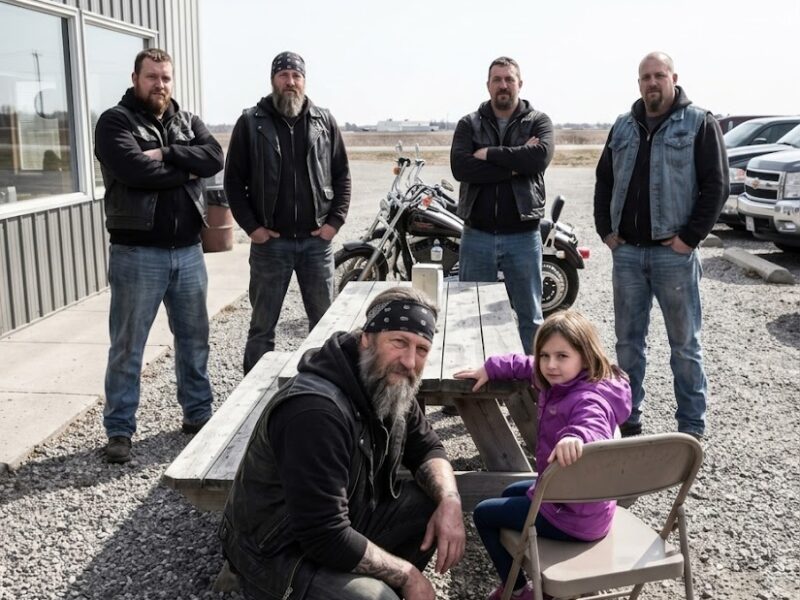
A Little Girl Kept One Chair Empty for Her Father—Then 250 Bikers Came to Share His Place
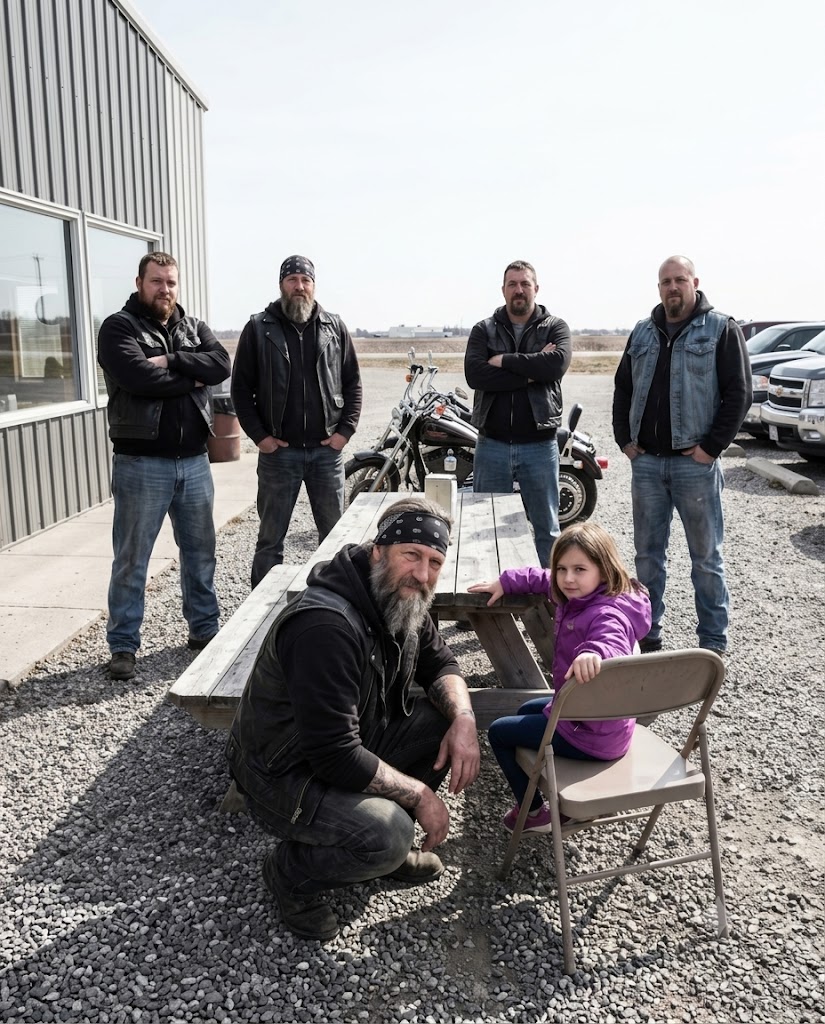
The October morning in Varna, Oklahoma, came in cold and red, the way it always did when the flat country had spent the night giving up whatever moisture the sky could spare.
Darnell Cross felt the vibration before he heard it, the way a man feels weather in an old break before the storm even shows itself on the horizon.
He was fifty-three years old, six feet and change, carrying two hundred and forty pounds across a frame that twenty years of wind and road had punched flat and hard.
His beard was the color of iron filings, streaked through with the particular white that doesn’t come from age alone but from the specific grief of outliving people you promised to protect.
He was road captain for the Long Mercy Riders, had ridden point on every run out of the flat red dirt country since he was thirty-two, and his face in its natural resting state had cleared intersections in three states without a single gesture.
He had not intended to cry that morning.
He had not intended a lot of things.
The part nobody standing in that street was ready for wasn’t the two hundred and fifty bikes.
It wasn’t the sound, either, which was enormous, a rolling concussive thing that pressed against the windows of every storefront on two blocks.
The part nobody was ready for was the reason the chair had been empty in the first place, and what an eight-year-old girl had been trying to tell the world for fourteen months before anyone with the power to listen finally did.
—
The morning that brought Darnell Cross to Varna had started the way most October mornings started in that part of Oklahoma.
Cold before the sun, the flat horizon going pink in the east like something being slowly heated from below.
The red dirt still dark from a night that had rung out what little moisture the sky could spare.
He had been at the chapter table at six, coffee in a cracked mug the size of a soup bowl, going over the route sheet for a weekend charity run to Enid.
His hands on that paper were a record of twenty years of roads.
The left thumb had a scar along its base from a chain adjustment gone wrong in 2009.
The knuckles were thickened from cold and vibration.
There was a permanent callous on the inside of his right palm where the throttle had lived for so long it had shaped him.
He was not a man who looked like he needed anything.
That was always the first and most expensive mistake people made about Darnell Cross.
—
The diner in Varna was called Maze, and it sat on the corner of two county roads at the place where the town sort of gave up trying to be a town and became flat country again.
It had eleven tables and a lunch counter with eight stools, a hand-lettered menu board above the pass-through, and a smell that wrapped around you at the door like something your grandmother cooked when you were small enough that the world still felt manageable.
Darnell had stopped at Maze maybe a dozen times over the years.
Enough that Burda Okafor, who owned it and ran it alone six days a week, knew his order without asking and had it moving before he reached the counter.
He had pulled in that particular Tuesday morning because he was running a parts delivery up to a brother chapter in Woodward, and Maze was the halfway point he always chose when he had a reason to choose halfway points carefully.
He took a stool at the counter, not a table.
Road captains do not take tables when they are alone.
It is a habit of economy that becomes a habit of character.
He had his coffee and was working through a plate of eggs when the bell above the door made its thin sound and the girl came in.
—
She was eight years old.
He would learn that later, but he could see in that first moment that she was small, for whatever age she was, wearing a jacket that was right for the temperature but had been washed so many times the color had gone from whatever it started as to a kind of exhausted beige.
Her hair was in two braids that someone had done carefully, which meant someone had been there to do them, which made the rest of what he was seeing harder to explain.
She carried a backpack that pulled her shoulders back and a paper lunch bag that she held against her chest with both arms.
The way you hold something breakable.
She looked around the diner with the particular steadiness of a child who has learned not to look uncertain in public because uncertainty invites attention she does not want.
She walked to a table near the window, not the counter, a table with four chairs.
She put her backpack down on one chair and sat in the chair next to it and placed the paper lunch bag on the table and did not open it.
She looked out the window.
She did not order anything.
—
Burda came around the counter with a glass of water and Darnell watched her set it in front of the girl and say something quiet, and the girl said something back, and Burda’s face did something complicated, and she went back behind the counter and did not say anything to the room.
A man two stools down from Darnell, older, seed company cap, glanced over at the girl and then at Darnell in a way that was not quite an accusation but was trying the door of one.
Darnell did not look at the man.
He looked at the girl.
She had put her hands flat on the table, one on each side of the paper bag, and she was watching the window with an attention so complete it looked like work.
The chair across from her was empty.
The chair across from her had a quality that Darnell could not name yet and could not stop noticing.
It sat the way a room sits after someone has just left it.
—
He gave it four minutes.
Then he picked up his coffee and his plate and he moved to the table and he said, “Mind if I pull up a chair?”
He did not sit in the chair across from her.
He pulled one of the side chairs around and sat at the corner of the table, which left the chair across from her exactly as it was.
She looked at him the way children look at large men they have decided not to be afraid of directly, measuringly, giving nothing away.
“Okay,” she said.
He set his plate down and ate for a moment without speaking.
The eggs had gone a little cold.
He ate them anyway.
“Waiting for someone,” he said.
She looked at the window again.
“My dad,” she said.
He nodded and let that sit.
—
The paper lunch bag was from a grocery store, folded over at the top with a crease that was too sharp, the kind you make when you fold the same bag the same way enough times that your hands know the motion.
It was not new.
It had been used before, many times.
He could see faint oil marks through the paper at the bottom.
The ghost of many packed lunches pressing through.
The girl had her eyes back on the window.
The light was morning flat and gray coming through the glass at a low angle that put a stripe of it across the empty chair and made the chair look like it had been set there on purpose.
“What’s in the bag?” Darnell said.
“His lunch,” she said.
“I make it and bring it.”
He did not say anything.
A question was building in the room the way pressure builds before weather arrives.
And he did not want to push it.
He drank his coffee.
“He likes the same thing every time,” she said.
“So I know how to make it.”
—
Darnell put his mug down.
He looked at his hands on the table.
The scar on his left thumb was white in the gray light.
“What time does he usually get here?”
She looked at him for a moment and then back at the window.
“He doesn’t always,” she said.
“But I come anyway in case.”
Those last two words, in case, they landed in Darnell’s sternum like something dropped from height.
He had not felt a thing land like that in a long time.
And the fact that he felt it now told him something about the months preceding this morning that he would have preferred not to know about himself.
He picked up his coffee again and held it.
The empty chair across from the girl held its quality.
“How long have you been coming?” he said.
She thought about it with the seriousness that children bring to accurate counting.
“Since last August,” she said.
“It’s October. Fourteen months.”
—
He did not ask the next question yet.
He was not ready.
And she was not a child who would answer a question before it was asked.
Burda came by with the coffee pot and refilled Darnell’s mug and looked at him over the girl’s head with an expression that said she knew things and was choosing the order in which to tell them.
He had known Burda Okafor for eleven years by sight and by the quality of her eggs, which were excellent, and he had never seen her face do what it was doing now.
She moved back behind the counter and he heard her on the phone.
Her voice low and controlled the way a person’s voice gets when they are managing the size of something.
The girl did not seem to notice.
She was watching the window with that working attention.
He asked the question then, simple and direct, because she was a child who answered simple and direct things.
“Where’s your dad, sweetheart?”
—
She turned from the window and looked at him.
Her eyes were the color of creek water over red clay, a warm brown that was difficult to look away from.
“He went away,” she said.
“Last August.”
She paused.
“He said he would come back.”
She looked at the bag.
“I don’t think he’s coming back,” she said.
“But I don’t want him to not have lunch if he does.”
The room was not loud.
It had been the ordinary low sound of a diner in the middle of a weekday morning.
Burda’s radio playing something country and staticky from behind the counter.
The coffee maker ticking as it cooled.
One of the other customers turning a newspaper page.
All of that went quiet without anyone deciding it should.
Not loud quiet, just the particular quiet of a room full of people who have heard something that requires them to stop.
—
Darnell’s hand on the mug was very still.
He was thinking about a boy he had known.
A boy who had been nine years old when Darnell was nineteen.
A boy who was his younger brother’s kid and who used to wait on the front step of his sister-in-law’s house every Friday evening because Friday was when Darnell’s brother said he might come by.
His brother had not come by on a Friday in four years by the time the boy stopped waiting.
And Darnell had not been the one to make him stop waiting.
And he had never forgiven himself for that specific failure in the way that you carry a specific failure forever.
Not because you cannot put it down, but because putting it down would be its own kind of wrong.
“What’s your name?” he said.
“Lily,” she said.
“Lily Creed.”
“I’m Darnell,” he said.
—
He did not offer his hand.
She was eight and he weighed two hundred and forty pounds and had an iron and white beard, and she had already decided he was okay, and shaking hands would have made it formal when what it needed to be was something else.
“Lily,” he said, “I’m going to make a phone call outside. Is that all right?”
“Okay,” she said.
She turned back to the window.
He stood up and he looked at the empty chair one more time.
Then he went outside into the October morning and he called his sergeant at arms, a man named Thirsten Webb, and he said four sentences.
And when he was done, Thirsten said, “How many do you want?”
And Darnell said, “All of them.”
—
Thirsten Webb was fifty-one years old and had been with the Long Mercy Riders for sixteen years.
And when Darnell Cross said all of them in that particular voice, Thirsten did not ask any more questions.
He started calling.
The chapter out of Varna had twenty-two riders on the active roll.
The Woodward chapter had thirty-one.
Enid had twenty-nine.
The Tulsa chapter, which was the largest, had sixty-seven.
There were three smaller satellite groups in the county’s east and south that together added another forty.
Phone calls went out in sequence, not by text chain, which would have taken longer, but by direct call, one after another, the way the club had always moved when it moved fast.
A human voice carrying weight that a typed message could not carry.
Thirsten called the vice president, who called the road captains of the satellite groups.
The road captains called their officers.
The officers called their riders.
—
It was 6:52 in the morning.
By 8:15, confirmed numbers stood at two hundred and thirty-one.
By nine, with stragglers still calling in from the eastern counties, the number was two hundred and fifty.
Two hundred and fifty riders who had been at breakfast tables, on their ways to jobs, asleep after night shifts, or already on county roads for one reason or another.
All of them turning toward Varna, Oklahoma, on a Tuesday in October because Darnell Cross had called Thirsten Webb and said all of them and meant it.
Inside Maze Diner, Darnell had gone back to the corner chair at Lily Creed’s table and ordered more coffee and a slice of the pie that Burda always had going.
Peach in October.
And he had asked Lily whether she wanted anything, and she had said she had her lunch, and he had not pushed.
They sat together in the way that people sit when they are not strangers anymore and are not quite sure what they are.
—
“You go to school in Varna,” he said.
“Yes,” she said.
“Mrs. Pruitt’s class.”
“You walk from school here?”
“It’s not far,” she said.
He did not ask where she had walked from before school.
Not yet.
He was watching what she did with her hands, which were small and careful, and stayed close to the paper bag, not gripping it, just staying near it.
The way a person stays near something that matters without wanting to look like it matters.
One of the other customers, a younger man in a work shirt, had been watching them from two tables over with the quality of attention that was building toward interference.
Darnell caught his eye once, not threateningly, just steadily, and the man looked back at his plate and stayed there.
Burda came by again, and this time she stopped and said quietly to Darnell, “I called the school. They know where she is.”
Darnell nodded.
—
Burda looked at the girl.
“Lily, honey, do you want some cocoa?”
Lily looked up from the window.
“Okay,” she said.
Burda brought cocoa in a heavy mug and Lily wrapped both hands around it and the careful steadiness in her face softened by one degree.
And that one degree was hard to look at directly.
“Your mom know you’re here?” Darnell said after a while.
Lily was quiet for a moment.
“She works mornings,” she said.
“She doesn’t get off till two.”
He absorbed that.
“She know you do this?”
Lily looked at the window.
“She knows I come on Tuesdays.”
She said it with the precision of a child who has been very careful about what she says and what she does not say.
And the gap between the two things was something Darnell filed away quietly.
—
He could hear the first bikes now.
Not close yet, but the sound was on its way.
The low rolling frequency of many engines traveling together, and it moved differently through flat country than it did anywhere else, arriving before the source arrived, a presence ahead of itself.
The man in the work shirt heard it, too.
He looked toward the window.
Lily heard it.
Her head came up the way a dog’s head comes up when it hears something outside the range of human comfortable certainty.
“What’s that?” she said.
“Some friends of mine,” said Darnell Cross.
He picked up his coffee.
“They wanted to see where I stopped for breakfast.”
—
They came down the county road from the east first, which was where most of them were coming from.
A line of them that Burda counted through the window and stopped counting at sixty because the line did not stop.
The morning sun was behind them and it put a long orange light on the front of the diner and on the riders’ backs and on the chrome that every one of those machines carried.
And the light bounced off that chrome in a way that made the window of the diner bright as something on fire.
They parked in formation because road captains are particular about formation even when there is no particular reason to be.
And the formation they made filled the street in front of Maze and the side lot and the gravel apron of the grain co-op next door and a stretch of the county road itself.
Two hundred and fifty motorcycles going still in a sequence that took eleven minutes from first engine cut to last.
The sound dying down in waves the way a massive crowd goes quiet.
Never all at once, always in a rolling motion that travels from one end to the other before it is done.
—
Lily Creed stood up from the table and pressed her face to the window.
She was eight years old and she had been carrying a paper lunch bag to an empty chair for fourteen months and she had never told anyone except her mother and she had never cried about it in public.
And she was not crying now.
She was looking out the window with that working attention that Darnell had seen when he first walked in.
And what she said was, “There’s so many of them.”
“Two hundred and fifty,” Darnell said.
She turned from the window and looked at him, and her eyes had that quality again, the warm brown of creek water over clay.
And she said, “Are they all your friends?”
“They are,” he said.
“Everyone.”
—
Thirsten Webb came through the door first, which was how it always worked.
The sergeant at arms entering the room ahead of his road captain to make sure the room was what it should be.
He was a wide man with a gray ponytail and a jaw like a piece of farm equipment.
And he looked at Darnell and then at Lily and then back at Darnell, and something passed between the two of them that did not require words because they had been riding together for sixteen years and that is enough time to build a language that has no words in it.
He pulled out the chair next to Darnell, not the one across from Lily, and sat down.
“Morning,” he said to Lily.
“Morning,” she said.
She sat back down and put her hands on the paper bag.
“Is it okay if some of the others come in?” Thirsten said to her.
“It’s not my diner,” she said.
Thirsten almost smiled.
He looked at Darnell.
—
Darnell was looking at the paper bag.
He knew what was in it, and he knew what it meant, and he knew the shape of the thing he was looking at, which was not a paper bag but fourteen months of a child’s faith in a man who had not been there to receive it.
And that shape had a weight that he recognized from a long time ago and had spent years trying not to look at directly.
He looked at it now.
He did not look away.
Burda had propped the door open and was standing behind the counter with her hands flat on the surface and her face composed in the particular way of women who have decided to hold the room together through pure force of composure while everything else around them is becoming something they did not expect.
Riders came in in groups of three and four, filling the counter, pulling chairs to tables, standing along the walls when the chairs ran out.
They were not loud.
—
That was the thing that the man in the work shirt who had not left would remember and tell people afterward.
They were not loud.
They ordered coffee and they ordered pie and they talked to one another in low voices and they looked at the girl at the table with the empty chair and they did not make it awkward because none of them were awkward men and all of them had been told what they were there for and that was enough.
Lily watched them with the measuring directness she had used on Darnell and she said, “They have patches like yours.”
“They do,” he said.
“Long Mercy Riders,” she said, reading the back of the closest cut with the careful sounding out of a child who has learned to read recently enough that it is still an act.
“That’s right,” he said.
She thought about it.
“Are you merciful?” she said.
He did not answer right away.
He looked at his hands on the table, the scar on his left thumb, the callous on his right palm.
Thirsten was watching him.
“We try to be,” Darnell said.
—
It was Thirsten who asked the questions that needed asking because Thirsten was better at the procedural things and Darnell was better at the sitting still.
They learned what they needed in pieces from Lily directly and then from Burda, who had been watching the situation for six weeks and had her own understanding of it that she delivered in a low voice at the counter while Lily was absorbed in a conversation with a young rider named Petey Gaines, who had a talent for talking to children because he had four of his own and had never let the talent go dormant.
Lily’s father was named Calvin Creed, thirty-four years old.
He had worked at the county co-op for nine years, which was the grain co-op whose gravel apron now held sixty of their bikes.
Eight months before last August, which put it at December of the year before, Calvin Creed had gone to a VA hospital in Oklahoma City for a scheduled appointment regarding the shoulder he had injured during his second deployment.
And the appointment had become an admission.
And the admission had become a psychiatric hold.
And the psychiatric hold had become something that moved through channels and procedures and institutional language so thick and specific that by the time his wife Renata Creed understood what had happened, Calvin was in a long-term residential program three hours away in Tulsa and had been assessed under a provision that made discharge conditional on a treatment plan that did not yet exist.
—
He had not gone away.
He had been helped away by a system that meant to help him.
And the help had settled around him like something that weighed the same as walls.
He had called Lily in the first weeks.
Then the calls had become less frequent because phone access in the program was restricted and inconsistent and because Calvin Creed was not always during that period in a condition to make calls.
Lily knew he was in Tulsa.
She knew he was not well.
She had been told by her mother in the careful age-appropriate language that mothers use that her father was working on getting better.
What Lily had decided in the private logic of an eight-year-old who loved her father and believed in specific acts over abstract reassurances was that she would make his lunch and bring it to the place where he had always stopped for breakfast on his way to work, and she would keep doing it because if he came through that door and there was no lunch for him, that would be a wrong she could have prevented and had not.
Fourteen months.
Every Tuesday, because Tuesday had been his day off and the day he would sometimes stop for a real breakfast instead of coffee at home.
She had never missed a Tuesday.
Burda had never charged her for the cocoa or the water.
The empty chair had been there every time.
—
Darnell stood at the counter and listened to Burda, and the blood in his veins went to something colder and slower than blood.
And he stood very still with his hands flat on the counter the way Burda’s were.
And he thought about his nephew on the front step on Friday evenings.
And he thought about the specific thing he had not done, which was drive to that house on a Friday and sit on that step with the boy and wait with him so that the waiting was not something the boy did alone.
And he thought about how many years he had carried that and how carrying it had not helped anyone.
Most of all, the boy who was a man now and was fine or said he was fine.
And Darnell had never asked him in enough detail to know whether fine meant fine or meant the other thing that fine sometimes means.
“What does she need?” he said to Burda.
“Right now,” Burda said, “right now she needs someone to go to Tulsa and cut through whatever is cutting Calvin Creed off from his daughter.”
—
Burda said, “Because whatever that program is doing, he has the right to see his child and his child has the right to see him. And whatever the rules are, somebody with some standing needs to be standing in front of them.”
Darnell straightened up.
He looked back at the table where Lily was demonstrating something with her hands to Petey Gaines, who was nodding with the seriousness of a man being given important technical information.
“Thirsten,” he said.
Thirsten was already on his phone.
What followed was the part that nobody outside the club ever saw clearly because it did not look like anything dramatic.
It looked like men making phone calls in a parking lot.
It looked like a man with a gray ponytail standing in a gravel lot with a notepad and a pen writing down names and numbers.
It looked like a woman named Angela Ferris, who was the Long Mercy Riders Club attorney and had been their club attorney for eight years and had a voice that could strip paint at a measured volume, taking a call from Thirsten at 10:23 in the morning and saying, “Give me the facility name and the patient’s full name and I’ll tell you what we’re working with in thirty minutes.”
—
It looked like Darnell Cross sitting back at Lily’s table and eating a piece of peach pie and asking Lily to show him how she packed the lunch, and Lily opening the bag with the careful deliberateness of someone showing someone something important.
A sandwich in a folded paper wrapper cut on the diagonal because her father had once mentioned preferring it that way.
And a bag of pretzels and an apple and a folded note in a child’s block printing that Darnell did not read because it was not for him.
It looked like the sixty-seven riders from the Tulsa chapter regrouping in a side formation and the road captain of the Tulsa chapter, a long-limbed man named Garrett Foss, getting coordinates from Thirsten and a direct line to Angela Ferris and being told to ride.
Sixty-seven bikes leaving Varna in formation was its own kind of statement.
Garrett Foss understood what kind of statement he was making.
He also understood that the statement was not about volume.
It was about showing up in numbers at the door of a place that had learned to believe that no one was going to show up and being wrong about that in a way the place could not ignore.
—
Angela Ferris called Thirsten back in twenty-seven minutes, not thirty.
She had the language of the facility’s specific holding provision.
She had the name of the case worker assigned to Calvin Creed’s file.
She had the subsection of the state mental health code that governed family contact rights.
And she had the name of the supervising physician.
And she had an opinion, which she delivered in the flat declarative way she delivered all her opinions, which was that the restriction of phone contact with a minor child in the absence of any court order limiting parental rights was not in her reading legally defensible, and that a formal inquiry on letterhead delivered in person by a licensed attorney accompanied by evidence of community support would likely produce a result within the same business day.
Community support in this case meant sixty-seven motorcycles in the parking lot.
Garrett Foss understood.
—
The facility was a brick building at the north end of a commercial district, three stories with a parking lot designed for ordinary weekday traffic.
And when sixty-seven motorcycles turned off the access road and filled that lot in a precise formation, that left the emergency egress lanes clear.
Because road captains are particular about emergency egress.
The woman at the reception desk, whose name was Sandra Teal and who had worked at the facility for eleven years, looked through the lobby window and stood up from her chair and did not sit back down.
She called her supervisor.
Her supervisor called the clinical director.
Angela Ferris was already at the front desk.
She was five foot four and wore a gray blazer and carried a leather folio.
And she put her card on the desk in front of Sandra Teal and said, “I need to speak with Dr. Hammonds regarding the family contact protocols for a patient currently under the long-term residential provision. I have documentation and I’m prepared to wait.”
Sandra Teal looked at the parking lot.
She looked at the card.
“I’ll let him know,” she said.
—
Dr. Hammonds was a compact man with careful eyes and the kind of stillness that comes from years of rooms where other people were not still.
He met Angela Ferris in a conference room off the main corridor and she laid her documentation on the table in a sequence that was itself an argument.
The relevant code subsection first.
Then the printout of the case file’s contact restriction notation.
Then a one-page summary she had drafted in the car on the way over.
And last, a photograph that Burda Okafor had taken on her phone six weeks ago and sent to Darnell that morning, which showed Lily Creed sitting at the table by the window with the empty chair across from her and the paper lunch bag in front of her, and it was the kind of photograph that did not require a caption.
Dr. Hammonds looked at the photograph for a longer time than he looked at the documents.
He was not a hard man.
He was a careful man, which is different, and careful men sometimes build careful systems that produce outcomes the careful man did not intend.
—
He looked at the photograph and he looked at Angela Ferris and he said the restriction was never intended to be permanent.
It was a hold during the acute phase pending reassessment.
Angela Ferris said, “Then reassess.”
He was quiet for a moment.
“He’s been in a better place for about six weeks,” Dr. Hammonds said.
He said it like a man who has had news he could have given sooner and knows it.
Angela put her hand on the table next to the photograph.
She did not say anything.
Sometimes silence is the sharpest instrument.
He picked up his phone.
—
In the parking lot, Garrett Foss sat on his bike in the low October sun and waited.
The sixty-seven engines were still.
The riders were still.
The parking lot had the quality of something holding its breath.
Forty minutes after Angela Ferris walked through the lobby door, a door at the side of the building opened and a man came out.
He was thirty-four years old and he was thin in the way of a man who has had a hard interior year.
But he was standing straight and his eyes were clear.
And he walked into the parking lot and stopped when he saw sixty-seven motorcycles arranged in a grid in front of him and sixty-seven men in Long Mercy cuts sitting on them in the October light.
Garrett Foss stood up off his bike.
He walked over to the man and shook his hand, a long grip, both hands.
“Mr. Creed,” he said.
“My name is Garrett. We’re going to take you to your daughter.”
—
Calvin Creed stood in the parking lot and looked at the sixty-seven bikes.
His face was doing several things at once.
He put his hand over his mouth and stood that way for a moment.
And Garrett Foss waited and did not look away and did not try to fill the silence because Garrett Foss had been riding with the Long Mercy Riders for nine years and had learned from Darnell Cross that the right response to a man trying to hold himself together is to stand there and let him do it.
Calvin took his hand down.
His eyes were wet.
“Why?” he said.
“Because a little girl has been packing your lunch every Tuesday for fourteen months,” Garrett said.
“And it’s Tuesday.”
Calvin Creed looked at the sky above the parking lot, which was the particular high, thin blue of an October sky in Oklahoma, the kind of blue that has no clouds in it and seems to go further up than it should.
He stood there looking at it for a moment.
Then he said, “Let’s go.”
—
They brought him back to Varna in the middle of the formation.
Sixty-seven bikes around one borrowed pickup truck because Calvin had no vehicle and because some members of the Tulsa chapter owned pickups and one of them had driven that morning as a matter of course.
They came into Varna on the county road from the north and the rest of the Long Mercy Riders who had not moved from Maze heard them coming the way you hear the Long Mercy Riders coming from three miles out on flat land.
Lily Creed was on her fourth hour at that table.
She had eaten her cocoa and then eaten a second one that Burda brought without asking.
Petey Gaines was still at her table and they had covered significant ground together.
The approximate maximum speed of a motorcycle, the correct way to fold a map, and the question of whether pretzels or peanuts were a superior travel food, which Petey had conceded was pretzels on grounds that peanuts leave residue on handlebars.
Lily heard the bikes first.
She always heard them first now.
—
She had been hearing them since ten o’clock in the morning, and she had learned the sound, the way it came across the flat country in a low rolling presence that arrived before the source.
But this time, she stood up.
She did not look at Petey or at Darnell or at Burda.
She looked at the door.
Darnell stood up, too.
He was watching her face.
It was doing the thing he had seen earlier in reverse.
The steadiness coming apart one degree at a time.
Not into distress, but into something that did not have a name that he knew.
The expression of an eight-year-old who has been holding a thing up for fourteen months and can feel for the first time someone else’s hands reaching for it.
The door opened.
The two hundred and fifty riders who had been in Maze and in the lots outside it made a corridor without being asked to and without any road captain calling it, from the door of the diner to the edge of the street.
Two hundred and fifty men stepping back and turning to face the center and standing a corridor of them.
—
Calvin Creed came through the diner door.
He stopped.
He saw the room.
He saw the corridor.
He saw Lily.
She crossed the diner in the way children move when they have stopped managing themselves, without calculation, without the careful steadiness, at a flat run.
And she hit him at waist height with enough force that he had to step back and he went down on one knee and put both arms around her.
And she put her face against his shoulder and the paper lunch bag was still in her hand and she did not let go of it.
It was quiet.
Not the quiet of a room holding its breath.
The quiet of a room that has let its breath out.
—
Darnell Cross stood at the edge of it and watched a man hold his daughter and the thing he had been carrying since a Friday evening thirty years ago when a boy on a front step looked down the empty street.
That thing shifted.
Not gone.
Things like that are not gone, but different.
Lighter by some amount he could not calculate, but could feel in the specific place behind his sternum where the weight had always lived.
Thirsten Webb was standing next to him.
His face was a road map of something that had nothing to do with directions.
Two hundred and fifty men in that room and in the corridors of it and in the street outside it.
And the room was quiet the way only large things can be quiet when they choose to.
Lily Creed lifted her face from her father’s shoulder.
She held the paper bag out to him.
“I made your lunch,” she said.
—
Calvin Creed took the bag.
His hands were shaking and he held it carefully.
The way you hold something that someone has been keeping for a long time.
“Thank you, baby,” he said.
It was four words.
The room let them land.
Three weeks after that Tuesday, the Long Mercy Riders held a chapter vote and allocated funds from the annual charity pool to cover six months of transitional support for the Creed family while Calvin completed his outpatient program and returned to work at the co-op, where his position had been held because nine years of showing up counts for something even in the absence of the person.
Angela Ferris filed a formal complaint with the state mental health authority regarding the family contact restriction protocols, which was not the dramatic part of what happened but was in some respects the more durable part.
Because formal complaints to state authorities, filed correctly, have a way of becoming policy revisions.
And policy revisions have a way of meaning that the next Calvin Creed does not wait as long as Calvin Creed waited and the next Lily Creed does not pack the same lunch for fourteen months alone.
—
The complaint took eleven months to resolve.
The resolution was a new procedural requirement that family contact assessments for patients with minor children be reviewed at thirty-day intervals rather than left to stand indefinitely.
It was not a headline.
It was a paragraph in a state agency quarterly report.
It was also, in the specific arithmetic of who it would eventually protect, worth more than a headline.
The following October on a Tuesday, the Long Mercy Riders made Maze Diner in Varna a mandatory stop on the annual Enid run.
All two hundred and fifty of them, by the standing commitment that Darnell Cross announced at the chapter table, which was: you ride with the Long Mercy Riders, you stop at Maze on the first Tuesday of October and you have breakfast and you leave a table by the window with one chair empty in honor of every kid who ever packed a lunch for someone who had not come home yet.
Burda Okafor did not charge the club for coffee on those mornings.
She said the coffee was the least of it.
—
On the first anniversary stop, Lily Creed was there.
She was nine by then, and she sat at the table by the window with her father, who was back at the co-op and putting weight back on and had the particular quality of a man who has come through a hard thing and knows it and is not ashamed of it.
And they had breakfast together, eggs and toast, and the October peach pie.
And the chair across from them was empty the way the club had voted it should be.
And Lily looked at the empty chair for a moment and then looked at Darnell, who was sitting at the counter on a stool the way road captains sit when they are alone, which he was not, because there were two hundred and fifty of them in and around that diner and never would be alone there again.
“You still have the bag?” she asked him.
He reached into the inside pocket of his cut and pulled out the paper lunch bag that Burda had saved from that Tuesday and given to him before the day was out.
It was folded the way Lily folded them.
The two sharp creases at the top, the oil ghosts at the bottom.
He put it on the counter.
—
He had carried it for a year, not because she had asked him to, because some things are not yours to put down until the person they belong to says so.
Lily nodded once, the serious nod of an eight-year-old who is now nine and has decided something has been handled correctly.
She turned back to her breakfast.
Outside the window, the county road ran flat and red dirt straight to the horizon, and the October light came across it long and gold, and two hundred and fifty motorcycles lined the street in the early sun like a thing that had always been there and was not going anywhere.
What the world sees when it looks at the Long Mercy Riders is iron and noise and the particular authority of men who do not apologize for taking up space.
What the world misses is the paper bag in the inside pocket.
The empty chair kept faithfully for someone who has not come home yet.
The two hundred and fifty engines that will start every time for a child who packed the same lunch for fourteen months on the faith that love maintained with enough steadiness is its own kind of road that will eventually bring someone back to it.
—
Darnell Cross sat at the counter of Maze Diner and drank his coffee and watched a girl and her father eat breakfast at a table by the window.
The chair across from them was empty.
It would always be empty on the first Tuesday of October.
That was the point.
That was the whole entire point.
Some chairs are kept empty not because no one is coming, but because someone already came, and the keeping of the chair is how you say thank you to the ones who showed up when showing up was the only thing that mattered.
The paper bag in his pocket was soft from a year of being carried.
The creases at the top were still sharp.
He had not opened it.
He never would.
That was not what it was for.









