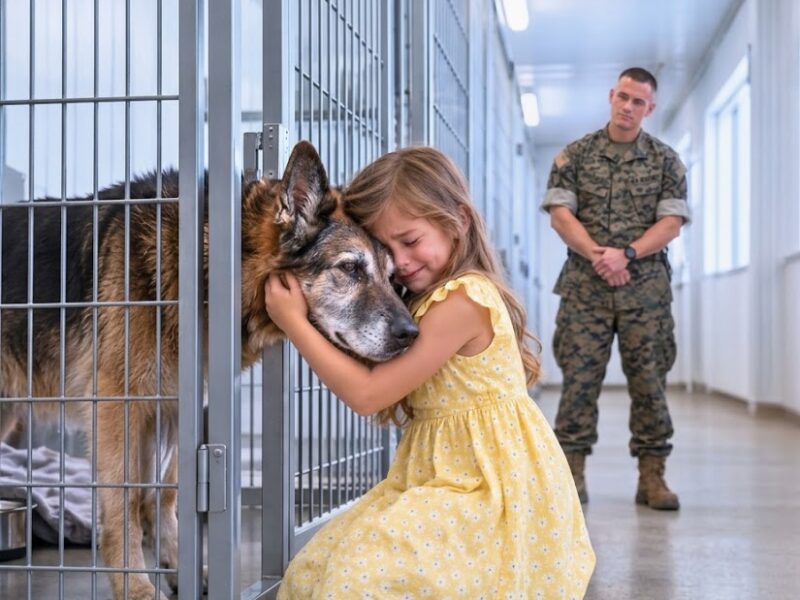
A Little Girl Hugged the German Shepherd Nobody Wanted—Then Her Marine Father Recognized the Scar Behind Its Ear
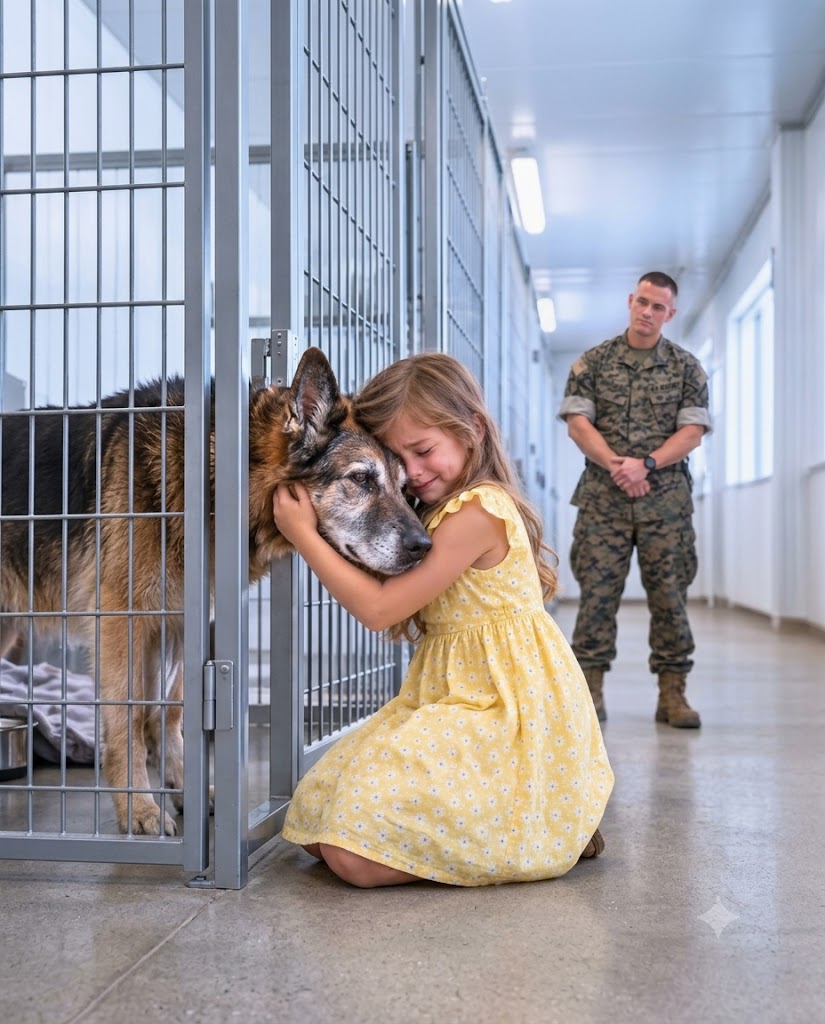
“Daddy, look at him.”
Ellie whispered beside the kennel, her small fingers wrapped around the steel bars.
Staff Sergeant Mason Reed turned and froze.
An aging German Shepherd stood behind the gate of a Colorado rescue shelter, his gray muzzle pressed against Ellie as she hugged him through the open door.
The dog had ignored visitors for months.
But when Mason lowered one hand beside his left leg, the shepherd instantly stepped into a perfect heel and sat.
Beneath his collar hung a scratched tag.
SRT-12.
That was no ordinary shelter dog.
—
A microchip revealed Major had once served with a mountain search and rescue unit and had been listed as dead three years earlier.
Following his past would uncover missing records, a forgotten handler, and one final mission no one expected him to complete.
Late afternoon sunlight stretched across the foothills outside Colorado Springs, turning the distant Front Range mountains pale gold beneath a wide September sky.
A cool wind moved through the cottonwoods around Front Range Animal Rescue, carrying the first hint that summer was nearly finished.
Staff Sergeant Mason Reed pulled his dark gray pickup beside the shelter entrance and shut off the engine.
For several seconds, he did not move.
An unopened envelope rested inside the center console beside his keys.
Mason had received it four days earlier from the Colorado Office of Emergency Preparedness, offering him a position as an emergency training coordinator once his current Marine Corps assignment ended.
He already understood what the job meant.
Planning evacuation exercises, training local emergency teams, coordinating responses before storms, fires, or other disasters turned confusion into something worse.
It would use nearly everything the Marine Corps had taught him without requiring the same long absences from home.
That should have made the decision easy.
It had not.
At forty-two, Mason Reed still looked unmistakably military, even in civilian clothes.
He stood six-foot-two, broad through the shoulders, with close-cropped dark brown hair showing faint gray near both temples, and a face weathered by years spent outdoors.
He was not unfriendly, although strangers sometimes assumed so.
Mason had simply spent much of his adult life learning to observe before reacting.
Years of deployments, training exercises, and responsibility for younger Marines had given him a calm manner that rarely changed, even when everything around him did.
His daughter had inherited none of that restraint.
“Dad, are we going in?”
Eight-year-old Ellie Reed was already halfway out of the passenger door.
She had long, light brown hair falling loosely across the shoulders of a yellow summer dress and carried a folded fleece blanket almost as wide as she was.
Ellie was small for her age, quick to smile, quicker to ask questions, and almost incapable of pretending she did not care about something.
The last two months had been harder on her than she admitted.
A recent move had placed her in a new school where everyone else seemed to have known one another for years.
She had made acquaintances, but no real friends yet.
Mason noticed that she talked more about animals lately.
Animals did not care whether you were the new kid.
“We’re donating the blankets,” Mason reminded her as he climbed from the truck.
“That’s all.”
Ellie looked at him over the roof.
“I know.”
Mason narrowed his eyes slightly.
That answer had come too quickly.
They carried two bags of dog food and several folded blankets toward the entrance.
Front Range Animal Rescue was smaller than Mason expected.
A low tan building with fenced exercise yards behind it and a hand-painted sign near the walkway.
A row of young trees separated the property from the road.
Nothing about the place felt sad.
Volunteers moved between kennels carrying bowls, towels, and laundry baskets while several dogs watched from outdoor runs.
Ellie stopped to greet nearly every one of them.
Mason kept reminding her that they were only dropping things off.
She kept agreeing.
Neither of them sounded particularly convincing anymore.
—
Inside, they were met by Clare Dawson.
Clare was twenty-six, slender and energetic with curly auburn hair pulled into a loose ponytail and freckles scattered across her nose.
She wore jeans, worn sneakers, and a green rescue t-shirt with one sleeve slightly stained from whatever she had been cleaning earlier.
Clare had volunteered at Front Range for almost three years while studying veterinary technology.
She had the kind of personality that made nervous animals relax because she rarely rushed them.
People received the same treatment.
“Ellie Reed?” Clare asked.
Ellie blinked.
“How do you know my name?”
“You wrote it on every blanket label.”
Ellie looked proud of herself.
Mason looked at the stack she had.
Clare showed them the supply room, and Ellie insisted on carrying the smaller bags herself.
When they finished, Clare offered to show her the dog wing.
Mason checked his watch.
“Five minutes.”
Ellie smiled.
“Ten.”
“Six.”
“Eight.”
“Seven.”
“Deal.”
Clare laughed.
“You negotiate with her often?”
“Every day.”
The large dog kennels occupied a bright hallway near the rear of the building.
Several dogs came forward almost immediately.
A young Labrador pressed both front paws against its gate.
A brindle mixed breed wagged so hard its entire body moved.
Another dog carried a red rubber ball to the bars as if presenting evidence that adoption would be an excellent decision.
Ellie stopped at every kennel.
Mason remained several steps behind.
Then Ellie stopped walking.
At the very end of the row was one more enclosure.
Unlike the others, there was no dog waiting at the gate.
An old German Shepherd lay in the back corner on a folded gray blanket.
He was large, though age and lost weight had narrowed his frame.
His coat was black and tan, dark across the shoulders and back, with lighter fur along the legs and chest.
Gray had spread heavily around his muzzle and beneath his eyes.
One ear stood straight, the other leaned slightly outward.
His paws were large, his chest deep, and even while resting, there was something disciplined about the way his body faced the kennel entrance.
A card attached to the gate read: “Major. Male, approx. 9 years. Calm, experienced. Home preferred.”
Ellie looked toward Clare.
“How long has he been here?”
“Almost three months.”
Ellie looked back at the shepherd.
“Why?”
Clare leaned against the opposite kennel.
“Mostly because he doesn’t really sell himself.”
Mason glanced at her.
Clare smiled faintly.
“That sounds strange, but some dogs run to the door when visitors arrive. Major doesn’t. He doesn’t chase toys much. He doesn’t bark for attention. He doesn’t climb onto people.”
“Is he scared?” Ellie asked.
“Not exactly.”
Clare looked toward Major.
“He watches.”
That was a better description.
Even from the floor, the shepherd’s eyes were tracking the hallway.
Mason noticed something else.
Major had chosen the only location inside the kennel that allowed him to see both the front gate and the narrow service passage behind the enclosure.
Not comfort.
Visibility.
“How did you get him?” Mason asked.
Clare’s expression became more thoughtful.
“County animal control found him about six months ago near an abandoned warehouse south of town. No owner information came up at the time. Another shelter held him first, then transferred him here.”
“Was he injured?”
“Nothing serious. Mostly tired, underweight, and overdue for routine care.”
Clare lowered her voice.
“He was polite with everyone. Just distant.”
Ellie crouched outside the kennel.
Major did not move.
She waited.
Mason almost told her their seven minutes had passed.
Then the shepherd lifted his head.
Clare straightened slightly.
Major looked directly at Ellie.
Not past her.
At her.
Ellie slowly lowered herself to the floor.
“Hi, Major.”
The shepherd remained still for several seconds, then he stood.
His movements were slower than a younger dog’s, but controlled.
He crossed the kennel.
Ellie extended one hand through the safe opening near the gate.
Mason took half a step forward.
Clare raised a reassuring hand.
“He’s gentle.”
Major did not immediately sniff Ellie’s fingers.
He studied her face.
Then he moved closer and quietly pressed the side of his head against her chest.
Ellie’s expression changed instantly.
She wrapped both arms around his neck as far as the barrier allowed.
“Oh.”
That was all she said.
Major closed his eyes.
Mason stood several feet behind them.
Something about the moment tightened unexpectedly in his chest.
Ellie had seemed more guarded since the move.
At school, she spoke carefully about classmates.
At home, she often insisted everything was fine before Mason had even asked.
But there was nothing guarded in the way she held that old shepherd.
Clare watched quietly.
“He hasn’t done that before.”
Mason looked at her.
“With anyone?”
“Not since I’ve known him.”
A metallic clatter suddenly rang from farther down the hallway.
A shelter employee had dropped a ring of keys beside a cleaning cart.
Major’s head lifted immediately, his ears came forward.
He looked toward the sound.
Then, before doing anything else, he turned his eyes back toward Ellie.
Only after confirming where she was did his attention return to the hallway.
Mason’s expression changed.
That sequence had been too deliberate to ignore.
—
Later, Clare brought Major into a small visitation room so Ellie could sit beside him without the kennel gate between them.
A few tennis balls sat in a basket.
Major ignored them.
Ellie rolled one toward him.
The ball tapped his paw.
Major looked down at it.
Then he looked at Ellie as if waiting for her to explain why she had done that.
She laughed.
“You don’t play.”
“He almost never does,” Clare said.
“What does he like?”
Clare considered the question.
“Structure.”
Mason turned slightly.
Clare pointed toward the feeding area through the window.
“Every evening we bring food down the row. Major doesn’t touch his bowl until the dogs around him have theirs.”
Mason looked at the shepherd.
“Every time?”
“Every time.”
Major was now sitting beside Ellie, not leaning against her, watching the room.
Mason had spent enough years around working dogs on military installations to know that training left patterns behind.
Not every unusual behavior meant something important.
But several unusual behaviors together were harder to dismiss.
Without thinking about it, Mason let his left hand drop beside his thigh.
It was a small movement, something he had seen handlers use years before when directing trained dogs into position.
Major reacted instantly.
He stood, moved away from Ellie, crossed directly to Mason’s left side, turned, sat.
Perfect alignment.
Mason became completely still.
Clare stared.
Ellie looked between them.
“Dad?”
Mason did not answer immediately.
He had never given Major a verbal command.
He had barely given him a signal.
Yet the shepherd sat with his shoulder aligned near Mason’s knee, looking upward and waiting.
Mason slowly crouched.
“Who trained you?”
Major remained focused.
Only then did Mason notice something beneath the thick fur around his neck.
A scratched metal plate hung behind his ordinary shelter tag.
Mason carefully turned it outward.
Most of the surface had been worn smooth.
Four characters remained clearly visible.
SRT-12.
Ellie leaned closer.
“What does that mean?”
Mason ran his thumb across the numbers.
“I’m not sure.”
That was not entirely true.
He did not know what this specific code meant, but he recognized the format.
Years earlier, during joint emergency response exercises, Mason had seen identification markings like it attached to working dogs assigned to organized search teams.
He looked at Major again.
The old shepherd was still seated beside his left leg, quiet, patient, waiting.
Seven minutes had turned into nearly an hour.
Mason had come to Front Range Animal Rescue to donate blankets and dog food.
He had planned to leave without changing anything about their lives.
Instead, his daughter was sitting on the floor beside a dog nobody had wanted for almost three months.
And beneath Major’s collar was a worn metal tag that suggested he had once belonged somewhere very different.
SRT-12.
Mason had seen codes like that before.
Not in animal shelters.
In search and rescue units.
—
Mason Reed signed the seven-day foster agreement the following afternoon, although Ellie treated the word “temporary” as though it were a technical mistake adults had invented.
By the time Major climbed into the rear seat of Mason’s pickup, she had already placed a folded blanket beside him, filled a small water bottle for the drive, and announced that the old shepherd preferred the left side of the vehicle.
Mason did not ask how she had reached that conclusion.
Major settled behind the passenger seat, watched the shelter disappear through the rear window, then shifted his attention toward Ellie, as though confirming she was still there.
The Reed house sat in a quiet residential neighborhood on the northern edge of Colorado Springs, where newer homes gradually gave way to open fields and long views toward the mountains.
Mason had chosen the place because it was close enough to his current assignment, while still giving Ellie a fenced yard and a little distance from military housing.
He had expected the move to make life feel more settled.
Instead, half-unpacked boxes still occupied one corner of the garage, Ellie was still learning names at her new school, and the unopened emergency training coordinator letter remained inside his pickup.
Major entered the house cautiously.
He did not wander from room to room like a curious pet.
He inspected them.
He paused at the kitchen entrance, looked through the dining room, checked the sliding back door, then moved toward the stairs.
Ellie followed with a spiral notebook she had bought after school.
Across the front she had written in purple marker: “Major’s Rules.”
“Rule number one,” she said. “Major likes quiet.”
Mason glanced toward the shepherd.
“You’ve known him less than twenty-four hours.”
“I’m observing.”
Major climbed the stairs slowly, favoring one rear leg slightly after the effort.
At the top, he checked Ellie’s bedroom first, then Mason’s room, then the small landing overlooking the staircase.
That evening, Mason placed a dog bed beside Ellie’s door.
Major ignored it.
Instead, he lay halfway between Ellie’s room and the top of the stairs, where he could see anyone approaching from below.
Mason noticed.
Near midnight, Ellie coughed once from inside her room.
Major immediately lifted his head.
He stood, walked to her doorway, looked inside, then returned to the landing when everything appeared normal.
By morning, Mason had stopped thinking of the behavior as coincidence.
He took Major into the backyard after breakfast.
The shepherd moved comfortably enough, but showed almost no interest when Ellie rolled a tennis ball across the grass.
Major watched it travel, looked at Mason, then sat down.
Ellie opened her notebook.
“Rule number two. Major thinks tennis balls are pointless.”
“That one might actually be accurate.”
Mason waited until Ellie went inside for her sweater.
Then he tried something simple.
He lowered one hand beside his left leg.
Major moved in to heel.
Mason raised a flat palm.
Major stayed.
He lowered his hand toward the ground.
Major went down.
The responses were not fast in the way they might have been years earlier, but they were precise.
Major seemed to know what Mason wanted before the movement was complete.
Then Mason tried a search cue he remembered from joint training exercises.
Major’s entire posture changed.
His ears lifted.
His attention sharpened.
The age in his movements seemed to recede beneath concentration.
Mason ended the exercise almost immediately.
He had no intention of pushing an older dog simply to satisfy curiosity.
A few minutes later, Ellie came running from the house.
“My bracelet is gone.”
The bracelet was a simple braided blue cord with a small silver star.
Inexpensive, but important because a girl from Ellie’s previous school had given it to her before the move.
Ellie had been wearing it while helping carry leaves toward the yard waste bin.
They searched near the porch first.
Nothing.
Mason noticed one of Ellie’s gardening gloves resting beside the steps.
He picked it up and let Major smell it.
The shepherd inhaled once, then again.
Major lowered his head and moved across the yard.
He checked near the porch, crossed toward the fence, circled a patch of taller grass, then stopped beside a row of shrubs near the back corner.
He sat.
Ellie ran over carefully.
Her bracelet lay beneath the leaves.
She stared at Major, then at Mason.
“He found it.”
Mason was staring, too.
“That he did.”
Major received no excitement beyond Ellie wrapping both arms around his neck.
He tolerated that for several seconds before looking toward Mason as though waiting for the next task.
—
That afternoon, Mason scheduled an examination at Pikes Peak Veterinary Center.
Dr. Hannah Brooks met them in a quiet treatment room near the back of the clinic.
Hannah was thirty-nine, medium height and lean, with dark auburn hair tied behind her neck and calm green eyes that seemed to notice small changes before anyone mentioned them.
She wore navy scrubs beneath a gray veterinary coat and spoke softly around nervous animals.
Earlier in her career, she had worked with retired police and military dogs at a rehabilitation program near Denver.
Several years around aging working animals had taught her not to confuse silence with weakness or obedience with comfort.
She let Major approach her first.
“He’s careful,” Hannah said.
“He watches everything,” Ellie replied.
“I noticed.”
The examination showed that Major was generally stable for his age.
His joints were stiff but manageable.
His weight needed improvement, and he had several old marks consistent with an active life.
One longer scar along his side caught Hannah’s attention.
“Old injury?” Mason asked.
“Very old,” she said. “Completely healed. Without records, I couldn’t tell you what caused it.”
She did not speculate further.
Then Mason showed her the metal tag.
SRT-12.
Hannah’s expression sharpened.
“That could be a unit identifier.”
“That’s what I was thinking.”
She brought out a microchip scanner.
The device registered almost immediately.
Hannah entered the number into several databases and waited.
Ellie stood beside Major with one hand resting gently against his shoulder.
A record appeared.
Hannah leaned closer.
“Here we go.”
Mason moved beside the monitor.
Name: Major.
Unit: Summit Rescue Task Force.
Identifier: SRT-12.
Handler: Captain Ryan Keller.
Ellie looked at Major.
“He really was a rescue dog.”
Hannah continued reading.
Then her expression changed.
The final entry showed: “Retired. Transferred to Mountain Ridge Working Dog Sanctuary.”
Hannah searched the organization.
The sanctuary had closed nearly four years earlier.
Most of its online pages were archived.
Some records had been moved.
Others appeared incomplete.
But an old contact file still listed Ryan Keller.
Mason called.
A man answered after several rings.
His voice was low, measured, and cautious.
Ryan Keller was fifty-four, as Mason learned later.
A former rescue team captain with graying black hair, a broad, weathered face, and the steady manner of someone accustomed to making decisions in difficult terrain.
After leaving active fieldwork, Ryan had moved north toward Fort Collins and kept mostly to himself.
Mason introduced himself.
Then he said the number.
“SRT-12.”
Silence followed long enough that Mason checked the screen to make sure the call had not disconnected.
Finally, Ryan spoke.
“Say that again.”
“SRT-12. The dog’s name is Major.”
Another silence.
Then Ryan’s voice became quieter.
“Major was my dog.”
Mason looked toward the old shepherd lying beside Ellie’s chair.
Ryan continued.
“And I was told he died three years ago.”
A photograph arrived on Mason’s phone before the call ended.
A younger Major stood beside Ryan in a red search harness, powerful and alert against a landscape of broken rock and emergency equipment after a mountain slide.
Around his neck hung the same metal tag.
SRT-12.
That night, Major returned to his place on the upstairs landing.
Ellie slept behind one door.
Mason stood quietly at the other.
According to the official record, Major had been dead for three years.
But the old shepherd was lying outside his daughter’s room, listening to every movement in the house.
—
By the third morning after Ryan Keller’s call, Mason Reed had stopped treating Major’s history as an odd shelter mistake.
The photograph of the younger shepherd in the red search harness still sat on his phone, and every time Mason looked at it, he saw the same scratched tag hanging beneath Major’s collar.
SRT-12.
The same dog was now stretched across the upstairs landing, one ear raised toward Ellie’s bedroom while morning light entered through the stairwell window.
Mason knew enough about institutional errors to understand that one incorrect record could happen.
But a dog officially listed as dead while living somewhere else for three years meant there had been more than one failure.
He called Deputy Caleb Turner before breakfast.
Caleb was forty-five, slightly shorter than Mason, but thick through the shoulders with close-cropped sandy hair, a square face, and pale blue eyes that rarely showed surprise.
The two men had met years earlier during a county emergency response exercise and remained friends because they shared the same preference for facts over theories.
Caleb had served six years in the Army before joining the El Paso County Sheriff’s Office.
He was patient, almost stubbornly methodical, and disliked dramatic conclusions before documents supported them.
When Mason finished explaining Mountain Ridge Working Dog Sanctuary, Ryan’s photograph, and the contradictory record, Caleb was quiet for several seconds.
“I can look,” he finally said. “But looking and proving are different things.”
Mason expected exactly that answer.
Mountain Ridge had once been a legitimate retirement facility for older police dogs, military working dogs, and civilian search and rescue animals.
Its original owner, a former canine trainer named Thomas Avery, had developed health problems several years earlier and eventually sold the property.
After that, ownership changed again.
Staff numbers dropped and records began moving between paper files, private computers, foster coordinators, and partner facilities.
Nothing Caleb initially found suggested a deliberate scheme.
The problem was almost the opposite.
Too many people had handled pieces of the system, and no one appeared to have retained the complete picture.
Some retired dogs went directly to approved families.
Others were transferred to smaller facilities.
Several were temporarily fostered.
A handful, including Major, had records that stopped making sense.
The electronic database showed Major as deceased from age-related complications three years earlier.
Caleb found the entry easily.
Then an archived paper transfer sheet surfaced from a county storage request.
That document listed SRT-12 differently.
“Transferred. Red Mesa Rehabilitation Farm.”
There was no receiving signature, no intake confirmation, no later medical record proving Major ever arrived.
Caleb called Mason that evening.
“I’ve got two records saying two different things.”
Mason stood in the kitchen while Major rested near the patio door.
“So which one is right?”
“That’s the problem. I don’t know yet.”
“Could somebody have entered the wrong dog?”
“Possible.”
“Could Major have been transferred and then lost from the system?”
“Also possible.”
Caleb paused.
“But right now, possible is all I can give you.”
Mason accepted that.
Major had already spent three years inside assumptions made by people who thought they knew where he was.
Mason had no intention of adding another one.
—
While he looked backward into Major’s past, Ellie began doing something entirely different.
Her teacher had assigned a small class project about improving the local community, and Ellie chose senior shelter dogs before Mason even knew the assignment existed.
She had learned from Clare that older dogs were often passed over because families naturally noticed puppies first.
Ellie decided the problem was not that senior dogs had nothing to offer.
People simply did not know anything about them.
So she made cards.
Not adoption cards filled only with age, weight, and breed.
Ellie wrote what each dog liked, what frightened them, whether they preferred quiet rooms, whether they walked slowly, whether they liked blankets, car rides, or sitting beside someone while that person read.
Across the top of the first poster, she wrote: “Old Dog, New Home.”
Major became the first example.
His card included: “Does not care about tennis balls. Watches doors. Likes having a job. Very good at finding things. Pretends not to enjoy hugs.”
Mason read the final line twice.
“He does not pretend.”
Ellie looked toward Major, who was leaning against her leg.
“Evidence says otherwise.”
Front Range Animal Rescue posted a photograph of Ellie sitting beside Major along with several of her cards.
Within two days, families began asking about older dogs they had previously overlooked.
One of them was Benny, an eleven-year-old yellow Labrador with cloudy brown eyes, a thick cream-colored coat, and a slow, cheerful walk.
Benny had arthritis and preferred sleeping beneath Clare’s desk to playing outside.
Ellie described him as an expert at keeping people company.
A retired couple from Monument saw the card and scheduled a visit.
Mason watched Ellie explain Benny to them at the shelter that Saturday.
She was still quiet around children at her new school, but here she spoke confidently, answered questions, and introduced dogs as if she had known them for years.
For the first time since the move, Mason realized she was beginning to build something of her own in Colorado.
That same afternoon, he found the emergency training coordinator letter beneath a stack of mail.
Ten days remained before the offer expired.
He folded it again without answering.
Ryan Keller called later that evening.
He wanted to come to Colorado Springs.
Then his certainty disappeared.
“What if he doesn’t remember me?” Ryan asked.
Mason looked across the living room at Major sleeping beside Ellie’s chair.
“I don’t know.”
Ryan gave a short breath.
“Six years together, and somehow that’s the question I can’t stop asking.”
He decided to wait a little longer.
—
Three days after Front Range posted Ellie’s project online, Clare called Mason.
“A man contacted us about Major.”
Mason straightened.
“What kind of man?”
“His name is Walter Briggs. He says he worked at Red Mesa.”
Walter was sixty-one, tall but slightly stooped with thinning gray hair, heavy eyebrows, and hands roughened by decades of maintenance work.
Since Red Mesa closed, he had lived alone in a small rented trailer outside Fountain and taken occasional repair jobs when he could find them.
He spoke carefully, as though years of being ignored had taught him not to expect people to consider his memories important.
Walter told Clare he remembered SRT-12 not because Major had been difficult, but because he had been unusual.
“He never made noise just because someone walked past,” Walter explained when Mason later joined the call.
“He watched.”
Mason looked at Major.
“That sounds like him.”
Walter continued.
During feeding, Major had often positioned himself near older, weaker dogs.
When unfamiliar workers entered the kennel area, he did not challenge them.
He simply placed himself between those dogs and the aisle until he understood what was happening.
Walter remembered the tag.
SRT-12.
And he remembered something else.
After Red Mesa closed, he had written down several transfers because paperwork was disappearing faster than animals were moving.
“You still have those notes?” Mason asked.
A pause followed.
“I think so.”
That evening, Walter opened an old plastic storage box beneath his kitchen table.
Inside were receipts, employment papers, faded photographs, and a black spiral notebook he had not touched in years.
He turned through page after page, then stopped.
There, halfway down one sheet, was a familiar number.
SRT-12. Moved east after Red Mesa closure.
Below it, Walter had written an address.
—
The address beneath Walter Briggs’s note led south toward Pueblo, Colorado, where the Front Range flattened into open country beneath a broad blue sky.
The old foster property sat beyond a narrow county road bordered by dry grass, cottonwoods, and weathered fencing.
Nothing about it looked mysterious from a distance.
There was a small farmhouse, a long metal storage building, three aging kennel structures, and a faded wooden sign with no readable name remaining.
Major changed before Mason even parked.
The old shepherd had spent most of the drive lying quietly beside Ellie in the rear seat, but as the property came into view, his head lifted, his ears moved forward.
He stood carefully, staring through the window.
Mason noticed immediately.
“You know this place.”
Major did not look at him.
Caleb Turner was already waiting beside a county vehicle with Walter Briggs and an animal services investigator named Dana Mitchell.
Dana was forty-seven, medium height and strongly built with short silver-blonde hair and a practical manner that made even ordinary questions sound important.
She had worked county animal services for almost eighteen years and had learned during several shelter closures that confusion could harm animals even when nobody intended it.
Because of that, she trusted paperwork only after comparing it against the people, places, and dates behind it.
Walter looked smaller outside than Mason remembered from their video call.
His old brown work jacket hung loosely from his shoulders, and he carried the black spiral notebook inside a clear plastic sleeve as though it had suddenly become more valuable than anything else he owned.
“This is it,” Walter said.
Major stepped from the truck.
For several seconds, he stood completely still.
Then he pulled slightly toward the kennels.
Not enough to drag Mason, enough to show recognition.
Ellie saw it, too.
“He remembers.”
Mason kept the leash loose and let Major choose the pace.
The shepherd moved past the first kennel row, paused near an old water station, then continued toward the metal storage building.
When they reached the entrance, Major stopped.
His posture tightened.
He looked inside the dark doorway, then turned away.
Mason did not encourage him forward.
“You don’t have to.”
Major moved back toward Ellie and stood beside her.
Dana watched without comment, although she wrote something into her notebook.
The property had served as a temporary foster site after Red Mesa Rehabilitation Farm began closing.
Most of the dogs staying there had been older working animals waiting for permanent placement.
The facility itself had never been designed as a full retirement center.
It had been a bridge between places.
That was exactly where the trouble began.
Inside the farmhouse office, boxes of archived paperwork remained on metal shelving.
The current property caretaker had preserved them because nobody had ever formally authorized disposal.
Dana, Caleb, and Walter spent nearly three hours comparing names, identification numbers, intake sheets, handwritten notes, and transfer forms.
Mason stayed nearby with Ellie and Major.
Slowly, Major’s missing years began taking shape.
Mountain Ridge Working Dog Sanctuary had transferred several dogs shortly before its closure.
Some records went electronically, others traveled as printed files.
When Mountain Ridge changed ownership, a batch of identification numbers was apparently entered incorrectly.
Major’s designation SRT-12 had been associated with another elderly shepherd whose file later recorded a natural death.
That error became Major’s official status.
Dead.
Meanwhile, the real Major had been transferred to Red Mesa.
Red Mesa later faced financial problems and closed.
Major then moved to the Pueblo foster property.
His temporary foster coordinator, a retired teacher named Margaret Lane, had planned to keep him until a permanent home became available.
Margaret had been a quiet woman in her late sixties who preferred older animals because she believed they were too often overlooked.
According to the surviving notes, she had taken special interest in Major.
But Margaret died unexpectedly the following year.
Afterward, responsibility for several dogs passed between relatives, local volunteers, and rescue contacts.
Major’s microchip was never updated.
Red Mesa no longer existed.
Mountain Ridge believed him deceased.
The Pueblo property assumed another organization had completed the transfer.
No one person held the entire chain.
Caleb placed two documents side by side.
“I think this is where the death record came from.”
One listed SRT-12.
The other listed SRT-17.
The names had been entered beside the wrong identification numbers during Mountain Ridge’s closure.
Mason stared at the papers.
“So Major didn’t disappear in one moment.”
Dana shook her head.
“No, he disappeared a little at a time.”
That answer bothered Mason more than any dramatic explanation might have.
Major had not been deliberately erased.
He had been passed through enough incomplete systems that eventually everyone believed somebody else knew where he belonged.
Outside, Ellie sat beside Major beneath a cottonwood tree.
Two older dogs remained at the property under the care of the current caretaker because their final adoption paperwork had never been completed.
One was Rosie, a twelve-year-old black Labrador with a graying face and a slow, gentle walk.
The other was Chester, a ten-year-old shepherd mix with large ears and a thick tan coat.
“They’re still waiting,” Ellie said.
Dana nodded.
“Technically, yes.”
Ellie immediately opened her Old Dog, New Home notebook.
By that evening, Clare at Front Range Animal Rescue had agreed to help bring both dogs into Ellie’s project once the county finished their paperwork.
Walter found something else before they left.
Behind a shelf in the storage building was an old red working dog harness.
The fabric was faded.
One side carried the letters SRT.
Walter held it silently.
Mason did not need Major to wear it to understand what it meant.
—
Back in Colorado Springs, Walter began volunteering at Front Range twice a week.
At first, he only repaired a loose kennel latch.
Then Clare asked about a damaged gate, then a shelf, then a section of outdoor fencing.
Within two weeks, Walter had stopped waiting to be asked.
He arrived each morning with a small toolbox.
For the first time in years, someone expected him somewhere.
Ellie had begun saving money, too.
Every dollar went into a glass jar labeled “Major Bed.”
She had researched orthopedic dog beds and decided Major deserved the largest one available.
Mason pretended not to notice that she had already chosen its color.
Late that evening, his phone rang.
Ryan Keller.
“I’m coming down,” Ryan said.
Mason looked toward Ellie.
She was sitting on the floor beside Major, writing another rule in her notebook.
Mason had not told her Ryan was considering visiting.
He knew exactly what she would fear.
That Major’s old handler had come to take him away.
“When?” Mason asked.
“Tomorrow.”
After the call ended, Mason looked at Major.
The shepherd was older now, slower, officially alive again after three years of paperwork saying otherwise.
Ryan Keller was finally on his way to Colorado Springs.
But before the two former partners stood face to face, Major would be asked to do something nobody expected a nine-year-old retired search dog could still do.
—
The storm arrived faster than anyone expected.
By late afternoon, dark clouds had rolled over the foothills west of Colorado Springs, turning the bright September sky gray above Front Range Animal Rescue.
Ellie had spent most of the day helping Clare sort donated towels for Old Dog, New Home while Mason repaired labels on several supply bins.
Major rested near the office doorway, watching the constant movement with the same quiet attention he brought everywhere.
Ryan Keller was supposed to arrive in Colorado Springs the following morning.
Mason had still not told Ellie.
A sudden burst of wind pushed across the property, followed by heavy rain and a brief power failure that darkened the kennel building.
Staff members immediately began moving dogs from the outdoor runs into the safer interior rooms.
The process was controlled, but one recently rescued German Shepherd became frightened when the routine changed.
Because the name Rosie had already been used for an older Labrador connected to the Pueblo property, the young shepherd was known here as Juniper.
She was about fourteen months old, tan with a dark saddle across her back, oversized ears, and a narrow face that still looked almost puppy-like.
Juniper was gentle, but deeply uncertain around unfamiliar people.
Since arriving two weeks earlier, she had preferred corners, quiet voices, and distance.
During the transfer, a side gate failed to close completely.
Juniper slipped through.
Nobody saw which direction she took until Clare reached the yard and noticed the empty run.
Within minutes, the shelter organized a search.
Caleb arrived to help coordinate volunteers while Mason walked the nearby road and open field.
The rain weakened, but wet ground and scattered brush made the search slow.
Juniper had not traveled with a leash, and because she was frightened easily, everyone was instructed not to chase her if they spotted her.
Ellie remained at the shelter.
She wanted to join Mason, but this time he refused.
Instead, Clare gave her an important job: preparing water bottles, clean blankets, and dry towels for the search teams when they returned.
Ellie took the responsibility seriously, arranging everything in neat rows near the front desk.
Walter Briggs arrived shortly afterward with his toolbox.
The moment he learned how Juniper had escaped, he went directly to the side gate, examined the latch, and quietly began replacing the worn hardware.
Hours passed.
Caleb found several tracks leading toward an open section of foothill terrain behind the property, but they disappeared where gravel and stone replaced the softer ground.
By early evening, the search had covered every obvious route.
Mason stood beside his pickup, soaked at the shoulders and frustrated by how little progress they had made.
Major sat beneath the open tailgate.
Caleb looked toward him.
Mason immediately understood the thought.
“No.”
Caleb did not argue.
“He’s nine,” Mason continued. “His joints are stiff. He’s done enough.”
“I didn’t say anything.”
“You didn’t have to.”
Major looked between them.
A vehicle pulled into the gravel lot.
Dr. Hannah Brooks stepped out carrying a sealed plastic bag.
She had heard about Juniper through Clare and brought a towel the young shepherd had used during her last clinic visit.
“We can keep searching without him,” Hannah said when she saw Mason’s expression.
“Nobody needs Major to prove what he used to be.”
Mason nodded.
That was exactly what he believed.
Then Hannah opened the bag.
Major stood before anyone called him.
His entire posture shifted.
The old shepherd stepped toward the towel and smelled it once, then again.
His head lifted.
Mason recognized the change immediately.
The gray muzzle remained.
The stiff back legs remained.
But beneath them, something older than age had returned.
SRT-12.
Mason crouched beside him.
“We walk. No pushing.”
Major looked toward the foothills.
Caleb joined them, carrying water and a flashlight.
As daylight began fading behind the mountains, Major moved steadily along the edge of the field.
He did not rush.
He checked patches of grass, paused where the trail crossed a drainage path, then continued toward a narrow route, climbing between scattered rocks and low brush.
Mason kept the leash loose.
Twenty minutes became forty.
Major stopped twice to drink.
Each time Mason expected him to be finished, each time Major chose to continue.
Speed was no longer part of the search.
Experience was.
Near the base of a rocky slope, Major suddenly changed direction and descended toward a shallow drainage channel.
Mason saw nothing at first, then Caleb pointed.
The tan shape was partly hidden beneath low brush several yards ahead.
Juniper.
She had become trapped on the lower side of the drainage after moving into terrain she could not confidently climb back through.
She appeared tired and frightened, but responsive.
Mason started forward.
Major stopped him by stopping himself.
Instead of approaching Juniper directly, the older shepherd lowered his body onto the damp ground several yards away.
He waited.
Juniper stared at him.
Major did nothing.
No pulling, no excitement, no pressure.
A minute passed, then another.
Juniper moved slightly forward.
Major remained still.
Slowly, the younger shepherd crossed the space between them.
When she reached him, she touched her nose gently against his muzzle.
Only then did Caleb move close enough to secure a leash.
Mason rested one hand against Major’s shoulder.
“You found her.”
But that was not what impressed him most.
Major had known how not to frighten her.
He had understood that finding Juniper was only half the job.
Bringing her back required trust.
By the time they returned to Front Range, Walter had completely rebuilt the side gate latch and added a second safety closure.
Ellie ran toward them, but stopped when Mason raised one hand, allowing Clare to settle Juniper inside first.
Once the young dog was secure, Ellie knelt beside Major and pressed her forehead against his.
Mason watched them.
For months, he had treated leaving the Marine Corps as though changing missions meant becoming less useful.
Major had just walked through the foothills at nine years old and proved something different.
He was slower than he once had been.
That did not make his experience smaller.
It made every decision more deliberate.
Mason thought about the emergency training coordinator letter still waiting at home.
For the first time, he wondered whether experience could matter more after the mission changed.
—
Near the far end of the parking lot stood a man Mason had not noticed when they returned.
Ryan Keller had arrived early.
He had watched the final moments from a distance and recognized Major immediately.
But Ryan did not call to him.
He did not step forward.
He waited until Major went inside with Ellie.
Later, beside Mason’s truck, Ryan looked toward the shelter doors.
“I watched him search hundreds of times,” he said quietly.
“I’m not worried he forgot the commands.”
Mason waited.
Ryan’s eyes remained on the doorway.
“I’m worried he forgot me.”
—
Morning came clear over Colorado Springs, the previous evening’s storm already moving east beyond the plains.
Sunlight spread across the Reed family’s front yard while the foothills behind the neighborhood emerged beneath a clean blue sky.
Ellie sat on the porch steps wearing her yellow cardigan, one hand resting on Major’s shoulder.
The old German Shepherd lay beside her with his front paws crossed, tired from the previous day’s search, but comfortable after a long night of rest.
Mason stood near the kitchen window, watching the road.
He had finally told Ellie that Ryan Keller was coming.
She had asked only one question.
“Is he taking Major?”
Mason had given her the only answer he could.
“I don’t know.”
A dark blue pickup turned onto the street shortly after nine.
Major lifted his head before the vehicle reached the driveway.
Ryan parked near the curb but remained behind the wheel for several seconds.
When he finally stepped out, Mason understood immediately why the man had waited so long to make this visit.
Ryan was fifty-four, broad-shouldered but slightly stooped from years of outdoor rescue work, with heavily graying black hair, a weathered face, and deep-set brown eyes that looked more nervous than Mason had ever heard him sound on the phone.
He wore jeans, work boots, and a faded navy jacket.
Nothing about him suggested the captain who had once directed mountain search teams.
That morning, he was simply a man approaching a partner he had spent three years believing was gone.
Ryan walked halfway across the yard.
He did not call Major.
He did not whistle.
He did not use a command.
He lowered himself onto one knee and waited.
Major stood.
Ellie’s hand fell slowly away from his collar.
The shepherd stared across the grass.
Gray covered much more of his muzzle than in Ryan’s old photographs, and age had softened the powerful working dog frame Ryan remembered.
For several long seconds, Major did nothing.
Then he stepped forward.
One step.
Another.
His pace increased.
By the time he reached Ryan, the old shepherd was moving faster than Mason had seen him move anywhere except the previous day’s search.
Major stopped directly in front of his former handler and pressed his head against Ryan’s chest.
Ryan closed both arms around him.
No one spoke.
Major’s tail moved slowly across the grass.
Ryan lowered his face against the dog’s neck and remained there for a long moment, one hand resting near the scratched SRT-12 tag that had somehow followed Major through every missing year.
Ellie looked away briefly and wiped her eyes before anyone could mention them.
Later, they sat beneath the porch while Ryan showed Ellie photographs from Summit Rescue Task Force.
Major crossing snowy trails in a red harness.
Major sitting beside Ryan near an emergency command truck.
Major asleep with his chin across Ryan’s boots after a long training day.
Then Ellie asked what everyone had been avoiding.
“Are you taking him home?”
Ryan looked at her.
Major was sitting between them.
For several seconds, Ryan said nothing.
Then Ellie stood to carry an empty water bowl inside.
Major immediately rose.
He followed her three steps toward the porch before stopping and looking back at Ryan.
Ellie disappeared through the doorway.
Major watched until she was inside.
Then he returned to Ryan.
Ryan smiled faintly.
That small movement answered the question before he did.
“He remembers me,” Ryan said.
“But remembering where you came from isn’t always the same as knowing where you belong now.”
Ellie returned.
Ryan looked directly at her.
“He stays here.”
Ellie dropped beside Major and wrapped both arms around him.
Ryan did not lose Major again.
He simply became part of the life Major had chosen.
—
Once a month, Ryan drove down from Northern Colorado.
Before long, Clare invited him to help Front Range Animal Rescue evaluate retired working dogs whose habits sometimes confused ordinary adopters.
Ryan discovered he still knew how to help dogs transition from structured work into quieter lives.
Other changes followed.
The elderly Labrador Rosie from the Pueblo foster property was adopted by a quiet Colorado Springs family who wanted a senior dog rather than a puppy.
Juniper, the young shepherd Major had found in the foothills, continued gaining confidence at Front Range until a carefully matched home became available.
Walter Briggs stopped calling himself a volunteer after Clare finally offered him a part-time maintenance position.
He repaired gates, rebuilt kennel shelving, and arrived early enough each morning that several dogs learned to recognize the sound of his truck.
Ellie’s Old Dog, New Home project spread beyond her classroom.
Teachers from other schools invited her to share the idea, and students began creating personality cards for senior shelter animals throughout the area.
Ellie, who had once worried about having no friends in Colorado, slowly found herself surrounded by children who wanted to help her make the next card.
Mason made his decision, too.
He accepted the emergency training coordinator position.
Leaving regular Marine Corps service did not feel easy.
The uniform had shaped most of his adult life, but Major had changed how Mason understood transition.
The old shepherd had not stopped being valuable when search and rescue ended.
Experience had simply found another purpose.
Mason realized his own life could work the same way.
—
Months later, Front Range converted the old end section of its large dog building into a quieter space designed specifically for retired working dogs and senior animals.
They called it Major House.
Above the entrance hung the faded red SRT harness Walter had recovered near Pueblo.
One year after Major first sat alone in the last kennel, Ellie sat outside Major House reading a book beneath the afternoon sun.
Major rested beside her, his muzzle almost completely silver now.
Walter was repairing a planter nearby.
Ryan had arrived for his monthly visit.
Mason came from work before sunset and sat beside his daughter.
Major shifted closer and placed his head across Mason’s boot.
He no longer needed to find missing people.
He no longer needed to prove what SRT-12 could still do.
Major had completed enough missions.
Mason looked at Ellie, then Ryan, then the old shepherd resting between them.
Some soldiers did not lose their purpose when one mission ended.
Sometimes they simply needed to discover where everything they had learned was still needed.
Ellie leaned down and wrapped her arms around Major.
Behind them, the kennel where nobody had wanted him was gone.
In its place stood Major House.
And this time, Major was exactly where he belonged.
—
You know what stays with me most about Major’s story?
It wasn’t the SRT-12 tag or his final search.
It was that after three lost years, he still remembered what mattered most.
Protect.
Search.
Stay close to those who needed him.
Most people saw an old shelter dog nobody wanted.
Ellie and Mason saw a lifetime of loyalty behind that gray muzzle.
And when Major remembered Ryan but still chose to stay with Ellie, he showed that loving your past does not mean leaving the home where your heart is found.
Maybe that was what God wanted Mason to understand.
A new mission does not erase your value.
Major found a family.
Ryan found his old partner.
Walter found purpose again.
And Ellie created Old Dog, New Home.
Sometimes purpose is not lost.
It simply changes where it leads you.
Tonight, I pray God blesses you, protects your family, heals the parts of your life that feel forgotten, and reminds you that you are still valuable even when your season changes.
If Major’s story touched your heart, write amen in the comments.
And if you believe in loyalty, family, faith, and second chances, subscribe and stay with us.
But Major was not the last old canine whose past refused to stay buried.
Wait until I tell you about the retired Marine who found an aging German Shepherd sitting alone beside an abandoned ranger station high in the Montana mountains.
Around his neck was a faded search and rescue tag belonging to a handler who had vanished years earlier.
Every evening, the dog returned to the same mountain trail as if he were still waiting for someone to come home.
And when the Marine finally opened an old storage locker inside that ranger station, what he found forced an entire county to look again at a search they thought had ended long ago.
Subscribe now, because the next story begins with one old dog refusing to leave a mountain and ends with a homecoming nobody believed was still possible.









