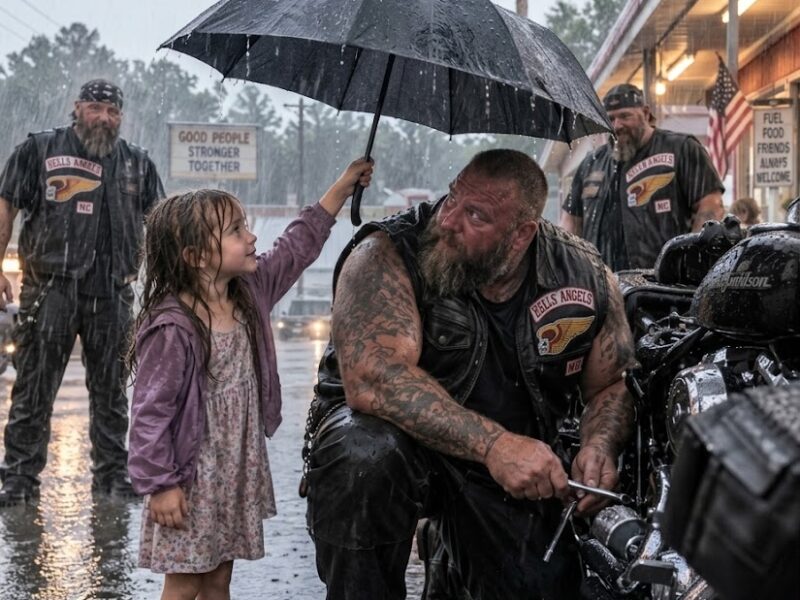
A little girl gave her only umbrella to a soaking wet biker stranded in the rain — she had no idea who he really was.
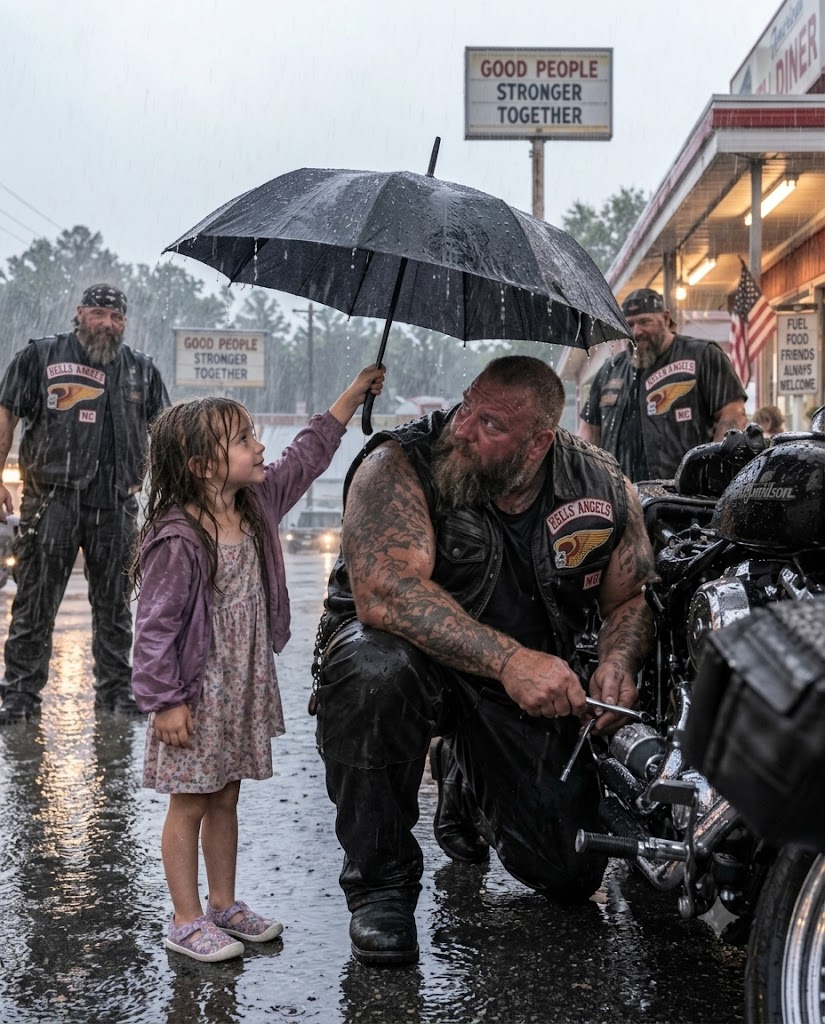
The rain had been falling over Asheville since noon, the kind of steady mountain rain that didn’t storm so much as commit.
It was the third Thursday in October, and eleven-year-old Hannah Whitfield was walking home from Irwin Middle School the way she always did, following Chestnut Street down toward the modest blue house she shared with her mother, Rachel, and her seven-year-old brother, Caleb.
The umbrella in her backpack was a birthday gift from her grandmother. Bright yellow, patterned with small sunflowers, sturdy enough to survive a Carolina downpour.
She was three blocks from home when she saw the motorcycle.
It was pulled halfway onto the shoulder of Montford Avenue, tilted at an angle that suggested it hadn’t been parked so much as abandoned mid-collapse. Beside it stood a man who looked like every warning her mother had ever given her about strangers made flesh.
He was well over six feet tall, built like someone who worked with his hands and his back, his arms sleeved in tattoos that disappeared under a leather vest gone dark and heavy with rainwater. A gray beard soaked flat against his jaw. Boots crusted with mud.
He stood with his head down, one hand braced against the motorcycle seat, and even from thirty feet away, Hannah could see that his shoulders were shaking. Not from cold, she would later understand, but from something closer to grief.
Her first instinct, the one drilled into her by every cautious adult in her life, was to cross the street. She almost did it. Her foot actually turned, angling toward the opposite curb.
The safe distance. The sensible choice.
But something made her stop. Maybe the way his hand trembled against the motorcycle seat. Maybe the fact that a man that size in weather that cold wasn’t sheltering under the gas station awning fifty yards away.
He wasn’t moving at all. He was just standing there, letting the rain hit him like a punishment he’d decided to accept.
Hannah thought of her father. She didn’t remember much about him. He’d left when she was four. But she remembered, or thought she remembered, the specific stillness of a grown man trying very hard not to fall apart in public.
It was a stillness she recognized instantly in the biker on Montford Avenue, and recognizing it undid every warning in her head.
She crossed toward him instead of away.
“Sir.” Her voice came out smaller than she wanted it to. “Are you okay?”
The man’s head came up slowly, and for a moment Hannah’s courage wavered. His eyes were red-rimmed, bloodshot in a way that rain alone couldn’t explain, and there was a rawness to his face that made him look, despite his size, unbearably breakable.
He didn’t answer right away. When he did, his voice was rough, low, careful, like a man unused to being spoken to gently and unsure how to respond to it.
“Bike’s dead,” he said. “Battery, probably. I’m fine.”
He was not fine. Hannah could see that the way she could see rain was wet.
“You’re going to get sick standing out here,” she said.
And before she could talk herself out of it, she unzipped her backpack, pulled out the yellow sunflower umbrella, and popped it open. She stepped forward and held it up absurdly, since he was nearly two feet taller than she was.
The umbrella barely reached his shoulders, but she held it as high as her arm would go anyway, angling it to catch the worst of the rain coming off the ridge behind them.
The man looked down at her, and something in his expression cracked open.
“Kid,” he said. “You don’t need to do that.”
“I know,” Hannah said, “but you looked like you needed it more than me.”
He stared at her for a long moment, rain running down his beard, down the collar of his vest, and Hannah watched something pass behind his eyes that she didn’t have a name for yet.
Not gratitude exactly, not surprise exactly, but some collision of both with a third thing she would only understand much later, the particular shock of being seen as human by someone who owed him nothing.
“What’s your name?” he asked.
“Hannah.”
“Thomas,” he said. “Thomas Callahan.”
She held the umbrella toward him, pushing the handle into his free hand. “Take it. I only live a few blocks that way. I’ll be fine.”
“I can’t take a kid’s umbrella.”
“You can if I’m giving it to you.”
She said it the way her mother said things when a conversation was over. And something about the phrase, so clearly borrowed from someone else’s authority, made the corner of Thomas’s mouth twitch. The first almost-smile he’d managed in longer than Hannah could have guessed.
He took the umbrella. His hand, when it brushed hers, was cold as the rain itself.
“I’ll get this back to you,” he said. “I promise.”
Hannah shrugged, already backing away, rain soaking into her hair, her jacket, the backpack she hadn’t bothered to protect. “It’s okay if you don’t. It’s just an umbrella.”
But Thomas Callahan did not look like a man who took the word “just” lightly, not about anything.
And as Hannah turned to jog the rest of the way home, she didn’t see the way he watched her go. Didn’t see him look down at the small yellow umbrella in his enormous scarred hand, or the way his jaw tightened against something that had nothing to do with the cold.
She didn’t know, as she pushed through her front door, dripping and grinning at her mother’s exasperated look, that the man on Montford Avenue had buried his wife three days earlier.
She didn’t know he’d ridden out to that spot because it was where he and Maria used to stop on their Sunday rides, back before the cancer, back before the hospital room, back before a silence moved into his house that no amount of noise could push out.
She didn’t know he’d been standing beside his dead battery, not because he couldn’t call for help, but because some part of him didn’t want to be helped. Didn’t think, in that moment, that he deserved to be.
All Hannah knew was that a man had looked cold and broken and she’d had an umbrella, and the math of that had seemed very simple.
She had no idea how far the simple math would travel.
By Saturday, the story had already outgrown Hannah’s understanding of it.
She hadn’t told anyone at school. It hadn’t seemed like the kind of thing worth mentioning, a small kindness on a rainy walk home, forgotten by most kids within the hour.
But Thomas Callahan was not most people, and grief, it turned out, made some men quiet and others compulsively honest.
He told the story first to Kevin Marsh, who ran the garage on Haywood Road, where Thomas had his bike towed the morning after. Kevin listened while he worked on the dead battery.
And when Thomas got to the part about the umbrella, a kid unprompted handing her only shelter to a six-foot-four stranger covered in tattoos, Kevin stopped working entirely.
“She wasn’t scared of you?” Kevin asked.
“She should have been,” Thomas said. “I looked like hell.”
“Doesn’t sound like it mattered to her.”
Thomas didn’t answer that. He was staring at the umbrella, which he’d propped, still damp, against the garage’s back wall, sunflowers bright against the gray cinder block.
He’d meant to return it that same evening. He hadn’t.
Some part of him, the part still raw from Maria’s funeral, still unable to sit in his own kitchen without hearing the specific quiet she’d left behind, wasn’t ready to let go of the one object that had made him feel, even briefly, like someone worth being kind to.
He told the story again on Sunday at the weekly gathering of the Blue Ridge Riders, the motorcycle club he’d ridden with for nineteen years.
He hadn’t meant to. James Delgado, no relation despite the surname, to anyone Thomas had known before moving to Asheville, asked why he looked different, steadier somehow, and the story came out before Thomas had decided to tell it.
The room went quiet in a way rooms of grown men rarely do.
Andrew Pierce, the club’s oldest member at sixty-three, a man who’d buried two wives of his own, was the first to speak.
“You know where she lives?”
“Rough idea,” Thomas said. “Chestnut Street near Montford.”
“We’re getting that umbrella back to her,” Andrew said. “Properly.”
What “properly” meant, Thomas didn’t fully understand until the following Thursday, when he pulled his now-functional motorcycle onto Chestnut Street and found four hundred other motorcycles already there.
Word had traveled through the club, then through neighboring clubs, then through the loose, sprawling network of riders across three counties who communicated less through phone calls than through the simple fact of showing up.
Nobody had organized it, not really. It had assembled itself the way certain kinds of stories do, gathering momentum with every retelling, until what began as one man’s quiet gratitude had become something closer to a pilgrimage.
Hannah Whitfield, walking home from school with her brother Caleb, stopped dead at the end of Chestnut Street and stared at a wall of motorcycles that stretched further than she could see.
“Hannah,” Caleb whispered, grabbing her sleeve. “Are we in trouble?”
She didn’t answer because she genuinely didn’t know.
Her first thought, the old trained thought, was fear. Four hundred bikers, leather and chrome, and engines idling low. A sound like distant thunder that didn’t stop.
Every instinct told her to turn around, walk the long way home, tell her mother.
Then she saw him.
Thomas Callahan stood at the front of the crowd, and even amid three hundred ninety-nine other riders, she recognized him instantly. The size of him, the gray beard, though it was dry now, neatly trimmed, and his eyes, though still carrying some shadow she didn’t have the life experience to name, were clearer than they’d been in the rain.
He was holding her umbrella.
“Hannah Whitfield,” he said, and his voice carried easily across the quiet street. “I believe this is yours.”
She walked toward him slowly, aware of every eye on her, aware of her sneakers squeaking faintly on the wet pavement, aware that whatever this was, it was bigger than she had the tools to process.
When she reached him, he crouched down, an enormous man folding himself smaller, deliberately, so they could be closer to eye level, and held the umbrella out with both hands like something ceremonial.
“You gave this to a stranger in the rain,” he said. “Didn’t ask my name first. Didn’t ask if I was safe. You just saw somebody who needed help, and you helped him.”
“It was just an umbrella,” Hannah said. The same words she’d used that day, though they felt smaller now, inadequate to the size of the crowd around her.
“It wasn’t,” Thomas said. “Not to me. Not that day.”
He paused, and something in his face shifted, opened in a way that made several grown men behind him look away, blinking.
“I lost my wife three days before I met you. I was standing on that street because it was somewhere we used to go together, and I didn’t much care if I caught pneumonia standing in the rain. Didn’t much care about anything.”
His voice roughened.
“And then this kid, no offense Hannah, this kid walks up and hands me her umbrella like it’s nothing, like I mattered. I hadn’t felt like I mattered in a long time.”
Hannah didn’t know what to say to that. She was eleven. Nobody had taught her the vocabulary for standing in the center of four hundred motorcycles while a grieving man told her she’d mattered to him.
So she did the only thing that made sense to her. She hugged him.
It surprised everyone, including Thomas, including Hannah herself. This small girl wrapping her arms as far around a massive stranger’s torso as they would go, her cheek pressed against worn leather that smelled like rain and motor oil and something that might have been relief.
Thomas went very still for a moment, and then slowly, carefully, as if she were something that might break, he hugged her back.
Rachel Whitfield arrived at that exact moment, alerted by a neighbor’s frantic phone call about hundreds of bikers on Chestnut Street, and found her daughter embraced by a leather-clad giant while three hundred ninety-nine motorcycles idled in respectful silence around them.
It took her a full minute of stammering explanation from Andrew Pierce to understand that she was not, in fact, witnessing an abduction, but something closer to its opposite.
“We wanted to do this right,” Andrew told her once the shock had passed. “Your daughter did something most adults wouldn’t have the nerve to do. We just wanted her to know it mattered.”
Rachel looked at her daughter, soaked lightly by the day’s drizzle, wrapped in a stranger’s arms, entirely unafraid, and felt something complicated move through her chest.
Pride, certainly, but also a sharp awareness of how differently this could have gone, and how much the outcome had depended not on Hannah’s caution, but on Thomas Callahan’s character.
She had judged him, too, in the half second before she understood. She would think about that half second for a long time.
The trouble started two weeks later, and it started, as trouble often does, with someone who hadn’t been there to see any of it.
Diane Whitfield, Hannah’s paternal grandmother, though estranged from the family for most of Hannah’s life, reappeared in the way estranged relatives sometimes do, drawn by a story circulating on local Facebook groups with a photo of Hannah hugging a heavily tattooed biker beneath the headline, “Local Girl’s Kindness Brings Out Hundreds of Motorcyclists.”
Diane did not see kindness. She saw danger.
She called Rachel directly, her voice sharp with an anxiety that masqueraded, as it often does, as concern.
“You let her walk up to some biker gang,” Diane said. “Rachel, do you have any idea what could have happened?”
“He’s not in a gang,” Rachel said, already tired. “It’s a motorcycle club. There’s a difference.”
“Is there? Have you met these people? Do you know anything about them?”
Rachel, to her own surprise, found that she did. That in the two weeks since Chestnut Street, she’d had coffee with Andrew Pierce, who’d wanted to make sure Hannah was doing all right after the overwhelming attention.
She’d learned that half the Blue Ridge Riders were veterans, that a third of them organized an annual toy drive for the children’s hospital, that Thomas Callahan himself worked as a machinist and had, before his wife’s death, volunteered every Saturday at a shelter downtown.
None of this fit the picture Diane was painting, and Rachel said so. It didn’t help.
Diane escalated, contacting the school, insisting that a known motorcycle gang had been allowed to surround a minor without any adult supervision, demanding the school investigate whether Hannah was safe.
The story, already public, took on a second life, this time uglier, filtered through comment sections where people who had never met Thomas Callahan speculated about his criminal history, his intentions, the danger he supposedly represented simply by looking the way he looked.
Thomas felt it acutely. He’d spent nineteen years building a life that let him feel, for stretches at a time, like the tattoos and the leather and the beard weren’t a costume he was hiding behind, but simply who he was.
A machinist. A widower now. A man who loved his motorcycle and his late wife and, in a smaller but real way, had come to care about a little girl who’d handed him an umbrella on the worst day of his life.
The comments reminded him with brutal efficiency that not everyone saw it that way. Some people would always see the leather first.
He almost stopped visiting. It was Hannah, in the end, who wouldn’t let him.
She found out about the complaints from her mother, delivered gently, carefully, in the kitchen after dinner. That Grandma Diane was worried. That some people online were saying unkind things. That the school had asked a few questions.
Hannah listened with the particular stillness of a child absorbing an adult problem she didn’t yet have the power to fix.
“Is Thomas in trouble?” she asked.
“No, sweetheart. Nobody’s done anything wrong.”
“Then why does everyone act like he did?”
Rachel didn’t have a good answer for that, because there wasn’t one. Not one that made moral sense, anyway.
The honest answer was that people had looked at a large man covered in tattoos standing amid four hundred motorcycles and decided, based on nothing but appearance, that danger was the most likely explanation.
The same instinct Hannah had nearly obeyed on Montford Avenue. The instinct to cross the street had simply won out in other people’s minds instead.
The following weekend, Hannah asked her mother to drive her to the garage on Haywood Road.
She found Thomas beneath a car, only his boots visible, and waited until he rolled out on the creeper, wiping grease from his hands with a rag that had seen better decades.
“Hey, kid,” he said, and his smile, when it came, didn’t quite reach his eyes. “Everything okay?”
“I heard people are saying mean things,” Hannah said, with the directness only children seem to retain past the age of six. “About you being dangerous.”
Thomas’s jaw tightened. “Some people are going to think what they think, Hannah. Not much I can do about that.”
“That’s not true,” Hannah said. “You could stop coming around. That’s what they want. But that’s not the same as them being right.”
Thomas looked at her for a long moment. This eleven-year-old girl standing in a garage that smelled of motor oil and rubber, delivering a piece of wisdom most adults three times her age hadn’t fully learned.
“When did you get so smart?” he asked.
“I’m not smart,” Hannah said. “I just remember what it felt like to almost cross the street. I didn’t because something told me not to. But I could have. And if I had, you’d have just been alone in the rain, and everyone who’s scared of you now would have never known any different.”
Thomas didn’t say anything for a while. When he finally spoke, his voice was thick.
“Your grandmother’s not wrong to worry, you know. World’s got real dangers in it. I get why people are careful.”
“I know,” Hannah said, “but careful and scared aren’t the same thing. You taught me that.”
“Not the other way around.”
He hadn’t taught her anything, not deliberately, but she’d decided that he had, and there was something in that decision, the way she’d taken a stranger’s grief and turned it into a lesson she could carry, that undid the last of his hesitation.
“Tell your mom I’ll be at the club meeting Sunday,” he said. “And tell her I’d like it if you and your brother came by. Not to prove anything to anybody. Just because I’d like you there.”
Hannah smiled, the particular smile of a child who has just won an argument she didn’t know she was having. “I’ll ask.”
She did ask. Rachel, weighing her mother-in-law’s anxiety against two weeks of evidence and her own daughter’s insistence, said yes.
Diane Whitfield, informed of this decision, stopped speaking to Rachel entirely for the better part of a month. It would take a single afternoon, still weeks away, to change her mind completely, though none of them knew that yet.
The turning point came on a Tuesday in late November, and it had nothing to do with umbrellas.
Caleb Whitfield, seven years old and prone to wandering in the particular way of children who haven’t yet learned the full weight of consequences, slipped away from the school playground during afternoon recess.
He followed a stray dog through a gap in the fence, chasing it three blocks before losing sight of it entirely, and found himself twenty minutes later thoroughly lost on the edge of the French Broad River, where the bank dropped steeply toward fast-moving water, swollen by a week of rain.
He was trying to climb back up the muddy slope when his foot slipped.
Thomas Callahan was two blocks away, delivering a part to a customer’s shop, when he heard the scream. A child’s voice, high and terrified, cutting through the ordinary noise of a Tuesday afternoon.
He didn’t think. He ran toward it, boots pounding pavement, and reached the riverbank in time to see a small figure in the water, arms flailing, being pulled by a current that had already carried him ten feet from where he’d fallen.
Thomas didn’t hesitate. He went in after him, fully clothed, boots and all, the cold hitting him like a wall.
The current fought him for every foot of ground, but nineteen years of hauling engines and steel had built a strength that didn’t quit easily, and he reached the boy, got an arm around his narrow chest, and began the brutal work of fighting back toward the bank.
It took almost three minutes. Three minutes that felt, to the small crowd gathering above, like an hour.
When Thomas finally hauled himself and the boy up onto the muddy grass, both of them coughing, shaking, alive, someone in the crowd was already on the phone with 911.
It was only when the paramedics arrived, when Thomas finally looked down at the boy wrapped in his ruined leather jacket, that he recognized him.
“Caleb,” he said, disbelief cracking his voice. “Caleb Whitfield.”
Caleb, teeth chattering, blinked up at him through wet hair. “Thomas?”
Rachel arrived at the hospital forty minutes later, having received the kind of phone call that stops a parent’s heart mid-beat, and found her son sitting up in a hospital bed, exhausted, cold, but entirely unharmed.
And beside him, wrapped in a hospital blanket over wet clothes he’d refused to change out of until he knew Caleb was safe, sat Thomas Callahan.
Rachel didn’t say anything at first. She crossed the room and hugged her son, checking him over with the frantic thoroughness of a mother, reassuring herself of a fact the doctors had already confirmed.
Then she turned to Thomas, and the words that came out surprised her as much as anyone.
“You went into the river.”
“Wasn’t going to let a kid drown two blocks from me,” Thomas said, as if it were the most obvious thing in the world. As if the calculation between his own safety and a stranger’s—no, not a stranger’s, Caleb’s, her child’s—had taken no time at all.
“You could have died.”
“Could have,” Thomas agreed. “Didn’t.”
Rachel sat down heavily in the chair beside the bed, the adrenaline of the last hour draining out of her all at once, leaving something raw underneath. Gratitude, yes, but also a kind of shame she hadn’t expected.
She thought of every cautious word she’d ever said about Thomas, every reflexive glance she’d given his tattoos and his motorcycle and his size before she’d known anything about the man underneath them.
She thought of her mother-in-law’s angry phone calls, the online comments, the assumption repeated so many times it had almost become truth: that a man who looked like Thomas Callahan was a danger to be managed rather than a person to be known.
“Thank you,” she said, and the words felt inadequate to the size of what he’d done. But they were the only ones she had.
“Thank your daughter,” Thomas said. “She’s the one who taught me it was worth showing up for people. I was ready to disappear a few weeks back, after Maria, after all the ugliness online. Hannah’s the reason I was even in this part of town today. I was coming from her school, dropping off a part for a shop she recommended.”
He looked down at Caleb, who had fallen into an exhausted doze against the pillow.
“Funny how that works out.”
News of the rescue traveled faster and further than the umbrella story ever had. Local news picked it up within hours. A tattooed six-foot-four biker diving into a swollen river to save a drowning seven-year-old.
And this time, the story that spread wasn’t clouded by suspicion. There was no ambiguity in a man risking his life for a child he had no obligation to save.
Diane Whitfield saw the news segment that evening, saw her grandson’s face, saw the man she’d spent a month calling dangerous described by the local anchor as a hero, and something in her calcified certainty finally cracked.
She called Rachel that night, her voice smaller than Rachel had heard it in years.
“I was wrong,” Diane said. “I judged him before I knew him. I’m sorry.”
It wasn’t a grand reconciliation. Those rarely come all at once. But it was a beginning, and Rachel, exhausted and grateful and still shaking faintly from the day’s fear, found she had room in her to accept it.
By the following spring, Thomas Callahan had become, in the quiet, unremarkable way that real belonging happens, part of the Whitfield family’s life.
He came to dinner most Sundays, usually bringing something he’d fixed or built. A wobbling kitchen chair repaired. A bookshelf reinforced. A bicycle chain rethreaded for Caleb, who had developed something close to hero worship for the man who’d pulled him from the river.
He taught Hannah, at her insistent request, the basics of engine maintenance, and she took to it with the same unflinching directness she’d shown him on Montford Avenue, asking questions until she understood, not satisfied with answers that skipped steps.
He still grieved Maria. That didn’t stop. Not in six months, not in six years, Rachel suspected.
But the specific, sealed-off quality of his grief, the version of it that had left him standing alone in the rain on the anniversary of everything falling apart, had softened into something he could carry alongside a life that kept, despite everything, moving forward.
The Blue Ridge Riders’ annual toy drive that December raised more than it ever had, boosted by a community that had, over the preceding months, learned to see the club not as a collection of intimidating strangers, but as neighbors who showed up for hospital deliveries, for elderly residents who needed firewood split, for a little girl whose kindness had, in its own small way, rearranged an entire town’s assumptions.
Hannah gave a short speech at the drive, standing on a folding chair to be seen over the crowd, her voice steady in a way that made Rachel’s chest tighten with pride.
“Everybody always tells you not to judge a book by its cover,” Hannah said. “But I don’t think most people actually believe that. I think they say it and then do the opposite the second they’re scared.”
She paused, looking out at the crowd.
“I was scared, too. For like two seconds when I saw Thomas on the street. But I decided to find out if I was right to be scared instead of just believing it. And I wasn’t right. He was just sad and cold and needed somebody to notice him.”
The room was very quiet.
“I think if more people did that, actually found out instead of just assuming, a lot fewer people would be standing alone in the rain.”
Thomas, standing near the back of the crowd in his cleaned and mended leather vest, had to look away for a moment, blinking hard against something he wasn’t ready to name in front of that many people.
Later that evening, after the toys had been loaded into vans bound for the children’s hospital, after the crowd had thinned to just the Whitfields and a handful of riders finishing coffee from paper cups, Thomas found Hannah sitting on the curb.
The same yellow sunflower umbrella, repaired now, one spoke replaced after a windy afternoon had bent it, rested across her knees.
“You still carry that thing everywhere,” Thomas said, sitting down beside her with the particular care of a large man lowering himself onto a small space.
“It’s a good umbrella,” Hannah said. “Besides, you gave it back. Feels wrong to just leave it in a closet.”
Thomas looked out at the string lights the club had hung for the drive, at the quiet, ordinary contentment of an evening that had started months ago as the worst day of his life.
“You know,” he said, “I used to think the world was pretty simple. You look a certain way, people decide who you are before you say a word. I stopped expecting anything different a long time ago. Figured that was just how it worked.”
He glanced down at her.
“And now, now I think maybe the world’s simple in a different way than I thought. Maybe it’s just some people stop at the first look, and some people, like you, keep looking until they actually see something true. That’s it. That’s the whole difference.”
Hannah didn’t say anything for a moment. She just sat there, the umbrella across her knees, watching the string lights sway in a breeze that carried the first hint of real winter.
“I’m glad I looked,” she said simply.
“Me, too, kid,” Thomas said. “Me, too.”
Above them, the rain that had been threatening all afternoon finally arrived. Light and unhurried, the kind that Asheville saw a hundred times a year, ordinary and unremarkable.
Except that this time, nobody reached for shelter. They just sat there together, umbrella closed, Thomas Callahan and Hannah Whitfield, letting it fall.









