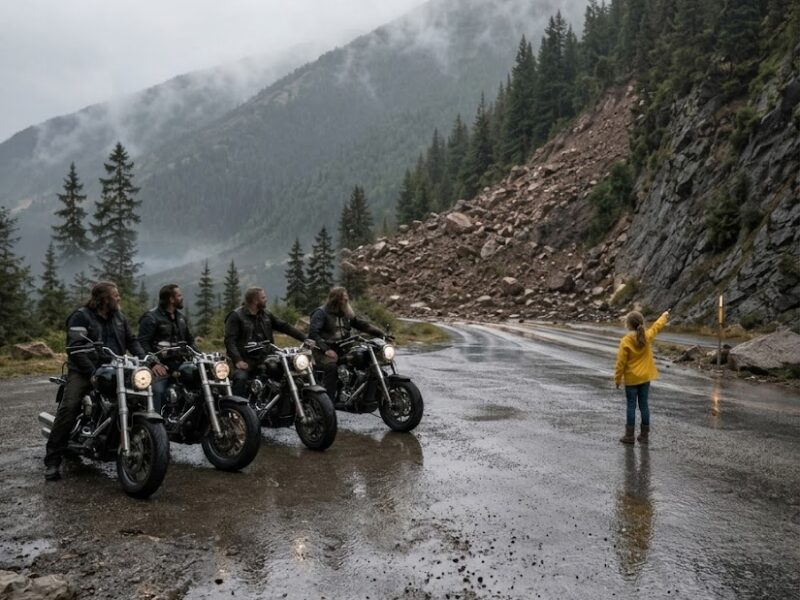
A Little Girl Forced 300 Hells Angels to Turn Back Just Seconds Before a Landslide Buried the Highway—What She Knew Saved Them All
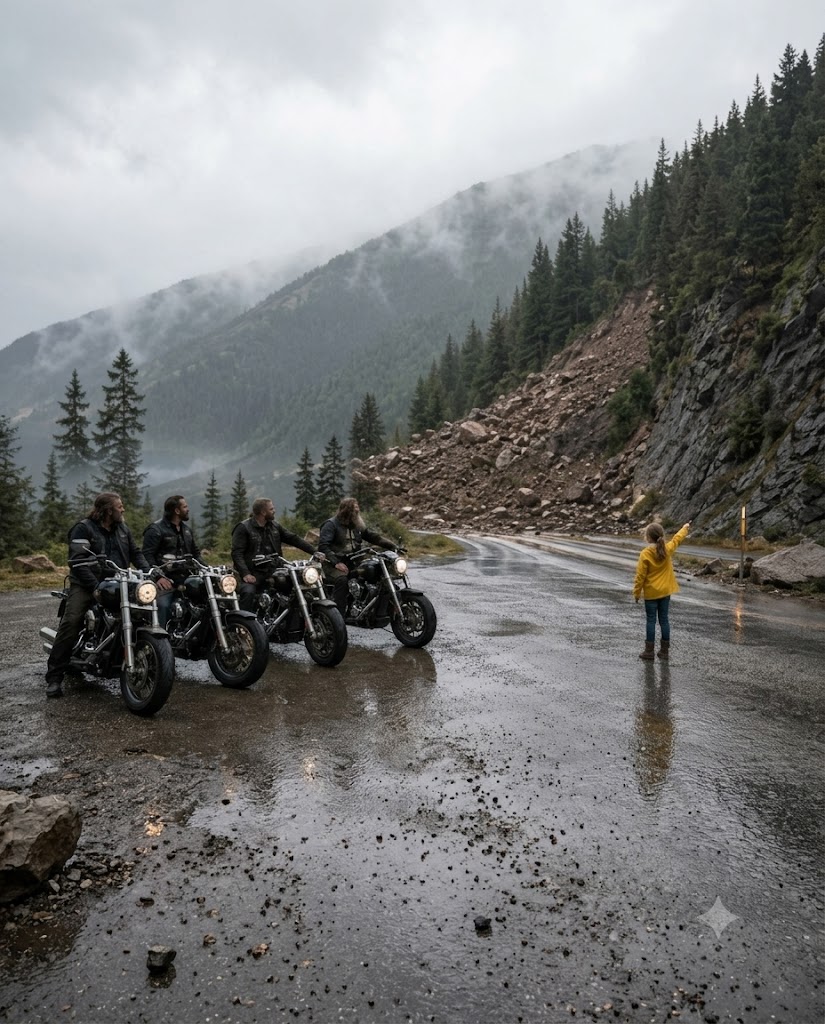
She was nine years old, and she was the only person on that mountain road who wasn’t moving.
Rain needled through her yellow jacket.
Four men sat on black machines behind her.
Leather cracked pale at the shoulders. Beards flattened dark with rain. Forearms stacked with faded ink nobody had ever cared to ask about.
Every driver who passed had already decided what those men were.
Every shopkeeper in town had already decided.
Every state trooper who had ever pulled them over on that road had already decided.
The gray-bearded rider up front was sixty-eight years old, and he had heard that verdict a thousand times.
She raised her arm and pointed at something on the hillside that was never supposed to move.
What he chose to believe in the next ten seconds is the only reason anyone is alive to tell this.
Piper Wexford had lived in Ouray, Colorado, for exactly eleven weeks of her life, all of them this summer.
She had already decided the mountains were not scenery. They were weather.
Her grandmother, Vera, said that too, in the flat way she said most things, wiping down the counter of the Switchback Cafe at six in the morning while the fog still sat in the gorge like something breathing.
“The San Juans don’t hold still for anybody, Piper girl,” Vera would say. “You learn to read them, or you learn to be surprised by them. Pick one.”
Piper had picked the first one.
Mostly because her grandfather, Walt, had taught her how, before he died two winters back.
Back then she still lived with her parents in Grand Junction and only came up to Ouray for two weeks every July.
Walt Wexford had spent thirty years driving snowplows and gravel trucks over Red Mountain Pass.
He used to point out the window of his truck at the streaks on the rock face. Dark where water had run recently. Pale where it hadn’t.
“A mountain is always announcing what it’s about to do, kiddo,” he’d say. “The trick is bothering to listen.”
When he died, Piper’s mother took a job that required more travel than a nine-year-old and a school year could survive together.
So Piper came to live with Vera full-time, in the apartment above the cafe, on the stretch of Highway 550 the road signs still called the Million Dollar Highway.
It was the kind of town where everybody knew Piper by name before she’d been there a month.
The little rock-collecting girl who could tell quartz from schist across a room.
She kept a coffee can of specimens under her cot, and Vera wouldn’t let her bring it downstairs, because half of them were, in Vera’s words, “just gravel with big feelings.”
It was also the kind of town where every August something made the whole valley a little tense.
The motorcycles came through.
Not a few. Hundreds.
The San Juan Run had been a tradition for almost twenty years, a charity ride that started in Durango, wound up through Silverton, crested Red Mountain Pass, and rolled down into Ouray before the riders scattered back to wherever they’d come from.
This year, the number printed on the flyer taped inside the Switchback’s front window was three hundred.
Half the town had an opinion about it before a single engine crossed the county line.
“Hells Angels,” Vera said, the way another woman might have said hailstorm, setting a stack of pancakes in front of a trucker at the counter. “Three hundred of them coming right through here. Right past the school. Right past the church picnic on Saturday.”
She wasn’t wrong that they were coming.
She wasn’t entirely right about what that meant, either, though Piper wouldn’t understand that for another nine days.
Piper had never seen a real motorcycle club up close.
She’d seen the patches on television. The leather vests. The way news anchors said certain words with a weight, as if the words themselves were dangerous.
So when the rumbling started on a wet Tuesday afternoon in early August, four bikes this time, an advance group scouting the route and the weather before the other two hundred ninety-six arrived later in the week, Piper pressed her whole face against the cafe window like she’d never seen weather before, let alone men.
The four riders parked in the gravel lot beside the propane tank.
Even through the rain-streaked glass, she could see they were soaked through. The kind of soaked that comes from riding two hundred miles under a sky that hasn’t stopped leaking since Sunday.
They walked in stiff-legged, dripping onto Vera’s clean floor, and the whole cafe went quiet.
Not rude. Small towns are rarely rude.
Just watchful, the way you’d watch weather you weren’t sure about yet.
The oldest of them took off his helmet last.
He had a gray beard soaked to his collarbone and eyes the pale, washed-out blue of a man who’d spent forty years squinting into wind.
He looked around the room. At the elk-antler light fixtures. At the faded photographs of the old Sunnyside Mine crew hanging along the wall. At Piper’s coffee can of rocks, sitting at the end of the counter where she’d forgotten it that morning.
Something in his face did a small, private thing.
Piper, who noticed things for a living even at nine years old, clocked it and filed it away.
“That yours?” he asked her, nodding at the can before he’d even ordered coffee.
Vera’s hand found the edge of the counter like she might need to vault it.
“She doesn’t bother customers,” Vera said, in the voice she used on tourists who let their dogs off the leash.
“She’s not bothering me,” the man said.
His voice was low and unhurried. Gravel worn smooth.
“I asked her a question.”
Piper looked at her grandmother, got the smallest possible permission in the set of her jaw, and slid the coffee can two inches down the counter.
She held up a gray-black rock with pale flecks.
“This one’s mostly quartz, but it’s got iron staining. See the orange? And this one, I’m not sure about.”
The man took the unidentified rock and turned it over twice in a hand crossed with old white scars.
The kind that don’t come from bar fights.
“Galena,” he said. “Lead and zinc ore. You’d have found that up toward Gladstone, probably. Somewhere they used to run drifts into the Sunnyside vein.”
He set it back in her palm, gentle as returning something borrowed.
“Good eye. Most folks walk right past that kind of rock their whole lives.”
“How do you know that?” Piper asked, before Vera could find a reason to end the conversation.
The man’s washed-blue eyes flicked toward the wall of old mining photographs.
They held there half a second longer than the question required.
Then they came back to Piper.
“Long story,” he said.
Something closed gently behind his face, the way a door closes when somebody doesn’t want the draft to reach the next room.
“Name’s Rosco.”
He didn’t offer a last name, and Vera didn’t ask for one.
But she did grudgingly pour him a coffee.
The four riders sat at the counter for forty minutes, drying out, while the rain drummed on the propane tank and ran in brown ribbons down the cut of the gorge behind the building.
Piper watched them the whole time, pretending to wipe a menu.
They didn’t look like the men on television.
One of them stirred four sugars into his coffee and apologized to the napkin dispenser for bumping it.
Another took out his wallet and tipped Vera twenty dollars on a nine-dollar check, then looked embarrassed, as if he’d been caught being kind.
When they got up to leave, Rosco paused at the door.
He looked back at Piper’s coffee can.
“Rain like this,” he said, “keep an eye on the hillsides the next couple weeks. Ground gets thirsty for water. Then it gets too much of it.”
He pulled his collar up.
“Things move that shouldn’t.”
Vera locked the door behind them a beat too fast.
“Bikers,” she muttered, though there wasn’t much heat left in it.
Piper didn’t say anything.
She was looking at the galena in her palm, and at the window, and at the gray sheet of rain sliding down over Cascade Mountain like something with an agenda of its own.
That night, lying on her cot with the coffee can pulled close, Piper thought about the way Rosco had said things move that shouldn’t.
Like it was something he already knew from the inside of his own bones. Not something he’d read in a pamphlet.
She didn’t know yet that he was right.
She didn’t know how right, or how soon.
She only knew that for the first time since she’d moved to Ouray, a grown-up who wasn’t her grandmother had looked at her rocks like they meant something.
And that the mountain outside her window had been talking to somebody who knew how to listen for a lot longer than she had.
The rain did not stop.
It rained through Wednesday, and it rained through Thursday, and by Friday the Uncompahgre River below town had gone the color of chocolate milk.
The county posted its first advisory about localized slope instability on the stretch of 550 between Ouray and the old ghost town of Ironton Park.
Six miles of blind curves cut into a canyon wall.
Six miles that three hundred motorcycles were scheduled to ride in five days.
Piper heard about the advisory the same way she heard about most things in Ouray.
Standing near the counter with a rag in her hand, technically drying dishes, actually listening to every word the adults said.
And believing that every single one of them meant exactly what it sounded like.
That was her first mistake, though she wouldn’t learn it for a while.
Grown-ups, she was about to discover, say a great many words they don’t quite mean.
That evening, after the cafe closed, Vera sat at the kitchen table upstairs with her reading glasses on and the county notice spread flat in front of her.
Piper sat across from her, sorting rocks into egg cartons.
“Grandma, what does localized slope instability mean?”
Vera took off her glasses.
“It means the county doesn’t want to scare anybody, so they used four words where one would do.”
“What’s the one word?”
Vera was quiet long enough that the refrigerator hummed through the whole pause.
“Slide,” she said.
The rain ticked against the window.
“Your grandfather used to say a mountain gives you three warnings. One you can see. One you can hear. And one you only feel in your gut, if you’ve been around long enough to have a gut that knows.”
“What was the one you can see?”
“Water, mostly.” Vera rubbed the bridge of her nose. “Water where there wasn’t any yesterday.”
Piper wrote that on the inside of an egg carton lid with a pencil stub, in letters she pressed so hard they dented the cardboard.
Water where there wasn’t any yesterday.
She would be glad of that dent later.
On Saturday the four scout riders came back through, and this time they stayed two nights.
They camped in the field behind the Elks Lodge with a dozen more who’d trickled in early, and by Sunday morning the Switchback had become the unofficial headquarters of what Vera still refused to call anything but “the situation.”
Piper had learned three more names.
Dwayne Coulter, a broad, quiet man who turned out to be the group’s road captain, and who checked weather radar on his phone the way other men checked football scores.
Marcus Delwood, who everyone called Tank, and who was, Piper decided, the least tank-shaped person she had ever met. Thin as a fence post, with a laugh that filled the whole cafe.
And Jesse Hartley, the youngest of the four. Twenty-eight, and new enough to the club that he asked Rosco questions and actually waited for the answers.
It was Jesse who told Piper, in a low voice, while Rosco was outside checking his bike chain in the rain, that Rosco had been riding the San Juan Run longer than anybody.
“Not once in nineteen years has he missed it,” Jesse said. “Not the year his knee needed surgery. Not the year his wife was in the hospital.”
He glanced at the window.
“And nobody knows why. Not Dwayne. Not even our chapter president back in Durango. Rosco just says he’s got business up here.”
Jesse shrugged like the mystery didn’t bother him.
The way he said it suggested it bothered him plenty.
“Old business,” he added.
Piper turned that phrase over the way she turned over rocks.
Old business.
She looked out the window at Rosco, crouched by his bike in the rain, gray beard dripping, hands moving over the chain with a precision that looked less like a man cleaning a machine and more like a man checking for a wound.
“Does he ever talk about it?” she asked.
“Rosco?” Jesse almost laughed. “Kid, that man talks about rocks and weather and how to tie a bowline. Anything else, he goes quiet like somebody pulled a plug.”
He looked at her sideways.
“But he talked to you about rocks for forty minutes on Tuesday. I counted. That’s a record.”
Piper felt something warm and strange spread through her chest.
She tucked it away beside the other things she was keeping.
Trooper Nolan Brackett came into the Switchback for the first time that Sunday afternoon.
Piper understood within about ninety seconds that he did not share whatever small truce her grandmother had reached with the visitors.
Brackett was young for a trooper, maybe thirty-five, with the particular stiffness of somebody who had learned his job mostly from a manual and hadn’t yet had the manual argue with reality.
He stood at the counter with his hat under his arm and his eyes doing slow laps around the room.
Cataloging patches. Counting exits. The way Piper’s teacher counted heads on a field trip.
“Three hundred of you coming through Thursday,” Brackett said to Dwayne. It wasn’t quite a question.
“Give or take,” Dwayne said, not looking up from his coffee. “Charity run. We do it every year.”
“Through a canyon the county has already flagged for slope instability.”
“We’re aware.”
Dwayne finally looked up.
“We talk to the county every year before this ride. We’ll talk to them again.”
Brackett’s gaze slid past Dwayne, past Tank, and landed on Rosco.
Rosco was sitting at the end of the counter with Piper’s coffee can pulled toward him again, sorting her rocks into two piles with the unhurried care of a man doing something that mattered to him more than he’d admit.
“You in charge of this circus?” Brackett asked him.
“Nobody’s in charge of three hundred bikers,” Rosco said, without looking up either. “You just try to keep them pointed the same direction.”
He held a chunk of pale, banded rock toward Piper.
“This one’s dolomite. See how it fizzes different than limestone if you put vinegar on it? Different mineral. Same idea.”
Piper leaned in, delighted.
She utterly failed to notice that she had just watched a grown man deflect a trooper’s suspicion with a rock lesson.
Years later, she would understand that was exactly what it had been.
Brackett left without finishing his coffee.
Vera watched him go. Then she watched Rosco.
Then she went back to wiping down a counter that did not need wiping down again.
“He’s not wrong to worry,” she said, mostly to herself. “That canyon’s been unstable since before I was born. My husband used to say the mountain up past Ironton Park had a mean streak.”
“Your husband sounds like he knew mountains,” Rosco said.
“He drove snowplow on this pass for thirty years.”
Rosco’s hands went still on the rocks.
“Walt Wexford,” Vera added, and her chin came up a fraction. “Piper’s grandfather.”
Something crossed Rosco’s face.
Recognition, or something adjacent to it.
For a moment, Piper thought he was going to say he’d known her grandfather. Ouray was small enough for that kind of coincidence.
Instead, he just nodded slowly, like a man filing a fact away beside other facts he already had.
“Man who drives a snowplow thirty years learns to read a slope pretty good,” he said.
He tipped his chin at Piper, who was busy trying to remember where Vera kept the vinegar so she could test the dolomite theory immediately.
“Looks like he taught this one some of it, too.”
That night, Piper dreamed about her grandfather’s truck.
In the dream, the windshield wipers swept back and forth, and Walt kept pointing at the dark streaks on a cliff.
He was saying something. His mouth moved. But the plow engine drowned out every word.
She woke at three in the morning with her heart going fast.
The rain was still falling.
She lay there in the dark, listening to it, and for the first time she thought it sounded less like rain and more like something clearing its throat.
Monday brought more rain and more riders.
Forty bikes now sat camped in the field. More arrived on Tuesday.
By Wednesday night, the town of Ouray, population eight hundred, was host to something closer to a small army of black leather and chrome.
The sky over Red Mountain Pass had not shown blue in six days.
The county advisory had been updated twice, each time with more careful, more worried language.
And each time, Hollis Ferris, the CDOT foreman who oversaw that stretch of highway, had come into the Switchback afterward looking like a man carrying something heavy uphill.
Hollis was fifty-two, with a gray mustache and the permanent squint of someone who had spent his life staring at things that were about to fail.
He wasn’t a bad man. Piper knew that even then.
He was a man with a phone that kept ringing.
“We can’t just close the pass on a hunch,” he told Vera on Wednesday evening, loud enough that half the cafe could hear him over the rain on the roof.
“Nobody’s asking you to close it on a hunch,” Vera said. “We’re asking you to close it on a mountain.”
Hollis pinched the bridge of his nose.
“Silverton gets cut off from the south side if I do that, Vera. The run organizers already paid for their permits. I’ve got three hundred riders committed, a fuel stop in Silverton that’s counting on the business, and a memorial ceremony for guys who died on this road.”
He lowered his voice, and it came out anyway.
“What I’ve got on that slope is some seep and some minor debris. That’s not a slide. There’s a difference.”
He said it like he was trying to convince the rain to stop listening more than he was trying to convince anyone in the room.
Piper, wiping the same clean spot on the counter she’d been wiping for five minutes, listened to the word seep.
She thought about her grandfather’s streaks on the rock face.
Dark, where water had run recently.
She thought about Rosco, crouched over his bike chain like it was a wound.
She did not say anything.
She was nine, and she had already learned what happens when a nine-year-old opens her mouth about the mountain.
Back in June, she had told her teacher that the creek behind the school had changed color after a storm.
The teacher had smiled the smile adults give to children who are being cute, and moved on to spelling words.
Piper had learned the way children learn most of the truly useful things.
By getting it wrong once, and remembering exactly how it felt.
That Wednesday night, long after the cafe closed, she crept down the back stairs in her socks.
The riders had mostly gone to the field to sleep. The only light in the place came from the pie case, glowing yellow over empty plates.
Rosco was sitting at the end of the counter alone, with a cup of coffee going cold in front of him.
He was looking at the wall of Sunnyside Mine photographs.
He didn’t turn around.
“Can’t sleep either?” he asked.
Piper climbed onto the stool two down from him, because it seemed rude to take the one next to him and rude to take the one at the far end.
“Grandma says Hollis is going to leave the road open.”
“Hollis is trying to do a hard job with a lot of people yelling at him.”
“Is he going to be wrong?”
Rosco turned his coffee cup a quarter turn on the saucer.
It took him a long time to answer.
“I don’t know,” he said finally. “That’s the honest answer. I don’t walk that slope every morning. He does.”
“But you’re worried.”
“I’m always worried in August.” The corner of his mouth moved, not quite a smile. “Comes with the territory. Some of us just carry it a little heavier.”
Piper pulled her knees up on the stool.
“Jesse says you have old business up here.”
Rosco let out a breath through his nose.
“Jesse talks a lot for a man who claims to be shy.”
“Is it a secret?”
“No.” He looked at the photographs again. “It’s just not a story that’s got a good ending. And I don’t tell those to nine-year-olds at midnight.”
Piper accepted this, because her grandmother had taught her that some doors are better knocked on twice.
But she did not forget it.
She slid off the stool and went to the end of the counter, where her coffee can sat in the shadow.
She took out one of the three rocks she’d been keeping on top, a smooth, dark, heavy piece, and put it by his coffee cup.
“For luck,” she said. “On the ride.”
Rosco looked at the stone for a long moment.
Then he picked it up carefully, the way you pick up something that might break, and tucked it into the inside pocket of his vest.
“I’ll bring it back,” he said.
“You don’t have to.”
“I know,” said Rosco Gallagher. “That’s why I will.”
Thursday came up gray and enormous.
By morning, the field behind the Elks Lodge held nearly three hundred motorcycles, lined up in ranks so long they seemed to bend with the curve of the valley.
Engines ticked in the drizzle.
Riders checked their rain gear and route sheets under a sky the color of wet slate.
The plan was simple enough.
South from Ouray, up through the canyon, past Ironton Park, over the summit of Red Mountain Pass, and down into Silverton for a lunch stop and a memorial ceremony for riders who had died in accidents over the years.
Then back the way they came.
Hollis Ferris had walked the flagged section of highway himself at six that morning with a geotechnical contractor from Montrose.
By seven, he’d made the call.
The road would stay open, with a spotter posted at the worst curve and speed restrictions in place.
Three hundred riders. One road. Six miles of canyon wall that had been seeping water for a week.
Vera had errands in Ridgway that morning.
And in a decision she would replay in her mind for the rest of her life, she agreed to let Piper ride along partway with Dwayne Coulter’s group.
Only as far as the Bear Creek Falls overlook, a wide pullout a mile into the canyon, where photographers always gathered to watch the bikes come through single file along the cliff road.
It wasn’t the pass itself. Vera wasn’t reckless.
It was just the overlook, with Dwayne’s wife and a handful of other riders’ families who had come to watch and wave.
“You stay behind the rail,” Vera said, zipping the yellow jacket to Piper’s chin. “You hold Marlene’s hand if there’s a crowd. And you do not go one step toward that road.”
“I promise.”
Vera held her face in both hands for a second longer than usual.
“This jacket,” she said, “is the color of somebody who wants to be found. Remember that.”
Piper wore the jacket.
She also carried, without asking permission, two rocks from her coffee can in her pocket.
She’d given the third to Rosco.
The rain eased to a fine mist by nine, when the column began to move.
Engine by engine, bike by bike, out of the field and onto 550 southbound.
Dwayne’s group rode near the front. Rosco rode just behind him, with Tank and Jesse flanking.
Piper stood at the overlook rail with a knot of other watchers, camera phones raised.
She felt the ground under her sneakers shiver faintly each time another cluster of bikes thundered past below, the sound folding back off the canyon walls until it seemed to come from everywhere at once.
It was during a lull, a gap in the column while a slower group caught up from behind, that she noticed the water.
She’d been watching the falls. The real ones. The ribbon of Bear Creek dropping two hundred feet down black rock into the gorge.
But her eye caught something wrong on the slope above the road, maybe sixty yards past the overlook, where the highway hugged the base of a steep, brush-covered hillside on its way toward Ironton Park.
A thin brown thread of water ran down a groove in the slope.
When she had looked at that same spot an hour earlier, out of pure habit, it had been dry.
Not rain runoff.
Rain runoff came down clear and everywhere.
This was the color of the river after a storm. Muddy. Coming from one specific crack, low on the hillside, right where the road cut into it.
Water where there wasn’t any yesterday.
She said something.
She wasn’t even sure afterward what words came out.
She only knew she tugged on the sleeve of the nearest adult, a stranger, one of the photographers, and pointed.
The man glanced over.
“Yeah, it’s been raining, sweetheart,” he said, and went back to his camera.
She tried Dwayne’s wife next.
“Stay behind the rail, honey,” Marlene said, distracted, and a hand on her shoulder steered her gently back.
She looked for a trooper and found one.
Not Brackett. A different one, stationed at the overlook to manage the crowd.
“Sir,” she said, as clearly as she could, “the hill is leaking mud where it wasn’t before.”
He looked.
He saw nothing more alarming than wet rock in a rainstorm.
“Good eye, kiddo,” he said kindly. “Stay with an adult, all right?”
For about four minutes, Piper Wexford was the only person at Bear Creek Falls Overlook who believed something was wrong.
And every single adult she told had a reason.
A good reason. An understandable reason.
A perfectly sensible reason not to believe a nine-year-old standing at a highway pullout in the rain.
She stood at the rail with her fists closed hard around the two rocks in her pocket.
She watched the thread of brown water thicken ever so slightly into two threads.
She felt something her grandfather used to call the mountain’s temper, rising in her chest like a held breath she couldn’t let out.
She thought of Rosco crouched over his bike chain in the rain.
She thought of him saying, Things move that shouldn’t.
And she understood, with the clean, uncomplicated logic of a nine-year-old who had just been dismissed by three grown-ups in a row, that the next person who rode past that spot was the person who needed to hear her.
Whether or not he had any reason to believe a stranger’s granddaughter.
What Piper didn’t know, what nobody in Ouray knew, not Vera, not Hollis, not even Dwayne after nineteen years of riding beside him, was this.
Rosco Gallagher had served two tours with a Navy construction battalion in Vietnam between 1968 and 1971.
He’d built roads and bridge approaches under fire outside Da Nang.
He had learned the hard way what saturated ground does to a cut slope when the weight of anything moves across it.
He came home, tried factory work, hated it, and ended up back in the mountains he’d grown up in.
First as a hard-rock miner. Then, after night classes paid for by the GI Bill, as a mine safety engineer for the Sunnyside operation up above Gladstone.
The same mine whose old crew photographs hung on the wall of the Switchback Cafe.
The ones he hadn’t been able to stop looking at his first afternoon in town.
For eleven years, he had read slopes and stopes and drift ceilings for a living.
And for eleven years, he had been, by every account, very good at it.
Until 1988, when he wasn’t.
That March, a nineteen-year-old apprentice miner named Cole Ridgeway had come to Rosco with a report of water changing color in a drift near the portal.
The kind of small, easy-to-dismiss observation a green kid makes when he doesn’t yet know which things matter.
Rosco had been three weeks from a scheduled slope stability survey, buried under paperwork from a ventilation upgrade.
“I’ll get to it Friday,” he’d told Cole.
On Thursday, a section of hanging wall let go without warning.
Cole Ridgeway was one of two men who didn’t walk out.
Rosco had spent every year since turning that Friday over in his hands like a rock he couldn’t identify.
And every year since, when somebody without rank or credential or reason to be believed told him something was wrong with the ground, he had made himself into a man who listened the first time.
At 4:47 that afternoon, riding fourth in a loose cluster approaching the overlook, Rosco saw a small girl in a yellow jacket vault the rail and run into the roadway, waving both arms over her head.
He did not think about liability.
He did not think about three hundred bikes strung out behind him for a mile and a half.
He did not think about how it would look for a member of the club to slam on his brakes for a child who had no business being in the road.
He thought about a Thursday in March, thirty-eight years gone.
And he stood on his brakes so hard the back tire chattered on the wet asphalt.
“The hill!”
Piper was screaming it before he’d even come to a stop, pointing past him at the slope.
The two threads of muddy water had become four.
Small stones, the size of her fist, were skittering loose and clattering down through the brush in a way that had nothing to do with rain.
“It’s moving! It’s really moving! Nobody will listen!”
Rosco didn’t ask her how she knew.
He didn’t ask her name, or her age, or what she was doing in the road.
He looked where she was pointing.
And in under two seconds, he saw everything Cole Ridgeway had tried to tell him thirty-eight years earlier.
Water finding a new path through saturated ground.
The almost imperceptible sag along the road’s uphill shoulder, where the slope had begun creeping downward under its own soaked weight.
A stand of young spruce forty yards up the hillside, leaning three or four degrees off vertical, roots losing their grip in real time.
It wasn’t going to slide sometime.
It was sliding now, in slow motion, gathering speed the way these things always do.
Quietly, and then all at once.
“Off the road!”
Rosco’s voice came out of him with a volume and a command that surprised even Dwayne, twenty feet ahead, who spun his bike around at the sound.
“Everybody off the road now! Get up on the overlook! Move!”
He was off his own bike in the same motion.
He grabbed Piper under the arms and half carried, half dragged her back toward the rail while he shouted at the trooper, at the photographers, at Dwayne’s wife, at anyone with a working set of legs.
“Rosco, what’ve you got?” Dwayne called.
“The whole hill, Dwayne! Stop the column! Stop the column!”
Dwayne Coulter did not waste a second questioning it.
He had ridden beside this man for nineteen years. He knew exactly what Rosco’s voice meant when it sounded like that.
He gunned his engine, spun back toward the oncoming riders, and began waving both arms in the wide, sweeping arc that every member of that club had been trained since their first mile to recognize.
The emergency stop.
The signal passed bike to bike, down the line, stretching back past the last curve.
Something ahead is wrong.
What happened over the next four minutes has been told a hundred different ways since.
At bars and clubhouses and dinner tables across three states.
Every version agrees on the essential shape of it.
Three hundred motorcycles, strung out along a mile and a half of blind mountain highway, turned themselves around without a single collision.
Without a single rider going into the ditch.
In less time than it takes to boil water for tea.
Dwayne’s signal reached the second cluster in seconds.
From there it moved by shouted word and pointed arm and flashing brake light.
Rider passing it to rider, each one trusting the signal, because the club had drilled exactly this kind of trust into itself for longer than some of the younger riders had been alive.
Bikes peeled off into the wider pullouts wherever they could find one.
They turned in tight, controlled arcs and started back the way they’d come.
Engines screaming up through the gears. Rain flying off two hundred ninety helmets.
Tank, in the middle of the pack, was heard to say afterward that he’d never made a U-turn that fast in his life, and that he’d never been that scared of a motorcycle accident in his life, and that he didn’t remember deciding to do either one.
Jesse Hartley, riding sweep, was the last man to make the turn.
He did it with his heart in his throat and his eyes in his mirrors, watching the hill, and he swore for years that he saw the whole slope breathe.
Hollis Ferris was driving up from the Ironton Park end of the closure in his CDOT truck when he saw the column reversing itself from half a mile off.
He radioed the state patrol before he understood why.
Trooper Nolan Brackett had been parked at the Silverton end of the pass, grumbling into his own radio about traffic control for a bunch of bikers who thought they owned the road.
He heard the reversal call.
He heard the word slide crackle through the static.
And he was moving before the dispatcher finished the sentence.
Piper, pressed against the overlook’s stone retaining wall with Rosco’s arm braced across her shoulders like a seat belt, watched the hillside finish what it had started.
The two threads of muddy water became a sheet.
The leaning spruce went down first. Then a second stand behind it.
Then the whole face of the slope seemed to exhale at once.
Brush and boulders and a churning wall of mud, sliding, then sliding faster than simply falling.
It thundered down across both lanes of Highway 550 in a roar that Piper felt in her back teeth.
It buried the roadway to a depth of eleven feet in the space of maybe twenty seconds.
Exactly where the last cluster of motorcycles had been idling not four minutes before.
Then the roar settled into the ordinary hiss of rain.
And the silence that followed was the loudest thing Piper had ever heard.
Nobody moved.
A photographer who had waved her off ten minutes earlier stood with his camera hanging forgotten at his chest, his mouth open.
The trooper who’d told her to stay with an adult had one hand over his own mouth.
Marlene Coulter was crying quietly, her fingers wrapped so tightly around the rail that her knuckles had gone white.
Rosco’s arm was still across Piper’s shoulders.
His hand, she noticed, was shaking slightly.
But his voice, when it came, was steady.
“You did that,” he said, not looking at her. He was looking instead at the raw brown scar where the hillside used to be.
“You did that. You understand me? Not me. You saw it first.”
Piper opened her mouth, and nothing came out.
Her knees had started to shake.
She reached into her jacket pocket and closed her fist around the two small rocks, the way you hold on to a railing in a boat.
“I tried to tell them,” she whispered.
“I know.”
“They all said it was just rain.”
“I know, sweetheart.” Rosco let out a breath that seemed to come from somewhere very far down. “They always do.”
Trooper Brackett arrived at a dead run four minutes later, radio still barking on his shoulder.
He skidded to a stop at the overlook rail, taking in the buried highway, the reversed column of motorcycles now parked in ragged, breathless ranks along both shoulders behind them, and Rosco kneeling in front of a nine-year-old girl in a yellow jacket.
Both of them soaked to the bone.
Neither of them hurt.
Brackett opened his mouth.
He was going to ask what happened. He was going to ask who was in charge. He was going to say something about the citation he’d probably need to write for three hundred motorcycles executing an unauthorized U-turn on a state highway.
And then he simply stood there for a long moment, rain running off the brim of his hat, looking at the wall of debris that would have buried every single one of them.
He said nothing at all.
For Nolan Brackett, that was its own kind of confession.
The call went out to 911 at 4:53 that afternoon.
By six o’clock, there were two sheriff’s units, a fire engine from Ouray, and an ambulance from Montrose idling at the barricade, all of them waiting for victims who never came.
There were no victims.
The EMTs spent most of the evening taking blood pressures and handing out bottled water to bikers who couldn’t stop laughing, and then, a few minutes later, couldn’t stop shaking.
Hollis Ferris arrived on foot, because his truck could not go any farther.
He stood at the edge of the debris in the failing light, looking up at the empty gap in the hillside where, that morning, he had stood with a geotechnical engineer and decided it would hold.
He was a very long time standing there.
When he finally turned around, his face was gray.
“Who saw it?” he asked the nearest rider. His voice cracked on the second word. “Who called it?”
The rider pointed to the overlook.
There, wrapped in a borrowed blanket and sitting on the tailgate of a fire engine with a paper cup of cocoa she wasn’t drinking, was a very small girl in a yellow jacket.
Vera Wexford had gotten there by then.
She had been twenty miles away, in line at the Ridgway hardware store, when a stranger came in and said the word slide out loud, and she had left a full cart behind and driven the whole way with the gas pedal on the floor.
She had run from her car to the overlook in her good shoes.
She did not say anything when she reached Piper.
She just dropped to her knees on the wet gravel and pulled that yellow jacket against her chest, and held on.
Over her granddaughter’s head, her eyes found Rosco, standing a few feet back with his helmet in his hands, trying hard not to look like he was waiting for anything.
“She was in the road,” Vera said. Her voice was not steady at all. “I told her not one step toward that road.”
“Yes, ma’am,” said Rosco.
“And she went anyway.”
“Yes, ma’am. She did.”
Vera closed her eyes.
When she opened them again, something in them had shifted, a small, enormous tectonic thing.
“Thank you for stopping,” she said.
It was the hardest sentence Vera Wexford had ever said to a man in a leather vest.
She said it anyway.
Highway 550 stayed closed for eleven days.
CDOT crews worked in shifts around the clock to clear the slide, then reinforced the slope with anchored mesh and a drainage system that Hollis Ferris, in his official report, credited to “field observations made prior to and during the event.”
That sentence made no mention of a child, or a coffee can of rocks.
But Hollis himself, standing at the Switchback counter a week later with his hat in his hands, admitted it meant exactly that.
“I walked that slope at six in the morning,” he told Vera. He didn’t look up. “I looked right at it. I had a PhD standing next to me, looking right at it. And a nine-year-old saw what we didn’t.”
“You’re not the first person to be wrong about a mountain,” Vera said.
“No, ma’am. But I might be the first one who got to find out about it alive.”
He put a twenty on the counter for a four-dollar coffee and left without waiting for change.
The story got out the way stories do in a town of eight hundred.
First at the post office. Then at the grocery. Then at the Sunday church service, where the pastor, a mild man not given to drama, set aside his sermon notes and talked for twelve minutes about the nature of attention.
By Wednesday, a reporter from the Montrose paper was standing in the Switchback with a notepad.
By Friday, a television truck from Denver had parked beside the propane tank.
Piper hated it.
She hid upstairs with her coffee can and refused to come down until the truck left.
“I don’t want to be on TV,” she told Vera. “They’ll make it sound like I’m brave. I wasn’t brave. I was scared the whole time.”
Vera sat on the edge of the cot.
“Piper girl,” she said, “that’s the only kind of brave there is.”
The other thing that happened that week was quieter.
The town changed its mind.
Not all at once, and not all of it. Mrs. Halvorsen at the church still crossed the street when she saw a leather jacket.
But people who had spent eleven weeks watching bikers the way you watch weather started offering them coffee.
The feed store owner gave Tank a discount on a bag of sunflower seeds and refused to explain why.
The kids from Piper’s school, who had been told for months to stay away from the bikers, now asked shyly if they could sit on one.
Dwayne said yes to every single one of them. He lifted each kid up by the waist, one at a time, and explained which handlebar did what.
And the sign painter on Main Street, an old man named Gus who had once called the club “a plague with exhaust,” quietly painted a hand-lettered sheet of plywood that read THANK YOU, RIDERS and nailed it to the lamppost outside the Elks Lodge.
He never mentioned it to anybody.
The riders pretended not to see it, and every single one of them stopped to read it anyway.
The San Juan Run’s memorial ceremony for fallen riders happened four days late.
Silverton was reachable only the long way around, through Durango, so the club held it instead in the field behind the Elks Lodge, with three hundred riders standing in the mud in a circle.
It was a circle that, without anyone deciding it formally, had opened up a space near its center for a nine-year-old girl in a yellow jacket.
It was there, with the rain finally down to a drizzle and Vera standing close enough to reach her granddaughter if her granddaughter needed reaching, that Piper finally heard the rest of it.
Not from Jesse’s careful half-guesses this time.
From Rosco himself, in front of the whole club, in a voice that shook only once.
He told them about Cole Ridgeway.
He told them about the Friday he’d meant to get to.
He told them about thirty-eight years of riding the same run every August, not because the club required it, but because somewhere past Ironton Park was as close as he could get to the ground where a nineteen-year-old had trusted him with something small and true.
And he hadn’t trusted it back in time.
“I built my whole life after that on one rule,” he said.
He was looking at Piper now. Not at the club.
“Somebody tells you the ground’s moving, you don’t ask what they look like first. You don’t ask how old they are, or what they’re wearing, or whether they’ve got the right kind of hands to be believed.”
He paused. Water ran off his beard.
“You go look.”
The field was very quiet.
“I got a lot of things wrong in this life,” Rosco said. “I judged plenty of people by their jackets before I ever heard their voices. Same as folks judge me by mine every single day. Walking into a diner. Pulling up to a stoplight.”
He took a breath.
“But I never once let a kid tell me the mountain was talking and then didn’t go check. Not since Cole.”
He looked out over the three hundred faces.
“And I’m alive today. And every soul that rode this run is alive today. Because a nine-year-old girl decided the same thing was true for her. That it doesn’t matter whether the person standing in the road looks like trouble or looks like nothing at all.”
His voice dropped.
“What matters is whether they’re right.”
Nobody clapped.
It wasn’t that kind of circle.
But Dwayne Coulter, standing at Rosco’s shoulder, put a hand briefly on the older man’s back.
Tank wiped his face with the flat of his palm, in a way that had nothing to do with rain.
Jesse Hartley stood with his helmet pressed against his chest and his eyes fixed hard on the ground.
And Vera Wexford, who had spent eleven weeks deciding what three hundred bikers meant before a single one of them had done anything to earn the verdict, found that her hand had come to rest on Rosco’s forearm.
Over the faded ink she had never once asked him about.
She left it there.
When the ceremony ended and the riders began to drift toward their bikes, Rosco crossed the grass to where Piper stood.
He reached into the inside pocket of his vest and held something out in his open palm.
It was the small, dark, heavy stone she had left beside his coffee cup.
“I said I’d bring it back,” he told her.
Piper looked at it.
“You can keep it,” she said. “It worked.”
Rosco’s eyes did something complicated.
“Then I’ll hold on to it a while longer,” he said, and closed it in his fist. “Some luck is worth carrying.”
Trooper Brackett came by the Switchback again two days after the ceremony.
This time, he didn’t do the slow, cataloging lap of his eyes around the room.
He’d filed his report on the incident. No citations issued. A line about “exemplary emergency response by civilian motorcyclists” that would have made the old Brackett choke on his coffee.
He sat at the counter and let Piper show him the difference between andesite and basalt for eleven straight minutes, without once looking at his watch.
“I owe you an apology,” he said, when she’d finished.
“For what?”
“For not believing you.” He rubbed the back of his neck. “The guy at the overlook, the one who told you to stay with an adult. That was my guy. I trained him. I taught him that kids who tell you the hillside is leaking are usually just bored.”
He looked at her.
“I’m changing the training.”
Piper considered this with the seriousness of a nine-year-old receiving a treaty.
“Okay,” she said. “But you have to put the part about water in there. Water where there wasn’t any yesterday.”
Brackett took out a small notebook and wrote it down.
Hollis Ferris installed a permanent slope-monitoring sensor at that curve before the season was out.
It was the first of its kind on that stretch of highway, and he told anyone who asked that the county owed the idea to some sharp field observations.
Which was as close as a civil engineer’s paperwork ever came to saying thank you to a child.
Rosco rode through one more time before the season turned.
Alone, this time. No run. No three hundred bikes.
Just an old man and a motorcycle and a stop at the Switchback that lasted longer than coffee usually takes.
He left Piper a small, careful box before he pulled back onto 550, headed south.
Inside, wrapped in a shop rag, was a chunk of high-grade galena ore.
Tucked beside it was a hand-lettered card, in blocky, uneven printing.
Sunnyside Mine, 1988. For the good eye.
He didn’t say goodbye like it was a big thing.
He just zipped his jacket, checked his mirrors out of forty years of habit, and rode off into a sky that had, for the first time in eleven days, gone completely, uncomplicatedly blue.
Piper watched until the sound of the engine folded back into the canyon and was gone.
Then she went inside, climbed the back stairs, and set the galena in the coffee can, right on top, where she could see it.
The next morning, Vera Wexford did what she had done every morning since the diner opened under her husband’s name twenty-two years earlier.
She wiped down the counter at six a.m., while the fog sat low in the gorge.
But this time, without remarking on it, without making it into anything, she set out a fourth coffee cup at the end of the counter.
Right next to the coffee can of rocks.
In case anyone with a leather jacket and a long story happened to ride through, wanting a place to dry off.









