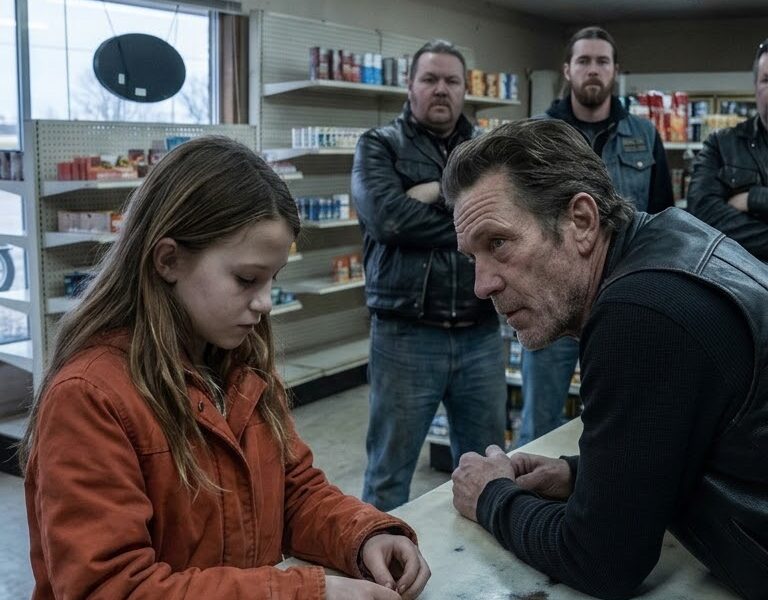
A little girl counted the same coins on the same counter every Saturday for a year. Nobody asked why. Nobody helped. Then 500 bikers paid—and everything changed.
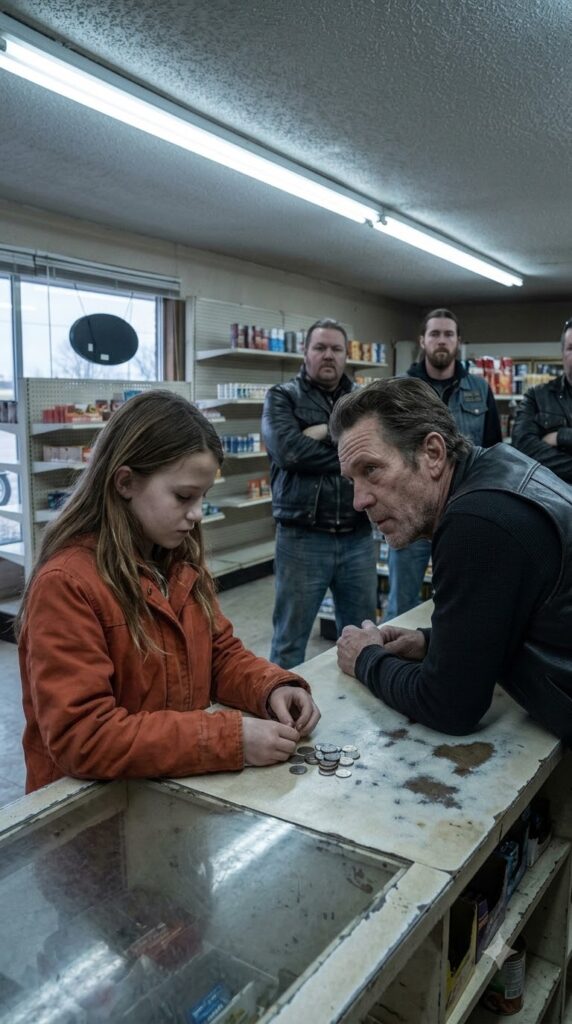
Vesper Kita wiped down the counter without looking up.
“Four dollars and thirty-one cents,” she said the same way she said it every Saturday.
The same flat measurement, no complaint in it. No apology.
She slid the stack of coins across the laminate toward the coffee and the Danish that were already waiting.
And she said nothing else.
She was eight years old. She was completely serious.
And the man on the other side of the counter—a man with seventy pounds on any reasonable guess, a gray beard that had grown past the second button of his vest, and knuckles that looked like creek gravel—stood there with his coffee in his hand and understood without being told that something about this moment was exactly, terribly wrong.
His name was Cass Ror. He was fifty-four years old.
He had been president of the Ash Creek Riders for eleven years and a founding member for six years before that.
And he had eaten breakfast at the Pintail Diner every Saturday morning for longer than the child across from him had been alive.
He had never seen her count those coins out before.
He did not know yet that she had been counting them out for fifty-two Saturdays in a row.
Nobody in the diner that morning knew that. Nobody knew what the coins were for, or what she was waiting for, or what the number was that she was building toward.
One careful Saturday at a time.
By the time anyone found out, it was already too late to pretend it was someone else’s business.
The morning was flat and cold, the way northern Arizona mornings get in October, when the light comes in sideways off the high desert and lands on everything at an angle that makes it look used.
The Pintail sat on the state route at the edge of Juniper Flat, a cinder block rectangle that had survived three owners and two floods and the indefinite grief of a highway that kept getting quieter.
The windows faced east, and they were sweating on the inside from the grill.
Outside, three bikes stood in the gravel lot at an angle that said their riders were in no hurry and intended everyone to know it.
The chrome caught the low sun and threw it sideways in narrow strips across the lot.
Cass Ror set his coffee down. He had not moved from the counter.
The girl behind it had turned back to the coffee station and was pouring with both hands. Careful the way you get careful when spilling has consequences.
She was small-framed, dark-haired, with a braid that had been done hours ago and had mostly held. She wore a sweater that was right for the cold and boots that had been resold at least once.
The coins were still on the counter, exactly four dollars and thirty-one cents, stacked in the way a person stacks coins when they have counted them more than once and wanted to be sure.
Cass looked at the coins, then at the girl, then at the door that led to the back, where a woman’s voice had called out something about the number three burner.
And he understood without being told that the woman and the girl were the whole of what was holding this place together.
He picked up his coffee. He did not pick up his Danish.
He left it on the counter, took his coffee to his regular booth in the back corner, and sat down with his two club brothers, Lenny Pace and a man everyone called Doorstop.
And he said nothing about the coins for forty-five minutes.
Then he said, “That girl’s been here every Saturday.”
Lenny looked up from his eggs. “Since when?”
“Since before I started noticing,” Cass said.
He went back to his coffee, and the Danish stayed on the counter untouched, and outside the wind moved across the lot and rattled the sign above the door, and three motorcycles stood in the gravel like something waiting for an answer.
Nobody had told him what the question was yet.
That part came later.
That part was the part nobody was ready for, because the answer to it turned out to cost exactly two thousand four hundred sixty-eight dollars and sixty-nine cents—which was the number the girl already knew by heart and had known since the first Saturday she climbed behind that counter and started counting.
The Pintail Diner had been open for twenty-two years under a name that changed twice before it settled.
The current owner was Miriam Khalida, who was forty-one years old and had bought the place with her husband six years ago and had been running it alone for the last fourteen months.
She had brown eyes and a way of moving through the kitchen that was efficient and a little braced, the way people move when they are waiting for the next thing to go wrong.
She was not the kind of person who asked for help easily.
Her daughter Vesper had apparently decided that was no longer relevant.
Vesper had started the coin jar the previous October, a month after the letter came. She did not call it a coin jar. She called it the Saturday Fund, because she only counted on Saturdays and she only added to it on Saturdays—which was the day she worked the counter so her mother could do the books in the back.
The fund had been running for fifty-two weeks when Cass Ror sat across from it with his coffee and noticed for the first time that a child was doing the accounting on something that was larger than a child should have to carry alone.
He just did not know that yet.
He found out the way he found out most things that mattered, which was by sitting still long enough that someone else said it out loud.
That someone was Doorstop, who had gone to the counter for a refill and come back with an expression that did not fit his face.
Doorstop’s real name was Gerald Frick, and he was fifty years old and had been riding with the Ash Creek Riders for twelve years, and he was not a man who was easy to unsettle.
He set his coffee down and said, “She told me it’s for the back taxes.”
Cass did not look up right away. “How much?”
“She said two thousand four hundred sixty-eight dollars and sixty-nine cents.” Doorstop paused. “She said it like a phone number.”
The diner was not busy. It was a Saturday in the second week of October, and the tourist traffic that sometimes drifted off the highway had slowed to nothing with the change in weather.
A man in a booth near the window was reading a newspaper and had been for an hour. The woman at the register, who was not Vesper, was someone Miriam had brought in on weekends when the traffic warranted it—which lately it barely did.
Miriam herself was in the back.
Vesper was at the far end of the counter, straightening the sugar caddy with the focus of someone performing a task that needed to be perfect.
Cass watched her for a moment, then looked back at his coffee.
“Back taxes on what,” he said.
“The building,” Doorstop said. “County assessor sent a notice fourteen months ago. Says the previous owner had a deferred payment arrangement, and the arrangement ended when Miriam took over the deed. She’s been paying it down, but there’s a deadline. Vesper told me the deadline is November thirtieth.”
He looked at his hands. “Six weeks.”
Lenny had stopped eating. The man with the newspaper had lowered it an inch without appearing to do so.
The diner was quiet enough that the sound of the grill from the back kitchen was distinct and separate from everything else—a low hiss that was the only thing still moving.
“How much has she saved?” Cass said.
“Three hundred eighty-one dollars and thirty-one cents,” Doorstop said. “She told me that too. She told me every week she adds whatever’s left in the tip jar after she pays herself and her mom back for the supplies. She said she’s been rounding up her totals when she can.”
He stopped. “She said she knows she’s not going to make it.”
Cass set his coffee cup down. The sound it made on the laminate was quiet and final—the way a gavel sounds in a room that is already paying attention.
He sat with that number for a moment. The gap between three eighty-one and twenty-four sixty-eight. A number that was two thousand eighty-seven dollars and thirty-eight cents, and was, for an eight-year-old counting tip money on Saturdays, essentially a wall.
He had been president of this club for eleven years. He knew what a wall looked like.
He also knew what a wall looked like when someone had been throwing themselves at it quietly for a year and had told nobody.
He pushed himself up from the booth. He was a big man, wide through the shoulders, with a belly that had come in the last few years and hands that were still thick from the decades before.
He wore a cut that had the Ash Creek Riders patch on the back in colors that had faded from the sun and from years of desert wind, and the president’s tab below it in white letters on black.
He walked to the counter and sat down on a stool two spaces from where Vesper was standing, and he put both forearms on the laminate and said, “Vesper.”
She turned and looked at him. She had her mother’s eyes—dark and level—and she looked at him the way certain children look at large strange things, which was directly and without expression until she had decided what she thought.
“How do you know my name?” she said.
“Your mother told me,” he said, which was not true, but it was close enough. “Those are nice stacks,” he said, and nodded at the coins, which were still on the counter in the same configuration they had been in since she slid them across.
“I recount them on slow days,” she said. “So I know the total is right. And the total’s right today. The total’s always right.” She paused. “It’s three hundred eighty-one dollars and thirty-one cents, and I need two thousand four hundred sixty-eight dollars and sixty-nine cents by November thirtieth.”
She said it the way Doorstop had described. Even and clean, like reading coordinates off a map.
“I’m not going to make it. I’ve known that since July. But I’m not stopping.”
Cass looked at the coins on the counter, then at the child’s face, and felt something move in his chest that he had not felt move in a long time. He did not name it in that moment. He just sat with it.
He said, “How come you know you’re not going to make it, but you keep adding to it?”
Vesper picked up the coins and put them in the jar she kept under the counter—the one that had a piece of tape on it with the running total written in pencil and updated every week, because four dollars and thirty-one cents is four dollars and thirty-one cents.
She said, “It’s not nothing.”
He stayed at the counter for another ten minutes without saying much. He asked her two more questions, both about the notice from the county assessor, and she answered both from memory—including the parcel number, the name of the assessor’s office contact, and the late payment penalty schedule if the deadline was missed.
She was eight years old. She had done her research.
When Cass got up to leave, he left a twenty on the counter for a four-dollar coffee and told her to put the change in the jar.
She looked at him for a second with something that was not suspicion exactly, but was careful. And then she put it in the jar and wrote the new total on the tape in pencil, in small even numbers.
And he walked out into the cold October morning and stood next to his bike with his hands in his pockets and stared at the gravel for a while.
Lenny came out behind him, then Doorstop. The three of them stood in the cold without talking.
The wind off the high desert had a smell to it this time of year—dry and mineral and faintly burnt from somewhere distant. The way the whole landscape smelled in the weeks before the cold settled in for good.
Cass’s bike was a 2007 Road King in a flat dark blue that had never been factory, because he had painted it himself in the second year of ownership and he had not been aiming for glossy.
It stood in the gravel with the other two, and he put his hand on the seat and looked out at the highway.
“Club meeting tomorrow,” he said.
“Tomorrow’s Sunday,” Lenny said.
“I know what day it is.”
Lenny looked at Doorstop. Doorstop looked at the diner.
Through the window, they could see Vesper at the counter, straightening things that didn’t need straightening. The way a person keeps themselves busy when the busyness is the only thing that feels like progress.
“What are you thinking?” Lenny said.
Cass got on his bike. “I’m thinking two thousand eighty-seven dollars and thirty-eight cents,” he said.
He started the engine, and the sound of it in the cold lot was low and rolling and settled the way a certain kind of authority settles without having to announce itself.
He pulled out onto the state route and rode east into the flat sideways light, and behind him, Lenny and Doorstop followed—three sets of pipes giving the cold morning a shape it didn’t have before.
He had not told them yet what he planned to do. He had not told himself yet, not in words.
But he had been riding for thirty-one years, and he had been keeping the Ash Creek Riders together for seventeen of them. And he knew the difference between a problem that was none of his business and a problem that had just become his business.
And what he had just seen in that diner was a child who had been doing a grown adult’s reckoning alone for a year, and had done it without a single corner cut, and was still adding to the jar even after she knew the jar wasn’t going to be enough.
He knew about that kind of arithmetic. He knew what it cost.
He also knew something else—something he had not thought about in months, and which surfaced now the way old things surface when the conditions are finally right.
His daughter had been nine years old when the accident happened. The details were not something he revisited at length, not anymore, because that was not how he had learned to survive them.
She had lived. The damage to her vision had been permanent and significant. And the cost of the surgical procedures that had kept her from losing everything entirely had been a number that he still could not say in full without his jaw doing something he preferred nobody see.
He had not had a club behind him then. He had been in the early years, the founding years, when there were seven of them and a phone tree and not much else. He had made payments for four years on something that should have been settled in months.
And he had done it without complaining, because complaining was not the option that was on the table. And all he had wished in those years was that someone had known and said something and not made him hold it alone.
He knew the number. He knew exactly what two thousand eighty-seven dollars and thirty-eight cents felt like when you were the only one carrying it.
He also knew, for the first time in a very long while, what it felt like to be able to do something about that.
The Sunday meeting was at the Ash Creek Riders Chapter Hall, a low cinder block building off a county road twelve miles north of Juniper Flat, with a gravel apron and a tin roof that the wind argued with all season and a hand-painted sign above the door that had been repainted twice but never moved.
The chairs were mismatched and the coffee was bad and the acoustic tile on the ceiling had been there since a previous generation of something, and it showed.
Cass called the meeting at ten in the morning. And by ten past, nineteen men had filed in and taken seats.
He told them what he had seen. He told them the number. He told them about the jar with the tape and the pencil and the total that was three hundred eighty-one dollars and thirty-one cents, and the deadline that was six weeks away.
He did not tell them about his daughter. That came later.
What he said at the table that morning was clean and direct.
“A woman is going to lose her diner to a back tax notice in six weeks,” he said. “And her eight-year-old has been building a fund to save it for a year. Saturday by Saturday. Four dollars at a time. And she’s still going, even after she did the math and knows the math is not going to work.”
He paused. “She told me four dollars and thirty-one cents is not nothing.”
The room was quiet for a moment.
Then a man named Burl Okafor, who was the club treasurer and had the kind of stillness that comes from twenty years of welding, said, “What’s the full amount outstanding?”
“Two thousand four hundred sixty-eight dollars and sixty-nine cents,” Cass said. “She has three hundred eighty-one thirty-one. We need two thousand eighty-seven thirty-eight.”
Burl wrote it down. He did not say anything else immediately.
Three seats down, a man named Cliff Reic, who ran the chapter’s spring charity ride, said, “Are we doing this as a club event?”
“I’m thinking bigger than a club event,” Cass said.
There was another pause. Cass did not elaborate. He had learned in eleven years of running this club that if you let the silence do the work, the right people filled it in the right order.
It was Pete Sandival who spoke next—a lean, quiet man who served as road captain and had contacts in every chapter from Kingman to Flagstaff.
He said, “How much time do we have?”
“Six weeks to the deadline,” Cass said. “But the sooner the better. November is cold. I don’t want to ride in November if we can help it.”
Pete nodded slowly. “I can make some calls,” he said. “I know people who know people. If we open it up to anyone who wants to come for the right reason—not just the club—we could pull some numbers.”
“How many are you thinking?” said Doorstop.
Pete thought about it. “If I call the right people and give them two weeks to spread it,” he said, “could be three hundred.” He looked at Cass. “Could be more.”
Cass looked back at him for a moment, then said, “Make the calls.”
He turned to Burl. “Set up the collection. I want it clean, documented, every dollar accounted for.”
“Understood,” Burl said.
“I’ll call Miriam,” said a woman’s voice from the doorway.
It was Lenny’s sister, Deb, who was not a member but attended meetings when logistics required it, and who was the person who had done the chapter’s bookkeeping for three years and therefore had Miriam’s number already.
Everyone looked at her.
“Someone needs to tell her what’s coming,” she said.
“She’s going to need a minute to accept it,” Cass said. “Tell her it’s the club. Tell her we heard about the deadline. Don’t tell her the number of people yet.”
“Why not?”
“Because she’ll say no,” he said. “Let her say yes first, and then we’ll tell her.”
Deb looked at him with an expression that said she thought he was probably right and had decided not to say so explicitly. She left the doorway.
The meeting ran for another forty minutes, covering logistics in the specific and unglamorous language of people who have organized events before and know where events fall apart: routes, parking, time of arrival, point of contact at the county assessor’s office, documentation, the question of whether the funds would go directly to the county or through an escrow buffer that would protect both parties legally.
Burl said he would consult with a man he knew who did property title work in Flagstaff, and he would have an answer by Wednesday. Cliff said he would handle the route sheet and the safety briefing. Pete said he would start the calls that afternoon.
The meeting broke at eleven forty-five. The men filed out into the cold.
The gravel lot held their bikes in a row that had its own order—an order everyone understood without having to be told, because seventeen years of riding together will do that.
The sky was low and the color of old concrete, and the wind that moved across the scrubland smelled faintly of juniper and cold asphalt and something else—something that was the particular atmospheric quality of the high desert in mid-October, as if the land was drawing a breath before it committed to winter.
Cass sat in the hall after the others had gone. He sat with his coffee, which had gone cold, and he looked at the wall, and he let himself think about the thing he had not said at the table.
He thought about a hospital waiting room in a city that was five hours from where he was sitting now, and a chair he had sat in for eleven hours, and a number on a piece of paper that a billing coordinator had handed him with an expression of professional sympathy that did not reach her eyes.
He thought about the drive home alone, his daughter still in the hospital, his phone in his pocket with nobody in it he could call who would know what to do with what he had to say.
He thought about what it would have meant that night if someone had shown up. Not with a fix. Just shown up.
He picked up his cold coffee and drank the last of it and set the cup down and stood up.
Two thousand eighty-seven dollars and thirty-eight cents, and a child who already knew the math wasn’t working and was still showing up to add to the jar.
He understood that child in a way that was not comfortable to understand.
He turned off the lights and walked out into the cold.
In Juniper Flat, Miriam Khalida answered Deb’s call on the third ring. She was in the back of the diner, reconciling the week’s receipts, which was the kind of task she performed with the mechanical focus of someone who has learned that numbers are at least honest.
She listened to what Deb said. She listened for a while without speaking.
Then she said, “I can’t accept charity.”
Deb told her what it was.
Miriam was quiet again. Then she said, “How did they find out?”
Deb said, “Cass Ror noticed.”
Miriam said nothing for a moment, and then said, “My daughter.” It was not a question.
She sat down off the stool she had been on, down to the floor of the back kitchen, with her back against the reach-in cooler, and she pressed the phone to her ear and did not say anything for a while.
And Deb, to her credit, did not fill the silence with anything unnecessary.
Outside, through the diner’s east windows, the low October light was doing what it did at midday, which was flatten everything out and make the highway look like a photograph of itself.
The coin jar was on the shelf under the counter. The tape on the side had Vesper’s penciled total on it, tidy and precise, updated as of this morning. It read three hundred eighty-one dollars and thirty-one cents. It had read a different number every Saturday for a year.
Miriam said, “Okay.” Just that one word.
Deb said she would be in touch with the details. Miriam said, “Thank you,” in a voice that was held together by the same thing that had been holding her together for fourteen months, which was the fact that there was still work to do today, and she intended to do it.
She got up off the floor. She went back to the receipts.
She did not tell Vesper. Not that afternoon. She was not ready yet for what Vesper’s face would do when she heard.
The calls Pete Sandival made that afternoon went outward the way a stone goes into still water—in rings, each ring touching the next. He called chapter contacts in five towns. Each of those contacts called their own people.
By Tuesday morning, the word had traveled to riders in places as far as Winslow to the east and Prescott to the south, and the message was consistent, because Pete had kept it simple.
A diner in Juniper Flat. A woman fighting to keep it. A little girl counting coins for a year. November thirtieth. Bring your bike and whatever you can.
The story of the coin jar spread faster than Pete had anticipated.
By Thursday, he called Cass and said, “We’re past three hundred.”
Cass said, “How far past?”
“Forty confirmed,” Pete said. “And I’m still getting calls.”
Cass was quiet for a moment. Then he said, “Make sure the route’s wide enough.”
“Already on it.”
The county assessor’s office presented its own obstacle, which was legitimate, and which made it worse.
The parcel delinquency, once it reached a certain age, had to be paid through a specific payment process that required documentation from the property owner, proof of payment source, and a formal release form signed by a county deputy assessor—a woman named Lorraine Kesler, who worked out of the Yavapai County annex office in the town of Walnut Creek, twenty minutes from Juniper Flat.
The process was not designed to accommodate a large cash collection from a motorcycle group. The process was designed to accommodate wire transfers from title companies and personal checks from lawyers, and it moved at the pace of those things.
Burl Okafor drove to Walnut Creek on Wednesday and sat across from Lorraine Kesler for forty minutes.
Lorraine Kesler was a compact, precise woman in her mid-fifties who had worked for the county for nineteen years and had seen a wide variety of people try to expedite a wide variety of county processes, and she was not moved by most of them.
She listened to Burl explain what the club was planning. She looked at the documentation he had brought, which was complete because Burl had known she would need it to be complete.
She said, “Mr. Okafor, the release process normally takes fourteen business days from receipt of full payment.”
Burl said, “The deadline is November thirtieth.”
Lorraine Kesler looked at the calendar on her desk, then at the documentation again.
She said, “The delinquency is on a commercial parcel.”
“Yes.”
“And the payment would come from a collected fund, not the property owner directly.”
“The fund would be gifted to the property owner and paid by the property owner,” Burl said. “The documentation would show it as her payment. The collection is the source of the funds, not the payor of record.”
Lorraine Kesler looked at him for a moment. She had a photograph on her desk, angled slightly away from visitors, of two children on a porch somewhere green and far from the desert.
She said, “A collected fund from a motorcycle organization.”
“From private citizens who want to help,” Burl said.
She looked at her desk. “I’ll need to speak with the property owner directly,” she said. “I’ll need a signed authorization that she is aware of the source of the funds and is accepting them voluntarily.”
“I can have that to you by Friday,” Burl said.
Lorraine Kesler wrote something on a notepad. Then she said, “The fourteen-day release window is a standard processing time, Mr. Okafor. It is not an absolute.”
She looked up at him. “If the full payment arrives documented and clean, no later than November twentieth, I can make sure it’s prioritized.”
She said it in the tone of someone reading a procedure without looking away, without blinking.
“That’s not an official accommodation,” Burl said.
“That’s the normal processing time for clean transactions,” she said.
“Understood.”
He drove back to Juniper Flat with the information and called Cass from the parking lot of the Pintail.
Cass listened without interrupting. When Burl finished, he said, “November twentieth. That’s the ride date.”
He paused. “How clean does the documentation need to be?”
“Spotless,” Burl said.
“Then we make it spotless,” Cass said. “Get me a list of what she needs.”
The list took two days to compile and another two to gather, and it was complete by Friday morning—which was when Miriam Khalida went to the annex office in Walnut Creek and sat across from Lorraine Kesler herself and signed the authorization.
The two women sat for a moment after the signing, the paper between them on the desk.
Lorraine Kesler looked at the authorization, then at Miriam, and said, “How long have you been running the diner?”
“Six years,” Miriam said. “Alone for the last fourteen months.”
Lorraine Kesler nodded once. She did not say anything else that was personal.
She set the authorization in a file folder and set the file folder aside and said, “I’ll expect the payment no later than the twentieth.”
She said it matter-of-factly. Then she said, “Good luck.”
And she said it using Miriam’s first name.
And that was when Miriam’s jaw worked in a way she had not anticipated. And she pressed her hand flat on the desk for a second before she stood up.
She drove back to Juniper Flat in the cold October afternoon with the heater going full and the highway empty and flat in front of her. And she did not stop until she was in the parking lot of the diner.
She sat in the car for five minutes. Then she went inside and told Vesper.
Vesper was at the counter. She listened to the whole explanation without interrupting, which was her habit when information was important. She asked two clarifying questions, both practical.
Then she said, “How many people are coming?”
Miriam said they thought it might be around four hundred.
Vesper looked at the coin jar on the shelf. She looked at it for a long moment, and then she said, “We should make food.”
She said it with the executive tone of someone who has been running operations here for a while and sees no reason to stop now for four hundred people. She paused. “How much can we fit in the parking lot?”
Miriam looked at her daughter. There was something in that look that she did not say out loud, because some things are too large and too precise to be said out loud, and this was one of them.
She said, “A lot, if they park the bikes close.”
Then she put her hand on the back of Vesper’s neck briefly and turned back to the kitchen.
November twentieth arrived with a frost that was not quite ice but came close—a cold that crystallized the ground without committing to hardness, the way early winter does in the high desert before it decides to be serious.
The sky was the color of pewter when Cass Ror left his house at six in the morning, and by seven he was on the state route, and by seven fifteen he heard them behind him.
He did not turn around immediately. He kept his eyes on the road and on the gray-blue light that was just starting to resolve itself off the eastern ridge. And he felt, through the seat and the handlebars and the soles of his boots on the pegs, the particular vibration of a large number of engines on a cold road.
Then he checked his mirror.
The road behind him was filled. Not crowded, not approximate—filled. It was a river of headlights and chrome and exhaust vapor in the cold morning air, an unbroken line that curved back around a bend and disappeared and was still going.
He looked for the end of it. He could not find the end of it.
His radio crackled, and Pete Sandival’s voice came through and said, “We just did a count at the staging point.”
“Five hundred eleven,” he said. “Five hundred eleven confirmed before latecomers.”
Cass held his line at sixty miles an hour, and he looked at the road ahead, at the flat frozen scrubland and the state route that ran through it like a seam, and he thought about a jar with tape on it, and pencil numbers, and a year of Saturdays, and his jaw did the thing he preferred nobody see.
He let it do it. There was nobody watching.
They came into Juniper Flat from the east, which meant the light was at their backs, and the shadow of the group ran ahead of them on the highway, long and broad and continuous, like a weather front arriving.
Cass pulled into the Pintail lot and stopped his bike and got off. And behind him the lot filled, and then the gravel shoulder filled, and then the highway itself had to be handled by two county deputies who had been briefed by Burl and who had parked their vehicles crosswise on the road to manage the approach.
The sound of five hundred eleven engines dropping to idle and then to silence was something that happened in stages, like a conversation ending—the last few voices the loudest.
And when it was quiet, it was the specific quiet of a very large number of people standing in a cold parking lot, not saying anything, waiting.
Vesper came out of the diner. She was wearing her sweater and the boots with the resole, and she had her braid done tight, and she stood on the concrete step outside the door and looked at the lot.
She looked for a long time. She looked at the rows of bikes and the rows of people—riders and support people who had come along. More faces than the town of Juniper Flat had probably seen gathered in one place since the fair years ago.
All of them looking back at her.
She did not look overwhelmed. She looked like someone doing a count.
She found Cass. He was near the front, at the edge of the gravel, his hands in the pockets of his cut, and he met her eyes and did not say anything.
She came down off the step and walked toward him through the crowd, which moved around her the way large things move around small precise things—carefully, without being asked.
She stopped in front of him and said, “You said the club.”
“I said the club,” he said.
“This is not just the club.”
“No,” he said. “It’s not.”
She looked at the lot again. She said, “How many?”
“Five hundred eleven confirmed,” he said. “Could be more.”
She looked at that number the way she looked at numbers in general—with application. Then she said, “Okay.” She looked up at him. “We have food inside.”
He almost smiled. “That’s good,” he said.
Burl Okafor had the collection organized at two tables near the diner’s east wall, with a receipt system and a running total on a laptop and a cashier’s lock box for the physical currency.
The collection took two hours, because five hundred eleven people is not a small line, and because many of the people in it wanted to say something to Miriam or to Vesper or both. And most of them said it quickly and plainly, in the way people who are not accustomed to ceremony conduct themselves when they are doing something ceremonial—which is to make it brief, because the feeling does not require the words to be long.
A man with white in his beard and a riding jacket that had seen forty winters pressed a folded envelope into Miriam’s hands and said, “My mother owned a diner for thirty years. I wish I’d had a chance to do this for her.” He was gone before she could answer.
A woman who had ridden from Prescott with a group from her own club, which was a club that had heard from Pete Sandival’s contacts and had decided the reason was sufficient, stood with Vesper at the counter for a moment and said, “You’re going to be running this place yourself one day.”
Vesper said, “I know.” She said it without arrogance. She said it as information.
The final tally, which Burl read aloud from the steps of the diner at a quarter past noon, with Cass on one side of him and Miriam on the other, was six thousand two hundred fourteen dollars and eighty cents.
The full delinquency was two thousand four hundred sixty-eight dollars and sixty-nine cents. The remainder, after Burl set aside a legal buffer of five hundred dollars against any processing fees or penalties, was three thousand two hundred forty-five dollars and seventy-nine cents.
And Burl said that that remainder belonged to the Pintail Diner and to Miriam Khalida and to no one else, and was to be used however she saw fit.
And she nodded without speaking.
Vesper was standing at the edge of the step when Burl said the numbers. She listened to both of them, and then she turned and went inside and came back with the coin jar.
She held it up for a moment—not for show, just to mark the moment, the way you mark a moment when you have been working toward it for a year and you need to register that you are here.
Three hundred eighty-one dollars and thirty-one cents in the jar, and six thousand two hundred fourteen dollars and eighty cents collected in two hours.
She set the jar down on the step.
Nobody laughed. Nobody cheered. Not yet. The lot was quiet in the way a room goes quiet when something real has just happened and everyone is deciding if they have permission to feel it.
Then someone near the back began to clap, and it went through the crowd the way warmth goes through something cold—quickly and completely—and five hundred eleven people in a frozen parking lot in Juniper Flat were making a sound like something finally said out loud.
Cass stood at the edge of it and did not join the sound immediately. He looked at the coin jar on the step, and he thought about a number he had carried for years—the number on the piece of paper the billing coordinator had handed him in a hospital. He could still see it perfectly if he let himself.
And he thought about the drive home and the chair in the waiting room and the way the night had felt absolute and sealed and without any opening in it at all. And he thought about what it would have meant if five hundred people had appeared in a parking lot. Just appeared. For him.
He could not quite finish thinking it all the way through. The feeling was too large for the middle of a cold parking lot with five hundred people watching. He let it stop where it stopped.
He took his hands out of his pockets. He clapped once, and then again, and then he kept going.
Burl submitted the payment and the documentation to Lorraine Kesler’s office at the Walnut Creek annex on the morning of November twenty-first, one day after the ride. The file was complete. The processing was initiated the same day.
The release was signed and delivered to Miriam Khalida on November twenty-seventh, three days ahead of the deadline, in an envelope that Lorraine Kesler dropped off herself on her lunch break—which was not part of her job description and which she did not mention to anyone at the office.
She said it on the counter of the Pintail, where Vesper was working, and she said, “Make sure your mother gets this today.”
Vesper said she would.
Lorraine Kesler looked at the counter for a moment—at the sugar caddy and the coffee station and the shelf where the coin jar had been and now wasn’t, because Miriam had moved the jar to the window sill the day after the ride, in the morning light.
She said, “Good place.” Meaning the diner. She left.
Vesper put the envelope under the counter, where things that were important went, and went back to work.
The Pintail Diner had its first full weekend without the debt notice in the window on the first Saturday of December. The morning came in clear and cold, the sky a deep hard blue that meant the temperature was not going up anytime soon, and the light hit the lot at the angle that Cass Ror had been seeing for years—sideways and thin and precise, the way a blade enters something.
He pulled in at seven forty-five and parked and went inside.
Vesper was at the counter.
“The usual,” she said.
“The usual,” he said.
He sat in the back booth. She brought the coffee and the Danish and set them down without a word. The diner was quiet in the way it was usually quiet on a Saturday morning—the grill going, the highway outside showing the occasional headlight.
Cass put his hands around the coffee and felt the heat move into his knuckles and sat with that for a while.
That December, the Ash Creek Riders formalized what they called the Saturday Fund as a standing line in the chapter’s charitable giving budget, open to any similar situation brought to the table with documentation.
The name was Vesper’s. Nobody voted against it.
The first item in the fund’s record, handwritten in Burl Okafor’s careful ledger, read: Pintail Diner, Juniper Flat. Delinquency retired November 21. Amount: two thousand four hundred sixty-eight dollars and sixty-nine cents. Attending riders: five hundred eleven.
The following October, a year after Cass had first sat across from the coin jar and noticed that something was wrong, the chapter held the first annual Saturday Fund Ride. It drew riders from seven counties and collected enough to cover two separate cases that year.
By the third year, it drew nine hundred forty riders and had a waiting list of names submitted by people who had heard what happened and had something similar of their own.
The jar with the tape on it sat on the window sill of the Pintail through all of it. The total on the tape never updated again, locked at three hundred eighty-one dollars and thirty-one cents, because Miriam had decided that was the number that should be remembered.
The number that represented a year of showing up when the math said it wasn’t going to work.
Vesper, by the time the third ride came around, was eleven years old and had taken over the counter fully on Saturday mornings. She still straightened things that didn’t need straightening when the mornings were slow. She still counted everything twice.
Cass Ror ate breakfast at the Pintail every Saturday until his knees made the long ride difficult, and then he drove, and then he found a way to be there anyway—because some habits are not about convenience and were never about convenience.
He never said much to Vesper that was not about the coffee or the Danish or the weather. She never said much to him that was not about those things either.
That was enough. That was, in fact, more than enough.
The kind of understanding that is too large to talk about lives in the places you keep showing up to even after the math says there’s no reason to keep going.
Even when the jar is not filling fast enough. Even when you are eight years old and you already know it.
And you add the four dollars and thirty-one cents anyway.
Because four dollars and thirty-one cents is not nothing.
It never was.
It was always the loudest sound in the room, waiting for five hundred eleven engines to come and prove it.









