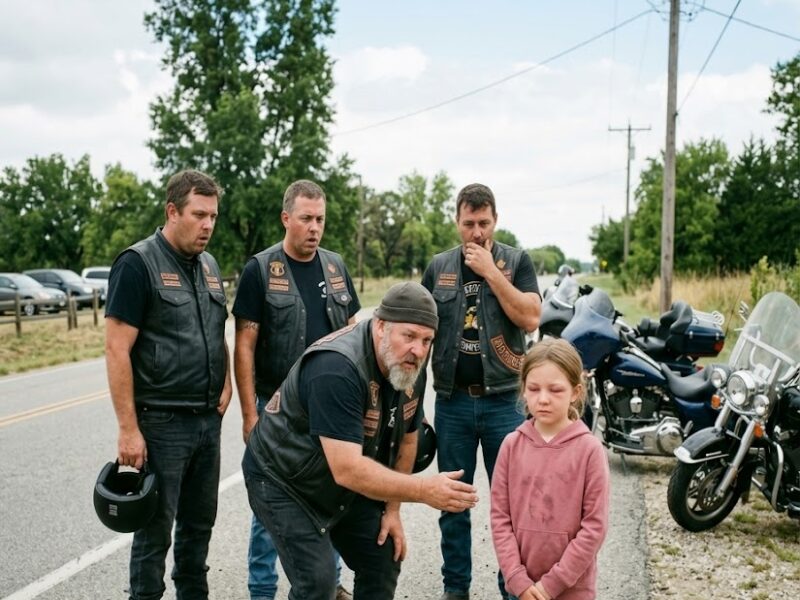
A Little Girl Couldn’t Open Her Eyes in the Sun—When One Biker Learned Why, 500 Hells Angels Changed the Entire Event
## Part 1
Five-year-old Hadley Mercer had never seen her mother’s face.
Not in the delivery room, not on her first birthday, not on any of the 1,826 days she had been alive. Her eyes were sealed shut, not by choice, not by injury, but by a condition she was born with that no amount of wishing could fix.
Her mother described the world to her every day. The color of the sky, the shape of the mountains, the way sunlight looks when it hits the river.
But when a weathered biker walked into a gas station and saw a little girl counting steps in the dark, gripping her mother’s hand, everything was about to change.
The Blue Ridge Parkway unspooled beneath Garrett Thornton’s tires like a ribbon of black silk draped across the shoulders of the mountains. October had come to Western North Carolina with its usual theatrics.
The ridgeline blazed in deep amber and burgundy, the morning air carrying the sweet bite of decaying leaves and distant wood smoke, and the kind of pale autumn light that made the whole world look like it was being remembered rather than lived.
Garrett leaned into a sweeping curve at mile post 355, the Harley-Davidson Street Glide growling beneath him with the steady bass note that had been the closest thing to a heartbeat in his life for 22 years.
At 44, the road captain of the Black Mountain charter of the Hells Angels carried himself with the quiet gravity of a man who had stopped trying to impress the world a long time ago.
He was broad through the shoulders and thick through the arms with dark hair going silver at the temples and a beard trimmed close enough to be deliberate, but long enough to mean business. His forearms were sleeved in faded ink, a compass rose on the left, a mountain ridgeline on the right, and between them a history of nights he didn’t talk about and mornings he was grateful to see.
He wore his vest like a second skin, the patches earned over two decades of road, and his eyes—gray, steady, perpetually narrowed against sun or wind or both—scanned the asphalt ahead with the automatic vigilance of a man who had learned that the road gives you exactly one warning before it takes something away.
He pulled off the parkway at the Ridgecrest exit and coasted down Route 70 into the town of Black Mountain, a place small enough that the local diner knew your order and the gas station clerk knew your name.
Garrett didn’t need gas. He needed coffee and 20 minutes of silence before the chapter meeting at noon. The kind of silence that only exists between a man and a Styrofoam cup at a corner table where nobody asks questions.
Boone’s General was a gas station that had forgotten to stop being a general store. Three aisles of canned goods, motor oil, fishing lures, and a coffee pot that had been brewing since 1987 and tasted like it.
Garrett pushed through the screen door, nodded at the kid behind the register, and was reaching for a cup when he heard the counting.
“14, 15, 16.”
A small voice, steady, deliberate, focused. The way a child counts when counting is not a game but a navigation system.
He turned. A woman stood at the end of aisle two holding the hand of a little girl. The woman was young, late 20s, dark hair pulled back. The particular posture of someone carrying weight that doesn’t show on the outside.
But it was the girl who stopped Garrett mid-reach.
She was five, maybe. Small for her age with a tangle of blond curls that caught the fluorescent light like spun copper. She wore a sundress with tiny blue flowers and sneakers that had been white three owners ago.
And her eyes were closed. Not squeezed shut. Not blinking. Closed the way a door is closed when the hinges don’t work. Settled, permanent, as if the lids had simply decided long ago that opening was not something they intended to do.
The girl moved by sound and touch, her free hand trailing along the shelf edge, her feet taking measured steps that she counted aloud with the practiced rhythm of someone who had mapped this store by memory.
“17, 18. Mama, the peanut butter is at 22, right?”
“22,” the woman confirmed, her voice carrying the particular gentleness of someone who has answered the same question a thousand times and will answer it a thousand more without complaint.
The girl’s hand found the jar. She picked it up, ran her fingers over the label the way other children look at pictures, and placed it in the basket her mother held. Then she turned her face in Garrett’s direction—not her eyes, because her eyes were somewhere behind those sealed lids, but her face angled toward him the way a satellite dish angles toward a signal.
“Someone standing there,” she said. “Not afraid, just reporting.”
“Yes, baby. A man getting coffee.”
“He smells like outside,” the girl said, “like the road after it rains.”
Garrett stood very still. In 22 years of riding, in bar fights and charity runs and funerals for brothers who didn’t make it home, nothing had ever rooted him to a floor the way this child’s voice did.
“Hey there,” he said. “Hi.”
The girl smiled, a full, unguarded, luminous smile that had no business belonging to a child navigating the world in permanent darkness.
“What color is your motorcycle?”
Garrett glanced through the window at the black Street Glide parked by the pumps. “How do you know I ride a motorcycle?”
“I heard it. The engine goes brum real low, not high like a car, and your boots are heavy. Motorcycle boots sound different.”
He crouched down, bringing himself closer to her level. “It’s black.”
“Black is the color my mama says the mountains are at night before the stars come out.”
Garrett looked at the woman. She met his gaze with the guarded expression of someone who has explained her daughter’s condition to strangers too many times and is tired of the pity that always follows.
“She was born this way,” Jolene Mercer said before he could ask. “Her name’s Hadley.”
“Garrett.” He extended his hand. She shook it, a brief firm grip. “Can I buy you two whatever you need in here? Seems like Hadley’s got the layout memorized better than I do.”
“We’re fine, thank you.”
“I know you are. I’m just a guy with a coffee and nowhere useful to be for another hour.”
Something in the way he said it—no pity, no performance, just a man offering what he had—made Jolene’s shoulders lower half an inch. She nodded.
Garrett carried their bags to a rusted sedan in the lot. Hadley held his hand for the walk, counting steps again, and when they reached the car she said, “27.”
“That’s three more than from the door to aisle two.”
He watched them drive away, the sedan trailing a thin ribbon of exhaust up Route 70. Then he sat on his bike and didn’t start the engine for a long time.
That night, in the one-bedroom house on Flat Creek Road that had felt like a waiting room since his divorce three years ago, Garrett sat in the dark kitchen and pressed his palms against the table. He could still feel the girl’s small hand in his. He could still hear her counting.
14, 15, 16. A five-year-old mapping the world in footsteps because the world had decided she didn’t get to see it.
He told himself it was none of his business. He told himself he had a chapter to run, bikes to maintain, a life that left no room for complications.
But Garrett Thornton had ridden enough mountain roads to know that sometimes the sharpest curves are the ones you don’t see coming and sometimes they take you exactly where you need to go.
He went back to Boone’s General four days later, told himself it was the coffee. The coffee was terrible and he knew it. And the lie sat in his mouth like a stone.
Hadley wasn’t there. But Earl Boone, the 70-year-old owner who had been selling gas and opinions in equal measure since the Carter administration, was behind the register. And Earl Boone was a man who considered silence a character flaw.
“You asking about the Mercer girl?” Earl said before Garrett had finished his first sentence. It wasn’t a question. “Jolene and her little one live on Vance Avenue, past the Baptist Church, white house with the green shutters. Well, they were green. Faded to gray now. Jolene’s been bringing Hadley in here since they moved down from Burnsville about 2 years back. Sweet kid, smart as a whip. Breaks your heart, though.”
“What’s the condition?”
“Something with the muscles in her eyelids. Born without them or born with them too weak. I don’t pretend to understand the medical side. Point is, the girl can see. Her eyes are fine. It’s the lids that won’t open. Like having perfect windows behind shutters that are nailed shut.”
Garrett found the house on Vance Avenue the following Saturday. The shutters were, in fact, gray. The porch steps sagged in the middle and a length of gutter hung loose from the roofline like a broken arm.
He parked across the street and sat on his bike for 5 minutes constructing excuses. He settled on the gutter.
Jolene answered the door with the expression of a woman who has heard every sales pitch the world has to offer and isn’t buying.
“I noticed your gutter’s about to come down,” Garrett said. “I’ve got tools in my saddlebag. Take me 20 minutes.”
“You rode across town to fix my gutter?”
“I was in the neighborhood.”
“Nobody’s in this neighborhood.”
They stared at each other. From inside the house, Hadley’s voice floated out. “Mama, is that the motorcycle man? I can hear his boots.”
Jolene’s jaw tightened. Then she stepped aside.
It took Garrett 40 minutes, not 20, because the fascia board behind the gutter was rotted, and he ended up replacing a 2-foot section with a piece of pine from the back of his truck. While he worked, Hadley sat on the porch steps below him, asking questions with the relentless precision of a child who has decided that if she cannot see the world, she will interview it until it confesses everything.
“How high up are you?”
“About 8 feet.”
“Is that higher than a horse?”
“Depends on the horse.”
“Have you ever been on a horse?”
“Once. Didn’t care for it. The horse didn’t care for me, either.”
Hadley laughed. It was the kind of laugh that makes adults remember that they used to laugh like that, too, before they learned to measure joy by what it might cost them.
That evening, after the gutter was fixed and Hadley was asleep on the couch with a blanket pulled to her chin, Jolene sat across from Garrett at the kitchen table and told everything. Not because she wanted to, because she had been carrying it alone for 5 years, and the weight had become geological.
Severe bilateral congenital ptosis. The levator muscles, the muscles responsible for lifting the upper eyelids, had never developed. Hadley’s eyes beneath were healthy. Her vision unimpaired.
When Jolene gently lifted her daughter’s eyelids with her fingertips, the girl could see colors, faces, shapes, the entire visual world rushing in like water through a broken dam. But the moment Jolene let go, the lids fell closed, and the darkness returned.
“She gets maybe 3 or 4 seconds at a time,” Jolene said, her voice steady in the way that steadiness can be its own form of grief. “I hold them open so she can see my face. She memorizes it. Every time she memorizes it again. Like she’s afraid she’ll forget.”
The surgery she needed was called a frontalis sling procedure, a technique where a surgeon threads a silicone sling from the eyelid to the frontalis muscle in the forehead, creating a mechanical link that allows the forehead muscle to lift the lid.
It was well-established, highly effective, and performed at Asheville Regional Medical Center by a pediatric ophthalmologist named Dr. Alan Whitford, who had done over 200 of them. It cost $42,000.
Jolene’s insurance, a bare-bones plan through her employer, had denied coverage. The denial letter, which she pulled from a kitchen drawer with the weariness of someone retrieving a document she had read until the words lost meaning, classified the procedure as cosmetic.
“Cosmetic,” Jolene repeated, the word landing on the table like something rotten. “My daughter has never seen a sunset. She has never looked at a book. She has never seen my face for more than 3 seconds, and they call it cosmetic.”
She had been saving—18 months of setting aside whatever she could from her cashier’s wage at Ingles Market and her evening shifts folding clothes at the Clean Spin Laundromat on State Street. The savings account held $2,800.
At her current rate, she would have enough in approximately 12 years. Hadley would be 17.
“She’s missing everything,” Jolene said. She was not crying. She had moved past crying the way a river moves past a rock—around it, over it, through sheer persistence. “She’s missing her whole childhood, and I can’t do anything about it.”
Garrett sat at that table for a long time after Jolene walked him to the door. He sat in the dark kitchen of a house that wasn’t his, staring at a denial letter that wasn’t addressed to him, and felt something shift inside his chest.
Not his heart, which had been functioning reliably for 44 years, but something deeper, something structural, the kind of shift that happens when a man realizes that the life he has been living and the life he should be living are two different roads and he has been on the wrong one.
He rode home through the mountain dark, the headlight cutting a narrow path through the October night. In his mind, a five-year-old girl counted steps in a gas station aisle and the number kept climbing and the counting never stopped.
And somewhere behind sealed eyelids, two perfect brown eyes waited for the world to let them in.
—
## Part 2
The Black Mountain Charter of the Hells Angels held its meetings on the first and third Friday of every month in a converted barn on Old Fort Road that smelled of motor oil, sawdust, and a lingering echo of a hundred arguments settled over warm beer.
The barn held 60 men comfortably and 80 if comfort wasn’t a priority. And on the first Friday of November, every seat was taken because Garrett Thornton had asked for floor time and Garrett Thornton never asked for floor time.
He stood at the front of the room—no podium, no notes, just a man in a leather vest standing on a concrete floor—and told them about Hadley Mercer.
He told it straight, no embellishment, no emotional manipulation, just the facts. A five-year-old girl, a medical condition, a surgery that could give her sight, and an insurance company that had decided her ability to see the world was a cosmetic concern.
He told them about the counting, 14, 15, 16, and about the three seconds Jolene could hold her daughter’s eyes open before the lids fell and the darkness came back. He told them about the 12 years of saving it would take on a cashier’s wage.
Then he said what he wanted. A benefit ride, a fundraiser. The full weight of the Hells Angels network brought to bear on a problem that no five-year-old should have to carry.
The room was quiet for four seconds. Then Curtis Pratt stood up.
Curtis was 50, built like a refrigerator someone had wrapped in denim with a shaved head and a handlebar mustache that he maintained with the same discipline other men applied to their retirement portfolios. As sergeant-at-arms, his job was to protect the club’s interests, and he took that job the way a guard dog takes a bone—with total commitment and zero flexibility.
“I’m not heartless,” Curtis said. “The kid’s situation is rough, but we’ve got brothers in this room who can’t make their truck payments. We’ve got Danny Ashworth’s widow still waiting on the memorial fund we promised eight months ago. We’re not a charity, Garrett. We’re a club.”
Murmurs, nods. The room split down the middle like a log under an axe.
Dutch Hargrove, the chapter president, sat in his chair at the head of the table and let the arguments run their course. At 56, Dutch had the silver goatee and the unhurried gaze of a man who had learned that the loudest voice in the room is rarely the wisest.
He had led the Black Mountain chapter for 11 years, and his leadership style could be summarized in three words: listen, think, decide.
When the room had exhausted itself, Dutch stood.
“Curtis is right,” he said. The room stilled. “We’ve got obligations. Brothers come first. That’s the foundation.”
He paused.
“But I’ll ask you something. What does this patch mean if the only people we protect are the ones wearing it? What kind of brotherhood only works when it’s convenient?”
He looked around the room. 57 men looked back.
“I didn’t put this vest on to ride past people who need help. None of you did either. Vote.”
The vote was 34 to 23. The ride was approved.
But approval and execution are different animals.
Over the next 3 weeks, Garrett learned that organizing a 500-rider benefit across multiple states was roughly equivalent to herding 500 cats through a thunderstorm while filling out government paperwork.
Permits from the North Carolina Department of Transportation, liability waivers, route planning along the Blue Ridge Parkway, which required coordination with the National Park Service, a venue for the post-ride fundraiser, sponsors, media outreach, food, water, portable restrooms.
Garrett worked 18-hour days. He called every charter president he knew—Asheville, Charlotte, Raleigh, Knoxville, Greenville, Charleston, Richmond. He reached out to allied clubs, independent riders, motorcycle associations.
He created a flyer with Hadley’s story—no photo of the girl, just the facts, because Jolene had asked him to protect her daughter’s privacy—and distributed it through every biker network in the Southeast.
Meanwhile, Hadley’s condition worsened.
The constant downward pressure of her eyelids had caused a corneal abrasion in her left eye. A scratch on the surface of the cornea that in a child who couldn’t open her eyes to apply drops or allow air to reach the tissue became a breeding ground for infection.
Dr. Whitford treated the abrasion with antibiotic ointment applied through a narrow gap in the lid, but his warning was clear and direct.
“The longer we wait, the higher the risk of corneal scarring,” he told Jolene with Garrett standing behind her in the clinic hallway like a leather-clad wall. “If the cornea scars significantly, the surgery to open her lids won’t matter. The windows will be open, but the glass will be frosted. She needs this procedure within the next 2 months.”
2 months. 8 weeks. 56 days to raise $42,000.
That night, Garrett sat alone in the empty barn on Old Fort Road. The chairs were stacked against the wall. The overhead light buzzed. He stared at the club’s banner hanging above the door—the winged death’s head, the letters, the name that made civilians cross the street—and felt the full weight of what he had taken on.
He had promised a woman and her daughter something he wasn’t sure he could deliver. He had staked his reputation, his standing in the club, and whatever credibility he had built over 22 years on the belief that 500 men on motorcycles could be moved by a story about a little girl who counted steps in the dark.
What if they weren’t? What if Curtis was right? What if the world was exactly as indifferent as it appeared?
His phone buzzed, a text from an unknown number.
“Mr. Garrett, this is Hadley’s mama. She wanted me to tell you something. She said, ‘Tell the motorcycle man that today mama held my eyes open and I saw a blue jay on the fence, and it was the most beautiful thing in the whole world, and I counted to four before they closed.’ She’s asleep now, but she wanted you to know. — Jolene”
Garrett read the message three times. Then he put his phone in his pocket, stood up, and walked to the workbench where the route maps were spread. He picked up a pen.
4 seconds. She had seen a blue jay for 4 seconds and called it the most beautiful thing in the whole world.
He was going to give her every second after that. Every single one.
—
The morning of November 14th broke clear and cold over the Blue Ridge. The kind of morning where the air tastes like iron and the mountains stand so sharp against the sky they look like they’ve been cut from sheet metal.
Garrett arrived at the staging area—the parking lot of the old Beacon Manufacturing Plant on the eastern edge of Black Mountain—at 5:30 in the morning, 2 hours before the scheduled start, because sleep had become theoretical and the anxiety in his chest needed the physical outlet of checking logistics for the 11th time.
The lot was empty. 3 acres of cracked asphalt, a chain-link fence, and the skeletal remains of a textile mill that had closed in 2008. He stood beside his bike and stared at the emptiness and tried not to calculate the probability that he had organized the most expensive failure in the history of the Black Mountain Charter.
At 6:15, Dutch Hargrove pulled in. Then Curtis Pratt, who nodded at Garrett without speaking, and began setting up the registration table with the mechanical efficiency of a man who does not waste motion.
By 6:30, the first out-of-town bikes arrived—a group of eight from the Asheville Charter, their headlights cutting through the morning mist like searchlights.
Then the sound began.
It started as a low vibration, felt more than heard, a subsonic tremor that traveled through the asphalt and up through the soles of Garrett’s boots into his bones. Then it became a growl, then a roar.
The access road from Route 70 filled with headlights—not eight, not 20, not 50, but a continuous river of chrome and steel that poured into the lot like a metallic flood.
They came from Charlotte and Raleigh, from Knoxville and Chattanooga and Nashville, from Greenville and Columbia and Charleston, from Richmond and Roanoke and the far western edge of Virginia, where the mountains flatten into foothills.
They came on Road Kings and Street Glides and Fat Boys and Softails, on Indians and custom choppers and rat bikes held together with wire and stubbornness. They came in cuts bearing patches from 16 different charters and a dozen allied clubs and at least 30 independent riders who had seen the flyer and decided that today was the day they would ride for something other than themselves.
By 8:00, the three-acre lot was full. Bikes stood in rows so tight that a man couldn’t walk between them without turning sideways. The overflow spilled onto the shoulder of Route 70, a gleaming corridor of motorcycles that stretched for a quarter mile in both directions.
Garrett stood on the bed of a pickup truck at the edge of the lot and looked out over the assembly—500 riders, 500 engines, 500 men and women in leather and denim who had woken before dawn and ridden through the mountain cold because a little girl they had never met couldn’t open her eyes.
He couldn’t speak for a moment. Dutch put a hand on his shoulder and squeezed once.
The ride left at 9:00. The route ran 32 miles along the Blue Ridge Parkway from the Black Mountain entrance at milepost 355 to the Craggy Gardens Overlook at milepost 364, then down through the Swannanoa Valley and back into town via Route 70.
500 motorcycles in a column that stretched for nearly 2 miles. The combined thunder of their engines reverberating off the mountain walls like a geological event.
Cars pulled to the shoulder, families stood on overpasses, children waving. A local television crew from the Asheville NBC affiliate followed the column in a van, the reporter narrating into a camera with the wide-eyed expression of someone witnessing something they hadn’t expected to feel in their chest.
At the Craggy Gardens Overlook, the column paused. 500 riders stood on the stone wall at the edge of the Parkway and looked out over the Blue Ridge—50 miles of mountains rolling toward the horizon in shades of amber and rust.
And for 30 seconds, nobody spoke. The engines ticked as they cooled, the wind moved through the trees, and in that silence, every rider understood that what they were doing mattered in a way that transcended the club, the patch, the road.
—
## Part 3
The post-ride event filled the municipal park in downtown Black Mountain. Local restaurants had donated food—pulled pork from Que Sera, brisket from Black Mountain Barbecue, pies from the Louise Cafe.
A bluegrass band played on a makeshift stage. Children from the elementary school had painted a banner that read, “Ride for Hadley—Help Her See the World.”
The fundraising table was staffed by club members who had never volunteered for anything in their lives and were now accepting donations with the earnest gratitude of men discovering a part of themselves they didn’t know existed.
Local businesses contributed—the hardware store, the bookshop, the veterinary clinic, the auto body shop on State Street. Envelopes arrived from people who weren’t there, mailed to the chapter’s post office box with notes that ranged from “God bless that baby” to a single $50 bill wrapped in a napkin with no note at all.
Curtis Pratt found Garrett behind the registration tent at 3:00 in the afternoon after the crowd had thinned and the band had packed up and the volunteers were folding tables.
“I want to show you something,” Curtis said.
He reached into the inside pocket of his vest and pulled out an envelope. Inside was a cashier’s check for $5,000.
Garrett stared at it. “Curtis, my daughter’s college fund had she needed. She graduated 2 years ago.”
Curtis’s jaw worked. “I was wrong, Garrett. At the meeting. I was thinking small. A man’s not supposed to think small when a kid can’t see.”
Garrett took the envelope. He didn’t trust himself to speak, so he shook Curtis’s hand and the handshake lasted longer than either of them would have admitted to afterward.
At 4:00, Dutch Hargrove stood on the stage with a microphone that crackled with feedback and announced the total.
“Brothers and sisters, friends—today 500 riders covered 32 miles of mountain road for a 5-year-old girl named Hadley Mercer.”
He paused. The crowd—300 people who had stayed for the final count—leaned forward.
“Today, this community raised $67,412.”
The sound that followed was not a cheer. It was something deeper—a collective exhale, a release of held breath from hundreds of lungs at once, followed by applause that built from the back of the crowd and rolled forward like a wave breaking against a shore.
$67,000. $25,000 more than needed.
That evening, Garrett and Dutch drove to the house on Vance Avenue. Jolene opened the door with Hadley beside her, the girl’s hand resting on the doorframe, her face tilted toward the sound of their boots on the porch.
“Ms. Mercer,” Dutch said, removing his hat. “The Black Mountain Charter of the Hells Angels, along with 15 other charters and 300 independent riders, would like to inform you that your daughter’s surgery is fully funded, effective immediately.”
Jolene’s hand went to her mouth. She didn’t make a sound. The tears came silently, the way they do when a woman who has been holding the sky on her shoulders finally feels someone take the weight.
Hadley tugged her mother’s sleeve. “Mama, why are you crying? Is it the good kind?”
Jolene knelt and pulled her daughter against her chest. “It’s the best kind, baby. It’s the very best kind.”
—
The surgery was scheduled for December 3rd at Asheville Regional Medical Center—a Tuesday, because Dr. Alan Whitford believed that Tuesdays had the calmest energy in the surgical wing. And while no peer-reviewed study supported this claim, 26 years of operating on children’s eyes had given him the right to his superstitions.
Hadley was admitted at 6:00 in the morning. She walked through the hospital entrance holding her mother’s hand with her left and Garrett’s with her right, counting steps.
14 from the car to the sliding doors. 22 from the doors to the elevator. Nine from the elevator to the pre-op room. Her voice steady, her curls bouncing with each step, her sealed eyes betraying nothing of the magnitude of what was about to happen.
In pre-op, the nurses fell in love with her in approximately 90 seconds. She asked one of them what color the ceiling was.
“White,” the nurse said.
Hadley nodded seriously. “When I wake up, I’m going to check.”
Dr. Whitford arrived at 7:15. He was a tall, lean man with reading glasses perched on his forehead and the particular calm of someone who has held the future of a child’s vision in his hands more times than he can count and has never once allowed his hands to forget the weight of it.
He explained the procedure to Jolene with diagrams and a steady voice. The frontalis sling technique, where a thin silicone band would be threaded beneath the skin from the upper eyelid to the frontalis muscle of the forehead, creating a mechanical bridge that would allow Hadley to lift her lids by raising her eyebrows.
“When she wakes up,” Dr. Whitford said, “the slings will already be in place. There will be swelling and we’ll keep the lids taped for the first 24 hours. But when the tape comes off, she’ll be able to open her eyes.”
Jolene signed the consent forms with a hand that shook only once—on the last signature, where the pen skipped and she had to initial the correction.
The surgery took 2 hours and 14 minutes. Garrett spent them in the waiting room on the third floor, in a plastic chair designed by someone who had clearly never sat in one, staring at a television mounted to the wall that was playing a home renovation show with the sound off.
Dutch had offered to come. Garrett had told him no. This part was small and quiet and it belonged to the people who had been in the gas station aisle and on the porch steps and at the kitchen table.
At 9:30, Dr. Whitford appeared in the doorway. His surgical cap was still on. His face was neutral in the way that a doctor’s face is neutral when the news is good and they don’t want to spoil it with the wrong expression.
“The procedure went perfectly,” he said. “Both slings are in place, tension is calibrated, and the tissue responded beautifully. She’s in recovery. We’ll remove the tape tomorrow morning.”
Jolene pressed both hands against her face and breathed in once, hard, the way a diver breathes before going under.
The next 24 hours were the longest of Garrett’s life, and he had once spent 31 hours riding through a rainstorm from Sturgis to Knoxville on a bike with a leaking fuel line. So he had a frame of reference.
He stayed at the hospital. Jolene stayed. Hadley slept, woke, asked questions, slept again. The tape over her eyes made her look like a tiny mummy from a movie she had never seen, and she made jokes about it with the fearlessness of a child who has lived in the dark long enough that the prospect of light is not frightening, but overdue.
—
## Part 4
December 4th, 8:45 in the morning, room 412.
The morning light came through the east-facing window in a long warm slant that fell across the foot of Hadley’s hospital bed like a golden carpet.
Dr. Whitford stood at the bedside. Jolene sat in the chair to Hadley’s right holding her daughter’s hand. Garrett stood in the doorway, arms crossed, his vest creaking softly every time he shifted his weight.
“Okay, Hadley,” Dr. Whitford said, “I’m going to remove the tape now. When I do, I want you to keep your eyes relaxed. Don’t try to force anything. Just let your forehead do the work. Raise your eyebrows gently like you’re surprised. Like when Mama drops a plate. Exactly like that.”
Dr. Whitford’s fingers worked with a precision that made their gentleness almost invisible. The tape came away in two slow strips, one for each eye.
Beneath it, Hadley’s eyelids rested closed as they always had, as they had for every minute of every hour of every day of her life.
“Whenever you’re ready, sweetheart,” Dr. Whitford said. “Raise your eyebrows.”
The room held its breath.
Hadley’s forehead moved—a tiny contraction, barely visible. And her eyelids, the lids that had been sealed since the day she was born, that had kept the world on the other side of a curtain for 5 years, 1,827 days, 43,848 hours, lifted.
Brown eyes. Wide. Clear. Perfect.
Light poured in. Hadley blinked—once, twice. Her pupils contracted against the brightness, then dilated, then found their focus. The room sharpened around her.
The white ceiling she had asked about. The beeping monitors. The window with its bar of golden light. The blue of the hospital blanket. The silver of the IV stand.
And her mother’s face.
Jolene was crying. She had been crying since the tape came off, silently. The tears running down her cheeks in two straight lines.
Hadley stared at her with the raw, unprocessed wonder of someone seeing a miracle for the first time. Which is what it was. Because for Hadley, every face and every color and every shape was happening for the first time in the way that first times are supposed to happen—with the full force of novelty and the full weight of meaning.
“Mama,” Hadley whispered.
She reached up and touched Jolene’s cheek. The way she always had, by feel. But now her eyes were open and she was seeing what her fingers had memorized.
“You’re so pretty. You’re the prettiest thing.”
Jolene broke. She gathered her daughter against her chest and held her. And the sound she made was not a word, but something older than language. The sound a mother makes when the world finally gives back what it took.
Then Hadley looked past her mother’s shoulder to the man in the doorway. The big man with the silver temples and the leather vest, who smelled like the road after it rains.
“You’re the motorcycle man,” she said.
Garrett uncrossed his arms. His eyes were red. His voice came out like gravel. “That’s me.”
“You look like how your voice sounds. Big and safe.”
He walked to the bed and knelt beside it, the way he had knelt on the floor of Boone’s General four months ago. And Hadley looked at his face with her new, wide-open, impossible eyes, and she smiled—the same luminous, unguarded smile, but now it had eyes behind it, and the eyes were full of the world.
—
Three weeks later, when Hadley had healed and the slings had settled and her eyelids rose every morning with the ease of curtains pulled back from a window, Garrett organized one more gathering.
He didn’t call it a ride. He didn’t call it an event. He sent one message through the network.
“The girl can see. Come to the municipal park in Black Mountain on Saturday at noon if you want to be the first thing she sees outside a hospital room.”
500 riders came.
They filled the park the way they had filled it on the day of the benefit. Bikes in rows, leather and chrome, the smell of exhaust and coffee, and the cold December air. They stood in a broad semicircle around the gazebo—500 men and women who had ridden mountain roads in the dark of early morning because a little girl was about to see them for the first time.
At noon, Jolene’s car pulled into the lot. The passenger door opened and Hadley stepped out.
She was wearing a new dress—red, because when Jolene had asked her what color she wanted, Hadley had said, “The color of the leaves that the motorcycle man told me about.” Her curls were combed. Her eyes were open.
She stood at the edge of the crowd and looked.
500 motorcycles gleaming in the winter sun. 500 riders in leather standing shoulder to shoulder. The mountains behind them, blue and ancient, framing the scene like the walls of a cathedral she had never known existed.
Her mouth opened. Her eyes—brown, wide, finally free—moved across the assembly trying to take in something too large for a 5-year-old’s understanding and too beautiful for an adult’s.
“Mama,” she breathed, “there’s so many.”
“They all came for you, baby.”
Hadley looked at the nearest rider—a bearded man in a Knoxville Charter vest who stood 6’4″ and weighed 270 pounds, and who, at this particular moment, was crying openly. She reached up and touched his hand.
“Thank you,” she said.
The man nodded. He couldn’t speak.
She moved through the crowd like a small red beacon, touching hands, looking at faces, absorbing the world with the bottomless hunger of someone who has been starving for 5 years and has finally been brought to a table.
Every face she looked at crumbled. The toughest men in six states—men who had ridden through storms and buried brothers and stared down trouble without flinching—undone one by one by a 5-year-old girl seeing them for the first time.
500 Hells Angels lost it. Not in anger, not in violence, in the way that strong men come apart when something too real breaks through the armor they’ve spent their whole lives building. Silently, completely, without a single attempt to stop it.
Hadley found Garrett at the center of the semicircle. She walked up to him, tilted her head back to look at his face—his full face in daylight with eyes that stayed open—and said, “I can see the mountains now. You were right. They look like they’re on fire.”
Garrett picked her up. She weighed almost nothing.
She rested her head against his shoulder and looked out at the Blue Ridge from the height of a man who had carried her story to 500 strangers and made them family.
—
## Part 5
The extra $25,000 raised beyond the surgery cost was placed in a trust for Hadley’s ongoing medical care and education. Curtis Pratt served as the trust’s first administrator, a role he performed with the same intensity he had once reserved for opposition.
On the wall of the Black Mountain Charter’s barn on Old Fort Road, next to the banner and the photographs of 32 years of rides, Dutch Hargrove hung a framed drawing.
It had been made by a five-year-old girl in red crayon—the only crayon she had asked for, because red was the first color she had chosen with her own eyes. It showed a motorcycle, a mountain, and a sun.
Beneath it, in the unsteady handwriting of a child who was still learning that the world is even more beautiful than it sounds:
“I can see you now.”
—
Six months later, in June, Garrett Thornton rode the Blue Ridge Parkway alone.
He passed milepost 355—the sweeping curve where the whole thing had started—and kept going. Past Craggy Gardens, past the turnoff for Black Mountain, past the exit that would have taken him to Boone’s General and the coffee that tasted like 1987.
He rode until the road ran out of mountain and the sky opened up into something flat and wide and full of light. Then he turned around and rode back.
When he pulled into the driveway on Vance Avenue, Hadley was sitting on the porch steps. The gutter was still fixed. The shutters were still gray. But the steps didn’t sag anymore—he’d replaced the boards in April—and there was a new screen door, and a swing on the porch that Jolene had bought at a yard sale in Swannanoa.
Hadley stood up when she heard the motorcycle. She didn’t count her steps anymore. She didn’t need to.
She ran to the edge of the porch, her eyes wide open, watching him pull in. The sun was behind her, catching her curls like spun copper, and she was looking at him—really looking, the way she had been looking at everything for the past six months, with the unbroken wonder of someone who had been given the world after being told it wasn’t hers.
“Hey, motorcycle man,” she said.
“Hey, Hadley.”
She tilted her head, studying his face the way she studied everything now—carefully, deliberately, like she was still memorizing it. “You look tired.”
“I rode a long way.”
“Was it beautiful?”
Garrett thought about the road. The mountains. The way the light had fallen across the valley at milepost 355, the same way it had fallen in October, the same way it would fall in another October, and another, for as long as the road held.
“Yeah,” he said. “It was beautiful.”
Hadley nodded, satisfied. Then she reached out and took his hand—not to guide her, not to count steps, just to hold it—and pulled him toward the house.
“Mama made lemonade,” she said. “And I want to show you the drawing I made. It’s a blue jay. I saw one on the fence this morning. I counted to four before it flew away.”
She looked up at him, her brown eyes bright and open and full of the morning.
“But I didn’t have to count this time,” she said. “I just watched.”
Garrett let her lead him up the porch steps, into the house that smelled like lemonade and summer and the particular quiet of a place where something had been fixed.
And somewhere behind them, on the wall of a barn on Old Fort Road, a red crayon drawing hung next to a winged death’s head, and the two of them—the girl who couldn’t see and the men who couldn’t cry—had become the same story.
A story about what happens when 500 riders decide that a five-year-old girl deserves to see the world.
A story about the road, and the people on it, and the sharpest curves you don’t see coming.
A story that started with a little girl counting steps in the dark.
And ended with her running toward the light.









