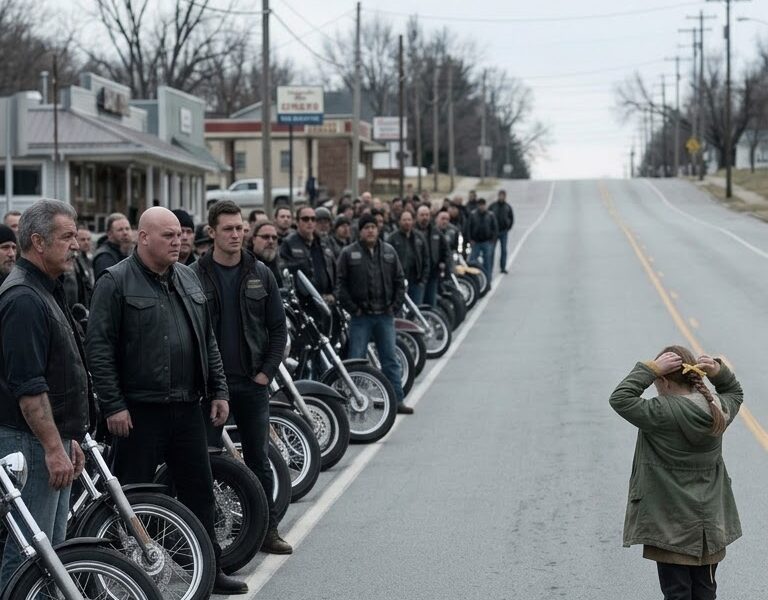
A little girl carried two bags of groceries up the same steep hill every Thursday. Nobody helped her. Nobody asked why. Then one Thursday, 450 bikers lined the street—and everything changed.
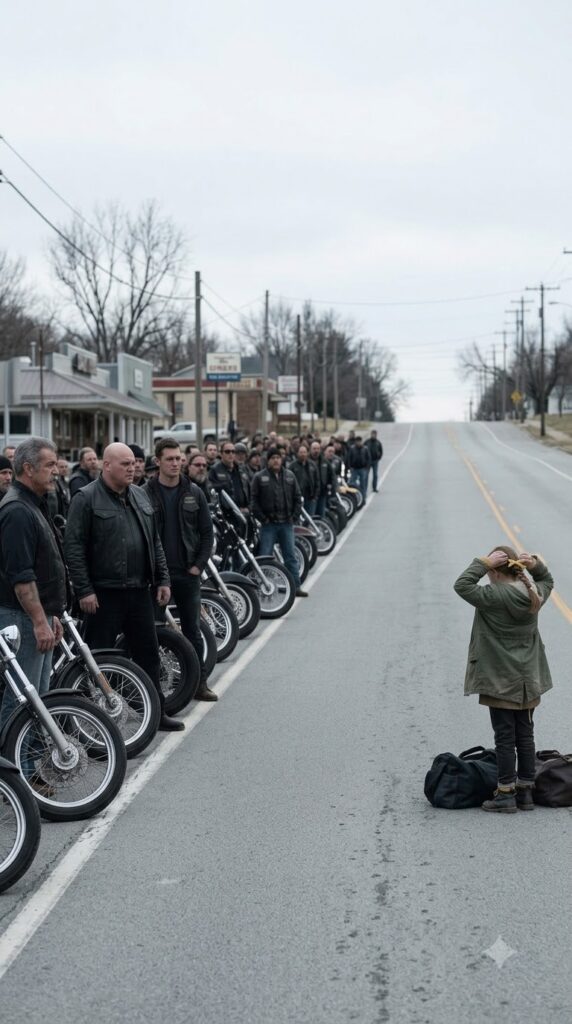
She was coming up the hill the way she always did, and Callum Drace watched her from the shoulder of the road the first time, without meaning to watch at all.
He had pulled over to let his engine cool in the November wind, both thick forearms resting on the handlebars, the visor of his helmet flipped up so the cold could reach his face.
He was 53 years old and had not been surprised by much in 30 years of desert riding, but the girl stopped him the way a hawk stops you mid-sentence.
She was maybe seven, maybe eight, small enough that the two grocery bags she carried looked borrowed from a larger world, one in each hand, arms straight down, the weight pulling her shoulders forward.
And she was walking at the pace of someone who had calculated exactly how many steps remained and had made peace with all of them.
That was a Thursday.
It was 4:20 in the afternoon and the light was already losing its nerve at the edges of the mesa.
She did not look at him.
She did not look at anything except the crest of the hill 30 yards ahead.
And when she reached it, she kept walking without stopping down the other side and out of sight.
And the only thing she left behind was the sound of the wind moving through the scrub and the faint plastic rustle of two grocery bags going still.
Callum Drace sat on his bike for another two minutes and did not pull back onto the road.
The engine had been cool enough to ride for most of that time.
He stayed because something in his chest had shifted the way weight shifts when you redistribute it wrong.
And it took him a moment to understand what he was feeling.
Not pity, not alarm, something quieter and older than either of those things.
The kind of thing that lives in the body and does not have a name until much later.
He pulled back onto the road.
He rode home.
He did not tell anyone what he had seen because at that point there was nothing to tell.
It was just a small girl carrying groceries up a hill on a Thursday afternoon in November, and he was a big man on a loud motorcycle, and the world was full of both those things.
But he came back the following Thursday and the Thursday after that.
And by the time the cold had hardened into genuine winter, he understood something that changed the nature of everything.
She was always there.
Same hill, same time, same two bags.
Every Thursday at 4:20.
Four hundred fifty bikers lined that hill on a morning in February, and not one of them had been there by accident.
That part is the part nobody was ready for.
The Ash Creek Riders rode out of the high desert scrub north of Flagstaff and had done so for 22 years.
Callum Drace had been president for 14 of those years, the last founding member still active, which meant he was also the last one carrying the weight of what the club had been before it became what it was.
The weight was not light.
He wore it in the set of his jaw, and in the way he stood slightly apart from any room he entered, not from arrogance, but from habit.
Men who have carried a thing long enough begin to leave space around themselves the way load-bearing walls leave space in a structure.
Not emptiness but function.
He was six foot two of work-built frame, which is to say large without decoration, the kind of large that comes from lifting and hauling, and not from a gym.
His beard was iron gray, going fully white at the chin, dense enough that in cold weather it held the shape of his breath.
He had broken his left hand twice, once in the first year of the club and once in the 14th, and the knuckles had healed thick and slightly offset, so that when he gripped a handlebar in cold air, you could see the joints had their own weather history.
The patch on his back said Ash Creek Riders, and below that, President.
And that was all anybody outside the club needed to know about him on first look.
What nobody saw on first look was the photograph he kept in the inside left pocket of his cut.
Not in his wallet, not on his phone, in his cut against his chest.
The way you keep something you are not done grieving.
The photograph was 12 years old and showed a different man.
Same frame, different eyes, standing beside a small bicycle with training wheels.
The bicycle was red.
The child beside it was laughing.
His name had been Eli, and Eli had been six years old, and there was not a Thursday in 12 years that Callum Drace had not known what day it was.
He never spoke about Eli to anyone in the club.
That was not the culture of the Ash Creek Riders.
You earned your place in the club through your hands and your reliability and your willingness to hold a line when a line needed holding, and you kept your grief the same way you kept your mechanical problems.
Diagnosed, managed, not performed.
But grief does not wait for permission, and it does not care about culture.
It finds its own exits.
The exit that November was a small girl with two grocery bags and a hill she climbed every Thursday at 4:20.
He went back the following Thursday and parked 200 yards down the road in the direction she came from.
He left the engine off.
He waited.
At 4:17 she appeared around the bend from the direction of the valley, both bags already in hand, and he understood that she had walked from somewhere lower than the hill, that the hill was not the beginning of her route, but the hard part of it, the part she had probably learned to pace herself for.
He watched her reach the base of the hill.
He watched her adjust her grip on both bags, the way a person does when they have been carrying something long enough to know where it hurts.
She was wearing a green coat that had once been a darker green and was now the green of something washed too many times.
Her boots were brown and practical and slightly too large, and she walked in them with the slightly rolling gait of a child compensating for extra room in the toe.
Her hair was two braids, both of them slightly loose by this point in the afternoon, one ribbon pink and one ribbon yellow, and both ribbons doing their best.
She reached the crest of the hill and went over it.
He did not follow.
He sat in the cold for a while, and then he drove home by a different road, and on the way home he thought about how many Thursdays he had been alive for, and how few of them he had paid attention to.
At the next church meeting of the Ash Creek Writers, Callum Drace sat at the head of the table in the back room of the shop on Juniper Flats Road, and said nothing about the girl for the first 40 minutes.
The meeting covered the usual business, the spring run, a fundraiser for the county food bank, a disagreement between two members about a borrowed tool that had been ongoing for six weeks and showed no sign of resolving itself.
He listened to all of it with the attention he always gave it, which was complete, and he made the decisions that needed making.
And then he said, “I need to tell you something I saw.”
The room went quiet in the way rooms go quiet when the president of an organization says a thing like that.
Not alarmed, attentive, six men and one woman around that table.
And all of them understood that Callum Drace did not introduce things he had seen unless they mattered.
He told them about the girl.
He told them about the hill and the bags and the Thursday schedule, and he told them he had gone back three times and she had been there all three times, same hour, same two bags.
He told them about the green coat and the braids and the way she adjusted her grip at the base of the hill.
And then he stopped talking and looked at the table.
Nobody said anything for a moment.
Then Rodrik Payne, who was road captain and had been riding with Callum since the early years, a broad-shouldered man of 48 with a shaved head and the callous patience of someone who had spent decades anticipating weather, said, “How far from the nearest store?”
Callum said, “I drove it a mile and a quarter from the ShopMart on Frontage Road to the base of that hill. Another quarter mile of hill.”
Rodrik Payne nodded.
He did not say anything else.
Beside him, Nessa Hulquist, the club’s treasurer and the only founding member besides Callum, a compact woman of 51 with grease-scarred hands and the direct gaze of someone who had learned not to soften things unnecessarily, said, “Every Thursday, every Thursday at 4:20?”
Callum said, “Every Thursday at 4:20.”
Nessa Hulquist looked at Rodrik Payne.
Rodrik Payne looked at the man across the table, a younger member everyone called Drift for the way he could hold a corner at speed, whose actual name was Marcus Toronto, 29 and from Kingman, with a talent for logistics that exceeded his formal education by a wide margin.
Drift was already looking at Callum with an expression that was not a question because the answer was obvious.
“How many can we get?” Callum asked him.
Drift said, “From the chapter, easy 60. From the network, if I have two weeks I can get you whatever number you say.”
Callum said, “I want the hill covered every yard of it both sides of the road shoulder to shoulder from the bottom to the top.”
Drift said, “I’ll need to know how long the hill is.”
Callum said, “312 yards.”
Drift looked at the ceiling for a moment, the way a man looks when he is doing multiplication without a surface to write on.
Then he looked back at Callum and said, “450 minimum. Could go higher.”
Callum said, “Make it exactly 450.”
The room was quiet again.
Then Nessa Hulquist said, “She doesn’t know, does she?”
“No,” Callum said, “and she doesn’t find out beforehand.”
What nobody at that table asked, and what Callum Drace was grateful none of them asked, was why it mattered to him personally.
The Ash Creek Riders had done a hundred acts of service across the high desert in 22 years.
They had ridden escort at funerals of first responders.
They had built ramps for veterans who came home without the use of their legs.
They had raised money and delivered food and showed up in numbers for people who needed numbers to feel that the world had not turned its back on them.
There was precedent for what Callum was proposing.
There was institutional memory for it.
The why of any particular instance did not require explanation.
But Callum knew why.
The way you know things you have stopped trying to put into language.
He knew it had something to do with Thursdays and a red bicycle and training wheels and the fact that his son had been six years old on the last day Callum had seen him.
He knew it had something to do with every Thursday since.
He put his hand flat on the table and left it there, and the meeting moved on to logistics, and that was the closest he had ever come to telling them.
Drift worked the phones for 11 days.
He was methodical in the way that people are methodical when they genuinely enjoy solving a problem of scale.
He started with the Ash Creek chapter and worked outward through the network of independent clubs and riders spread across the high desert corridor from Kingman to Holbrook.
Men and women who had ridden with the Ash Creek at various events over the years and who answered his calls the way people answer calls from someone they respect, which is to say quickly and without excess conversation.
He kept a handwritten ledger, columns in pencil, clubs and individuals by geographic zone because he had learned from watching Callum that written things have a different weight than digital things, a different accountability.
By the end of the first week, he had 230 riders committed.
By the end of the second week, he had 419.
He called Callum at quarter to nine on a Wednesday night and Callum was already awake because he rarely slept well on the night before a Thursday.
“419 confirmed,” Drift said. “31 more on the line if I call tonight.”
Callum said, “Call them.”
By midnight, Drift had 451.
He trimmed one from the outer list to land on the number Callum had given him.
And then he spent 20 minutes writing out the positioning grid on paper, rider by rider, yard by yard, each cluster of 12 covering roughly eight yards of hillside on the shoulder, staggered so that the road itself remained clear.
He had organized convoy logistics before for the long runs, and this was not unlike that except that the objective was stillness instead of movement.
The whole art of it was in the placement.
You could not let it look like a crowd.
It had to look like something deliberate, something chosen, something that had been there a long time and intended to stay.
He faxed the grid to Callum the next morning at 6:15.
Callum was already in the shop, a cup of coffee going cold on the workbench beside him.
He looked at the grid for a long time without speaking, tracing the positions with one thick finger, counting the intervals.
Then he put the paper on the workbench and picked up his coffee and drank what was left of it and said nothing because there was nothing that needed saying.
Drift had done it exactly right.
The plan was straightforward.
Four hundred fifty riders would arrive at the hill in coordinated groups between 2:30 and 3:45, parking on the gravel shoulder and the wider verge below.
And they would take their positions along the 312 yards of hillside on foot, standing on both shoulders of the road, at intervals of roughly two feet, facing the road, every bike engine off, every engine silent by 3:50.
The girl came around the bend at 4:17, and she would have the full length of the hill lined and waiting before she saw a single face.
The morning of the Thursday in question was the kind of February morning the high desert produces when it wants to remind you that beauty and hostility are not opposites.
The sky came up purple and then rose gold and then a pale hard blue that promised wind and the wind delivered.
By eight in the morning, the temperature on the mesa was 31 degrees, and the road surface on the hill had a thin frost on the aggregate that would be gone by noon, but was there now, and Callum Drace rode out to inspect the location at 8:45 alone, in full gear, and walked the 312 yards of hill twice in the cold, uphill, and then downhill, his boots leaving prints in the frost.
He stood at the crest and looked at the view.
From the top you could see a wide basin of scrub, mostly juniper and rabbit brush, and beyond it the suggestion of canyon walls in the far distance, and beyond those the mountains.
It was the kind of view that makes the chest feel larger and the problems feel smaller, and it had been doing that to people in this part of the world for longer than the road had been there.
He thought about a small girl carrying groceries over this crest every Thursday and looking at this view and then walking down the other side of it.
And he thought she probably did not stop to look.
When you are carrying something heavy, your eyes go to the ground in front of your feet.
That is just physics.
That is just what weight does to your field of vision.
He went back to the shop and spent the next three hours doing ordinary work because ordinary work was how he had always managed large feelings.
By noon, 12 members of the Ash Creek chapter had gathered in the shop lot, and by one in the afternoon, the road outside was beginning to show the first of the arriving columns.
They came from the east along Route 89 and from the south along the Juniper Flats connector, single file and quiet the way the Ash Creek ran any road in populated territory.
They came in Harley-Davidsons from the 80s and the 90s and the early 2000s mostly, and in a scattering of other makes, and in a few trucks with bikes in the beds for riders who had suffered winter mechanical issues that morning and refused to miss the event for something as minor as an engine problem.
They came in cold weather gear, which meant they looked enormous, which meant that when 450 of them began parking on the gravel shoulder below the hill, they looked from a distance like some kind of geological event.
The county sheriff’s deputy who came out to inquire at 2:45 was a young man named Garrett Selsby, 26, and three years on the job, who had received three separate calls from residents reporting an unusual concentration of motorcycle traffic on a county road.
He pulled his cruiser up to the edge of the gathering and got out with the carefully neutral expression of a man who has not yet decided what he is looking at.
Callum Drace walked over to him alone without hurrying and shook his hand.
He explained the situation in about four sentences, which was enough, and he showed Garrett Selsby the positioning grid so he could see that the road itself would be clear, and then he said, “She comes over the hill at 4:17. If you want to see it, you are welcome to stay.”
Garrett Selsby looked at 450 bikers arranging themselves along a hillside in formation in the February cold.
And then he looked at Callum Drace, and then he said, “I’ll stay.”
He parked the cruiser a hundred yards below the base of the hill and did not get back in it.
By 3:50, the engines were off, all 450 of them.
The high desert silence came back the way silence comes back when a large machine stops.
First you hear the wind, then you hear the smaller sounds underneath the wind.
Then you hear your own breathing.
Three hundred twelve yards of hillside, both shoulders, bikers standing two feet apart in the February cold, faces toward the road, nobody speaking.
The frost was gone from the aggregate by now, and the afternoon sun had moved to a low angle that put long shadows across the hill and made everything look stretched and deliberate.
Callum Drace stood at the bottom of the hill, at the base, at the point where the road flattened out and the grade began.
He stood with his back to the hill and his face toward the bend in the road.
She would come around at 4:17 and he put his hands at his sides and he waited.
Rodrik Payne stood three yards to his left.
Nessa Hulquist stood three yards to his right.
Drift was somewhere in the upper third of the hill near the crest because he had said he wanted to be close to the top so he could see her face when she crested it.
Nobody had argued with that.
The wind moved through the juniper on both sides of the road.
A hawk crossed the sky above the hill from west to east and did not pause.
The afternoon light went from pale gold to a deeper amber that caught the chrome on 450 parked motorcycles below and turned the whole lot of them into something that looked briefly like fire.
Four-forty-three. A minute of silence.
Another.
At 4:11, someone in the upper half of the hill coughed, and the sound carried down the whole length of it, and nobody turned to look.
At 4:14, Callum Drace put his hand in the inside left pocket of his cut and touched the photograph without taking it out.
4:16.
The wind dropped, the way wind sometimes drops before a significant moment, as if the air itself is paying attention.
Four hundred fifty people on a hillside in the high desert and the only sound was the far-off movement of a truck on a road they couldn’t see.
And then that too went quiet.
She came around the bend at 4:17 and two minutes, not 4:17 exactly, and Callum Drace saw her before she saw anything.
She came around the bend at her usual pace, one bag in each hand, arms straight, shoulders slightly forward, eyes on the road surface ahead of her feet.
She had on the green coat, she had the two braids, both slightly loose by this hour.
The ribbon on the left was pink, and the ribbon on the right was yellow, and they were both present and doing their best, same as every Thursday.
She walked 15 feet before she raised her eyes and saw the bottom of the hill.
She stopped. Fully stopped, both feet planted, both bags still in her hands.
She looked up the hill and she looked to the left shoulder and she looked to the right shoulder and she looked at Callum Drace at the base.
And the expression on her face was not fear, not confusion exactly.
It was the expression of someone who has seen something that does not fit inside any category they possess and is taking a moment to make a new one.
Callum Drace crouched down on one knee so that his face was closer to her height.
That was all he did.
He did not wave.
He did not speak.
He just lowered himself to her level and looked at her and waited.
She looked at him for a long moment.
Then she looked up the hill again and something in her face shifted the way weather shifts over open ground, slowly and then all at once, and she picked up both bags again, adjusted her grip the way she always did, and walked to the base of the hill and started up it.
She walked up the center of the road and the 450 people on both shoulders did not move.
They stood the way things stand that have decided to stand, the way a wall stands, with intent and with permanence.
Some of them had their helmets off, some of them had not.
None of them spoke.
As she walked past each pair of them, they turned incrementally to face her passage, the way sunflowers track light, so that she walked through a corridor that was always facing her, always.
Every step of the 312 yards.
About a third of the way up, she stopped again.
She set one bag down on the road surface, just one.
She put her freed hand up and touched the ribbon in her right braid, the yellow one, which had been working itself loose all afternoon, and she retied it tightly with both hands.
And then she picked the bag back up and kept walking.
Rodrik Payne, standing on the right shoulder six feet from where she had stopped, looked straight ahead.
He did not look at her.
He gave her the privacy of it.
Drift saw her come over the crest.
He said later that he had prepared himself for the moment by deciding in advance that he would not do anything undignified, and that the preparation had not worked at all, and that the view from the top of that hill in the February afternoon light was one he did not expect to carry for the rest of his life, but understood in the moment it happened that he would.
She reached the crest and stood on it, and looked back down the hill she had climbed, the whole length of it, and the whole length of it looked back at her.
Four hundred fifty people in the amber light of a February Thursday, and the light was in her face, and the wind was moving her braids, and both bags were still in her hands.
She stood there for 23 seconds.
Drift counted them.
Then she turned and walked down the other side of the hill, and the sound of her boots on the road faded, and after a while, there was only the wind.
Nobody spoke for a full two minutes.
Then the rider nearest the crest on the right shoulder, a man of 60 from Winslow, whose name was Burl, cleared his throat and said to no one in particular, “She didn’t put down a single bag until she was ready.”
Nobody answered him because it didn’t need answering.
Callum Drace was still at the base of the hill.
He stayed there after the others began moving back toward their bikes.
He stood in the road and looked at the crest and the sky above it, which was going from amber to a deep rose at the western edge, and staying pale blue directly overhead.
He had his hand in the inside left pocket of his cut.
He had the photograph out.
He looked at it for the first time in a long time in daylight, in the open air, without the privacy of his shop or his house around him.
Nessa Hulquist walked past him toward the lot.
She did not look at what he was holding because she was not that kind of person.
But she put her hand on his shoulder for one second, briefly, just the weight of it, and then she kept walking.
He put the photograph back.
He looked at the sky.
He had ridden every road in this part of the world, and he knew the way the light changed over the mesa when the day was ending, and he let it change now without trying to hold it.
That was the thing about grief.
Not that it left, but that eventually you could stand in the open air with it and let the light do what it was going to do.
Drift came back down the hill and stood beside him.
He said, “We counted 451. I miscounted one commitment.”
Callum said, “451 is fine.”
Drift said, “We need a name for it.”
Callum thought about it.
He thought about the hill and the bags and the green coat and the braids and the way she had stopped to retie the yellow ribbon and then picked the bag back up without anyone’s help.
He thought about the photograph in his pocket and the red bicycle with training wheels and a boy who had been six years old.
He said, “Thursday.”
Drift looked at him.
“Just Thursday. The Thursday Ride.”
Callum said, “Every February, any child carrying something too heavy for their size, any hill in the high desert, we find them first and we stand there before they arrive.”
Drift nodded.
He took a small notebook from his chest pocket, the same ledger he’d used for the positioning grid, and he wrote it down in pencil on the next blank page.
He was not a man who wasted words or pages, and the act of writing it down meant he considered it settled.
Three days after the Thursday on the hill, a woman knocked on the door of the Ash Creek Chapter House on Juniper Flats Road.
Her name was Plet Reigns, and she was 31 years old, and she had the particular stillness of a person who has decided to do something difficult and committed to it in advance.
She asked to speak to whoever was in charge.
She was shown to the back room where Callum Drace was working on a set of intake manifolds and she stood in the doorway of that room and said, “She’s mine. The girl, her name is Corali. I heard what you did.”
Callum wiped his hands on a rag and said, “How’d you hear?”
Plet Reigns said, “Garrett Selsby told his wife. His wife told the library. There is no other path of information in this town.”
Callum nodded.
He gestured toward the chair near the workbench.
She sat down.
He stayed standing because the grease was not all the way off his hands yet.
She told him the rest without him asking because she had decided on the drive over that she would not make him ask.
She worked the 3 to 11 shift at the Ponderosa Flats Care Center.
Her mother watched Corali after school.
On Thursdays, Corali’s grandmother had a physical therapy appointment in the valley at 3:30 that could not be moved.
And Corali had been getting herself home from the bus stop via the ShopMart for eight months because Corali had decided at some point in the fall that the household needed the Thursday shop done and she was the person available to do it.
Plet Reigns had not known Corali was carrying both bags.
She had believed the grandmother was managing at least one of them.
When she found out in late October she had tried to change the arrangement and Corali had objected strenuously and at length in the manner of a person who considers that they have mastered a system and does not appreciate the suggestion of replacement.
Callum listened to all of this.
When she was done he said, “She’s a serious kid.”
Plet Reigns said, “She has been serious since she was four.”
There was a pause.
Callum set the rag on the workbench and looked at his hands, which were mostly clean now.
He said, “We’re starting something every February. We call it the Thursday Ride. Your daughter gave us the idea, and she doesn’t owe us anything for it, but I want you to know it’ll go on.”
Plet Reigns looked at him for a moment.
She said, “She talked about it for two days after. She said there were so many people that the whole hill looked like it was wearing a coat.”
Callum said, “A coat? That’s what she said.”
He looked at the manifolds on the workbench and he looked at the far wall and he said quietly, the kind of quietly that means the words have a long way to travel before they arrive, “Tell her it’ll be there next February, too.”
Plet Reigns stood up.
She shook his hand with the directness of someone who does not perform gratitude, who just delivers it and moves on.
Then she left.
He stood in the back room for a while after she went.
The intake manifolds needed another 40 minutes of work.
Outside, someone’s engine turned over on the lot and settled into idle and then pulled away.
The afternoon light through the single window in the back room was coming in at the angle it came in at this time of year, low and particular, and it laid a bar of gold across the workbench and across the photograph that Callum Drace had taken out of his pocket and set face up on the corner of the bench before Plet Reigns arrived.
He did not pick it up right away.
He stood in the room and looked at it and let the light be on it.
The following February, the Thursday Ride numbered 604.
The year after that, 811.
The Ash Creek Riders printed the positioning grid on the club letterhead and formalized the coordinator role, which Drift held for every year that followed.
The ledger replaced by a clipboard, but the pencil the same pencil, a habit he declined to explain to anyone who asked.
Riders came from as far as Tucson and Albuquerque.
The county sheriff’s office sent Garrett Selsby in an official capacity to assist with traffic management, and he came willingly and early, and the year after that he sent two deputies, and the year after that three, and the year he made lieutenant, he came in his personal truck.
Corali Reigns grew three inches between the first Thursday and the second.
By the time the Thursday Ride reached its third year, she was 10 years old, and tall enough that the grocery bags no longer made her look borrowed from a larger world.
She still came over the hill at 4:20.
She had started carrying a third bag, which she balanced in the crook of her left elbow with the competence of someone who has thought about load distribution and reached a conclusion.
The first time she came over the hill to find 604 bikers lining the road, she stopped at the crest and stood the way she had stood the first time, and then she adjusted the bag in the crook of her elbow and walked down the far side the same as always.
On the fourth year, she stopped at the crest and looked directly at Drift, who was standing on the right shoulder near the top with the clipboard, because by then he had moved his position to the crest, and she said, “How many this year?”
Drift said, “712.”
Corali Reigns looked down the hill at 712 people standing on both shoulders in the February light.
Then she said, “Good,” and went over.
In a town built on juniper and hard weather and the particular loneliness of the high desert, a name can end up on more than one kind of wall.
The Ponderosa Flats Community Center has on the wall beside the entrance to the main hall a framed photograph taken in February.
It is a photograph taken from the air from a drone Drift borrowed from a friend who operates one professionally, and it shows 312 yards of desert road with two unbroken lines of people standing along it from base to crest.
You cannot count individuals from that altitude, but you can see that the lines are complete, that there is no gap in them, that someone thought about the spacing.
In the lower right corner of the photograph, on the road itself, at the crest of the hill, there is a small dark figure with two bags, one in each hand, arms straight, shoulders slightly forward.
Beneath the photograph, in plain letters on a strip of wood, are four words.
They say she never put them down.
Callum Drace drove past the community center on a Thursday in March, two years after the photograph went up.
He was alone on the bike and it was late morning and the sun was coming from the east in the particular way it comes in March, lower than you expect, with a quality of attention that winter light does not have.
He did not stop.
He slowed as he passed the entrance enough to see the frame through the window, the shape of it, the two lines, and the small figure at the top.
He thought about a red bicycle.
He thought about training wheels and a boy who had been serious since before he could talk, who had approached every new thing with the same deliberate assessment, the same refusal to be hurried.
He thought about how weight teaches you things that ease cannot teach.
He thought about two braids and a yellow ribbon retied in the middle of a hill without anyone’s help, and both bags picked back up after.
He accelerated, and the road opened out ahead of him into the mesa, and the sky above the mesa was the deep, clear blue of a morning that has decided to be generous.
And the sound of the engine under him was the sound of a thing that knows what it is for.
He had been carrying the photograph for 12 years.
He was still carrying it, but it was lighter than it used to be.
The way things get lighter when you finally let them mean what they mean.
When you stop trying to keep the grief separate from the gratitude and let them ride together.
The way two bags ride in two hands, neither one put down.
Both of them arrived at the crest, the hill behind you, and the whole long view still ahead.
—
The phone call came on a Tuesday, which was the first thing that made Callum Drace pay attention.
Nothing about the Thursday Ride happened on a Tuesday.
Tuesdays were for inventory at the shop, for the long slow work of ordering parts and reconciling invoices and doing the kind of administrative labor that kept the Ash Creek Riders solvent and legitimate in the eyes of the county and the state and the IRS.
Tuesdays were for the unglamorous machinery of an organization that had been alive for 22 years and intended to stay alive for 22 more.
But the phone rang at 2:15 in the afternoon and it was Nessa Hulquist on the other end, and Nessa Hulquist did not call during shop hours unless something had gone wrong.
“Turn on the news,” she said.
Callum said, “Which channel?”
“Any of them. It’s on all of them.”
He put down the torque wrench he had been holding and walked to the small office at the back of the shop, where a 13-inch television sat on a filing cabinet and had been tuned to the same local news station for as long as anyone could remember.
He turned it on and the picture came up and he stood there with his hands still smelling of grease and watched.
A woman in a red coat was standing in front of a courthouse in Flagstaff, and behind her was a crowd of people holding signs, and the chyron at the bottom of the screen said, “State Moves to Restrict Motorcycle Gatherings After Highway Incident.”
Callum watched the whole segment without moving.
A state senator from Phoenix, a man named Douglas Prine, had introduced a bill that would require permits for any gathering of more than 200 motorcycles on a public road, with fines starting at $5,000 and escalating to $25,000 for repeat violations.
The bill was being framed as a public safety measure, a response to what the news anchor called “a growing concern about unpermitted events on rural roads.”
The incident they kept showing was not the Thursday Ride.
It was a different gathering, in a different part of the state, a group of riders who had blocked a highway outside of Sedona for a charity event that had not been properly coordinated with local law enforcement, and there had been an accident, and a woman had been injured, and the footage was ugly in the way that footage is always ugly when it has been looped for 24 hours.
But the bill was not about that incident.
The bill was about all gatherings.
And the bill had been written in such a way that the Thursday Ride, which had been running for six years by then, which had grown to 1,200 riders, which had become a fixture of the high desert calendar the way the rodeo is a fixture and the county fair is a fixture, would be classified as an unpermitted event unless the Ash Creek Riders applied for a permit 90 days in advance and paid a fee of $7,500 and submitted a traffic control plan approved by the state department of transportation.
Callum turned off the television.
He stood in the office for a moment and then he walked back out to the shop floor and picked up the torque wrench and went back to work.
He worked for another two hours without speaking.
At 5:30, Rodrik Payne came in through the bay door and stood there with his arms crossed and said, “You heard.”
Callum said, “I heard.”
Rodrik said, “What are we going to do?”
Callum set the torque wrench down on the bench and looked at his hands.
He said, “We’re going to do what we always do. We’re going to show up.”
—
The meeting that night was the largest the Ash Creek Riders had ever held.
Not just the chapter, but the network, the independent clubs and the individual riders who had stood on the hill every February for six years, who had driven from Tucson and Albuquerque and Kingman and Holbrook, who had made the Thursday Ride into something that belonged to all of them.
They filled the back room of the shop and then they filled the shop floor and then they filled the lot outside, and Callum Drace stood on the tailgate of a pickup truck because there was no room left inside, and he spoke to them in the cold March air with his breath coming out in clouds.
He said, “You all know what we do. You all know why we do it. And you all know that what happened in Sedona is not what we are. But the state does not know the difference, and the state is going to make us prove it.”
He said, “The bill requires a permit. The permit costs $7,500. The permit requires a traffic control plan approved by the state. The permit requires 90 days’ notice. The Thursday Ride is in 11 months. We have time. But time is not the problem.”
He said, “The problem is that the bill also requires us to disclose the names of every rider who will be present. Every name. Every license plate. Every address. And that is not something we do.”
The crowd was quiet.
Then a man near the back, a rider from Kingman named Hector Villanueva who had been coming to the Thursday Ride since the second year, said, “So what do we do instead?”
Callum said, “We do it without the permit. We do it the way we have always done it. And if the state wants to fine us, they can fine us. If the state wants to arrest us, they can arrest us. But we are not going to let them turn a hill in the high desert into a paperwork problem. That hill is not a paperwork problem. That hill is a promise.”
The crowd made a sound that was not quite a cheer, because it was too low and too serious for that, but it was the sound of people agreeing with something they already knew.
Nessa Hulquist stepped up beside the truck and said, “We need to talk about the money. If they fine us $7,500 the first year, and $25,000 the second year, and $25,000 every year after that, we cannot absorb that. The club treasury is $18,000. We need a plan.”
Callum said, “We’ll raise it.”
Nessa said, “From who?”
Callum said, “From anyone who has ever stood on that hill. From anyone who has ever seen the photograph in the community center. From anyone who understands what it means to carry something heavy and not put it down.”
He looked out at the crowd, at the faces that were lit by the headlights of parked trucks and the single floodlight above the shop door, and he said, “We are going to need $75,000. That is the number. That is three years of fines and legal fees and the cost of a lawyer who can fight this thing in court. And I am telling you now, I do not know where it is going to come from. But I know that it is going to come. Because that is how this works.”
The meeting went until 10:30.
By the time it ended, $22,000 had been pledged in cash and checks and promises, and Drift had a clipboard with 47 names on it, and Nessa Hulquist had a spreadsheet on her phone that she would transfer to paper the next morning because she believed in paper the way Callum believed in paper.
And Callum Drace drove home alone on the dark road and thought about the bill and the fine and the lawyer and the hill.
He thought about the fact that the state of Arizona was trying to make it illegal to stand on the side of a road and face a child who was carrying groceries.
He thought about how the law could be used to erase things that were not hurting anyone, simply because the law did not understand what it was looking at.
He thought about the photograph in his pocket, the red bicycle, the training wheels, the boy who had been six years old.
He thought about how the world kept finding new ways to make you put things down.
And he thought about how he had spent 12 years learning not to.
—
The lawyer’s name was Margaret Okafor, and she was 44 years old and she had a small office in Flagstaff and a reputation for taking cases that other lawyers called unwinnable.
She had grown up in Phoenix, the daughter of a Nigerian immigrant father who had driven a cab for 30 years and a Mexican-American mother who had worked in a laundry, and she had put herself through law school at the University of Arizona by working nights at a call center and weekends at a bookstore.
She had been practicing for 18 years, and in that time she had sued the state of Arizona four times and won three of them.
She was not a biker.
She had never ridden a motorcycle in her life.
But she had read about the Thursday Ride in the newspaper, and she had seen the photograph in the community center, and when Callum Drace called her office and asked if she would take a meeting, she said yes before he finished the sentence.
They met on a Friday morning in her office on Aspen Avenue, and Callum brought Nessa Hulquist and Rodrik Payne and Drift, and Margaret Okafor listened to the whole story without interrupting.
She listened to the part about the girl and the bags and the hill.
She listened to the part about the 450 riders and the 1,200 riders and the photograph on the wall.
She listened to the part about the bill and the permit and the fine and the disclosure requirement.
And when they were done, she leaned back in her chair and looked at the ceiling for a moment, the way a person looks when they are doing something complicated in their head.
Then she said, “The bill is unconstitutional. Not the whole thing. But the disclosure requirement. The state cannot compel an organization to disclose the names and addresses of its members as a condition of exercising First Amendment rights. That is settled law. The permit fee is also vulnerable because it is not narrowly tailored and it imposes an undue burden on a specific type of expression. The traffic control plan is probably fine. The 90-day notice is probably fine. But the disclosure requirement is a problem for them, and I can use it.”
Callum said, “What does that mean for us?”
Margaret Okafor said, “It means we sue them. We file in federal court in Phoenix and we ask for an injunction that prevents the state from enforcing the disclosure requirement while the case is pending. If we win the injunction, the Thursday Ride happens this year the same as always. If we lose the injunction, we go to the Ninth Circuit, and if we lose there, we go to the Supreme Court. But I do not think it will go that far. I think the state knows the disclosure requirement is a problem. I think they put it in there as a bargaining chip, and I think they will drop it if we push back hard enough.”
Nessa Hulquist said, “How much is this going to cost?”
Margaret Okafor said, “My hourly rate is $350. I estimate this will take 200 hours between now and the hearing. That is $70,000. I will do it for $50,000 if you pay me in installments and if you let me use the story. Not the names. Not the details that would identify anyone. But the story. The girl and the hill and the riders. I want to tell that story in court, because that is the story that wins these cases. Judges are human beings. They respond to human beings. And the state is going to have a hard time explaining why it wants to stop a little girl from walking home.”
Callum said, “We can pay $50,000. We have $22,000 already and we are raising more.”
Margaret Okafor said, “Then we have a case. I will file the complaint on Monday. I will request an expedited hearing. And I will do everything I can to make sure that hill is lined this February the same as it has been every February for six years.”
She stood up and shook their hands one by one, and when she shook Callum’s hand she held it for a moment longer than the others and said, “I read about your son. I am sorry.”
Callum did not ask how she knew.
He just nodded and said, “Thank you.”
And he walked out of the office into the March sunlight and stood on the sidewalk for a moment with his hands in his pockets and the photograph against his chest and the whole weight of the thing pressing down on him.
He had not told anyone about Eli.
Not the club, not the lawyer, not the woman from the community center.
But somehow she had known.
And somehow that made it easier to carry.
—
The lawsuit was filed on a Monday morning in federal court in Phoenix, and by Wednesday it was on the front page of the Arizona Republic, and by Friday it was on the national news.
The headline in the Republic said, “Biker Club Sues State Over Permit Law, Citing First Amendment.”
The headline on the national wire said, “Arizona Motorcycle Group Fights State Over Annual Event Honoring Local Girl.”
And the story that Margaret Okafor had wanted to tell, the story of the girl and the hill and the riders, was suddenly everywhere.
It was on the morning shows and the evening news and the cable channels that needed something to talk about between political scandals.
It was in the newspapers and the magazines and the blogs and the social media feeds of people who had never been to Arizona and had never ridden a motorcycle and had never heard of the Ash Creek Riders.
And the response was not what the state senator from Phoenix had expected.
The response was $112,000 in donations in the first two weeks.
The response was letters and emails and phone calls from people who wanted to help, who wanted to come to the Thursday Ride, who wanted to stand on the hill and be part of something that was bigger than a permit fee.
The response was a retired judge from Tucson who volunteered to file an amicus brief.
The response was a state representative from Flagstaff who introduced a counter-bill that would exempt gatherings of fewer than 2,000 motorcycles from the permit requirement, and who stood on the floor of the state legislature and read the story of the girl and the hill into the official record.
The response was the county sheriff’s office, which had been quietly supportive of the Thursday Ride for six years, issuing a public statement that said, “The Ash Creek Riders have always cooperated with law enforcement and have never caused a single traffic incident. We do not believe this legislation is necessary.”
And the response was Douglas Prine, the state senator who had introduced the bill, holding a press conference in Phoenix where he said, “I have received a great deal of feedback from constituents, and I am willing to work with all parties to find a solution that protects public safety without infringing on the rights of law-abiding citizens.”
Which was politician for “I am losing this fight and I know it.”
The injunction was granted on a Thursday in April.
Margaret Okafor called Callum Drace at the shop and said, “We won. The judge ruled that the disclosure requirement is unconstitutional and that the permit fee is an undue burden. The Thursday Ride can proceed this year without a permit. The state can still require a traffic control plan, but I have already submitted one, and it is identical to the plan you have been using for six years. You are clear.”
Callum said, “Thank you.”
Margaret Okafor said, “You do not have to thank me. You paid me. And you gave me a story that I will be telling for the rest of my career.”
Callum said, “You should come to the hill this February.”
Margaret Okafor said, “I will be there.”
—
The Thursday Ride that February was the largest it had ever been.
Two thousand three hundred riders lined the hill, not just the 312 yards of the original hill but the quarter mile of road below it and the quarter mile above it, because there were more people than there was hill, and nobody wanted to be turned away.
They came from 14 states.
They came on motorcycles and in trucks and in cars and in one case on a bicycle, a man from Oregon who had lost his license to a DUI 10 years ago and had decided that he was going to be there anyway, even if he had to pedal.
They came because they had read the story and seen the photograph and understood that this was not about motorcycles.
This was about showing up.
This was about standing in the cold and facing the road and saying, without words, that the world had not turned its back on a little girl who was carrying groceries up a hill.
The county sheriff’s office sent six deputies and two cruisers and a helicopter, not to monitor the event but to manage traffic on the surrounding roads, because the county had finally understood that the Thursday Ride was not a problem to be solved but a thing to be protected.
The local news stations sent crews and the national news sent a correspondent and a camera operator, and the footage that ran that night showed two thousand three hundred people standing in a line that stretched from the base of the hill to the crest and beyond, and a small girl in a green coat with two grocery bags, one in each hand, walking up the center of the road.
She was 13 years old that year.
She had grown tall enough that the bags no longer pulled her shoulders forward, but she still carried them the same way, arms straight down, eyes on the road ahead of her feet.
She still wore two braids, though the ribbons had changed over the years, and that year they were both blue, because blue was her favorite color.
She still reached the crest and stopped and looked back down the hill, and the whole length of it looked back at her.
And when she reached the top, she did not go over immediately.
She set both bags down on the road, just for a moment, and she turned and faced the hill and the people on it, and she raised one hand, just one, in a wave that was small and deliberate and belonged entirely to her.
Two thousand three hundred people waved back.
And then she picked up both bags and walked down the other side of the hill and out of sight.
Callum Drace watched her from the base of the hill, where he had stood every year, and he had his hand in the inside left pocket of his cut, and the photograph was there, the same photograph, the red bicycle, the training wheels, the boy who had been six years old.
He was 59 that year.
He had been carrying the photograph for 18 years.
He had been carrying the Thursday Ride for seven.
And he understood, standing there in the February cold with two thousand three hundred people on a hillside and a girl disappearing over the crest, that the two things had become the same thing.
The grief and the promise.
The weight and the reason for carrying it.
He pulled the photograph out of his pocket and looked at it, and he did not put it away right away.
He stood in the road and let the light be on it.
The light was amber and low and particular, the way it always was on the third Thursday in February, and it fell on the photograph and on his hands and on the road that led up the hill.
And then he put the photograph back in his pocket, against his chest, where it had been for 18 years, and he walked up the hill to join the others.
—
The Thursday Ride is still running.
It has been running for 14 years now, through lawsuits and legislation and the kind of cultural shifts that make some things easier and some things harder.
It has grown and shrunk and grown again, depending on the year and the weather and the news cycle, but it has never missed a February.
It has never missed a Thursday.
Corali Reigns is 21 years old now.
She goes to college in Flagstaff, studying nursing, because she wants to work in the same care center where her mother worked and her grandmother was cared for.
She comes home on Thursdays when she can, and when she comes home she walks up the hill, and when she cannot come home, someone else walks in her place.
Not the same person every year.
Not a substitute, exactly.
A reminder.
A young woman from the community center who works with children, or a teenage boy whose mother is in the hospital, or a girl from the middle school who has been carrying her own groceries up her own hill and did not know that anyone had noticed until someone told her about the Thursday Ride.
The hill is still there.
The road is still there.
The frost still forms in February and the wind still moves through the juniper and the hawk still crosses the sky from west to east without pausing.
And on the third Thursday of every February, the riders come.
They come in numbers that vary and on bikes that vary and from places that vary, but they come, and they stand, and they face the road.
And when the person carrying the groceries reaches the crest, they stop, and they look back, and they see the line.
They see the people who showed up.
They see the thing that happens when a community decides that a small act of endurance is worth honoring.
And they pick up their bags, whatever bags they are carrying, whatever weight they are carrying, and they walk down the other side.
The photograph is still on the wall of the Ponderosa Flats Community Center.
It has been joined by other photographs, one for each year, and the wall has become a kind of timeline, a record of a thing that started with one man on a motorcycle and one girl on a hill and grew into something that nobody could have predicted.
In the earliest photograph, the one taken from the drone, you can see the small dark figure at the crest with two bags, one in each hand.
In the latest photograph, taken last February, you can see the same figure, taller now, with two bags, one in each hand, and behind her, stretching down the hill and out of frame, a line of people that goes on and on.
Beneath the latest photograph, on a strip of wood, are the same four words that have been beneath every photograph since the first one.
They say she never put them down.
And below that, in smaller letters, added in the 10th year, are four more words.
They say neither did we.
Callum Drace is 67 years old now.
He still rides.
He still runs the shop on Juniper Flats Road and still serves as president of the Ash Creek Riders, though he has talked about stepping down and the club has talked him out of it every time.
He still keeps the photograph in the inside left pocket of his cut.
The photograph is 26 years old now, and the colors have faded, and the edges are soft from handling, but the boy is still laughing beside the red bicycle with training wheels, and the man in the photograph is still young, and the day is still the day before everything changed.
Callum does not look at the photograph as often as he used to.
He does not need to.
He carries it the way you carry a thing you have stopped trying to put down, which is to say the way you carry your own hands, the way you carry your own breath.
It is part of him now.
It is part of the hill and the road and the riders and the girl and the people who show up every February to stand in the cold and face the road.
It is part of the story that Margaret Okafor told in court and that the state representative read into the record and that the news crews beamed across the country.
It is part of the thing that happens when you refuse to put down what you are carrying.
The way two bags ride in two hands, neither one put down.
Both of them arrived at the crest, the hill behind you, and the whole long view still ahead.









