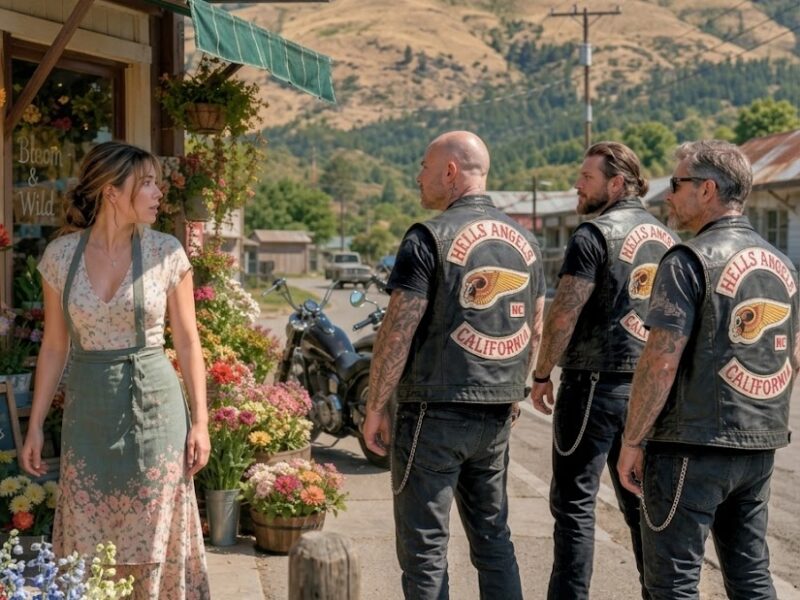
A little flower girl was abandoned by her own father at the altar — then three Hells Angels chapters stood up and claimed her as their own.
A car door slammed shut.
Gravel sprayed as tires spun and a beat-up sedan tore out of the chapel parking lot.
A little girl ran after it, one hand clutching a bunch of half-dead flowers.
She screamed a word that no child should ever have to scream in an empty parking lot.
Daddy.
The car didn’t slow down.
It didn’t even tap the brakes.
It just got smaller and smaller until the dust swallowed it whole.
And then there was nothing.
No engine, no voice.
Just a six-year-old in a white dress, standing alone at the edge of a desert highway, holding a wilting bouquet and a shivering little dog.
Her name was Lily Mercer.
She was about to be left behind by the one man who was supposed to love her most.
What happened next, nobody in that entire desert town saw coming.
Stay with me on this one.
Now, to understand what happened that afternoon, you have to picture the place.
It was a little wedding chapel just off Route 66 on the edge of Kingman, Arizona.
The kind of place with a gravel lot, a hand-painted sign, and a couple of dusty plastic flowers by the door.
There was a wedding scheduled for 2:00.
Lily was the flower girl.
Somebody had put her in a white dress and white shoes and told her to wait outside until it was time.
So, she waited.
She was good at waiting.
She’d had a lot of practice.
Her father, Dean Mercer, had dropped her at the chapel that morning.
He told her the bride’s family would take care of her.
He told her he just had to run an errand and he’d be right back.
And then he drove off and he did not come right back.
He did not come back at all because Dean Mercer had no intention of coming back.
He’d found a way to disappear, and a six-year-old in a white dress was just weight he didn’t want to carry anymore.
Here’s the thing, though.
The bride’s family didn’t even know Lily was theirs to watch.
There had been a mix-up, a miscommunication.
The truth is, nobody was expecting her.
So, when the ceremony started inside, Lily was still standing out in that lot in the sun, holding those flowers, holding that little dog.
The dog was a scruffy brown terrier, all ribs and matted fur, a stray.
Lily had found him behind a gas station two weeks earlier and shared her sandwich with him, and he’d been following her ever since.
She named him Biscuit.
He was the only thing in the world that had never left her.
Now, across that same lot, parked in a neat row of chrome and steel, sat about a dozen motorcycles.
And leaning against the biggest one was a man built like a refrigerator.
Broad shoulders, gray beard, arms covered in faded ink.
On his back, stitched into worn black leather, was a patch that most folks in that part of the country knew on sight.
Hells Angels.
His name was Cutter Delgado, and he was the road captain of the local chapter.
The club wasn’t there for the wedding.
They were staging for a charity ride, a toy run for the children’s hospital down in Bullhead City.
Forty bikes were supposed to roll out at 3.
Cutter was early like he always was, checking straps and fuel and tire pressure when he heard it.
A sound that cut right through the rumble of idling engines.
A child crying.
Not the fussy kind of crying, the lost kind.
Cutter turned and he saw her.
This tiny thing in a white dress standing all alone by the highway sobbing so hard her whole body shook, clutching a bunch of dead flowers and a dog that looked half-starved.
He looked around for a parent.
There wasn’t one.
He looked for anybody at all who seemed to belong to her.
Nobody.
Now, let me tell you something about Cutter Delgado.
He was sixty-one years old.
He’d done two years in prison in his twenties for things he didn’t like to talk about.
He’d buried a wife to cancer and a brother to the road.
He was by any measure a rough man, but he had three grandchildren he’d have laid down in traffic for.
And something about this little girl standing alone at the edge of a highway put a cold stone right in his gut.
He didn’t rush her.
A man his size in that leather rushing a scared kid only makes things worse.
So he walked over slow.
He got down on one knee about ten feet away, so his eyes were lower than hers, and he spoke soft.
“Hey there, little one,” he said.
“You lost somebody.”
Lily backed up a step, held Biscuit tighter.
The dog growled this pathetic little sound, trying to protect a girl half his own size.
“My daddy,” she said.
“My daddy drove away. He said he’d come back.”
Cutter felt that stone in his gut turn to ice.
He’d seen a lot in his life.
He knew what it looked like when somebody meant to come back, and he knew what it looked like when they didn’t.
He asked her how long she’d been waiting.
She said since the morning.
It was now almost 2:00 in the afternoon.
That child had been standing alone in the Arizona sun for the better part of five hours.
He took off his jacket, this big, heavy vest with the club colors on it, the most valuable thing a man like him owns, and he draped it over her little shoulders like a blanket.
It swallowed her whole.
Then he reached into his saddlebag, pulled out a bottle of water and a granola bar, and set them on the ground between them, and he backed off so she wouldn’t feel cornered.
“Drink that,” he said.
“You and Biscuit both. Nobody’s going anywhere, you hear me? Nobody’s leaving you here.”
And that’s when Cutter did something that would change everything.
He reached up to the radio clipped to his shoulder, keyed the button, and put out a call to every bike in range.
His voice was steady, but every man who heard it knew that steady meant serious.
“All units, this is Cutter. I got a little girl abandoned at the chapel off Route 66, six years old, all by herself. I need bodies here, and I need them now.”
What happened in the next sixty minutes turned a routine charity ride into something this whole town would talk about for years.
The first bikes came within ten minutes, then more, then a whole thundering wall of them.
By the time the sun started dropping, three separate Hells Angels chapters had rolled into that gravel lot.
Kingman, Flagstaff, and a chapter that had ridden up from Bullhead City.
Bikes as far as you could see, chrome throwing the light, engines shaking the ground.
And in the middle of all that leather and steel and noise, stood one small girl in a white dress, no longer alone.
They surrounded her, not to scare her, to shield her.
They formed a wide circle, engines going quiet one by one.
And every single one of those big, rough men got real gentle real fast.
Now Lily should have been terrified.
Forty strangers on motorcycles is a frightening thing for a grown adult, but children see truth faster than we do.
She looked around at all those faces, and somehow she understood that not one of them was going to hurt her.
She stopped shaking.
A woman rode in with the Flagstaff crew.
Her name was Rose Vega, though everybody called her Mama Rose.
Fifty years old, silver streak in her black hair, patches all up and down her vest.
She was the one who walked right through that circle, sat down cross-legged in the gravel next to Lily like it was the most natural thing in the world, and started talking to her about her dog.
“Biscuit, huh?” Mama Rose said.
“That’s a good name. He hungry?”
Lily nodded.
Mama Rose looked up.
“Somebody get this dog some food.”
Three grown men practically fell over each other running to their bikes.
One of them, a mountain of a man called Tank, came back with a rotisserie chicken from a gas station bag, tearing it into pieces with hands like shovels, feeding it to that stray terrier one piece at a time.
Another guy pulled a bandanna off his own neck and tied it around Biscuit’s collarless throat so the dog wouldn’t look so much like a stray.
The little terrier ate until his belly was round.
Then curled up in Lily’s lap and fell asleep for the first time in weeks.
They fed Lily too, chicken and crackers and an orange somebody peeled into a flower shape to make her smile.
It worked.
She smiled.
And when that little girl smiled, you could see forty hardened bikers just melt.
But Cutter wasn’t smiling because Cutter was thinking about the part nobody wanted to say out loud.
This child had a father somewhere.
And that father had driven off and left her at a highway chapel like a bag of trash by the road.
That wasn’t a lost kid.
That was a crime.
He pulled Mama Rose aside.
“We can’t just take her home,” he said low.
“Much as I want to, we do that, we’re the bad guys. We call it in. We do it right. But we don’t leave until she’s safe, and we don’t let anybody make her feel abandoned twice.”
So they called the sheriff and then they did the hardest thing a group of restless men can do.
They waited.
The whole club waited, all three chapters sitting in that lot as the sky turned orange and then purple.
Some of them told stories to keep Lily distracted.
Tank did a bad impression of a rooster that made her laugh.
Preacher hummed an old hymn under his breath.
And the whole time, not one of them so much as glanced at their watches.
Even though a hundred toys were still strapped to their bikes, waiting to be delivered.
That ride could wait.
This little girl couldn’t.
When the deputy finally pulled up, the first thing he saw was forty Hells Angels forming a protective ring around a sleeping six-year-old and her dog.
He sat in his cruiser for a second, just looking at it, trying to make sense of it.
He told people later he’d never seen anything like it in twenty years of wearing a badge.
The deputy was decent about it.
He knelt down, talked to Lily gentle, wrote everything down, her name, her father’s name, the car, the story, and when Lily started to cry again, scared of being taken somewhere new by a stranger, it was Cutter she reached for.
This enormous man in a black T-shirt, arms full of tattoos.
She grabbed his hand and wouldn’t let go.
“Can I stay with him?” she asked the deputy.
“Can I stay with the man who gave me his jacket?”
Nobody in that lot said a word.
The deputy looked up at Cutter.
Cutter looked down at that little girl.
And this man who’d buried a wife and done time in prison and ridden a million hard miles, this man’s eyes filled right up with tears he was too proud to let fall.
Child protective services came that night.
There was no other family they could find.
Not right away.
So, Lily and Biscuit were placed in emergency foster care.
And here’s the part that matters.
Mama Rose was a licensed foster parent.
Had been for years.
Took in kids the system had given up on.
So, after some phone calls and some paperwork, that little girl went home that night, not to a stranger’s cold building, but to Mama Rose’s house, with her dog, and with the whole club’s word that they’d be watching over her.
That night, Lily slept in a real bed for the first time in longer than she could remember.
Biscuit slept at her feet with his new bandana still on.
And outside, though she didn’t know it, two bikers sat in a truck at the curb, keeping watch, just in case her father ever thought about coming back for the wrong reasons.
For a little while, everything was calm.
For a little while, it looked like the storm had passed.
The bikes went home.
The paperwork went through.
Lily started to heal.
The months that followed were the best of Lily’s short life.
She stayed with Mama Rose and the club practically adopted her.
Tank taught her to fish and to bait her own hook, which she thought was disgusting and wonderful all at once.
A biker named Preacher, who really had been a pastor once, read her bedtime stories in a voice like gravel and honey.
They threw her a birthday party when she turned seven that had a bounce house, a cake shaped like a motorcycle, and forty of the scariest-looking men in Arizona wearing paper party hats.
There’s a photo of it.
Cutter’s got a pink hat on his gray head and he’s grinning like a fool.
Lily is on his shoulders.
She started school.
Her teacher said she was the sweetest kid in the class.
Biscuit got fat and happy, and slowly that haunted look started to fade from the little girl’s eyes.
The look of a child who was always waiting for the next person to leave.
She stopped flinching when cars drove by.
She stopped hiding food in her pockets, a thing she used to do without even knowing why.
She started to believe maybe that she was somewhere she got to stay.
She started calling Mama Rose “Mama.”
She started calling Cutter “Bear.”
And every Sunday, the whole crew would gather at Rose’s place for dinner.
And Lily would sit at the head of the table like a little queen.
And for the first time in her life, she had more family than she could count.
It was good.
It was so good that everybody let their guard down.
And that’s exactly when it happened.
It was a Tuesday.
Lily was at school.
Mama Rose was in the kitchen when there was a knock at the door.
She opened it, dish towel still in her hand, and found two men on the porch.
One was in a suit.
The other one she recognized from a photo the deputy had shown them months ago.
It was Dean Mercer, Lily’s father, and the man in the suit was his lawyer.
Dean smiled a slick smile, held up a folder full of documents, and said seven words that stopped Mama Rose’s heart cold.
“I’ve come to take my daughter back.”
And just like that, everything changed.
This was no longer a story about saving a lost little girl.
This was war.
Because Dean Mercer hadn’t come back out of love.
Not even close.
And when the club found out the real reason he’d come back, it lit a fire in forty people that no lawyer was ready for.
Here’s what had happened.
While Lily was busy learning to fish and blow out birthday candles, her mother, Dean’s ex-wife, had died in a car accident two years before all this.
And there was a lawsuit, a wrongful death settlement against the trucking company whose driver caused the crash.
That settlement had finally come through.
And guess who the money was legally meant for?
Not Dean.
The child, Lily.
A trust fund with a couple hundred thousand dollars in it.
And Dean Mercer, as her father and guardian, would control every cent of it until she turned eighteen.
That’s why he came back.
Not for his daughter, for the money that came with her.
Mama Rose figured it out fast.
Dean was too smooth, too rehearsed, kept talking about his rights as a father, and never once asked how his own child was doing.
Not one question.
Not “is she okay?”
Not “does she still have her dog?”
Nothing.
Just papers and rights and dates for the handover.
And here’s the thing that turned Rose’s stomach cold.
When she mentioned the dog on purpose, just to test him, to see if he even remembered Lily had one, his eyes went blank.
He didn’t know what she was talking about.
His own daughter’s best friend in the whole world, and the man had never even noticed the dog existed.
Rose kept her cool.
She didn’t let him in the house.
She said the placement was through the state and he’d have to go through the courts, and she shut the door in his face.
Then she stood in her kitchen for a long minute with her back against that door, hands shaking, because she knew what was coming.
Then she got on the phone, and within the hour, Cutter Delgado was standing in her living room with his jaw set like concrete.
Now, if you’re still with me, and I hope you are, because this is where it turns, do me one favor.
Hit that subscribe button and let me know down in the comments what you would have done in Cutter’s boots.
Because what this club did next is the whole reason I’m telling you this story.
Cutter didn’t kick down any doors.
He didn’t threaten anybody.
A younger, dumber man might have.
Some of the younger guys wanted to.
There was a hothead named Rico who stood up in that living room and said he could make Dean Mercer disappear and nobody would ever ask a question.
Cutter shut him down flat, told him that the second they did something stupid, they handed Dean the story he needed, and they handed a judge the reason to give that little girl right back to him.
No, Cutter had learned the hard way that you don’t beat a man like Dean with your fists.
You beat him with the truth in the one place he can’t ride away from.
A courtroom.
So the club did something people don’t expect from Hells Angels.
They lawyered up.
Turned out one of the Flagstaff members, a woman named Diane who rode a Sportster on weekends, was a family law attorney during the week.
She took Lily’s case for free, and the whole club emptied its pockets to fund the fight.
Selling bikes, working overtime, passing the hat at every bar and clubhouse in the state.
Diane laid it out plain.
Legally, Dean had a strong claim.
He was the biological father.
He’d never been convicted of anything.
Abandonment is hard to prove when the man claims it was a temporary lapse, a mental health crisis, a mistake he’s now sober and sorry for.
And his lawyer was going to paint the club exactly the way the world already saw them.
Criminals.
A gang.
Bad influences trying to steal a man’s daughter.
“They’re going to say you’re dangerous,” Diane told the room full of bikers.
“They’re going to say no judge in his right mind hands a little girl to the Hells Angels. And unless we can prove Dean came back for the money and not the kid, they might be right.”
The room went quiet.
Then Cutter spoke up.
“Then we prove it,” he said.
“We prove exactly what he is.”
And that’s what they did.
They went to work like an army.
Cutter split them into groups, gave everybody a job, ran it like a mission.
They tracked down the gas station where Dean bought cigarettes the morning he left Lily and pulled the security footage that showed him driving off calm as could be.
No crisis, no tears, just a man dumping a kid and lighting a smoke.
They found a woman Dean had been living with three states away who told them he’d bragged about a settlement coming.
Said he just had to collect the kid first to unlock it.
She agreed to testify, and Tank drove eleven hours straight to pick her up so she wouldn’t back out.
They found bank records.
They found a paper trail of a man who had never once in two years sent a birthday card, a phone call, or a single dollar for his daughter’s care.
They even found the motel where Dean had been staying.
And the clerk remembered him.
Remembered him complaining that lawyers were slow and money was tight months before he ever came looking for Lily.
Piece by piece, they built a wall of truth taller than any wall of chrome.
The court date came on a bright morning in spring.
And when Dean Mercer walked up the courthouse steps with his slick lawyer, he stopped dead because lining both sides of those steps, standing silent in their colors, were the members of three Hells Angels chapters.
Sixty of them.
Not saying a word.
Not making a threat.
Just standing there like a jury of stone watching him walk past.
Dean’s face went white.
His lawyer had to nudge him to keep moving.
Inside, it got worse for him.
Diane didn’t yell.
She didn’t have to.
She just laid the truth out one piece at a time like cards on a table.
She played the gas station footage.
The whole courtroom watched Dean Mercer drive away from his six-year-old daughter without a backward glance.
She called the woman from three states over who told the court under oath exactly what Dean had said about the money and the kid.
In that order.
She showed the bank records, the settlement documents, the trust fund.
She showed that in two full years Dean had provided nothing.
Not a card, not a call, not a cent.
And then right after the money came through, he suddenly remembered he had a daughter.
Dean’s lawyer fought hard.
He called the club a gang.
He called Cutter a felon, which was true, and read out his record in a loud, slow voice, letting every word hang in the air.
He said it was insane to consider these people as anything but a danger.
He looked right at the judge and asked him what kind of court would take a child from her own blood and hand her to a pack of criminals.
And for a moment it hung in the balance, because on paper he wasn’t wrong about who they were.
Then Diane called her last witness.
And it wasn’t a biker.
It was Lily’s school teacher, Mrs. Alvarez, an ordinary woman in a cardigan.
She told the court about the frightened, silent little girl who’d shown up in her class months ago, flinching at every sound.
And she told them about the child that little girl had become.
Happy.
Safe.
Loved.
She talked about the birthday party and the forty rough men in paper hats and how in twenty years of teaching she had never seen a child more cared for.
She said, and this is close to word for word, “I don’t care what those men look like or what patch they wear. I have never seen a child loved harder. That little girl was thrown away by the one who was supposed to protect her, and she was picked up by strangers who owed her nothing. If that’s not family, I don’t know what is.”
Nobody in that courtroom said a word.
Even the judge had to look down at his papers for a long moment.
Then the judge asked to speak to Lily herself, alone in his chambers.
Just the two of them, the way it’s done, so a child can speak the truth without a room full of adults staring.
Nobody knows exactly everything that was said in there.
But we know one thing, because the judge repeated it later in open court.
He asked seven-year-old Lily where she wanted to live.
And that little girl looked up at him and said, “I want to stay with the people who came when I was scared. My daddy left me. They didn’t.”
Out of the mouth of a child.
The judge came back out.
He looked at Dean Mercer for a long, cold moment.
Then he ruled.
He denied Dean’s petition for custody top to bottom.
He didn’t stop there.
He found that Dean had abandoned his daughter.
And he referred the whole matter of that trust fund to be locked down and protected with an independent trustee so that not one dollar of Lily’s mother’s memory would ever line her father’s pocket.
Dean Mercer walked out of that courthouse with nothing.
Which was exactly what he tried to leave his daughter with.
And custody of Lily, the judge granted it to the one person who had been there every single day.
Mama Rose, with the whole club named on the record as her support.
The gavel came down and sixty bikers who had sat silent and still through the whole thing let out a roar in that courtroom that rattled the windows.
Lily ran across the room past the lawyers and the tables and jumped straight into Cutter’s arms.
He caught her the way he had that first day in the gravel lot.
And this time neither one of them was letting go.
Lily Mercer became Lily Vega on a Saturday in June, the day the adoption was made final, and Mama Rose became her mother in the eyes of the law.
But the truth is, she’d had a whole family long before the paperwork caught up.
She grew up in that world, not a wild world, whatever you might imagine.
A world of Sunday dinners and fishing trips and homework at the clubhouse table while grizzled men argued about carburetors in the next room.
When she got picked on at school, a father showed up to every parent-teacher meeting.
Not one father.
A dozen of them, taking turns filling the little chairs, terrifying the principal into treating that child right.
Biscuit, the little stray who started it all, lived to be a fat and happy old dog.
And when he finally passed, he was buried under a tree behind Mama Rose’s house with a little stone, and every member of the club came to stand there in silence, because that dog had guarded their girl before any of them ever did.
Cutter Delgado never had a daughter of his own.
He had grandsons and he loved them fierce.
But he’d always carried a quiet sorrow about the little girl he never got.
He never told anybody that.
He didn’t have to, because everybody could see what Lily was to him.
She called him Bear until the day she was grown.
And he taught her to ride when she turned sixteen.
And he cried like a baby, this huge man, when she rode her first mile on her own down that same stretch of Route 66 where he’d found her.
The years went on.
The chapters kept riding.
And that charity toy run, the one they’d been staging for the day they found her, it changed forever.
They renamed it Lily’s Run.
Every year, hundreds of bikes roll out of Kingman to raise money for abandoned and foster kids across the state.
Because after that day, the club made a promise, and they carved it right into a plaque on the clubhouse wall.
“No kid on our watch gets left behind. Not one. Not ever.”
Lily read that plaque every day of her growing up.
And when she turned eighteen, the trust fund her mother left her finally became hers, safe and whole.
Every dollar of it protected by the very people her father had dismissed as a gang.
She could have done anything with that money.
Bought a car, traveled the world.
Nobody would have blamed her.
You know what she did?
She went to college, became a social worker, and spent her life pulling other abandoned kids out of the same dark hole she nearly disappeared into.
She works for the state now.
On her desk, there’s a photo of a birthday party with a motorcycle cake and forty men in paper hats.
And when a frightened child sits down across from her, she tells them a true story about a little girl in a white dress left alone at the edge of a highway with a wilting bouquet and a stray dog.
And about the wall of leather and chrome that rolled in and decided all at once that she was theirs.
As for Dean Mercer, nobody in that family ever heard from him again.
He got exactly what he came for.
Nothing.
And here’s where it all comes back around.
Remember how this started?
A car door slamming, tires spinning, a man driving away from his own child without ever tapping the brakes, getting smaller and smaller until the dust swallowed him whole.
A little girl alone, screaming a word into an empty lot.
Years later, on the day Lily got married, for real this time, in a proper chapel, she asked Cutter Delgado to walk her down the aisle.
He was old by then, slower, gray all the way through.
But he stood up straight in a suit that didn’t fit right over all that muscle and ink, and he walked that girl down the aisle with tears running right down into his beard, not caring who saw them now.
And outside that chapel, when the ceremony was done, there were no tires spinning to leave.
There was the low, rolling thunder of a hundred motorcycles, engines running, riders in their colors, waiting to escort her off into her new life.
Nobody drove away from Lily that day.
Nobody ever drove away from her again.
Because a father once decided she was worth nothing, and a bunch of strangers on motorcycles decided she was worth everything.
—
The morning Dean Mercer drove away from that chapel, he stopped at a gas station twelve miles down Route 66.
The security camera caught him walking in, calm as a Sunday drive.
He bought a pack of cigarettes, a cup of coffee, and a scratch-off ticket.
He joked with the clerk about the heat.
He didn’t look back once.
Didn’t check his rearview.
Didn’t wonder if his daughter was still standing in that gravel lot, clutching those dead flowers, waiting for a car that was never coming back.
The clerk testified to that later.
Said he remembered the guy because he was the only customer all day who didn’t say thank you.
Just took his change and walked out, lighting a smoke before he even hit the door.
That footage became Exhibit A.
Not because it proved he was a monster.
Monsters are easy to spot.
It proved he was ordinary.
That’s what made it chilling.
A man who could leave his child on the side of a highway and then stop for coffee like he’d just dropped off a library book.
No tears.
No hesitation.
No backward glance.
Just a receipt timestamped 10:47 a.m., six miles from where his daughter would stand waiting for five more hours.
Diane played that footage in court and you could hear a pin drop.
Dean’s lawyer objected, said it was irrelevant, said it proved nothing.
The judge overruled him.
Said it proved everything.
Because abandonment isn’t just a moment.
It’s a series of choices, each one stacking on top of the last like bricks in a wall.
Dean Mercer chose to drive away.
He chose to stop for cigarettes.
He chose to scratch off a lottery ticket while his six-year-old daughter stood in the Arizona sun, clutching a wilting bouquet and a stray dog, screaming a word into an empty parking lot.
That’s not a mistake.
That’s a blueprint.
—
Now here’s the part that nobody talks about.
The part that happened after the cameras left and the headlines faded and the town went back to its quiet desert rhythm.
Lily didn’t just survive.
She thrived.
But thriving isn’t a straight line.
It’s a thousand small battles, most of them invisible.
She had nightmares for years.
Not about her father leaving.
About him coming back.
She’d wake up screaming, convinced she heard a car door slam in the driveway, convinced she saw his silhouette through the window.
Mama Rose would hold her until the shaking stopped.
Cutter would sit outside her door until dawn, just in case.
It took time.
It took therapy.
It took a village of leather-clad guardians who refused to let her feel alone for even a single night.
When she was nine, she asked Mama Rose a question that broke her heart.
“Do you think he ever loved me? Even a little?”
Mama Rose didn’t lie.
She didn’t say yes just to make her feel better.
She said, “I think he didn’t know how. And that’s not your fault. That’s his brokenness, not yours.”
Lily sat with that for a long time.
Then she said, “I think I’m okay with that.”
And she was.
Not all at once.
But slowly, the way a desert flower blooms after a rare rain.
She learned that love isn’t something you have to earn.
It’s something that shows up in a gravel lot with forty motorcycles and a rotisserie chicken and a bandana tied around a stray dog’s neck.
It’s something that stays.
—
When Lily was twelve, she wrote a letter to her father.
She never sent it.
She showed it to Cutter instead.
It said, “I used to think you left because I wasn’t good enough. But now I know you left because you were never good enough. And that’s okay. Because I found people who are.”
Cutter read it twice.
Then he folded it carefully, handed it back, and said, “You’re the strongest person I know, kid.”
She hugged him so hard he pretended his ribs hurt.
They both knew he was crying.
—
When Lily was fifteen, she started volunteering at a shelter for abandoned kids.
She’d sit with them, read to them, tell them stories.
Not the story of her own abandonment.
Not yet.
She saved that for the ones who needed it most.
The ones who looked at her with that same haunted look she used to have.
The look of a child who was always waiting for the next person to leave.
She’d sit down across from them and say, “I know what it feels like to be left behind. But I also know what it feels like to be found. And I promise you, if you hold on, you’ll be found too.”
Some of them believed her.
Some of them didn’t.
But she never stopped trying.
Because she knew what it meant to be that six-year-old in the white dress, standing alone at the edge of a highway, holding a wilting bouquet and a shivering little dog.
And she knew what it meant to be saved.
—
When Lily turned eighteen and the trust fund finally became hers, she did something nobody expected.
She didn’t buy a car.
She didn’t travel the world.
She didn’t even move out of Mama Rose’s house, not right away.
She took that money, every last dollar of it, and she set up a scholarship fund.
For kids aging out of foster care.
For kids who had been abandoned, forgotten, left behind.
For kids who had nobody.
The scholarship covered tuition, books, housing, and a monthly stipend.
It wasn’t a fortune, but it was enough.
Enough to give a hundred kids a chance they never would have had.
Enough to tell them, “You matter. You’re worth investing in. You’re not invisible.”
The first recipient was a girl named Maria.
She’d been in eleven foster homes by the time she was sixteen.
She’d been told she was unadoptable, unlovable, unreachable.
Lily met her at a shelter and saw herself in those eyes.
She sat down across from her and said, “I’m going to tell you a story. It’s true. And it’s going to sound impossible. But I need you to listen.”
And she told her.
About the chapel.
About the gravel lot.
About the dead flowers and the stray dog and the word she screamed into the empty air.
About the wall of leather and chrome that rolled in and decided she was theirs.
When she finished, Maria was crying.
Lily reached across the table and took her hand.
“That’s why I’m here,” she said.
“Because someone showed up for me. And now I’m showing up for you.”
Maria graduated from college four years later with a degree in social work.
She now runs a shelter for homeless teens in Phoenix.
And on her desk, there’s a photo of her and Lily, arms around each other, grinning like fools.
Two girls who were told they were nothing.
Two girls who became everything.
—
The club never stopped riding.
They never stopped showing up.
When Lily graduated from college, sixty bikers in their colors sat in the back of the auditorium, cheering louder than anyone.
When she got her master’s degree, they were there again.
When she got her first job as a social worker, Cutter showed up at her office with a bouquet of flowers and a card that said, “We always knew you’d do something that mattered.”
She still has that card.
It’s framed on her wall.
—
Mama Rose passed away when Lily was thirty-two.
It was peaceful.
She went to sleep and didn’t wake up.
Lily was devastated.
The whole club was devastated.
They held the funeral at the clubhouse, not a church.
Mama Rose would have wanted it that way.
Sixty bikers stood in silence as Lily spoke.
She talked about the woman who took her in when nobody else would.
The woman who taught her that family isn’t about blood, it’s about showing up.
The woman who held her through nightmares and celebrated her victories and never once made her feel like a burden.
She said, “Mama Rose taught me that love is a verb. It’s not something you feel, it’s something you do. And she did it every single day of her life.”
Then she looked at Cutter.
“And so did he.”
Cutter didn’t speak at the funeral.
He couldn’t.
But when they buried Mama Rose under the same tree where they’d buried Biscuit, he stood there longer than anyone.
Just standing.
Just remembering.
And when he finally walked away, Lily was waiting for him.
She took his hand and said, “You’re not alone, Bear. You never were.”
He nodded.
Didn’t trust himself to speak.
But he squeezed her hand back.
And that was enough.
—
Cutter passed away five years later.
He was seventy-eight years old.
He died in his sleep, in his own bed, with a photo of Lily on his nightstand.
The club held his funeral at the same clubhouse.
The same sixty bikers.
The same silence.
But this time, it was Lily who stood at the front, holding back tears.
She talked about the man who gave her his jacket when she was cold.
The man who sat outside her door until dawn, just in case.
The man who taught her to ride and cried when she rode her first mile alone.
The man who called her “kid” and meant it like a prayer.
She said, “Cutter Delgado was the toughest man I ever knew. He’d been to prison. He’d buried a wife. He’d ridden a million hard miles. But he was also the gentlest. He showed me that strength isn’t about how hard you can hit. It’s about how hard you can love.”
Then she walked to the front of the room and placed a single white flower on his casket.
A daisy.
The same kind she’d been holding in that gravel lot when he first found her.
She stepped back and whispered, “Thank you, Bear. For everything.”
And sixty bikers stood in silence, tears streaming down their faces, because they all knew.
They’d all been there.
They’d all seen what love looked like.
And it looked like a man in leather kneeling in the gravel, offering a bottle of water and a granola bar to a scared little girl in a white dress.
—
The club continued.
New members joined.
Old members retired.
But the promise never changed.
“No kid on our watch gets left behind. Not one. Not ever.”
They still do the toy run every year.
Now it’s called Lily’s Run.
Hundreds of bikes roll out of Kingman, Arizona, every June, delivering toys to children’s hospitals and shelters across the state.
And every year, Lily rides at the front.
Not on a motorcycle.
She never learned to love the speed the way the others did.
She rides in the sidecar of Cutter’s old bike, restored and repainted, the club colors gleaming in the sun.
She waves to the crowds.
She hugs the kids.
She tells them her story.
And every year, without fail, she stops at the old chapel off Route 66.
The one with the gravel lot and the hand-painted sign and the dusty plastic flowers by the door.
She stands there for a long moment, looking at the place where her life almost ended.
And then she looks at the highway, at the long stretch of road where her father drove away.
And she smiles.
Because she knows something he never did.
She knows that being left behind isn’t the end of the story.
It’s just the beginning.
—
There’s a photo that hangs in the clubhouse now.
It’s old, slightly faded, taken on a cheap camera by someone who didn’t know they were capturing history.
It shows a gravel lot at sunset.
Forty motorcycles lined up in a row.
Forty bikers in their colors, standing in a wide circle.
And in the middle of that circle, a little girl in a white dress.
She’s holding a scruffy brown terrier.
She’s wearing a leather vest that’s way too big for her.
She’s smiling.
The caption underneath the photo says, “The day we found our girl.”
Lily visits the clubhouse every year on the anniversary of that day.
She stands in front of the photo and remembers.
The heat.
The dust.
The fear.
And then the wall of chrome and steel that rolled in and decided she was worth everything.
She reaches out and touches the glass.
And she whispers, “Thank you.”
Not to the photo.
To the men in it.
To the ones still living.
To the ones who’ve passed.
To the ones who showed up when nobody else did.
To the ones who taught her that family isn’t about blood.
It’s about showing up.
It’s about staying.
It’s about love.
And that’s a lesson she’s spent her whole life passing on.
One child at a time.
One story at a time.
One act of love at a time.
Because she knows what it feels like to be abandoned.
And she knows what it feels like to be found.
And she’s made it her mission to make sure as many kids as possible get to feel the second one.
—
The last time Lily saw her father was in a courtroom.
She was seven years old.
He was trying to take her away.
He lost.
She never saw him again.
She doesn’t know where he is now.
Doesn’t care.
He’s a ghost.
A shadow.
A footnote in a story that became something beautiful.
But sometimes, late at night, when she can’t sleep, she thinks about him.
Not with anger.
Not with sadness.
Just curiosity.
She wonders if he ever regretted it.
If he ever thought about the little girl in the white dress, standing alone at the edge of a highway, holding a wilting bouquet and a shivering little dog.
She wonders if he ever wondered what happened to her.
If he ever imagined her growing up, going to college, becoming a social worker.
If he ever imagined her standing in front of a courtroom, telling a judge, “I want to stay with the people who came when I was scared.”
She doubts it.
Men like Dean Mercer don’t look back.
They just drive away and never tap the brakes.
But that’s okay.
Because she stopped looking back too.
She stopped waiting for him to come back.
She stopped wondering if she was good enough.
She stopped carrying the weight of his abandonment like a stone around her neck.
She let it go.
And she let love in.
And that made all the difference.
—
Lily is forty-three now.
She’s married to a kind man named David who teaches fifth grade and makes her laugh every single day.
They have two kids.
A boy named Cutter, after the man who saved her.
And a girl named Rose, after the woman who raised her.
They live in a modest house in Flagstaff, Arizona, with a big backyard and a dog named Biscuit the Second.
Every Sunday, they have dinner with the club.
The old members are mostly gone now.
But the new ones carry the same patch, the same promise, the same heart.
And Lily sits at the head of the table, just like she did when she was seven.
She looks around at all those faces, young and old, rough and gentle, and she feels something she never thought she’d feel.
She feels home.
Not a place.
A people.
A family.
A love that showed up in a gravel lot when she was six years old and never left.
And when her daughter Rose asks her, “Mommy, why do you always cry when you tell that story?”
Lily smiles and says, “Because I’m happy, baby. Because I’m so, so happy.”
Rose doesn’t understand yet.
She will someday.
When she’s old enough to hear the whole story.
When she’s old enough to understand that her mother was once a little girl in a white dress, standing alone at the edge of a desert highway, screaming a word into an empty parking lot.
And that a bunch of strangers on motorcycles decided she was worth everything.
—
The old chapel off Route 66 is still there.
It’s abandoned now.
The sign is faded, the gravel lot overgrown with weeds.
But if you drive past it on a June evening, just as the sun is setting, you might see something strange.
A long line of motorcycles, chrome gleaming, engines rumbling low.
They pull into that gravel lot and park in a neat row.
The riders get off and stand in a wide circle.
And in the middle of that circle, a woman in a white dress.
She’s not a little girl anymore.
But she still holds a bouquet of flowers.
Not dead ones.
Fresh daisies.
She places them on the ground where she once stood, waiting for a father who never came back.
And she whispers, “Thank you.”
Not to him.
To them.
To the men who showed up when nobody else did.
To the men who taught her that love isn’t about blood.
It’s about showing up.
It’s about staying.
It’s about being there when it matters most.
And as the sun sinks below the horizon, painting the sky in shades of orange and purple, she turns and walks back to the bikes.
Back to her family.
Back to the life she built from the ashes of the one she was given.
And she doesn’t look back.
Because she doesn’t need to.
She knows where she’s going.
She’s going home.
—
That’s the thing about being abandoned.
It doesn’t have to be the end of your story.
It can be the beginning.
The beginning of something better.
Something stronger.
Something beautiful.
Because sometimes, when you’re left behind, you get found by the people who matter most.
The people who see you, really see you, and decide you’re worth everything.
Lily Mercer was left behind.
But she was also found.
And that made all the difference.









