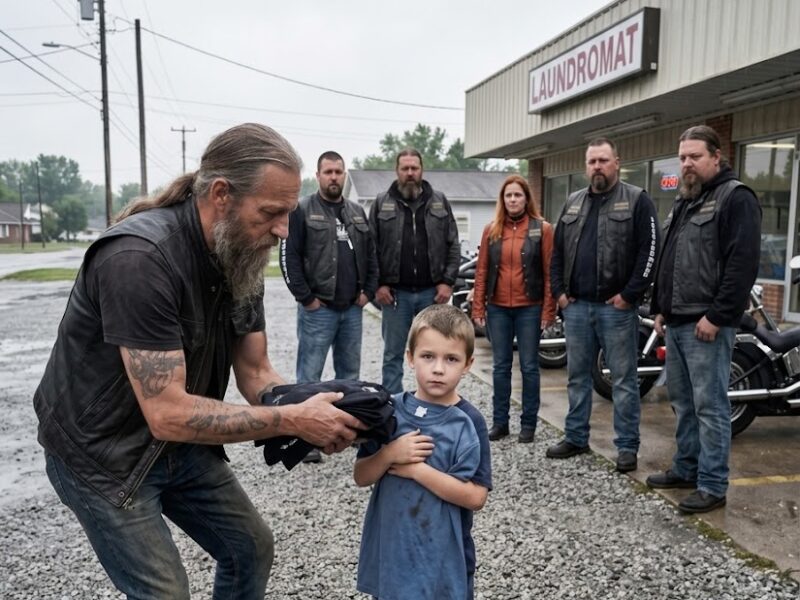
A little boy washed the same shirt every single night. He had only one. He’d wash it in the sink, hang it by the window, and wear it again the next day—still damp. Nobody noticed. Nobody asked. Then 300 bikers found out—and they didn’t just buy him six shirts. They gave him something he’d never had before.
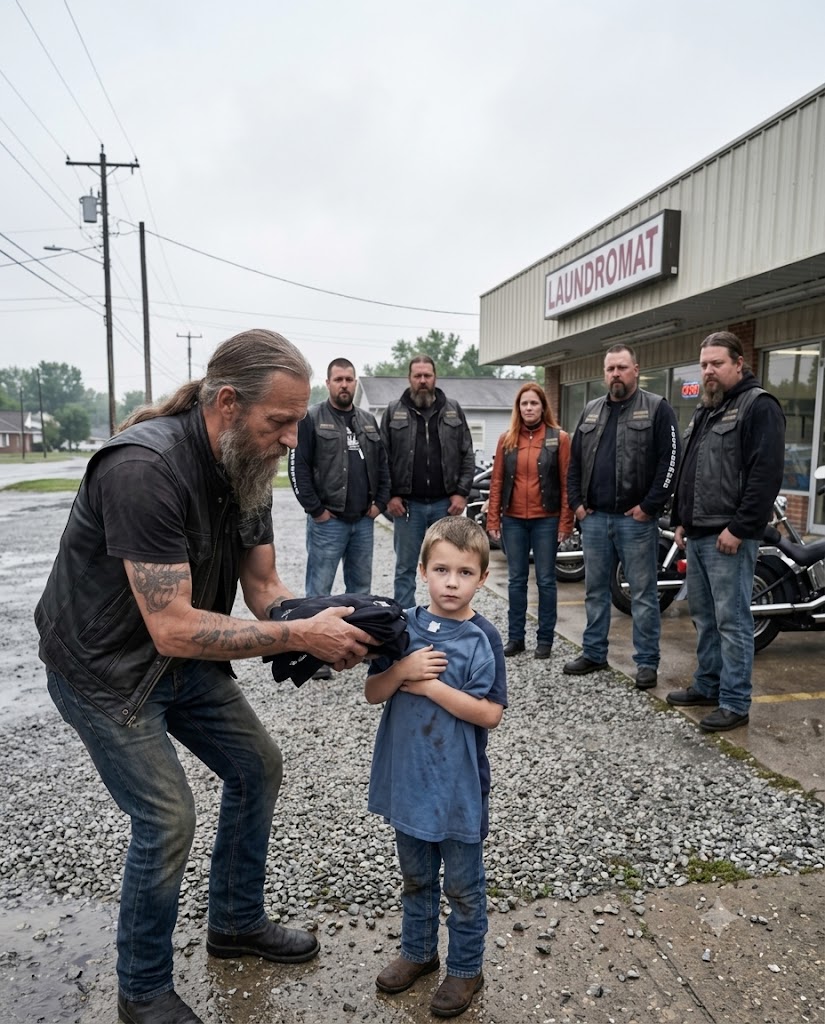
Darnell Pug spotted the boy first.
He was the one who came back to the pump bay doorway and said, “Quiet is anything, Cap. You need to come see this.”
Darnell did not say why. He did not gesture or explain. He just turned and walked back out into the flat white morning light.
And Curtis Moab, road captain of the Long Mercy Riders, sat down his coffee and followed. Because in twenty years of riding point together, Darnell had never once asked him to come see something that wasn’t worth seeing.
What Curtis saw when he stepped out of the Redemption Fuel Stop on Highway 281 south of Enid, Oklahoma, was a child standing at the edge of the gravel lot beside a green highway mile marker with both hands wrapped around the strap of a canvas bag that was clearly too heavy for him.
The boy was not moving. He was not crying. He was just standing there in the flat red dirt morning with his chin up like he had made a decision and intended to keep it.
He was wearing a shirt that was still damp. Three hundred bikers would come to understand eventually why that shirt was damp.
But that morning, in the thin November light coming low from the east, turning the gravel silver and the dust pale gold, Curtis Moab understood only that the boy was waiting for something, and that whatever it was, it had not arrived yet, and that the boy had decided he would not leave until it did.
That was the part nobody was ready for. Not the waiting, and not the shirt, and not the canvas bag. The reason—the reason when it came out—turned every assumption to ash.
The morning had started the way most of Curtis’s mornings started that time of year, which was cold and unhurried, and carrying the low particular weight of a man who had been doing the same thing long enough that the doing had become indistinguishable from the breathing.
He was fifty-three years old. He had a gray-threaded beard that reached the second button of his cut, hands like old tanned leather, and a scar that ran from the heel of his right palm to the base of his ring finger from a road rash incident outside Ponca City eleven years back.
He was not tall. He was wide in the chest and slow in the way of a man who had learned that moving fast was mostly theater, that the world generally waited for you if you gave it a reason to.
He had ridden road captain for the Long Mercy Riders since he was thirty-two, which meant he had spent two decades placing himself between the club and whatever came first on a route. Whether that was bad weather or bad traffic or something worse.
The Long Mercy Riders were based out of Garfield County, and they were not small. They were not the kind of club that appeared at parades with waved hands and slow grins. When they rode into a town in column formation, people stepped back from the sidewalk curb. Not because anyone told them to, but because something in the body understood that this was a thing with force behind it, a thing with intention, a thing that did not need to announce itself.
The morning the boy appeared at the Redemption Fuel Stop, the club was a week out from its annual November ride, which was the run they did every year up through Kay and Grant counties and back south along the river roads. Forty-some odd members on that particular morning, passing through in staggered groups to fuel up and eat before the final leg home.
Curtis had arrived first with Darnell and three others, which was standard. Road captain came ahead, checked the route, checked the stop, made sure there was nothing waiting that the column didn’t need.
He had been inside maybe eleven minutes, wrapping both hands around a paper cup that the woman behind the counter—a heavy-set person named Terry, with reading glasses pushed up into her hair—had filled without being asked because Curtis had been stopping here long enough that his coffee was automatic.
He was watching the gravel lot through the smudged window above the cold case when Darnell came through the pump bay door.
Darnell was fifty-one, built like a refrigerator turned sideways, and he had a face that people who did not know him often described as hostile, which was not accurate. Darnell’s face was simply honest. And it happened that what it was honest about was frequently unimpressed.
He was not unimpressed now. He was something else. He was careful.
“Cap,” he said. “You need to come see this.”
Curtis put down the cup.
The boy was seven years old. Curtis would learn that later.
Standing at the mile marker, he looked younger than that, or maybe just smaller than the situation warranted, which was a different kind of thing. He had dark hair that needed cutting and boots that were the right size but had been resoled at least once, with what looked like electrical tape across the left toe.
The canvas bag strap was digging into both his palms from the weight of it, and he had not put it down. He was not putting it down.
The shirt he was wearing—a plain blue cotton pullover with a small horizontal tear near the second button—was visibly damp in the way that cloth goes when it has been washed by hand and then worn before it finishes drying.
The air temperature that morning in Enid was forty-one degrees. Curtis knew this because he had checked the weather before mounting up at 6:15. Forty-one, northwest wind at twelve. And the boy was standing in it in a shirt that had not finished drying.
Curtis walked toward him slowly. Not cautiously. Slowly. There was a difference. Cautious was about protecting yourself. Slow was about not frightening what was in front of you.
He stopped about four feet away, which was close enough to see the boy’s eyes—which were brown and very steady—and far enough that the boy could run if the boy needed to run.
He did not crouch immediately. He stood for a moment and looked at what the boy was looking at, which was the road south. The boy was watching the road going south.
Then Curtis crouched. His knees were not what they had been a decade ago, and they registered their opinion about this, but he got down level and stayed there.
He did not say hello. “What are you waiting for?” he said.
The boy looked at him. He considered the question like it was reasonable, which it was.
“My dad,” he said.
Curtis let that sit for two full seconds. “He coming from that direction?” He nodded toward the south.
The boy’s chin moved up and down. Once. Decisive. “He said he was coming back this way.”
Curtis looked at the road. Then he looked at the bag. “What’s in there?” he said.
The boy adjusted his grip on the strap. “His stuff,” he said. “He forgot it.”
He said it without accusation, without blame. He said it the way you state a fact about gravity, a thing that simply is and has always been and does not require your opinion.
He had gathered up his father’s belongings and carried them to the highway and was standing in a forty-one-degree wind in a damp shirt, waiting for the man to come back and retrieve them.
Curtis’s jaw worked. He did not say anything for a moment.
Behind him, he could hear Darnell breathing, which meant Darnell was close, which meant Darnell had heard all of it, which meant the look on Darnell’s face right now was one that Curtis had seen only a handful of times in twenty years, and that he had no interest in turning around to confirm.
“How long you been standing here?” Curtis said.
The boy thought about it. “Since it got light,” he said.
That was the first pivot. The quiet one. The one that rearranged something in the chest that would not go back the way it had been.
Terry from the counter had come to the pump bay door. She was holding her own coffee cup with both hands, and she was not looking at the boy the way strangers usually looked at children who were visibly misplaced—with that bright, urgent alarm that was really about the witness’s own discomfort.
She was looking at him the way a person looks at something they have been watching for a while and have already made a private decision about. She caught Curtis’s eye when he stood back up, and she gave him a look that was not a question. It was an answer.
She had seen this before. Not this boy, not this road, not this specific morning, but this shape of thing. This particular configuration of a child outside in the cold with someone else’s bag. She had seen the shape of it, and her face said so without her having to.
Darnell touched Curtis on the arm, not to steer him, but just to be there. And Curtis pulled out his phone. He did not call anyone yet. He looked at the time. 7:42.
Then he looked at the boy, who had gone back to watching the road south, and he said, “You hungry?”
The boy said, “I ate.”
Curtis said, “That wasn’t what I asked.”
The boy looked at him again, that same measuring steadiness, and then he said, “Yes, sir.”
And that was the second thing that rearranged itself in Curtis Moab’s chest. The sir. The automatic politeness of a kid who had been taught his manners by someone and was keeping them regardless of what that someone had or hadn’t done, because the manners were his and they did not belong to the situation. They belonged to him.
Curtis put a hand briefly on his own knee and straightened up. “All right,” he said. “Let’s get you something warm.”
The boy did not move. He looked at the road. “I can’t go inside,” he said. “I might miss him.”
Curtis looked at the road, too. At the long, flat, empty two-lane going south into the distance until the redness of the earth swallowed it.
“I’ll watch it,” he said. “I’ll stay right here and watch it. You won’t miss him.”
The boy considered this for a moment with the gravity of a person who is negotiating something important. Then he said, “Okay.”
He did not let go of the bag.
Inside, Terry put a plate down in front of the boy without ceremony. Eggs and toast and a cup of hot chocolate that she must have made on purpose, because there was no machine for it visible behind the counter, which meant she had done it from scratch.
The boy ate with focus. He kept the canvas bag on the stool beside him, its strap looped around his wrist even while he used the fork. He did not take the strap off his wrist once.
Curtis sat two stools down and drank his coffee, and Darnell sat at the small table by the window where he could see the road south, because Curtis had said he’d watch, and Darnell had simply taken that over without being asked, which was the nature of things between them.
The boy ate half the plate, and then he stopped. He looked at the eggs like he was thinking about something. Then he said, without looking up, “He probably just got confused about which way.”
Curtis said, “Probably.”
The boy said, “He does that sometimes. Gets turned around.”
Curtis said, “Yeah.”
And then the boy said, quiet and still, looking at the eggs, “He left three days ago.”
The silence that followed was not the silence of shock. It was the silence of a room receiving something it already knew was coming and had been bracing for.
Terry turned to the sink. Darnell at the window did not move. Curtis wrapped both hands around his cup.
Three days. The boy had been tracking this for three days. And at some point in the morning—before dawn, or the night before, or both—he had decided to gather up his father’s forgotten bag and carry it to the highway and wait at the mile marker on the theory that his father might get confused about which direction he was going and need some help finding his way back.
Curtis thought about what Darnell’s face looked like right now. He kept not turning around to look.
“What’s your name?” he said.
“Ren,” the boy said. “Ren Basley.”
Curtis put his hand out, and Ren shook it, the grip firm and quick, the strap still looped at his other wrist.
“Curtis,” Curtis said. “You live close?”
Ren nodded. “Behind the filling station in Haymaker, on the creek side.”
Haymaker was six miles north on 281. Six miles. The boy had walked six miles in the early dark with a canvas bag full of someone else’s belongings because he thought his father might come back and need them.
Curtis set down the cup. He pulled out his phone, and this time he made a call.
The call went to a woman named Sheila Basley, Ren’s mother, who picked up on the second ring and who said, “Oh God, oh God, is he all right?” before Curtis had finished saying his name—which told him two things at once. That she had been awake and waiting. And that she had already done a portion of her own breaking down and was now on the other side of it, in the clear-eyed, urgent mode of a person who has moved past panic into action.
Curtis told her the boy was fine, that he was warm and fed, that he was at the Redemption Fuel Stop on 281.
There was a short silence, and then Sheila Basley said, “He took his father’s bag, didn’t he?”
It was not a question.
Curtis said, “Yes, ma’am.”
She made a sound that was not crying and was not not crying. “I’ll come right now,” she said. “I’ll come right now.”
Curtis told her to drive careful. He hung up and looked at Ren, who was watching him from the stool.
“Your mom’s on her way,” he said.
Ren nodded. He looked at the door, then at the window, then at the road. “She’s going to be upset,” he said.
Curtis said, “Probably.”
Ren said, “She worries a lot.”
Curtis said, “That’s what moms do.”
Ren looked at him with that measuring gaze, older than it had any right to be on a seven-year-old face. “Do you have one?” he said. “A mom?”
Curtis was quiet a beat. “Had one,” he said.
Ren nodded like this was acceptable information. He picked up his hot chocolate. He drank. He did not ask anything else.
Outside, the first two other club bikes rolled into the lot, the low rumble of them coming through the walls, and Ren looked up at the sound without alarm, just registering it, just noting it. The way a kid who has grown up near roads learns to register the various sounds of engines passing through.
Sheila Basley arrived twenty-two minutes later in a hatchback with a cracked left tail light and a rosary hanging from the rearview mirror.
She came through the door fast, spotted Ren on the stool, and crossed to him in four steps. And Ren let her put her arms around him, and he put one arm back—the other still occupied with the canvas bag strap—and she held on for a long moment with her eyes closed.
She was thirty-one, slight, with the particular exhaustion around her eyes that was not recent. This was not a new exhaustion. This had been building for a while.
She pulled back and looked at his face, and then she looked at the shirt. Her expression changed in a very specific way. She touched the fabric at his shoulder, still damp. She pressed her lips together hard.
She looked at Curtis, who was standing a careful distance away, and she said, “Thank you for finding him.”
Curtis said, “He wasn’t lost.”
She looked back at Ren. “How long has that shirt been wet?”
Ren looked down at it. “I washed it last night,” he said.
“It was almost dry,” she said.
Ren said, “It was the clean one.”
And in those five words was the entire structure of a life that had been running on less than it needed for longer than it should have. A child doing his own laundry by hand because that was what had to happen. Washing and rewearing the same shirt because that was what there was. Hanging it to dry and wearing it before it finished because the morning wouldn’t wait.
Sheila Basley turned back to the sink line and held herself together with the visible effort of someone who is refusing to dissolve in front of her kid. Terry behind the counter set a cup of coffee in front of her without asking. Sheila wrapped both hands around it.
The club bikes outside had been multiplying for the last twenty minutes as more riders came through on the fuel stop rotation, and the sound of them out there was the low layered rumble of many engines idling, the sound of something large gathering itself.
Curtis went out.
What he saw in the lot was thirty-one bikes now, with more coming down 281 from the north, and the riders standing in loose clusters with their cups and their road-worn hands. And Darnell already moving between them, which told Curtis that Darnell had gone out before Sheila arrived and had been talking.
He could tell by the way men were listening and not talking back, which was never the natural state of this group. Darnell was economical when it mattered. He didn’t over-explain.
Curtis walked out to where Darnell was standing with a cluster of four men, one of whom was named Garfield Sodto, who handled logistics for the club with a precision that had once famously moved fifty-seven bikes across a flash-flooded detour route in less than thirty minutes without losing a single rider.
“I already called Pratt and Dubec,” Darnell said when Curtis came up. “Pratt is heading to a Walmart in Enid. Dubec’s on his phone.”
Curtis said, “Shirts.”
Darnell said, “Shirts. Jeans. Whatever that kid needs.”
Garfield said, “We got sizes.”
Curtis said, “I’ll get sizes.”
He went back inside. He asked Ren casual how old he was and what size pants he wore. Ren answered with the same earnest directness. He answered everything. Seven years old, size seven pants, shirts that ran a little big on him.
Curtis went back out. Garfield was already on his phone with a notepad in his other hand—which was not a phone notepad. It was an actual small spiral notepad that he carried in his front chest pocket. Because Garfield trusted paper.
Darnell had moved to three more riders. The operation had begun the way all good operations began—without an announcement and without a ceremony, just the quiet, efficient conversion of men who knew what they were doing into men who were doing it.
Curtis Moab stood at the edge of the gravel lot and looked south down 281, the way Ren had been looking, and he let himself feel what he had been holding back since the boy said three days.
He had a daughter. He had had a daughter for exactly four years before her mother moved them both to Tulsa and then to somewhere in Texas. And the courts had run their course the way courts run—grinding and slow and not particularly interested in the feelings of a man who worked a motorcycle route and kept irregular hours.
Her name was June. She would be nineteen now. He had not seen her since she was eleven.
He had a photograph that he kept in the inside pocket of his cut. Not a phone photograph—a real photograph, four by three, slightly bent at one corner from being carried so long.
He knew what it was to leave a bag of things behind that someone who loved you had picked up and carried to a road to give back. Not the bag. The shape of the thing. He knew the shape.
He did not close his eyes. He stood in the cold morning light and looked at the road and let the shape of the thing move through him. And then he turned back around, because the club was moving and there was work.
By the time Pratt arrived from Enid an hour and twenty minutes later, his hard bags loaded with items, there were sixty-three bikes in the lot of the Redemption Fuel Stop and along the gravel shoulder of 281 on both sides, stretching north past the sightline.
Terry had stopped pretending to run a normal business and had propped the door open and was running coffee as fast as she could brew it.
Ren was sitting on an overturned milk crate that someone had brought out for him, positioned so he could see both the road south and the cluster of riders, and he was watching the bikes with the calm absorption of a person who has decided this is real and is committed to the experience of it.
Pratt laid the bags out on the hood of a truck that someone had moved into the lot for the purpose, and the riders were quiet while he itemized.
Seven shirts. Not six. The number had gone up between Darnell’s call and Pratt’s shopping because other members had called Pratt directly on the way to Enid and added to the request. Seven shirts in age-seven sizes in various colors, two pairs of jeans, a winter coat, thermal undershirts, socks, a pair of boots that Pratt had sized by calling Curtis, who had looked at the electrical-taped toe and made his best judgment.
Garfield had in the meantime been on the phone with the county social services office in Enid—not to report anything, not to trigger any process that the family had not asked for, but to ask a quiet question about what resources existed for a single mother in Haymaker whose situation was what it was.
And a woman named Brenda Crawl, a family services coordinator who had initially answered with the professional weariness of someone who fielded strange calls daily, had asked Garfield what organization he was calling from, and Garfield had said, “Long Mercy Riders, ma’am, out of Garfield County.”
And after a pause, Brenda Crawl had said, “I know who you are.”
And her voice had changed. Because apparently the Long Mercy Riders had done something three years ago in Alva that Brenda Crawl was aware of, though Curtis would not learn the details of that until later.
Garfield had written down four program names and two phone numbers in his spiral notepad. And when he came to find Curtis, he tore out the page with the precision of someone who has already decided where that page is going.
Sheila Basley came out of the fuel stop and stopped when she saw the lot. She had known there were bikes. She had heard them. But knowing a sound and then seeing what makes it are different cognitive events.
And she stood in the doorway for a moment looking at the rows of machines and the crowd of leather-cut men, and she said nothing at all. Terry was behind her and put a gentle hand on her back without making a thing of it.
Ren, from his milk crate, saw his mother’s face and then looked at the lot with fresh eyes, recalibrating, seeing it as she was seeing it for the first time.
Pratt had the bags arranged on the truck hood, and he brought them over to Ren, who had climbed down from the crate, and set them down in front of him. He did not make a speech. Pratt was not a speech-making man. He just said, “We got you some things,” and stepped back.
Ren looked at the bags. He looked at the shirts, which were folded and stacked. He reached out and touched the top one, which was red.
And then he looked up at the line of men and the rows of bikes and the flat November sky behind them, and he said, “That’s a lot of shirts.”
Garfield, who was standing near the back, made a sound that was not quite a laugh but was in that neighborhood. A few others did, too. The brief, sharp exhale of men who are holding something large and find a crack of light.
Ren picked up the red shirt and held it in both hands. He looked at his mother. Sheila Basley was crying without making any sound, the tears running straight down, and she nodded at him. One nod. And he nodded back. One nod.
The canvas bag was on the ground beside him. The strap was still looped around his wrist.
Curtis went to the boy last, after Pratt had walked him through the bags and after Sheila had knelt down and held his face in her hands for a moment.
He crouched in front of Ren again, knees lodging their same complaint, and he looked at him for a moment.
“You know what road captains do,” he said.
Ren shook his head.
“No,” Curtis said. “They ride at the front. They make sure everybody gets where they’re going.”
Ren looked at him. Then he looked at the road south. “What if somebody goes the wrong way?” he said.
Curtis said, “Then you go find them.”
Ren took that in. He looked at the canvas bag. He touched the strap with his free hand, testing it, running his thumb across the worn cotton.
“I was trying to help him,” he said.
“I know,” Curtis said.
Ren looked at him with the full weight of his brown, steady eyes. “Do you think he’s coming back?” he said.
And Curtis Moab, who had ridden point for twenty years, and who had learned to know the road by what it gave back when you watched it, who had a four-by-three photograph of a daughter named June, bent at one corner, in his inside pocket, looked at the boy in the damp shirt holding his father’s bag on a highway in November, and he said, “I think some people get so turned around they don’t know how to find the way back.”
He paused. “But that’s not on you.”
Ren was quiet for a moment. Then he said, “Okay.” He picked up the red shirt and held it against his chest. “I like this one,” he said.
“I figured you might,” Curtis said.
He stood up. His knees had nothing left to say about it.
Darnell organized the departure the way he organized most things—with minimum words and maximum effect. The riders would not all leave at once. They would fuel up those who needed it and pull out in groups of eight so as not to overwhelm the lot or the road. And they would pass the Basley hatchback on their way north, because Sheila had said she came from north of here and they were all going north anyway.
It was not a plan they discussed with her. It was a plan they made and simply executed, because sometimes you do not ask a person if they want to be accompanied. You just accompany them.
Sheila helped Ren carry the bags to the car. He would not let go of the canvas one. She did not make him.
When they were loaded and she came around to the driver’s side, Curtis was standing near the hood, not blocking her, just there. She stopped. She looked at him.
She said, “I don’t know how to say what this is.”
Curtis said, “You don’t have to.”
She said, “He washed that shirt every night for three weeks. The same shirt, because it was the one good one.”
Curtis said nothing.
She said, “I kept meaning to get to town.”
He said, “I know.”
She got in the car. She put her hands on the wheel. She did not pull out yet.
Through the window, he could see Ren in the back seat, the red shirt folded on his lap, looking straight ahead with the resolve of a boy who has made his peace with something and intends to carry forward. The canvas bag was on the seat beside him.
Sheila started the car. She pulled out of the gravel lot and turned north on 281.
And one by one, the Long Mercy Riders fell in behind her. Not close, not crowding, just present. The column forming the way it always formed, with the patience of things that have been doing this a long time.
Curtis mounted up last. He pulled onto 281 and looked in his mirror at the column behind him. And then he looked at the road ahead, at the tail lights of the hatchback with the cracked left lamp moving north, and he rode.
Six miles was nothing at road speed. It was four minutes. But they rode it slow. The way you ride a thing you want to last.
And when Sheila pulled off onto the Haymaker cut road and the column held its line without breaking, just moving as one organism around the turn and then continuing north without her, she slowed at the corner and looked back.
Sixty-three bikes.
She would tell Brenda Crawl about it two weeks later when Brenda called her. She would describe it as the sound of something very large being very careful, which was the most accurate description Curtis would ever hear of what the Long Mercy Riders sounded like when they meant it.
He did not hear her say it. He heard it later, secondhand, from Garfield, who heard it from Brenda, who had written it down in a case note because she thought it was worth preserving.
Garfield read it to him from the notepad. Curtis had listened and not said anything, and Garfield had folded the page back and put the notepad in his chest pocket, and that had been that.
Three weeks after that morning on 281, Garfield presented a proposal to the full club at their Garfield County meeting, which took place in a low metal building off County Road 60 that smelled of gear oil and old coffee.
And the proposal was voted on by 112 present members, with six absent voting by proxy. The vote was unanimous.
The Long Mercy Riders would establish an annual collection run on the Saturday before Thanksgiving, riding the county roads between Enid and Alva and Kay County, with stops at designated points where families in need could receive donated clothing, shoes, school supplies, and non-perishable goods.
It would be called the November Point Run.
The name was not discussed at length. It was proposed by Darnell, who said it quietly, and the room agreed the way rooms agree when a name is simply correct.
The patch sewn to denote participation was a small embroidered road marker, white on black, the number 281 in it. Garfield ordered 112 of them from a shop in Enid. They came in a flat box, and he set the box on the table at the next meeting and said nothing. And the members came up one at a time and took one, and by the end of the meeting there were none left.
Ren Basley, the following spring, received a framed photograph taken that November morning. Sixty-three bikes on Highway 281 stretching north into the distance against a pale flat sky. It was taken by Terry from the fuel stop, who had come outside with her phone at some point and simply taken it because she was a woman who recognized a thing that ought to be remembered.
The photograph was mounted and hung in the Basley kitchen. Sheila would later tell Brenda that Ren looked at it every morning before school. Brenda told Garfield. Garfield wrote it down.
The canvas bag sat in the corner of the kitchen after that, under the photograph. Ren did not take anything out of it. He did not pack anything new into it. He left it there with the strap hanging over the side, the cotton faded now and soft from being held.
Sheila asked him once if he wanted to put it away, and he thought about it and said, “No. He’d leave it out.”
She didn’t ask again.
The red shirt wore thin at the elbows by February, the way things do when they are worn often and worn gladly. And Brenda Crawl noted on a follow-up visit that the boy was wearing it and that it was pilled at the collar and that he did not appear to find this objectionable in the least.
By the time the second November Point Run came around, Ren was eight, and he stood in the gravel lot of the Redemption Fuel Stop, where Terry had arranged a collection table, and he helped pass out gloves to other children, moving down the line with the focus and gravity of someone who understood what the work was for.
Curtis saw him doing it from across the lot. He did not go over. He just watched for a moment. This eight-year-old in a worn red shirt with his chin up and his hands moving, passing something warm to someone who needed it.
And then Curtis turned back to the column and rode point the way he always had.
The November Point Run grew.
By its fourth year, 187 bikes made the run. By its sixth year, the number was 261, with riders coming from four counties and two neighboring states, and a waiting list for the collection stops that Garfield managed from his spiral notepad and a secondary spreadsheet that he kept on a laptop he did not entirely trust.
In the sixth year, a reporter from an Enid paper came out to ride alongside for the day and wrote a piece that ran on page three and described the Long Mercy Riders as “an unexpected source of regional community infrastructure,” which was a phrase the club discussed at some length and with mixed feelings, though most agreed it was not wrong.
The piece mentioned Ren Basley without using his name, describing only a boy at a mile marker in November who had been waiting with his father’s bag and the 300 bikers who had seen him there.
The 300 was the paper’s number. By the time of publication, the actual count from that morning was sixty-three. But by the time of the sixth annual run, 300 had in fact shown up. So the paper was correct in the sense that counted.
Curtis read the piece in the metal building off County Road 60, holding it in his tanned leather hands in the gear oil smell, and he set it on the table and said, “Not bad.”
Darnell, across the table, said, “They got the number right.”
Curtis said, “Eventually.”
Garfield wrote something in his notepad. That was the extent of the discussion.
He carried the photograph of June in the inside pocket of his cut. He had carried it through cold and heat and road grime and eleven years of 281 and all the roads that fed into it. The corner that had bent would not unbend anymore.
He did not look at it often. He knew what it said.
What he had learned on that November morning in a forty-one-degree wind from a seven-year-old boy with a canvas bag and a damp shirt and the absolute unsentimental conviction that the right thing to do when someone is lost is to go to the road and wait with their things was not something that translated into words easily.
And Curtis Moab was not a man who needed it to.
He knew it in the same place he knew the road—in the sternum, in the slow particular weight of a man who has learned that the work does not wait for you to be ready. That you go out to the road and you ride point and you carry what needs carrying and you hand it to whoever needs it next.
That was what the boy had done. That was what the club did. That was what the run was for.
And if some nights the weight of the photograph in his pocket felt different than it used to—lighter and heavier in different measures, like a thing that had found its place inside a larger thing—that was between Curtis Moab and the road, which had always been the only confessor he trusted anyway.
The long flat two-lane goes south from Enid into the red earth and the cold sky, the same road the boy had watched, the same road that had not yet given back what he was waiting for.
And every November the column turns north on it, slow and deliberate and loud. The sound of something very large being very careful.
And somewhere along those six miles between the fuel stop and the Haymaker cut, the sound becomes something else entirely. Something that has no name, the way the most important things rarely do.
And you feel it in the chest, the way you always feel the road when you’ve been on it long enough to know it loves you.









