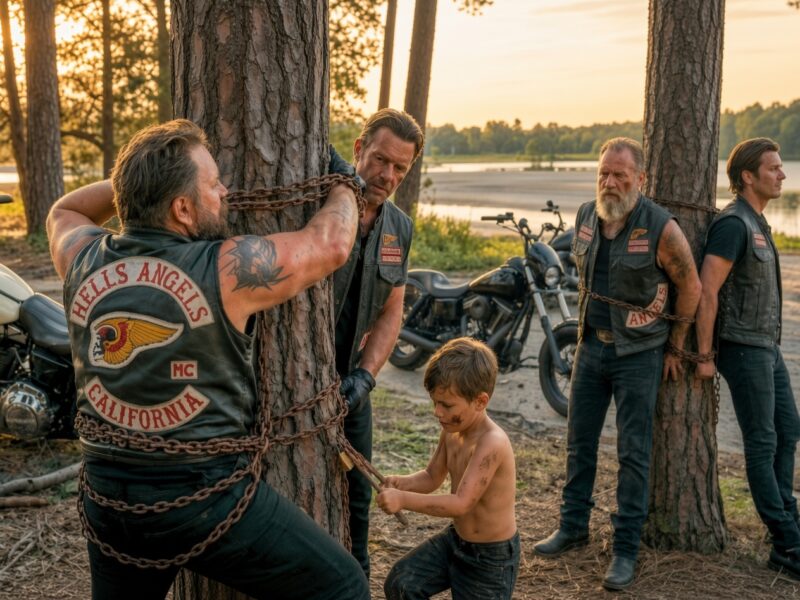
A little boy stumbled upon four Hell’s Angels chained to a tree in the middle of nowhere — what he did next brought 2,000 riders to their knees.
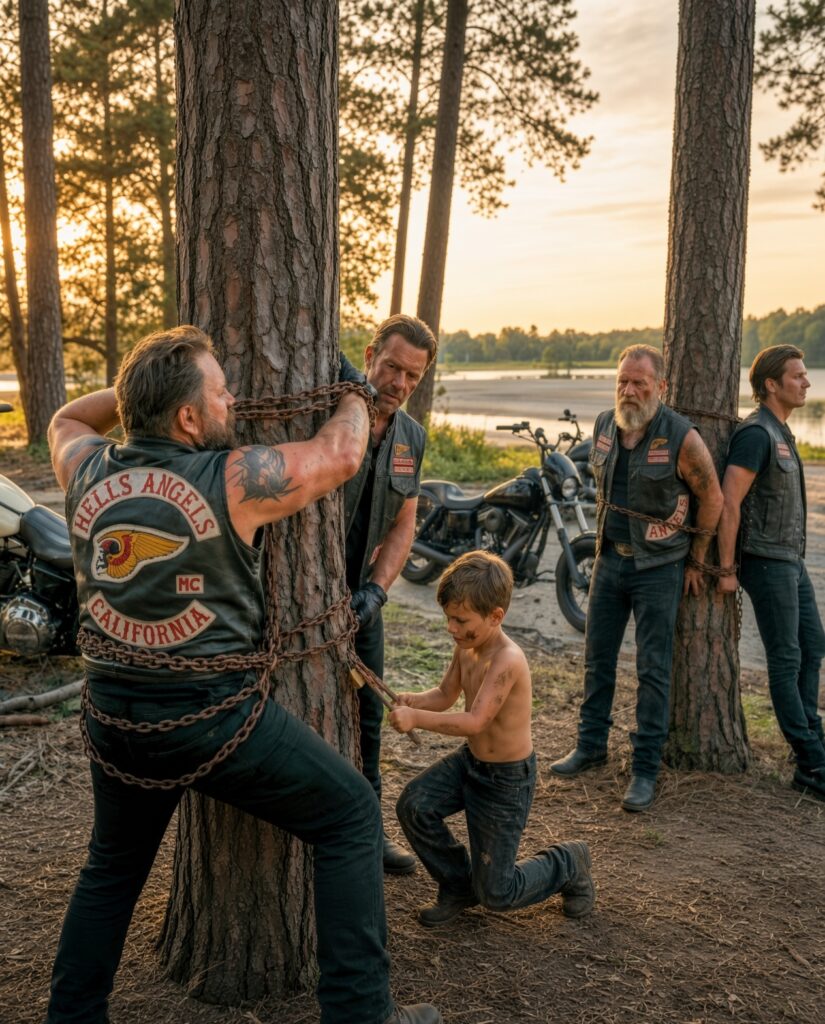
The chain snapped tight around the big man’s chest and slammed him back into the trunk of the old Caldwell Oak so hard the bark split.
A boot cracked into his knee, and he went down into the dirt with a grunt that didn’t sound human.
Two others were already roped to that same tree, their heads hanging low, blood drying in the brutal July heat.
A fourth man swung his fists at nothing but air before three men in dark vests wrestled him to the ground and lashed his wrists to the rough bark.
Then the motorcycles fired up, that deep rumble echoing off the pines, and the back road went dead quiet.
Nobody helped.
Cars slowed, saw the leather and the chains and the men, and drove off faster than they’d come.
For two hours, those four men baked in the Arizona sun with no water and no way loose.
Then a small shadow stepped out from the pines.
He was nine years old, and a three-legged dog walked at his side.
His name was Danny Rourke.
What could a boy that size possibly do for four men the whole county had already written off?
Stay with me on this one.
Let me back up.
—
Cedar Hollow, Arizona, is the kind of town you’d miss if you blinked twice on the highway.
One gas station, one diner, a feed store at the end of Main Street that still runs on a handwritten ledger.
Danny Rourke lived two miles out past the cattle guard in a house his grandfather built with his own two hands.
Most afternoons that summer, Danny made the same walk down to the feed store for a sack of chicken scratch, then back home along the pine road with Biscuit trotting beside him.
Biscuit was a shepherd mix with three legs.
He’d lost the fourth to a coyote trap two winters back, but that dog could still run.
Faster on three than most dogs on four, and smarter than half the men in town.
Danny had raised him from a pup, fed him by hand when nobody thought he’d make it.
The two of them were a pair.
Where one went, the other followed.
Now, here’s the thing about Danny.
He was small for nine.
Quiet.
The kind of kid teachers forget to call on.
The kind who sits in the back and misses nothing.
His daddy was gone, had been for years, run off before Danny was old enough to hold the memory.
His mama worked doubles at the diner to keep the lights on.
So Danny mostly raised himself, with his grandfather keeping a slow eye from the porch.
He knew how to fix a fence.
He knew how to read the weather off the ridge.
He knew how to gut a fish and drive the truck across the back field before his feet reached the pedals right.
And he knew better than most grown men how to keep his mouth shut and watch.
He’d learned young that the world doesn’t hand quiet kids much.
You take what’s yours by paying attention.
But there was one more thing about Danny, and it’s the thing that matters most in this whole story.
He remembered kindness.
In a town where most folks kept a running tally of who owed them what, Danny kept a different kind of ledger.
He remembered the people who were good to his mama when they didn’t have to be.
He remembered them for years.
That’s what he was doing that July afternoon.
Walking home.
He’d come around the bend by the old Caldwell Oak, that wide tree everybody used as a marker, when Biscuit stopped cold.
Ears up.
A low growl in his chest.
Danny followed the dog’s eyes, and that’s when he saw them.
Four men chained to the tree.
Now everybody in Cedar Hollow knew who the Hell’s Angels were.
You didn’t grow up in that county without hearing the stories.
The leather vests, the rumble of engines coming through town like a storm rolling in.
Grown men crossed the street when the club showed up.
Mothers pulled their kids inside.
The word was simple.
You leave them be and they leave you be.
Whatever they did, they did among themselves, and a smart person kept clear.
So when the cars had passed that afternoon, and a few had, nobody stopped.
A rancher in a pickup slowed, saw the vests lying torn in the dirt, saw the chains, and pressed the gas.
A church van did the same.
Everyone in that town had decided in the space of a heartbeat that whatever was happening to those four men was none of their business.
Biker trouble.
Not for them.
But Danny didn’t see four bikers.
He saw one face he knew.
The big one roped lowest to the trunk.
The one with the thick neck and the gray in his beard.
Danny had seen him before.
Eight months back on a freezing morning, his mama’s truck had died in the diner lot.
Wouldn’t turn over.
She’d stood there near tears, late for her shift.
And this man had rolled up on his bike, popped the hood without a word, and had it running in ten minutes.
Wiped his hands on his jeans.
Never asked her name.
Never asked for a dime.
Just nodded and rode off.
Danny remembered that.
Kids remember who’s kind when nobody’s watching.
And now that same man was chained to a tree, head down, lips cracked, cooking in the sun while the whole county drove by.
Danny stood at the edge of the pines a long moment.
His heart was going hard.
Every rule he’d ever learned told him to walk away.
These were dangerous men.
This was dangerous business.
He was nine years old and eighty pounds soaking wet.
But he thought about that cold morning.
And he thought about how his mama had cried in the truck afterward, not from the cold, but because somebody had helped her when she’d expected nothing at all.
He set down his sack of chicken scratch, and he stepped out of the trees.
—
The big man heard the footsteps first.
He lifted his head slow, and his eyes found the boy.
For a second, neither of them said a word.
“Kid.” His voice was ruined from the heat.
Barely a scrape.
“Kid, you got to go. You can’t be here.”
Danny didn’t go.
He walked closer.
Close enough now to see how bad it was.
The ropes had cut deep into their wrists.
Their faces were burned raw.
One of the younger ones wasn’t moving much at all, his chin down on his chest, his breathing shallow and quick.
The big man saw where Danny was looking.
“His name’s Cole,” he said.
“He’s in a bad way. Been out here since morning.”
He worked his dry mouth.
“You got water, kid?”
Danny shook his head.
“Not on me.”
Then quieter, “But I can get some.”
The man studied him.
Nine years old.
A dog with three legs.
And something in his face shifted, like he couldn’t quite believe what he was looking at.
“Listen to me,” the man said.
“The men who did this, they said they’re coming back to check on their work before dark.”
“You do not want to be standing here when they do. You understand me? Go home.”
Danny looked at Cole, the young one who wasn’t moving right.
He looked at the chains, thick and padlocked, the kind bolt cutters were made for.
And he thought about his grandfather’s shed, where a pair of long-handled cutters hung on the wall next to the water jugs.
Home was a mile off.
Danny could run it in maybe twelve minutes.
But Biscuit could run it in six.
He knelt down and grabbed the dog’s face in both hands the way he did when it mattered.
“Go home,” he said.
“Get Grandpa. Go, Biscuit. Go home.”
That dog had been fetching Danny’s grandfather off the porch for two years.
Every time supper was ready, he knew the word home like he knew his own name.
Biscuit spun around on those three legs and shot into the pines, gone in a blur.
And Danny turned back to the four chained men.
“I’ll be back,” he said.
“I promise.”
But he didn’t just stand there doing nothing.
There was a stock tank forty yards off the road.
Water for the cattle, warm and green, but wet.
Danny ran to it, pulled off his own shirt, soaked it through, and ran back.
He wrung the water into the young one’s mouth drop by drop.
He pressed the wet cloth to the big man’s neck.
He went back and soaked it again and again.
Four men, one small shirt, back and forth across that field while the sun beat down on all of them.
“Why?” the big man asked him on the third trip.
His voice was coming back a little now.
“Whole town drove past us. Kids, grown men, a church van. Everybody. Why you?”
Danny wrung the shirt into Cole’s mouth.
“You fixed my mama’s truck,” he said.
“In the winter. You didn’t even take her name.”
The big man went quiet.
He stared at the boy for a long time.
Then he closed his eyes, and something that might have been a laugh or might have been something else moved through his chest.
“I don’t even remember that,” he said.
“I do,” said Danny.
The man watched him work a minute longer.
Then he said, “You know, we got a rally this weekend. Whole club coming up from four states for it.”
“Two thousand of us, maybe more, rolling into the valley south of here.”
“That’s why those Diablos wanted us gone now. Wanted us out of the way before all our people showed up.”
He shook his head slow.
“They figured nobody’d find us on this road till it was too late.”
He looked at the boy.
“They didn’t figure on you.”
Danny didn’t say anything to that.
He just kept running the shirt back and forth, and he filed the words away the same way he filed everything else.
Quiet, careful, for later.
His arms were shaking by the eighth trip.
The sun wasn’t letting up, and every minute he stood out there, he heard the big man’s warning turning over in his head.
They’re coming back to check on their work before dark.
He kept glancing down the road.
Every far-off sound made his stomach drop.
But he didn’t stop, and he didn’t run, because the young one still wasn’t right.
And a man doesn’t leave a job half done just because he’s scared.
His grandfather had told him that once.
Danny was starting to understand what it meant.
Then, far off through the trees, an engine.
Danny froze.
His heart went straight up into his throat.
But it wasn’t a motorcycle.
It was a truck.
An old, coughing, familiar truck, bouncing up the pine road too fast, with a three-legged dog hanging halfway out the passenger window and a gray-haired man hunched over the wheel.
Grandpa came out of that cab with the bolt cutters already in his hands.
He took one look at the tree, one look at his grandson standing shirtless and soaked among four chained Hell’s Angels, and he didn’t ask a single question.
Not one.
He just handed Danny the water jug and went straight to work on the chains.
The cutters bit down once, twice.
The first chain fell away, and the big man slumped forward, free.
Grandpa moved to the next.
Danny went down the line with the jug.
And now the men could drink for real, long pools of cold water, coughing and gasping.
Cole came around slow, blinking, alive.
Grandpa cut the last link and stepped back, wiping his forehead.
Four men free, sitting in the shade of the tree they’d been chained to, water running down their beards.
The danger over, or so it looked.
The big man leaned his head back against the bark and breathed.
Grandpa sat down on the truck’s running board.
Danny poured the last of the water over Cole’s head, and the young one actually smiled.
For one long, quiet minute out on that back road, it seemed like the worst was behind them.
Just a rescue, just a good deed done.
Everybody was going to be fine.
The chains hadn’t been on the ground five minutes when Danny heard it.
Engines.
A lot of them, coming back up the road.
The big man’s head came up fast.
All the ease drained out of his face.
“Get the boy behind the truck,” he said.
“Now.”
They came around the bend in a wall of chrome and dust.
Not four bikes.
A dozen riders in vests that read Diablos across the back.
A rival crew.
And at the front of them rode a man built like a side of beef, arms sleeved in ink, a shaved head slick with sweat.
He rolled to a stop twenty feet off and killed his engine, and the rest killed theirs behind him, and the quiet that came after was worse than any noise.
He looked at the cut chains.
He looked at the four men he’d left to die, now sitting up and breathing.
And then he looked at the old man and the little shirtless boy standing by a beat-up truck.
“Well,” he said, and he smiled.
“Somebody’s been busy.”
Now, up until that second, this had been one kind of story.
A boy finds four men in trouble and helps them.
Simple.
Good.
But the moment that man smiled, it turned into something else entirely.
Because the four Angels had been left there over club business.
A turf thing.
Pride between crews.
That was one thing.
But now there were witnesses.
An old man.
A child.
People who’d seen the Diablos’ faces, seen exactly what they’d done.
And a man like that doesn’t leave witnesses.
This wasn’t about pride anymore.
It was about who walked away from that tree alive.
The big man tried to stand, and his legs buckled.
Six hours in the sun had wrung him out.
All four Angels were in the same shape, barely able to hold themselves up, and they knew it.
Twelve fresh men against four half-dead ones and an old man.
The math was ugly.
—
If you’re still with me, take one second and hit that subscribe button.
Because what this little boy did in the next ten minutes is the part nobody in Cedar Hollow has stopped telling since.
The Diablo leader, a man they called Cutter, swung off his bike and walked over slow, taking his time, enjoying it.
He crouched down in front of Danny, put his big face right level with the boy’s, and grinned.
“You cut my chains, little man.”
Danny didn’t answer.
He just looked at him.
Cutter reached out and shoved Grandpa hard in the chest.
The old man stumbled back against the truck.
“You know who these men are,” Cutter said.
“You know what they had coming, and you show up and undo it.”
“Now I got a problem, because I don’t leave problems standing.”
He straightened up and looked around at the men, the boy, the old man, and his voice went flat and cold.
“None of them ride out of here.”
Here’s what Cutter didn’t know.
When Grandpa had grabbed the bolt cutters off the shed wall, he’d grabbed something else, too, and it was still sitting in the truck cab.
And Danny knew right where it was.
But it wasn’t the shotgun that saved them.
It was the radio.
See, the big Angel, the one who’d fixed the truck, his name was Boon.
And while Danny had been running that shirt back and forth from the stock tank, Boon had told him something.
He told him the whole club was on the road that very weekend.
Two thousand riders coming from four states, rolling into the valley for the summer rally, not fifteen miles south.
And Grandpa’s old truck had a CB radio bolted under the dash, the kind ranchers and truckers still used out where the cell towers didn’t reach.
While Cutter was busy grinning at the old man, Danny had already slipped around the far side of the truck.
He climbed into the cab quiet as a cat, pulled the CB mic off its hook, and keyed it the way his grandfather had taught him.
And he said the only thing he could think to say.
“Anybody out there? Anybody?”
“There’s four Angels going to die at the Caldwell Oak on Route 9. Twelve Diablos. Please, somebody come.”
He didn’t know if a soul heard it.
He let go of the button, and the radio just hissed.
And then a Diablo yanked the door open and dragged him out by the arm and threw him in the dirt at Cutter’s feet.
Cutter looked down at the boy.
Then he looked at the truck.
At the antenna.
And he understood, and the grin came off his face.
“You little—” he started.
That’s when the radio crackled back to life.
A voice came out of it, calm and hard and clear enough that everybody in that clearing heard it.
“Copy that, son. We’re coming. Hold on.”
For a moment, nobody moved.
Cutter stared at the truck like it had bitten him.
And then from the south, faint at first, then building, then filling the whole valley until the ground under their boots buzzed with it, came a sound.
Engines.
Not a dozen.
Not a hundred.
Thousands.
Cutter turned toward the noise, and the color went out of his face.
His men shifted on their feet, looking at each other.
Because every one of them knew that sound, and every one of them knew what it meant.
Boon got himself up onto one knee, then onto his feet, swaying, and he started to laugh.
Low and rough.
“You hear that, Cutter?” he said.
“That’s my family. All of them.”
“And a little boy just called them down on your head.”
They came over the rise like a flood breaking.
Bike after bike after bike, headlights blazing in the dusk, filling both lanes and the shoulders and the field.
A river of chrome and leather that didn’t stop coming.
Two thousand riders rolling in for the rally, routed by one panicked call on an old CB.
They kept coming for a full two minutes, and still they came.
And the Diablos just stood there watching the road fill up with the very thing they’d tried to get ahead of.
The riders poured off the pavement and spread out and formed a circle around that oak tree, engine after engine cutting out, one after another, until the Diablos stood ringed in by a wall of men ten deep.
And then the last engine died, and the silence came back down over everything.
Nobody rushed them.
That was the strange part.
Two thousand angry men, and not one of them moved fast.
They just closed the circle tight and waited, because they already knew how this ended.
And so did the Diablos.
An older rider walked to the front.
Silver beard, patches all down his vest that marked him as the man in charge, the president of the whole thing.
He didn’t even look at Cutter first.
He walked past him like he wasn’t there and went straight to his four men.
He knelt by Cole and put a hand on the back of the young one’s neck and said something low that nobody else could hear.
He checked the rope burns on Boon’s wrists with his own fingers.
He took his time.
He wanted every one of those Diablos to stand there and watch him count the damage.
Then, and only then, he turned to Cutter.
“You chain my men to a tree,” he said, quiet.
“In the sun. To die slow.”
He let that sit in the air.
“And a nine-year-old boy is the only person in this whole county with the guts to cut them loose.”
“You understand what that makes you?”
Cutter tried to talk.
He tried the tough voice, the one that had worked his whole life, the one that made men step off sidewalks.
“This was club business. Boon knew the risk. This ain’t got nothing to do with the boy. So if we just stop—”
The old rider didn’t raise his voice.
He didn’t have to.
Two thousand men stood dead still behind him, and the word landed like a door slamming.
“You don’t get to talk anymore. You lost that when you touched a child.”
Cutter’s men were already done.
You could see it.
A couple of them had their hands half up.
One had started backing toward his bike before three riders stepped in front of it.
There was nowhere to go.
There had never been anywhere to go from the second that CB clicked.
What happened next, the whole town would talk about for years.
And here’s what surprised everybody.
They didn’t beat those Diablos bloody.
That’s not how it went.
And honestly, it didn’t need to.
Beating them would have been easy.
This was worse.
The old president just nodded once, and his men moved in.
And one by one, they took the Diablos’ vests.
The colors those men had worn like a crown.
The only thing men like that truly own.
And they stripped every last one right off their backs.
No club lets that happen.
No club survives that.
And every Diablo standing there knew that the moment those colors came off, they were nothing, and they would be nothing for the rest of their lives.
Cutter fought.
Of course he did.
He swung on the first man who reached for him, and it was the last free swing he got.
Four riders put him face down in the same dirt he’d thrown Danny into an hour before, and they held him there, and they pulled the vest off him while he cursed and kicked and spat.
And when it came free, they stepped back and let him get up.
He came up filthy and heaving, no colors on his back.
And for the first time all day, there was fear in that man’s eyes.
Real fear.
Because he finally understood what he’d lost.
Then the president crouched down in front of him, slow, the exact same way Cutter had crouched in front of a nine-year-old boy an hour before.
He wanted him to feel that, too.
“You’re done,” he said.
“Not just here. Everywhere.”
“Every chapter in four states is going to know your name and your face by morning.”
“There’s not a road left in this country where you can show that face.”
“You wanted these four gone before the rally rolled in.”
He stood back up and looked down at him.
“Turns out you’re the one that’s gone.”
The sheriff came eventually.
Somebody had called 911 back when the first engines were still coming.
He rolled up with two deputies and one long look at that field full of bikes.
And for a second, you could see him weighing whether he even wanted to get out of the car.
But he did.
He walked over, and he took one look at the rope burns on four men’s wrists and the cut chains lying in the dirt and the small boy standing there in a wet shirt, and he didn’t need anybody to explain it to him.
He arrested Cutter and his whole crew on the spot.
Attempted murder, kidnapping, and a list longer than his arm.
And not one of those Diablos said a single word in their own defense.
Because there was no word to say.
Because two thousand men were watching them.
Because saying anything at all would have only made it worse.
They loaded them into county trucks, stripped of their colors, and hauled them off down the same road they’d ridden in on like kings.
Two thousand riders watched them go without a sound.
That silence followed those trucks all the way to the county line.
And Cole, the young one who’d been an hour from dead under that tree, was already sitting up in the grass with a cold drink somebody had pressed into his hand, the color coming back into his face, blinking around at all of it like a man waking up from a bad dream.
He was going to be just fine.
They all were.
Because a boy the whole county had overlooked had refused to drive past.
—
The sun was down by the time it was over.
Somebody had built a fire.
Two thousand bikes were parked across that field and along the road for half a mile in both directions.
And the men who rode them, men the whole county had spent their lives being afraid of, were sitting quiet in the grass around a nine-year-old boy and his three-legged dog.
Boon sat down heavy next to Danny.
His wrists were wrapped now.
He didn’t say anything for a while.
Then he reached into what was left of his torn vest and pulled out a patch, a small one worn soft from years, and he pressed it into the boy’s hand.
“I’ve had that since before you were born,” Boon said.
“I want you to have it.”
Danny turned it over in his fingers.
“What’s it for?”
“It’s for a man who does the right thing when it costs him something,” Boon said.
“When it’s easier to look away.”
He nodded toward the road, toward town, toward all the cars that had driven past that day.
“Everybody looked away. Grown men. The whole county. Everybody but you.”
Danny’s grandfather stood off to the side with his hands in his pockets, and if you looked close, you could see the old man’s eyes were wet, and he wasn’t ashamed of it.
Then a truck came up the road, and Danny’s mama got out, still in her diner apron, having heard some wild story in town about her boy and a thousand bikers.
And she ran across that field, scared half out of her mind, and two thousand of the most feared men in the state stood up out of respect as she crossed to her son.
She stopped short when she saw Boon.
He stood slow, and something crossed her face, a memory surfacing.
“You,” she said.
“The truck last winter.”
“Yes, ma’am,” Boon said, and he looked almost shy about it.
“Turns out your boy’s got a better memory than I do, and a whole lot more nerve than most men I know.”
She pulled Danny into her and held on, and over his head she looked at Boon, and neither of them needed to say another word.
Word got around Cedar Hollow fast, the way it does in small towns.
And here’s what’s funny.
Every single person who’d driven past that tree that afternoon suddenly had a reason why they hadn’t stopped.
They were late.
They didn’t see the chains.
They thought somebody else would handle it.
The rancher in the pickup wouldn’t meet anybody’s eye at the feed store for a month.
Because a nine-year-old had done the one thing not a single grown adult in that county had the nerve to do, and everybody knew it.
And there’s no explaining your way out of a thing like that.
The whole town had to look at a small, quiet boy and understand exactly what they were made of by comparison.
That’s a hard mirror to stand in front of.
—
The rally happened that weekend like it always did.
But that year, it was different.
Two thousand riders took up a collection, and by Sunday they’d handed Danny’s mama an envelope thick enough to fix the truck for good, pay off the diner debt, and put money away for the boy’s schooling besides.
She tried to give it back.
They wouldn’t hear it.
Boon came around after that.
Not often, but enough.
He’d roll up on a Saturday, fix whatever was broken around the place, sit on the porch with Grandpa, and drink coffee.
Never asked for a thing.
Same as always.
And here’s the part I keep coming back to.
That whole long day, four grown men, a dozen more with clubs and chains, two thousand riders, a sheriff, a whole county.
And the only person who actually did anything, who stepped out of the trees when every rule and every fear told him to keep walking, was a small, quiet boy with a three-legged dog.
He didn’t do it because they were tough or dangerous or famous.
He did it because one cold morning, a stranger had been kind to his mother and asked for nothing back, and a nine-year-old had never forgotten it.
That’s the whole thing, really.
Kindness doesn’t just disappear.
You hand it to somebody, and it goes quiet, and you forget you even gave it.
And then one hot afternoon on a back road years later, it comes walking out of the pines to save your life.
Danny kept that patch.
Kept it his whole life.
And to the end of his days, whenever somebody asked him why a little kid had done what a hundred grown men were too scared to do, he’d just shrug and say the same simple thing.
“Somebody helped my mama once. Didn’t even take her name.”
And Biscuit, that three-legged dog who ran a mile to bring the bolt cutters home, lived to be old and gray and slept every night at the foot of Danny’s bed.
Because where one went, the other followed.
That was always how it worked with those two.
Right to the very end.
—
The story didn’t stop with Cedar Hollow.
It couldn’t.
A thing like that gets legs, and once it gets legs, it runs.
Within a week, the tale had crossed the county line.
Within two, it had crossed the state line.
A trucker who’d been parked at the diner heard it from a waitress and carried it to Flagstaff.
A reporter from the regional paper drove out to the feed store, bought a sack of chicken scratch he didn’t need, and stood around asking questions until the owner finally pointed him down the pine road.
The story ran on a Sunday.
Small column, tucked between an article about a water rights dispute and a notice about a charity bake sale.
The headline said something forgettable.
Something about a local boy and a motorcycle club.
But the details.
The details were what made people read it twice.
A nine-year-old.
Four men chained to a tree.
A three-legged dog.
Two thousand riders coming over the rise like a flood.
Nobody in the newsroom could quite believe it, and neither could the readers.
By Monday, the paper had gotten more calls about that column than anything else they’d printed all year.
By Wednesday, a television crew from Phoenix was parked outside the diner, and Danny’s mama had to walk through a gauntlet of cameras just to get to her shift.
She didn’t like it.
Neither did Grandpa.
They were private people, the Rourkes.
The kind who fixed their own fences and minded their own business and didn’t much care for strangers poking around.
But the story was out there now, and there was no putting it back.
—
Here’s what the reporters never quite got right.
They kept calling it a rescue.
A dramatic rescue, they’d say, with a little boy hero and a grateful motorcycle club.
But that’s not what it was.
Not really.
A rescue is a thing that happens once and then it’s over.
You pull somebody out of a river, you call 911, you do your good deed, and then everybody goes home and goes back to their lives.
That’s not what happened here.
Because the moment Danny stepped out of those trees, he didn’t just save four men.
He changed something.
He changed the way those four men saw the world.
He changed the way two thousand riders saw it, too.
And he changed the way Cedar Hollow saw itself.
You can’t put that back in the box.
You can’t pretend you didn’t see it.
—
The Diablos didn’t last the year.
That’s not a threat, and it’s not a boast.
It’s just what happened.
Word travels fast in certain circles, and the story of what went down at the Caldwell Oak traveled faster than most.
A crew that lets its colors get stripped doesn’t command respect anymore.
A leader who gets put face down in the dirt by a rival club doesn’t command fear.
Cutter’s name was mud before he even made bail.
His men scattered.
Some of them left the state.
Some of them tried to start over with new patches and new names, but it never took.
Nobody trusted them.
Nobody wanted them.
And the ones who’d been in that clearing, who’d stood there and watched two thousand riders close a circle around them, they never forgot it.
They couldn’t.
The Diablos were done, and everybody knew it, and the only person who didn’t seem to care one way or another was the nine-year-old boy who’d set it all in motion.
—
Danny went back to school that fall like nothing had happened.
That’s the thing about kids.
They don’t dwell.
They don’t carry things the way adults do.
He did his homework.
He played with Biscuit.
He walked down to the feed store for chicken scratch and walked back home along the pine road.
The other kids asked him about it, of course.
They’d heard the story from their parents, seen it on the news, read about it in the paper.
They wanted to know what it was like to stand in front of two thousand motorcycles.
They wanted to know if he’d been scared.
Danny just shrugged.
“Not really,” he’d say.
And that was the truth, or close enough to it.
He’d been scared in the moment.
Scared when Cutter crouched down in front of him.
Scared when the Diablo yanked him out of the truck and threw him in the dirt.
But looking back, it all seemed smaller than it should have.
Less like a thing he’d done and more like a thing that had happened to him.
A thing he’d walked into because it was the right thing to do, and then walked out of because it was over.
That’s how kids process these things.
They don’t make it bigger than it is.
They just keep going.
—
The patch Boon gave him stayed in Danny’s pocket for a long time.
He didn’t wear it.
He didn’t sew it onto anything.
He just kept it, the way he kept everything that mattered.
In his pocket during school.
Under his pillow at night.
In the drawer next to his bed when he got older and started caring about other things.
That patch was a piece of a world he’d never really been part of, a world of leather and chrome and violence, and yet it meant something to him.
It meant something because Boon had given it to him.
It meant something because of what Boon had said.
“For a man who does the right thing when it costs him something.”
Danny thought about that a lot.
He thought about it when things got hard.
When his mama was working doubles and he barely saw her.
When Grandpa got sick and the house got quiet.
When Biscuit got old and slow and finally laid down in the sun one afternoon and didn’t get up again.
He thought about what it meant to do the right thing when it costs you something.
And he tried to live that way.
Not because he wanted to be a hero.
Not because he wanted people to remember his name.
But because somebody had done the right thing for his mama once, and he’d never forgotten it.
And he figured the least he could do was pass it on.
—
Biscuit lived to be thirteen years old.
That’s old for a shepherd mix.
Old for any dog, really, especially one who’d lost a leg to a coyote trap and spent most of his life running on three.
But he’d had a good life.
A long life.
A life full of pine roads and stock tanks and a boy who loved him.
When he finally went, Danny buried him under the old Caldwell Oak.
It seemed right.
That tree had been a marker for as long as anybody could remember, a place where people stopped and looked around and figured out where they were going.
And now it was a resting place for a dog who’d run a mile to save four men he’d never met.
Danny didn’t cry at the funeral.
Not in front of anybody, anyway.
He stood there with his hands in his pockets and watched his grandfather shovel dirt over the small body, and he thought about all the afternoons they’d spent walking that road together.
He thought about the way Biscuit had stopped cold when he saw those men chained to the tree.
He thought about the way he’d grabbed that dog’s face in both hands and said, “Go home. Get Grandpa.”
And he thought about the way Biscuit had spun around on those three legs and shot into the pines without a moment’s hesitation.
That dog had saved them.
Maybe not alone.
Maybe not in a way that would make the papers.
But he’d done his part, and he’d done it without being asked, because that’s what you do when somebody you love needs you.
Danny figured he could learn something from that.
—
The years went by.
Cedar Hollow stayed small, the way small towns do.
The feed store got a computer, but the owner still kept the handwritten ledger because he didn’t trust machines.
The diner changed hands twice and then changed back.
The gas station closed for a while and then reopened under a new name.
Danny grew up.
He got taller.
His voice dropped.
He stopped being the small, quiet kid in the back of the classroom and became something else.
Still quiet.
Still watchful.
But bigger now, and stronger, and harder to overlook.
He played football in high school, not because he was fast or particularly talented, but because he was stubborn and he didn’t quit.
He worked summers at the feed store and weekends at the diner, saving money for a truck and then for college and then for whatever came after.
He didn’t talk much about what had happened at the Caldwell Oak.
Most people in town knew the story, of course.
It was part of the local lore now, a thing people told their kids and their grandkids and the occasional stranger who stopped for gas and asked what there was to see around here.
But Danny didn’t bring it up.
He didn’t dwell.
He just lived his life and tried to do right by the people who mattered, and if anybody asked him about that day, he’d shrug and give the same simple answer he’d been giving since he was nine years old.
“Somebody helped my mama once. Didn’t even take her name.”
—
Boon came around less as the years went on.
That was natural.
He was getting older, and the club was changing, and the road was getting longer every year.
But he never forgot.
Every Christmas, a card would show up at the Rourke house, no return address, just a simple message inside.
“Thinking of you folks. Hope all is well. — B.”
Every few years, Boon himself would roll up on a Saturday, older now, grayer, slower, but still with that same quiet smile and that same way of fixing things without being asked.
He’d sit on the porch with Grandpa and drink coffee and watch the sun go down over the ridge.
He’d ask Danny about school and work and whatever else was going on in his life.
He never brought up the rally, or the Diablos, or that long hot day under the oak tree.
He didn’t have to.
Some things don’t need to be said.
Some things just are.
—
Grandpa passed when Danny was twenty-three.
It was peaceful, the way these things sometimes are.
He went to sleep in his chair on the porch, a blanket over his lap and a half-empty cup of coffee on the table beside him.
Danny found him the next morning.
He didn’t cry.
Not then.
He just stood there for a long time, looking at the old man who’d raised him, the old man who’d come out of that truck with bolt cutters in his hands and hadn’t asked a single question.
And he thought about everything Grandpa had taught him.
How to fix a fence.
How to read the weather off the ridge.
How to gut a fish and drive a truck and keep his mouth shut and watch.
How to do the right thing when it costs you something.
Grandpa had lived that way his whole life.
He’d never asked for credit.
He’d never expected a reward.
He’d just done what needed doing, and he’d done it quietly, and he’d done it well.
Danny figured that was the best thing you could say about a man.
—
The funeral was small.
Family and friends and a few neighbors and, of course, Boon.
He showed up on his bike, older than ever now, moving slow, but still upright, still proud, still wearing that vest with all its patches and pins.
He stood at the back of the crowd and didn’t say much.
But when it was over, when the last words had been spoken and the last handful of dirt had been tossed onto the coffin, he walked up to Danny and put a hand on his shoulder.
“Your grandpa was a good man,” he said.
“He was,” Danny said.
“He ever tell you about the day he came out to that tree?”
Danny shook his head.
“He didn’t talk about it much.”
Boon nodded.
“He didn’t have to. I was there. I saw the way he looked at you when he pulled up. The way he didn’t ask any questions. The way he just went to work.”
He paused.
“That’s a rare thing, you know. A man who sees his grandson standing in the middle of something like that and doesn’t waste a second on fear or anger or anything else. Just does what needs doing.”
Danny thought about that.
He thought about Grandpa handing him the water jug and going straight for the chains.
He thought about the way Grandpa had sat on the running board afterward, wiping his forehead, not saying a word.
He thought about all the years after that, all the quiet mornings on the porch, all the cups of coffee and the conversations that didn’t need to be finished because they both already knew how they ended.
“Yeah,” Danny said.
“That was him.”
—
Boon died a few years later.
Danny got the news from another rider, a man he’d never met, who called the house one evening and introduced himself as a friend of a friend.
“Boon passed last night,” the man said.
“Peaceful. In his sleep. He wanted you to know.”
Danny thanked him and hung up and sat in the kitchen for a long time, staring at the wall.
He thought about the patch Boon had given him, still in a drawer somewhere, still worn soft from years.
He thought about the way Boon had looked at him that day under the oak tree, like he couldn’t quite believe what he was seeing.
He thought about all the Saturdays Boon had rolled up to fix things and drink coffee and never ask for anything in return.
And he thought about what Boon had said, the one time Danny had asked him why he kept coming around.
“Because you did the right thing when it cost you something,” Boon had said.
“And I figure the least I can do is try to do the same.”
—
Danny got married when he was twenty-eight.
Her name was Sarah, and she was from a town even smaller than Cedar Hollow, a place up in the mountains where the snow stayed on the ground until April and everybody knew everybody else’s business.
She was kind and patient and had a laugh that made Danny smile every time he heard it.
They bought a house on the edge of town, not far from the old Rourke place, and they fixed it up over the years, painting the shutters and planting a garden and building a fence that Danny’s grandfather would have approved of.
They had two kids, a boy and a girl, and Danny raised them the way he’d been raised.
Not with lectures or long explanations, but with example.
He showed them how to fix a fence.
How to read the weather off the ridge.
How to gut a fish and drive a truck and keep their mouths shut and watch.
And every summer, on the anniversary of that long hot day at the Caldwell Oak, he’d take them out to the tree.
It was still there, of course.
Still wide and old and patient, its branches spread out over the road like arms.
Danny would stand there with his kids and tell them the story.
Not all of it.
They were too young for all of it.
But the important parts.
The parts that mattered.
He’d tell them about the four men chained to the tree and the boy who’d stepped out of the pines to help them.
He’d tell them about the three-legged dog who’d run a mile to get help.
He’d tell them about the two thousand riders who’d come over the rise like a flood, and the way the whole county had looked away, and the way one small boy had refused to.
And he’d tell them the thing he always came back to, the thing that was the heart of the whole story.
“Somebody helped my mama once,” he’d say.
“Didn’t even take her name.”
His kids would nod, not fully understanding, the way kids do.
But they’d remember.
They’d remember the tree and the story and their father standing there with his hands in his pockets, looking up at the branches like he could see something they couldn’t.
And one day, when they were older, they’d understand.
—
The patch stayed in Danny’s drawer for the rest of his life.
He never wore it.
He never put it on a jacket or a hat or a backpack.
He just kept it, a small piece of leather worn soft from years, a reminder of a day that had changed everything.
When he was old, older than his grandfather had been, he took it out one last time and held it in his hands.
He thought about Boon, and the way Boon had looked at him that day.
He thought about Cutter, and the way fear had finally come into that man’s eyes.
He thought about the two thousand riders coming over the rise, and the sheriff’s car, and the silence that had followed those trucks all the way to the county line.
He thought about his mother, and his grandfather, and Biscuit, and all the people who’d made him who he was.
And he thought about what it meant to do the right thing when it costs you something.
He’d tried to live that way.
He hoped he’d done enough.
He put the patch back in the drawer and closed it and went to bed, and the next morning, he woke up and did it all again, the same way he’d been doing it for seventy years.
That’s the thing about kindness.
It doesn’t stop.
It just keeps going, from person to person, from generation to generation, until it’s so woven into the fabric of a place that you can’t separate it out anymore.
That’s what Danny learned.
That’s what he taught his kids.
That’s what he left behind when he finally went.
A story.
A patch.
A reminder that even a small, quiet boy with a three-legged dog can change the world, if he’s willing to step out of the trees when every rule and every fear tells him to keep walking.
—
The Caldwell Oak is still there.
It’s older now, of course.
Wider.
The bark is rough and scarred from decades of weather, and the branches stretch out over the road like they always have, like they always will.
People still use it as a marker.
They still slow down when they pass it, though most of them couldn’t tell you why.
Maybe they’ve heard the story.
Maybe they’ve just got a feeling.
Maybe the tree itself remembers something, the way trees do, the way places hold onto the things that happen in them.
Whatever the reason, the oak stands.
And on hot July afternoons, when the sun beats down and the road shimmers with heat, you can almost see it.
A small shadow stepping out from the pines.
A three-legged dog at his side.
A boy with the nerve to do what a whole county couldn’t.
And a chain, lying in the dirt, cut loose by hands that were too small to hold a bolt cutter but did it anyway.
That’s the story.
That’s the whole story.
And it started with a kindness.
One cold morning.
One stranger.
One thing.
—









