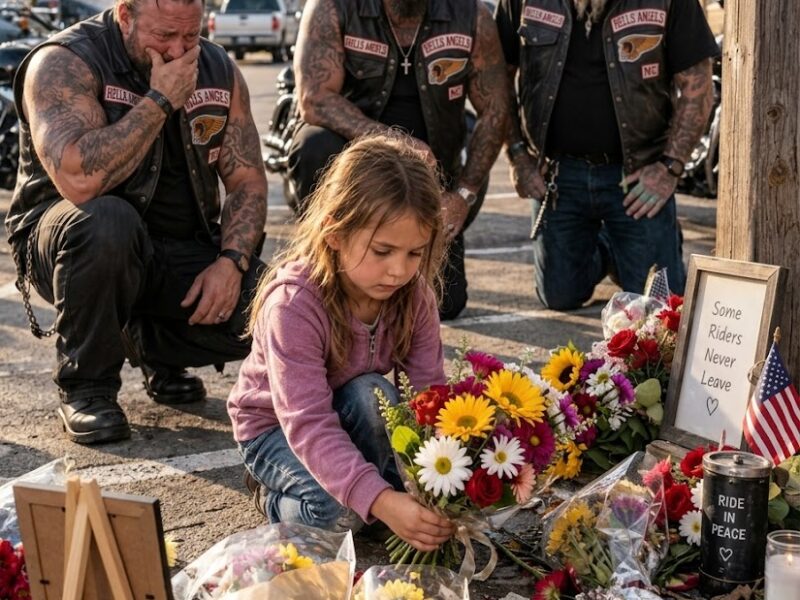
A little boy sold his only toy just to buy a biker a cup of coffee — and what happened next brought 300 riders to his door with gifts.
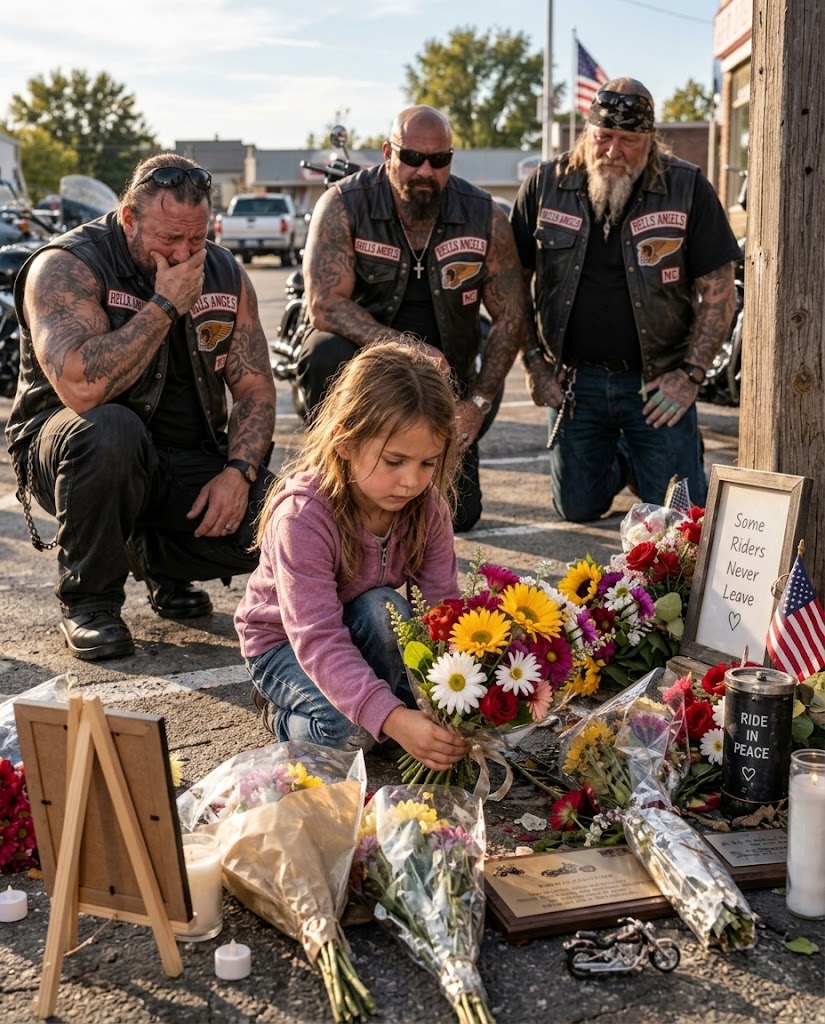
The rain had turned the gravel lot behind the Roadhouse Diner into a slick gray mirror, and eleven-year-old Marcus Webb stood at the edge of it with a cardboard box clutched against his chest, wondering if he had made the biggest mistake of his life.
Inside that box was his entire collection of vintage Hot Wheels, forty-three cars in total, including the rare 1968 Custom Camaro in redline condition that his father had given him three days before the accident that took both his parents on Interstate 75.
He had sold them all that morning to a collector in Middletown for $340, and now that money was folded into a tight wad in his jacket pocket, burning against his ribs like a secret he wasn’t sure he could carry.
The Roadhouse Diner sat at the corner of Third and Patterson in Dayton, Ohio, a squat brick building with a neon sign that had been flickering on and off for so long that nobody could remember when it had last worked properly.
Every Friday evening, a group of motorcycle riders called the Iron Line gathered there, men and women in leather vests with patches on their backs, drinking coffee and telling stories that Marcus had been listening to from the sidewalk for three months.
He wasn’t supposed to be there.
His grandmother, who had taken him in after the state finished its investigation and determined that a eleven-year-old boy with no living parents and no close relatives willing to take him should go to the woman who lived in a small house on the east side of Dayton, had told him explicitly to come straight home after school.
But Marcus had been coming to the Roadhouse every Friday for twelve weeks, ever since the day he had walked past on his way to the library and heard a man in a leather vest laughing at something, a deep, rolling laugh that reminded him so sharply of his father that his knees had gone weak.
His father had ridden a motorcycle.
Not a big one, just a Honda CB350 that he had rebuilt in the garage over the course of two years, and Marcus had sat on the gas tank more times than he could count while his father worked on the engine, handing him wrenches and asking questions that his father always answered like they were the most important questions in the world.
His mother had hated the motorcycle, had called it a death trap, and now she was gone too, and the motorcycle had been sold along with everything else in the house to pay for the funerals.
Marcus had kept only the Hot Wheels, hidden in a shoebox under his bed at his grandmother’s house, because they were the last thing his father had given him, and now they were gone too.
He had told himself it was worth it.
The man he had been watching for three months, a broad-shouldered rider with gray in his beard named Kevin Whitfield, had been buying coffee for a homeless veteran who came to the Roadhouse every Friday, and Marcus had overheard him tell Patty Coleman, the waitress, that he was going to have to stop because money was tight.
Marcus didn’t know why that mattered so much to him.
Maybe it was because his father had always told him that you take care of the people around you, even when you don’t have much yourself.
Maybe it was because the homeless veteran, a man named Ray who had served two tours in Afghanistan and had been living out of his truck for the past year, reminded Marcus of his father in some small way.
Maybe it was just because he was tired of feeling helpless.
The rain was coming down harder now, and Marcus knew he should go home, but his feet wouldn’t move.
He watched the door of the Roadhouse open and close as riders arrived, their boots splashing through puddles, their laughter carrying across the lot.
He watched Kevin Whitfield pull up on a battered Harley-Davidson and park in the same spot he always did, the third one from the propane tank, a spot that was always empty even when the rest of the lot was full.
Marcus had noticed that spot months ago, had wondered why nobody ever parked there, had even asked Ray about it once, and Ray had just shaken his head and said, “That spot belongs to somebody who ain’t coming back.”
Marcus didn’t know what that meant.
He only knew that he had $340 in his pocket and a cardboard box in his arms, and he had no idea what he was supposed to do next.
The door to the Roadhouse opened again, and this time it was Patty Coleman, the waitress, stepping out onto the porch with a dish towel over her shoulder and a look on her face that suggested she had seen a lot of strange things in her nineteen years working at the diner but nothing quite like this.
“Hey there, sweetheart,” she called out, her voice carrying over the rain. “You been standing out here for a while now. You okay?”
Marcus didn’t answer.
He couldn’t.
Patty came down the steps, her apron flapping in the wind, and when she got close enough to see his face, her expression shifted from curiosity to concern.
“Baby, you’re soaked through,” she said, reaching out to touch his shoulder. “Come inside before you catch your death.”
Marcus shook his head.
“I can’t,” he said, and his voice cracked on the words. “I have to give something to somebody first.”
Patty’s eyes dropped to the cardboard box in his arms, then back up to his face, and something in her expression changed.
“What’s your name, honey?” she asked gently.
“Marcus,” he said. “Marcus Webb.”
Patty went very still.
Marcus didn’t understand the look that crossed her face, the way her lips pressed together and her eyes went distant for a moment, like she was seeing something that wasn’t there.
“What’s in the box, Marcus?” she asked.
Marcus looked down at the cardboard, at the faded writing on the side that said “FRAGILE” in his mother’s handwriting, and felt the tears he had been holding back for three months finally start to rise.
“My Hot Wheels,” he said. “I sold them. All of them. I got three hundred and forty dollars.”
Patty’s hand went to her chest.
“Why would you do that, baby?”
Marcus swallowed hard.
“There’s a man who comes here every Friday,” he said. “He buys coffee for another man who doesn’t have any money. And I heard him say he couldn’t do it anymore because things were tight. And I thought—”
He stopped, because the tears were coming now, and he couldn’t stop them.
“I thought if I gave him the money, he could keep buying the coffee,” Marcus said. “Because that’s what my dad would have done. My dad always said you take care of the people around you.”
Patty Coleman had worked at the Roadhouse Diner for nineteen years.
She had seen grown men cry into their coffee after losing jobs, had watched marriages fall apart over the sticky tables, had witnessed the kind of quiet grief that only shows up in places where people feel safe enough to let their guard down.
But she had never, in all those years, seen anything quite like this.
She reached out and took Marcus by the hand, her grip firm and warm despite the cold rain.
“Come with me,” she said, and this time Marcus didn’t resist.
She led him up the steps, through the screen door, and into the warm, noisy interior of the Roadhouse Diner, where the smell of bacon and coffee and motor oil hung in the air like a familiar song.
The Iron Line was gathered at their usual tables, a loose collection of men and women in leather vests, most of them old enough to be Marcus’s grandparents, all of them turning to look as Patty walked in with a soaked eleven-year-old boy clutching a cardboard box.
Kevin Whitfield was sitting at the corner table with Doc Jennings and Frank Dolan, the diner’s owner, and when he saw Marcus, something flickered across his face.
It was the same look Patty had given him outside, the same look Ray had given him when Marcus had asked about the empty parking spot.
Recognition.
“Patty,” Kevin said slowly, setting down his coffee mug. “Who’s this?”
Patty didn’t answer directly.
She guided Marcus to a stool at the counter, helped him up onto it, and then turned to face the room.
“This young man,” she said, her voice carrying across the diner, “just sold every single one of his Hot Wheels so he could give Kevin here three hundred and forty dollars to keep buying coffee for Ray.”
The room went silent.
Marcus felt his face burn, felt every eye in the diner turn toward him, and for a moment he wished the floor would open up and swallow him whole.
But then Kevin Whitfield stood up from his table, crossed the room in four long strides, and knelt down in front of Marcus so that their eyes were level.
“You did what?” Kevin asked, and his voice was rough in a way that Marcus didn’t understand.
“I sold my Hot Wheels,” Marcus said, his voice barely above a whisper. “I heard you say you couldn’t buy Ray’s coffee anymore. And I wanted to help.”
Kevin stared at him for a long moment, and then he did something that Marcus didn’t expect.
He laughed.
Not a mean laugh, not a mocking laugh, but a laugh that was full of something Marcus couldn’t name, something that sounded almost like grief.
“Kid,” Kevin said, shaking his head. “You don’t even know me.”
“I know you buy coffee for Ray,” Marcus said stubbornly. “And I know you park in the same spot every Friday. And I know nobody else ever parks there.”
Kevin’s laugh died in his throat.
“What did you say?” he asked quietly.
“The third spot from the propane tank,” Marcus said. “Ray told me it belongs to somebody who ain’t coming back.”
The silence in the diner stretched so long that Marcus could hear the rain drumming on the roof, could hear the hum of the neon sign outside, could hear his own heart beating in his ears.
Kevin Whitfield looked at the boy in front of him, at the soaked jacket and the cardboard box and the stubborn set of his jaw, and felt something crack open in his chest.
“What’s your name, kid?” he asked.
“Marcus,” the boy said. “Marcus Webb.”
Kevin closed his eyes.
When he opened them again, they were bright with tears he didn’t bother to hide.
“Marcus,” he said slowly. “Was your dad’s name David Webb?”
Marcus nodded, his own eyes widening.
“How did you know?”
Kevin stood up, turned to face the room, and every member of the Iron Line was watching him now, waiting, their coffee going cold in their hands.
“David Webb,” Kevin said, and his voice carried across the diner like a bell. “Rode a Honda CB350. Rebuilt it himself in a garage over on Wayne Avenue. Used to come here every Friday night for six years. Sat right there.”
He pointed to a booth near the window, and Marcus followed his gaze, saw the worn vinyl seat, the scratched table, the small chip in the Formica that looked like it had been there for a decade.
“He was one of us,” Kevin said. “And twelve years ago, he died on Route 4 during the Iron Line’s annual charity run. A box truck jackknifed on black ice. Your dad saw a stalled car in the path of the wreckage and swerved to draw the truck away. He bought the driver three seconds to get clear.”
Marcus felt the words hit him like physical blows.
“He saved a stranger’s life,” Kevin continued. “And he left behind a wife and a son. A son who was eight years old.”
The room was dead silent.
“After the funeral,” Kevin said, “your mom moved you to Columbus. Cut off contact with everyone here. We didn’t know where you went. We didn’t know how to find you.”
He paused, his voice cracking.
“We’ve been waiting twelve years for you to come find us.”
Marcus sat on the stool, his legs dangling, the cardboard box still clutched against his chest, and felt something inside him shift.
He had spent three months coming to this diner, watching these people, listening to their stories, feeling a connection he couldn’t explain.
He had thought it was just because they reminded him of his father.
He had been wrong.
They weren’t just like his father.
They had known his father.
They had loved his father.
“You knew my dad,” Marcus said, and it wasn’t a question.
“We loved your dad,” Kevin corrected. “He was my best friend. He taught half the men in this room how to change their own oil. He once rode four hundred miles overnight to be at a friend’s hospital bedside.”
He reached into his jacket pocket and pulled out a photograph, worn at the edges, creased down the middle.
It showed a man on a motorcycle, laughing, the Roadhouse sign visible over his shoulder.
Marcus took the photograph with trembling hands.
He had seen pictures of his father before, of course, but none like this.
None that showed him so alive, so happy, so completely at home.
“That’s him,” Marcus whispered. “That’s my dad.”
Kevin nodded.
“Your dad,” he said, “was the kind of man who would give you the shirt off his back. The kind of man who would stop on the side of the road to help a stranger change a tire. The kind of man who would sell everything he owned to help somebody else.”
He looked at the cardboard box in Marcus’s arms.
“Which is exactly what you just did.”
Marcus looked down at the box, at the forty-three Hot Wheels he had sold for $340, at the last physical connection he had to his father, and felt the tears come again.
“I wanted to help,” he said. “I wanted to do something.”
Kevin knelt down again, took Marcus by the shoulders, and looked him in the eye.
“You did something, kid,” he said. “You did something your dad would have been proud of. And you did it for a man you didn’t even know.”
He stood up and turned to face the room.
“Iron Line,” he called out. “We’ve got a situation here.”
The riders looked up, their faces expectant.
“This young man sold everything he had to help one of ours. He didn’t know who we were. He didn’t know we knew his father. He just saw somebody in need and decided to do something about it.”
He paused, letting the words sink in.
“Now I think it’s time we returned the favor.”
Doc Jennings stood up from his table, a wiry man with gray hair and a face that had seen too much.
“What did you have in mind, Kevin?” he asked.
Kevin looked around the room, at the men and women who had been his family for thirty years, at the community that Daniel Carter had helped build.
“I think,” he said slowly, “we need to find out what happened to those Hot Wheels.”
The collector in Middletown was a man named Harold Pinsky, a retired schoolteacher who had been collecting die-cast cars for forty years and had never in all that time seen a collection quite like the one Marcus Webb had brought him.
Forty-three Hot Wheels, all in excellent condition, including a 1968 Custom Camaro in redline that Harold had been trying to find for a decade.
He had paid $340 without hesitation, knowing the collection was worth far more, knowing that the boy standing in front of him with red-rimmed eyes and a cardboard box was clearly selling something precious.
Harold had asked Marcus why he was selling.
Marcus had said he needed the money for something important.
Harold had not pressed further.
But when a group of motorcycle riders showed up at his door three days later, led by a broad-shouldered man with gray in his beard and a look in his eyes that suggested he was not there to negotiate, Harold began to understand that he had stumbled into something much larger than a simple transaction.
“You bought forty-three Hot Wheels from a kid named Marcus Webb,” Kevin said, standing on Harold’s front porch with Doc Jennings and Frank Dolan flanking him. “We’re here to buy them back.”
Harold, a small man with glasses and a nervous manner, looked at the three men in leather vests and swallowed hard.
“I paid three hundred and forty dollars,” he said. “They’re worth more than that.”
“We know,” Kevin said. “How much?”
Harold considered.
The collection was worth at least two thousand dollars, maybe more.
But there was something in the way Kevin Whitfield stood on his porch, something in the way he said the boy’s name, something in the story Harold had pieced together from the news and the rumors and the way Marcus’s hands had shaken when he handed over the box.
“I’ll sell them back for what I paid,” Harold said quietly. “Three hundred and forty dollars.”
Kevin blinked.
“That’s it?”
Harold nodded.
“That boy didn’t want to sell those cars,” he said. “I could see it in his face. He was selling something he loved to help somebody else. I’ve been a teacher for thirty years. I know what that looks like.”
He paused.
“I also know what it looks like when a kid doesn’t have anybody left. So take the cars. Pay me what I paid. And tell that boy I hope he finds what he’s looking for.”
Kevin reached out and shook Harold’s hand.
“You’re a good man,” he said.
Harold smiled sadly.
“I’m just a man who knows a thing or two about loss,” he said.
The Iron Line gathered at the Roadhouse Diner that Friday evening, and the parking lot was fuller than it had been in years.
Kevin had put out the word through the network of riders that stretched across Ohio and into Indiana and Kentucky, and by the time the sun went down, there were more than three hundred motorcycles parked in neat rows along the gravel.
Marcus stood at the edge of the lot with his grandmother, who had been persuaded to come by Patty Coleman and a promise of free pie, and watched as the riders arrived.
He didn’t understand what was happening.
He only knew that Kevin Whitfield had told him to be there, that something important was going to happen, and that he should bring the cardboard box.
“What is all this?” his grandmother asked, her voice tight with suspicion.
Marcus’s grandmother, Ruth, was a woman who had spent most of her life expecting the worst from people. She had raised three children, buried one, and watched the other two move away to places she couldn’t afford to visit. She had taken Marcus in because he was family, but she had made it clear from the beginning that she was too old and too tired to deal with anything beyond the basics of food, shelter, and school.
She didn’t understand why Marcus came to this diner every Friday.
She didn’t understand why he had sold his Hot Wheels.
She didn’t understand anything about the world her grandson had been navigating alone for three months.
“I don’t know,” Marcus admitted. “Kevin just said to be here.”
Ruth harrumphed.
“Kevin,” she muttered. “A grown man in a leather vest. What kind of example is that for a boy your age?”
Before Marcus could answer, the screen door of the diner swung open and Kevin stepped out onto the porch, a cardboard box in his arms.
The box looked familiar.
Marcus felt his heart stop.
“Iron Line,” Kevin called out, and the crowd of riders went quiet. “We’re here tonight for a reason. Three months ago, a kid started showing up at this diner every Friday. He didn’t come inside. He didn’t talk to anybody. He just stood on the sidewalk and watched.”
He paused, looking out at the sea of faces.
“I didn’t know who he was. None of us did. But we noticed him. And we noticed that he seemed to be looking for something.”
Marcus felt his grandmother’s hand tighten on his shoulder.
“Turns out,” Kevin continued, “that kid was Daniel Carter’s son. Daniel Carter, who died twelve years ago saving a stranger’s life on Route 4. Daniel Carter, who was one of us. Daniel Carter, whose son we didn’t even know existed until three days ago.”
A murmur ran through the crowd.
“His name is Marcus Webb,” Kevin said. “And three days ago, he sold every single Hot Wheel his father ever gave him so he could give me three hundred and forty dollars to keep buying coffee for Ray.”
He gestured toward Ray, who was standing near the back of the crowd, his face unreadable.
“Ray didn’t know Marcus. Marcus didn’t know Ray. But Marcus saw somebody in need and decided to do something about it. Because that’s what his father would have done. Because that’s what we do.”
Kevin held up the cardboard box.
“These are the Hot Wheels Marcus sold. I bought them back. Every single one.”
He walked down the steps of the porch and crossed the gravel lot to where Marcus stood, his grandmother beside him, his face pale with shock.
“Marcus,” Kevin said, kneeling down and holding out the box. “These belong to you.”
Marcus stared at the box, at the faded “FRAGILE” written in his mother’s handwriting, at the forty-three Hot Wheels he thought he had lost forever.
“I don’t understand,” he whispered.
“You did something good,” Kevin said. “And the Iron Line takes care of its own. Your dad was one of us. That makes you one of us too.”
He pressed the box into Marcus’s hands.
“Welcome to the family, kid.”
Marcus looked down at the box, then up at Kevin, then out at the crowd of riders who had come from all over the state to be here tonight.
Three hundred motorcycles.
Three hundred people who had known his father.
Three hundred people who had shown up because a boy they had never met had done something kind for a man he barely knew.
“Thank you,” Marcus said, and his voice cracked on the words. “Thank you for—”
He couldn’t finish.
Kevin pulled him into a hug, and Marcus felt the tears come again, but this time they weren’t tears of grief.
They were tears of something else entirely.
Ray stepped forward from the crowd, his weathered face twisted with emotion.
“I didn’t know,” he said, his voice rough. “I didn’t know about your dad. I didn’t know about any of this.”
He reached into his pocket and pulled out a folded piece of paper.
“I wrote something,” he said. “For you. For what you did.”
Marcus took the paper with trembling hands and unfolded it.
It was a letter, written in Ray’s careful, blocky handwriting, and it said:
*Dear Marcus,*
*I don’t know if you remember me, but I’ve been coming to the Roadhouse every Friday for about a year now. I lost my job, then my apartment, then my wife. The only thing I had left was my truck and my pride.*
*Kevin started buying me coffee about six months ago. He never asked for anything in return. He never made me feel like a charity case. He just bought me coffee and sat with me and talked to me like I was a human being.*
*I didn’t know he was going to stop. I didn’t know things were tight for him. And then you showed up, and you sold everything you had so he could keep buying me coffee.*
*I don’t know what I did to deserve that. I don’t know what any of us did to deserve people like you.*
*But I want you to know that I’m going to be okay. I got a job last week. A real job. At a warehouse over in Vandalia. And I’m going to get my life back together.*
*And it’s because of you.*
*Thank you, Marcus. Thank you for reminding me that there are still good people in the world.*
*Your friend,*
*Ray*
Marcus read the letter twice, then folded it carefully and put it in his pocket.
He looked up at Ray, at the man who had been living out of his truck, at the man his father would have helped without hesitation.
“You’re welcome,” he said quietly.
Ray nodded, his eyes bright, and then he did something that surprised everyone.
He turned to face the crowd of riders and raised his hand.
“I want to say something,” he said, his voice carrying across the lot. “I want to say thank you. Not just to Marcus, but to all of you. To Kevin, and Doc, and Patty, and Frank. To everyone who ever bought me a cup of coffee or sat with me when I didn’t have anywhere else to go.”
He paused, his voice breaking.
“I served two tours in Afghanistan. I saw things I can’t unsee. I lost friends I can’t bring back. And when I came home, I thought I was alone. I thought nobody understood. I thought nobody cared.”
He looked around at the three hundred riders in their leather vests, at the men and women who had built a community around a diner and a parking lot and a shared love of the open road.
“But I was wrong,” Ray said. “I was wrong about all of it. You people—you’re the reason I’m still here. You’re the reason I didn’t give up.”
He turned to Marcus.
“And you,” he said. “You’re the reason I’m going to keep going. Because if a kid I’ve never met can sell everything he owns to help me, then I can get my life together. I can be somebody worth helping.”
The crowd erupted in applause, the sound rolling across the gravel lot like thunder.
Marcus stood in the middle of it, his grandmother’s hand on his shoulder, the cardboard box in his arms, and felt something he hadn’t felt in three months.
He felt like he belonged.
The celebration continued late into the night, and by the time the last rider pulled out of the gravel lot, Marcus had met more people than he could count.
He met Doc Jennings, who told him stories about his father’s younger days, about the time Daniel had ridden all night to help a friend whose motorcycle had broken down outside of Indianapolis.
He met Patty Coleman, who gave him a slice of pie and told him he was welcome at the diner any time, no questions asked.
He met Frank Dolan, who shook his hand and said, “Your dad was a good man. You’re going to be a good man too.”
And he met Kevin Whitfield, who sat with him on the porch of the diner as the sun came up, the two of them watching the light spread across the gravel lot.
“I have something for you,” Kevin said, reaching into his jacket pocket.
He pulled out a small patch, the kind the Iron Line members wore on their vests, and handed it to Marcus.
It was shaped like a motorcycle wheel, with the words “IRON LINE” embroidered in silver thread and a single word underneath: “FAMILY.”
“This was your dad’s,” Kevin said. “He never got to wear it. It was supposed to be a surprise for his fifth anniversary with the club, but he died before we could give it to him.”
Marcus looked down at the patch, at his father’s patch, at the symbol of a community that had loved him enough to keep his memory alive for twelve years.
“I can’t take this,” he said.
“You can,” Kevin said. “You should. He would have wanted you to have it.”
Marcus closed his fingers around the patch, felt the rough embroidery against his palm, and thought about his father.
He thought about the Honda CB350 in the garage, the hours he had spent sitting on the gas tank, the questions he had asked and the answers he had received.
He thought about the last thing his father had ever said to him, the night before the accident.
“Take care of the people around you, Marcus. Even when you don’t have much yourself.”
He had done that.
He had sold his Hot Wheels to help a man he didn’t know.
He had found his father’s second family.
He had learned that his father wasn’t just a man who had died on a cold March road.
He was a man who had lived, who had loved, who had built something that lasted long after he was gone.
“I want to be like him,” Marcus said, and his voice was steady. “I want to be the kind of person who takes care of people.”
Kevin smiled.
“Then you already are,” he said.
**Six months later**
The Roadhouse Diner had survived.
The community use protection designation had been granted, the developer had backed off, and Frank Dolan had signed another five-year lease.
The gravel lot was still gravel, the neon sign still flickered, and the third spot from the propane tank was still empty.
But it was no longer a space defined only by absence.
It had become, instead, exactly what Daniel Carter’s life had always been about: a place where people showed up for each other, Friday after Friday, for as long as it took.
Marcus came to the diner every Friday now, not as a stranger on the sidewalk, but as a member of the family.
He sat in the booth where his father had sat, drank root beer instead of coffee, and listened to the stories that the Iron Line told about the old days.
He wore his father’s patch on the denim jacket that Kevin had bought him, and when new riders came to the diner, he was the first to greet them.
He had learned to ride, too, on a battered Honda that Doc Jennings had helped him rebuild, and on Saturday mornings, he and Kevin would take the back roads out of Dayton, past the warehouses and the chain-link fences, past the place where cracked asphalt met the great Miami River.
They would ride for hours, the wind in their faces, the road stretching out ahead of them.
And Marcus would think about his father, about the man who had died on a cold March road, about the life he had lived and the community he had built.
He would think about the Hot Wheels, sold and returned, the cardboard box with “FRAGILE” written in his mother’s handwriting.
He would think about Ray, who had a job now, and an apartment, and a life that was slowly being rebuilt.
And he would think about the words his father had said, the last words he remembered.
“Take care of the people around you, Marcus. Even when you don’t have much yourself.”
He had done that.
And he would keep doing it, for as long as he could, for as long as the road stretched out ahead of him.
Because that was what family did.
That was what the Iron Line did.
That was what his father had taught him, even after he was gone.
**Three years later**
The letter arrived on a Tuesday, in a plain white envelope with no return address.
Marcus, now fourteen years old and taller than his grandmother, opened it at the kitchen table while Ruth watched from the stove.
Inside was a photograph and a handwritten note.
The photograph showed a woman in her forties, standing in front of a house with two children beside her.
The note said:
*Dear Marcus,*
*My name is Carol Anne Weiss. Your father saved my life.*
*I’ve wanted to write to you for years, but I didn’t know where you were. Kevin Whitfield found me last month and told me about you. He told me about the Hot Wheels, about the coffee, about everything.*
*I don’t know how to thank you for what your family has meant to mine. Your father gave me three seconds, and those three seconds gave me a lifetime.*
*My son graduated from high school last spring. My daughter is going to college in the fall. I have a house full of memories that your father made possible.*
*I’ve enclosed a photograph of my family. I want you to see what your father’s sacrifice built.*
*And I want you to know that I think about him every day. I think about the man on the motorcycle who saw my car in the path of that truck and made a choice that cost him everything.*
*I think about the kind of courage that takes.*
*And I think about you, his son, who sold everything he had to help a stranger.*
*You are your father’s son. Never doubt that.*
*With love and gratitude,*
*Carol Anne Weiss*
Marcus read the letter twice, then looked at the photograph.
A woman, a boy, a girl, standing in front of a house with a white picket fence and a garden full of flowers.
A family that existed because his father had made a choice.
He folded the letter carefully and put it in the cardboard box with the Hot Wheels, the box that still had “FRAGILE” written on the side in his mother’s handwriting.
Then he went outside, where Kevin was waiting with the Honda, and they rode.
They rode past the warehouses and the chain-link fences, past the great Miami River running gray under a September sky.
They rode until the sun went down and the road stretched out ahead of them like a promise.
And Marcus thought about his father.
And he smiled.
**Epilogue: The Fifth Friday**
The Roadhouse Diner was crowded that night, fuller than it had been in years.
The Iron Line had gathered for their annual charity run, the one that raised money for the pediatric wing at Dayton Children’s Hospital, the one that Daniel Carter had been riding in when he died.
Three hundred riders had shown up, just like they did every year, their motorcycles parked in neat rows along the gravel lot.
And in the third spot from the propane tank, where no car had parked in fifteen years, a single motorcycle stood.
It was a Honda CB350, rebuilt from parts that Doc Jennings and Kevin Whitfield had collected over the years, painted the same deep blue that Daniel Carter’s motorcycle had been.
It was Marcus’s motorcycle now.
He had rebuilt it himself, with help from the Iron Line, and he had painted it the color his father had loved.
He stood beside it, fourteen years old and already taller than most of the men in the club, wearing his father’s patch on his denim jacket.
Kevin walked up beside him, coffee in hand, and looked at the motorcycle.
“You did good, kid,” he said.
Marcus nodded.
“I wanted to honor him,” he said. “I wanted to do something that mattered.”
Kevin put a hand on his shoulder.
“You already did,” he said. “You did it the day you sold those Hot Wheels. You did it the day you walked into this diner. You did it the day you decided to be the kind of person your father was.”
Marcus looked out at the crowd of riders, at the men and women who had become his family, at the community his father had helped build.
“I’m going to keep doing it,” he said. “For as long as I can.”
Kevin smiled.
“That’s all any of us can do,” he said.
And then he raised his coffee mug, and the Iron Line raised theirs, and three hundred voices said the same word at the same time.
“Family.”
The word echoed across the gravel lot, past the chain-link fences, past the great Miami River running gray under the September sky.
It echoed past the warehouses and the cracked asphalt, past the place where Daniel Carter had parked every Friday for six years.
It echoed into the night, into the future, into the lives of everyone who had been touched by a man who had died saving a stranger.
And in the third spot from the propane tank, where no car had parked in fifteen years, a single motorcycle stood.
Waiting.
Remembering.
Ready to ride.









