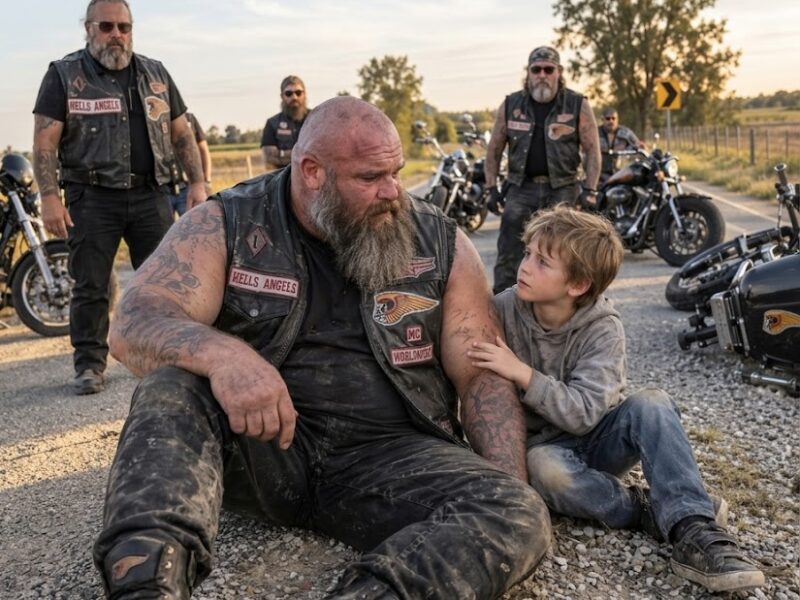
A little boy refused to leave a fallen biker’s side — and when 600 riders found out, they made sure he never had to.
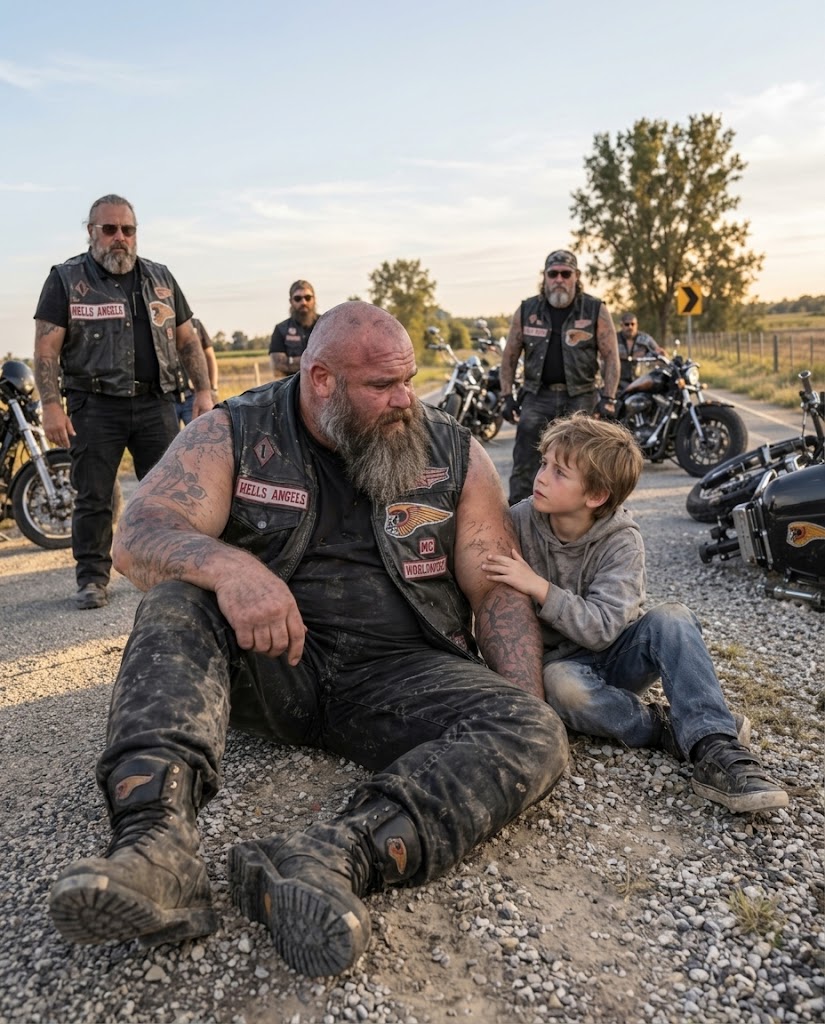
Rain hammered the mountain road as an 11-year-old boy knelt beside a stranger bleeding out on wet asphalt.
The boy gripped the man’s hand while a thunderstorm raged overhead, refusing to let go even as adults told him to step back.
They said to let the paramedics handle it, to go home where it was safe.
He refused.
For 20 minutes alone in a downpour, this child became the only thing keeping a grown man conscious.
He had no idea the stranger belonged to a motorcycle club 600 members strong, or that his stubborn refusal to leave would soon bring every single one of them roaring down his street.
What happens when an entire community decides a child’s courage deserves an answer no one will ever forget?
—
Benjamin Carter was 11 years old and had a habit his mother called “waiting for engines.”
Every afternoon after school, he climbed the low wooden fence behind his grandfather’s property on Beaver Dam Road and sat with his elbows on his knees.
He watched the bend in the highway where the mountain road curled down from Craggy Gardens toward town.
He wasn’t waiting for anything in particular.
He simply liked the sound, long before he could see the shape.
First a hum, then a growl, then the flash of chrome and leather cutting through the green wall of rhododendron that lined the curve.
His grandfather, Walter Carter, had ridden motorcycles for 40 years before his knees gave out and his doctor told him it was time to sell the old Harley.
Walter still kept a photograph on the mantle—a much younger version of himself standing beside 20 other riders outside a diner in 1987.
All of them squinting into the sun.
All of them part of something called the Blue Ridge Road Brothers.
Benjamin had asked more than once what happened to all those men.
His grandfather always answered the same way.
“Some moved on, some passed on. But once you ride with a club like that, Ben, you’re never really alone on the road again. Doesn’t matter if you’re on two wheels or four or none at all.”
Benjamin didn’t fully understand what that meant.
Not yet.
He understood engines and gear ratios better than he understood people, and he understood the curve on Beaver Dam Road better than almost anyone in Buncombe County.
Because he’d spent three years of afternoons watching it.
He knew which drivers slowed down too late.
He knew that in autumn, when the maple leaves fell wet across the asphalt after a rain, the whole bend turned as slick as a skating rink.
He knew where the deer crossed in the evenings, right where the guardrail bent inward from an accident nobody in town liked to talk about anymore.
His mother, Diane Carter, worked the evening shift at Mission Hospital, which meant Benjamin often walked home from the bus stop alone.
He let himself into his grandfather’s house two doors down, where he did homework at the kitchen table until she came to collect him around 6.
His father was not in the picture.
He had left when Benjamin was four, and by now the boy barely thought of him as a person so much as a fact.
The way you might think of a country you’d once visited but couldn’t quite remember.
What Benjamin loved most—more than the homework he rushed through, and more than the video games his friends talked about at school—was motorcycles.
Not owning one.
He was years too young for that.
But the idea of them.
The independence.
The unmistakable sound of a V-twin engine downshifting into a curve.
A sound that felt to an 11-year-old boy whose father had disappeared and whose mother worked nights like a promise that someone somewhere was always moving toward something.
He had a small spiral notebook hidden under his mattress where he kept a rough tally of every motorcycle that passed the curve.
Not the license plates, which he couldn’t read from that distance, but the makes he could recognize by silhouette and sound.
Harleys with their unmistakable rumble.
Sport bikes that shrieked past in a blur of color.
The occasional old British twin that sputtered and coughed on the uphill grade.
His friends at school collected trading cards and video game achievements.
Benjamin collected engine sounds, filed away in his memory the way other boys memorized batting averages.
It was, his grandfather had told him once with a laugh, the strangest hobby he’d ever heard of in 68 years of living in these mountains.
But he never once told Benjamin to stop.
—
On the Tuesday that changed everything, Benjamin was sitting on the fence a little later than usual because his math teacher had kept the class back to finish a worksheet on long division.
The sky over the Blue Ridge had turned the color of a bruise.
Purple-gray clouds stacked up behind Craggy Dome the way they did before the mountain thunderstorms that rolled through almost every October evening.
His grandfather had told him once that riders called this kind of sky “biker’s warning.”
Beautiful enough to tempt you onto the road.
Dangerous enough to kill you if you didn’t respect it.
Benjamin should have gone inside.
His mother’s rule was firm—fence until 5:30, then homework.
No exceptions, especially not with a storm coming.
But he had counted only four motorcycles pass that whole afternoon, which was unusually quiet for a Tuesday.
Some stubborn, curious part of him wanted to see if a fifth would come before the rain did.
He heard it before he saw it.
A single engine, a big touring bike by the depth of the sound, moving fast around the bend from the direction of the parkway entrance.
Too fast, Benjamin thought immediately.
The way you think a thought without deciding to think it.
He had watched enough traffic on this curve to know the rhythm of a safe approach, and this rider was carrying speed like someone who either didn’t know the road or wasn’t thinking about it at all.
Then he saw the deer.
It came out of the tree line on the inside of the curve, exactly where Benjamin always said it would.
A young doe moving in that panicked sideways lurch that deer make when headlights or engine noise catches them mid-crossing.
The rider swerved hard to the right.
For one suspended second, the whole scene seemed to hang perfectly still in Benjamin’s vision.
The bike leaning at an angle no bike should hold.
The rear tire losing its grip on wet leaves that had fallen from last night’s rain.
The rider’s shoulder dropping toward the asphalt.
Then the world came apart into sound.
Metal scraping stone.
An engine dying mid-cry.
A long, terrible skid that ended against the bent section of guardrail.
The same guardrail his grandfather always mentioned.
The one nobody in town liked to talk about.
Benjamin was off the fence and running before he had made any decision to run at all.
—
Three hours earlier and 40 miles east, Michael Hendricks had been sitting alone in a booth at a diner outside Marion, North Carolina, finishing a cup of coffee that had gone cold 20 minutes before he noticed.
He was 53 years old, built like a man who had spent 30 years doing physical work, and had only recently let some of that muscle soften into the comfortable stoop of middle age.
His hands, when he wrapped them around the coffee mug, were scarred across the knuckles in the particular pattern of a man who had once worked as a diesel mechanic.
Burns, nicks, one crooked pinky that had been broken and reset badly on a job site in 1998.
Michael was a member of the Highland Guardians Motorcycle Club, a group of riders based out of Asheville who had over the past 15 years become less of a club and more of a family for a lot of men who didn’t have much family left.
Michael’s wife, Karen, had died of cancer six years earlier.
His only son, Tyler, lived in Denver now and called on Sundays out of duty rather than desire.
Michael did not resent this.
He understood, in the quiet way that grief eventually teaches a person to understand things, that Tyler had built a life far from the mountains because staying close to his mother’s memory had become unbearable.
Michael had stayed close to it on purpose.
He had kept the house.
He had kept the garage where Karen used to bring him lemonade while he worked on other men’s engines for extra money.
And he had kept the club, because the club was the only place left where people still said his name like it meant something.
The Highland Guardians were not the kind of club people saw in movies.
They did not deal in trouble.
What they did mostly was ride long weekend trips up into Tennessee, charity runs for the children’s hospital in the spring, and every third Tuesday of the month, a diner meeting exactly like the one Michael had just finished.
Twelve to twenty men in leather vests talking about carburetors and grandchildren in roughly equal measure.
Michael had joined the club almost by accident, back when Karen first suggested he needed something outside the garage to occupy his weekends.
What he’d found instead was a strange, unspoken understanding among men who rarely talked directly about their troubles but somehow always seemed to know when a member was struggling.
When Karen got sick, three different Guardians had shown up at the hospital without being asked, taking turns sitting in the waiting room so Michael never had to face an update from her doctors alone.
When she died, the club had ridden in formation behind the hearse—40 motorcycles moving at a funeral pace through downtown Asheville.
Michael had understood then, more clearly than he ever had before, exactly what his grandfather’s generation of riders had meant when they called the road a brotherhood.
—
That Tuesday’s meeting had run long because Daryl Whitfield, the club’s oldest member at 71, had announced he was finally hanging up his riding boots for good.
Nobody wanted to let the moment pass without a proper sendoff of stories.
Michael had laughed harder that afternoon than he had in months, listening to Daryl recount a ride to Sturgis in 1979 that had apparently involved a flat tire, a stolen goat, and a night in a South Dakota jail cell that Daryl still refused to fully explain.
By the time Michael climbed back onto his motorcycle—a deep green 2015 Harley-Davidson Road King that had been Karen’s favorite because she said the color matched his eyes—the storm clouds were already gathering over the ridge line to the west.
Any sensible rider would have taken the interstate home.
Four lanes of flat, boring, forgiving asphalt.
But Michael had never been able to resist the parkway route through Craggy Gardens, especially not in October, when the leaves turned the whole mountainside into something that looked less like North Carolina and more like a memory of a better world.
He told himself he’d beat the rain.
He almost always did.
The first 20 minutes of the ride were everything Michael loved about riding.
The cool mountain air sharpening against his face.
The long, sweeping curves that a Road King could carry with a confidence smaller bikes couldn’t match.
The particular quiet inside his own helmet that let him think about nothing and everything all at once.
He thought about Karen.
He thought about Daryl’s stolen goat.
He thought, briefly and without much sting anymore, about how strange it was that a man could build a whole life and then watch half of it disappear and somehow keep riding anyway.
He did not think about the deer until it was already in front of him.
Michael had ridden for 31 years without a single serious accident, a fact he was quietly proud of in the way riders are proud of things they know are partly luck.
His instincts took over the moment the doe broke from the tree line.
Swerve, don’t brake hard.
Lean away from the animal, not into it.
He executed the maneuver almost perfectly.
What he could not account for was the carpet of wet fallen leaves hidden under a thin sheen of rainwater, exactly where his rear tire needed traction most.
The back end of the Road King stepped out from under him with a suddenness that felt, in the strange slow-motion honesty of real danger, almost gentle.
Then it was not gentle at all.
Michael felt the bike go.
Felt his own body separate from 400 pounds of falling steel.
Felt the impact of asphalt against his shoulder and hip and helmet in a rapid, disorienting sequence he would only be able to reconstruct properly weeks later.
The world tumbled.
Metal screamed against the guardrail.
And then, abruptly, there was nothing but the sound of rain beginning to fall and his own breath, ragged and shallow, filling the inside of a helmet that had likely just saved his life.
Michael Hendricks lay on the shoulder of Beaver Dam Road, his left leg bent at an angle that told him with total clarity that it was broken.
He understood, with the particular loneliness of an injured man on an empty road, that he had absolutely no idea if anyone had seen him fall.
—
Benjamin reached the guardrail in under a minute, though it felt to him like both no time at all and an entire lifetime.
He had never run that fast in his life, not even during the mile they were forced to run every spring at school.
His lungs burned with a fire he didn’t have room to notice yet.
The motorcycle lay on its side 20 feet past the bent guardrail, one wheel still spinning slowly, ticking with the sound of hot metal cooling.
The rider—a big man, gray-stubbled, wearing a green and black leather vest with patches Benjamin didn’t recognize—was on the ground near the tree line, unmoving except for the rise and fall of his chest.
“Hey,” Benjamin said, his voice cracking as he dropped to his knees in the wet grass beside the man.
“Hey, mister, can you hear me?”
The man’s eyes opened slowly behind a helmet visor that had cracked but not shattered.
“I hear you,” he managed, his voice thick with pain.
“Leg’s broken. Don’t—don’t move me.”
“I won’t,” Benjamin said quickly.
“I know. My grandfather says you’re not supposed to move somebody after a crash. I’m calling for help.”
He fumbled his phone out of his backpack, hands shaking so badly he had to try twice before his fingers found the right buttons.
The dispatcher’s voice was calm in a way that Benjamin found almost unbearable, asking him questions he didn’t fully know how to answer.
Mile marker. Cross streets. Is the patient conscious?
While thunder rolled somewhere behind Craggy Dome and the first fat drops of rain began to fall through the canopy above them.
“They’re coming,” Benjamin told the man, kneeling back down.
“But it’s going to take a while. We’re kind of far from town.”
“Figured as much,” the man said, and even through the pain, Benjamin heard something like dry humor in it.
“Name’s Michael. Benjamin, you live around here?”
“Right up there.” Benjamin pointed toward the fence line, barely visible now through the thickening rain.
“I was watching the road. I saw you come around the curve.”
Michael’s eyes closed briefly, and for one terrible second Benjamin thought he had lost consciousness.
But then they opened again, fixed on the darkening sky.
“Deer came out of nowhere,” he said.
“Didn’t want to hit it.”
“I know. I’ve seen deer cross right there a hundred times. Nobody ever believes me when I tell them it’s dangerous.”
The rain came harder now, cold and relentless, plastering Benjamin’s hair to his forehead.
He shrugged off his backpack and, without really thinking about it, draped his own jacket—a thin school jacket that would do almost nothing against the storm—over Michael’s chest, tucking it as best he could around the older man’s shoulders.
“You don’t have to do that, kid.”
“You’re hurt. You’ll get cold faster than me.”
A truck slowed on the road above them, and a man in a fluorescent work vest climbed down the embankment, radio crackling at his hip.
“I called it in already too,” he told Benjamin, kneeling on Michael’s other side.
“Ambulance is coming from Weaverville. Might be 15, 20 minutes with this rain.”
“20 minutes,” Michael repeated, and something in his face tightened.
“I’m not going anywhere,” Benjamin said, surprising himself with how certain he sounded.
—
The construction worker, whose name turned out to be Roy Ferris, gently suggested that Benjamin head back up to the road, out of the rain, and let the grown men handle things from here.
Benjamin shook his head.
“He needs someone to keep talking to him. Keep him awake. That’s what you’re supposed to do.”
He wasn’t entirely sure where he’d learned this—some mix of a first aid unit at school and a dozen medical dramas his mother left playing on the television during her rare nights off.
But it felt true, and more than that, it felt necessary.
Roy exchanged a glance with another bystander who had pulled over—an older woman named Patricia Doyle, who worked for the county and had a blanket in her trunk.
Nobody argued with Benjamin further.
There was something about the set of his jaw, kneeling there in the freezing rain with his hand wrapped around a stranger’s, that made grown adults quietly step back and let him keep doing what he was doing.
For the better part of 20 minutes, Benjamin talked.
He talked about the fence and the curve and every motorcycle he’d ever counted passing his grandfather’s house.
He talked about his grandfather’s old club, the Blue Ridge Road Brothers, and the photograph on the mantle.
He asked Michael questions to keep him answering.
“What club are you with? How long have you ridden? Do you have kids?”
And Michael answered in a voice that grew weaker and more effortful as the minutes stretched on, though he never stopped answering.
At one point, Michael’s eyes fluttered, and his words began to slur, and something like real fear moved through Benjamin’s chest for the first time.
“Hey,” he said sharply, gripping Michael’s hand tighter.
“Hey, stay with me. Tell me about your bike. What color is it?”
“Green,” Michael mumbled.
“Wife picked it. Said it matched my eyes.”
“That’s a good color,” Benjamin said, and kept talking, kept squeezing, kept refusing in the small, fierce way that only a child fully committed to a decision can refuse to let the silence win.
When the ambulance finally arrived, its lights washing red and white across the wet asphalt, one of the paramedics had to gently pry Benjamin’s fingers loose from Michael’s hand.
“You did good, son,” the paramedic told him.
“Real good. You probably helped keep him conscious and calm, which matters more than people think.”
Benjamin stood in the rain, soaked through, shaking from cold and adrenaline both, and watched them lift Michael Hendricks onto a stretcher.
Michael turned his head as best he could and found Benjamin’s eyes.
“Thank you,” Michael said.
“I mean it. Thank you.”
Benjamin didn’t know what to say back, so he just nodded and watched the ambulance doors close.
He stood there on the shoulder of Beaver Dam Road until his mother’s car came skidding to a stop beside him, Diane Carter’s face white with a fear that had nothing to do with the storm.
—
Michael Hendricks spent six days at Mission Hospital with a fractured femur, three broken ribs, and a mild concussion that the doctors watched carefully for the first 48 hours.
He drifted in and out of a fog of pain medication for much of the first two days, but one memory stayed sharp and constant beneath the haze.
A boy’s voice, steady and stubborn, refusing to let him go quiet.
On the third day, clearer-headed and restless, Michael asked a nurse if anyone knew what had happened to the boy who’d stayed with him on the road.
It was Diane Carter, as it turned out, who worked the evening shift on that very floor, who overheard the question and stepped into the doorway.
“That was my son,” she said.
“Benjamin.”
Michael’s eyes, still shadowed with pain, filled with something that looked almost like disbelief.
“Your son saved my life.”
“He wouldn’t stop talking about you for three days,” Diane admitted, a tired, proud smile crossing her face.
“Wanted to know if you were okay. I told him hospital rules meant he had to wait to visit.”
That evening, when her shift ended, Diane brought Benjamin to room 412.
He stood in the doorway for a moment, oddly shy in a way he hadn’t been kneeling in the rain, until Michael waved him in with the one arm that wasn’t in a cast.
“There he is,” Michael said.
“The kid who wouldn’t let a grown man quit on himself.”
Benjamin walked to the bedside, and for a while neither of them said much of anything important.
They talked about the motorcycle, which had been towed to a shop in town, and about school, and about the storm.
But something had shifted between them that had nothing to do with words.
Michael Hendricks, a man who had spent six years since his wife’s death gradually shrinking his world down to a club, a garage, and a house too quiet for comfort, found himself looking at an 11-year-old boy and feeling, for the first time in a long while, something close to hope.
—
Word of what had happened moved through the Highland Guardians the way important news always moved through the club—fast, and through Daryl Whitfield first.
Daryl had called Michael’s hospital room the moment he heard, and by the time the call ended, half the club already knew that a local kid had knelt in a thunderstorm and refused to leave one of their own.
“You should have seen him, Daryl,” Michael said, his voice still rough from the ventilator he’d briefly needed.
“11 years old. Didn’t budge for 20 minutes. Paramedic said he probably kept me from losing consciousness.”
Daryl was quiet on the other end of the line for a long moment.
“You know what that is, right?” he finally said.
“That’s a road brother, Mike. Doesn’t matter that he’s never sat on a bike in his life. Kid’s got the heart for it.”
The idea took hold among the Highland Guardians the way ideas take hold among people who have spent their whole lives believing that gestures matter more than words.
It started small—a handful of members wanting to visit Benjamin and thank him personally, maybe bring him a club patch as a keepsake.
But within a week, as the story spread from the Highland Guardians to neighboring clubs across western North Carolina—the Smoky Mountain Riders, the Foothills Freedom Association, a dozen smaller groups Michael barely knew by name—the idea grew into something much larger.
“We want to bring him home,” Daryl told Michael, sitting in a folding chair beside his hospital bed during a visit two weeks after the accident.
“When you’re discharged—not just a couple of us. All of us. Every club that’ll come. We escort you both home. You and the boy. So this kid knows exactly what it means when somebody says a whole community has your back.”
Michael, still confined to a wheelchair for the foreseeable future, felt something tighten in his throat that had nothing to do with his healing ribs.
“600 people don’t just show up for a stranger, Daryl.”
“They’re not showing up for a stranger,” Daryl said simply.
“They’re showing up for a kid who reminded every single one of us why we ride together in the first place.”
—
The planning took nearly three weeks, coordinated mostly through phone calls and a shared spreadsheet that Daryl’s daughter, embarrassed by her father’s total inability to use a computer, ended up managing on his behalf.
Clubs from as far away as Knoxville and Greenville confirmed their attendance.
A local radio station picked up the story after a Highland Guardian mentioned it during an unrelated charity interview, and within days, calls were coming in from riders who had no connection to Michael, Benjamin, or Asheville at all.
People who simply wanted to be part of something that felt, in a world that often seemed to reward the opposite, like genuine decency being recognized in public.
Michael, still working through physical therapy twice a week for his leg, found the growing scale of the plan almost embarrassing.
“It’s getting bigger than I ever meant it to be,” he told Daryl during one of their visits.
“That’s not up to you anymore,” Daryl said, not unkindly.
“Some things stop belonging to the person they started with. This one belongs to the boy now.”
Word reached Diane Carter through a phone call from Daryl himself—careful and respectful, asking permission before anything was arranged.
She sat Benjamin down at the kitchen table that evening, the same table where he did his homework every day, and told him what the Highland Guardians and their neighboring clubs were planning.
Benjamin, for once in his life, didn’t have anything to say at all.
“They want to do this because of you,” his mother said gently, watching her son’s face carefully.
“Because you didn’t leave that man alone on the road.”
“I just did what Grandpa always says you’re supposed to do,” Benjamin finally managed.
“Stay with someone who needs you.”
Diane reached across the table and took her son’s hand—the same hand that had gripped a stranger’s for 20 minutes in a thunderstorm.
“That’s exactly why they’re coming, honey.”
—
The morning Michael Hendricks was discharged from Mission Hospital broke clear and cold over the Blue Ridge, the kind of crisp October sky that seemed almost designed for the occasion.
Benjamin had barely slept the night before, lying awake, listening for the first distant rumble of engines the way he used to listen for single motorcycles passing his grandfather’s fence.
He heard it long before it arrived.
Not the hum of one engine, but a sound that built and rolled and grew until it seemed to come from the mountains themselves.
A low, continuous thunder that had nothing to do with weather.
By the time Benjamin, his mother, and his grandfather reached the hospital’s front circle, the street beyond it was already filling with motorcycles as far as he could see in either direction.
Green and black Highland Guardians vests mixed with the colors of a dozen other clubs.
Riders who had traveled from Tennessee, South Carolina, and Virginia after hearing the story secondhand and deciding they needed to be part of it in person.
Daryl Whitfield, out of retirement for one final ride, stood beside Michael’s wheelchair near the hospital entrance, grinning like a man half his age.
“Told you they’d come,” he said.
Michael, freshly discharged, his legs still in a heavy cast propped on the wheelchair’s extension, could not speak for a moment.
Six hundred riders—the number the club had ultimately tallied from sign-in sheets at three separate staging points—filled Biltmore Avenue and beyond, engines idling in a low chorus that Benjamin felt as much in his chest as he heard with his ears.
When Benjamin appeared at the top of the entrance ramp beside his mother, a hush moved through the crowd of riders, spreading outward like a ripple.
One by one, men and women who had never met this boy began to applaud.
Not the polite applause of strangers, but something closer to a roar.
Hundreds of gloved hands clapping and engines revving in a rhythm that felt to an 11-year-old who had spent three years watching this exact kind of moment happen in miniature from a wooden fence like something out of a dream he hadn’t known he was allowed to have.
Daryl waved him forward.
Benjamin walked down the ramp slowly, overwhelmed, until he reached Michael’s wheelchair.
“These are all for you, too, you know,” Michael told him, his voice thick with an emotion he made no effort to hide.
“Every single one of them.”
“I didn’t do anything special,” Benjamin said, the same thing he’d told his mother two weeks earlier.
Daryl crouched down to Benjamin’s eye level, an old man’s knees cracking audibly in protest.
“Son, let me tell you something. It took most of us 30, 40 years of riding to understand. It’s not the miles that make you part of something. It’s showing up when somebody needs you and not leaving until the job’s done. You did that in a thunderstorm, on your own, at 11 years old, for a stranger. Every rider here has spent their whole life trying to live up to that idea. You just went ahead and did it.”
He reached into his vest and produced a small leather patch—the kind sewn onto the back of a member’s jacket.
The Highland Guardians crest, with a smaller banner beneath it that had been specially made for the occasion.
It read: “Honorary Road Brother.”
“This isn’t official until you’re 18 and can actually ride,” Daryl said, pressing it into Benjamin’s hands.
“But as far as every person on this street is concerned, you already earned your place.”
—
The procession that followed took nearly two hours to travel a route that would normally have taken 20 minutes, winding slowly and deliberately from the hospital through downtown Asheville and out toward Beaver Dam Road.
Past the very curve where the accident had happened.
Before finally arriving at Michael Hendricks’s quiet house at the edge of town.
Benjamin rode the final stretch in the passenger seat of Daryl’s pickup truck, positioned directly behind Michael’s van, watching 600 motorcycles fill his rearview mirror and stretch back farther than he could see.
People came out of their houses along the route to watch, drawn by the sound, and many of them would later say it was the most motorcycles they had ever seen pass through Asheville at one time.
More even than the annual charity ride the Highland Guardians held every spring.
But for Benjamin, sitting in that truck, what mattered wasn’t the size of it.
What mattered was that every single engine in that procession existed because a group of strangers had decided that loyalty, once shown, deserved to be answered.
When they finally reached Michael’s driveway, the riders parked in careful rows along both sides of the street, engines falling silent one by one until the only sound left was the wind moving through the trees and the distant, familiar hum of Beaver Dam Road.
Michael was helped from his van into a chair set up on his front porch, and Benjamin stood beside him as Daryl called for quiet.
“Michael Hendricks has been part of this club for 15 years,” Daryl announced to the assembled crowd.
“And in all that time, I don’t think any of us truly understood what it meant to be part of something bigger than ourselves quite as clearly as we do today. Because of an 11-year-old boy who never even sat on a motorcycle before that Tuesday.”
He turned to Benjamin.
“Anything you want to say, son?”
Benjamin looked out at 600 riders, standing quietly in front yards and driveways along a street he had walked or biked past a hundred times in his life.
All of them waiting patiently for whatever he wanted to tell them.
He thought of his grandfather’s photograph on the mantle.
He thought of the sound of engines rounding the bend on Beaver Dam Road, a sound he had once believed meant nothing more than someone passing through on their way to somewhere else.
“I always thought bikers were just people passing by,” he finally said, his voice carrying further than he expected in the quiet street.
“I didn’t know you were all looking out for each other this whole time. I guess now I know.”
Michael reached over from his chair and rested a hand on Benjamin’s shoulder—the same shoulder the boy had once used to shield him from the rain with a jacket too thin to matter and a will too strong to break.
“You’re one of us now, Ben,” Michael said quietly, just between the two of them, though half the street heard it anyway.
“Wherever the road takes you.”
—
Benjamin Carter went home that evening to his grandfather’s house, where Walter Carter was waiting on the porch, having watched the entire procession pass by from his old rocking chair.
His grandfather didn’t say much.
He rarely did about things that mattered most.
But he handed Benjamin a folded photograph—the same one that had sat on the mantle for as long as Benjamin could remember.
The Blue Ridge Road Brothers, standing outside a diner in 1987.
“Now you understand what that picture means,” Walter said simply.
Benjamin held the photograph carefully, then looked back down the road one more time toward the curve where a stranger had once fallen and a boy had once decided, without fully knowing why, that some people are worth staying for.
He was still watching the road that evening, long after the last engine had faded into the distance, waiting the way he always had for whatever came around the bend next.









