A Little Boy Hid His Empty Lunchbox Every Day—Then 350 Bikers Discovered His Father’s Patch Inside
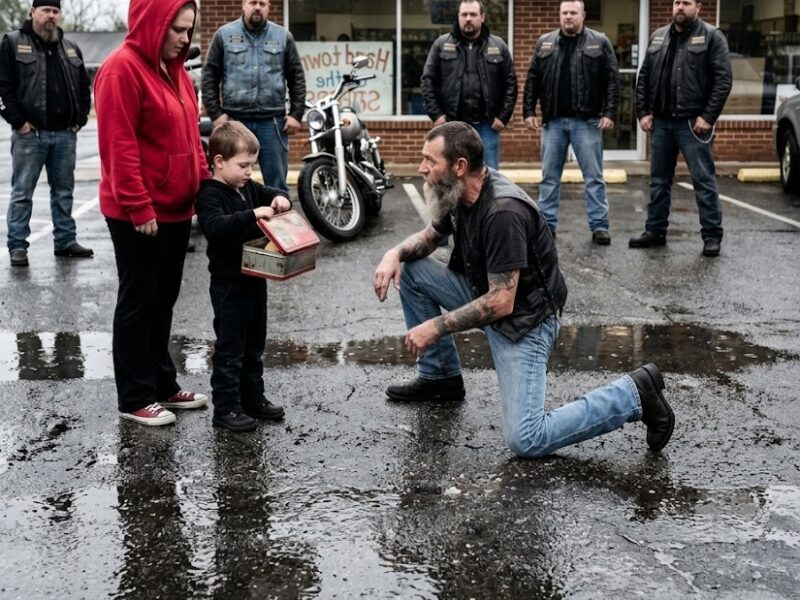
Fourteen months after that lunchbox came home untouched for the last time, 350 motorcycles rolled down a two-lane stretch of red Oklahoma hardpan in a column that raised dust you could see from the water tower.
The boy stood at a chain-link fence and counted them with his finger, moving his lips, losing track around 60, and starting over.
He had been waiting since before the sun cleared the roofline of the grain elevator.
He had something in his arms that nobody had asked him to carry, and he would not put it down for any reason, and nobody who saw his face that morning tried to make him.
The riders came in formation, throttle low, boots off the pegs, a noise like a long slow exhale rolling across the flatland.
Everybody in that county who had heard what the boy did at school the year before knew why they were here.
What nobody was prepared for—not the boy, not his grandmother, not the sheriff’s deputy who stood at the edge of the lot with her arms at her sides and her jaw locked because she would not cry in front of 350 strangers—was the reason the lead rider had chosen this particular road on this particular morning.
That part took a while to understand.
This is the story of how it got understood.
—
The morning the whole thing began was an ordinary Tuesday in late September, the kind of day that comes to that part of Oklahoma like a slow burn.
Air dry and copper-tinted, the sky a shallow bowl of blue with nothing kind in it.
Cash Dillard was 54 years old, and he had the hands of a man who had spent 30 of those years doing things to engines that engines resisted.
Three fingers on his left hand sat at angles that no knuckle should sit at.
The side of his neck carried a scar from a chain job gone wrong in the winter of 2009, a crescent of pale tissue that his collar covered in town and that everyone in the Long Mercy Riders had long since stopped noticing.
He was not a tall man, but he was a wide one.
Chest built like a hay bale.
Beard gone iron gray from jaw to sternum.
And when he walked into a room that did not know him, people made space without understanding why they did.
He had been road captain for the Long Mercy Riders for 21 years.
He had ridden point on runs through ice, through grief, through the kind of collective anger that turns a column of bikes into something that feels less like traffic and more like weather.
He did not ride for the look of it.
He rode because the road was the only place where the inside of his head went quiet.
—
The diner where it started was called Pearline’s and it sat at the junction of State Highway 34 and a county road with no name on the sign.
Just a number someone had spray painted over years ago.
Ilsa Crane ran the place.
She was 61 years old, had operated Pearline’s for 19 of those years under her own name despite the sign she had never bothered to change, and she had a memory for faces that her regulars called uncanny and that she called paying attention.
She knew who took their coffee black and who stirred it for 30 seconds without drinking it.
And she knew the difference between a man who was thinking and a man who was waiting for something he did not have a name for.
Cassius Drell came in on Tuesday mornings for the eggs.
He had done so for 11 years.
They were not friends exactly.
They were the kind of people who had learned each other’s silences and considered that sufficient.
He was on his second cup when the school bus stopped across the road.
It was 7:40 in the morning.
The light was coming in hard from the east, flat and orange, cutting through the plate glass at an angle that made everything on that side of the diner look like it was on fire.
There were seven kids who got off that bus.
Six of them ran.
One did not.
The one who did not was a boy, 7 years old, small even for seven, wearing a red jacket with a broken zipper that he held shut at the collar with his fist.
He stood at the edge of the gravel where the shoulder met the road, and he was looking at the lunchbox in his other hand, not at the road, not at the school bus pulling away.
At the lunchbox.
He stood there for what Cassius later counted as 90 seconds.
He knew because he watched the second hand on the clock above the register, not because he was timing the boy, but because he was trying to decide whether to move.
The boy looked at the lunchbox.
Then he sat down on the gravel, sat all the way down, cross-legged in the copper morning light, and put the lunchbox on his knees and looked at it, and did not open it.
Ilsa had already pushed through the counter gate.
She was across the road before Cassius got his boots under him.
He watched through the glass as she crouched beside the boy and said something.
The boy shook his head.
She said something else.
He shook his head again.
She did not reach for the lunchbox.
She sat down next to him on the gravel in her apron, and together they sat there, an old woman and a small boy in the hard morning light at the edge of Highway 34, and neither one of them opened anything.
Cassius left two dollars on the counter and walked out.
He did not run.
Running across a road toward a child you do not know is a way to make everything worse, and he understood that instinctively, the way a man understands which way a bike is going to fall.
He crossed the highway at a walk, hands loose at his sides.
The boy heard him coming and looked up.
His eyes were brown and very steady, the kind of steady that is not calm but is something a child builds when calm is not available.
The jacket zipper pull was broken.
Someone had replaced it with a twist of red wire.
“His name is Marcus,” Ilsa said without looking.
She said it in the way you give someone information they will need.
Cassius sat down on the gravel on the boy’s other side.
There was a pickup that slowed on the highway, the driver looking at the three of them.
An iron gray bearded man and an older woman sitting in the dirt with a small child between them.
The driver looked for a long time.
Then the pickup moved on.
“You don’t want to go to school,” Cassius said.
It was not a question.
Marcus looked at the lunchbox.
“I go,” he said.
“I just don’t open it there.”
Cassius waited.
“Why not?” he said.
“Because then it’s empty,” Marcus said.
“And I have to look at it all afternoon.”
Ilsa made a sound that was not quite a word.
Cassius looked at the lunchbox.
It was a blue one, the hard plastic kind with a clasp that had been repaired with electrical tape.
It had a cartoon of a rocket ship on the lid.
“Who packs it?” he said.
Marcus looked at his knees.
“My dad did,” he said.
He said it in the tense that tells you everything.
Cassius put his hands on his thighs and looked out at the flat red land and the sky going pale above the grain elevator and said nothing for a long time.
Then he said, “What’s in it today?”
Marcus said, “I don’t know. I never know.”
That was the thing.
He stopped.
Then he said, “Mom packs it now, but she doesn’t know what he put. So, I don’t open it because it won’t be the same, and I don’t want to know yet.”
He looked at Cassius directly then for the first time.
“Is that stupid?”
Cassius said, “No.”
He said it with the flatness of a man making a statement about the physical world, not reassurance, fact.
They sat a while longer.
The school bus was long gone.
Cassius looked at Ilsa.
She looked at him.
Between them, Marcus held the lunchbox on his knees with both hands.
“I’ll drive him,” Cassius said.
Ilsa nodded once.
She stood up, brushed the gravel from her apron, went back across the road and into the diner.
Cassius stood up and held out his hand.
Marcus looked at it, then he took it, and they crossed the highway together, the boy carrying the blue lunchbox against his chest, and Cassius did not ask him to put it in the truck bed, and Marcus did not offer.
The school was nine miles out on the county road.
Cassius drove it in the F-250 that he used for towing, the cab smelling of chain oil and the pressed cardboard scent of an old air freshener that had not freshened anything in two years.
Marcus sat with the lunchbox in his lap and looked out the window at the flat land going by.
“He died in April,” Marcus said about three miles in, not looking away from the window.
“That’s five months,” Cassius said.
“I know April,” Marcus said.
“Were you sad in April?”
“I’m sad in most months,” Cassius said.
Marcus appeared to consider this fair.
“The kids at school think I’m weird,” he said.
“For not opening it?”
“Let them,” Marcus said.
“My teacher thinks I’m not eating. She called my grandma.”
“Your grandma know why?” Cassius said.
“Yeah,” Marcus said.
“She cries. I don’t like that. So, I don’t talk about it there.”
He paused.
“I talk about it now because you’re not going to cry.”
Cassius kept his eyes on the road.
His jaw moved once, the way a jaw moves when a man is deciding something.
“Probably not,” he said.
Marcus seemed satisfied.
He held the lunchbox a little tighter for a moment, then relaxed.
They pulled into the school loop.
There was a teacher on morning duty at the door, a young woman with a clipboard, and she watched the truck with an expression that moved from neutral to uncertain when Cassius stepped out, because a man his size with a beard that covered his collar and a neck scar and no-color eyes tended to produce that expression.
He walked around to the passenger side and opened the door.
Marcus climbed down with his lunchbox.
He stood on the asphalt and looked up.
“It was peanut butter and banana,” he said.
That was his thing.
“Every time,” Cassius said.
“I know that combination.”
Marcus looked at the school doors, then he looked back.
“You don’t have to do anything,” he said.
“I didn’t ask for anything.”
“I know,” Cassius said.
Marcus walked into the school.
The teacher with the clipboard watched the truck pull away and wrote something down.
Cassius drove back to the highway.
He stopped in the lot at Pearline’s and sat with the engine running for a while.
Then he went inside and told Ilsa what the boy had said.
She listened without interrupting, refilling his cup twice, though it did not need it.
When he finished, she said, “His dad was Danny Ketrick. He was in here every Friday.”
She set the pot down.
“Peanut butter and banana, every Friday on toast.”
Cassius looked at the counter.
Outside, the morning had gone full and ordinary.
The light no longer copper, but the flat bleached white of a working day.
“Find out who his mother is,” he said.
Ilsa said, “Sandra Ketrick. She’s doing night shifts at the poultry plant in Alva. Her mother, Evie, keeps Marcus.”
“I need Evie’s number,” Cassius said.
Ilsa already had it.
She wrote it on the back of a receipt and set it in front of him.
He folded it and put it in his chest pocket and finished his coffee and left.
He was three miles down the highway before he understood why he had not hesitated.
He had a boy of his own once.
His name was Theo.
He had died six years ago at the age of 17 in a way that Cassius had never described to anyone in the club and that he would not describe now.
And what he felt that morning on the gravel at the edge of Highway 34 watching Marcus look at a lunchbox he could not open was the exact shape of a thing he had been carrying since Theo’s last morning, which was the morning Cassius had put a sandwich in a bag and left it on the counter, and Theo had walked past it without taking it, and Cassius had let him go.
He called Evie Ketrick that afternoon from the shop parking lot.
She picked up on the second ring, voice careful in the way of a woman who had learned to be ready for bad news.
He told her his name and who he rode with and that he had driven Marcus to school that morning.
There was a pause.
“He talked to you,” she said, not a question.
“Enough,” Cassius said.
Another pause.
“He hasn’t talked to anybody,” she said.
“Not his teacher, not the grief counselor they sent from the district, not me, not Sandra.”
Her voice stayed steady.
He gave her credit for it.
The lunchbox, he said.
I know about the lunchbox, Evie said.
I know he doesn’t open it.
I’ve been packing it every day for five months because Sandra can’t yet.
I don’t know what to put in it.
She stopped.
Then she said, I put in what I think Danny would have.
But I don’t know what Danny put.
I never asked.
Cassius said, peanut butter and banana.
Silence on the line.
Then a sound that was not crying, but was the thing just before crying.
Every time? Evie said.
That was his thing.
I’ll tell Sandra.
Cassius said, there’s something else I want to do if you’ll let me.
I need to talk to some people first.
Can I call you Thursday?
Evie said, yes.
He said, do you know if Marcus has ever seen a large motorcycle run?
Evie said, his dad used to take him to watch the highway from the overpass when the runs came through in summer.
He’d count them.
Cassius was quiet a moment.
I’ll call Thursday, he said, and hung up.
And called his sergeant-at-arms, whose name was Roland Fitch, and talked for 40 minutes.
Roland Fitch was 58 years old and had been with the Long Mercy Riders for 23 years.
He had a face like eroded sandstone and a voice he had to pitch up to reach conversational because his default register was a murmur that people in quiet rooms sometimes had to ask him to repeat.
He handled logistics for the club the way an air traffic controller handles a crowded sky with a quality of attention that looked like stillness, but was actually total concentration.
When Cassius finished explaining, Roland was quiet for a moment.
Then he said, how many do you want?
Cassius said, as many as will ride.
Roland said, “When?”
“Fourteen months,” Cassius said.
“I want to give Sandra time to be ready. I want Marcus to be eight.”
Roland said, “That’s a long plan for a Tuesday. He’s been carrying that lunchbox for five months.”
Cassius said, “He can wait 14 more if we’re going to do this right.”
Roland said, “All right. I’ll start working the chapter network.”
He paused.
“What’s the number we’re announcing?”
“We don’t announce it,” Cassius said.
“We see how many come.”
The call ended.
Cassius sat in the truck outside the shop.
The sun was going down behind the grain elevator and the light was long and amber and very quiet.
He thought about Theo and the sandwich on the counter and how he had watched his son walk out the door and had thought, I’ll ask him tonight.
We’ll talk tonight.
And he had said nothing and done nothing and tonight had not come.
He thought about a blue plastic lunchbox with a rocket ship on the lid.
He did not go back inside.
He drove out to the highway and rode point on a training run for the newer members until the dark came in full because that was the thing the road was for.
—
The 14 months were not quiet.
Cassius drove Marcus to school seven more times that fall, always on Tuesdays, always because he was passing by on the county road, which was a lie both of them understood and neither of them acknowledged.
In October, Marcus told him that the school counselor had started a lunch group for kids who had lost a parent.
He went twice, he said, and then stopped.
“Why?” Cassius said.
“They made us draw pictures,” Marcus said, “of the person.”
He looked out the window.
“I don’t want to draw him. I want to remember him.”
Cassius said, “Then don’t draw.”
Marcus said, “She said it was healthy.”
“A lot of people are wrong about what’s healthy,” Cassius said.
Marcus looked at him.
“What do you do?” he said.
Cassius said, “I ride.”
Marcus thought about this.
“That’s not drawing.”
“No,” Cassius said, “it’s not.”
By November, Ilsa had begun keeping a peanut butter and banana sandwich in the case on Tuesday mornings.
She did not offer it to anyone in particular.
She set it there, and if Marcus happened to come in with Cassius after the ride to school, it was available.
Marcus ate it three times before Christmas.
He did not comment on it.
Ilsa did not ask him to.
Cassius watched this from his stool and said nothing, and drank his coffee, and thought about Roland and the calls going out through the chapter network, the Long Riders’ Mercy into the bordering states through the cold months.
Chapter by chapter, the message plain and without sentimentality, the way Roland communicated everything.
“There’s a boy in Garfield County who lost his dad in April. His dad used to count bikes from an overpass. We’re going to come to him. Tell us who’s riding.”
By January, the number Roland had was 212.
By March, it was 291.
By the following August, 14 months after the Tuesday on the gravel at Highway 34, the confirmed number stood at 347, with more calling in through the week.
Sandra Ketrick had been told.
Evie had cried.
Sandra had not, which Evie reported to Cassius as significant in a way that only someone who loved Sandra would understand.
“She’s ready,” Evie said.
“She hasn’t been ready for anything in a year, and now she is.”
The school had been contacted through a member who had a nephew on the district board and permissions had been granted without complaint.
The route was filed with the county sheriff’s department and the deputy who processed the paperwork was a woman named Ardith Blaine who had dispatched emergency calls in this county for 16 years and who had heard the Long Mercy Riders name in connection with things that were not always kind.
And who read the stated purpose of the permitted route three times before she walked it down to the sheriff and set it on his desk and said, “You need to look at this.”
The sheriff looked.
He approved it in four minutes and authorized a county escort, which he had never offered the Long Mercy Riders in 20 years of operations.
Cassius got the call from Roland about the escort at 6:00 in the morning of the ride day and sat with it for a moment.
Then he said, “Tell them thank you. Tell them to stay back and let us set the pace.”
Roland said, “Already did.”
—
The morning of the ride was a Saturday in November.
The sky low and pewter.
The air carrying that particular flatland cold that comes not from wind, but from the sheer unobstructed distance the temperature has traveled.
Cassius was on his bike by 5:30.
Not the F-250, not the tow rig, his road bike.
A machine he had put 112,000 miles on.
A bike the color of old iron that ran quieter than any bike its age had a right to because he had spent 30 years maintaining engines and this one he treated the way some men treat the last thing they have left that still works.
He rode to the staging area, a wide gravel lot behind the county fairgrounds that Roland had arranged and when he got there the lot was already filling.
He sat on his bike at the entrance and watched them come in, headlights in the dark.
The sound of it building.
Not a roar.
Something older than a roar.
At 6:45, Roland came to the entrance on foot and stood beside him.
“Current count?” Cassius said.
“350,” Roland said.
“Give or take nobody because I counted twice.”
Cassius looked at the lot.
Bikes as far as the fairground fence.
Riders standing in the gray pre-dawn.
Breath visible.
Talking low.
Checking straps and mirrors.
“He’s going to lose count,” Cassius said.
Roland said, “He can start over.”
They lined up at 7:00.
The column stretched back through the lot and out onto the county road.
Cassius pulled to the front.
He sat at the head of 350 machines and let the engine idle under him and looked at the pewter sky going lighter at the edge.
The first thin color of a November morning coming in low over the flat land.
And he thought of Theo once.
Clearly and with the new quality he had learned for that thinking.
Which was not the ripping open it used to be.
But was instead something closer to the way a man presses a scar to remember what it cost.
He thought of a boy on gravel holding a blue lunchbox.
He gave the signal.
The column moved.
The school was nine miles from the fairgrounds.
The Long Mercy Riders took 17 minutes to cover it.
Cassius holding the pace low.
And the column so long that when his bike reached the school lot, the tail end was still leaving the fairgrounds.
The school stood at the end of a straight county road.
And the sound arrived before the lights did.
Cassius heard afterward from Ardith Blaine that it reached the school windows four minutes before the column was visible.
He heard that classrooms went quiet.
He heard that two teachers went to the windows and a third stood in the hall and did not bother pretending she had a reason to be there.
The principal, a compact man named Delores who wore the expression of someone chronically underfunded and overextended, had been briefed and stood at the front entrance with his arms crossed, which was his posture for uncertainty.
The county escort followed the tail of the column at a distance, lights on, doing the thing that Cassius had asked, which was staying back and letting the riders set the pace.
Marcus was at the chain-link fence at the edge of the school lot.
He was wearing the red jacket.
The zipper had been repaired, not with a twist of red wire anymore, but with a proper pull, chrome, the kind a parent puts on a jacket when they decide the jacket is going to last.
Sandra Ketrick stood 15 feet behind him with Evie, both of them in winter coats.
Sandra had her arms wrapped around herself.
She was watching her son at the fence.
She was not watching the road.
She was watching Marcus.
He had the lunchbox under his arm, the same blue one, rocket ship on the lid.
The electrical tape repair on the clasp had been replaced, also recently, with a small hinge of polished brass that someone had fitted by hand.
He held it against his side and raised his other hand to the fence and began to count with his finger.
The column came in at a low rumble, Cassius at the point, the iron gray bike rolling into the lot with the kind of deliberate slowness that only a powerful machine at full control can manage.
He stopped at the fence.
He cut the engine.
Behind him, one by one in a slow wave rolling back 350 bikes, engines cut, and the silence that built was so gradual and so total that when it was complete, it sounded like something had been placed gently over the world.
Marcus had lost count around 60.
He started over.
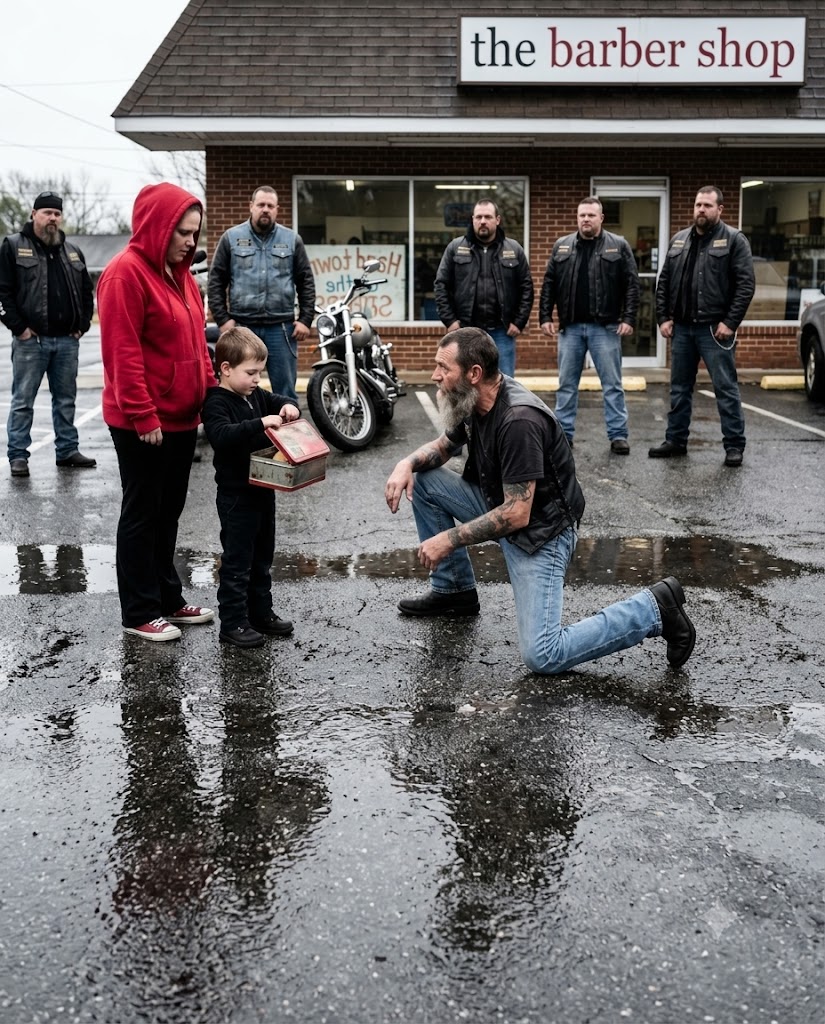
He was still counting, finger moving, lips moving when Cassius stepped off the bike and came to the fence and crouched down so they were at the same height.
“Morning,” Cassius said.
Marcus said, “I lost the count. I have to start again.”
“We’re not going anywhere,” Cassius said.
Marcus counted.
He got to 80 and lost it and started again.
The third time he made it to 140 before losing track and he pressed his forehead to the chain link and breathed.
“Too many,” he said.
He did not say it with frustration.
He said it the way a person says something that is also an astonishment.
“350,” Cassius said.
Marcus lifted his head from the fence.
He looked at the lot at the column stretching back down the county road as far as the bend at 350 riders sitting on their machines in the November cold and not one of them moving, not one of them revving, just sitting.
He looked a long time.
Then he looked at Cassius.
“For my dad,” he said.
“For your dad,” Cassius said.
“And for you.”
Marcus looked down at the lunchbox under his arm.
He was quiet for a moment, the kind of quiet that has work going on behind it.
Then he brought it out from under his arm and looked at the lid, the rocket ship, the polished brass clasp.
He put his thumb on the clasp.
He looked at Cassius.
“Will it be different?” he said, not asking permission, not asking for comfort, asking a real question, the kind a child asks when they understand that the answer is yes and they want someone to agree to face it with them.
Cassius said, “Yeah.”
He said it level.
“Will you still know it’s from him?”
Marcus said, “Even if it’s different.”
Cassius thought about a sandwich on a counter and a door that closed and 17 years of a person who was no longer a person in the physical world and who was nevertheless entirely present in the way that people who are gone are present, which is completely and painfully and also in time with a tenderness that does not diminish with years but changes quality the way iron changes in fire.
And he said, “You’ll know. You’ll always know.”
Marcus pressed the clasp.
The lunchbox opened.
Inside, in a small wax paper parcel, was a peanut butter and banana sandwich cut on the diagonal the way Danny Ketrick had always cut it.
Sandra had made it that morning.
Evie had told her how.
Marcus looked at it for a long time.
Then he looked up at 350 riders sitting in the November cold on a county road in the red dirt plains of Oklahoma and none of them moved and none of them looked away.
Principal Delores had come off the front step.
He was standing in the lot with his arms no longer crossed.
He did not speak.
Ardith Blaine in the county cruiser at the back of the column had both hands on the wheel and was looking through the windshield at a distance that was not the road.
Roland Fitch was 11 bikes back from point and Roland Fitch, who had murmured his way through 23 years of this club without raising his voice for anything, made a sound that the rider beside him would describe later as something between a word and a note.
Not a word in any language, just the sound a person makes when they are full.
Marcus closed the lunchbox.
He looked at Cassius.
“Thank you,” he said.
And Cassius, who had ridden point for 21 years and had never been undone by distance or weather or grief or the thing that had happened to Theo or any of the 112,000 miles behind him, felt his jaw go tight in the way it went tight and looked at the boy and said, “Your dad knew how to pack a lunch.”
Marcus looked at the lunchbox.
A small sound came out of him that was the first laughter Evie had heard from him in 14 months, and she said so later, and she said it quietly, and she only said it once.
—
What came after was not fast and not simple because the things that matter are never fast and never simple.
A fund was established in Danny Ketrick’s name through the club’s community account, administered through the county extension office, earmarked for families in Garfield County who had lost a primary earner within the preceding two years.
The first disbursement went out six weeks after the ride.
By the end of the first year, it had reached 11 families.
The club filed the ride as an annual permitted event under the county calendar, and the second year’s confirmed count was 406.
The third year, 471.
Ilsa Crane added peanut butter and banana on toast to the Pearline’s regular menu.
She did not give it a name on the menu.
She described it as a house special and charged $3.50 and donated the proceeds every Tuesday to the fund.
The blue lunchbox with the rocket ship on the lid was retired.
Sandra kept it on the shelf above the kitchen window, which faced east, and in the mornings, the light caught the polished brass clasp and held it for 20 minutes before moving on.
Marcus Ketrick turned eight, then nine, then 10.
He opened every lunchbox after that.
Not right away, not without a moment of looking at the lid first.
A habit that would stay with him longer than childhood, but he opened them.
He grew tall faster than anyone expected.
He came to Pearline’s on Tuesdays sometimes.
Not every week.
Sometimes with his grandmother.
He ate at the counter.
He drank chocolate milk and did not say much.
And when he did say something, it was concrete and exact in the way of a child who had learned early that words were for real things.
He knew Cassius by Tuesday mornings and by the sound of the F-250.
And he did not make a production of the knowing, which suited Cassius precisely.
Cassius rode point for the Long Mercy Riders for four more years after the first ride before handing the position to Roland Fitch, who accepted it with a murmur that might have been gratitude.
Cassius still rode.
He still rode that iron gray bike with 112,000 miles on it and then more miles because a well-maintained machine does not stop being useful at any particular number.
He rode to clear the inside of his head.
He rode on mornings that were too cold for most and on evenings that went dark too fast for comfort.
He rode sometimes to the overpass on State Highway 34, the one Marcus had told him about, the one where Danny Ketrick had taken his son to count bikes from above.
He would stop there on slow days and look out at the flat red land and the long straight road going south.
And he would think about Theo with the new quality, the fire-changed iron quality.
And he would think about a boy on gravel who had sat down with a lunchbox and waited for someone to sit down with him.
And he would feel the weight of what had been possible and what had been done and what it had cost and what it had returned and he would give it the silence it deserved before he put the bike in gear and rode on.
The Danny Ketrick Memorial Ride ran for seven consecutive years before it was formally adopted by the county as a recognized community event.
The year it was adopted, the confirmed rider count was 512.
The county put a small sign at the entrance to the school lot.
It read, “In memory of those who packed the lunch.”
Nobody had suggested that wording.
It appeared on the sign as if it had always been there.
—
You spend your life making judgments at distance, measuring a man by his size, his volume, his surface, the way fear teaches you to before experience can teach you better.
And then a bearded road captain sits down in the gravel at the side of a highway next to a boy with a lunchbox and does not say the right thing and does not do the impressive thing and does not reach for the clasp and you understand that the loudest machines on the road can move in silence.
And that the gentlest act in a year of grief is sometimes just this, sitting down and staying until the person beside you is ready to open what they have been holding.
That understanding did not arrive in a single moment for most people who witnessed it.
It arrived the way the light arrived on those November mornings, incrementally, from the edge, changing what it touched before you noticed it was changing.
Ardith Blaine was the first person outside the club to say it plainly.
She said it to the sheriff six days after the first ride, standing in the parking lot of the county building with a cup of coffee she had forgotten to drink.
She said, “They came for a kid they didn’t know because someone sat in the dirt with him for 90 seconds.”
The sheriff looked at her.
She said, “That’s what 350 people showed up for. 90 seconds of someone sitting down.”
The sheriff thought about it.
He said, “Sounds about right.”
She drank the cold coffee.
She attended every subsequent ride as a private citizen, not in the cruiser, not in uniform.
She rode with a friend who had a passenger seat.
She told Cassius this at the fourth annual ride, standing near the chain-link fence in the early cold, and Cassius said, “We’re glad to have you.”
She said, “I had you figured wrong.”
He said, “Most people do.”
She said, “I know. I’m a professional. I should have known better.”
Cassius looked at the lot filling with machines.
He said, “You came. That’s the correction right there.”
She did not answer that because there was nothing to add to it, and she understood from his delivery that he was not looking for her to add anything.
Delores, the school principal, became a quiet advocate for the fund.
He was not a man of large gestures.
He was a man of paperwork and procedural persistence, and in that mode he was formidable.
He wrote three successful grant applications in the first two years that doubled the fund’s annual disbursement capacity.
He never spoke publicly about why he cared about it.
He had lost his own father young, a fact he had not shared with his staff or his school board, and he did not share it now.
He shared it with Marcus one afternoon when Marcus was nine and had been sent to the office for something minor and was sitting outside the principal’s door waiting.
Del came out and sat down beside him on the bench in the hallway.
He said, “I was eight.”
Marcus looked at him.
Del said, “When I lost mine.”
Marcus nodded slowly.
He thought about it.
Then he said, “Did it get different?”
Del said, “It got different.”
Marcus looked at his shoes.
“Not easier,” he said.
“Not a question,” Del said.
“Different is its own thing.”
“It doesn’t need to be easier to be worth having.”
Marcus sat with that for a moment.
Then he said, “Okay.”
He said it in the way children say, “Okay,” when they mean, “I will remember this and carry it.”
Del sent him back to class and sat in the hall for a minute by himself.
It was the longest minute of the school week, and he did not begrudge it.
Sandra Ketrick came to the third annual ride and stood not behind Marcus at the fence, but beside him, her hand on the top watching the column come in.
She had finished the night shifts at the poultry plant by then.
She had taken a position as a dispatch coordinator for a freight company in Enid, day hours, home by 5:00.
She looked steadier than she had looked in two years, which Evie reported to Cassius not as a declaration, but as an observable fact, the way Evie reported everything, with the precision of a woman who had survived enough to know the difference between hope and evidence.
Sandra did not speak to Cassius at the third ride, not directly.
She looked at him across the lot when the engines went quiet, and she nodded once.
He nodded back.
That was the whole of it.
It was enough.
It was exactly enough.
—
There was a Thursday in the spring of the fourth year when Cassius stopped at Pearline’s on a morning that was not a Tuesday, which was unusual.
He came in at 9:30, the diner mostly empty.
The light coming in from the south windows warm and unremarkable.
Ilsa set his coffee down without being asked.
He drank it looking at the counter.
After a while he said, “I went to the overpass this morning.”
Ilsa said, “How was it?”
He said, “Quiet.”
“Good quiet.”
She refilled his cup.
“I thought about Theo,” he said.
He had not said the name out loud to anyone at Pearline’s in 11 years of Tuesday mornings.
Ilsa did not react with the sudden careful attention people deploy when a name like that surfaces.
She just listened, which was the right thing.
He said, “I used to think about him the way you think about something you dropped and heard shatter. All aftermath. All broken parts.”
He turned the cup on the counter.
“Now it’s more like I know where he is. He’s in the things I do when I don’t hesitate.”
He stopped.
Ilsa said, “Good place for him.”
Cassius looked at the menu board.
The house special listed plain and without flourish.
$3.50.
Proceeds Tuesdays to the fund.
He said, “Danny Ketrick never met me and I never met him. But we packed the same lunch.”
He said it as if he were identifying something in a field guide, naming a thing that had been present for a while without a name.
Ilsa set the pot down.
She did not say anything for a moment.
Then she said, “I’ll put it on the tab.”
He paid the tab as he always did and walked out into the spring morning where his bike sat in the lot with 119,000 miles on it.
Iron gray in the warm south light, patient as the land itself.
He put on his gloves.
He swung over the seat.
He looked out at Highway 34 going flat and straight toward the overpass and the school and the county road and all the distances he had covered and would cover and he started the engine and the sound it made was not loud.
It was the low even note of a machine that knew its work.
He rode.
—
Three hundred fifty times the flat red country had sent that sound rolling ahead of something worth rolling toward and it would again and it would again and that sound which you have heard your whole life and told yourself was only noise was never only noise was in fact the specific frequency of people refusing to let a child sit alone on gravel in the cold light of a morning with a lunchbox he could not yet open by himself.
The first year after the ride, Marcus asked Evie if he could write a letter to the riders.
He was eight years old and his handwriting was still large and uneven, the letters leaning into each other like they were holding hands.
Evie gave him a sheet of lined paper and a blue pen and he sat at the kitchen table for 40 minutes.
When he was done, he folded the paper in thirds and put it in an envelope and asked Evie to address it to the Long Mercy Riders, care of Roland Fitch, because Roland was the only name he knew besides Cassius and he did not want to bother Cassius with something this small.
Evie addressed it and mailed it and did not read it first, which she later described as one of the harder decisions of her life.
The letter reached Roland Fitch 11 days later.
He opened it in his garage, sitting on a stool beside his bike, because that was where he opened things that mattered.
It said:
“Dear Long Mercy Riders, Thank you for coming to my school. I counted 350 but I lost track three times so I am not sure. My dad used to take me to the overpass to count and I always lost track there too. He said that was okay because the number was not the point. I did not understand that before. I think I understand it now. The sandwich was peanut butter and banana. My mom made it. It was good. I ate it. Thank you for sitting with me. Marcus Ketrick.”
Roland read it twice.
Then he folded it and put it in the inside pocket of his riding jacket, where it stayed for the next six years, through rain and heat and the long winter rides, until the paper went soft at the creases and the ink began to fade and Roland finally took it out and put it in a frame and hung it in the clubhouse above the bar, where it stayed.
Nobody asked him to frame it.
He just did.
The clubhouse had a wall of photographs from runs going back 30 years.
Men and machines and miles of highway and the particular flat light of the plains in every season.
Roland cleared a space in the middle of the wall, at eye level, and hung the letter there.
Members would stop and read it sometimes, not saying anything, just reading and then moving on.
It became a kind of quiet landmark, a thing that was always there and that nobody needed to explain.
—
The second year, a chapter out of Kansas called Roland and asked if they could participate.
Roland said yes.
The third year, chapters from Missouri and Arkansas called.
Roland said yes.
The fourth year, a chapter out of Texas called, and Roland said yes, and the ride grew past 500 for the first time.
The fifth year, a woman named Corinne Devereaux called Roland from a chapter in Louisiana.
She was 47 years old and had been riding for 20 years and she had heard about the ride through a friend of a friend.
She said, “I lost my son in 2019. He was 12. He used to pack his own lunch because he liked to do it himself. He cut his sandwiches in triangles, not squares, because he said triangles tasted better.”
Roland listened.
She said, “I don’t want to make this about me. I just want to ride. I want to be part of something that makes sense.”
Roland said, “You’re welcome to ride.”
She said, “What do I need to do?”
Roland said, “Show up.”
She showed up.
She rode the 700 miles from Baton Rouge to Garfield County on a 2016 Indian Scout with a cracked windshield and a seat that had been reupholstered twice.
She arrived at the fairgrounds at 5:45 in the morning, cold and tired and not complaining.
Roland found her at the edge of the lot and asked her if she wanted coffee.
She said yes.
They sat on the tailgate of Roland’s truck and drank coffee from a thermos and did not say much.
After a while she said, “My son’s name was Eli.”
Roland said, “I’ll remember that.”
She said, “I know you will.”
She rode with the column that year and every year after that.
She never spoke at the ride.
She never asked for anything.
She just showed up and rode and then went home.
Cassius noticed her the second year she came and asked Roland who she was.
Roland told him.
Cassius said, “She rides point-position clean.”
Roland said, “She does.”
Cassius said, “Keep her close.”
Roland said, “Already do.”
—
The fund grew.
By the fifth year, it had disbursed over $47,000 to families in Garfield County and the surrounding counties.
The money went to rent and groceries and utility bills and school supplies and the kind of ordinary expenses that become impossible when a primary earner dies and the surviving parent is trying to hold everything together with both hands.
The fund did not pay for funerals or headstones or the big dramatic expenses that people expect.
It paid for the electric bill in February when the heat had been running too long.
It paid for new tires on a car that had to get a kid to school.
It paid for a winter coat that was the right size and did not have a broken zipper.
Evie Ketrick administered the fund through the county extension office.
She was 67 by then and had the kind of organizational mind that made paperwork feel like a form of care.
She kept a ledger in a green spiral notebook and recorded every disbursement in handwriting that was small and precise.
She never missed an entry.
She never missed a Tuesday at Pearline’s either, where she had started coming for the house special and stayed for the coffee and the quiet.
She and Ilsa had become something like friends, which was a word neither of them used but both of them understood.
They sat together at the counter on Tuesday mornings and talked about nothing in particular and that was enough.
—
Marcus turned 12 in the spring of the sixth year.
He was tall for his age by then, all elbows and knees, with his father’s steady brown eyes and his mother’s habit of looking at things for a long time before saying anything about them.
He had not been to the overpass in years.
He had not needed to.
He carried his father in other ways, in the way he cut his sandwiches on the diagonal, in the way he checked the clasps on things before he closed them, in the way he stood at the edge of a room and watched before he decided to enter it.
He asked Cassius once, when he was 11, why he had sat down on the gravel that morning.
Cassius thought about it for a long time.
They were at Pearline’s, Marcus with a chocolate milk, Cassius with his coffee.
The light was coming in from the south, ordinary and warm.
Cassius said, “Because you were sitting.”
Marcus said, “That’s not an answer.”
Cassius said, “It’s the only answer I have.”
Marcus looked at him.
He said, “You could have just driven by.”
Cassius said, “Yeah.”
Marcus said, “Why didn’t you?”
Cassius said, “Because I knew what it looked like when somebody sat alone with something they couldn’t open.”
Marcus was quiet.
Then he said, “Theo.”
Cassius did not flinch.
He said, “Theo.”
Marcus said, “I’m sorry.”
Cassius said, “Don’t be. He was here. That’s the part that matters.”
Marcus drank his chocolate milk.
He said, “I think my dad would have liked you.”
Cassius said, “I think I would have liked him.”
Marcus said, “He was funny. He told jokes that didn’t make sense. He laughed at them anyway.”
Cassius said, “That’s the best kind.”
Marcus said, “Yeah.”
They sat there for a while and did not say anything else and that was enough.
—
The seventh annual ride was the largest yet.
Five hundred twelve bikes.
The county had adopted the event by then and there was a small sign at the entrance to the school lot that said, “In memory of those who packed the lunch.”
Nobody had suggested that wording.
It had appeared on the sign as if it had always been there.
The sheriff’s department provided a full escort, not just a single cruiser, and the county commissioners had started referring to the ride in their meeting minutes as a “community asset,” which was the highest compliment a county commissioner could pay to anything.
The ride had become something that people planned their fall around.
Motels in Enid and Woodward booked out weeks in advance.
Restaurants in the county saw their biggest day of the year.
The fund had grown past $60,000 and had helped more than 40 families.
The ride had become bigger than Danny Ketrick.
It had become bigger than Marcus.
It had become bigger than the Long Mercy Riders.
It had become a thing that belonged to the county, to the flat red land and the long straight roads and the people who lived there and understood that grief is not a thing you get over but a thing you carry and that the carrying is easier when you do it together.
Cassius was 61 by then.
He had handed the road captain position to Roland four years earlier and had settled into a role he described as “just another rider” which everyone in the club knew was a lie because Cassius would always be point, would always be the one people looked to when the column needed to know what to do.
He still rode the iron gray bike.
It had 187,000 miles on it by then and ran as quiet as it had the day he’d first sat on it.
He had replaced the engine once, rebuilt the transmission twice, and had a standing arrangement with a machine shop in Enid that had been making parts for him since 2009.
The bike was not a machine anymore.
It was a part of him.
He rode it to the overpass sometimes, on mornings when the light was right and the road was empty, and he would sit and look out at the land and think about Theo and about Danny Ketrick and about Marcus and about all the things that had happened and all the things that had not.
He did not think about the things that had not anymore.
He had stopped doing that.
He thought about what was.
He thought about the boy on the gravel and the lunchbox and the 350 riders and the silence that had been so complete it sounded like something had been placed gently over the world.
He thought about the sign at the school and the letter in the frame at the clubhouse and the green spiral notebook where Evie kept the ledger.
He thought about all of it and he felt something that was not quite peace but was close to it, was maybe the thing that comes after peace, the thing that is just the quiet knowledge that you did something that mattered and that it mattered because you did it and not because anyone saw you do it.
He started the bike and rode home.
—
The eighth year, Marcus was 15 and had his learner’s permit.
He had saved up $2,000 from working at a feed store in Enid and had bought a 2004 Honda Shadow that was not pretty but ran well and that he maintained himself with the help of a manual and the occasional phone call to Cassius.
He rode it to Pearline’s on a Tuesday morning in October, the first cold morning of the fall, and parked it in the lot next to Cassius’s truck.
He walked in wearing a jacket that zipped properly and sat down at the counter next to Cassius and ordered a chocolate milk.
Cassius looked at him.
He said, “You rode.”
Marcus said, “I rode.”
Cassius said, “How was it?”
Marcus said, “Cold.”
Cassius said, “That’s October.”
Marcus said, “I know.”
They sat for a while.
Ilsa set a peanut butter and banana sandwich on the counter in front of Marcus, the house special, no charge.
Marcus looked at it.
He said, “You still make these.”
Ilsa said, “Every Tuesday.”
Marcus said, “For me?”
Ilsa said, “For whoever needs one.”
Marcus looked at the sandwich.
Then he picked it up and took a bite and chewed and swallowed and said, “It’s good.”
Ilsa said, “I know.”
Cassius drank his coffee.
He said, “You know how to cut it?”
Marcus said, “Diagonal.”
Cassius said, “Good.”
Marcus ate his sandwich.
He said, “I’m going to ride in the memorial this year. Not just watch.”
Cassius said, “I know.”
Marcus said, “How do you know?”
Cassius said, “Because you’re here on a Tuesday with a bike.”
Marcus said, “That’s not an answer.”
Cassius said, “It’s the only answer I have.”
Marcus laughed.
It was the first time Cassius had heard him laugh out loud and it was a good sound, a full sound, the sound of a kid who had learned that laughter was still possible and had decided to do it.
They finished their coffee and their sandwich and walked out to the lot together.
Marcus got on his bike and started it and the sound it made was small and a little ragged, the sound of a machine that was still learning itself.
Cassius got in his truck and started it and the sound it made was low and even and patient.
They pulled out of the lot at the same time, Marcus turning left toward Enid, Cassius turning right toward the shop.
They did not wave.
They did not need to.
—
The eighth annual ride was the year Marcus rode.
He was 15 years old and he had his mother’s permission and his grandmother’s blessing and a bike that was not pretty but ran well.
He lined up at the back of the column, which was where the newer riders lined up, and he sat on his machine in the November cold and watched the 500-plus bikes ahead of him and felt something he had not felt before, which was the particular feeling of being part of something that was larger than yourself and that you had earned your place in.
Sandra and Evie stood at the fence at the school lot, where they had stood every year, and watched the column come in.
Sandra had stopped crying years ago.
Evie had not.
Evie cried every year, quietly, at the moment the engines went silent, and she did not apologize for it and nobody asked her to.
Marcus rode into the lot with the column and cut his engine with the rest of them and sat there in the silence that built and built until it was complete.
He looked at the school.
He looked at the fence.
He looked at his mother and his grandmother standing there.
He looked at the place where he had sat on the gravel 14 months after his father died with a lunchbox he could not open.
He looked at it and he did not feel the thing he had felt then.
He felt something else.
He felt the thing that comes after grief, which is not the absence of grief but the integration of it, the way a scar becomes part of the skin and stops being a wound and starts being a map of where you have been.
He got off his bike and walked to the fence.
His mother hugged him.
His grandmother hugged him.
He stood with them and watched the rest of the column come in and he did not count.
He had stopped counting years ago.
The number was not the point.
It had never been the point.
—
The ride continued.
Year nine, year ten, year eleven.
The fund grew past $100,000.
The county renamed the county road that led to the school after Danny Ketrick, which was a thing that had never happened before for anyone who had not been a sheriff or a commissioner or a state legislator.
The sign at the school lot was joined by a second sign, a small bronze plaque mounted on a post, that read: “Danny Ketrick Memorial Ride. Founded by the Long Mercy Riders. In honor of all who have packed a lunch for a child they loved.”
Marcus graduated from high school and went to college at Oklahoma State and studied mechanical engineering, which surprised no one who knew him.
He worked summers at a machine shop in Stillwater and came home for the ride every year.
He rode his Honda Shadow until it died and then bought a used Sportster and rode that.
He kept the blue lunchbox with the rocket ship on the lid on a shelf in his dorm room and then his apartment and then his first house.
He did not open it.
He did not need to.
It was not a thing to be opened.
It was a thing to be kept.
Cassius got older.
He was 68 when Marcus graduated from college and 70 when Marcus got married and 72 when Marcus had his first child, a boy named Daniel, after his grandfather.
Cassius held the baby at the hospital, which was a thing he had not expected to do and had not prepared for, and he looked down at the small face and the small hands and the small everything and he said, “Hey, Danny.”
Marcus said, “You don’t have to call him that.”
Cassius said, “I know.”
Marcus said, “I want you to.”
Cassius looked at the baby.
He said, “I’ll teach him to ride.”
Marcus said, “I know you will.”
Cassius said, “I’ll teach him to pack a lunch.”
Marcus said, “I know you will.”
Cassius handed the baby back to Marcus and walked out of the hospital and sat in his truck in the parking lot for a while.
He thought about Theo.
He thought about the sandwich on the counter and the door that closed and the 17 years that had ended too soon.
He thought about Marcus on the gravel with the lunchbox and the 350 riders and the silence that had been so complete it sounded like something had been placed gently over the world.
He thought about all of it and he did not cry and he did not need to.
He started the truck and drove home.
—
The Danny Ketrick Memorial Ride ran for 25 consecutive years before Cassius Dillard died.
He was 79 years old and he died in his sleep on a Tuesday morning in September, which was the same day of the week and the same month as the morning he had first seen Marcus on the gravel at the edge of Highway 34.
He had ridden the memorial ride every year until the year he died.
He had been at the front of the column for 21 of those years and at the back for the last four, because he said he wanted to see the whole thing from behind, wanted to watch the column stretch out and know that it was still there and still growing and still moving.
He had been at the front of the column the year before he died, at 78, on a bike that had 300,000 miles on it and that he had rebuilt so many times it was more a record of his hands than a machine.
He had ridden point one last time and had led the column into the school lot and had cut his engine with the rest of them and had sat in the silence and had looked at the fence and the sign and the plaque and the people and had felt the thing he had been feeling for 25 years, which was not pride and not satisfaction and not even peace, but was something closer to the simple knowledge that he had done what he had set out to do and that it had mattered and that it would continue to matter after he was gone.
He had gotten off his bike and walked to the fence and stood there with Marcus, who was 40 years old by then and had a son of his own who was 15 and who had ridden in the column that year on a bike that was not pretty but ran well.
They had stood together at the fence and watched the rest of the column come in and had not said anything and that had been enough.
—
The funeral was at a church in Enid that seated 400 people.
More than 600 came.
The Long Mercy Riders provided an escort, not a column of 350 but a column of 600, because riders had come from six states and from chapters that had never met Cassius and from chapters that had been riding in the memorial for 20 years and from chapters that had just heard the name and wanted to be there.
Roland Fitch was 82 years old and had not ridden in three years because of his knees, but he rode that day.
He rode at the front of the column, at point, where Cassius had ridden for 21 years, and he led the 600 bikes from the church to the cemetery and he did not say a word the entire time.
The column was nine miles long.
The school was on the route.
The principal had known and had arranged for the students to be at the fence.
They stood there, 400 of them, from kindergarten to 12th grade, and they watched the column come in and they did not count and they did not need to.
They stood there in the cold November light and they watched the machines go by and they understood something that they had not understood before, which was that a person could be gone and still be present and that the things a person did could outlive them and that the lunchbox on the shelf was not a relic but a promise.
Marcus stood at the fence with his son.
Daniel was 15 and had ridden in the column that year and had held his position at the back and had counted the bikes and had lost track around 200 and had started over and had lost track again and had stopped counting because he understood, the way his father had understood, that the number was not the point.
Marcus put his hand on his son’s shoulder.
He said, “That’s the man who sat down with me.”
Daniel said, “I know.”
Marcus said, “You don’t have to do anything.”
Daniel said, “I know.”
Marcus said, “You just have to sit down with somebody when they need it.”
Daniel said, “I will.”
Marcus said, “I know you will.”
They stood there and watched the column go by and they did not say anything else and that was enough.
—
The Danny Ketrick Memorial Ride continued after Cassius died.
It continued the year after and the year after that and the year after that.
Marcus led it for a while, and then Daniel led it, and then Daniel’s son led it, and the ride grew past 1,000 bikes and then past 2,000 and then the county stopped counting because it was not a number anymore.
It was a thing that happened.
It was a thing that had always happened.
It was a thing that would always happen.
The blue lunchbox with the rocket ship on the lid stayed on a shelf in Marcus’s house and then in Daniel’s house and then in Daniel’s son’s house.
Nobody opened it.
Nobody needed to.
It was not a thing to be opened.
It was a thing to be kept.
And on the shelf, in the morning light, the polished brass clasp caught the sun and held it for 20 minutes before moving on.
The End.









