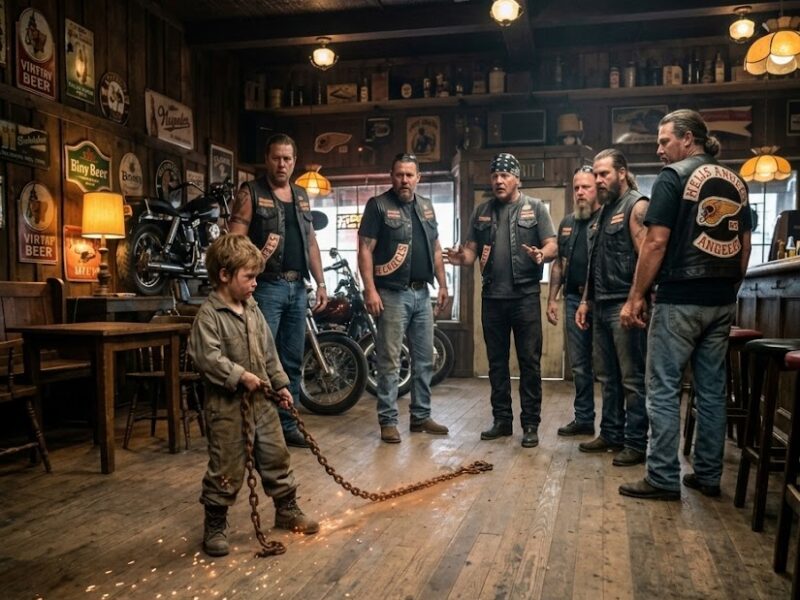
A Little Boy Entered a Biker Clubhouse Dragging a Chain—400 Hells Angels Froze When They Saw the Names Attached
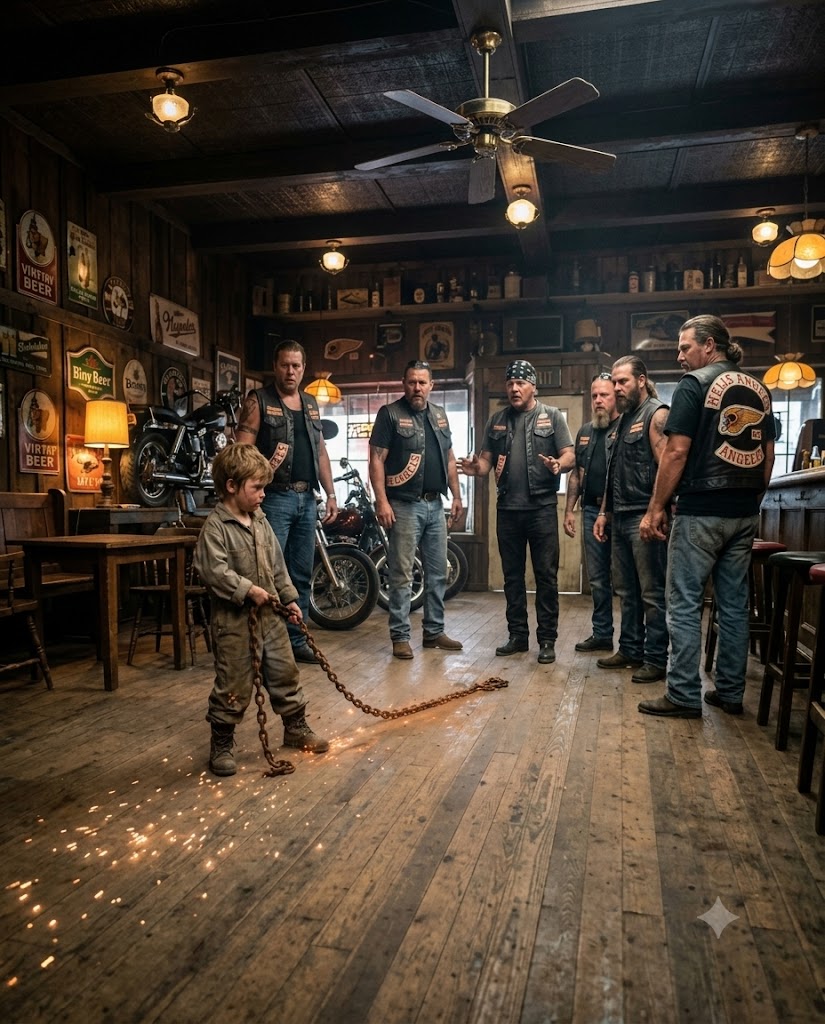
The door of The Rusty Spoke opened at 11:11 on a Saturday night.
Four hundred bikers turned toward it, bearded and tattooed, the kind of men who make the ground feel heavier wherever they stand.
What walked through weighed less than sixty pounds.
A boy.
Seven years old, sneakers torn, face streaked with dust and dried tears.
He was dragging a motorcycle chain across the wooden floor, wrapped tight around his raw, bleeding wrist.
At the other end, a leather vest covered in patches every man in that room recognized.
Patches belonging to a dead man.
The boy looked up at four hundred frozen faces and whispered, “My daddy sent me here.”
—
The Rusty Spoke sat at the western edge of Rapid City, South Dakota, like a scar the city had stopped trying to hide.
Low-slung, flat-roofed, built from cinder block and defiance.
A hand-painted sign above the entrance showed a broken wheel spoke wrapped in chain.
The parking lot held sixty cars on a normal night.
Tonight it held four hundred motorcycles.
They filled the gravel in gleaming rows and spilled onto the shoulder of the road, Harley-Davidson Road.
Road Kings and Fat Boys, Indian Chieftains, custom choppers with ape hanger handlebars and chrome pipes that caught the glow of the neon beer signs above the door.
The annual August gathering of the Black Iron Motorcycle Club drew members from thirty-seven chapters across nineteen states, and every rider had cut through the South Dakota heat to be here.
To drink cold beer under a hot sky and honor a tradition their founders had started forty-one years ago in a garage in Deadwood.
Inside, the noise was a living thing.
The jukebox fought a losing war against four hundred voices, the crack of pool balls, and the steady percussion of bottles meeting the bar top.
The air hung thick with the smell of leather, engine oil, and the kind of sweat that comes from ten hours on a highway in ninety-five degree heat.
Men with beards down to their belt buckles stood shoulder to shoulder with younger riders whose tattoos were still healing.
The ceiling was invisible behind a gray tide of cigarette smoke.
The Rusty Spoke had never met a health regulation it cared to follow.
—
At the far end of the bar, Tucker Graves sat on a stool that had borne his weight so many Saturday nights the padding had permanently molded to his shape.
At fifty-six, the president of the Black Iron MC carried himself with the authority of a man who had spent his youth lifting engines and his middle years carrying the weight of every problem five hundred members could generate.
Six-foot-four, two hundred sixty pounds, salt and pepper beard trimmed close to a jaw that looked carved from quarry stone, forearms sleeved in tattoos so old the ink had blurred into something between history and art.
His eyes were pale blue, the kind that had stared down armed men without blinking and watched brothers lowered into the ground without flinching.
Though the watching had always cost him more than the staring ever did.
He was listening to Hank Dawson, his vice president, retell a story about a blown rear tire on Interstate 90 outside of Wall.
A story Hank had told at least four times that year, but that somehow improved with each version, the way all good road stories do.
When the front door opened, nobody noticed at first.
Doors open in bars.
That is what doors do.
But then the conversations nearest the entrance began to stall.
Laughter dried up one voice at a time, the way a creek runs dry from the edges inward.
Heads turned, brows furrowed.
The dominoes of silence fell across the room, one table, then the next, then the next, until the jukebox seemed to be playing to itself in a room full of statues.
Tucker felt the shift before he heard the cause.
Thirty years of reading rooms the way a sailor reads the sea had made him fluent in the language of sudden quiet.
He set down his beer and turned.
—
The crowd near the entrance had parted, not deliberately, not the way men step aside for authority, but instinctively, the way people pull back from something they don’t understand.
And there, standing in the doorway, was a boy.
He couldn’t have been more than seven.
He was small, not just young small, but thin small, the kind of thin that comes from meals that never quite fill the plate.
His hair was sandy brown and matted with dust.
His face was streaked with dried sweat and the ghost of tears that had evaporated long ago in the August heat.
He wore a white T-shirt two sizes too large tucked unevenly into shorts that hung past his knees, and his sneakers, once white, now the color of South Dakota gravel, had split along both soles, the rubber peeling away from the canvas like dead skin.
But it wasn’t the boy that froze the room.
It was what he was dragging.
A chain.
A thick, heavy motorcycle chain, the kind used to lock a Harley to a post, the kind that weighs nine or ten pounds and hangs like an iron snake.
It was wrapped three times around the boy’s left wrist, cinched so tight that the skin beneath had turned the angry red of raw meat, blistered and swollen where the links had bitten into flesh with every step he had taken to get here.
The chain trailed behind him across the wooden floor.
And at the other end, scraping against the planks with a sound that cut through the silence like a blade, a leather vest.
Black, worn, the leather cracked along the shoulders from years of highway sun and mountain wind.
On the back, stitched in silver thread against a black field, the patches of the Black Iron Motorcycle Club.
The chapter rocker, the center insignia, and above them all, a name patch that made Tucker Graves grip the edge of the bar until his knuckles went white.
Ghost.
—
Every man in that room knew the name.
Every man had stood beside the casket where its owner had been laid to rest eighteen months ago in a cemetery outside Sturgis under a sky so blue it felt like mockery.
Derek Whitfield.
Road name, Ghost.
Sergeant at Arms for twelve years.
The man who could ride so silently through the Black Hills that you wouldn’t hear his engine until he was right beside you.
And by then he was already gone.
Four hundred men, men who had ridden through storms, outrun trouble, buried brothers, and built a brotherhood on the principle that nothing in this world could shake them, stood frozen staring at a seven-year-old boy who had walked through their door dragging the vest of a dead man.
The boy’s blue eyes, enormous in his thin face, red-rimmed but dry because he had used up his tears somewhere on the long road behind him, swept across the room until they found the biggest man.
The one at the bar.
The one with the president’s patch.
“My daddy told me to bring the chain,” he said.
His voice was small.
It should have been swallowed by the silence.
Instead, it went through the room like a crack through glass.
Tucker Graves, who had stared down men with weapons in their hands, who had ridden through a plains tornado without pulling over, who had delivered eulogies for seven fallen brothers without his voice breaking once, felt his chest tighten and his vision blur.
Because he knew that vest.
He had folded it himself.
He had placed it in the arms of a widow eighteen months ago along with a promise he had not kept.
—
Tucker moved without deciding to.
His boots carried him across the floor the way instinct carries a man’s hand to catch a falling child.
No thought, no hesitation, just the deep buried reflex of someone who has spent his life being the first one through the door when something goes wrong.
He dropped to one knee in front of the boy.
The floor was hard beneath his kneecap, and the crack in the joint sounded like a small caliber round in the silent room, but none of that mattered.
Up close, the child looked worse.
His lips were cracked from dehydration.
His arms were scratched with the long, thin lines that come from walking through roadside brush in the dark.
His eyes were glassy with exhaustion, the pupils too large, the kind of tired that goes past the body and settles into the bones.
“Hey,” Tucker said, and his voice came out rougher than he intended.
He softened it, a thing he had not done in years.
“Hey, son, what’s your name?”
“Cole.”
The boy’s voice was barely a whisper now, as though saying his father’s instruction at the door had used up the last of his strength.
“Cole Whitfield.”
The name went through the room like a shockwave.
Tucker heard it behind him, the sharp intake of breath from a dozen men at once, the low murmur that runs through a crowd when the ground shifts beneath their understanding of the world.
Whitfield.
Derek Whitfield’s boy.
“Somebody get me water,” Tucker said without turning around, “and a towel. Now.”
—
A bottle was in his hand within seconds.
He held it to the boy’s lips, cupping the back of his head with a hand that could palm a basketball, tilting the water gently because everything about this child looked like it might break.
Cole drank in small, desperate sips, his throat working, his eyes never leaving Tucker’s face.
Tucker set the water down and reached for the chain.
Carefully, more carefully than he had ever handled anything in his life, more carefully than he had handled his own mother’s china the day they packed up her house after the funeral.
He began to unwrap it from the boy’s wrist.
The links had pressed into the flesh so deeply they had left ridged impressions like a brand.
The skin beneath was raw, bleeding in two places where blisters had burst and the chain had ground into the open wounds with every step.
“How far did you walk, Cole?”
“I don’t know.”
The boy’s brow furrowed the way a child’s does when trying to measure something too big for his experience to hold.
“Since morning. Mama showed me which way to go.”
Since morning.
Tucker looked at his watch.
11:14 p.m.
This child had been walking for seventeen hours.
Hank Dawson was beside him now, crouching.
His stocky frame casting a shadow over the boy like a second roof.
Hank’s face was the color of old chalk.
He and Derek had been close, not just club brothers, but real friends.
The kind who lend each other money and never mention it again.
Who show up at three in the morning when the phone rings.
Derek’s death had hollowed something out of Hank that eighteen months had not refilled.
“That’s Ghost’s boy,” Hank said.
The words came out flat, stripped of everything except the bare fact.
“I know who he is.”
—
Tucker finished unwrapping the chain.
Russell Tate’s wife, Gloria, a retired nurse with steady hands and a temperament that allowed no argument, appeared with a first aid kit and knelt beside Cole, cleaning and bandaging his wrist while the boy watched her with the patient stillness of a child accustomed to being handled by strangers.
“Is your mama at home, Cole?” Tucker asked.
The boy shook his head.
“She fell down in the kitchen this morning. She wouldn’t get up. I called the number she told me, 911. People came and took her in a van with lights.”
“An ambulance.”
“Yes, sir. And then Mrs. Patterson from next door came. She stayed with me.”
His voice wavered for the first time, the thin wall between bravery and terror cracking just enough to let the fear show through.
“But Mama said, Mama always told me if something bad happened and she couldn’t be there, I was supposed to take Daddy’s chain to the bar where the motorcycles are. She showed me the way. She drove me the road one time and showed me what to look for. The water tower, the bridge, the gas station with the red roof. Then straight until I see the bikes.”
He paused, swallowed.
“So I went to the closet and got the chain and Daddy’s vest and I started walking.”
Silence.
The kind that fills a room the way water fills a sinking ship, rising from the floor, pressing against the walls, heavy enough to drown in.
Tucker looked at the vest on the floor behind the boy.
Derek’s vest.
The leather was scraped raw in places from being dragged across miles of asphalt and gravel.
One of the patches was half torn.
The bottom rocker, the one that read South Dakota.
Tucker remembered sewing that rocker on himself in the back room of this very bar the night Derek earned his full patch.
Derek had stood there grinning, twenty-six years old and invincible, holding a beer in one hand and his vest in the other.
Tucker had told him, “You take care of this. It’s worth more than anything you’ll ever own.”
And Derek had said, “Yes, sir. I know what it means.”
Tucker picked up the vest, held it against his chest for a moment, then folded it with the care he had learned at funerals and set it on the bar.
“Cole,” he placed both hands on the boy’s thin shoulders, “I knew your daddy. He was one of us. He was one of the best of us. And I’m going to make sure you’re safe. You hear me?”
The boy nodded.
Then he reached into the pocket of his too-large shorts and pulled out a folded piece of paper, creased so many times it was soft as cloth.
The edges worn transparent.
“Daddy left this,” Cole said. “Mama kept it in the box with the chain. She said give it to the man in charge.”
—
Tucker took the paper.
His hands, steady enough to hold a motorcycle at one hundred ten on a mountain switchback, were shaking.
He looked at Hank.
Hank’s eyes were already red.
“Get riders to every hospital within fifty miles,” Tucker said. “Find Claire Whitfield. Russell, I need someone at their apartment. Take the address from the neighbor if you have to. Move. Now.”
The room erupted.
Not with noise, with purpose.
Men who had been laughing and drinking five minutes ago were pulling on jackets, grabbing helmets, heading for the door.
Engines roared to life in the parking lot one after another, the sound rolling across the South Dakota night like approaching thunder.
Four hundred men had come to The Rusty Spoke to celebrate.
Now they were riding for a dead brother’s son.
Tucker unfolded the paper.
The creases had been pressed and repressed so many times that the pencil marks along the fold lines had worn away, leaving gaps in the words like missing teeth, but the handwriting was unmistakable.
The same left-leaning slant, the same way of crossing T’s with a stroke that ran too far right, the same compact letters of a man who had never enjoyed writing, but understood that some things need to be put on paper because spoken words disappear and paper doesn’t.
The letter was dated eighteen months ago, the morning of Derek Whitfield’s last ride.
Tucker read it silently first, then he read it again.
The second reading was harder because the first time he had been reading words, and the second time he was hearing Derek’s voice.
The quiet, steady baritone that had talked sense into a thousand arguments, that had calmed panicking riders on rain-slicked highways, that had once told a room full of angry men, “We’re better than this, and you know it.”
And been right.
The bikers who hadn’t left for the hospitals and the apartment stood in clusters around the bar, watching their president hold a dead man’s letter like it was the most dangerous thing he had ever touched.
Cole sat on the bar top, his bandaged wrist resting in his lap, a half-eaten sandwich in his other hand.
Gloria Tate stood beside him, one arm around his narrow shoulders.
“Read it,” Hank said from behind Tucker. “They need to hear it.”
—
Tucker cleared his throat.
He held the paper in both hands, and he read.
“Tucker, if you’re reading this, it means something happened to me, and something happened to Claire, and my boy Cole found his way to you. I know how that sounds. I know you’re standing there thinking I was crazy for writing this. But here’s the thing, I ride five hundred miles a week on a machine that weighs eight hundred pounds and offers no protection except speed and luck. I’ve been lucky for a long time, but luck runs out. It runs out for everybody.”
Tucker paused, steadying his voice.
“Claire has been sick. She doesn’t talk about it. She’s too proud to ask anyone for help. You know how she is. But her lungs aren’t right, and the doctor bills are stacking up, and I’ve been picking up extra shifts at the shop trying to keep us above water. If I go down, she’ll hold it together as long as she can. She’ll sell everything she owns before she asks a single person for a dollar. And when she can’t hold on anymore, she’ll send Cole.”
The room was absolutely still.
“I taught her the route from our place to The Rusty Spoke along the back roads where there’s no fast traffic. Eleven miles. I know that’s a long way for a little boy, but Cole is tougher than he looks. He’s tougher than I ever was. And the chain will get him through your door. Nobody ignores a kid dragging a chain.”
—
Tucker’s voice cracked, and he paused again.
“Hank, if you’re there, I know you’re crying. Stop it. You look ugly when you cry.”
A sound went through the room, something between a laugh and a sob, the kind of noise that comes out of men who have forgotten how to do either.
Tucker continued.
“Here’s what I need, Tucker. Take care of my boy. I’m not asking the club to adopt him. I’m not asking for charity. I’m asking you, the man, not the president, to make sure my son doesn’t grow up the way I did, wondering every night if anybody in the world gives a damn whether he eats breakfast. You and the brothers are the only family I’ve got besides Claire and Cole. Don’t let them disappear.”
He had to stop.
His hands were shaking so hard the paper rattled.
“I know I should have set up something better, life insurance, savings, a plan, but I spent my whole life building things out of steel and leather, and the one thing I should have built out of paper, I never got around to. So, this letter is my plan. It’s not much, but it’s got your name on it, and I’ve never known you to walk away from something with your name on it. Brothers don’t forget brothers. Don’t forget mine. Ghost.”
—
Tucker finished reading.
He folded the letter along its worn creases and pressed it against his chest.
The room was silent in a way that silence is not usually silent.
Not empty, but full, packed tight with the weight of a hundred men breathing through clenched jaws and burning eyes.
These were men who had been to funerals, to courtrooms, to hospital beds.
Men who had carried caskets and ridden through grief and come out the other side with their faces set and their hands steady.
And now they were undone, not by violence, not by anger, not by any of the forces that had shaped their lives, but by a dead man’s letter and the seven-year-old boy who had carried it eleven miles in the dark.
Russell Tate, sixty-two years old, the club’s elder statesman, the man who had taught Derek to ride when Derek was sixteen and fatherless and furious at the world, sat in a corner booth with his face buried in his hands.
His shoulders shook.
He did not try to hide it.
There was no point.
Everyone in the room was fighting the same war, and most of them were losing.
—
Hank’s phone rang.
The sound was jarring, a modern intrusion into a moment that felt older than phones, older than electricity, older than anything except a father’s fear for his child.
“Yeah,” Hank answered.
He listened.
His face, already pale, went the color of candle wax.
He lowered the phone.
“She’s at Rapid City Regional, ICU, severe pneumonia, advanced.”
He paused, looked at Cole sitting on the bar with his sandwich, the boy watching him with wide blue eyes that missed nothing.
Hank lowered his voice, though Cole heard every word anyway, because children always do.
“Complicated by malnutrition. She hasn’t been eating, Tucker. She’s been feeding the boy and skipping her own meals. The apartment, the guys just got there. It’s empty. No furniture except a mattress on the floor in Cole’s room. She gave up her own bed. The fridge has peanut butter and two apples. That’s it. That’s what Ghost’s family has been living on.”
Tucker closed his eyes.
Behind the lids, he saw Derek at the funeral, not in the casket, but standing beside it, arms crossed, watching, waiting to see if the living would keep their word to the dead.
They hadn’t.
Eighteen months.
Eighteen months since the funeral, since the folded flag and the long ride home.
They had given Claire a check from the club’s emergency fund, three thousand dollars, standard for a fallen brother’s family.
They had told her to call if she needed anything.
And then they had ridden back to their lives, to their bars and their highways and their gatherings.
And they had not called, had not visited, had not driven the eleven miles from this bar to that apartment to see if the woman and child of their dead brother were eating.
Tucker opened his eyes.
His jaw was set in a way Hank recognized, the expression that preceded decisions from which there was no turning back.
“We’ve got eighteen months to make up for,” Tucker said. “We start tonight.”
—
The hospital corridor had never held this much leather.
Rapid City Regional Medical Center was a clean, quiet building designed for clean, quiet emergencies, broken arms from ski slopes, chest pains from retirees, the occasional rancher who had lost an argument with a bull.
At 12:15 a.m., thirty-two members of the Black Iron Motorcycle Club walked through the automatic doors of the emergency wing, and the night shift nurses behind the station looked up with the expression of people watching a weather system move indoors.
They were, to a man, enormous, bearded, tattooed, dressed in leather and denim, their boots leaving dusty prints on the polished floor.
One still wore a bandana knotted at the back of his skull.
Another had a chain hanging from his belt loop.
The security guard at the front desk reached for his radio, then stopped because the first man through the door, a bald stocky man with a jaw like a cinder block, walked straight to the nurses station, removed his sunglasses, and said, in the most polite voice the overnight staff had ever heard from a man his size, “Ma’am, my name is Hank Dawson. We’re looking for Claire Whitfield. She was brought in by ambulance this morning. We’re her family.”
The nurse hesitated.
Hank waited.
He did not raise his voice.
He did not lean over the counter.
He stood with his hands at his sides, the posture of a man who wants the world to know he is not a threat, which from a man built like Hank Dawson required more effort than most people understood.
“Room 417,” the nurse said, “ICU, family only past those doors.”
“We’re all family, ma’am.”
She looked at the thirty-one men standing behind him.
Then she buzzed them through.
—
Claire Whitfield lay in a bed that made her look even smaller than she was.
Thirty-four years old, dark hair spread across the pillow, her face the pale gray of someone who had been running on will long after the body stopped cooperating.
An IV line ran into her left arm.
A nasal cannula fed oxygen into lungs that had spent weeks fighting an infection while their owner refused to stop working long enough to see a doctor because doctors cost money, and money went to rent and food and keeping the lights on for a seven-year-old who had already lost his father and could not afford to lose anything else.
The doctor, a young man named Dr. Alan Mercer who had been on shift for fourteen hours and thought nothing left in this world could surprise him, found Hank in the corridor twenty minutes later.
“She’s stable,” Mercer said. “Bilateral pneumonia, fairly advanced. She’s also significantly underweight and dehydrated. It looks like she’s been neglecting her own health for a considerable period. If she’d waited another week, we’d be having a very different conversation.”
“She wasn’t waiting,” Hank said. “She was surviving.”
“She has no insurance on file.”
“She does now. Send every bill to me.”
—
Back at The Rusty Spoke, the crowd had thinned, but the weight in the room had not.
Tucker sat on a bench against the back wall with Cole beside him.
The boy was clean now.
Gloria had washed his face and arms with warm water from the bar sink, and someone had found a Black Iron T-shirt, size small, that hung past the boy’s knees like a nightgown.
His bandaged wrist rested on a cushion someone had pulled from the office couch.
His eyes were heavy, fighting sleep the way children fight it, stubbornly and without success.
“Tucker?”
“Yeah, buddy.”
“Tell me about my daddy.”
Tucker looked down at the boy.
Those blue eyes, Derek’s eyes, the exact same shade, the same quiet intensity.
Looking into them felt like looking at a man he had buried eighteen months ago.
“Your daddy,” Tucker said, “was the bravest man I ever rode with.”
“What did he do?”
“Everything. He could fix any engine ever made. He once rebuilt a transmission in a gas station parking lot with nothing but a socket wrench and a flashlight. He organized our toy drive every December. We’d collect over a thousand toys for kids across the county. He could arm wrestle men twice his size and laugh when he lost, which was often, because your daddy was strong, but he wasn’t quite as strong as he believed he was.”
Tucker paused, the memory bending his mouth into something between a smile and a wound.
“And he’d ride five hundred miles through a thunderstorm if a brother needed help changing a flat tire.”
Cole was quiet for a moment.
Then, “How did he die?”
—
Tucker had known the question was coming.
He had been dreading it since the boy walked through the door.
But a child who had walked eleven miles with a chain wrapped around his wrist deserved the truth.
And Tucker Graves had never been a man who rationed the truth because the listener was small.
“A truck crossed the center line on Highway 79,” Tucker said, “heading straight for a family in a minivan, a mom, a dad, two little kids in the backseat. Your daddy was riding behind them. He saw it happening and he made a choice. He laid his bike down and put himself between that truck and that family. The truck hit his motorcycle instead. The family in the van, all four of them, drove away without a scratch.”
Cole’s chin trembled once, a small, hard tremor like a minor earthquake in a face that was trying very hard to stay still.
“He saved them?”
“All four.”
“And he didn’t even know them?”
“No, Cole. He didn’t need to. That’s who your daddy was. He didn’t need to know people to protect them.”
The boy was quiet for a long time.
His eyes glistened, but the tears did not fall.
Not because he was too proud, but because at seven years old he was still learning the geography of grief, still mapping which losses produce rain and which produce only the heavy, waterless ache of a sky that wants to cry, but cannot.
“I want to be like him,” Cole said.
Tucker pulled the boy against his side, rough, clumsy, the only way he knew how to hold things when he was afraid of breaking them and more afraid of letting go.
“You already are, kid. You already are.”
—
His phone buzzed, a text from Hank.
She’s stable. Pneumonia, malnutrition. Doctors say she’ll make it. She’s awake. She’s asking for Cole.
Tucker looked down.
Cole had lost his fight with sleep.
His head rested against Tucker’s arm, his breathing slow and even.
One small hand still clutching the remnant of a sandwich.
In sleep, the worry lines that had no business being on a seven-year-old’s face had smoothed away.
And he looked for the first time since he walked through that door like what he was, a child.
Tucker didn’t move.
He sat on that bench with a sleeping boy against his arm and a dead brother’s letter pressed against his heart.
And he held still.
Outside, engines idled and tires crunched on gravel as riders came and went.
To the hospital, to the apartment, to their phones to make calls that would bring money and manpower and resources to bear on a problem that should have been solved eighteen months ago.
Tucker pulled out his phone and called home.
His wife, Lorraine, answered on the second ring.
The way she always did when he called after midnight, instantly, because midnight calls from Tucker Graves had never once been about good news.
He told her everything.
The silence on the other end lasted seven seconds.
Then Lorraine’s voice came back, thick and cracked and absolute.
“You bring that boy home, Tucker. Tonight. You bring him to this house.”
“Yes, ma’am.”
“And Tucker?”
“Yeah?”
“We failed that family. Don’t you dare fail them again.”
She hung up.
Tucker held the phone against his ear for a moment longer, listening to the dead air, feeling the weight of the sleeping child against his arm, and understanding, with the clarity that only arrives at two in the morning when every pretense has been stripped away and a man is left alone with the raw architecture of what he is, that the most important ride of his life had no motorcycle in it.
It was the eleven miles a seven-year-old boy had walked in the dark, and it had led straight to this bench.
—
Three months later, the chain was still.
It hung on the wall behind the bar at The Rusty Spoke, cleaned and polished until the steel links gleamed under the overhead lights like something between jewelry and monument.
Below it, a brass plate had been mounted and engraved in clean block letters.
“Ghost’s chain, carried eleven miles by the bravest rider who ever walked through this door, Cole Whitfield, age 7.”
Beside the chain, in a glass-fronted frame, hung Derek’s letter, the creases pressed flat, the pencil marks carefully preserved, the words a man had written on a kitchen table at five in the morning, now visible to anyone who stood close enough to read them.
And next to the letter, a small drawing in crayon, a motorcycle, a large rider with a beard, and a smaller figure holding a chain that stretched between them.
Above the figures, in the careful, uneven handwriting of a child who was learning the weight of words, “Brothers.”
—
October had come to the northern plains, carrying the first cold and the last of the cottonwood leaves.
The Black Hills had turned amber and rust, and the mornings smelled of frost and woodsmoke, and the particular clean sharpness that arrives when summer finally stops pretending it will last forever.
Claire Whitfield stood at the window of a three-bedroom house on Elk Creek Road, watching her son ride a bicycle up and down the gravel driveway.
The house belonged to a retired club member named Carl Fletcher, who had refused to accept a single dollar of rent.
When Claire protested, and she protested twice a day for the first two weeks, Carl had said, “Ma’am, your boy walked eleven miles for us. The least we can do is give him a place to ride a bike.”
She had stopped arguing after that, not because she had accepted it, but because she had learned that arguing with Black Iron men was like arguing with the weather.
You could do it all day and it wouldn’t change a thing.
She was still thin.
Three months of recovery couldn’t undo years of deprivation overnight, but the color had returned to her face and the cough that had rattled in her chest like a stone in a tin can had finally gone quiet.
The doctors at Rapid City Regional had treated her aggressively once Hank Dawson made it clear that the word uninsured no longer applied.
Three weeks in the hospital, six weeks of outpatient treatment, antibiotics, nutrition plans, follow-up appointments that Claire attended because Tucker Graves personally drove her to every single one and Tucker Graves was not a man you said no to.
Not because he was intimidating, though he was, but because he showed up and kept showing up with the relentless consistency of a man trying to honor a promise he should have honored a long time ago.
—
Cole’s transformation had been faster, the way children’s transformations always are.
As though youth carries its own momentum and all you have to do is remove the obstacles and a child accelerates toward who they were always supposed to be.
He was back in school wearing clothes that fit, eating three meals a day and sometimes four because Gloria Tate had appointed herself his unofficial grandmother and kept appearing at the door with casseroles and fresh baked bread and the particular brand of no-nonsense affection that only a woman from the Great Plains knows how to deliver.
He had a bedroom, a real one with walls he could pin drawings to and a bed high enough off the floor to store his shoes underneath and a desk where he did his homework every evening while Claire sat across from him reading or resting, the two of them sharing the kind of silence that doesn’t need filling because the presence is enough.
And he had uncles.
Four hundred of them.
Not all at once, they came in rotations, steady and reliable as the tides.
Hank Dawson appeared on Tuesday evenings to help with math homework, sitting at the kitchen table with his massive hands wrapped around a pencil, squinting at fractions with the focused intensity of a man defusing an explosive.
Russell Tate came on Thursdays for chess.
He was teaching Cole the game the same way he had taught Derek, one move at a time, with the patience of a man who understood that some lessons take years to settle.
Tucker came on Saturdays, every Saturday, without exception.
He took Cole fishing in Rapid Creek, hiking in Custer State Park, or just sitting on the porch of The Rusty Spoke drinking root beer while Tucker drank black coffee and told stories about the road.
—
The club had established a trust fund in Cole’s name, the Derek “Ghost” Whitfield Education Fund, seeded with fifteen thousand dollars from the club’s treasury and growing through donations that arrived from chapters across the country.
The annual August gathering had been renamed Ghost’s Ride.
The inaugural year raised forty-seven thousand dollars.
The second, still months away, had already pulled in twice that in pledges.
Every dollar went to the same place, making sure Derek Whitfield’s son would never have to walk eleven miles in the dark again.
The following August, Tucker Graves stood at a makeshift podium outside The Rusty Spoke for the opening ceremony of the second annual Ghost’s Ride.
The parking lot held more bikes than he had ever seen in one place, not four hundred, but five hundred twelve.
Word had traveled.
Chapters from states that had never sent riders before had made the journey.
Men who had heard the story of the chain, the boy, and the letter wanted to be part of what it had become.
Tucker looked out at the crowd.
Then he looked at Cole standing beside him in a small black leather vest with a single patch stitched by Gloria Tate, a silver chain link and the words “Honorary Brother.”
—
“Most of you know why we’re here,” Tucker said.
His voice carried across the lot, steady as a highway, rough as the gravel beneath their boots.
“Two years ago, a man named Derek Whitfield rode Highway 79 for the last time. He died saving four people he had never met. We buried him with honors. We rode for three days. We gave his widow a check and told her to call if she needed anything.”
He paused, let the silence do its work.
“And then we went home. We went back to our bars and our bikes and our lives. And we forgot. We forgot that Derek had a wife named Claire and a son named Cole. We forgot that family doesn’t end at the cemetery gate. We forgot the one thing we swore we’d never forget, that brotherhood means you don’t leave the people who can’t ride for themselves.”
His voice dropped, not quieter but heavier, the way a voice drops when it’s carrying something too important to shout.
“One night that door right there opened and a boy walked in. Seven years old, sixty pounds. He’d walked eleven miles in the August heat dragging his dead father’s motorcycle chain because his mother was in an ambulance and he had no one else in this world. He wrapped that chain around his own wrist so he wouldn’t lose it. He tore his skin open and he didn’t stop walking, not once. He walked through that door and asked for help because his daddy wrote in a letter that the brothers would come through.”
Tucker looked at the chain mounted on the wall visible through the open bar door.
“That chain up there is not a trophy. It’s not a decoration. It’s a debt. A debt we came within an inch of never paying. Derek planned for the worst because he loved his son more than he feared dying. He built a road, eleven miles of back roads, landmarks, and a chain heavy enough to make sure nobody could ignore a little boy standing in a doorway. He built that road because he trusted us.”
He let the word hang.
“And for eighteen months, we were not worthy of that trust. We are now. That chain says we don’t forget again. Not Claire, not Cole, not any brother’s family ever. You ride for the patch, you ride for each other, and you ride for the ones waiting at home. That’s the deal. That’s what Ghost taught us, and it took his seven-year-old son to deliver the lesson.”
—
Silence held the lot for three full seconds.
Then a single pair of hands clapped.
One sharp crack that split the air.
Then another.
Then a wave.
The applause built until it rolled across the parking lot louder than five hundred engines, louder than any rally Tucker had ever attended.
Louder than anything he had heard in thirty years of riding.
Because it wasn’t just noise.
It was four hundred men, plus one hundred more, saying the same thing at the same time without words.
We hear you.
We won’t forget.
Cole stood beside Tucker, one hand folded into the big man’s calloused grip.
In his other hand, he held a photograph, creased and soft from handling.
The edges curled from being tucked under a pillow every night.
It showed a man on a motorcycle, sandy-haired, blue-eyed, grinning into the wind with the unguarded joy of someone who has found exactly where he belongs in the world.
Cole looked up at Tucker.
And he smiled.
The full, open, unguarded smile of a child who has been lost and found.
Who has walked through the longest dark and come out the other side into a place where five hundred voices are calling his name.
—
That evening, Tucker sat on the porch of the house on Elk Creek Road.
Claire brought him coffee.
Black, no sugar, the way he’d been drinking it for forty years.
They sat without speaking, watching the last light of August bleed across the Black Hills in slow shades of copper and gold.
The sky turning the color of something that hasn’t decided yet whether to be beautiful or sad.
Inside, Cole was at his desk drawing.
A motorcycle, a large rider with a beard, a small figure beside him, and between them a chain.
Not dragging, not weighing anyone down, but linking them together link by silver link, the way a bridge links two shores that would otherwise be too far apart to reach.
Tucker looked at the sky where the first stars were beginning to burn through the deepening blue.
“I hope you can hear me, Ghost,” he said quietly.
“Your boy made it. He walked your road and he found us. And I swear to you on every mile I’ve ever ridden and every brother I’ve ever buried, we will not lose that road again.”
Claire put her hand on his arm.
Inside, Cole laughed at something, a bright clear sound that filled the house the way sunlight fills a room that has been dark for a very long time.
The chain was on the wall.
The road was open.
The family was whole.
—
**[END OF PART 1]**
—
The first winter after Cole came to live on Elk Creek Road was the kind that tested men and machines alike.
South Dakota did not do anything halfway, and winter was no exception.
The wind came down from Canada with nothing between it and the Black Hills except a few hundred miles of frozen grassland, and it carried a cold that got into your bones and stayed there like a squatter who had no intention of leaving.
Tucker Graves had ridden through forty winters, and he had learned long ago that the key to surviving them was preparation and stubbornness in equal measure.
He kept the club’s garage heated year-round, a cinder block building behind The Rusty Spoke that smelled of motor oil and sawdust and the particular metallic tang of cold steel warming up.
It was there, on a Tuesday afternoon in January with the temperature outside hovering at nine degrees, that Cole Whitfield learned to change his first spark plug.
—
Hank Dawson stood beside the boy, his massive frame blocking the wind that leaked through the garage door, watching Cole’s small hands work the socket wrench with the concentration of a surgeon.
“Easy now,” Hank said. “Don’t force it. Let the tool do the work.”
“I’m trying,” Cole said, his tongue poking out the corner of his mouth the way it always did when he was concentrating.
“Try harder. And slower. Slow is smooth, smooth is fast.”
The boy adjusted his grip, turned the wrench with careful pressure, and felt the plug give way.
It came loose with a satisfying click, and Cole held it up like a trophy, his face splitting into a grin.
“I did it!”
“You did it,” Hank agreed. “Now put the new one in. And don’t cross-thread it, or I’ll make you do it again.”
Cole’s grin faltered.
“How do I not cross-thread it?”
“By paying attention. By feeling the threads catch. By not being in a hurry. Everything worth doing takes patience, kid. Your daddy knew that. He could rebuild an entire engine in a weekend because he never rushed a single bolt.”
The boy nodded, his expression turning serious, and went back to work.
—
Hank watched him, and felt something shift in his chest, something that had been frozen for a long time and was only now beginning to thaw.
He had known Derek Whitfield for twenty-two years.
They had met at a gas station outside Sturgis when Hank was twenty-eight and Derek was nineteen, both of them riding bikes that were held together with duct tape and prayer.
Derek had been trying to fix a carburetor with a screwdriver and a lot of swearing, and Hank had pulled over because the kid looked like he was about to set the whole gas station on fire out of sheer frustration.
“Need a hand?” Hank had asked.
“Need a miracle,” Derek had said.
Hank had laughed, walked over, and spent the next hour teaching Derek how a carburetor actually worked.
They had been brothers ever since.
Not by blood, but by something stronger.
By choice.
—
When Derek died, Hank had stood at the graveside with the rest of the club, his face a mask of stone, his hands steady, his voice level when he spoke the words of remembrance.
He had not cried.
Not then.
Not at the reception afterward, where Claire had sat in a corner with Cole on her lap, both of them too shocked to eat, too hollow to speak.
Not in the weeks that followed, when he had thrown himself back into the club’s business with a ferocity that alarmed even Tucker.
He had not cried because crying was not something Hank Dawson did.
He was the vice president.
He was the rock.
He was the man who held things together when everything else was falling apart.
But late at night, in the dark of his own bedroom, with his wife asleep beside him, Hank had lain awake and stared at the ceiling and thought about all the things he should have said and all the things he should have done.
He should have called Claire.
He should have driven out to the apartment.
He should have made sure that Derek’s family was taken care of, not just with a check and a promise, but with presence.
With time.
With the kind of steady, unglamorous attention that real brotherhood required.
He had failed.
They had all failed.
And the proof of that failure had walked through the door of The Rusty Spoke on a Saturday night, dragging a chain and a dead man’s vest and eleven miles of silent desperation.
—
Now, watching Cole work the socket wrench with the same concentration Derek had once brought to a carburetor, Hank made himself a promise.
Not the kind of promise that gets written down or spoken aloud.
The kind that gets carved into bone.
He would not fail this boy.
He would not fail Claire.
He would be there, not just on Tuesdays for math homework, but on the days when nobody was watching, on the days when the only thing that mattered was showing up.
He would teach Cole everything Derek would have taught him.
How to ride.
How to fix an engine.
How to stand up for what was right.
How to be a man.
—
“You know what your daddy told me once?” Hank said.
Cole looked up from the engine, his small face smudged with grease, his eyes curious.
“What?”
“He said the best thing about riding a motorcycle is that it doesn’t care who you are. It doesn’t care how much money you have or where you came from or what you did before. It only cares about one thing.”
“What’s that?”
“Whether you’re willing to put in the work. Whether you’re willing to learn. Whether you’re willing to fall down and get back up and keep going. That’s all it asks. And if you give it that, it’ll give you everything.”
Cole was quiet for a moment, processing.
“I fell down a lot when I was walking here,” he said finally. “In the dark. I tripped over rocks and roots and I scraped my knees and my hands.”
Hank nodded.
“And what did you do?”
“I got back up.”
“That’s right. You got back up. That’s what matters. That’s what your daddy would have wanted you to do.”
The boy looked at the engine, then back at Hank.
“I’m going to ride someday,” he said. “Like my daddy.”
“You will,” Hank said. “And I’ll be right there with you when you do.”
—
Spring came late that year, the way it always did in the Black Hills, fighting its way through the last of the snow and the stubborn cold that refused to surrender until the very end.
The first warm day was in late April, and Tucker Graves celebrated the way he always did, by opening the windows of The Rusty Spoke, firing up the grill behind the bar, and inviting every member of the club within a hundred miles to come eat burgers and drink beer and tell lies about the winter.
The parking lot filled by noon.
By one o’clock, the smell of charcoal and grilled onions was thick in the air, mixing with the smoke of cigars and the rumble of engines as riders came and went.
Cole Whitfield sat at a picnic table with Russell Tate, a chessboard between them, the boy’s brow furrowed in concentration as he studied the pieces.
“You’re overthinking it,” Russell said, leaning back in his chair and taking a long pull from his beer.
“I’m not overthinking,” Cole said. “I’m thinking.”
“Same thing, most of the time. What did I tell you about the knight?”
“Control the center.”
“Right. Control the center. The knight is your fastest piece. It can strike from places the other pieces can’t reach. But only if you put it in the right spot. So stop worrying about what I’m going to do and start deciding what you’re going to do.”
The boy nodded, moved his knight, and looked up at Russell with a questioning expression.
Russell studied the board for a long moment, then smiled.
“That’s a good move, kid. A really good move.”
Cole beamed.
—
Across the lot, Tucker stood with Hank and a few of the older members, watching the scene with the quiet satisfaction of a man who had seen his family come back together.
The club had changed in the months since that night.
Not in any way that was easy to measure, but in the small, daily ways that mattered.
There were more phone calls now.
More visits.
More check-ins.
The trust fund had grown to over sixty thousand dollars, and the club had established a new policy: every fallen brother’s family would be assigned a liaison, a member whose job was to stay in touch, to show up, to make sure that nobody got forgotten.
It wasn’t a grand gesture.
It was just the right thing to do.
And it had come, Tucker thought, from a seven-year-old boy with a chain wrapped around his wrist.
—
“You ever think about what would have happened if he hadn’t walked through that door?” Hank said, his voice low.
Tucker shook his head.
“I try not to. But yeah. I think about it.”
“If he hadn’t walked through that door, we’d never have known. We’d have gone on with our lives, and Claire would have died in that apartment, and Cole would have ended up in the system, and we’d never have known.”
The words hung in the air, heavy and cold.
“That’s not going to happen again,” Tucker said. “Not to any family. Not ever.”
“How do you make sure of that?”
Tucker looked at him, his pale blue eyes steady.
“You change the culture. You make sure that every man in this club understands that brotherhood isn’t just about riding together. It’s about taking care of each other. Not just on the road. Not just when it’s easy. All the time. No matter what.”
Hank nodded slowly.
“And what about Cole?”
Tucker looked at the boy, sitting at the picnic table with Russell, laughing at something the old man had said.
“What about him?”
“You think he’s going to be okay?”
Tucker was quiet for a long moment.
Then he said, “He walked eleven miles in the dark with a chain wrapped around his wrist and a dead man’s vest dragging behind him. He didn’t stop. He didn’t quit. He didn’t ask for help until he got here, and when he did, he knew exactly what to say. That kid is going to be okay. He’s going to be more than okay. He’s going to be the best of us.”
—
That summer, the second annual Ghost’s Ride drew five hundred twelve riders from thirty-seven states, and raised over ninety thousand dollars for the trust fund.
The following year, the number was six hundred twenty riders, and the year after that, it crossed seven hundred.
The chain on the wall of The Rusty Spoke became something of a legend.
Riders came from all over the country to see it, to read the letter, to stand in the place where a seven-year-old boy had walked through the door and changed everything.
And every year, on the first Saturday in August, Tucker Graves stood at the makeshift podium outside the bar and told the story again.
The story of the boy with the chain.
The story of the man who had loved his son enough to write a letter that would save his life.
The story of a brotherhood that had failed and then found its way back.
—
Cole grew up surrounded by men who loved him.
He learned to ride when he was nine, sitting in front of Hank on a Harley, his small hands gripping the handlebars while Hank held the controls.
He learned to fix engines when he was eleven, spending weekends in the garage with Russell, learning the art of patience and precision.
He learned to stand up for what was right when he was thirteen, when he saw a kid at school getting bullied and stepped in without hesitation, the way his father would have.
He grew tall and strong, with sandy hair and blue eyes that held a quiet intensity.
He wore a leather vest of his own, with a single patch on the back, the Ghost patch, given to him by the club on his sixteenth birthday.
He graduated from high school with honors, and the trust fund paid for his college education, every penny of it, the way Derek would have wanted.
He studied engineering, because he loved how things worked, and when he graduated, he came back to Rapid City and took a job at the same shop where his father had worked, the shop on the edge of town where Derek Whitfield had spent his days fixing engines and his nights dreaming of the road.
—
And on the first Saturday of August, every year, without fail, Cole stood beside Tucker at the podium and told the story.
Not the whole story, because some things were too personal to share.
But the part that mattered.
The part about the chain.
“I was seven years old,” he would say, his voice strong and clear. “I didn’t know what I was doing. I just knew what my mama told me. She said, take the chain to the bar where the motorcycles are. She said, the brothers will help you. And she was right.”
He would pause, look out at the crowd of riders, and smile.
“They helped me. They helped my mom. They’ve been helping me ever since. And I want you to know something.”
The crowd would go silent, waiting.
“Brotherhood isn’t just about riding. It’s about showing up. It’s about being there when it matters. And my dad knew that. He wrote a letter that told them exactly what to do. And they did it. They did it for me, and they did it for my mom, and they’ve been doing it ever since.”
He would look at Tucker, standing beside him, older now, grayer, but still solid as a rock.
“The chain up on that wall is a reminder,” Cole would say. “It’s a reminder that we don’t leave anyone behind. It’s a reminder that family isn’t just blood. It’s choice. And I chose this family. And this family chose me.”
—
The years passed.
The Rusty Spoke was still there, still low-slung and flat-roofed, still built from cinder block and defiance.
The sign still showed a broken wheel spoke wrapped in chain.
The chain still hung on the wall, polished and gleaming.
And on the first Saturday of August, every year, the parking lot filled with motorcycles, and the noise was a living thing, and the air hung thick with the smell of leather and engine oil and the kind of sweat that comes from a long ride on a hot day.
Men with beards down to their belt buckles stood shoulder to shoulder with younger riders whose tattoos were still healing.
And in the corner, at a table by the window, an older man with a salt and pepper beard sat with a young man with sandy hair and blue eyes, and they talked about the road.
Not just the highway.
The road of life.
The road that had brought them both here.
—
“You ever wonder what would have happened if you hadn’t walked through that door?” Tucker asked.
Cole looked at him, his blue eyes thoughtful.
“I think about it sometimes,” he said. “But not too much. Because I know what happened. And I know that everything that came after, all of it, started with that one night.”
“A seven-year-old boy with a chain.”
Cole smiled.
“A seven-year-old boy with a chain and a dead man’s vest and a letter from his daddy.”
Tucker nodded.
“A letter that saved your life.”
“And yours,” Cole said. “And Hank’s. And everyone else’s. Because that night changed something. It changed how we think about family. It changed how we think about brotherhood. It changed everything.”
They sat in silence for a moment, watching the crowd.
Then Cole said, “You know what the strangest part is?”
“What?”
“I wasn’t scared. Not really. I was walking through the dark, dragging a chain, and I knew it was dangerous. But I wasn’t scared. I kept thinking, my daddy said they’d help me. My daddy said the brothers would take care of me. And I believed him. I believed him more than I believed anything in the world.”
Tucker’s eyes were wet, but he didn’t wipe them.
He had learned, over the years, that some tears were worth keeping.
“Your daddy was a smart man,” Tucker said.
“The smartest.”
“And a good father.”
“The best.”
“And a brother,” Tucker said, “who knew exactly what he was doing when he wrote that letter. He knew what it would mean. He knew what it would cost. And he did it anyway. Because he loved you more than he loved himself.”
Cole nodded, his throat tight.
“I know,” he said. “I’ve always known.”
—
That night, after the last rider had left and the last bottle had been cleared away, Tucker stood alone in the bar.
The chain was on the wall.
The letter was in its frame.
And on the bar, a photograph, faded and creased, showing a man on a motorcycle, sandy-haired, blue-eyed, grinning into the wind.
Tucker looked at the photograph for a long time.
“I hope you can hear me, Ghost,” he said quietly.
“Your boy made it. He grew up strong. He grew up good. He grew up exactly the way you would have wanted him to.”
He paused, his voice thick.
“We did what you asked. We took care of him. We took care of Claire. We kept our promise. It took us a while. It took us too long. But we did it. And we’ll keep doing it. For the rest of our lives. For the rest of the club’s life. We will not forget. We will never forget.”
He reached out and touched the chain, the links cool and smooth beneath his fingers.
“Thank you, brother,” he said. “Thank you for trusting us. Thank you for giving us a chance. Thank you for sending us your son.”
He turned off the light.
The chain gleamed in the darkness, catching the glow of the neon beer sign above the door.
And outside, in the parking lot, a single motorcycle sat under the stars, waiting for the morning.
—
**[THE END]**









