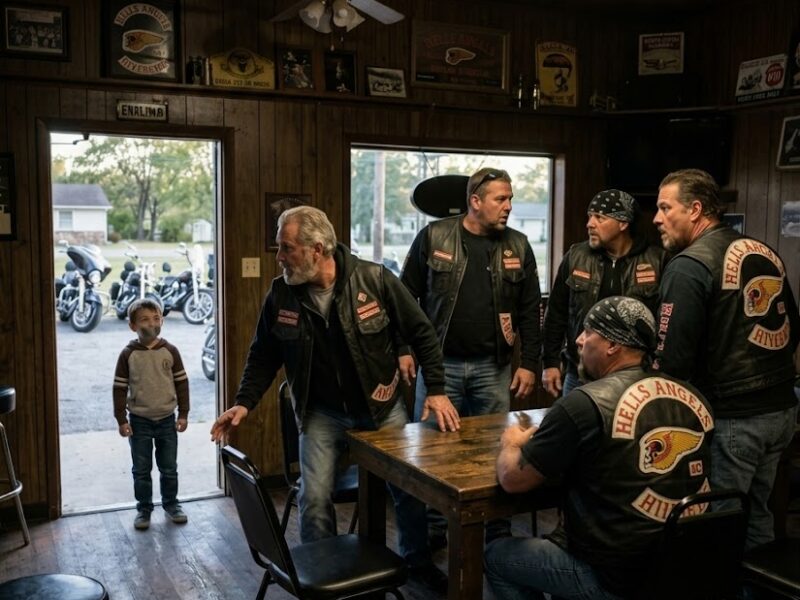
A Little Boy Arrived at a Biker Clubhouse With Tape Over His Mouth—500 Hells Angels Fell Silent When They Learned Why
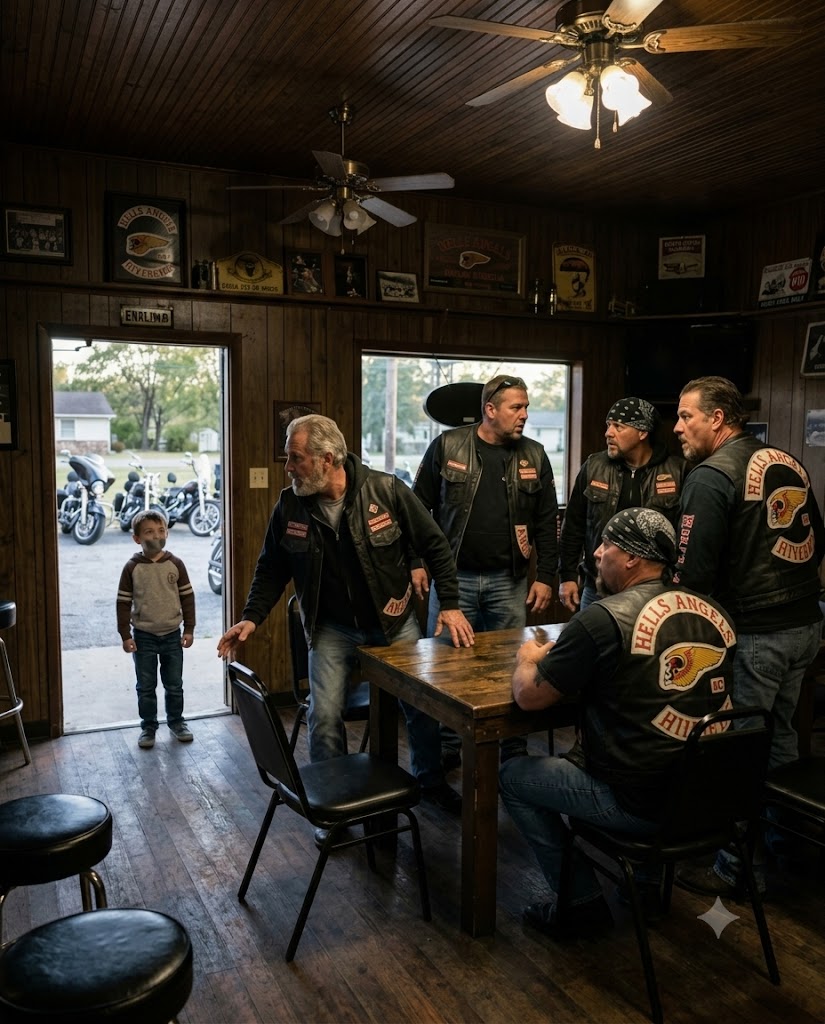
The door of the Iron Horse Tavern swung open on a Thursday night in July. Five hundred bikers turned toward it, tattooed, leather-clad, the kind of men who made the floorboards groan beneath their boots. What stood in the doorway weighed less than sixty pounds. A boy, eight years old, barefoot, duct tape sealed across his mouth in three thick strips, the edges crusted with dried blood where the adhesive had ripped skin. His eyes were not crying. They were burning. He walked straight to the biggest man in the room, stood on his toes, and pointed at the tape with trembling fingers. When Grant Harlan knelt down and peeled it away, the first words out of that boy’s mouth turned five hundred engines into a single heartbeat.
The Iron Horse Tavern had been standing on the corner of Lancaster Avenue and 9th Street since 1971, which meant it had survived five recessions, two fires, one tornado that took the sign but spared the roof, and more fistfights than any police blotter could accurately catalog. The building itself seemed to absorb punishment the way old leather absorbs rain. It darkened, it stiffened, but it held. The walls inside were layered with decades of smoke residue, concert flyers from bands that had broken up before most of the current patrons were born, and framed photographs of men on motorcycles who grinned into cameras as though the future was something they had already beaten.
On this particular Thursday evening in July, the air inside the Iron Horse carried the weight of five hundred bodies and the heat of a Texas summer that had been breaking records for three consecutive weeks. The temperature outside had touched 104 degrees at two in the afternoon and had only retreated to 97 by the time the sun began its slow, reluctant surrender behind the Fort Worth skyline. Inside, ceiling fans the size of helicopter rotors churned the air without cooling it, and the condensation on beer glasses evaporated almost as quickly as it formed.
Five hundred members and associates of the Stone Creek Motorcycle Club filled the tavern from wall to wall. It was the annual summer run gathering. The one night each year when every chapter from across Texas converged on the original Fort Worth clubhouse to pay respects, settle debts, swap road stories, and drink until the stories improved. The noise was a living thing. Laughter that rattled the windows, arguments that flared and died like matches in wind, the deep bass thrum of classic rock bleeding from speakers that had been rewired so many times the sound came out more like a memory of music than music itself.
At the far end of the bar, Grant Harlan sat on a stool that had learned his shape the way a saddle learns its rider. At fifty-two, the president of the Stone Creek MC carried himself with the economy of a man who had learned that wasted motion was wasted strength. Six foot three, two hundred seventy pounds, a barrel chest that tested the seams of his leather vest, thick gray beard trimmed close to a jaw that could have been carved from Texas limestone. His forearms were sleeved in tattoos so layered they looked like pages from a book written in ink and scar tissue. Eagles, chains, dates, names, one small angel wing on the inside of his left wrist that he never explained and nobody asked about. His eyes were deep set and brown, the color of creek water after a storm, and they held the particular stillness of a man who had buried his only son six years ago and had been slowly, methodically rebuilding himself around the hole ever since.
He was listening to Hank Mercer, his vice president, recount an encounter with a state trooper outside Abilene, a story that involved a busted taillight, a cooler full of brisket, and a trooper who turned out to be a second cousin Hank hadn’t seen since a family reunion in 1998. When the front door opened.
Doors open in bars. That is what doors are built to do. But this door did not open the way doors usually open in the Iron Horse. It did not swing wide with the confident shove of a man entering a room he owned. It opened slowly, tentatively, the way a hand parts a curtain when the person behind it is not sure what they will find on the other side.
The conversations nearest the entrance stuttered. Laughter dried up one voice at a time, the way a radio loses signal driving through hill country. Heads turned, brows furrowed. The silence spread outward from the door in concentric rings, one table, then the next, then the cluster of men by the pool table, then the row of stools along the bar, until five hundred voices had been replaced by the sound of a jukebox playing Waylon Jennings to a room full of statues.
Grant felt the shift before he saw the source. Thirty years of leading men had made him fluent in the language of sudden quiet. He set his beer down without looking at the glass and turned. The crowd near the entrance had parted. Not deliberately, not the way men step aside for rank or respect, but instinctively, the way people pull back from something their brains have not yet categorized. And there, standing in the doorway with the yellow glow of a street lamp behind him like a halo made of heat, was a boy.
He could not have been more than eight years old. He was small, not just young, small, but hungry small, the kind of thin that comes from plates that are never quite full and cupboards that are mostly empty. His hair was brown and tangled, plastered to his forehead with sweat. His face was sunburned across the cheeks and nose, the skin peeling in patches that he had clearly been picking at. He wore a gray T-shirt three sizes too large that hung past his hips like a dress, and shorts that had been cut from jeans with scissors that were not sharp enough to cut straight. His feet were bare. The soles were black with road grime and a thin line of blood traced along the outside of his left foot where something, glass, gravel, a nail, had cut him during what must have been a long walk.
But it was not the boy’s feet or his clothes or his size that silenced five hundred men. It was his mouth. Three strips of silver duct tape had been pressed across it horizontally, one on top of the other, sealing his lips from cheek to cheek. The tape had been there for some time. The edges had curled where sweat and heat had weakened the adhesive. And beneath those curled edges, the skin was raw and red, cracked in places where the tape had fused to flesh and torn it when the boy moved his jaw. A thin line of dried blood ran from the corner of his mouth down to his chin, following the path of gravity like a crack in a sidewalk.
His eyes were hazel, green near the center, brown at the edges, and they were not crying. They were searching. They swept the room with a focus that did not belong to a child, scanning face after face the way a drowning person scans a shoreline for anything solid enough to hold. And when those eyes found Grant Harlan, the biggest man in the room, the man in the president’s chair, the man whose patch read Stone Creek MC in letters stitched with gold thread, they stopped.
The boy walked toward him. Five hundred men watched an eight-year-old child cross a barroom floor in bare bleeding feet, weaving between boots and table legs and fallen peanut shells, and not one of them moved. Not because they did not want to, because they did not know how. Because the distance between what they were seeing and anything they had ever prepared themselves to see was so vast that their bodies had simply locked in place the way a compass needle freezes when it encounters a magnetic field it cannot reconcile.
The boy stopped in front of Grant. He tilted his head back to look up at a man who was nearly four times his height from that angle. He raised one hand, small, dirty, trembling, and pointed at the tape on his mouth. Then he pointed at Grant, then back at the tape. Grant Harlan had not cried in six years. Not since the hospital, not since the chaplain, not since the small casket that had weighed almost nothing and yet had somehow been the heaviest thing he had ever carried.
He knelt down. His knees hit the wooden floor with a sound like a gavel. He brought his face level with the boy’s face. He could see the tape up close now, the way it pulled at the skin with every breath, the way the boy’s nostrils flared wide to compensate for the mouth that could not open, the way his chest rose and fell in quick, shallow rhythms.
“I’m going to take this off,” Grant said, and his voice, a voice that had commanded five hundred men, that had delivered eulogies and ultimatums with equal steadiness, cracked on the last word like a branch that had held too much weight for too long.
He peeled the first strip, slowly. The boy’s eyes watered, but he did not flinch. The second strip. The skin beneath was raw and angry. The third strip. The boy’s lips parted, dry and cracked, and he took a breath through his mouth for what looked like the first time in hours. Then he spoke.
“My name is Levi Beckett,” the boy said, and his voice was small and rough and steady. “My daddy was Bolt. He rode with you, and my mama needs help.”
The room did not make a sound, not one sound, because every man in it had just heard a ghost’s son call them by name. Derek “Bolt” Beckett had died on Interstate 20 three years ago, eleven miles east of Fort Worth, on a Tuesday morning in October when the sky was so blue it looked painted. He had been riding alone, something he rarely did, but Sarah had a doctor’s appointment and he had dropped Levi at school early so he could make the morning run to pick up parts in Dallas. A flatbed truck carrying steel pipe had lost its load on a curve. Derek had no time and no room. The paramedics said it was instant. The club said it was a tragedy. The road said nothing because roads never do.
His funeral had packed the Iron Horse to the walls. Three hundred riders had escorted the hearse from the church to the cemetery in a column so long it stopped traffic on three highways. Hank Mercer had delivered the eulogy. Grant Harlan had folded Derek’s vest and placed it on the casket with hands that shook for the first and only time anyone could remember. Sarah Beckett, twenty-nine years old, had stood at the graveside holding five-year-old Levi’s hand while the boy asked in a whisper that carried farther than any engine, why his daddy would not wake up.
The club had promised to take care of the family. They always promised. It was the thing you said at funerals, the same way you said, “He’s riding with the wind now,” and “He was the best of us.” Not because the words were empty, but because grief has a script and the script exists to carry people through moments their own language cannot reach. For three months they had kept the promise. Groceries appeared on Sarah’s porch every Friday. Hank Mercer mowed her lawn. Donna Tate brought casseroles that could feed a family for a week. Grant himself had sat with Levi one Saturday afternoon and taught him to tighten a spark plug on an old Sportster that would never run again, but served its purpose as a classroom.
Then the months became a year. The groceries thinned. The lawn visits grew further apart. The casseroles stopped. Not because anyone decided to stop. No one ever decides to stop, but because the living have a gravitational pull that the dead cannot match, and the daily demands of the club, the road, the next ride, the next crisis, slowly and silently pulled every man’s attention away from a small house on Crenshaw Lane where a young widow was learning to survive without the man who had promised her the world and then left it.
Now, standing in the silence of the Iron Horse with the taste of the boy’s name still hanging in the air like gunsmoke, Grant felt the weight of every missed visit, every skipped phone call, every promise that had rusted from neglect.
“Bolt’s kid,” Hank Mercer said from behind Grant’s shoulder. His voice was barely a whisper, but in the silence of the room it carried like a shout. “That’s Bolt’s boy.”
Grant did not take his eyes off Levi. “I know who he is.” He placed both hands on the boy’s shoulders, gently, the way you hold something you are afraid of breaking, and looked into those hazel eyes that were so much like Derek’s it made his chest ache. “Levi, tell me what happened. Tell me everything.”
The boy took a breath. His lips were cracked and bleeding in the corners where the tape had pulled, and when he spoke, the words came out in a rush, as though he had been rehearsing them for miles.
“Mama married a man named Wade after Daddy died. He was nice at first. He said he’d take care of us. Then he moved us to a house out past Lake Worth, way out where there’s nothing. He took Mama’s phone. He took her car keys. He said we didn’t need anybody else. He said the club was bad people and we should forget about Daddy.”
Grant’s hands tightened on the boy’s shoulders. Not hard, but enough that Levi could feel the tremor in the man’s fingers.
“He doesn’t let Mama leave the house. She’s sick, but he won’t take her to a doctor. He says she’s fine, but she’s not fine. She coughs all night and she can’t get out of bed anymore, and there’s blood on her pillow in the mornings.”
The room had begun to breathe again. Not with relief, but with the slow pressurized breathing of five hundred men whose blood was rising in temperature one degree at a time.
“Why the tape, son?” Grant’s voice was a low scrape of gravel.
Levi’s eyes dropped to the floor, then came back up. “I tried to tell the mailman two weeks ago, when Wade went to the store. I ran to the mailbox when the truck came, and I told the mailman my mama was sick and we needed help. But the mailman just drove away. And when Wade came back, the mailman had—I guess he called somebody because Wade knew. And he was real mad.”
The boy’s voice did not shake. It was the voice of a child who had moved past fear into something harder, something colder, something that should never live inside an eight-year-old.
“He put the tape on my mouth. He said if I couldn’t keep quiet on my own, he’d keep me quiet himself. He put me in my room and locked the door from the outside. That was yesterday morning.”
“Yesterday morning?” Grant repeated.
“I waited until it got dark. I waited until I heard him go to bed. Then I climbed out the window. It’s small, but I’m small. And I walked here.”
Hank Mercer stepped forward. “How far, kid? How far did you walk?”
Levi looked at him with those old steady eyes. “I don’t know exactly. I followed the highway, the one Daddy used to take when he rode here. I remembered the turns. It took me a long time. I left when it was dark, and I walked all night and all day today.”
Twenty miles. An eight-year-old boy with tape on his mouth and no shoes on his feet had walked twenty miles through Texas heat to reach a bar full of men who had forgotten he existed.
Donna Tate, who had been watching from behind the bar with her hand pressed over her mouth, turned away and put both palms flat on the counter. Her shoulders shook once, hard, and then she was still.
Grant stood. His knees popped. His back straightened. When he turned to face the room, every man in it saw something change in his eyes, a door closing on patience and opening on something far more ancient.
“You all heard the boy,” Grant said. His voice was not loud. It did not need to be. Five hundred men would have heard him whisper. “That’s Derek Beckett’s son. Bolt’s son. Our brother’s son. And we let him down.”
The silence that followed was not empty. It was full. Full of guilt. Full of anger. Full of the particular shame that comes from realizing you broke a promise you swore on a dead man’s grave.
“We’re going to fix it,” Grant said. “Tonight.”
The first thing Grant did was take care of the boy. He carried Levi, who did not resist, who went limp against Grant’s chest the way a child does when exhaustion and relief arrive at the same moment, to the back office of the Iron Horse, the small room behind the bar where Donna kept the books and a cot she used during inventory nights. He set the boy on the cot. Donna appeared with a glass of water, a wet towel, and a first aid kit that had seen more use on road-rashed bikers than on children.
“Drink slow,” Grant said, holding the glass to Levi’s lips. “Small sips.”
Levi drank. His throat moved with the effort of swallowing, as though the muscles had forgotten how to work without obstruction. Donna cleaned the cuts on his feet with antiseptic that made him wince but not cry. She pressed a cold wet cloth to the raw skin around his mouth where the tape had stripped the top layer away, leaving patches that were pink and weeping.
“You walked twenty miles in bare feet,” Donna said quietly, wrapping gauze around the worst of the cuts. “Honey, why didn’t you put shoes on?”
“They were in the hall closet,” Levi said. “Wade’s bedroom is next to the hall. I couldn’t get to them without making noise.”
Grant stood in the doorway and watched Donna work. His hands were fists at his sides, not because he was angry at the boy, never at the boy, but because the image of an eight-year-old climbing through a window in the dark, walking twenty miles of Texas highway in bare feet with tape on his mouth rather than risk making noise past a locked bedroom door had settled into his chest like a cold that would never cool.
Hank appeared behind him. “What’s the play, brother?”
Grant stepped into the hallway. The noise from the bar had shifted, no longer the loose, scattered sound of a gathering, but the tight, focused hum of men waiting for orders. Five hundred riders stood or sat in clusters, speaking in low voices, every face turned halfway toward the back hallway, waiting.
“We do this right,” Grant said, “not hot, not stupid. Right.”
“Right how?”
“Call 911, Tarrant County Sheriff. Tell them we have a child who walked twenty miles to report his mother is being held against her will. Tell them the boy’s feet are cut to pieces and there was tape on his mouth. Give them the location.”
Hank’s jaw worked. “And if the cops drag their feet?”
“Then we don’t drag ours, but we give them the first shot. Derek wouldn’t want us going in there and ending up in handcuffs while his boy watches.”
Hank nodded slowly. “And the club?”
Grant looked past him through the doorway at the sea of leather and denim and hard-lined faces. “The club rides, every last one of them. We escort the sheriff out there. We stand on the property line. We don’t cross it unless we’re asked, but we make sure that man sees five hundred of us on that road and understands exactly what’s standing between him and ever hurting that boy or his mother again.”
Hank pulled out his phone and dialed. While Hank made the call, Grant went back into the office. Levi was lying on the cot with the wet cloth over his eyes. His chest rising and falling with the deep uneven rhythm of a body fighting between consciousness and collapse.
“Levi.”
The boy pulled the cloth away. “Yes, sir.”
Grant pulled a wooden chair beside the cot and sat. The chair groaned under his weight. He leaned forward, elbows on his knees, and looked at the boy the way he used to look at his own son. With a focus so total, it left no room for anything else in the world.
“I knew your daddy. I rode with him for eight years. He was one of the best men I ever met. Fast on the bike, but faster to help a brother. He had this laugh. You could hear it over the engines, even at full throttle. Sounded like someone shaking a bucket of gravel.”
Levi’s lips trembled. “I remember the laugh.”
“He used to talk about you all the time. Every meeting, every ride, every Saturday night at this bar. ‘Wait till Levi’s old enough to ride,’ he’d say. ‘That boy is going to be faster than me.’ He said it so often, Hank told him he had to pay a dollar every time he mentioned your name. Your daddy owed about three hundred dollars by the end.”
A sound came from Levi that was halfway between a laugh and a sob. It was the first sound he had made that sounded like a child.
“I should have been there,” Grant said. “After your daddy died, I should have checked on you, on your mama. I promised I would, and I didn’t. A lot of men out there promised, and none of us kept it. That’s on us, all of us.”
Levi looked at Grant with those hazel eyes, Derek’s eyes, unmistakably, terribly Derek’s eyes, and said something that hit Grant harder than any fist ever had.
“Daddy said if anything ever happened, go to the club. He said the club was family. I waited three years to come. I wanted to come sooner, but I didn’t know if you’d remember.”
Grant put his hand over his face. His shoulders did not shake. His breathing did not change. But when he lowered his hand, his eyes were wet, and he did not try to hide it.
“We remember,” he said, “and we’re coming.”
Hank appeared in the doorway. “Sheriff’s on the line. They’re sending a unit, but they want us to stay put until they—”
“No.” Grant stood. “We ride. We meet them there. Every man in this building.”
Hank hesitated. “Grant, they said—”
“I heard what they said, and I’m telling you what we’re doing. We ride behind them, not ahead of them. We follow the law, but that boy walked twenty miles to find us, and we are not going to sit in this bar drinking beer while his mother is out there alone with a man who put tape on a child’s mouth.”
Hank looked at Grant for a long moment. Then he nodded. “I’ll get them moving.”
Within four minutes, the Iron Horse Tavern was empty. The sound was something Fort Worth had never heard before and would never hear again. Five hundred motorcycles lined up four abreast, stretching back along Lancaster Avenue for nearly half a mile, their engines creating a vibration that rattled windows in buildings three blocks away. Street lights reflected off chrome and polished steel in ribbons of white and amber. The rumble was not loud in the way a concert is loud. It was loud in the way an earthquake is loud, something felt in the bones before the ears could process it, something that made the pavement itself seem to pulse.
Grant rode at the front, alone. His Harley Road King, black with silver trim, the same bike he had ridden for fourteen years, ate the road with the steady patience of a machine that knew exactly where it was going. Behind him, Hank Mercer. Behind Hank, the rest. Chapter presidents, road captains, sergeants-at-arms, prospects, hang-arounds, men who had ridden since before Levi was born, and young men who had just earned their patches last spring. All of them, every single one.
Levi sat behind Grant, his thin arms wrapped around the man’s waist, his cheek pressed against the leather of Grant’s vest. Grant had given him a pair of boots from the lost and found, too big by three sizes, stuffed with bar towels to fill the space. And Donna Tate’s reading glasses doubled as wind protection for his eyes. He looked absurd. He looked safe.
Two Tarrant County Sheriff’s cruisers waited at the junction of Route 199 and Lake Worth Road. Their light bars painted the darkness in alternating red and blue. The deputies had been told to expect a motorcycle club. They had not been told to expect five hundred.
The lead deputy, a woman named Sergeant Ellen Crawford, fifteen years on the force, unflappable by professional requirement, stepped out of her cruiser as the column approached, and stood with her hands on her hips, watching the line of headlights stretch back into the darkness like a river of stars flowing in the wrong direction.
Grant pulled alongside her cruiser and cut his engine. The silence that followed was almost as disorienting as the noise that had preceded it. Five hundred engines dying in sequence, a cascade of quiet that rolled backward through the column like a wave retreating from shore.
“Sergeant Crawford,” Grant said.
“You’re Grant Harlan.”
“Yes, ma’am.”
She looked at the column behind him. “I was told there would be a few of you.”
“A few more than a few.”
Her eyes moved to Levi, who peered out from behind Grant’s back like a small animal considering whether the world outside the burrow was safe. “Is this the boy?”
“Levi Beckett, eight years old. His mother is Sarah Beckett. The property is registered to Wade Dunlap, 14200 Old Creek Road. My VP gave dispatch the details.”
Crawford knelt to Levi’s eye level. Her voice changed, not softer exactly, but wider. The way a river widens when it reaches flat ground. “Hi there, Levi. I’m Sergeant Crawford. You did a very brave thing tonight. Can you tell me what we’re going to find when we get to the house?”
Levi swallowed. “My mama, she’s in her bedroom. The door locks from the outside. Wade put a padlock on it after she tried to leave the first time. And Wade, he’ll be asleep. He goes to bed at ten and he sleeps real hard.”
Crawford’s jaw tightened almost imperceptibly. She stood and looked at Grant. “Here’s how this works. My units go in first. Your people stay on the road. Nobody crosses the property line. If Dunlap is there and cooperates, we handle it clean. If he doesn’t cooperate, we still handle it clean. Either way, your people stay out. Understood?”
“Yes, ma’am.”
“I mean it, Mr. Harlan. I appreciate what you’re doing. I understand why you’re here. But if any one of your five hundred friends sets foot on that property, I will arrest them. And I will arrest you. And this boy will spend the night in a CPS office instead of somewhere safe.”
Grant looked at her steadily. “Not one foot on the property. You have my word.”
She held his gaze for three seconds. Then she nodded. “Follow us. Single file once we hit Old Creek Road. And for the love of everything, keep those engines low.”
The convoy moved. Old Creek Road was a two-lane blacktop that wound through rolling pasture land. The kind of road that existed primarily to connect properties that did not want to be connected to anything. There were no streetlights. The only illumination came from the headlights of the cruisers and the five hundred motorcycles that followed them. A snake of light crawling through the Texas darkness.
The Dunlap property sat at the end of a gravel driveway, half a mile off the road, behind a line of live oaks that blocked the view from the highway. The house was a single-story ranch, white paint gone gray with neglect, porch light burned out, windows dark except for the blue flicker of a television visible through a gap in the curtains.
The cruisers turned up the driveway. Grant stopped at the road. Behind him, five hundred motorcycles came to rest in a line that stretched back along Old Creek Road for a quarter mile. They did not cut their engines. The sound filled the night, low, steady, patient, a sound like the breathing of something enormous that was watching and waiting and would not leave.
From the road, Grant could see the cruisers stop in front of the house. Doors opened, flashlights, Crawford’s voice amplified by distance and authority calling out, “Tarrant County Sheriff’s Department, open the door.”
Silence. Then the porch light came on. Someone had replaced the bulb or flipped a switch, and the front door opened, and a man stood there in a T-shirt and boxer shorts squinting into the flashlights with the confused, irritated expression of someone who did not understand why the world had come to his door.
The conversation was too far away to hear, but Grant watched the body language. Crawford squared and steady. Dunlap arms crossing, uncrossing, gesturing, shaking his head. The second deputy circling toward the side of the house. Crawford’s hand moving to her radio. More words. Dunlap’s posture shifting, shoulders rising, chin jutting, the universal language of a man who was about to make a mistake.
And then from inside the house, a sound that carried across the gravel and through the trees and reached the road with perfect, terrible clarity. A woman’s voice, faint, ragged, desperate. “Help me, please. Someone help me.”
Crawford moved past Dunlap and into the house. The second deputy positioned himself between Dunlap and the door. Dunlap took one step forward and the deputy placed a hand on his chest. Not a push, not a strike, just a hand, a boundary, a wall.
Three minutes later, Crawford emerged. She was supporting a woman who could barely stand. Thin, pale, wearing a nightgown that hung on her frame like a flag on a windless day. The woman’s hair was matted, her cheeks were hollow. She blinked at the flashlights as though she had not seen light brighter than a bedroom window in months.
Levi made a sound. It was not a word. It was not a cry. It was the sound of a boy who had walked twenty miles in bare feet through Texas heat with tape on his mouth to find help for his mother and was now watching that help arrive.
“Mama,” he whispered.
Grant put his hand on the boy’s shoulder. “She’s safe, son. Look, she’s safe.”
An ambulance materialized, called by Crawford at some point during the approach, and paramedics moved toward Sarah with the efficient urgency of people who could see at a glance that this woman needed a hospital. Dunlap was placed in handcuffs. He did not resist. Whatever fight he had been considering had evaporated when he heard the sound from the road. That low, ceaseless rumble, and looked past the cruisers to see, stretching into the darkness, a line of headlights so long it seemed to have no end. Five hundred men sitting on five hundred machines watching him with the collective patience of a jury that had already reached its verdict.
He said nothing. He got into the cruiser. The door closed.
Sarah Beckett spent nine days in Harris Methodist Hospital. The doctors found pneumonia that had gone untreated for so long it had begun to scar her lungs. They found dehydration, malnutrition, vitamin deficiencies that spoke of a diet consisting primarily of canned soup and tap water. They found bruises in various stages of healing on her arms and wrists. Fingerprint bruises, the kind that come from being held in place by someone stronger. They found a woman who had been thirty-two years old, but whose body had been forced to age a decade in less than two years of isolation and deprivation.
What they did not find was a woman who had given up. Because Sarah Beckett, even in her worst moments, even when the padlock clicked shut on the outside of her bedroom door, even when the days blurred together into an endless gray corridor of coughing and silence, and the distant sound of her son being told to be quiet, had done one thing that Wade Dunlap had never known about.
She had told Levi about the club. Every night whispering through the locked door, her voice thin and broken, but relentless, she had told her son stories about his father, about the Stone Creek MC, about the Iron Horse Tavern on Lancaster and 9th, about the men who had called Derek Bolt because he was the fastest thing on two wheels in Tarrant County. She had described the route down the highway, past the lake, through the underpass, left on Lancaster, until Levi could recite it in his sleep. She had told him over and over in a whisper that carried more weight than any shout, “If you ever get the chance, baby, go to the club. They were your daddy’s family. They’ll be yours.”
She had given him the map. He had walked it.
Grant visited her every day she was in the hospital. The first visit, she had looked at him with eyes that held so much gratitude and so much accusation that he had not been able to speak for a full minute. The second visit, she had asked about Levi, who was staying with Donna Tate in the apartment above the Iron Horse, eating three meals a day for the first time in a year, and sleeping in a bed with sheets that smelled like fabric softener instead of dust. By the third visit, they were talking. By the fifth, she was sitting up. By the seventh, she was standing at the window looking out at the parking lot counting the motorcycles.
There were always motorcycles. The Stone Creek MC had established an informal rotation. Two riders at the hospital at all times parked outside Sarah’s window like chrome and steel guardian angels who smoked too much and swore too loudly in the parking lot. But who were there, visible, constant. A promise being kept in real time.
Wade Dunlap was charged with unlawful restraint, endangering a child, and assault causing bodily injury. He did not make bail. His court-appointed attorney advised him to take a plea. He took it. The details were handled by lawyers and judges and a system that moved with its own particular slowness. But the outcome was never in doubt. Not after Levi’s testimony, delivered in a courtroom with a steady voice and dry eyes, described the tape, the locked doors, the silence, and the twenty-mile walk.
The boy spoke, and the court listened. The world, as it turned out, tended to listen when Levi Beckett decided to speak.
On the day Sarah was released from the hospital, Grant drove her home. Not to the house on Old Creek Road, which she would never see again, but to a small two-bedroom house on Crenshaw Lane, three blocks from where she and Derek had lived before. The house had been rented and furnished by the club. The deposit had been paid from the general fund. The refrigerator had been stocked by Donna Tate. The lawn had been mowed by Hank Mercer, who had also fixed a leaking faucet in the kitchen and repainted the front door a shade of blue that Sarah later said reminded her of the sky on the day she married Derek.
Levi was waiting on the porch when they arrived. He was wearing new sneakers, a gift from a prospect named Tyler who had three boys of his own and understood the sacred importance of shoes that fit. And a T-shirt that was, for the first time in as long as he could remember, the right size.
Sarah walked up the porch steps. Her legs were still unsteady. Her breathing was still shallow, but she was walking under her own power in the open air without a locked door behind her. She knelt in front of her son. She took his face in both hands, hands that were thin and trembling and stronger than any hands Grant had ever seen. And she looked at him.
“You found them,” she whispered.
“I remembered the way,” Levi said. “You told me the way.”
She pulled him into her arms and held him. And the boy held her back. And neither of them made a sound because there are moments that exist beyond language, beyond voice, beyond the reach of any word in any tongue. Moments that can only be held, not spoken.
Grant stood by his motorcycle and watched. Hank stood beside him. Neither spoke. Behind them, on the street, six motorcycles idled. The escort that had followed them from the hospital, engines rumbling with that low, steady patience that had become the soundtrack of the Beckett family’s resurrection.
After a long time, Sarah stood. She looked at Grant. “Thank you,” she said.
Grant shook his head. “Don’t thank me. I was three years late. You came. Your boy came. He walked twenty miles to find us. All we did was answer the door.”
Sarah looked at Levi, who was sitting on the porch railing now, swinging his legs, watching the motorcycles with an expression that Grant recognized because he had seen it on Derek’s face years ago, the first time Bolt had sat on a Harley and felt the engine come alive beneath him. That look of belonging, of knowing where you fit.
“He’s his father’s son,” Sarah said.
“Yes, ma’am. He is.”
That evening, the Stone Creek MC held church at the Iron Horse Tavern. Five hundred members were not present. The summer run had ended. The chapters had returned to their home cities. But the Fort Worth chapter, eighty-seven men strong, filled the back room the way they had every Thursday night for decades. Grant stood at the head of the table. He did not sit. He looked at each man in the room one by one the way a captain counts his crew.
“Three years ago, we buried Derek Beckett. We promised his wife we’d be there. We promised his son. And we broke that promise. Every one of us. We let the road pull us away from a family that needed us. And an eight-year-old boy had to walk twenty miles in bare feet with tape on his mouth to remind us who we are.”
He paused. The room was silent.
“That doesn’t happen again. Not to the Becketts. Not to any family that carries our name. A brother dies, his family becomes our family. Not for three months. Not until the grief gets inconvenient, but for as long as they need us. That’s not a suggestion. That’s law. Starting tonight.”
He reached into his vest and pulled out a small object. A patch. Not a full member’s patch. Something smaller, simpler. A single word stitched in gold thread on a black background.
“Family. This goes to every wife, every husband, every child of every member who’s ever ridden with us. It means they can walk into any Stone Creek clubhouse anywhere, anytime, and they will be heard. No questions. No waiting. No twenty-mile walk required.”
He set the patch on the table. “The first one goes to Levi Beckett.”
Hank Mercer started the applause. It spread through the room like a brush fire, growing louder and harder until the walls of the Iron Horse shook with it. Not the polite applause of agreement, but the thunderous full-bodied applause of men who were clapping for their own redemption.
Two weeks later, on a Saturday morning, when the Texas heat had finally broken enough to allow the sky a few clouds, Grant Harlan pulled his Road King up to the house on Crenshaw Lane. Levi was sitting on the porch wearing the family patch pinned to his T-shirt, his new sneakers double-knotted the way Grant had taught him.
“Ready?” Grant said.
Levi walked down the steps. Sarah appeared in the doorway behind him, coffee in hand, color returning to her cheeks, weight returning to her frame. She watched her son approach the motorcycle with an expression that was equal parts terror and pride. The expression of a mother who understands that she cannot protect her child from the world, only equip him to face it.
Grant helped Levi onto the back of the bike, the boy’s arms wrapped around his waist, stronger now, steadier, no longer trembling.
“Where are we going?” Levi asked.
Grant kicked the engine to life. The Harley roared, then settled into its deep rolling idle, the sound of patience, of power held in check, of a machine that had all the time in the world.
“Wherever you want, son.”
They rode, and for the first time in three years, the road did not feel like something that had taken someone away. It felt like something that was bringing someone home.
—
The weeks that followed carried a rhythm the Beckett household had not known in years. Sarah slept past sunrise without startling at the sound of a door. Levi ate breakfast at a table with two chairs instead of one. The house on Crenshaw Lane began to smell like coffee and laundry detergent instead of stale air and fear.
Grant came by every Sunday. Not because anyone asked him to, but because he had learned that promises kept on a calendar were the only kind that mattered. He fixed a loose board on the porch. He changed the oil in Sarah’s new used sedan, a beige Honda the club had bought at auction and repaired in Hank’s garage. He taught Levi how to check tire pressure, how to hold a wrench, how to listen to an engine and hear what it was trying to say.
“You don’t have to keep coming,” Sarah told him one afternoon, watching from the doorway as Grant and Levi crouched beside the Honda.
“I know,” Grant said, not looking up. “That’s why I keep coming.”
Levi started third grade at a new school that September. The first week, a boy on the playground asked him why his T-shirt had a patch on it. Levi looked down at the gold-threaded word stitched across his chest and said, “It means I have family.”
The boy didn’t understand. Most people wouldn’t. But that was all right. Levi wasn’t explaining it for them. He was saying it for himself.
The Stone Creek MC kept its word. The family patch became a quiet institution, stitched onto vests and jackets and backpacks across Texas. When a member’s wife was diagnosed with cancer in Amarillo, three chapters rotated shifts at the hospital. When a prospect’s father died in El Paso, six riders showed up for the funeral in their colors. When a chapter president’s daughter needed a kidney transplant in Houston, the club raised $47,000 in eleven days.
Nobody kept count. Nobody needed to. The patch was enough. It meant what it said.
Wade Dunlap was sentenced to twelve years in state prison. He would be eligible for parole in six. Sarah did not attend the sentencing. She did not need to. She had already moved past the man who had locked her behind a door and told her son to be quiet. The courtroom was a formality, a punctuation mark at the end of a sentence that had already been served.
Levi testified for the last time at a hearing in October. He wore a button-down shirt that Donna Tate had ironed for him. He answered the prosecutor’s questions in a clear, steady voice. He did not look at Wade Dunlap. Not once. Not because he was afraid, but because Wade Dunlap no longer existed in the world Levi was building. Some people you leave behind. Not with anger. With absence.
After the hearing, Grant took Levi to lunch at a diner on Camp Bowie Boulevard. They sat in a booth by the window and ordered cheeseburgers and chocolate shakes. Levi ate his fries one at a time, dipping each one in ketchup with the methodical precision of a boy who had once gone to bed hungry and had never forgotten what it felt like.
“You did good today,” Grant said.
“I know,” Levi said. “Mama said I did good too.”
“She’s right.”
Levi was quiet for a moment, chewing. Then he said, “Grant?”
“Yeah?”
“Do you think my daddy would be proud of me?”
Grant set down his burger. He looked at the boy across the table, at the hazel eyes that were so much like Derek’s, at the small hands that had peeled tape from a mouth and walked twenty miles in the dark.
“He’d be proud of you every single day,” Grant said. “But not because you walked twenty miles. Not because you testified in court. Not because you were brave. He’d be proud of you because you’re you. Because you’re his son. Because you remembered the way home.”
Levi nodded slowly. He picked up another fry. “I miss him.”
“I know. I miss him too.”
They ate in silence for a while. Outside, the October sky was blue and wide and clean, the way it had been on the morning Derek Beckett died. But Levi didn’t know that. He only knew that the sun was warm on the window, and the shake was cold, and the man across from him had kept every promise he had ever made.
That was enough. That was more than enough.
The Iron Horse Tavern still stands on the corner of Lancaster Avenue and 9th Street. The sign has been repainted twice. The jukebox still plays Waylon Jennings. The floorboards still groan beneath the boots of men who have ridden through the worst weather Texas can offer and come back to tell about it.
But something changed that Thursday night in July. Something shifted in the foundation of the place, something that had nothing to do with the building and everything to do with the men inside it. The Iron Horse became more than a bar. It became a promise. A place where a boy could walk in with tape on his mouth and find five hundred men ready to listen.
Levi Beckett still comes to the Iron Horse. Not every week, not every month. But on the nights when the club gathers, when the engines rumble low and the laughter rattles the windows, he is there. Sometimes he sits at the bar with a root beer and listens to the men tell stories about his father. Sometimes he stands by the door and watches the motorcycles pull in, one after another, a river of chrome and steel that never runs dry.
And sometimes, when the night is quiet and the jukebox is between songs, he reaches up and touches the patch on his jacket. The one that says Family. The one that means he will never have to walk twenty miles in the dark again.
Because the door of the Iron Horse Tavern is always open. And the men inside are always listening.
That is what the patch means. That is what the club is for. That is what happens when five hundred bikers hear a knock at the door and remember that family is not something you earn. It is something you keep.
And Levi Beckett, eight years old, barefoot, with tape on his mouth, walked twenty miles to remind them.
They never forgot again.
—
## PART TWO
The first frost of November arrived in Tarrant County like a rumor that turned out to be true. Temperatures dropped from the eighties to the forties in a single day, and the trees along Crenshaw Lane shed their leaves in a slow-motion cascade that turned the sidewalks gold and brown. Levi watched from the front window, his breath fogging the glass, his fingers tracing patterns in the condensation. He had never noticed seasons before. In the house on Old Creek Road, the days had blurred together into a single gray corridor of waiting and silence. Now he noticed everything. The way the sky changed color at dusk. The way the air smelled different when it was about to rain. The way his mother hummed while she cooked breakfast.
Sarah was getting stronger. The doctors had said it would take time, that her lungs would heal, that her body would remember how to be healthy. They were right. Every week she could walk a little farther, breathe a little deeper, stay awake a little longer. She had started working part-time at a bookstore on Camp Bowie Boulevard, shelving paperbacks and drinking coffee with the owner, a woman named Patricia who had hired her on the spot after hearing her story.
“You’re a survivor,” Patricia had said. “I hire survivors.”
Sarah had cried in the car on the way home. Not because she was sad. Because she had forgotten what it felt like to be seen.
Levi was doing well in school. His teacher, a young woman named Ms. Okonkwo, had called Sarah after the first month to say that Levi was reading at a level two grades above his age, that he had a gift for math, that he was quiet but observant. “He watches everything,” Ms. Okonkwo said. “He notices things other kids miss.”
Sarah knew what that meant. She knew that hypervigilance was a survival skill, that Levi had learned to read rooms and faces and silences the way other children learned to ride bikes. She knew that some of the things he noticed were things no eight-year-old should have to notice. But she also knew that those same skills would serve him well. That the boy who had walked twenty miles in the dark would grow into a man who could find his way through anything.
The Stone Creek MC had become a fixture in their lives. Not in an overwhelming way, not in a way that crowded them or made them feel watched. Just present. Hank Mercer still mowed the lawn, but now he did it on Saturdays when Levi could help, teaching the boy how to check the oil and sharpen the blade. Donna Tate still brought casseroles, but now she stayed for dinner, sitting at the table with Sarah and Levi and talking about books and weather and the latest drama at the Iron Horse. Tyler, the prospect with three boys of his own, had started a weekly ritual of taking Levi to the park on Sunday afternoons, where they would throw a football and talk about nothing in particular.
And Grant. Grant was always there. Not every day, not even every week. But always. A phone call on Tuesday to check in. A text on Friday to ask if Levi needed anything. A surprise visit on a random Wednesday with a bag of groceries and a new book for Levi’s collection. He never stayed long. He never made a fuss. He just showed up, the way family does.
Levi started calling him Uncle Grant in October. It happened without ceremony, without a conversation. Levi simply said it one afternoon when Grant pulled into the driveway, and Grant simply nodded, and that was that. The word settled into the space between them like it had always been there.
“How’s your mama doing?” Grant asked one Saturday, sitting on the porch steps while Levi dribbled a basketball in the driveway.
“She’s good. She laughed at a movie last night. A real laugh, not the fake kind.”
Grant nodded. “That’s good. That’s real good.”
“Uncle Grant?”
“Yeah?”
“Do you think Wade will come back?”
Grant’s jaw tightened. He had been waiting for this question. He had been dreading it, preparing for it, rehearsing his answer in the shower and on the road and in the quiet moments before sleep.
“No,” he said. “He won’t.”
“How do you know?”
“Because he’s in prison. And because even if he got out, he’d have to go through me. Through Hank. Through every man in the club. He knows that. He saw us on that road. He knows what’s waiting for him if he ever comes near you or your mama again.”
Levi stopped dribbling. He looked at Grant with those hazel eyes that were so much like Derek’s, and he said something that made Grant’s chest ache.
“I’m not scared of him anymore.”
“Good.”
“I used to be. I used to be scared all the time. But then I walked to the bar, and you took the tape off, and I wasn’t scared anymore. I don’t know why.”
Grant stood up. He walked over to Levi and knelt down, the way he had knelt in the Iron Horse all those months ago. He put a hand on the boy’s shoulder.
“You’re not scared because you did the scariest thing you could do. You walked twenty miles in the dark with tape on your mouth. You faced the unknown. And you survived. That’s what courage is, Levi. Not the absence of fear. The decision that something else is more important.”
Levi nodded slowly. He looked at the basketball in his hands, then back at Grant.
“I want to be like my daddy,” he said. “I want to ride motorcycles and help people and be brave.”
“You already are brave,” Grant said. “And you’ve already helped people. You helped your mama. You helped yourself. The motorcycles can wait.”
Levi smiled. It was a small smile, but it was real. “Okay.”
“Okay.”
They went back to playing basketball. The sun was warm on their shoulders, and the sky was blue and wide, and for a moment, the world felt exactly the way it was supposed to feel.
Thanksgiving came and went. The Stone Creek MC hosted a dinner at the Iron Horse, a potluck that filled the back room with turkey and dressing and pies of every description. Sarah brought a green bean casserole that Donna Tate had helped her make. Levi brought his appetite.
The room was loud and warm and crowded. Men who had once terrified him now clapped him on the back and called him Little Bolt. Women who had once been strangers now hugged him and asked about school. He sat at a table with Hank and Donna and Tyler and their families, eating until he couldn’t eat anymore, laughing at jokes he didn’t fully understand, feeling something he had not felt in a long time.
He felt like he belonged.
After dinner, Grant stood up and called for quiet. The room settled slowly, the way a room does when the person calling for quiet is someone everyone respects.
“I want to say something,” Grant said. “Something I should have said a long time ago.”
He looked around the room, at the faces of the men and women who had ridden with him through good times and bad, who had stood beside him when he buried his own son, who had followed him into the darkness on a July night because a boy with tape on his mouth had asked them to.
“Three years ago, we lost Derek Beckett. And we made a promise. A promise we didn’t keep. We let time and distance and the daily grind pull us away from a family that needed us. And that family paid the price.”
The room was silent. Sarah looked down at her plate. Levi looked at Grant.
“But here’s the thing about promises,” Grant continued. “They can be broken. And they can be remade. That’s what we did. We remade a promise. We made it stronger. We made it permanent.”
He reached into his pocket and pulled out something small. A patch. The same patch he had given to Levi two weeks after the night at the bar. A single word stitched in gold thread on a black background.
“Family,” Grant said. “That’s what this means. That’s what we are. Not just the men who wear these colors. Everyone who wears this patch. Every wife. Every husband. Every child. Every mother and father and brother and sister. We are family. And family shows up.”
He looked directly at Levi. “Levi Beckett showed up. He showed up for his mama. He showed up for us. He reminded us who we are. And I want everyone in this room to remember that. I want you to remember what it felt like to see that boy walk through that door. I want you to remember what it felt like to know that we had failed him, and to decide that we would never fail him again.”
Grant raised his glass. “To Levi. To Sarah. To Derek. To family.”
The room echoed back. “To family.”
Levi didn’t understand everything that was happening. He was eight years old, and the world was still large and confusing and full of things he didn’t know. But he understood this: he was surrounded by people who loved him. People who had shown up for him, just like he had shown up for them. People who would keep showing up, no matter what.
And that was enough. That was everything.
December brought cold winds and early sunsets. Sarah decorated the house on Crenshaw Lane with a small tree and a string of lights that Hank had helped Levi hang. The house smelled like cinnamon and pine, and the windows glowed warm against the dark.
Christmas Eve, the Stone Creek MC held a party at the Iron Horse. It was smaller than the summer run, quieter, but no less warm. Men who had once been strangers were now friends. Levi sat at the bar with a mug of hot chocolate, watching the adults talk and laugh and exchange gifts.
Grant came over and sat beside him. “How you doing, kid?”
“Good. I got a present for you.”
“You did?”
Levi reached into his jacket and pulled out a small box wrapped in newspaper. Grant took it and unwrapped it carefully. Inside was a keychain. A silver motorcycle, small and detailed, with the words Stone Creek MC engraved on the side.
“I got it at the store with Mama,” Levi said. “I wanted to get you something. Because you gave me something.”
Grant looked at the keychain for a long time. His eyes were wet again, but he didn’t try to hide it.
“What did I give you?” he asked.
“A home,” Levi said. “A family. A place to go.”
Grant closed his hand around the keychain. He looked at the boy beside him, at the hazel eyes and the steady gaze and the small, determined chin.
“You gave me the same thing,” Grant said. “You gave all of us the same thing.”
Levi smiled. “Merry Christmas, Uncle Grant.”
“Merry Christmas, Levi.”
They sat together in the warmth of the Iron Horse, listening to the laughter and the music and the low rumble of motorcycles outside. The night was cold, but the room was warm. The world was dark, but the lights were bright.
And somewhere, in the quiet corner of the universe where the road meets the sky, a man named Derek Beckett smiled.
He had told his son to go to the club. He had told his son that the club was family. And his son had listened. His son had walked twenty miles in the dark with tape on his mouth. His son had found help.
And the club had answered.
That was the story. That was the promise. That was the way it was supposed to work.
—
## PART THREE
Spring came to Fort Worth like a slow exhale. The trees along Crenshaw Lane exploded into green, the bluebonnets bloomed along the highways, and the air carried the smell of cut grass and possibility. Levi turned nine in April, and the club threw him a party at the Iron Horse that was, by any measure, excessive.
Donna Tate baked a cake in the shape of a motorcycle. Hank Mercer brought a piñata shaped like a helmet. Tyler and his boys set up a makeshift ring toss using old tires. Sarah stood in the corner, watching her son run between the tables with a dozen other children, his face flushed with laughter, and felt something she had not felt in years.
She felt safe.
The party went on for hours. There were presents and games and more food than anyone could eat. Levi received a new bike, a real one, a blue Schwinn with training wheels that Grant had picked out himself. He received books and board games and a pocket knife that Sarah had only reluctantly allowed. He received hugs and handshakes and claps on the back.
But the best present came at the end of the night, when the children had gone home and the adults had settled into chairs and the jukebox had switched to something slower.
Grant stood up and called for quiet. The room settled.
“Levi,” he said. “Come here.”
Levi walked over, suddenly shy. He stood in front of Grant, looking up at the man who had become so much more than a stranger.
“Nine years old,” Grant said. “That’s a big deal. That’s almost a decade. That’s old enough to start learning some things.”
Levi nodded.
“Your daddy was a rider,” Grant said. “He was one of the best. And I know he would have wanted you to learn to ride. Not just a bicycle. A real bike. A motorcycle.”
Levi’s eyes went wide.
“Now, you’re too young to ride on the road. But you’re not too young to learn. So here’s what we’re going to do. Every Saturday, starting next week, you’re going to come out to Hank’s garage. And we’re going to teach you how to work on bikes. How to fix them. How to understand them. And when you’re old enough, when you’re ready, we’ll teach you how to ride.”
Levi didn’t say anything. He just looked at Grant with those hazel eyes, and then he launched himself forward and wrapped his arms around Grant’s waist.
Grant hugged him back. The room was silent for a moment, and then it erupted in applause.
Sarah wiped her eyes with the back of her hand. Hank clapped the loudest. Donna let out a whoop that rattled the windows.
And Levi, nine years old, held onto Grant and felt the world settle into place around him.
He had found his family. He had found his home. And he had found something else, something he would carry with him for the rest of his life.
He had found his way.
The Saturdays at Hank’s garage became the highlight of Levi’s week. He would show up early, wearing old jeans and a T-shirt, ready to learn. Hank would hand him a wrench and a rag and a list of things to check. Grant would show up later, after his morning ride, and sit on an old crate, drinking coffee and offering advice.
They taught him the difference between a flathead and a Phillips. They taught him how to check the oil, how to change a spark plug, how to clean a carburetor. They taught him the names of the parts and the sounds of the engines and the feel of a machine that was running right.
But they taught him something else too. They taught him about patience. About taking your time. About doing things right the first time so you didn’t have to do them twice.
“You can’t rush a bike,” Hank said one afternoon, watching Levi struggle with a stubborn bolt. “You have to listen to it. Feel it. Every machine has its own personality. You have to learn to work with it, not against it.”
Levi nodded. He kept working, his small hands gripping the wrench, his brow furrowed with concentration. The bolt finally gave way, and he let out a breath.
“Good,” Hank said. “Now you know. Next time, it’ll be easier.”
Levi smiled. He was learning. Not just about bikes. About life.
Summer came, and with it the annual summer run. Five hundred riders converged on the Iron Horse for a weekend of riding, drinking, and storytelling. The streets around the bar filled with motorcycles, and the air filled with the rumble of engines.
Levi was there for all of it. He sat at the bar with a root beer, listening to stories about road trips and close calls and the time Hank had accidentally led a group of riders into a cattle ranch in New Mexico. He watched the men and women in their colors, their vests covered in patches and pins, their faces weathered and strong. He watched the way they treated each other, with respect and affection and the easy familiarity of people who had been through things together.
And he watched Grant, who moved through the crowd like a captain through his crew, shaking hands and offering words and making sure everyone was taken care of. Grant was different at the bar. He was more relaxed, more open, more like a man who had found his place in the world.
Levi wanted to be like that. He wanted to be someone people looked up to. Someone people trusted. Someone who showed up when it mattered.
He was nine years old, and he had already learned more about being a man than most people learned in a lifetime.
The summer run ended, and the chapters returned to their homes. The bar grew quiet. The streets emptied. Fort Worth settled back into its regular rhythm.
But the club stayed. The Fort Worth chapter met every Thursday, and Levi was always welcome. He sat in the back room during the meetings, listening to the men discuss club business, watching the way they made decisions and settled disputes and took care of each other.
He didn’t understand everything. He didn’t need to. He was learning. He was watching. He was becoming.
One Thursday in August, Grant called him into the back office after the meeting. Levi walked in and sat on the cot, the same cot he had lain on the night he had first come to the Iron Horse.
“Levi,” Grant said. “I have something for you.”
He reached into a drawer and pulled out a small box. He handed it to Levi.
Levi opened it. Inside was a patch. A small patch, black and gold, with a single word stitched in the center.
Prospect.
“What’s this?” Levi asked.
“It’s a prospect patch,” Grant said. “It means you’re part of the club. Not a full member, not yet. You’re too young for that. But you’re one of us. You’re family.”
Levi looked at the patch. It was smaller than the family patch he already wore. Simpler. But it meant something more.
“I don’t understand,” Levi said.
“You will,” Grant said. “You’re going to grow up in this club, Levi. You’re going to learn to ride, and you’re going to earn your colors, and one day, you’re going to be a member. A full member. A man who can lead other men. A man who shows up.”
Levi looked at Grant. “Like you?”
“Like me,” Grant said. “Like your daddy. Like every man in this club who ever kept a promise.”
Levi held the patch in his hand. It was small and light and meant everything.
“Thank you,” he said.
“You’re welcome,” Grant said. “Now, let’s go get some dinner. I’m hungry.”
They walked out of the office together, into the warmth of the Iron Horse, into the noise and the laughter and the life of the club. Levi sat at the bar next to Grant, eating a cheeseburger and watching the room.
He was nine years old. He had walked twenty miles in the dark. He had peeled tape from his mouth and spoken words that had turned five hundred engines into a single heartbeat.
And now he was a prospect. A future member. A man in training.
He had a long way to go. But he knew where he was going. And he knew who would be there with him.
That was enough. That was everything.
The years passed. Levi grew. He learned to ride a motorcycle at twelve, a small dirt bike that Hank had fixed up for him, and by fourteen he was riding on the road, following the club on short runs. By sixteen, he had his driver’s license and his own bike, a used Harley Sportster that he had rebuilt himself with help from Grant and Hank.
He was a quiet kid, still. He still watched everything. He still noticed things other people missed. But he was also strong, and steady, and loyal. He was the kind of young man who showed up early and stayed late. The kind of young man who kept his word.
Sarah remarried when Levi was fourteen. A man named David, a high school teacher who had never ridden a motorcycle and had no interest in learning. He was kind and patient and loved Sarah in a quiet, steady way. Levi liked him. Not the way he loved Grant, not the way he loved the club, but in a different way. A good way.
David understood that Levi had two families. The family he had been born into, and the family he had found. He never tried to compete. He never tried to replace. He just showed up, the way Grant did, the way everyone did.
“You’re a lucky kid,” David told Levi one night, sitting on the porch while the sun set over Crenshaw Lane. “You have more people who love you than most people ever know.”
Levi nodded. “I know.”
“Do you know why?”
Levi thought about it. He thought about the tape on his mouth. He thought about the twenty miles in the dark. He thought about the door of the Iron Horse swinging open.
“Because I showed up,” Levi said. “And they showed up back.”
David smiled. “That’s right. That’s exactly right.”
Levi graduated from high school on a warm June day. The ceremony was held in a football stadium, and Sarah and David sat in the front row, along with Donna and Hank and Tyler and his boys. And Grant, who sat with his arms crossed and his eyes wet, watching the boy he had first met in a barroom walk across a stage and accept a diploma.
After the ceremony, there was a party at the Iron Horse. Not the big party, not the summer run, just the Fort Worth chapter and their families. The room was loud and warm and full of laughter.
Grant stood up and called for quiet. The room settled.
“Levi,” he said. “Come here.”
Levi walked over. He was eighteen now, tall and strong, with his father’s hazel eyes and his mother’s steady smile. He stood in front of Grant, looking down at the man who had become his uncle, his mentor, his family.
“You’re a man now,” Grant said. “You’re going to go out into the world and make your own way. But before you do, I want you to know something.”
Levi nodded.
“Your daddy was a rider,” Grant said. “He was one of the best. And I know he would be proud of you. Not because you graduated. Not because you’re smart. Not because you’re strong. Because you’re you. Because you kept your word. Because you showed up.”
Grant reached into his pocket and pulled out a patch. A full member’s patch, the Stone Creek MC patch, with the colors and the letters stitched in gold thread.
“This is yours,” Grant said. “You’ve earned it. You’ve been a prospect for nine years, and you’ve proven yourself. You’re not just family anymore. You’re a member. You’re one of us.”
Levi took the patch. He looked at it for a long moment. Then he looked at Grant.
“Thank you,” he said. His voice was steady, but his eyes were wet.
“You’re welcome,” Grant said. “Now, let’s get you a vest.”
The room erupted in applause. Sarah was crying. Hank was laughing. Donna was hugging everyone she could reach.
And Levi, eighteen years old, stood in the middle of the Iron Horse Tavern, holding the patch that meant everything, and felt the world settle into place around him.
He had walked twenty miles in the dark. He had peeled tape from his mouth. He had spoken words that turned five hundred engines into a single heartbeat.
And now he was a member. A full member. A man who could lead other men.
He had found his way. And he would spend the rest of his life showing others how to find theirs.
The story of Levi Beckett did not end that day. It continued, as all stories do, into the years that followed. He rode with the club. He earned his place. He became a road captain, then a sergeant-at-arms, then a vice president. He married a woman named Maria who was not a biker but who understood, and they had two children, a boy and a girl.
And every year, on the anniversary of the night he walked into the Iron Horse, he told the story. Not for himself. For the new members. For the prospects. For the children.
He told them about the tape. About the dark. About the twenty miles.
He told them about the door swinging open. About the five hundred men turning toward him. About the biggest man in the room kneeling down and peeling away the tape.
He told them about the words he had spoken, the words that had turned five hundred engines into a single heartbeat.
“My name is Levi Beckett,” he said. “My daddy was Bolt. He rode with you, and my mama needs help.”
And every time he told the story, he ended with the same line.
“The door of the Iron Horse Tavern is always open. And the men inside are always listening. That is what the patch means. That is what the club is for. That is what happens when five hundred bikers hear a knock at the door and remember that family is not something you earn. It is something you keep.”
That was the story. That was the promise. That was the way it was supposed to work.
And Levi Beckett, who had walked twenty miles in the dark with tape on his mouth, had made sure it would never be forgotten.
**THE END**









