A Kind Woman Invited a Homeless Stranger Home—Unaware He Was the World’s Richest Man Searching for Someone He Could Trust
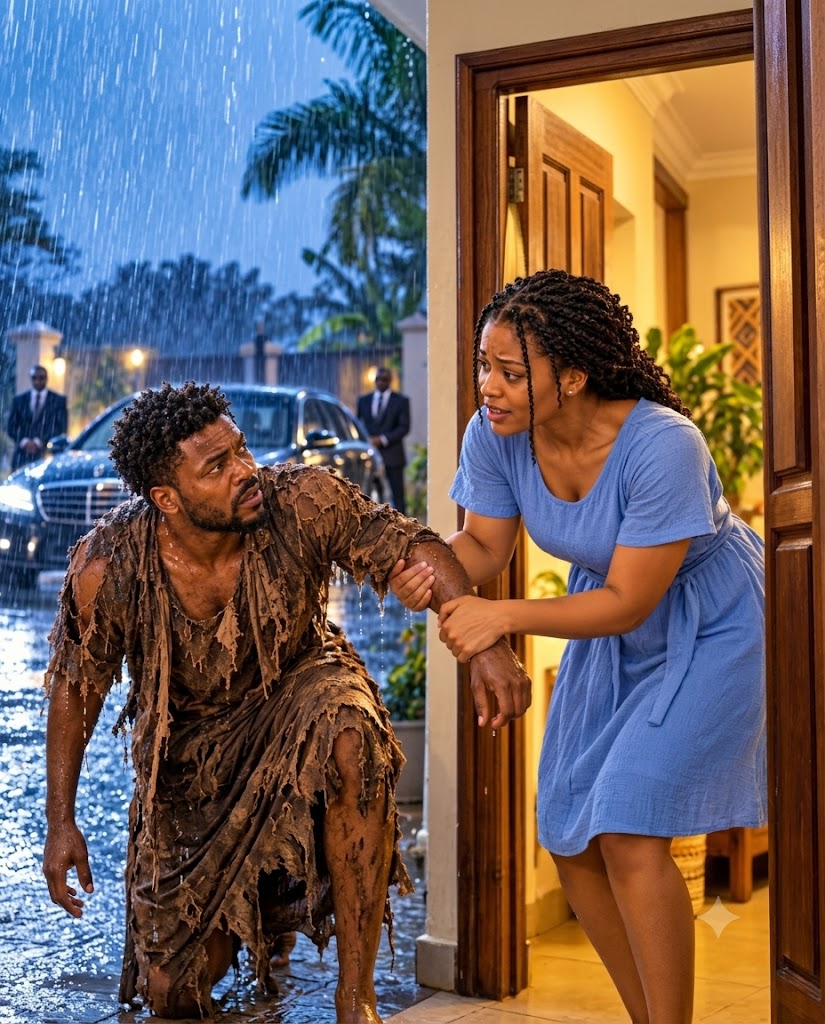
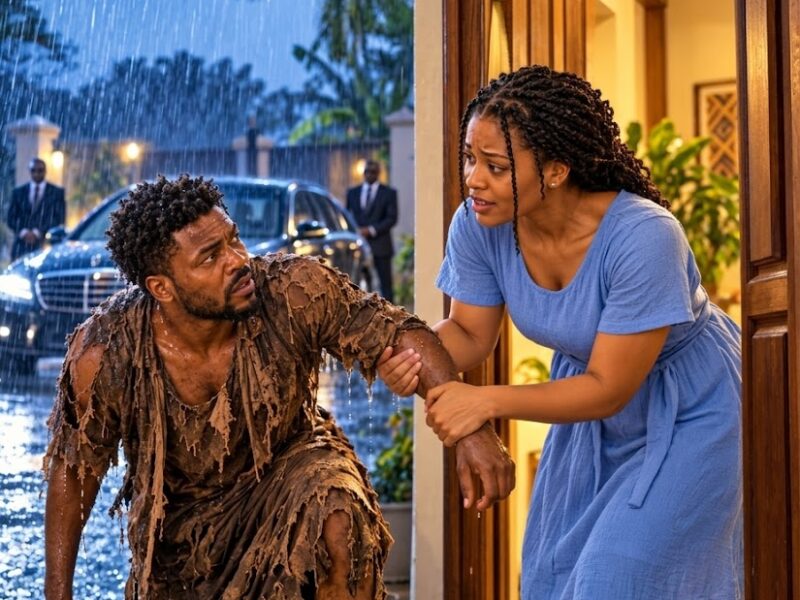
The rain hammered the pavement outside the Hillside Community Center like a judge’s gavel, each drop a small verdict against anyone foolish enough to be caught outside.
Abena Mensah pulled her coat tighter and cursed herself for forgetting an umbrella on the one day the sky decided to empty its entire reservoir over downtown Fairview.
She was halfway to her car when she saw him.
A man sat against the brick wall near the center’s side entrance, his knees drawn up, a soaked cardboard sign propped beside him that read: *Anything helps. God bless.*
His clothes were threadbare, his shoes held together with duct tape, and his eyes, when they briefly met hers, held something she couldn’t name.
Not desperation. Not shame.
Something quieter.
She looked away and kept walking.
—
Her mother would kill her if she brought a stranger home.
That thought played on loop as Abena sat in her car, heater blasting, watching the rain intensify through her windshield.
The man hadn’t moved.
He hadn’t asked her for anything.
Most people on that corner called out, held cups, made sure you couldn’t pretend not to see them.
He just sat there, getting soaked, as if he’d already accepted that the world had nothing left to offer him.
“Not my problem,” Abena muttered, shifting into reverse. “Not my problem. Not my—”
She killed the engine.
“Damn it.”
—
“Excuse me,” she called, stepping back into the downpour. “Do you have somewhere to go tonight?”
The man looked up slowly, rain streaming down his face. “I’ll manage. Thank you.”
“That’s not an answer.”
“It’s the only one I have.”
Abena crossed her arms, already shivering. “What’s your name?”
A pause. Then: “Kojo.”
“Kojo what?”
“Just Kojo.”
She studied him, this stranger with no last name and no dry clothes and no explanation for why he was sitting outside a community center in the worst storm Fairview had seen in a decade.
“My place is five minutes from here,” she said. “You can dry off, eat something, and leave in the morning. That’s it.”
Kojo’s eyes widened slightly. “You don’t know me.”
“I know you’re about to get hypothermia.”
“That’s not the same as safe.”
“No,” she agreed. “It’s not. But it’s what I’ve got.”
—
The duplex Abena shared with her mother and younger sister was small but warm, filled with the smell of whatever Essie had attempted to cook for dinner.
“Abena, is that you?” her mother’s voice called from the kitchen. “You’re soaked! Did you not check the weather?”
“I was busy.” Abena gestured for Kojo to stay near the door, out of sight. “Mom, I need to tell you something.”
Adwoa Mensah appeared in the hallway, wiping her hands on a towel.
The moment she saw Kojo, the warmth drained from her face like water from a cracked glass.
“Who is this?”
“He needed help. It’s just for one night.”
“Abena, we don’t have room for—”
“He’ll sleep in the storage room. He won’t bother anyone.”
Adwoa’s eyes narrowed. “You brought a homeless man into my house.”
“I brought a human being out of a storm.”
—
Essie, seventeen and perpetually glued to her phone, emerged from her bedroom and immediately started recording.
“Essie, put that away,” Abena snapped.
“This is going on my story. ‘Sister brings home mysterious stranger.’ People will freak.”
“Essie!”
“What? It’s content.”
Kojo stood silently by the door, dripping onto the welcome mat, saying nothing.
Adwoa looked at him the way one might examine a stain on a favorite dress.
“One night,” she said finally. “And he’s gone by sunrise.”
“Thank you,” Kojo said quietly.
“Don’t thank me. Thank my daughter’s bleeding heart.”
—
The storage room was cramped and dusty, but it was dry.
Abena brought him a towel, a change of clothes that had belonged to her late father, and a plate of rice and stew.
“You didn’t have to do this,” Kojo said, accepting the food with both hands.
“You keep saying that.”
“Because it’s true.”
Abena leaned against the doorframe. “What happened to you? If you don’t mind me asking.”
Kojo chewed slowly, as if the question required more energy than he had. “I had a business. It failed. The people I trusted disappeared. I ran out of options.”
“That’s it?”
“That’s the short version.”
“What’s the long version?”
He met her eyes. “One I’m not ready to tell.”
—
Abena didn’t push.
She’d learned long ago that people carried their wounds differently, and some needed time before they could show them.
“Goodnight, Kojo.”
“Goodnight, Abena.”
She closed the door and stood in the hallway, listening to the rain.
Somewhere in the back of her mind, a voice whispered that she was making a mistake.
She ignored it.
—
The next morning, Kojo was gone before sunrise.
He’d folded the borrowed clothes neatly, washed the plate, and left a note on the storage room shelf.
*Thank you for treating me like a person. I won’t forget it.*
Abena read it twice, then tucked it into her pocket.
She told herself she’d never see him again.
She was wrong.
—
Three days later, she found him sitting outside the same community center, wearing the same clothes, looking like he hadn’t eaten since the rice and stew.
“You’re back,” she said.
“I never left.”
“Why didn’t you come back to the house?”
“I didn’t want to wear out my welcome.”
Abena sighed. “Come on. Let’s get you something to eat.”
—
One meal became two. Two became a week.
Kojo helped around the house, fixing the leaking faucet, patching the back door, carrying groceries without being asked.
He was quiet, observant, and unfailingly polite.
Adwoa tolerated him but made no secret of her disapproval.
“A man with no job, no address, no future,” she said one evening. “And you’re feeding him like a pet.”
“He’s not a pet, Mom.”
“Then what is he?”
Abena didn’t have an answer.
—
Essie, however, had plenty of questions.
She followed Kojo around with her phone, documenting his every move.
“Where did you sleep before my sister found you?”
“Under the bridge near the highway.”
“What did you eat?”
“Whatever I could find.”
“Do you have any family?”
Kojo paused. “I used to.”
“What happened?”
“They believed a lie.”
Essie stopped recording. “What kind of lie?”
“The kind that makes people turn their backs on you.”
—
Abena overheard the conversation from the kitchen.
She said nothing, but that night, she sat beside Kojo on the back porch and asked him the question she’d been holding for weeks.
“What lie, Kojo?”
He stared at the stars for a long time.
“I built a company from nothing,” he said finally. “DreamChase Group. You’ve probably heard of it.”
Abena’s blood ran cold. “The investment firm?”
“Yes.”
“The one that—”
“Lost millions in a fraud scandal. Yes.”
She turned to face him fully. “Kojo, what are you telling me?”
“I’m telling you that the scandal was real, but I wasn’t the one behind it.”
—
The name hit her like a physical blow.
Kojo Agyeman.
The founder of DreamChase Group, one of the largest investment firms in the country.
The man who had vanished after a devastating fraud investigation that had made national headlines.
The man everyone assumed had fled with the money.
“You’re—”
“A fugitive. According to the news. A criminal. According to my family.”
“Are you?”
He looked at her with eyes that had seen too much. “No.”
—
Abena wanted to believe him.
She also knew that belief without evidence was how people got hurt.
“Prove it.”
“I can’t. Not yet.”
“Then why tell me?”
“Because you treated me like a human being before you knew my name had power. That deserves the truth.”
—
The next morning, Abena called in sick to work.
She spent the day researching DreamChase Group, the fraud scandal, the missing funds, and the man who had been blamed for all of it.
What she found made her stomach turn.
The investigation had been led by Daniel Tet, the company’s senior executive, who had conveniently taken over as CEO after Kojo’s disappearance.
The missing funds had been traced to shell companies connected to Chief Badu, a wealthy businessman with political connections.
Kojo’s name had been dragged through the mud, but no direct evidence had ever tied him to the crime.
“A setup,” Abena whispered.
She looked at Kojo, who was fixing the porch light, and felt something shift inside her.
—
“Tell me everything,” she said that evening.
And he did.
Kojo told her about the seven days he’d spent disguised as a homeless man, investigating the disappearance of relief funds meant for low-income families.
He told her about Daniel Tet, who had approved false beneficiaries and funneled money through property purchases.
He told her about Chief Badu and his son Kofi, who had used the stolen funds to expand their business empire.
He told her about the evidence he’d gathered and the plan he’d set in motion.
“You’re not homeless,” Abena said.
“I was. For seven days. To understand what it’s like to be invisible.”
“Why?”
“Because the people who suffer most from this fraud are the ones nobody sees.”
—
Abena sat in silence for a long moment.
“You could have told me.”
“I needed to know if you’d treat me the same when you thought I had nothing.”
“That’s not fair.”
“I know.”
“It’s manipulative.”
“I know.”
“And yet you did it anyway.”
Kojo nodded. “I’ve spent three years being lied about. I wanted to know if there was anyone left who could see me.”
—
The truth settled between them like a third person in the room.
Abena wanted to be angry.
She wanted to feel betrayed.
But all she felt was a strange, aching sadness for the man who had lost everything and still chose to fight for people who would never know his name.
“What happens now?” she asked.
“Daniel is still in power. The fraud is still happening. And I still have the evidence.”
“Then what are you waiting for?”
“Someone I can trust.”
—
The next week passed in a blur.
Kojo, no longer pretending to be homeless, moved into the guest room and began making calls.
Abena watched him transform from the quiet, broken man on the street to the sharp, calculating businessman he’d once been.
It was like watching a sculpture emerge from stone.
“Who are you calling?” she asked one night.
“The board. My lawyers. Inspector Sarpong.”
“Is that supposed to mean something to me?”
“Inspector Sarpong handled the original investigation. He knows the evidence was tampered with.”
“And the board?”
“They think I’m dead.”
—
The plan was simple but risky.
Kojo would present his evidence to the board, clear his name, and expose Daniel Tet and Chief Badu.
But first, he needed to ensure Abena was protected.
“If this goes wrong, they’ll come after anyone connected to me.”
“I’m already connected.”
“Which is why you need to stay out of it.”
Abena crossed her arms. “No.”
“Abena—”
“You slept in my storage room. You ate my food. You fixed my door. You don’t get to push me away now.”
Kojo looked at her with something like admiration. “You’re stubborn.”
“I’ve been told.”
—
Two days before the board meeting, Abena’s boss summoned her into his office.
“Miss Mensah, I hear you’re sheltering a homeless man.”
She froze. “Where did you hear that?”
“Does it matter? The company is concerned about your associations.”
“He’s not—”
“Daniel wants him out of your house and out of Fairview. Tonight.”
Abena’s stomach dropped. “Daniel?”
“Daniel Tet. He’s been asking questions about you.”
—
She told Kojo everything.
“He knows,” she said, pacing the living room. “He knows you’re here.”
“Then we move now.”
“Now? The board meeting is in two days.”
“Daniel won’t wait two days. If he’s asking about you, he’s already suspicious.”
“So what do we do?”
Kojo grabbed his phone. “We call Inspector Sarpong. We tell him everything. And we hope he believes us.”
—
Inspector Sarpong arrived at the house within the hour.
He was a tall, serious man with the kind of face that had seen too many lies and learned to recognize them.
“Mr. Agyeman,” he said, extending his hand. “I’ve been looking for you for three years.”
“I’ve been hiding.”
“I can see that.”
“You know I’m innocent.”
“I know the evidence was tampered with. I know Daniel Tet is dirty. But knowing isn’t proving.”
“Then let me prove it.”
—
Kojo laid out everything: the altered applications, the shell companies, the property purchases, the connections to Chief Badu and his son Kofi.
Inspector Sarpong listened without interrupting.
When Kojo finished, the inspector leaned back and exhaled slowly.
“This is enough to arrest Daniel. But Chief Badu and his son have connections. They’ll fight back.”
“Let them.”
“You understand what you’re asking. This will be public. Your name will be everywhere.”
“I don’t care about my name. I care about the families who lost everything while Daniel and Badu got rich.”
—
The plan was set.
Kojo would present the evidence to the board. Inspector Sarpong would make the arrests. The press would be notified.
But first, they needed to get through the next forty-eight hours.
Adwoa, who had been listening from the kitchen, stepped into the room.
“So you’re not a beggar,” she said.
“No, ma’am.”
“You’re rich.”
“I was.”
“And you let me treat you like dirt.”
Kojo met her eyes. “You treated me the way you treat anyone you think has nothing. That’s not about me. That’s about you.”
Adwoa’s face flushed. “How dare you—”
“Mom,” Abena interrupted. “Stop.”
“This man lied to us.”
“And you judged him before you knew him.”
—
The silence that followed was heavy with things unsaid.
Adwoa turned and walked back to the kitchen without another word.
Essie, who had been watching from the hallway, whispered to Abena: “Is he really the DreamChase guy?”
“Yes.”
“Holy crap.”
“Yeah.”
—
The board meeting was held in a glass-walled conference room on the twenty-second floor of DreamChase Tower.
Kojo walked in wearing a suit that Inspector Sarpong had arranged, looking nothing like the man who had slept in a storage room.
Daniel Tet was already seated at the head of the table.
He looked up, and his face went pale.
“Mr. Agyeman. This is a surprise.”
“Is it?”
“We assumed you were… gone.”
“I’m sure you did.”
—
The board members exchanged uneasy glances.
Kojo placed a thick folder on the table.
“Seven days ago, I began an investigation into the disappearance of relief funds meant for low-income families. What I found was systematic fraud, approved by Mr. Tet himself.”
Daniel stood. “This is ridiculous. He’s a fugitive.”
“Then why are the files he’s accusing me of destroying sitting in my folder?”
—
Inspector Sarpong entered the room with two officers.
“Daniel Tet, you’re under arrest for fraud, destruction of corporate records, and diversion of relief funds.”
“This is a mistake—”
“We recovered the files you ordered your staff to destroy.”
—
The room erupted.
Board members shouted questions. Daniel’s face twisted with rage.
And in the chaos, Kojo turned to Abena, who had slipped in through the back door.
“You came,” he said.
“I told you. You don’t get to push me away.”
—
The trial lasted three months.
Daniel Tet was convicted on all charges and sentenced to fifteen years.
Chief Badu and his son Kofi were arrested for money laundering and fraud.
The stolen funds were recovered and returned to the families who had been denied.
And Kojo Agyeman, once known as the homeless beggar of Fairview, was reinstated as chairman of DreamChase Group.
—
But the story didn’t end there.
Abena returned to her job, but not the same one.
Kojo offered her a position leading a new division dedicated to transparency and community outreach.
“You earned it,” he said.
“I didn’t earn anything. I just treated you like a person.”
“That’s exactly what qualified you.”
—
They worked together for months, rebuilding trust in a company that had lost it.
And slowly, the walls between them came down.
“I need to tell you something,” Kojo said one evening.
“I’m listening.”
“When I wrote that note, the one I left in the storage room, I meant it. I won’t forget what you did.”
“I didn’t do anything special.”
“You gave me dignity before you knew my name had power.”
—
Abena smiled. “Is that your way of saying thank you?”
“It’s my way of saying I love you.”
The words hung in the air like a held breath.
“I love you too,” she said. “But I’m not going to be your charity case.”
“I never thought you were.”
“And I’m not going to let you test me again.”
“No more tests.”
—
Three months later, Kojo proposed.
It was simple, quiet, and entirely without pretense.
“A ring would be ridiculous,” he said, holding out a small velvet box. “You have excellent judgment.”
“And you have too much money.”
“That’s the first sensible thing your wealth has taught you.”
—
The wedding was small.
Adwoa attended, though she spent most of the ceremony looking like she’d swallowed a lemon.
Essie cried and livestreamed it.
Inspector Sarpong sat in the back row, watching with the quiet satisfaction of someone who had seen justice done.
And when Kojo said “I do,” Abena whispered:
“One condition.”
“Name it.”
“No disguises. No secret investigations. And no firing anyone at our wedding.”
“I can agree to all three.”
—
After the ceremony, Kojo pulled her aside.
“There’s something I need you to know.”
“What?”
“Wealth shows what a person can buy. Hardship shows who a person is. You saw me when I had nothing. That’s the only version of me that matters.”
Abena touched his face. “I see all of you.”
“That’s more than I deserve.”
“It’s exactly what you deserve.”
—
The cardboard sign from that first night was framed and hung in their living room.
*Anything helps. God bless.*
It was a reminder of where they started, what they survived, and what they built together.
And every time Abena looked at it, she remembered the storm, the stranger, and the decision to see a person instead of a problem.
Money can make a crowd lower its head.
Only character can make someone stay when there is nothing to gain.
—
**THE END**









