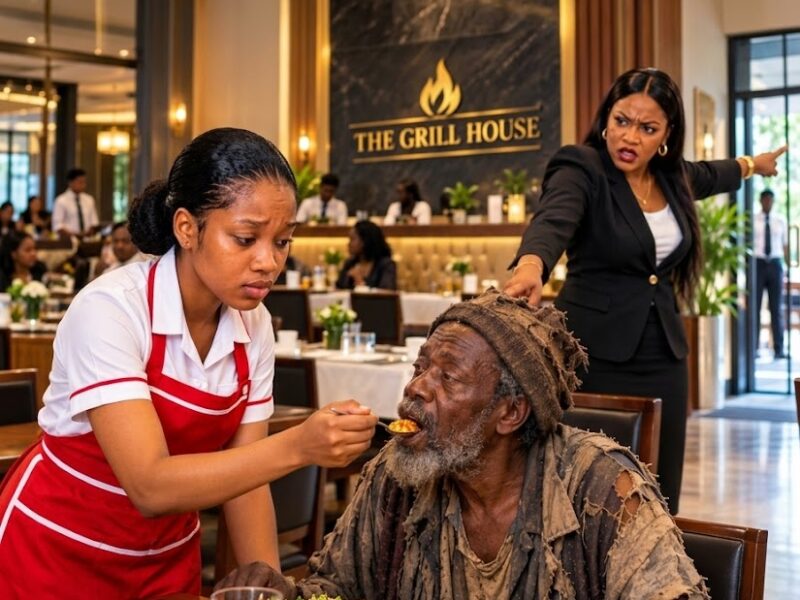
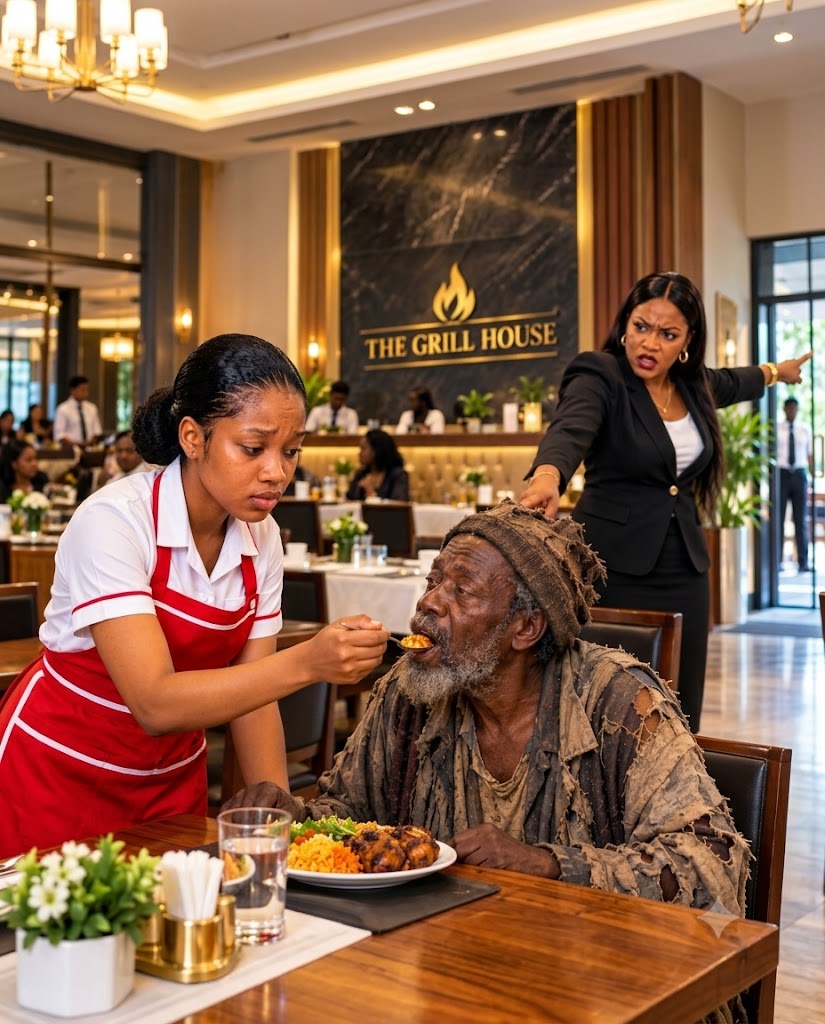
A Kind Waitress Risked Her Job to Feed a Hungry Old Man—Unaware He Owned the Restaurant
The August heat in New York City doesn’t just sit on you—it crawls under your collar and makes a home there. I was twenty-four years old, carrying a tray that weighed more than my rent, and I had exactly forty-three dollars in my checking account. The lunch rush at The Grill House had finally died down, leaving behind the smell of grease and the quiet hum of the industrial refrigerator. Through the window, I spotted him again—the old man on the sidewalk, slumped against the brick wall like he’d been there since the beginning of time.
He’d been coming for three weeks. Same spot. Same worn coat. Same empty eyes.
“Joy, table six needs their check,” Daniel called from behind the counter, his voice sharp as a broken bottle. I nodded, but my feet didn’t move. I was watching two men in tailored suits approach the old man, their laughter carrying through the glass like a bad radio signal.
“Look at this old man sitting outside a nice place like this,” one of them said, loud enough for everyone to hear. “You’re chasing customers away. Somebody should pour water on him. Maybe then he’ll go beg somewhere else.”
My hands tightened around the tray. The old man didn’t flinch. He just stared at the concrete, like he’d heard it all before.
“Leave him alone,” I said, stepping outside before I could think better of it. “He hasn’t done anything wrong.”
The taller man turned, eyebrows raised like I was a stain on his shoe. “And who are you? His daughter?”
“I don’t need to be his daughter to know this is wrong.” My voice was steadier than my heart. “Now go before I call real security.”
They laughed. Actually laughed. But they left.
Daniel was waiting when I walked back in, his face the color of old cheese. “Joy, do you know who that man was? He is filming everything. Do you know what this will look like online?”
“I don’t care how it looks, sir. What I did was right.”
“Come to my office. Now.” He didn’t wait for an answer. “Do you know what happens to a manager when staff make trouble in front of customers? That video is maybe online already.”
“Then let it be online. Let people see that grown men were laughing at a poor old man for fun.”
Daniel stopped at his office door, hand on the frame. “This is not about who is right, Joy. This is about my job. Head office does not care who is right. They only care about complaints and bad reviews.”
“And what do you care about, sir? There was a time you used to greet all of us in the morning. A time you would have stopped those men yourself.”
For a second, something flickered behind his eyes—the ghost of the man he used to be. “That time is finished, Joy. Head office removed three workers last month. I am one bad month away from losing my own job, too. Just be careful. I cannot protect you if this goes further than some spilled coins.”
“I hear you, sir. For what it’s worth, I don’t think you’re a bad man. I think you’re just a tired one.”
—
The phone call came at 6:47 AM, before my alarm had even finished its first round. My brother Toby’s voice cracked through the speaker like he’d been crying all night. “Joy, it’s Mama. She collapsed. We’re taking her to the ER.”
I don’t remember getting dressed. I don’t remember the subway ride. The next thing I knew, I was standing in a hospital hallway that smelled like antiseptic and fear, watching doctors move around my mother’s bed like she was just another task on their list.
“Your mother is stable for now,” the doctor said, clipboard in hand, eyes already on the next patient. “But she needs proper treatment. This hospital can’t manage it. She should transfer to a bigger facility, but that will cost.”
“Please, just tell me the amount. I’ll find it.”
He paused. Actually looked at me. “Ninety thousand dollars. Minimum. That’s just for the first month.”
Ninety thousand dollars.
I felt Toby’s hand find mine. He was seventeen, still just a kid, but his grip was tighter than a grown man’s. “Joy, where will we find that kind of money?”
“I don’t know, Toby. But I will find it. I always do.”
—
I showed up to work four hours late, eyes hollow, uniform wrinkled from the hospital chair. Daniel didn’t even look up from his clipboard. “Are you here to work or to sleep standing up? This is not a charity house for tired girls.”
“I’m sorry, sir. My mother is in the hospital. I haven’t slept.”
“Everybody has problems, Joy. If you cannot carry a simple tray, maybe this job is not for you.”
Faith, one of the other waitresses, appeared at my side. “It’s okay. I’ll cover her section for an hour. Let her breathe.”
Daniel’s jaw tightened, but he walked away. Faith squeezed my arm. “He wasn’t always like this, you know. Before the new owner started pushing him, he used to greet us in the morning.”
“Maybe. But pressure changes people.”
—
I didn’t expect to see the old man again. Not after that morning, not after everything. But when I came back from my break, there he was—same spot, same silence. He looked smaller today. Hungrier.
I packed a plate without thinking. Rice, plantains, the last of the grilled chicken from the lunch special. Faith caught me at the back door.
“Packing another plate for your guest outside?”
“He hasn’t eaten today. I saw him from the window this morning, just sitting there.”
“Joy, one day Daniel will count these plates and take it from your pay. You know this.”
“Then he will take it from my pay. My stomach can manage one less plate. His cannot manage none.”
She shook her head, but she was smiling. “You will not change. Even hungry yourself, you are feeding another hungry person.”
I found him exactly where I’d left him. His hands were trembling when I knelt beside him, but his eyes—those eyes held something I couldn’t name. Gratitude, maybe. Or memory.
“You weren’t here yesterday,” he said, voice rough as sandpaper. “I kept this rice for you, but it went cold. I ate it myself so it wouldn’t waste.”
“You remembered me.”
“It is a small thing. Everybody deserves one hot plate a day.”
I sat down on the concrete beside him, not caring about my uniform or the stares from passing strangers. “Why does a girl who treks to work every morning still have food to spare for a stranger?”
“Because somebody did this for my mother once when I was small and we had nothing. I never forgot it. That small kindness carried us through a hard time.”
He was quiet for a long moment. Then: “What did you want to become before life gave you a tray instead of a book?”
“A nurse. I wanted to heal people. Now I only serve them food and hope they tip well.” I checked my watch and winced. “I have to go before Daniel counts my minutes. Can I ask you something, Papa Joe?”
“You can ask. I cannot promise a good answer.”
“Where is your family? A man your age should not be alone on the street like this.”
Something shifted in his face—a door closing, or maybe opening. “I had a family once. Now I mostly have people who want things from me. Old friends, old business. It is complicated.”
“It doesn’t sound complicated. It sounds lonely.”
“You should not spend so much time worrying about an old man’s loneliness. Save that worry for yourself.”
“Worrying about other people is easier than worrying about myself. I’ve had more practice.”
—
Three weeks passed. Three weeks of rice and plantains and conversations that felt like secrets. Papa Joe never asked me for anything—not money, not favors, not even sympathy. He just listened. And I found myself telling him everything. My mother’s illness. Toby’s fear. The ninety thousand dollars that hung over our heads like a guillotine.
And then, one morning, I walked into the hospital and found a woman I’d never met sitting in my mother’s room, clipboard in hand.
“I don’t understand,” I said, staring at the paperwork. “We can’t afford this.”
“It has already been paid for, ma’am. Someone came early this morning and settled everything. Full transfer to the best facility in the city. Private room. Specialist care.”
“Who?”
“No name was given. Just a well-wisher.”
I didn’t sleep that night. I couldn’t. The next morning, I walked into The Grill House and stopped dead in my tracks.
He was sitting at a table by the window. Clean-shaven. Tailored suit. Same eyes, but different—like a painting that had been restored to its original colors.
“Papa Joe?”
He stood, and I saw the way Daniel hovered behind him, the way the other staff whispered. “I owe you the truth, Joy. All of it.”
“Weeks. Weeks of me sitting beside you, telling you everything about my life, my mother, my brother, my dreams, while you sat there wearing rags and lying to my face.”
“I never lied about anything that mattered. Everything I felt sitting on that ground with you was real.”
“Was it real when I gave you food I could not spare? Was it real when I cried in front of you last night, thinking you were just a lonely old man?”
“I have more money than I could spend in ten lifetimes, Joy. And not one person in my life has ever cared for me without wanting something from it. Until you. I needed to know if that kind of person was even real.”
“Who paid for my mother’s hospital bill?”
“I did. Not to buy your forgiveness. It was the right thing to do, and I would have done it whether you ever spoke to me again or not.”
I should have walked away. I should have been furious. But all I could think about was the way he’d looked at me that first day—like a man who had forgotten what kindness tasted like.
“What’s your real name?” I asked.
“Richard Sterling.”
“The Richard Sterling? The one who owns half the restaurants in Manhattan?”
“The one who owns The Grill House. And several other properties. And a company I never wanted to inherit.” He paused. “I came here to understand the people who work for me. I stayed because of you.”
—
The board meeting was three days later. I wasn’t supposed to be there—I was still a waitress, technically—but Richard insisted.
“Before this so-called engagement is even announced,” a man named Victor said, standing at the head of the table like a general addressing troops, “I think the board deserves to know exactly who this woman is. She’s a waitress. No family name. No business background. I’ve already prepared a statement for the press.”
“Prepared a statement saying what, Victor?” Richard’s voice was calm. Too calm.
“That the woman who fed a stranger with her own money, without knowing who he was, is somehow not good enough to stand beside me?”
“I’m protecting this company’s image.”
“You’re protecting your inheritance. Don’t dress it up as loyalty.”
Victor’s face twisted. “This is not over.”
“It is. From today, you’re moved from Chief Operating Officer to a regional post in Ohio. You have real skills. Use them honestly somewhere else.”
I didn’t realize I’d been holding my breath until the door clicked shut behind him.
“Joy.” Richard turned to me, and for the first time, I saw the man I’d met on the street—uncertain, vulnerable. “I did not expect you to still want to speak with me.”
“I’m not here for an apology, though I wouldn’t say no to one.”
“I am sorry. For that day, for many days before it. I let my own fear turn me into a man I didn’t want to be.”
“I know what it is to carry more than you can hold and still be expected to smile. I don’t hate you for it. I only came to see if you’re all right. And to tell you—whatever happens now, you don’t have to be afraid of losing your job because of me.”
Richard stared at me like I’d just solved a puzzle he’d been working on for years. “Thank you, Joy. Truly.”
—
**Part 2**
My mother woke up five days later. The private room was filled with flowers I hadn’t sent, cards I hadn’t written. She took one look at my face and knew.
“A man lied to me, Mama. But somehow, he also saved us.”
She reached for my hand, her fingers still weak but warm. “Sometimes the truth wears strange clothes before it fully arrives. Does he deserve a chance to explain himself properly?”
“Maybe.”
“Then maybe is enough for now.”
Richard took me to dinner the following week. Not a fancy restaurant—a small Italian place in Brooklyn where the owner knew his name but didn’t care about it. We sat in the back, and for two hours, he told me everything. His father, who built the company from nothing. His mother, who died when he was twelve. The board members who saw him as a cash machine, the women who saw him as a prize.
“I didn’t know who to trust,” he said, swirling his wine but not drinking. “So I stopped trusting anyone. Until I met you.”
“I’m still just a waitress.”
“You’re the only person who’s ever looked at me and seen a human being.”
“Take your time,” he said when he walked me home. “I’ve already waited this long. I can wait a little more.”
—
Six months later, I opened the door to my own restaurant. Not a gift from Richard—every penny came from my savings, from the waitressing, from the small business loan I’d applied for in secret. The sign above the door read “Joy’s Kitchen,” and the first person through the door was Papa Joe.
“You did this yourself,” he said, looking around at the small space, the handwritten menus, the flowers on every table.
“I didn’t touch one cent of your money. I need to know I can stand on my own two legs.”
He smiled—a real smile, the kind that reached his eyes. “I respect that more than you know.”
—
The wedding was small. Just family, just friends. My mother in a wheelchair, Toby in a suit that didn’t quite fit, Faith standing beside me as maid of honor.
“I have known Joy since we were both carrying trays that were too heavy and getting paid too little,” Faith said, raising her glass. “I watched her give away her own food more times than I can count. I always told her, ‘Joy, one day your kindness will feed you back.’ I didn’t know it would feed her a whole company.”
Toby’s voice cracked when he spoke. “My sister raised me more than she should have had to. She gave up a lot so I wouldn’t have to. I’m happy today is about her finally receiving after years of only giving.”
Richard took my hands. His palms were sweaty. So were mine.
“Joy Bennett, do you take Richard Sterling to be your husband?”
I thought about the first day I saw him—just an old man on the sidewalk, invisible to everyone but me. I thought about the rice that went cold, the conversations that went late, the truth that took weeks to arrive.
“I do.”
“And Richard Sterling, do you take Joy Bennett to be your wife?”
“I do. I’ve never been more sure of anything in my life.”
—
After the ceremony, I found myself alone for a moment in the garden. The string lights were still on, casting everything in a warm glow. I touched the small photograph in my pocket—the only picture I had of my father, torn at the edges, faded with time.
“Wherever you are,” I whispered, “I hope you’re proud. Even without you here to see it.”
“I’m sure he is.”
I turned. Richard stood in the doorway, jacket off, tie loosened.
“How do you know?”
“Because I’ve seen the woman you became without him. And she’s extraordinary.”
I laughed—a real laugh, the kind that came from somewhere deep. “You’re just saying that because you love me.”
“I’m saying it because it’s true.” He crossed the garden, took my hand. “Come back inside. Your mother wants to dance.”
—
Three years later, I graduated from nursing school. Richard sat in the front row, holding our daughter—six months old, named Hope, because that’s what she was. Faith was there, and Toby, and my mother, healthy and strong. And in the back of the auditorium, sitting alone, was Daniel.
He found me afterward, hat in his hands like a supplicant. “I know I don’t deserve your forgiveness.”
“You were scared. I understand scared.”
“That doesn’t excuse what I did. What I said.”
“No,” I agreed. “It doesn’t. But you’re here. That counts for something.”
He nodded, eyes wet. “Thank you, Joy. For being the kind of person I should have been.”
—
The Grill House closed last year. New owners, new vision, new everything. But Richard kept the building, and we turned it into something else—a community kitchen, serving free meals to anyone who needed one. No questions, no paperwork. Just a hot plate and a place to sit.
The first customer was an old man, hunched and tired, invisible to everyone but me.
“You don’t have to pay,” I said, setting a plate in front of him. “Everybody deserves one hot plate a day.”
He looked up, startled. “How did you know?”
“Know what?”
“That I haven’t eaten in two days.”
I sat down across from him. “Because I’ve been there. And because somebody did this for me once, when I had nothing. I never forgot it.”
He ate slowly, like he was savoring every bite. When he finished, he looked at me with eyes that held something I couldn’t name.
“What’s your name?” he asked.
“Joy.”
“That’s a good name.”
“It’s the name my mother gave me. She said it was because I brought her happiness.”
He nodded. “She was right.”
—
Richard found me later that night, sitting alone in the empty kitchen. The day’s dishes were done, the lights dimmed. He wrapped his arms around me from behind.
“You’re quiet tonight.”
“I keep waiting for someone to tell me this is a dream. That I’ll wake up tomorrow, trekking to work with empty pockets.”
“It’s not a dream. But I’ll tell you the truth—this new life won’t be easy either.”
“It never was.”
“No,” he agreed. “But we’re together.”
I turned to face him. “Do you ever regret it? The company, the board, all of it?”
“Every day I regret the time I wasted hiding from the world. But I don’t regret finding you. I’d do it all again—the rags, the sidewalk, the cold rice—just to hear you tell me about your dreams.”
—
Hope is five now. She has my eyes and Richard’s stubbornness. She doesn’t understand why we don’t live in a big house like her friends at school.
“We have enough,” I tell her. “More than enough.”
“Then why do we give things away?”
I kneel down to her level. “Because once, a long time ago, a woman I never met gave my mother food when we had nothing. That kindness saved us. And I decided that I would spend the rest of my life passing it on.”
She thinks about this for a moment. “So giving is like catching something and throwing it to somebody else?”
“Exactly.”
She nods, satisfied. Then she runs off to play with Toby, who’s visiting from college, and I watch them—my family, my whole world—and I think about how it all started.
An old man on the sidewalk. A plate of rice. A choice to be kind when it cost me everything.
—
The letter arrived on a Tuesday. No return address, just my name in handwriting I didn’t recognize.
*Dear Joy,*
*I don’t know if you remember me. I was at the wedding—the photographer’s assistant, the one who spilled champagne on your dress. You told me it was fine, that these things happened, and then you helped me clean it up. You didn’t have to do that. You were the bride. But you did.*
*I’ve thought about that moment for three years. I was going through the hardest time of my life—my father had just died, my mother was sick, and I was working a job I hated just to pay the bills. I was ready to give up.*
*And then you sat down with me in the bathroom, this woman in a wedding dress, and you said, “Whatever you’re carrying, you don’t have to carry it alone. That’s what people are for.”*
*I don’t know if you remember saying that. But I remember hearing it. And I decided to keep going.*
*Today, I opened my own photography studio. It’s small, but it’s mine. And I wanted to thank you—not for the kind words, but for the way you live. You made me believe that kindness wasn’t weakness. That it was the strongest thing a person could be.*
*I hope you’re well. I hope your family is well. And I hope you know that what you do matters—even when you don’t see the results.*
*Thank you,*
*Marcus*
I read the letter three times. Then I folded it carefully and placed it in the box where I kept my most treasured things—the photograph of my father, the first dollar I ever earned, a seashell Richard gave me on our first date.
Kindness. It ripples outward, touching shores you’ll never see.
—
Richard found me crying in the kitchen.
“What’s wrong?”
“Nothing.” I handed him the letter. “Everything.”
He read it, then set it down. “You changed his life.”
“I just talked to him.”
“You saw him. That’s all anyone wants—to be seen.”
I thought about Papa Joe, sitting on that sidewalk, invisible to everyone but me. I thought about the rice that went cold. I thought about all the small moments that had added up to this life I never expected.
“Do you think he’s okay?” I asked. “My father. Wherever he is.”
Richard took my hand. “I think he’d be proud. I think he’d see the woman you became and wonder how he ever let you go.”
“Maybe.”
“Definitely.”
—
My mother died two years ago. Peacefully, in her sleep, with all of us around her. Her last words were to me.
“You kept your promise, Joy. You took care of everybody.”
“I learned from you, Mama.”
“No.” She squeezed my hand. “You learned from yourself. I just showed you the way.”
At her funeral, I stood up to speak. The church was full—family, friends, strangers whose lives she’d touched without ever knowing their names.
“My mother had nothing,” I said. “And she gave everything. She taught me that kindness isn’t about what you have—it’s about who you are. And who you choose to be, every single day.”
I looked at Toby, at Richard, at Hope. “She lives on in all of us. In every meal we share, every hand we hold, every stranger we choose to see.”
—
The community kitchen serves three hundred people a day now. We’ve expanded twice. Faith runs the morning shift; Toby runs the evening. And every day, I stand at the door and greet whoever walks in—rich or poor, clean or dirty, seen or invisible.
Because that’s what Papa Joe taught me. That’s what my mother taught me. That’s what I want to teach Hope.
Everybody deserves one hot plate a day. Everybody deserves to be seen.
And sometimes, the smallest kindness—a plate of rice, a moment of attention, a choice to care—can change everything.
I know. Because it changed me.
—
The old man came back today. Not Papa Joe—a different one. Same worn coat, same empty eyes.
I set a plate in front of him and sat down.
“You don’t have to do this,” he said.
“I know.”
“Why, then?”
I smiled. “Because somebody did it for me once. And I never forgot.”
He ate slowly, like he was afraid it would disappear. When he finished, he looked at me with those eyes—the same eyes I’d seen in the mirror for years.
“What’s your name?” he asked.
“Joy.”
“That’s a beautiful name.”
“It means happiness.”
He nodded. “I can see that.”
And for a moment—just a moment—I saw myself in him. The hunger. The fear. The hope that maybe, just maybe, someone would see past the surface.
I reached across the table and took his hand. “You’re not alone. You never were.”
He didn’t say anything. He didn’t have to. The tears in his eyes said enough.
—
That night, I held Hope a little tighter.
“What’s wrong, Mama?”
“Nothing, baby. I’m just happy.”
“Why?”
I kissed her forehead. “Because I learned something today.”
“What?”
“That kindness is never wasted. Even when you can’t see the results, it’s there. Growing. Spreading. Changing things.”
She thought about this. “Like seeds?”
“Exactly like seeds.”
She snuggled closer. “I want to plant seeds too, Mama.”
“You already do. Every time you share your toys, every time you help a friend. You’re planting seeds.”
“I am?”
“You are.”
She yawned. “Good. I want to grow a whole garden.”
I smiled in the darkness. “You will, baby. You will.”
—
The photograph hangs in my office now. My father, young and smiling, holding me as a baby. I don’t know where he is. I don’t know if he’s alive. But I know this: his absence shaped me, but it didn’t define me.
I am Joy Bennett-Sterling. Waitress. Nurse. Wife. Mother. Friend.
And I am the sum of every kindness ever shown to me—and every kindness I’ve chosen to show in return.
The seeds keep growing.
And the garden keeps spreading.
—
**Author’s Note (for the reader):**
This story is fiction, but the truth at its heart is real: kindness matters. It ripples. It echoes. It changes lives in ways we may never see.
If you take anything from Joy’s journey, let it be this—you never know who’s watching. You never know whose life you might change with a single act of compassion.
So be kind. Not because it’s easy. Not because you’ll get something back. But because it’s right.
And because somewhere, someone is waiting for a plate of rice, a moment of attention, a reason to believe that they matter.
Be that reason.
—
**THE END**









