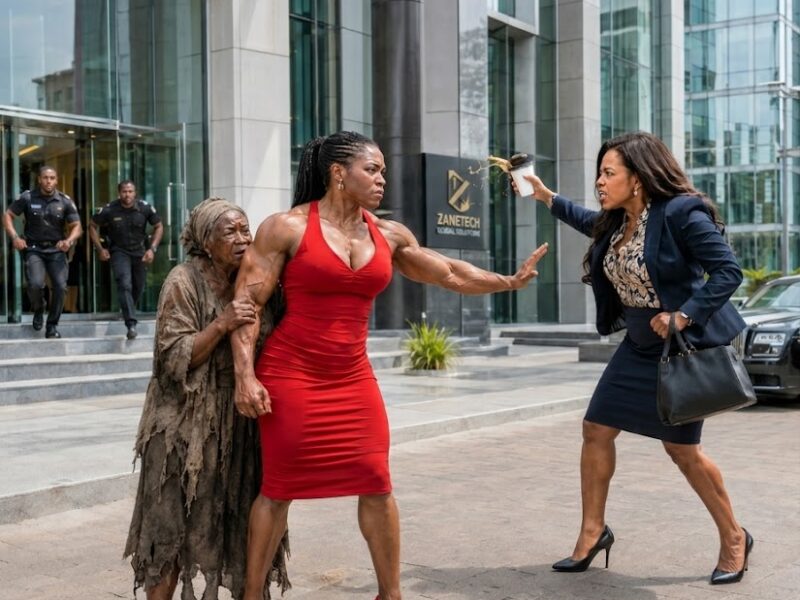
A kind, muscular woman missed her job interview to help an old woman cross the street. She had no idea the woman she just helped was the CEO’s mother.
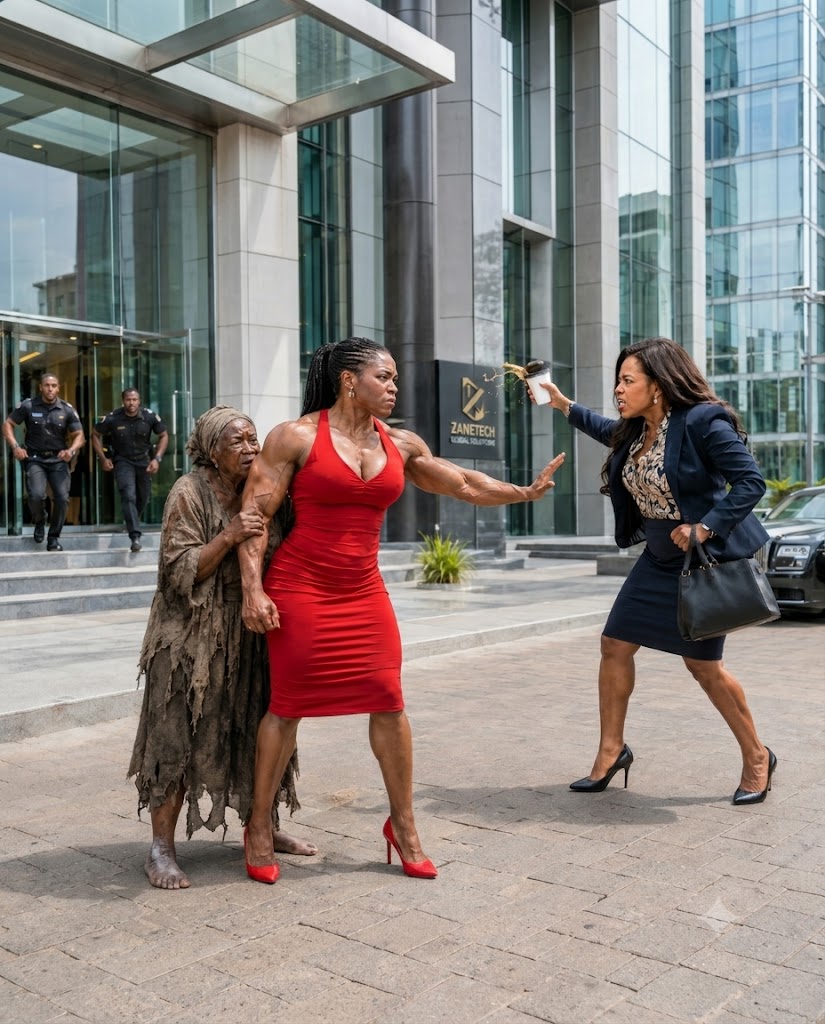
These beggars will not leave this place.
Every single morning they are here blocking the entrance, like they have nowhere else to be and nothing better to do than make my life difficult.
Just pass her and mind your business.
We did not come here to count beggars.
Chai.
See her shoulders.
Which one of us is competing with that?
I have already lost.
Lower your voice.
She can hear you and she looks like she can carry you.
Good morning.
Please, do they collect the letters outside or do we submit them upstairs?
Upstairs.
Twentieth floor.
But the door closes at 8, so do not leave this queue.
Thank you.
I have been looking for work for 8 months now.
I am not leaving here.
Everybody standing here is fighting for the same three openings on that floor.
Head of facility security.
Seven thousand five hundred dollars a month.
I need this job.
We all need it.
My own letter has been folded in my bag since January.
That old woman by the wall.
Look at her chest.
She’s not breathing well at all.
Please do not start.
If you leave this line, you will lose your place.
Stay here.
How much for the bottled water?
Give me two and one of those energy bars if you have them.
Water is fifty cents each, bar is two dollars, three dollars altogether, ma’am.
No discount?
Take five dollars, keep the change.
My brother, I do not need it back this morning.
Ma’am, five dollars, bless you.
I will remember your face, I swear to God.
Mama, good morning.
Take this, daughter.
Sit properly and drink it slowly.
Do not rush it.
My daughter, I am fine.
Go back to your line before they close that door on you.
The door is not going anywhere.
Drink first.
When did you last eat something, mama?
Yesterday afternoon.
But I am not hungry.
I only sat down because my legs were shaking.
You again.
I warned you on Friday.
This is not a bus station.
It is an office.
Do you know how much this building costs?
Clients drive in here and see you sitting there.
I am not begging anybody.
I sat down because I was tired.
I will stand up now.
Then stand up.
I have said the same thing to you three times in two weeks.
Ma’am.
Monica, come outside now.
Am I the one who will carry her by myself?
Ma’am, I am watching the queue.
If I leave this door, these people will rush inside.
So, I should stand here and beg her.
Fine, I will move her my own way.
This coffee is very hot.
I am counting to three.
One.
Two.
Are you standing up?
My daughter?
Do you know who I am?
Ask yourself that question before you do it.
I know exactly who you are.
You are the woman who is making my morning difficult.
Are you mad?
Do you know who?
Remove your hand from me now.
Ma’am, she is somebody’s mother.
Whatever she has done, hot coffee is not the answer.
Leave my hand.
Ma’am, are you blind?
A woman is assaulting me in front of you.
Ah.
It poured on her.
Ma’am, that thing is hot.
Go and wash it right now.
It is only a blouse.
It will dry.
Mama, hold my arm and let us move.
You put your hand on a senior staff member.
You have just finished yourself this morning.
I came here for an interview at 8.
Do what you want.
I am not fighting you.
An interview.
So you are one of the applicants standing on my steps this morning?
Yes.
Head of facility security.
My name is Amara Eze and my letter is here.
Amara.
I have your name now.
Thank you very much for making this very easy.
Everybody listen.
The doors open now and close at 8.
Whoever is outside stays outside.
Ma’am, come now.
Forget the woman.
Leave her there.
It is two minutes to 8.
Go inside, my daughter.
Please do not lose your own life because of an old woman.
Mama, if I leave you here and something happens, no job will make me sleep tonight.
Eight months without work and you are throwing it away for somebody you do not know.
I know you cannot stand.
That is enough.
Put your arm around my neck.
Hold tight.
She is really leaving.
Seven thousand five hundred dollars a month and she is walking away.
Let her go.
Marcus, close that door.
8:00 is 8:00 in this company.
What is your name again, my daughter?
Say it slowly so that I will remember it.
Amara.
Do not worry about my name.
Mama, worry about sitting down and drinking that water.
Amara.
Right inside my head or I will not forget this morning for the rest of my life.
Sit back.
Put your back on the wood.
Do not talk yet.
Just breathe in and out.
I am trying.
My chest has been doing this since yesterday night.
It comes and goes.
Small sips.
Not one time.
If you rush it, you will start coughing again.
Mama, you have done enough.
Now go back to that building.
Maybe they have not started inside.
They have started and I am not moving until your hand stops shaking like this.
What is inside that building that made you stand outside since morning?
Tell me the truth.
A job.
Head of facility security.
Nineteen cameras, two gates, forty staff under one person.
And you can do that work or you were going there to try your luck like others.
I can do it.
I ran security at a warehouse in Oakland for three years.
Mama, then why are you looking for work?
Three years is not a small thing at all.
The warehouse closed in November.
Forty of us went home the same day with two months salary.
That was eight months ago.
What have you been eating since November, my daughter?
Anything.
I carry cement at building sites.
Eleven interviews since November.
Eleven times they said no.
Eleven.
What reason did they give you?
Somebody must have told you something to your face.
Two of them said I am not presentable.
One said the client will be afraid of me.
Afraid of you?
You that carried an old woman you have never seen in your life.
We have eleven candidates on this list.
Only nine walked in.
Who are the two missing?
One did not show up at all.
The second one was outside but she caused a disturbance.
Disturbance at the entrance of this building.
What exactly happened outside this morning?
Vivian.
She put her hand on me in front of the applicants.
She grabbed me by the wrist.
Grabbed you over what?
A person does not just hold a stranger’s hand for nothing.
Over a beggar that has been sitting at our entrance for two weeks disturbing everybody.
I am writing it in my report today.
Amara is a disqualified aggressive conduct at the entrance.
Fine.
Send the report to the twenty-second floor before closing.
The CEO reads everything himself.
You did not answer me.
Why this particular job?
You have been looking for eight months.
Because of the money, mama.
Seven thousand five hundred dollars.
Nobody else has offered me that.
Money for what?
You are one person.
One person does not need that kind of money.
My mother.
Kidney failure both sides.
Dialysis two times a week.
Two thousand dollars each time.
Two times a week.
That is four thousand dollars every seven days.
My daughter.
Yes, we have missed three sessions already.
The last one was on Thursday last week.
What did the doctor say will happen if she misses the next one?
Tell me plainly.
He said Friday.
If she does not come on Friday, he cannot promise me anything after.
Friday.
Today is Tuesday.
So, you have three days to find four thousand dollars.
Three days.
And I just spent my last five dollars on water and bread.
Your last five dollars.
That was your transport money going home.
Why did you not say?
If I told you, you would not have drunk it, then it will be wasted money.
Mama, your phone is ringing inside your bag.
Somebody has been calling you since morning.
It is nobody important.
Let them call.
I am not ready to go home yet.
You have somebody at home.
All this time I thought you were sleeping outside somewhere.
I have a son.
He is a big man now.
Very big and very busy.
A big man.
And his mother is sitting on the ground outside a bank at 7.
He did not send me there.
I went by myself because I wanted to see something.
See what?
An old woman does not sit and hug her to see something.
I wanted to see what people do when they think you have nothing to give them.
Now stand up and go back to that building.
Beg them.
Two minutes is all you need.
They locked the door in front of me.
Ma’am.
That one took my name and everything.
So because of one woman with a coffee cup your mother will not do dialysis on Friday.
You are right.
Even if they shout at me, shouting has never killed anybody before today.
Good.
And do not tell them anything about me.
Just ask for your own two minutes.
Why?
If I tell them I was helping a sick woman, maybe they will understand me.
If you use me to get that job, you did not help me.
You bought something.
Then I will not mention you.
Sit here.
Do not move until I come back.
Mama, it is me.
Bring the car in one hour.
Not now.
And do not tell my son anything.
Interview is closed.
8:00 was the time.
Miss Vivian said nobody else should enter.
Please open small.
I am on the list.
My name is there.
Amara.
I know your name.
Everybody inside knows your name now.
That is exactly your problem, ma’am.
Two minutes.
Let me climb to the twentieth floor and talk to them for two minutes.
I cannot.
If I open this door for you, I will be outside here tomorrow morning.
One minute.
Then give me one minute and I will never come back to this place.
Ma’am, step back from the glass.
I am calling my colleague.
Do not make it worse.
You are still here.
After everything this morning, you came back to knock on my door.
Ma’am, I am not here to fight.
I came to apologize and to ask for two minutes.
Apologize for what exactly?
Say it loud so these people at the gate can hear you.
I am sorry that I held your hand this morning.
It was wrong.
Please forgive me.
And the old woman.
Are you sorry for embarrassing a senior staff member over a beggar?
No, ma’am.
I am sorry for my hand.
I am not sorry for the old woman.
Then we have nothing to discuss.
Your file is closed.
Your name is already written down.
Ma’am, please.
My mother is sick.
I am not doing this for myself.
I swear.
Everybody’s mother is sick.
Nine people sat in that room today and all of them have problems.
Take her off the property.
If she comes back here tomorrow, call the police station.
Mama.
Mama, where are you?
I told you to sit down and not move anywhere.
My brother, the old woman that was sitting here, did you see where she went?
Ma’am, a black SUV came.
Very big one.
Two men came down and entered with her.
A black SUV?
Are you sure it is the same woman?
The one in brown rapper?
Same woman.
They were greeting her like somebody big.
One man was carrying her bag.
So she has people.
Thank God at least one person’s problem was solved this morning.
Ma’am, take your change.
I have been holding it since morning.
I said keep it.
A man does not collect back what has left his hand.
Then how will you go home?
Ma’am, your face is telling me something is wrong.
I will walk.
It is not far.
Seven miles is nothing.
I have done worse.
Ma’am Bara, enter now.
The rain is beating you.
Two dollars only.
Enter.
I do not have it.
Go ahead, my brother.
I will use my leg today.
You do not have two dollars.
Ma’am, this rain will not stop till evening.
Then it will beat me till evening.
Rain has never stopped anybody from getting home.
Amara, is that you?
Why are you dripping water on the floor like that, my child?
Rain caught me at the bus stop.
Mama, do not worry.
I will mop it now.
The bus stop, you trade from the bus stop in this rain.
What happened to your transport money?
Amara.
I dropped it somewhere.
It is nothing.
How is your body since this morning, mama?
My body is my body.
I have been praying since 6:00.
How did the interview go?
It went well, mama.
Three men and one woman asked me questions for almost thirty minutes.
Thirty minutes?
What did they ask you?
Tell me everything from the beginning, my daughter.
They asked about the warehouse in Oakland.
They said they will call me before Friday.
Before Friday.
God has done it.
I told you God will not let us down.
Amara, turn and look at my face.
Why are you talking to me from the wall?
Sorry mama, I am removing this wet blouse.
Sleep small.
I will make tea for you.
Amara.
I have been watching you standing here for twenty minutes.
What is worrying you?
Nothing.
I am only taking air.
The room is hot since the rain stopped.
Taking air with your face wet.
Amara, I have known you since you was fifteen.
The interview did not happen.
I am busy.
I stopped to help somebody and I lost it.
You lost seven thousand five hundred dollars a month because you stopped to help somebody.
Yes.
And I would do the same thing again tomorrow which is why I am crying.
Your mother must go to hospital on Friday.
Do you have anything left to sell?
One thing.
National Weightlifting 2014 bronze.
I have never allowed anybody to touch it.
A medal cannot do dialysis.
Amara, carry it to the market tomorrow morning early.
Two days left.
Tomorrow I sell this and then I go and carry cement at the site.
Sir, I have brought her.
She refused to enter the car until almost 5:00 this evening.
5:00 Sunday, I have been calling you since 5:08 this morning.
Sir.
She switched off her phone.
When she switched it on, she told me to wait.
Wait, where?
My mother has a heart condition and you left her on the road all day.
Leave the boy alone.
He did what I told him.
Shout at me, not at him.
Sunday, go home.
Come back tomorrow at 7:00.
We will talk about this another time.
Mommy, look at your feet.
Look at this rapper.
Where did you go dressed like this?
I went out.
I am seventy-one years old.
I do not need permission to leave a house.
You had a hospital appointment at 10:00.
Dr. Bell called me twice looking for you.
I will see Dr. Bell tomorrow.
Today I had somewhere more important than his office.
More important than your own heart?
Mommy, please tell me where you were this morning.
I was sitting on the ground in front of your office building from 7:00.
In front of Okono Holdings.
On the ground.
Mommy, why would you do such a thing?
Sit down first.
If you stand up while I am talking, I will not finish.
Do you remember the compound in Eastwood?
One tap for eleven families and I sold peppers.
I remember everything.
Mommy, why are we talking about Eastwood by 9:00 at night?
Because I wore that same rapper for six years and people look through me every day.
Now you have a building with glass and marble and I wanted to see one thing.
See what?
You could have called me and I would have shown you anything you want.
If I come as your mother, everybody will smile.
I wanted to come as Agnes.
So you sat on the ground outside my company to test my staff.
For how long?
This is the third time.
Two weeks now.
Nobody has ever asked me if I ate.
Two weeks.
My own staff walked past my mother for two weeks and said nothing.
Walking past is not the problem, my son.
This morning, somebody did more than walk past.
What did somebody do?
Mommy, look at my face and tell me exactly what happened.
A woman came down the steps with hot coffee.
She told me to move.
I could not stand.
She counted to three.
One.
Two.
Then she lifted that cup above my head.
She poured her coffee on you.
Mommy, are you telling me somebody poured coffee on you?
No, it did not touch me.
A girl came from the queue and held her hand.
Which girl?
Was she staff?
Mommy, tell me who this girl is and I will find her.
She was not staff.
She came for an interview at 8:00 in your building.
The coffee poured on her chest instead.
She did not shout.
She carried me away.
Carried you away to where?
And the interview she came for, what happened to it?
She missed it.
The doors closed while she was carrying me to a bench outside.
She missed the interview for a woman she had never seen before in her life.
And she bought me water and bread with her last five dollars then walked home.
What is her name?
Mommy give me her name and I will call the office now.
Amara.
That is all she gave me.
I asked twice and she only said Amara.
Amara.
Do you know how many people called Amara walked into that building this morning?
Mommy, then look for the one with a coffee stain on a blue blouse.
She is not small.
Not small.
How?
Mommy, describe her properly for me.
What did the woman actually look like?
Very tall.
Shoulders like a man that offloads trailers.
She lifted me like a pillow.
And her mother is on dialysis.
She must find four thousand dollars by Friday.
By Friday.
Mommy, it is Tuesday night.
That is three days from this moment.
Sir, your driver dropped this from the office.
The day’s reports from human resources department.
Leave it there.
Mommy, sit down and eat something.
I will start looking tomorrow morning.
Do not only look for the girl, Chidi.
Look at the building you have built.
Chaka, it is me.
Are you awake?
I know it is late.
I just closed.
Tell mommy the money will come on Friday.
Tell her not to open the shop tomorrow.
No, nothing happened.
Something small happened at work today, but I handled it very well.
A woman was sitting on the ground at our entrance.
Beggars, Chaka, every single morning.
You do not understand.
I am the only person from Eastwood on that whole floor.
Everybody there went to school abroad.
If I make one mistake, I am back in that shop.
So when they look at that entrance, they must see marble, not somebody’s mother sitting down.
Incident report.
Tuesday, entrance disturbance during scheduled interviews for head of facility security position.
Candidate Amara Eze disqualified aggressive conduct at the entrance.
Physically assaulted a senior staff member.
You are still awake.
It is past 10.
What are you reading with that kind of face?
Mommy, the girl has a surname.
It is written here in my own company’s report.
Written by who?
Read it to me.
Who wrote a report about that girl tonight?
The same woman with the coffee.
She wrote that the girl assaulted her at the entrance.
Assaulted.
She caught her wrist to stop hot coffee from landing on my head.
I know that because she told me.
Tomorrow morning I will hear it from a camera.
Sir, this is camera four, main entrance.
Time stamp is 7:52 this morning.
Stop there.
Go back ten seconds and play it again slowly.
I want to see her hand, sir.
See it.
She only held the wrist.
She did not push.
She did not swing.
The coffee went on her.
She released the hand herself.
Nobody separated them at all.
Correct.
And she turned her back.
Watch what she does for the next four minutes.
Play the part where the doors close.
I want to see your face at that moment.
Sir, she looked at that door.
She saw it was open.
Then she carried the woman.
Copy it.
Put it on the screen in my office first thing tomorrow morning before 8.
Good morning, sir.
I got the message that you want to see me before 9.
Sit down.
I read your report last night, the one about the entrance disturbance yesterday.
Yes, sir.
I wrote it immediately because I felt it was a serious security matter.
Explain it to me in your own words.
Start from when you came down the steps.
There is a beggar woman that has been sitting at our entrance for two weeks.
I asked her politely to move.
She refused.
So I raised my voice small.
That is all.
You raised your voice.
And what was inside your right hand while you were raising it?
My coffee, sir.
I was holding my coffee, but I never touched that woman at all.
You never touched her because a candidate stopped you.
Is that what happened or not?
Sir, that candidate grabbed me in front of everybody.
That is why I disqualified her.
Look at the screen.
Camera four, main entrance, 7:52 yesterday morning.
Watch your hand.
That cup is above her head.
Nobody grabbed you.
Somebody caught your wrist, Vivian.
Nineteen cameras in that building.
Should I bring another angle or should I stop here?
Now, I want to ask you one question.
Who exactly do you think that woman is?
Sir, I do not know her.
She is just a woman that sits at our gate.
Her name is Agnes Okono.
She sold peppers in Eastwood for six years to train me.
That is my mother sitting on the ground in front of the building I built.
Sir, I swear I did not know.
Please, sir, I did not know who she was.
That is the problem.
Vivian, you did it because you thought she was nobody.
Now bring me her file.
Amara, application form, phone number, address, everything you collected.
Vivian.
I said bring me the file.
Why are you sitting down on the floor?
Disqualified candidates are removed the same day.
It is the normal procedure in my department.
Removed.
Meaning what exactly?
Did you throw a human being’s file inside a dust bin yesterday?
I shredded it, sir.
Yesterday evening before I closed.
Her form and her covering letter.
So there is no address, no phone number, no way for me to reach that woman.
Sir, the agency that shortlisted her may still have her number in their own system.
Then you will call that agency this morning and you will do it standing outside.
Outside, sir, please.
My mother is not working.
I send money home every single Friday.
The woman you shredded also has a mother.
Hers is on dialysis until Friday.
Marcus, walk her out of this building.
Same way you walked somebody out yesterday morning.
Marcus, yesterday a woman knocked on that glass door.
Tell me the truth about it, sir.
She knocked at 8:42.
She begged me for two minutes.
I refused her.
She did not shout.
She did not push.
Two men walked her off the property quietly.
Did she leave any number, a paper, a name, any place at all to find her?
Nothing, sir.
She just walked down the steps.
She did not even look back one time.
Two hundred applicants, no photographs, no file at all, and two days before that woman’s mother dies.
Good morning.
I want to sell this.
It is bronze national competition 2014.
Bronze.
Ma’am.
This is not gold.
This one is metal with silver color on top.
I know it is not gold but it is heavy.
Weigh it and tell me something.
One hundred twenty dollars.
That is my last price.
Nobody buys sports metal in this market.
Ma’am, one hundred twenty dollars.
I lifted 231 pounds for this thing in Washington.
Ma’am, I am buying metal.
I am not buying Washington.
One hundred fifty dollars and that is final.
One hundred fifty dollars.
Count it.
And do not melt it today in case I come back.
Ma’am, everybody says that nobody has ever come back for anything in twenty-two years.
Four thousand dollars by Friday.
I have one hundred fifty.
I need three thousand eight hundred fifty more.
Good afternoon.
I am looking for work.
Anything today?
Offloading, mixing, carrying, anything.
We are not taking women here.
The bags are one hundred ten pounds each.
Go to the other side.
One hundred ten pounds.
Give me one bag.
If I drop it, I will leave without saying anything.
Okay, you can walk today and I am paying you sixty dollars, not one hundred.
Sixty dollars.
These men are collecting one hundred.
I am carrying the same bag as them.
They are men.
You should be grateful I even allowed you to stand on this site.
Sixty dollars.
Fine.
Give me the work.
My mother does not care whose money it is.
See this woman two bags asks.
Where has she been since all this time?
Vivian, I need your staff identity card and the office phone.
Sir asked me to collect it.
Take it.
Nine years I gave this company.
Nine years in this office.
One morning finished me.
Did you call the agency like he asked?
He has been asking me since 2:00.
I called them three times.
The number they have for her is switched off since Tuesday.
Switched off.
Is that all?
Did they say anything else about that woman at all?
They said the number belongs to a business center somewhere in Berkeley.
That is all.
Berkeley is very big.
Did they give a street, a landmark, anything he can work with?
Nothing.
Angela, tell him something for me before I go home this evening.
Tell him I am not the only person in that building who walked past his mother.
Amara, they have not called you.
It is Thursday evening.
Did they not say before Friday?
Tomorrow is still Friday.
Mama, big companies do their own things at their own time.
Where did you go this morning?
Your body is smelling of cement since yesterday.
Amara.
I went to greet a friend at the site.
Mama, do not worry yourself about me.
Amara.
Where is your medal?
That nail has been carrying that medal for eleven years.
I moved it, mama.
I put it inside my bag so that dust will not spoil it.
Bring it.
Let me see it now.
Amara, bring that medal and put it in my hand.
You sold it.
Amara, you sold the only thing you have ever worn in your life.
It was metal, mama.
One hundred fifty dollars of metal.
Your machine does not accept metal.
Mama.
Mama.
Look at me.
I am busy.
Are you busy?
Come out here now.
Come now.
She is stable for now.
But the doctor says she must start dialysis tonight, not tomorrow.
Tonight?
They told us Friday.
The doctor said Friday when we came last week.
That was last week.
Her potassium is very high tonight.
We cannot wait until tomorrow.
Okay, start it.
Whatever it is, start it now and I will bring the money.
Ma’am, we cannot start without a deposit.
Two thousand dollars before they connect the machine.
One hundred fifty from the medal, sixty from yesterday, sixty from today, two hundred seventy dollars.
Two hundred seventy.
Ma’am, the deposit is two thousand.
You are short by one thousand seven hundred thirty dollars tonight.
I will bring it by morning.
I swear on my mother’s life, I will bring it.
Ma’am, I am not the one refusing you.
Do you have any family you can call?
There is nobody.
It has been me and her since my father died in 2009.
Then start calling anybody.
Church, neighbors, your old workplace.
One thousand seven hundred thirty dollars before 6:00.
Amara, sleep more now.
You have been counting that same money since 9 tonight.
If I count it again, maybe it will become two thousand.
That is what I am doing.
I have one hundred dollars at home.
In the morning, I will bring it.
That is all I have.
It is midnight already.
Tomorrow morning, we start from the entrance and we ask everybody there, every hawker, every conductor, every gate man on that whole street.
Somebody there saw where she went.
Sir, it is five minutes past 6.
The street is still empty.
Nobody has opened yet.
Then we wait here until they open.
Sunday, park the car and come and help us.
Sir, we have asked eleven people since yesterday evening.
Nobody knows that woman at all.
Then we will ask the twelfth person and the thirteenth, Sunday.
I am not going anywhere.
Ma’am, please stay inside the car.
Sir will be very angry if you stand in this cold.
I sat on this ground for two weeks.
Standing on it for one hour will not kill me.
Mommy, go back inside.
We have people asking questions.
Let us handle it, please.
You are asking the wrong question.
You are asking who saw her leave that morning.
What is the right question, mommy?
Tell me and I will ask it right now.
Ask who sold her something.
She bought water and bread for me that morning.
But from where?
Mommy, there is no shop on this street that opens before 8.
Not a shop.
A boy with a tray on his head.
He was standing at that corner.
A hawker.
Sir, hawkers come out before 6.
They are usually the first people here.
Sunday.
Go to the corner now.
Bring every hawker you see.
I will pay them.
And Chidi, one more thing.
She gave that boy five dollars and refused her change.
She refused her change.
And the same morning she had no transport money to go home.
That is why he will remember her.
Nobody forgets somebody that gives them five dollars.
I did not do anything.
I am only selling water.
Please, I have a license.
Nobody’s arresting you.
I want to ask you about Tuesday morning before 8:00.
Tuesday morning.
Okay, sir.
I was here from 5 like every other day.
A very tall woman bought water and bread from you.
She gave you five dollars.
Ma’am.
Sir, I know that ma’am.
She told me to keep the four dollars change.
You know her?
Do you know her name?
Do you know where that woman lives?
Her name?
No, sir.
But I have seen her two times this week carrying cement.
Carrying cement where?
Speak slowly and tell me exactly where you saw her carrying cement.
The site, sir.
The new building near the bridge.
My cousin is working on that same site.
Sir, the site is twenty-five minutes from here if we leave before the traffic builds.
Enter the car.
You will show us the place.
Sunday, start the engine now.
Good morning.
I am looking for a woman that walked on this site here.
A woman on this site?
Women here, the bags are heavy.
Very tall woman.
Big shoulders.
She would have been carrying two bags at the same time.
Two bags at once.
Ah, that ma’am.
She work Wednesday and Thursday both full days here.
She did not come this morning.
Yesterday night something happened.
Her mother entered hospital.
Which hospital?
Do you have her address?
Do you have a phone number for her?
No number.
I wrote her address in my book before I paid her on Wednesday.
Amara Eze, 14 Idoro Street, Berkeley.
How much did you pay her per day?
Sixty dollars.
Sir, the men collect one hundred.
But you know how it is with women.
She carried two bags for sixty dollars.
You will pay her the difference before Monday.
Sir, the car cannot enter.
The street is too narrow.
We have to walk from here.
Good morning.
Is anybody inside there?
I am looking for Amara.
Amara, please open the door.
Who are you?
Amara is not here.
Are you from the landlord or what?
Not from landlord.
Ma’am, please.
Where is she now?
It is very urgent.
Her mother collapsed yesterday night around 8.
They carried her to the general hospital at 9:00.
Moses, call the hospital now.
Tell them whatever that woman owes this company.
Mommy, that is her.
Look at the chair by the wall.
That is the woman.
I know it is her.
Stand back, Chidi.
Let me be the one to wake her.
Nurse, please.
Is it my mother?
Has something happened?
I have the money coming now.
It is not the nurse, my daughter.
Look at my face properly.
Look at me well.
Mama.
Mama from the bench.
Ah, mama.
Look at you.
Look at how you are dressed.
I have been looking for you since Tuesday night.
Three days, my daughter.
Three whole days.
Amara, this man standing behind me is my only son.
His name is Chidi Okono.
Okono.
Okono.
Like the building.
Mama, please tell me it is that building.
It is that building.
Okono Holdings.
That is my son’s company.
Amara, that is his name.
Mama, you sat on that ground.
Your son owns the whole building and you sat outside.
I sat there three times in two weeks and only one person asked if I ate.
Ma’am, my name is Chidi Okono.
I have been looking for you since Tuesday night.
Looking for me?
Sir, your own woman told your gate man to call police if I return.
I know.
I watched the camera eleven times.
I know what happened on those steps.
Then you know I held her hand.
If holding a hand is assault, I did it.
You caught a cup above my mother’s head.
Nobody in that building has called it assault since.
The site is settled.
Deposit and the outstanding.
They are connecting her machine in ten minutes.
Settled by who?
Ma’am, who settled it?
Nobody asked me anything.
Who paid that money?
The company paid it.
Four thousand dollars covering the next four weeks completely.
Take it back, sir.
Please take that money back.
I did not come here for money.
Take it back.
Ma’am, your mother is inside that ward.
The machine is being connected.
I know where my mother is.
I have been sitting outside that door since 9:00.
But I did not sit on that bench so that somebody would pay me for it.
Amara, listen to me.
If your mother dies today, will your pride carry her body?
Then it is a loan.
Write it down as a loan, sir.
I will pay it back.
Pay it back with what?
You are carrying cement for sixty dollars a day.
Then give me work, not charity, sir.
Give me the interview I came for on Tuesday.
That is the only thing you asked me for since I walked into this corridor.
3:00 this afternoon, twentieth floor.
Come with the same letter you brought on Tuesday.
Ma’am, please ma’am, I have been standing here since 12:00 waiting for you.
Ma’am, I am begging you.
Talk to your son for me.
Nine years I served this company.
You stood over me with hot coffee.
Do you remember counting?
One.
Two.
I remember it.
Ma’am, I did not know who you were.
If I had known.
I swear I would never.
That is your whole problem, my daughter.
You were waiting to know who somebody is first.
Ma’am, please.
My mother is not working.
Today is Friday and I have nothing to send.
I am sorry for your mother.
I am not sorry for you.
Angela, let us go.
Miss Eze, sit down.
Tell us about your last position and why you left that place.
Warehouse security.
Oakland, three years.
Nineteen staff under me.
The company closed in November.
Everybody left.
This role manages an annual security budget of 1.5 million dollars.
Have you handled budgets?
No ma’am, I have never handled 1.5 million dollars.
I will not sit here and lie.
You understand that is a serious gap for this position at this level.
Mrs. Z, I understand.
I can learn a budget.
Give me six months on one person to teach me.
One last question.
What would you do if a staff member abused a stranger at our entrance?
I would stop the staff member first.
Then I would sit with the person on the ground.
Sit with them.
Miss Eze, your job would be to remove them from the premises.
Sir, if a person is on the ground, the first question is whether they can stand.
One hundred dollars.
You brought it to the hospital before anybody else did.
Am I keep it?
Your mother is still in hospital.
Where will you get money now?
The site owner paid me the difference.
One hundred twenty dollars for Wednesday and Thursday, both days.
Where did you go, Amara?
You left here since morning without telling anybody anything.
Market.
The man had not melted it.
Two hundred twenty dollars to buy it back but he kept it.
Eleven years that nail carried it.
Do not remove that thing again in your life.
Ma’am, good morning ma’am.
I did not know that morning.
Please ma’am, I did not know.
Marcus, you told me the truth that day.
You said you would lose your own job.
From today, the door opens at 8 and it does not close on anybody outside.
Ma’am, do not mind him.
These people sit here every morning.
Just enter.
Ma’am, please.
Papa.
Good morning.
Have you eaten anything this morning?
Do not stand up.
Sit down.
My daughter, I’m not begging.
My son walks in a cage.
I came to find him.
Two water and one bread for papa.
And every morning from today, come and find me.
—
The morning light hit the glass doors of Okono Holdings like a blade, and Amara stood across the street with her interview letter pressed flat against her chest.
She had ironed her one good blouse three times the night before, and still the collar would not sit right.
Her mother had been stable through the night, the dialysis machine humming its steady rhythm, and for the first time in months Amara had slept without dreaming of cement dust.
Now she watched the entrance from a distance, noting the new sign bolted to the wall beside the revolving door.
*All Are Welcome. Doors Open at 8:00 AM. No One Left Outside.*
She read it four times, and each time her throat tightened a little more.
“You are early,” a voice said behind her.
Amara turned to find Chidi Okono stepping out of a black SUV, his suit jacket open, his tie already loosened at the collar.
“I wanted to see the sign,” she said. “Before the crowd.”
“It is permanent,” he said. “Bolted with six screws. Vivian watched them install it.”
“Where is she now?”
“Gone. Nine years, and she packed her desk in one afternoon.”
Amara nodded slowly, unsure what to feel about that.
“She called me,” she admitted. “Last night. She apologized for the report.”
“What did you say?”
“I told her I forgave her. Then I hung up and cried for twenty minutes.”
Chidi studied her face, and she saw something shift in his expression, something that looked almost like respect.
“You are not what I expected,” he said.
“What did you expect?”
“Someone who would hold a grudge. Someone who would want revenge.”
“I am too tired for revenge,” Amara said. “And my mother raised me better than that.”
They walked toward the building together, and the security guard at the door nodded at Amara as if he had known her for years.
Inside, the lobby gleamed with marble and glass, and every sound echoed like a promise.
A young woman at the reception desk looked up and smiled.
“Miss Eze, your interview is at 3:00. Would you like to wait in the executive lounge?”
“No,” Amara said. “I would like to sit in the lobby. Where the people wait.”
The receptionist glanced at Chidi, who nodded once.
Amara chose a chair by the window, where she could see the entrance and everyone who walked through it.
For the next hour, she watched the parade of employees arriving, their faces smooth with privilege, their shoes clicking against the floor like metronomes.
At 2:45, a woman in her sixties walked through the door carrying a tray of bottled water.
She was not tall, and her shoulders were not broad, but she moved with the quiet authority of someone who had survived things.
“Papa,” the woman called out. “I brought the water you asked for.”
An old man sitting near the elevator raised his hand, and the woman walked over to him, setting the tray on a small table.
Amara watched them talk, watched the old man laugh at something the woman said, watched the woman pat his shoulder before she left.
“Who is that?” Amara asked the receptionist.
“That is Mrs. Agnes Okono. The CEO’s mother. She comes every morning now.”
“Every morning?”
“Yes. She sits with whoever is waiting. Sometimes she brings water, sometimes bread. She says no one should ever wait alone.”
Amara felt something crack open inside her chest, something she had been holding shut for eight months.
At 3:00 exactly, she rode the elevator to the twentieth floor.
The interview panel was different this time, three men and two women, and they asked her about budgets and crisis management and how she would handle a hundred different scenarios.
She answered every question honestly, even when the honesty hurt.
When they asked her about the warehouse closure, she told them about the forty people who lost their jobs, and how she had helped three of them find new work before she found any for herself.
When they asked her about the entrance incident, she told them the truth, all of it, including the part where she would do it again.
At the end, the lead interviewer leaned back in his chair and studied her for a long moment.
“Miss Eze, you are the only candidate who has ever told us the truth about a failure. Everyone else blames the economy, or the market, or someone else. You blamed yourself.”
“I blamed myself because it was my fault,” she said. “I should have moved faster. I should have held that cup tighter. I should have found a way to do both things.”
“But you did the right thing.”
“Yes. And it cost me.”
The interviewer nodded slowly.
“We will call you by 5:00,” he said. “Wait in the lobby.”
Amara rode the elevator down, her heart pounding so hard she could feel it in her teeth.
She sat in the same chair by the window, and at 3:47, a woman walked up to her carrying a small paper bag.
“Miss Eze?”
“Yes.”
“Mrs. Okono asked me to give this to you.”
Amara opened the bag and found a single bottle of water and a wrapped sandwich.
There was a note attached, written in careful, looping handwriting.
*You carried me when I could not stand. Now let me feed you while you wait.*
Amara pressed the note to her chest and did not cry, but only because she had promised herself she would not.
At 4:30, Chidi Okono walked into the lobby and sat down beside her.
“The panel has made their decision,” he said.
“And?”
“They want you to start Monday. Head of facility security. Full benefits. The salary we discussed.”
Amara stared at him for a full ten seconds before the words actually landed.
“Monday,” she repeated.
“Monday. Unless you need more time.”
“No. Monday is fine.”
Chidi smiled then, a real smile, and she saw how much he looked like his mother.
“She told me something last night,” he said. “Something I have not been able to forget.”
“What did she tell you?”
“She said you reminded her of herself. When she was young. Before she had anything. When all she had was the will to keep going.”
Amara looked down at the water bottle in her hands, at the sandwich she had not yet eaten.
“She reminded me of my mother,” she said quietly. “The way she sat there, so proud, like she had nowhere to be and nothing to prove.”
“She did not want to prove anything. She just wanted to see.”
“See what?”
“What people do when they think no one is watching.”
Amara nodded slowly, and for a long moment neither of them spoke.
Then Chidi stood and offered her his hand.
“Come on,” he said. “My mother is waiting in the car. She wants to take you to see yours.”
Amara took his hand and let him pull her to her feet.
Outside, the sun had begun to set, painting the glass building in shades of amber and rose.
Agnes Okono was sitting in the back seat of the black SUV, her window rolled down, her eyes bright with something that looked like joy.
“My daughter,” she called out. “Come. Sit with me.”
Amara climbed into the back seat and closed the door.
“Your mother is well?” Agnes asked.
“She is stable. They are keeping her for observation until Monday.”
“Good. Then Monday, we will go together. You will start your job, and I will visit your mother, and we will begin this new thing the right way.”
“What new thing?”
“The thing where we take care of each other,” Agnes said simply. “The way people should.”
Amara leaned her head back against the seat and let the warmth of the car wrap around her.
For the first time in eight months, she allowed herself to believe that something good might actually last.
Three weeks later, Amara stood at the main entrance of Okono Holdings, watching the morning crowd arrive.
The doors were already open, and the security guards were greeting everyone with a smile and a nod.
There was no line, no pushing, no fear of being left outside.
At 7:55, she saw an old woman walking slowly up the street, carrying a tray of bottled water.
Amara walked out to meet her, taking the tray from her hands.
“Mama Agnes, you do not have to do this every morning.”
“I know,” Agnes said. “But I want to.”
Together, they walked into the lobby and set up the water at the small table near the elevator.
A young man sat in the corner, his interview letter crumpled in his hands, his face tight with fear.
Agnes walked over and sat down beside him.
“Have you eaten anything this morning?” she asked softly.
The young man shook his head.
Agnes reached into her bag and pulled out a wrapped sandwich.
“Take this,” she said. “Sit properly and eat it slowly. Do not rush it.”
The young man stared at her, his eyes wide with something that looked like disbelief.
“Thank you,” he whispered. “Thank you so much.”
Agnes patted his hand.
“Do not thank me,” she said. “Thank her.”
She pointed at Amara, who was standing near the window, watching the entrance.
The young man looked at Amara, and Amara looked back, and for a moment she saw herself sitting in that same chair, holding that same letter, wondering if the world would ever open a door for her.
Then she smiled and walked over to the table.
“What is your name?” she asked the young man.
“Daniel.”
“Daniel, the interview is at 3:00. You are early.”
“I know. I have been looking for work for six months.”
Amara sat down beside him.
“Then let me tell you something my mother told me,” she said. “The door does not close on anybody who is willing to stand outside long enough.”
Daniel looked at her, and something in his face shifted.
“Are you sure?”
“I am sure,” Amara said. “I stood outside for eight months. And one morning, a woman I had never seen before asked me if I had eaten.”
She glanced at Agnes, who was already walking toward the elevator, her tray now empty, her hands now free.
“Now,” Amara said, turning back to Daniel, “eat your sandwich. And when they call your name, you go upstairs and you tell them the truth. All of it.”
Daniel nodded and unwrapped the sandwich with trembling fingers.
Amara stood up and walked to the entrance, where the morning sun was pouring through the glass like a blessing.
She looked at the sign bolted to the wall, at the words that had become her anchor.
*All Are Welcome. Doors Open at 8:00 AM. No One Left Outside.*
Then she walked out to the street and stood beside the door, watching the city wake up, waiting for whoever needed her next.
—
**THREE MONTHS LATER**
The dialysis ward at General Hospital had become a second home to Amara, a place of humming machines and whispered prayers and the smell of antiseptic that never quite left her clothes.
Her mother was sitting up in bed, a magazine open in her lap, her face fuller than it had been in years.
“You are late,” her mother said, but she was smiling.
“I stopped to bring someone,” Amara said, and stepped aside.
Agnes Okono walked into the room carrying a bouquet of flowers and a box of pastries from the bakery on the corner.
“For the patient,” Agnes said, setting everything on the bedside table. “And for the daughter who never rests.”
Amara’s mother looked from Agnes to Amara and back again.
“You are the woman from the bench,” she said quietly. “The one who was sitting outside the building.”
“I am,” Agnes said. “And your daughter carried me when I could not stand. Now I have come to carry her.”
Amara’s mother reached for Agnes’s hand and held it tight.
“Thank you,” she whispered. “For everything.”
Agnes sat down in the chair beside the bed and began unpacking the pastries.
“There is one with cream,” she said. “And one with chocolate. You must try both.”
Amara stood in the doorway and watched the two women talk, watched them laugh, watched them share stories about their children and their gardens and the days when they had nothing but each other.
At the end of the visit, Agnes stood and kissed Amara’s mother on the forehead.
“We will come again tomorrow,” she said. “And the day after that. And the day after that.”
“That is too much,” Amara’s mother protested.
“No,” Agnes said firmly. “That is exactly enough.”
They walked out of the hospital together, Amara and Agnes, their steps matching, their silence comfortable.
At the entrance, Agnes stopped and looked up at the sky.
“You know,” she said, “I sat on that ground for two weeks. Three times. I wanted to see if anyone would notice. And you were the only one.”
“I noticed because you reminded me of my mother,” Amara said. “The way you sat there. The way you refused to beg.”
“I was not refusing to beg. I was refusing to disappear.”
Amara nodded slowly.
“I know,” she said. “I have been refusing to disappear my whole life.”
Agnes turned and took Amara’s face in her hands.
“You will not disappear,” she said. “You will rise. And you will carry others with you.”
Then she let go and walked toward the car, her small frame silhouetted against the setting sun.
Amara watched her go, and for the first time in her life, she believed that the world could be kind.
—
**ONE YEAR LATER**
The lobby of Okono Holdings was filled with people on a Monday morning, but there was no line, no pushing, no fear.
Amara stood at the entrance, greeting everyone who walked through the door, her badge gleaming on her chest.
She had hired three new security guards, all of them women, all of them trained to look for the people who were struggling, the ones who needed a hand.
At 7:45, a young woman walked up to the building carrying a cardboard sign that said *WILL WORK FOR FOOD*.
The security guard at the door started to move toward her, but Amara held up her hand.
“I will handle it,” she said.
She walked out to the street and stood in front of the young woman.
“Good morning,” Amara said. “Have you eaten anything today?”
The young woman shook her head, her eyes wary.
Amara reached into her bag and pulled out a wrapped sandwich and a bottle of water.
“Take this,” she said. “Sit properly and eat it slowly. Do not rush it.”
The young woman stared at her, her hands trembling.
“Why are you helping me?”
“Because someone helped me once,” Amara said. “And I promised I would never forget.”
The young woman took the sandwich and sat down on the bench by the entrance.
Amara sat down beside her.
“What is your name?”
“Grace.”
“Grace, the doors open at 8:00. They do not close. You can go inside whenever you are ready.”
Grace looked at the glass doors, at the people walking in and out, at the sign bolted to the wall.
*All Are Welcome. Doors Open at 8:00 AM. No One Left Outside.*
“Thank you,” Grace whispered.
Amara nodded and stood up.
“Do not thank me,” she said. “Thank her.”
She pointed at the woman standing in the lobby, the woman with gray hair and kind eyes, the woman who was already walking toward the entrance with a tray of bottled water.
Agnes Okono set the tray down on the bench and sat beside Grace.
“Good morning,” she said. “My name is Agnes. What is yours?”
“Grace.”
“Grace, that is a beautiful name. Now eat your sandwich, and when you are done, we will go inside together.”
Grace nodded and took a bite, and Agnes smiled.
Amara watched them from the doorway, and for a moment she saw everything at once, the past and the present and the future, all of it connected, all of it whole.
Then she turned and walked back into the building, ready to greet whoever came next.
—
**FIVE YEARS LATER**
The Okono Foundation had opened three shelters across the city, each one named after a woman who had refused to disappear.
The Agnes Okono Center for Women and Families was the largest, a four-story building with a rooftop garden and a kitchen that never closed.
Amara Eze was the executive director, and she still came to work every morning at 7:00, still stood at the entrance, still greeted everyone who walked through the door.
Her mother had passed away two years earlier, peacefully, in her sleep, after a long conversation with Amara about all the things she had wanted to say.
Agnes Okono had been there too, holding Amara’s hand, whispering the words that had carried her through her own grief.
*You will not disappear. You will rise.*
And Amara had risen.
She had risen so high that she could see the whole city from her office window, and every morning she looked out at the streets and remembered where she had come from.
On the fifth anniversary of the day she had missed her interview, the foundation held a celebration in the lobby of Okono Holdings.
There were speeches and flowers and a plaque bolted to the wall beside the entrance.
*In Honor of Amara Eze. Who Stopped to Help a Stranger. And Changed Everything.*
Amara stood at the podium and looked out at the crowd, at the faces of the people she had helped, at the faces of the people who had helped her.
“I have only one thing to say,” she began. “And it is this.”
She paused and looked at Agnes, who was sitting in the front row, holding a bottle of water.
“Every morning, I stand at the entrance and I ask one question. Have you eaten anything today? Because that is the question that saved my life. That is the question that reminded me I was human. That is the question that told me I was not alone.”
She stepped away from the podium and walked to the entrance, where the doors were open and the sun was pouring in.
“Now,” she said, “let us go and ask someone else.”
The crowd followed her out to the street, where a young woman was sitting on the ground with a cardboard sign, and Amara knelt beside her and asked the only question that mattered.
“Have you eaten anything today?”
The young woman shook her head.
Amara reached into her bag and pulled out a wrapped sandwich and a bottle of water.
“Take this,” she said. “Sit properly and eat it slowly. Do not rush it.”
The young woman took the sandwich and began to eat, and Amara sat beside her, and the whole city seemed to pause.
For a moment, everything was still.
Then the young woman looked up and asked, “Why are you helping me?”
Amara smiled.
“Because someone helped me once,” she said. “And I promised I would never forget.”
She pointed at the woman standing in the doorway of the building, the woman with gray hair and kind eyes.
“Thank her,” Amara said. “She is the one who started it all.”
Agnes Okono walked out to the street and sat down beside the young woman, and the three of them stayed there together, in the morning light, in the open door.
And the sign on the wall said it all.
*All Are Welcome. Doors Open at 8:00 AM. No One Left Outside.*
—
**THE END**









