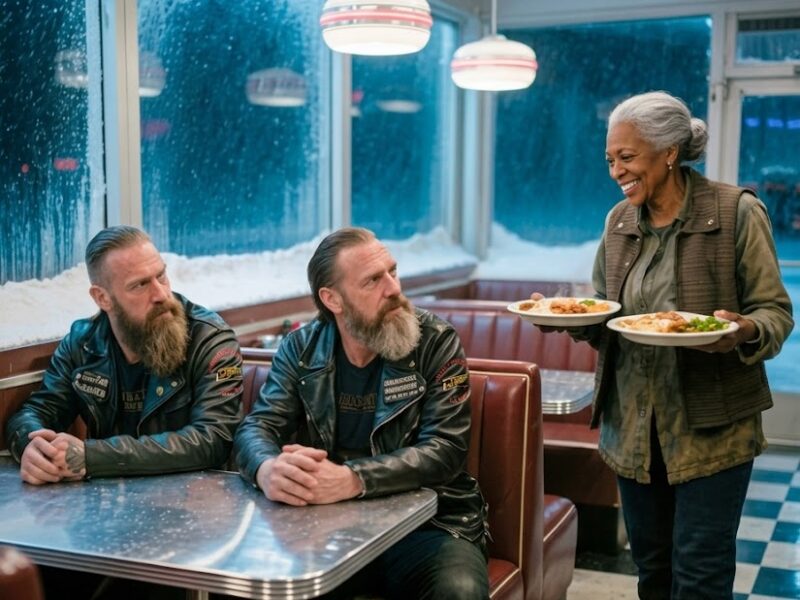
A Kind Elderly Woman Sheltered 15 Hells Angels During a Snowstorm—The Next Morning, 100 Motorcycles Lined Up Outside
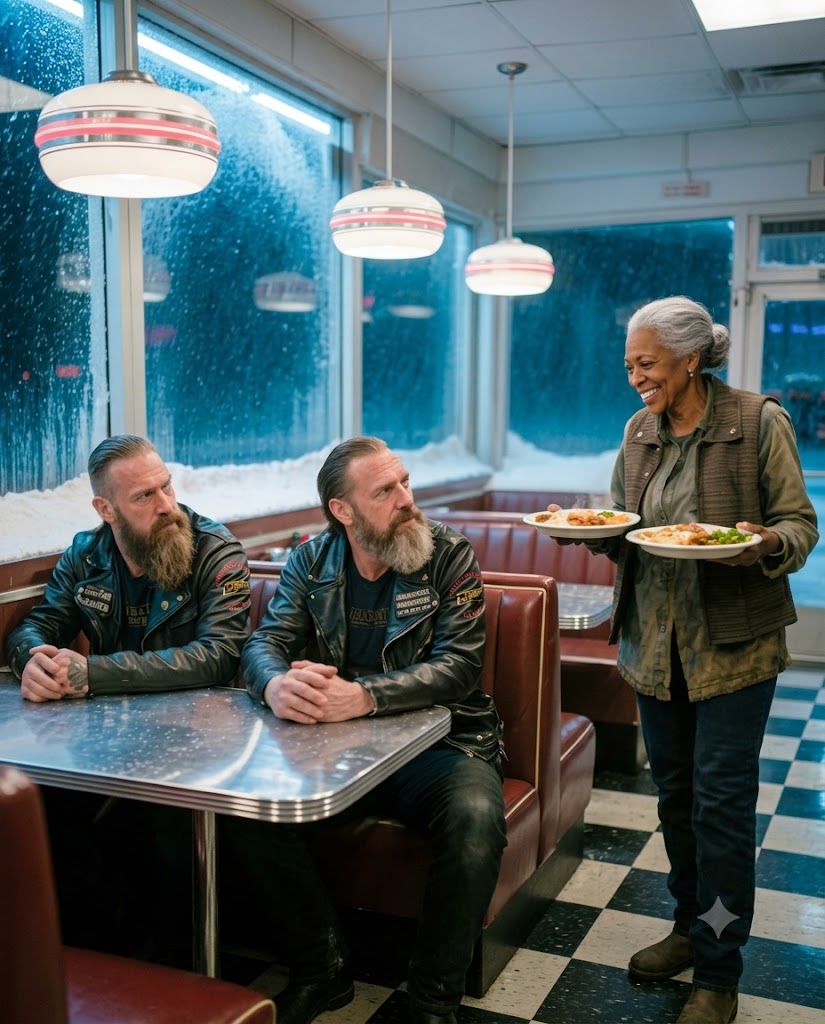
The snow came down like a punishment from heaven, thick and relentless, burying Highway 70 under drifts that swallowed cars whole and turned the Colorado mountains into a frozen graveyard of forgotten dreams.
Sarah Williams stood behind the counter of Midnight Haven Diner, her weathered hands trembling as she counted the crumpled bills for what felt like the hundredth time that evening.
Forty-seven dollars.
That was it.
That was everything.
The wind howled outside like a wounded animal, rattling the windows of the small diner perched on the forgotten stretch of mountain highway, and Sarah pulled her cardigan tighter around her shoulders as she stared at the foreclosure notice tucked beneath the cash register.
Seven days.
She had exactly seven days before the bank took everything she and Robert had built together, everything they had dreamed of, everything that remained of a love story that had ended too soon.
At fifty years old, Sarah had weathered plenty of storms, both the kind that dumped feet of snow on the Rockies and the kind that tore through your heart without warning.
But this one felt different.
This one felt like an ending.
She moved slowly around the empty diner, her footsteps echoing off the worn linoleum floor that had seen better days, probably better decades, if she was being honest with herself.
The red vinyl booths sat empty, their surfaces cracked from years of use, from thousands of tired travelers who had stopped for coffee and pie and a moment of warmth before continuing their journeys into the unknown.
The coffee pot gurgled weakly, half full of the bitter brew that had been sitting there since noon, and Sarah made a mental note to dump it out before she closed up for the night.
Not that it mattered.
Not that anything mattered anymore.
It was nearly eight o’clock, and she hadn’t seen a customer in over three hours, not since a trucker from Nebraska had stopped for a quick cup of coffee and a slice of her famous apple pie, the last slice, as it turned out.
Sarah paused at booth number four, Robert’s favorite spot, the one where he used to sit every morning with his newspaper and his coffee, his gentle smile warming the room more than any heater ever could.
Even two years after the cancer took him, she could still see him sitting there, his dark eyes twinkling with that optimism that had always driven her crazy and kept her going in equal measure.
They had bought this place together fifteen years ago with nothing but dreams and a small inheritance from her grandmother, a woman who had believed in Sarah when nobody else did.
“We’ll make it work, baby,” Robert used to say, his voice soft and sure, the way he always sounded when he was certain about something. “This place will be a light for travelers, a home away from home for people who need one.”
Now the lights flickered overhead, threatening to go out just like everything else in her life.
The heating system groaned and wheezed, fighting a losing battle against the mountain cold that seeped through every crack and crevice, and Sarah could see her breath forming little clouds in front of her face.
She walked back to the counter where the foreclosure notice seemed to mock her with its official letterhead and cold bureaucratic language, words like “delinquent” and “default” and “immediate possession” jumping off the page like accusations.
The diner’s CB radio crackled weakly in the corner, its antenna bent from years of neglect, and Sarah remembered how that radio had once been their lifeline to the trucking community.
A constant stream of voices sharing road conditions and warnings and the occasional joke, a reminder that even in the middle of nowhere, they were never truly alone.
Now it mostly sat silent, just another relic of better times, another ghost haunting the halls of her failing business.
Sarah opened the register again, counting the money one more time, as if the numbers might magically change if she just wished hard enough.
They didn’t.
Forty-seven dollars wouldn’t even cover the electric bill, let alone the three months of back payments the bank demanded, the payments she had fallen behind on after Robert died and the medical bills piled up and everything spiraled out of control.
She had already sold her wedding ring, the one Robert had saved for months to buy, the one she had worn for twenty-three years without ever taking it off.
She had sold his tools, his truck, everything of value they had accumulated over their decades together, and still it wasn’t enough.
This diner was all she had left.
The wind picked up outside, shaking the building so hard that the old neon sign buzzed and flickered, casting strange shadows across the snow-covered parking lot.
Through the window, Sarah could see the snow piling up against the gas pumps, burying them under white drifts that looked like gravestones in a cemetery, markers of dreams that had died.
Highway 70 was completely invisible now, lost beneath the storm, and Sarah knew that anyone foolish enough to be out in this weather was probably in serious trouble.
She glanced at the clock above the coffee machine.
Eight fifteen.
Time to close up, flip the sign, and admit defeat.
Tomorrow, she would call the lawyer, maybe see if she could work out some kind of payment plan, though she knew it was hopeless.
The bank had been patient enough.
She was reaching for the light switch when she heard it.
A low rumble that cut through the howling wind like thunder, deep and rhythmic and unmistakably mechanical.
At first, she thought it might be a snowplow, one of the big state trucks that sometimes patrolled the highway during storms, clearing the way for emergency vehicles.
But the sound was different, deeper, more primal, like a heartbeat made of steel and chrome and gasoline.
Sarah pressed her face to the window, squinting through the snow that plastered itself against the glass like a white curtain.
At first, she saw nothing but white.
Then, slowly, shapes began to emerge from the storm, headlights cutting through the darkness like searchlights, lots of them, more than she could count at first glance.
And beneath the lights, the distinctive silhouettes of motorcycles, big ones, Harley-Davidsons by the look of them, their engines roaring against the wind.
The rumble grew louder as the bikes approached, their riders hunched against the cold, their machines gleaming with accumulated ice and snow.
Sarah counted fifteen machines in total, all riding in tight formation despite the treacherous conditions, their headlights sweeping across the diner’s windows like prison searchlights.
As they pulled into the parking lot, their engines revving in unison, Sarah stepped back from the window, her heart pounding against her ribs like a caged animal.
She had heard stories about motorcycle clubs, seen them in movies and on the news, but she had never actually encountered one in person.
These men, and they were all men, she could tell even through their heavy winter gear, looked like something out of a nightmare.
Leather jackets and boots and helmets that hid their faces, their bodies bulky with muscle and layers of clothing, their presence filling the parking lot with an almost physical weight.
They moved with the confidence of people who weren’t used to being told no, people who had learned long ago that the world was a harsh place and only the strong survived.
The lead rider dismounted first, a tall man with broad shoulders who seemed to command the others without saying a word, his movements deliberate and controlled despite the storm.
He looked toward the diner, and Sarah could feel his gaze even through the window, could feel the weight of his attention like a physical thing.
Slowly, deliberately, he began walking toward the front door.
Sarah’s hand hovered over the light switch, her mind racing with possibilities, none of them good.
She could turn off the lights and lock the door and pretend the diner was closed, and these men would never know the difference.
They would probably just move on, find somewhere else to wait out the storm, somewhere that wasn’t her problem.
But as the man approached the door, she saw something that stopped her cold.
He was limping.
Not badly, but enough to notice, enough to suggest that he had been hurt, that he was in pain, that he was struggling more than he wanted to show.
Behind him, the other riders were dismounting, and she could see that several of them were struggling too, their movements stiff and slow, their bodies battered by hours of riding in impossible conditions.
They had been out in this storm for hours, maybe longer, and they were cold and exhausted and probably desperate for shelter.
The man reached the door and paused, his gloved hand hovering over the handle, and through the glass, Sarah could see his face clearly now.
He was older than she had expected, maybe forty-five or fifty, with gray streaking his dark beard and lines carved into his weathered face by years of sun and wind and hard living.
His eyes were tired, she could see that even from a distance, tired in a way that went beyond physical exhaustion, tired in a way that spoke of losses and regrets and roads not taken.
They were the eyes of someone who had seen enough hardship to recognize it in others.
He knocked three times, gentle wraps that somehow managed to be both respectful and urgent, and Sarah felt something shift in her chest.
She looked back at the forty-seven dollars on the counter, then at the foreclosure notice, then at the man waiting in the storm.
Robert’s voice echoed in her memory, soft and sure, the way it always was when he was certain about something.
“A light for travelers, baby. A home away from home.”
Sarah walked to the door and turned the lock.
The moment she opened the door, the full force of the storm hit her like a physical blow, snow swirling into the diner and the temperature dropping twenty degrees in seconds.
The man standing on her threshold was covered head to toe in ice and snow, his leather jacket frozen stiff, his beard white with frost, his breath coming in clouds that were instantly torn away by the wind.
But it wasn’t just one man.
Behind him, Sarah could see the others dismounting from their motorcycles, and her breath caught in her throat.
These weren’t ordinary bikers.
The leather jackets bore the unmistakable patches she had seen in news reports and documentaries, the Death’s Head logo and the winged skull and the words that identified them as members of the most notorious motorcycle club in America.
Fifteen of them, all massive men with arms thick as tree trunks and faces weathered by years of hard living, and the kind of presence that made smart people cross to the other side of the street.
The leader was easily six foot four, with salt and pepper hair pulled back in a ponytail and a gray beard that reached his chest, and tattoos covered every visible inch of his arms.
Intricate designs that told stories Sarah didn’t want to know, stories of violence and loyalty and a code of honor that existed outside the boundaries of normal society.
A jagged scar ran from his left temple to his jawline, and his eyes, pale blue and sharp as winter ice, held the weight of someone who had seen too much and done things he couldn’t take back.
Behind him, the others looked like they had stepped out of a movie about motorcycle gangs, all leather and tattoos and barely contained aggression.
One had a shaved head covered in tattoos, including a spiderweb on his neck that seemed to pulse with his heartbeat.
Another sported a mohawk despite being well into his fifties, with arms so heavily muscled they strained the seams of his leather jacket.
The youngest couldn’t have been more than twenty-five, but he carried himself with the swagger of someone trying to prove he belonged with these dangerous men.
“Ma’am,” the leader said, his voice rough from the cold and probably decades of cigarettes, “I know this is an imposition, but we’ve been riding for twelve hours straight. The highway’s completely shut down about ten miles back, and we’re not going to make it much further in this weather.”
Sarah’s heart hammered against her ribs, every instinct screaming at her to close the door and lock it and call the police.
These men looked like they could tear her diner apart with their bare hands and probably had done worse to people who had crossed them.
The patches on their jackets weren’t decorations.
They were warnings.
But then she saw something that gave her pause.
Despite their intimidating appearance, they stood respectfully in the snow, waiting for her answer, none of them pushing forward or trying to force their way in.
The leader kept his hands visible, his posture non-threatening despite his size, and there was something in his eyes, exhaustion yes, but also a kind of desperate hope that she recognized all too well.
“How many of you are there?” Sarah asked, already knowing the answer but needing to hear it.
“Fifteen,” the man replied. “I’m Jake Morrison. We’re part of the Thunder Ridge chapter, heading back from a memorial service down in Denver. We’ve got cash for food and coffee, and we won’t cause any trouble. We just need somewhere warm to wait out the storm.”
Sarah looked past Jake at the group of men removing their helmets, and they were a terrifying sight.
Beards and tattoos and scars that told stories of violence and hard living, hands that looked like they could crush bone, faces that had seen the wrong side of too many fights.
But she also saw something else.
Exhaustion that went bone deep, the kind that came from fighting the elements for hours on end, the kind that made even the strongest men weak.
These men, dangerous as they might be, were at the end of their rope.
“Come in,” she said, stepping aside. “All of you.”
The relief on Jake’s face was immediate and profound, his shoulders sagging as if a weight had been lifted from them.
“Thank you,” he said simply. “You have no idea what this means.”
The Hell’s Angels filed in one by one, stomping snow off their boots and shaking ice from their jackets, their massive frames filling the small diner with an almost overwhelming presence.
They were huge men, most of them, the kind who had learned to take up space in the world through necessity and reputation, their leather jackets creaking as they moved.
The patches and pins on their jackets caught the diner’s fluorescent light, chapter names and ranks and badges that marked territory and allegiances in a world Sarah had never been part of.
But despite their fearsome appearance, they moved carefully in the small diner, conscious of their size, respectful of the space they had been given.
The one with the mohawk actually held the door for the youngest member, and Sarah caught several of them wiping their boots extra clean before stepping onto her floor.
Sarah counted them as they entered, fifteen just as Jake had said, their faces a mixture of relief and wariness as they took in their surroundings.
The oldest looked to be in his sixties, gray-haired and dignified despite the Death’s Head on his jacket, his eyes sharp and assessing as he surveyed the diner.
The youngest, the one she had noticed earlier, had nervous eyes and hands that shook slightly as he pulled off his gloves, looking more like a scared college kid than a member of America’s most notorious motorcycle club.
“Find seats wherever you can,” Sarah told them, moving behind the counter. “I’ll get some coffee going.”
The men settled into the booths and counter stools with obvious gratitude, their frozen leather creaking as they moved, their voices low and respectful as they spoke among themselves.
Up close, Sarah could see the details that the storm had hidden, the intricate artwork of their tattoos and the careful maintenance of their patches.
The way they instinctively arranged themselves so that the older, more senior members took the best spots while the younger ones deferred without being asked.
The young one, Sarah heard someone call him Danny, sat near the window, still shivering despite the warmth of the diner, his eyes darting around the room like he was waiting for something bad to happen.
An older man with intricate tattoos covering both arms and sergeant at arms embroidered beneath his chapter patch took the stool closest to the counter, nodding respectfully when Sarah made eye contact.
“Haven’t seen weather like this in years,” Jake said, settling onto a stool near the register, his jacket hanging open now to reveal more patches.
President in bold letters, service ribbons that suggested military background, and a small American flag pin that seemed oddly patriotic for someone society labeled an outlaw.
Sarah poured coffee into thick white mugs, the familiar ritual calming her nerves, the smell of the bitter brew filling the air and mixing with the scent of wet leather and snow.
“Sugar and cream are on the counter,” she said. “Help yourselves.”
As the men warmed their hands on the hot mugs, Sarah took stock of her situation, and the math was grim no matter how she worked it.
Fifteen Hell’s Angels, a nearly empty freezer, and forty-seven dollars to her name.
These weren’t the kind of men you wanted to disappoint or turn away hungry, but she also wasn’t sure how she was going to feed them.
But looking at their faces, weathered and tired and grateful for simple warmth, she realized that beneath the leather and patches and fearsome reputation, they were just human beings caught in a storm.
Just like her.
Just like everyone else.
—
By ten o’clock, the storm had only gotten worse, the wind howling like a living thing and the snow falling so hard that the windows looked like they had been painted white.
Jake’s prediction about the highway being closed proved optimistic, according to the radio that crackled with updates from the state patrol.
Interstate 70 was shut down in both directions with no estimate for when it might reopen, and the forecast called for another twelve to eighteen inches before morning.
“Could be tomorrow morning, could be two days,” Jake told Sarah as she refilled his coffee for the third time, his voice matter-of-fact but his eyes apologetic. “State patrol’s not even trying to clear it until the wind dies down.”
Sarah nodded, doing mental calculations that didn’t add up no matter how she worked them.
Fifteen men, two days, virtually no food left in the kitchen.
The eggs and bacon were long gone, the hash browns a memory, and she had managed to find a few cans of soup in the back storage room, but that wouldn’t stretch far.
Her forty-seven dollars might buy enough groceries for one day if the roads were clear and the stores were open, which they weren’t, and even then it wouldn’t be enough to feed fifteen hungry men.
The bikers had settled in for the night, some dozing in the booths, others playing cards with a worn deck that Pete had produced from his jacket pocket.
They had offered to pay for their meal, pulling out wallets thick with bills, but Sarah had waved them off.
How could she charge them for the scraps she had managed to cobble together, for soup that came from a can and coffee that had been sitting since noon?
Danny had fallen asleep with his head on the table, exhaustion finally overtaking him, and he looked even younger in sleep, maybe twenty-two or twenty-three.
The kind of face that belonged in a college classroom rather than on the back of a Harley, the kind of face that reminded Sarah of her own son, the one she had lost to a drunk driver ten years ago.
Marcus had draped his leather jacket over the kid’s shoulders, a gesture so gentle it made Sarah’s throat tight, and she had to look away for a moment to compose herself.
“He reminds me of my son,” Marcus explained quietly when he caught Sarah watching, his voice soft with memory. “Same age, same stubborn streak. Always trying to prove he’s tougher than he really is.”
“Where’s your son now?” Sarah asked, and she saw something flicker in Marcus’s eyes, something that looked like pain.
“Afghanistan,” Marcus replied. “Third tour. Comes home next month if all goes well.”
His voice carried the weight of a father’s worry, the kind that never really went away no matter how old your children got, and Sarah felt a kinship with him that surprised her.
She poured herself a cup of coffee and leaned against the counter, surveying her unexpected guests, seeing them in a new light now.
In the harsh fluorescent light, they looked less intimidating than they had when they had first arrived, their leather jackets hanging over chair backs to reveal ordinary clothes underneath.
Flannel shirts and worn jeans and work boots that had seen better days, the uniform of working men, blue-collar guys who probably had more in common with her late husband than with the movie stereotype she had expected.
They spoke quietly among themselves, their voices low and respectful, and Sarah caught snippets of conversation about families and jobs and the memorial service they had attended in Denver.
One of them, a man with a shaved head and a spiderweb tattoo on his neck, was showing another pictures of his grandchildren on his phone, his face soft with pride.
These weren’t monsters.
They were grandfathers and fathers and sons, brothers and uncles and friends, men who had chosen a different path than most but who still cared about the same things everyone else did.
Jake approached the counter, his expression serious, his eyes holding something Sarah couldn’t quite read.
“Sarah, we need to talk about payment,” he said, his voice low so the others wouldn’t hear. “You’ve been more than generous, but we can’t just take advantage of your hospitality.”
“Don’t worry about it,” Sarah interrupted, waving her hand dismissively. “It’s just food.”
“No, it’s not,” Jake said firmly, his voice leaving no room for argument. “It’s hospitality. It’s kindness. And it’s costing you money you probably don’t have.”
Sarah felt her cheeks flush, embarrassed that her financial situation was so obvious, that a stranger could see what she had been trying so hard to hide.
“I manage just fine,” she said, trying to keep her voice steady.
Jake’s eyes moved to the foreclosure notice sticking out from under the register, the one she had forgotten to hide, and Sarah realized her attempt at discretion had failed.
His expression softened with understanding, the hard lines of his face relaxing into something almost gentle.
“How long do you have?” he asked quietly.
“Seven days,” Sarah admitted, the words falling out of her mouth before she could stop them, the truth she had been carrying alone for weeks finally spilling out. “But that’s my problem, not yours.”
“The hell it is,” Jake said, his voice sharp with conviction. “You opened your door to us when you didn’t have to. You fed us when you couldn’t afford to. That makes it our problem too.”
Sarah shook her head, a bitter laugh escaping her lips. “I appreciate the sentiment, but there’s nothing you can do. I’m behind on three months of payments, and the bank’s not interested in sob stories.”
Jake was quiet for a moment, his weathered hands wrapped around his coffee mug, his eyes distant as if he was thinking about something far away.
Then he looked up at her with eyes that seemed to see straight through her defenses, straight through the walls she had built to protect herself from the world.
“Tell me about this place,” he said. “How long have you owned it?”
“Fifteen years,” Sarah replied, and she felt something loosen in her chest, the need to talk about it, to share the weight she had been carrying. “My husband, Robert, and I bought it with my grandmother’s inheritance. It was his dream, a place where travelers could find a hot meal and a friendly face no matter what time of night they rolled in.”
“Sounds like he was a good man.”
“The best,” Sarah said, her voice catching slightly. “Cancer took him two years ago. I’ve been trying to keep the place running, but…”
She gestured helplessly at the empty diner, the flickering lights, the general air of barely controlled decay that seemed to cling to every surface.
“But it’s hard to run a business on memories and good intentions,” Jake finished for her.
“Something like that.”
Jake was quiet again, and Sarah could see him thinking, weighing options she couldn’t guess at, his mind working behind those pale blue eyes.
Finally, he spoke.
“What if I told you that you’ve helped more people than you know?”
Sarah frowned, confused. “What do you mean?”
“What if I told you that this place, your kindness, has probably saved lives?”
“I’m not sure what you’re getting at.”
“Fifteen years is a long time,” Jake said, his voice thoughtful. “A lot of travelers pass through this stretch of highway. A lot of people in trouble looking for help. You remember all of them?”
Sarah shook her head. “There have been thousands. I can’t possibly remember them all.”
“But you helped them all, didn’t you? Hot coffee, a warm meal, maybe a kind word when they needed it most.”
“I tried to,” Sarah said. “Robert always said we were supposed to be a light for people. A beacon, you know? Someone who’d leave the porch light on for travelers.”
Jake smiled, and there was something almost secretive about it, something knowing that made Sarah uneasy.
“A beacon,” he repeated. “Yeah, that’s exactly what you are.”
Before Sarah could ask what he meant, a commotion arose from one of the booths, Pete shaking Danny awake, his voice urgent but gentle.
“Kid, wake up. You’re having a nightmare.”
Danny jerked upright, his eyes wild and unfocused, and for a moment he looked around the diner like he couldn’t remember where he was.
Then recognition dawned, and his shoulders sagged with relief, the tension draining from his body as he realized he was safe.
“Sorry,” he mumbled, his voice hoarse. “Bad dreams. They come and go.”
“Want to talk about it?” Pete asked, settling back into his seat across from the younger man.
Danny shook his head, but after a moment he spoke anyway, his voice barely above a whisper.
“It’s always the same dream. I’m lost on some dark highway. My bike’s broken down and there’s nowhere to go. No lights, no help, just endless darkness.”
He looked around the warm diner at the faces of his fellow riders, at Sarah behind the counter, and something in his expression shifted.
“But then I wake up and I’m here and it’s okay.”
Sarah felt something shift in her chest, a recognition she couldn’t quite name, a connection to this young man she had never met before tonight.
How many people had sat in these same booths, found comfort in this same warm light?
How many travelers had been lost and cold and desperate, only to find refuge in the unlikely beacon she and Robert had built on this forgotten stretch of mountain highway?
She looked at Jake, who was watching her with that same knowing smile, his eyes holding secrets she couldn’t begin to guess at.
“What aren’t you telling me?” she asked.
“Nothing you won’t figure out soon enough,” he replied. “But right now, we need to focus on practical matters. You said the bank wants three months of back payments.”
Sarah nodded reluctantly.
“How much?”
“Twelve thousand,” she admitted. “Plus late fees and legal costs. It’s probably closer to fifteen.”
Jake whistled low, a sound of sympathy and surprise. “That’s serious money.”
“More than I’ll ever have,” Sarah said, the words bitter on her tongue. “Look, I appreciate what you’re trying to do, but fifteen thousand dollars isn’t the kind of thing you find in couch cushions. This place is finished, and maybe that’s okay. Maybe it’s time.”
“No,” Jake said, his voice sharp enough to cut through her resignation, sharp enough to make her look up in surprise. “It’s not time. Not for a place like this. Not for a woman like you.”
He stood up, fishing his cell phone out of his pocket, his movements purposeful and determined.
“I’m going to make some calls.”
Sarah looked up at him, surprised by the intensity in his voice, by the fire she saw burning in his eyes.
“And Sarah?”
She waited.
“Don’t you dare give up yet. This story isn’t over.”
As Jake walked toward the front door, presumably to get better cell reception, Sarah found herself staring after him, her heart pounding with something she hadn’t felt in months.
She didn’t understand what was happening, didn’t know what kind of calls he intended to make or what difference they could possibly make.
But for the first time in longer than she could remember, she felt a flicker of something she had almost forgotten how to recognize.
Hope.
—
Jake returned from making his phone calls with snow in his hair and an expression Sarah couldn’t read, his face a mask of carefully controlled emotion.
He had been outside for nearly an hour, pacing back and forth in the storm, his voice occasionally rising above the wind as he spoke to whoever was on the other end of the line.
The other bikers had watched him through the windows, exchanging glances that suggested they knew something Sarah didn’t, their faces holding a mixture of anticipation and satisfaction.
“Well?” Pete asked when Jake finally came back inside, stomping snow off his boots and shaking ice from his jacket.
“Tomorrow morning,” Jake said simply. “Maybe sooner if the road’s clear.”
“What’s tomorrow morning?” Sarah asked, but Jake just smiled and poured himself another cup of coffee, his silence more frustrating than any answer could have been.
It was Marcus who broke the tension, the older biker who had been quiet most of the evening, content to play cards and nurse his coffee.
But now he was studying Sarah with an intensity that made her uncomfortable, his eyes narrowed as if he was trying to remember something important.
“You know,” he said slowly, “you look familiar.”
Sarah raised an eyebrow. “I doubt that. I don’t get out much these days.”
“No, I’m serious.” Marcus set down his cards and really looked at her, his head tilted slightly to the side. “How long did you say you’ve been running this place?”
“Fifteen years.”
“And before that?”
“Before that, Robert and I lived in Denver. He was a truck driver, did long hauls all over the western states. I worked as a dispatcher for his company.”
Marcus snapped his fingers suddenly, so loudly that several of the other bikers looked up, their conversations dying as they turned to see what had caught his attention.
“That’s it. Tommy Patterson. You saved Tommy Patterson’s life.”
Sarah frowned, the name not immediately ringing a bell. “I’m sorry, I don’t…”
“Big guy. Red beard. Drove for Western Mountain Transport.” Marcus was getting excited now, his voice rising with each word. “This would have been maybe twelve, thirteen years ago. He was having chest pains, pulled off right here at your diner.”
The memory hit Sarah like a physical blow, sudden and vivid and overwhelming.
She hadn’t thought about that night in years, had buried it under the weight of all the other memories, all the other travelers who had passed through her doors.
But now it came flooding back, as clear as if it had happened yesterday.
A trucker, alone and scared, clutching his chest in the parking lot.
She had found him there when she had gone out to check the dumpster, his face gray with pain and fear, his breath coming in short, ragged gasps.
She had called 911, then driven him to the hospital herself when the ambulance couldn’t make it through a rock slide on the highway, her old pickup truck sliding on the icy roads as she prayed they would make it in time.
“Tommy,” she said quietly, the name finally connecting to a face. “I remember Tommy.”
“He’s my brother-in-law,” Marcus said, grinning now, his face transformed by the smile. “Married my sister five years ago. He tells that story at every family gathering. How the angel in the mountains saved his life. How you stayed with him at the hospital all night, called his wife, even paid for his parking when he couldn’t find his wallet.”
Sarah felt heat rise in her cheeks, embarrassment mixing with the warm glow of remembered kindness.
“It wasn’t anything special. Anyone would have done the same thing.”
“No,” Marcus said firmly, his voice leaving no room for argument. “Anyone wouldn’t have. That’s the point.”
He looked around the diner at his fellow bikers, his eyes bright with something that looked like pride.
“Guys, I think we’re sitting in a legend.”
The word legend seemed to electrify the group, suddenly everyone was talking at once, comparing notes and sharing stories.
It turned out that several of them had their own memories of Midnight Haven Diner, their own reasons to be grateful to the woman who ran it.
Carlos remembered stopping here five years ago when his daughter had been in a car accident in Denver, and Sarah had let him use the phone to call the hospital.
She had given him directions to the fastest route and packed him a sandwich for the road when he had been too upset to think about eating.
Pete recalled a night when his bike had broken down in a snowstorm much like this one, and Sarah and Robert had not only fed him and let him stay warm.
Robert had helped him fix his bike, refusing payment for either the parts or the labor, saying that was what neighbors did for each other.
And Danny, quiet, nervous Danny, suddenly spoke up with a story that made everyone go silent, his voice barely above a whisper.
“You might not remember me,” he said, his eyes fixed on the table in front of him. “But I was here three years ago. I was having a really bad time.”
Sarah watched him, saw the way his hands trembled, saw the pain that flickered across his young face.
“My parents had kicked me out. I dropped out of college, lost my job. I was riding my bike west with no plan, no money, no hope. I was actually thinking about…”
He paused, swallowed hard, unable to finish the sentence.
“About ending it all.”
Sarah felt her breath catch, her heart clenching at the words, at the thought of this young man, this boy really, standing on the edge of despair.
“I stopped here because my bike was almost out of gas and I was almost out of everything else. I had maybe five dollars in my pocket, but you served me anyway. A full meal, coffee, pie. When I tried to pay, you said I looked like I was having a rough day and the meal was on the house.”
Danny’s eyes were bright with unshed tears, his voice thick with emotion.
“You asked me where I was headed and when I said I didn’t know, you told me that was okay. Sometimes not knowing where you’re going is the first step to finding where you belong.”
Sarah remembered now, a skinny kid with hollow eyes and a motorcycle that sounded like it was held together with prayer and duct tape.
She had seen that look before, the look of someone who had given up on tomorrow, and she had recognized it because she had worn it herself in the dark days after Robert died.
“Then you gave me a business card for a friend of yours in Salt Lake City. Said he might have work for someone willing to learn.”
Danny looked up at her, his eyes meeting hers for the first time, and Sarah saw the man he had become, the strength that had grown from the seeds of kindness she had planted.
“That job changed my life. And the man who hired me, he became like a father to me. Helped me get back in school, introduced me to these guys.”
He gestured around the table at his fellow bikers, his brothers in everything but blood.
“You saved my life that day, Sarah. Not just by feeding me, but by reminding me that there were still good people in the world. People who cared about strangers.”
The diner fell silent except for the wind outside and the soft hum of the coffee machine, the weight of Danny’s words settling over them all.
Sarah stood frozen behind the counter, overwhelmed by the weight of these revelations, by the knowledge that her small acts of kindness had rippled outward in ways she had never imagined.
She had helped people over the years, sure, but she had never thought of it as anything extraordinary.
She had just done what felt right, what Robert would have wanted her to do, what her grandmother had taught her was the only way to live.
“There are more stories,” Jake said quietly, his voice cutting through the silence. “A lot more. You’ve been a beacon on this highway for fifteen years, Sarah. You’ve touched more lives than you know.”
“I just served food,” Sarah protested weakly, her voice barely above a whisper. “I just tried to be decent to people.”
“Exactly,” Marcus said, his voice firm. “In a world that’s gotten pretty indecent, that makes you special.”
Sarah sank onto a stool behind the counter, her legs suddenly unsteady, her mind reeling with the implications of what she had just learned.
She thought about all the faces that had passed through this diner over the years, all the travelers and truckers and families and lost souls.
People running from something or toward something else, people who had stopped for a meal and found something more, something they hadn’t known they were looking for.
She had fed them all, listened to their stories, offered what comfort she could.
It had never occurred to her that she was doing anything remarkable.
“The calls I made tonight,” Jake said, his voice pulling her back to the present. “They were to people like Tommy Patterson. People who remember this place, who remember you. People who owe you a debt they’ve never been able to repay.”
“You don’t owe me anything,” Sarah said, her voice thick with emotion.
“That’s where you’re wrong,” Jake replied, his eyes meeting hers with an intensity that made her breath catch. “And tomorrow morning, you’re going to understand just how wrong.”
As if summoned by his words, new lights appeared outside the windows, cutting through the storm like stars breaking through clouds.
Not the single headlights of motorcycles this time, but the dual beams of cars and trucks, vehicles of all shapes and sizes.
Jake looked out the window and smiled, a genuine smile that transformed his weathered face into something almost boyish.
“Or maybe tonight.”
The first vehicle to pull into the parking lot was a pickup truck with Wyoming plates, its headlights sweeping across the diner’s windows.
Then came a sedan from Utah, followed by a semi-truck with Colorado markings, its air brakes hissing as it came to a stop.
Within minutes, the small parking lot was filling up with vehicles, their occupants climbing out into the storm and hurrying toward the diner’s front door.
Sarah watched in amazement as the door opened and people began filing in, men and women of all ages, all looking around the diner with expressions of recognition and gratitude.
Some she remembered, their faces triggering memories of nights long past, of conversations and meals and moments of connection.
Others were strangers, people she had never met, but they all wore the same look, the look of people coming home.
The first person through the door was a big man with a red beard, his arms spread wide, his face split by a grin that seemed to take up half his face.
“Sarah Williams!” he boomed, his voice filling the diner. “You beautiful angel! Tommy Patterson, in case you don’t remember. You saved my worthless hide thirteen years ago, and I’ve been looking for a chance to return the favor ever since.”
Before Sarah could respond, Tommy had crossed the room and enveloped her in a bear hug that lifted her off her feet, his laughter rumbling through his chest.
As he set her down, Sarah saw that the diner was filling up, more and more people streaming through the door, their faces a blur of smiles and tears and gratitude.
She saw truckers and bikers and travelers, people from all walks of life, all connected by one thing.
They had all been touched by her kindness, by the light she and Robert had kept burning on this forgotten stretch of highway.
And now they had come to return the favor.
As Tommy finally released her, Sarah realized that Jake had been right.
This story wasn’t over.
It was just beginning.
—
By dawn, Midnight Haven Diner looked like the epicenter of the biggest Hell’s Angels gathering in Colorado history, the parking lot packed with motorcycles and trucks and cars of every description.
What had started with fifteen stranded bikers had grown into something Sarah couldn’t have imagined in her wildest dreams, a movement of people who had been touched by her kindness and wanted to give something back.
The parking lot was packed with motorcycles, dozens and dozens of them, their chrome gleaming in the morning sun, arranged in neat rows that stretched beyond the diner’s property line.
More vehicles were still arriving, their occupants climbing out and stretching after long drives through the night, their faces tired but determined.
Sarah moved through the crowded diner in a daze, accepting hugs from leather-clad men whose faces triggered forgotten memories, whose stories she was only now beginning to understand.
These weren’t just random bikers.
They were Hell’s Angels from chapters across the western United States, each wearing their colors proudly despite the early morning hour.
“I still can’t believe this,” she murmured to Jake, who was coordinating the controlled chaos with the efficiency of a general directing troops.
“When word got out through the network that Jake Morrison’s chapter was stranded at Sarah Williams’s place,” Marcus said, appearing at her elbow with a cup of coffee, “every chapter within five hundred miles started moving.”
“The Angel of Highway 70 isn’t just a trucker legend,” Pete added, his mohawk slightly askew from sleep. “Bikers know that name too. We’ve got long memories.”
Sarah looked around in amazement, recognizing patches from different chapters, Oakland and Denver and Phoenix and Salt Lake City.
Men who normally wouldn’t be caught dead in the same state were sharing coffee and stories at her counter, their differences set aside by a common purpose.
A massive man with Oakland on his back and arms like tree trunks approached her, his face weathered by years on the road.
“Twenty-three years ago,” he said, his voice surprisingly gentle for a man his size. “You found me passed out in your parking lot. Hypothermia. You called the ambulance, rode with me to the hospital, even called my old lady to let her know I was alive.”
Sarah stared at him, the memory slowly coming back, a younger man barely conscious, his bike broken down in a snowstorm.
“Big Mike Hendrix,” he said, extending a hand the size of a dinner plate. “President of the Oakland chapter. I owe you my life.”
The stories kept coming, each one a piece of a puzzle Sarah hadn’t even known she was assembling.
A biker from Phoenix whose bike had broken down, and Sarah and Robert had let him sleep in the diner while waiting for parts.
A rider from Denver whose daughter had been in an accident, and Sarah had given him directions to the fastest route and coffee for the road.
Story after story, life after life, all connected by the simple acts of kindness that Sarah had performed without thinking, without expecting anything in return.
Jake approached with a thick envelope, his expression serious but his eyes bright with something that looked like satisfaction.
“Sixty-eight thousand dollars,” he announced to the crowd, his voice carrying over the murmur of conversation. “Cash from every chapter represented here.”
Sarah stared at the envelope, her hands trembling, her mind unable to process what she was seeing.
“This is too much. I can’t…”
“You can, and you will,” Big Mike interrupted, his voice carrying the authority of someone used to being obeyed. “This money comes with conditions.”
“What conditions?”
“You keep this place running,” said a woman biker from Salt Lake City, the first female Hell’s Angel Sarah had ever met, her gray hair pulled back in a tight braid. “You keep being the angel you’ve always been.”
Jake produced a rolled paper from his jacket and spread it on the counter, revealing an architect’s drawing of the diner expanded and renovated.
“Midnight Haven Biker Haven,” he explained, pointing to the various features. “Official rest stop for every Hell’s Angels chapter from California to Colorado. We’ll guarantee regular business, provide security, handle maintenance.”
A grizzled veteran from Phoenix stepped forward, his face scarred from years of hard living but his eyes kind.
“We’re also setting up a protection detail. Nobody messes with this place or you ever again. You’re under Hell’s Angels protection now.”
The CB radio suddenly crackled to life, a voice cutting through the static with urgent energy.
“Breaker 1-9, this is Road Dog calling for the Angel. We got forty bikes rolling your way from Utah. ETA thirty minutes.”
Sarah picked up the microphone with shaking hands, her voice trembling as she responded.
“Road Dog, this is Midnight Haven. Angel heard.”
“Through the grapevine you were in trouble,” Road Dog replied, his voice warm with concern. “Salt Lake chapter is rolling hot to help out. We ain’t letting anything happen to our guardian angel.”
The cheer that erupted from the packed diner rattled the windows, a roar of approval that seemed to shake the very foundations of the building.
Outside, motorcycle engines revved in celebration, creating a thunder that echoed off the mountains, a sound of power and protection and brotherhood.
Jake approached with one final envelope, smaller than the first but somehow heavier.
“This is from Tommy Patterson. He’s a prospect with our Denver chapter now. Used to be a trucker till you saved his life.”
Sarah opened the envelope to find a worn business card, the edges frayed from years of being carried in a wallet, and a handwritten note.
“Thirteen years I carried this. Time to bring it home where it belongs. Thank you for giving me a second chance at life.”
Sarah felt tears streaming down her face, tears of joy and gratitude and overwhelming emotion, tears she had been holding back for years.
As the various chapter presidents began discussing logistics for the expanded operation, Sarah found herself outside, looking at the sea of motorcycles that filled every available space.
Chrome and steel gleamed in the sunlight, the patches telling stories of brotherhood and loyalty and a code of honor most people would never understand.
Jake approached, his own bike loaded and ready, his face relaxed in a way she hadn’t seen before.
“You know what the best part of all this is?”
Sarah shook her head, still overwhelmed by everything that had happened.
“Last night, you didn’t see Hell’s Angels or outlaws. You just saw fifteen men who needed help, and you opened your door. That’s what started this.”
He climbed onto his Harley, the engine roaring to life beneath him.
“Keep the light on, Angel. And don’t worry, you’ve got the most powerful protection in America watching over this place.”
As the Thunder Ridge chapter rode out, their engines creating a symphony of power that echoed off the mountains, Sarah felt Robert’s presence beside her.
She could almost hear his voice, soft and sure, the way it always was when he was certain about something.
“I told you this place would be special, baby. I just never imagined it would become the heart of something this big.”
Sarah stood in the parking lot, watching the motorcycles disappear into the distance, and for the first time in two years, she felt like she wasn’t alone.
She had never been alone.
She had just forgotten how to see the light.
—
Six months later, Midnight Haven Biker Haven was featured in Easy Riders magazine as the most important Hell’s Angels gathering spot west of the Mississippi.
The parking lot had been expanded to accommodate over a hundred bikes, and the security was legendary.
Nobody caused trouble within fifty miles of Sarah’s place.
The diner itself had been renovated, the old vinyl booths replaced with comfortable leather seating, the kitchen expanded and updated.
But the heart of the place remained the same, the same warmth and welcome that had drawn travelers to its doors for fifteen years.
Sarah stood behind the counter, pouring coffee for a group of bikers from the Phoenix chapter who had stopped on their way to a rally in Sturgis.
The CB radio crackled constantly with bikers calling in from across the country.
“How’s our angel doing tonight?”
Sarah always answered the same way, her voice warm with gratitude and love.
“The light’s on, the coffee’s hot, and the roads always open for family.”
Because that’s what Midnight Haven had become, the unofficial headquarters of Western Hell’s Angels hospitality, proof that respect and kindness could bridge any gap.
Proof that sometimes the most unlikely guardians were the ones who protected what mattered most.
The light would always guide them home.
And Sarah would always be there to welcome them, her door open, her heart full, her faith in humanity restored by the very people society had written off.
The Angel of Highway 70, they called her.
But Sarah knew the truth.
She wasn’t an angel.
She was just a woman who had never stopped believing in the power of kindness, who had never stopped leaving the light on for travelers.
And in the end, that had made all the difference.









