A K9 Refused to Abandon the Marine Beneath a Frozen Bridge—Then Rescuers Read His Dog Tag
## Part 1
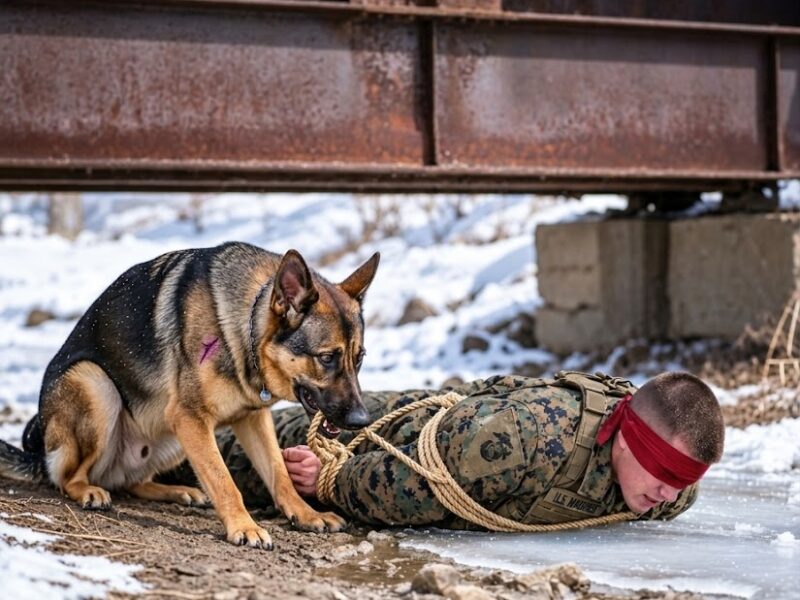
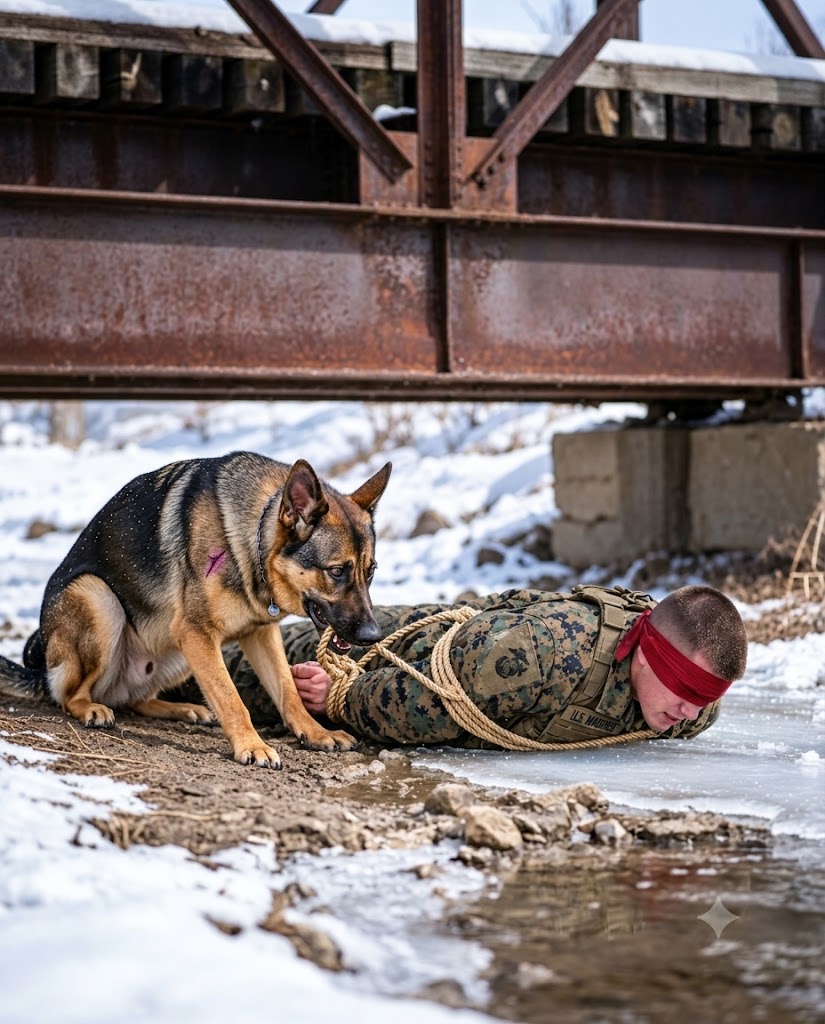
A former Army medic was driving outside Bozeman, Montana, when a wounded German Shepherd appeared beneath an abandoned railroad bridge. The dog’s shoulder was bleeding, his paws were torn, and he kept running toward the frozen creek, then looking back. Jack Sullivan followed and found Staff Sergeant Ethan Cole lying on the ice, blindfolded, bound with cargo rope, and barely conscious.
The shepherd was Ranger, Ethan’s retired military canine. He had fought through the cold to find help after men from a freight company left them both to die. Before passing out, Ethan whispered three words. “Don’t trust Holloway.”
What looked like a brutal attack would soon expose missing aid shipments, falsified transport records, and a hidden warehouse. January had turned the hills north of Bozeman, Montana into white fields, dark pines, and roads glazed with ice. The sun had not cleared the mountains when Jack Sullivan’s pickup rounded the bend toward an abandoned railroad bridge.
Jack was 43, tall and broad-shouldered, with graying brown hair, a weathered face, and quiet eyes that noticed trouble early. He ran a small repair garage outside town and volunteered with a county rescue group whenever winter storms trapped drivers in the mountains. Years earlier, Jack had served as an Army medic in Afghanistan. He rarely spoke about those years.
One failed rescue involving his closest friend had stayed with him long after the uniform came off. Since then, Jack had become patient with frightened people, careful in emergencies, and almost incapable of driving past someone who might still need help. That morning, he was returning from a ranch where he had repaired a frozen fuel line when movement beside the creek caught his attention.
A German Shepherd stood near the snowy embankment. His name was Ranger, though Jack did not know that yet. Ranger was about 8 years old, large but lean, with a black and tan coat dusted with snow and amber eyes that remained unusually alert despite his exhaustion. One shoulder showed signs of an earlier injury, and he placed one front paw cautiously against the frozen ground. He looked tired, but he did not look lost.
Jack slowed his truck. “Hey, buddy.” Ranger stared at him. Then the shepherd turned and moved toward the bridge.
Jack pulled onto the shoulder and stepped outside. Ranger immediately backed away several yards. He stopped, looked at Jack, then moved downhill again. Jack followed two steps. Ranger stopped and looked back once more. Downhill. Stop. Look back.
Jack’s expression changed. “You want me to follow?” Ranger turned toward the creek.
Jack zipped his canvas jacket higher and started down the slope. The abandoned railroad bridge crossed a narrow frozen creek below the road. Rusted steel beams stretched above concrete supports darkened by decades of Montana winters. Snow covered most of the old maintenance path beneath it.
Ranger moved carefully, but with purpose. Then Jack noticed something near the bridge. Vehicle tracks. Large ones. They crossed part of the maintenance road before disappearing beneath fresh snow. Jack crouched briefly. Whatever vehicle had made them had not been gone long.
When he looked up again, Ranger had stopped beside the creek. That was when Jack saw the man. A figure lay near the edge of the ice, partly sheltered beneath one of the concrete supports. Jack’s old training returned before he had time to think about it. He moved forward.
Ranger stepped directly into his path. “Easy.” The shepherd did not bark. He did not charge. He simply stood between Jack and the man on the ground, exhausted, but completely unwilling to move.
Up close, Jack noticed a military-style collar beneath Ranger’s thick fur. The identification tag was missing. This was not a stray protecting a stranger. Jack slowly raised both hands. “Easy, soldier. I’m here to help him.”
Ranger watched Jack’s face. One second passed, then another. Finally, the shepherd stepped aside.
Jack knelt beside the man. He was Staff Sergeant Ethan Cole, though Jack would not learn his name for another few moments. At 35, Ethan was broad through the shoulders with closely cropped dark hair and the strong, disciplined build of a career Marine. Even in his weakened condition, there was something controlled about him, as though years of military life had settled permanently into the way he carried himself.
A winter field jacket covered his Marine Corps camouflage. A red cloth covered his eyes. His hands had been secured behind him with thick rope. He was breathing, but weakly.
Jack removed the cloth. “Sir, can you hear me?” Nothing.
Jack immediately called 911 and gave the dispatcher their location. Then he examined the rope, heavy braided cargo rope. Jack had seen the same kind around freight yards and commercial shipments. That detail stayed with him. Using the rescue tool from his emergency kit, Jack freed Ethan’s hands and covered him with a thermal blanket.
Ranger remained close enough to touch Ethan. “Stay with him,” Jack said quietly. Ranger lowered himself beside the Marine.
Jack checked Ethan’s jacket for identification. Staff Sergeant Ethan Cole, 35, United States Marine Corps. Inside a waterproof inner pocket, Jack found something else. A small metal USB drive sealed inside a clear protective sleeve. Jack paused.
Before he could wonder why Ethan had been carrying it, the Marine moved. His eyes opened slightly. “Ethan.” Jack leaned closer. “You’re safe. Help is coming.”
Ethan struggled to focus. For a moment, his gaze moved past Jack toward Ranger. Then he whispered three words. “Don’t trust Holloway.”
His eyes closed again. Jack looked toward the shepherd. “Holloway? Who?” Ranger only watched Ethan.
Jack returned the USB to the exact pocket where he had found it. Then something dark protruding from the snow caught his attention. Jack walked several feet and picked it up. A broken piece of black molded plastic rested in his hand, no larger than his palm. Part of a white mountain logo remained across one side. Beneath it was a company name, Northridge Logistics.
Jack looked toward the fading vehicle tracks, then toward Ethan. The clues did not fit together yet, and Jack had learned years ago that forcing an answer before the facts were ready usually led a man in the wrong direction. Still, one thing bothered him. This place was more than 30 miles from town.
Twenty minutes later, an ambulance and county rescue vehicle reached the bridge. Two paramedics in heavy winter gear moved quickly but calmly, stabilizing Ethan before transferring him onto a stretcher. The moment they lifted him, Ranger stood. His injured leg faltered. Still, he tried to follow.
Jack caught him gently around the chest. “Easy. He’s not leaving you.” Ranger resisted once, then he stopped and stared after Ethan.
One paramedic glanced back. “Is that his dog?” “I think so.” “Does he have a name?” Jack looked at the empty collar. “Not one I know yet.”
They could not leave the shepherd beneath the bridge, and Ranger refused to lose sight of Ethan. So Jack climbed into the county rescue vehicle beside him. Only then did the old German Shepherd settle. As they pulled away, Jack looked back through the window. Fresh snow was already covering the tire tracks. The abandoned bridge disappeared behind the pines.
In Jack’s pocket was the broken Northridge Logistics fragment. Ahead of him was a Marine who had used the last of his strength to give one warning. And beside him sat a wounded dog who had refused to abandon his person. If this had only been a robbery, one question remained. Why bring a Marine more than 30 miles from town and leave him beneath an abandoned bridge? And who was Holloway?
—
Ethan Cole woke to the pale winter light of Bozeman filtering through a hospital window. For several seconds, he did not know where he was. The ceiling above him was white. A monitor blinked beside the bed, and somewhere beyond the closed door, a cart rolled slowly along the hallway. Then the cold returned to his memory. The bridge. Snow. Ranger. After that, nothing came clearly.
Jack Sullivan was sitting in a chair near the window, still wearing the same canvas jacket from the previous morning. At 43, Jack had the kind of patience that made silence feel deliberate rather than awkward. He had stayed long enough to learn Ethan was stable, then long enough to make sure somebody familiar was there when the Marine opened his eyes.
“Ranger?” Ethan asked. “Alive,” Jack said immediately. “He’s with a veterinarian.” The tension in Ethan’s face eased before anything else did. He tried to sit up, but Jack raised one hand. “Take it easy.”
Ethan looked toward him. “Who are you?” “Jack Sullivan. I found you under the bridge.”
Ethan closed his eyes briefly. “Ranger found you.” Jack almost smiled. “That might be more accurate.”
The woman who entered a few minutes later was Deputy Rachel Morgan. Rachel was 34, tall and lean with dark brown hair pulled into a practical ponytail and gray-green eyes that tended to stay on people a second longer than expected. She had spent nine years in county law enforcement and had developed a reputation for being calm without being soft. Early in her career, she had watched a promising investigation collapse because too many people treated suspicion like proof. Since then, Rachel had become almost stubborn about evidence.
She pulled a chair closer to Ethan’s bed. “I’m going to ask you a few questions. If you don’t remember something, say you don’t remember.” Ethan nodded. “What’s the last clear thing you do remember?” “A warehouse. Northridge Logistics.”
His eyes shifted toward her. “Yes.” That was the first solid connection.
Ethan explained that after finishing a training rotation he had been volunteering with Frontline Home Project, a nonprofit that delivered winter supplies to veterans and military families across rural Montana. Most of the work was ordinary. Heaters, blankets, food boxes, generators, medical kits. But over the previous three months, supplies had begun disappearing between inventory checks and delivery.
At first, nobody thought much of it. A missing heater became a paperwork mistake. Two boxes of medical supplies became a loading error. Then an entire generator disappeared. Ethan started comparing shipping records. The missing loads had one thing in common, he said.
Rachel already knew the answer. “Northridge.” Ethan nodded. Every shipment had passed through one of the company’s transfer yards.
He had begun making his own list of container numbers, dates, and delivery discrepancies. Then, the night before Jack found him, Ethan received a message from an unknown number. He remembered the wording exactly. If you want to know where the missing shipments went, come alone.
“Did you?” Rachel asked. “Mostly,” Jack looked at him.
Ethan’s mouth tightened faintly. “I brought Ranger.” That decision, he now understood, had probably saved his life.
Beyond arriving at the warehouse, his memory became fragmented. A loading bay. A vehicle door. Someone telling him to stop asking questions. Then cold air and darkness.
Rachel did not push him beyond what he could remember. Instead, she placed the broken plastic fragment Jack had found into an evidence bag. “Northridge logo,” she said. “And the rope Jack found was commercial cargo rope. Those things matter, but they don’t tell us who put you there.”
Ethan studied her. “You think I’m wrong?” “I think evidence should tell me what happened before I decide what happened.” That answer seemed to satisfy him.
—
Across town, Ranger was having a considerably less patient morning. Carolina Mountain Veterinary Clinic occupied a small brick building near the southern edge of Bozeman. The veterinarian treating him was Dr. Emily Carter, 36, slender with shoulder-length chestnut hair, usually tied loosely behind her neck, and warm hazel eyes that sharpened whenever an animal was frightened. Emily had built her practice around older dogs, working animals, and difficult recovery cases.
Her husband had died in a winter rescue accident two years earlier, and since then, she had become quieter outside the clinic, but even more careful inside it. She had learned not to mistake fear for aggression.
Ranger lay on a padded examination mat, watching every movement. Emily had already determined that his shoulder injury was manageable and that his paws showed signs of a long journey across rough frozen ground.
“You worked hard yesterday,” she said softly. Ranger watched her without moving.
A small object near his shoulder required closer examination. Emily removed it carefully and set it into a metal tray. It was not a bullet. It was a broken piece of a cargo seal, the kind used to secure freight containers.
Emily stared at it for several seconds. That changed the meaning of Ranger’s injuries. He had not simply wandered through the woods. At some point, he had been close enough to secured freight equipment for part of a seal to become lodged against him.
The clinic door opened. A girl stood in the hallway. Sophie Carter was 11, small for her age, with straight brown hair cut just below her shoulders and the same hazel eyes as her mother. Before her father died, Sophie had followed him everywhere, especially when he worked with rescue teams. After the accident, the rescue dog that had accompanied him came home. Her father did not.
Sophie never blamed the animal, but afterward large dogs made her uneasy. She stopped when she saw Ranger. Ranger raised his head. Sophie immediately stepped backward.
Emily noticed. “You don’t have to come closer.” “I know.”
Ranger looked at the girl for a moment. Then, instead of moving toward her, he lowered his head back onto the mat. Sophie stayed in the doorway. That was all.
The next morning, she returned before school carrying a metal water bowl. She placed it several feet from Ranger, then moved away. Ranger stood, drank, and returned to his blanket without approaching her. Sophie watched him quietly. It was the first thing either of them had offered the other.
—
Back at the sheriff’s office, Rachel examined the metal USB recovered from Ethan’s jacket. Most of the files were encrypted, but a technician managed to access one partial directory. It contained dozens of container numbers. No descriptions, no customer names, just numbers and dates. Rachel compared them against Ethan’s notes. Several matched missing Frontline shipments.
Late that evening, she found something else. A traffic camera north of Bozeman had recorded Ethan’s truck on the night he disappeared. Less than two minutes behind him was a dark commercial vehicle. The plate belonged to a small transportation company registered under a Northridge subsidiary.
Rachel leaned closer to the screen. For the first time, the sequence was beginning to look deliberate. Then she checked the vehicle report. Her expression changed. The same vehicle had been reported stolen two days before Ethan disappeared.
Rachel sat back. Someone had not simply followed Ethan. Someone had arranged for the vehicle following him to lead nowhere. And whatever had happened beneath that frozen bridge had started before Ethan ever arrived there.
—
Three days after waking in the hospital, Ethan Cole walked out beneath a pale Montana sky with strict instructions to rest. He disliked every word of that sentence. At 35, Ethan had spent most of his adult life measuring recovery by how quickly he could return to work. Being told to stay home felt less like treatment and more like confinement.
Jack Sullivan drove him from the hospital. Ethan spent most of the ride staring through the passenger window. “I want to talk to Holloway.”
Jack kept his eyes on the road. “No.” Ethan turned toward him. “You found me under a bridge. You don’t get to tell me no.” “That’s exactly why I get to tell you no.”
Ethan said nothing. Jack had seen that look before in soldiers who mistook movement for progress. “Whoever arranged this was willing to go a long way to stop you from asking questions. If they feel cornered, they may do something worse.”
Ethan looked toward the snow-covered mountains. “So I sit around.” “You recover. Rachel investigates.” “Those are different things.”
Deputy Rachel Morgan agreed. By that afternoon, she was sitting in a records room at the Gallatin County Sheriff’s Office with Northridge Logistics spread across two computer screens. On paper, the company looked almost boringly respectable. It had operated in Montana for 13 years, transporting construction equipment, agricultural supplies, government freight, and nonprofit shipments across several western states.
Its safety record was clean, taxes were current, insurance certificates were valid. Its owner, Grant Holloway, was 52, tall and carefully groomed, with silver beginning to show at his temples, and the practiced smile of a man who had spent years shaking hands at public events. Photographs showed him donating winter coats to schools, standing beside firefighters at fundraising dinners, and presenting checks to veteran organizations.
People described him as generous, confident, and unusually good at remembering names. Northridge had sponsored school programs. It had funded equipment for volunteer fire departments. It had donated to veterans charities. That made Rachel more cautious, not less. A good reputation was not evidence of wrongdoing, but it was not evidence against it either.
She spent hours comparing freight records against the container numbers found on Ethan’s USB. Late in the afternoon, she found the pattern. Twenty-seven containers over 18 months carried the same final notation. Damaged. Disposed.
Rachel searched for disposal certificates. None. She checked insurance claims. Incomplete. Then she compared the container numbers with Frontline Home Project records. Eleven matched shipments of veteran relief supplies.
Rachel leaned back in her chair. Twenty-seven containers had supposedly become unusable, yet nobody seemed able to show where they had gone.
—
Across town, Ethan was staying temporarily at Jack’s house when an old compact sedan pulled into the gravel driveway. The driver remained inside for nearly a minute. Jack noticed him from the garage.
The young man who finally stepped out was Tyler Brooks. Tyler was 19, thin, slightly shorter than average, with sandy brown hair falling over his forehead and nervous blue eyes that rarely stayed in one place. He wore a Northridge work jacket over a faded sweatshirt, though he had removed the company badge from the chest.
Tyler had grown up fast after his mother became seriously ill. He worked whatever hours he could find and had developed the cautious habit of someone who believed one lost paycheck could change everything at home.
“You Jack Sullivan?” “That depends.”
Tyler swallowed. “I sent the message to Ethan Cole.”
Jack’s expression changed. Ten minutes later, Tyler sat at Jack’s kitchen table with Ethan across from him.
“You told me to come alone,” Ethan said. “I didn’t think you’d bring the dog.” “Good thing I did.”
Tyler looked down. “I’m sorry.” Ethan studied him. “Tell me what you know.”
Tyler had started at Northridge as a seasonal worker, mostly moving paperwork and checking seal numbers. Several months earlier, supervisors began giving him unusual overnight assignments. Certain containers arrived normally. Then, after midnight, those containers were moved away from the main yard to an older storage site. Their seal numbers changed. Sometimes their paperwork changed with them.
Later, Tyler recognized items from those shipments being moved to private buyers or other freight companies. “Heaters,” Tyler said. “Generators. Boxes marked for veteran programs.”
Ethan’s jaw tightened. “Why didn’t you report it?” Tyler looked up, embarrassed, but defensive. “My mom has treatments twice a week. I pay rent, groceries, gas. If I lose that job, I don’t know what happens.”
Silence settled over the kitchen. A few days earlier, Ethan might have heard only the silence and mistaken it for complicity. Now he saw a frightened 19-year-old trying to keep his family together.
“You still contacted me?” Ethan said. Tyler nodded. “Because it kept getting bigger.”
He gave them a name. Cold Creek Depot, an abandoned timber storage facility deep in the mountains, officially listed as inactive. “That’s where they move the containers.”
Ethan started to stand. Jack immediately pointed toward the chair. “No.” “I wasn’t.” “You absolutely were.”
—
At Carolina Mountain Veterinary Clinic, Ranger’s recovery was moving more slowly than his patience. A Northridge truck passed outside while Emily Carter was changing his bandage. The low diesel engine reached the examination room.
Ranger’s head came up instantly. He moved toward the window. Sophie, sitting on the floor with a book, froze. But Ranger was not trembling. He was watching.
Jack happened to arrive moments later to check on him and saw the shepherd tracking the truck through the glass until it disappeared. “He’s not afraid of it,” Jack said.
Emily looked at him. “Then what is he doing?” “Following it.”
Sophie had been spending a little more time near Ranger each day. At first 10 feet separated them, then six, then three. She read while Emily worked, never looking directly at him for too long. Ranger never closed the distance himself.
One afternoon, Sophie fell asleep with her book open beside her. When Emily returned, Ranger had quietly positioned himself between Sophie and the clinic door. Sophie woke and saw him there. For several seconds, she did nothing. Then she slowly reached out and touched the fur between his ears. Ranger remained still. It was the first time she had touched a large dog since her father died.
—
That same evening, Rachel called Ethan and Jack to the sheriff’s office. She had recovered footage from a gas station camera along the highway. The image was poor, but clear enough. A commercial vehicle stopped briefly. Later, Ethan appeared to be inside it, and far behind, almost lost in the darkness, a German Shepherd was running after the vehicle.
Rachel used distances between cameras to estimate the route. Ranger followed it more than 6 miles.
Ethan stared at the screen. “Six miles through a Montana winter night. Injured. Alone. Still following.”
“He never stopped,” Ethan said. Jack looked at him. “Apparently, neither did you.”
Near midnight, Ethan’s phone rang. Tyler. Ethan answered immediately. “Tyler.” Breathing on the other end. Then the young man’s voice. “They know I talked.”
The call ended. Ethan stared at the dark screen. This time, nobody in the room needed Rachel to explain what it meant.
—
By sunrise, Tyler Brooks had stopped answering his phone. Deputy Rachel Morgan did not wait for another call. By 7:30, she had two patrol units checking Tyler’s apartment, workplace contacts, and the roads between Bozeman and the Northridge yard.
His mother, Linda Brooks, met Rachel outside a modest duplex on the west side of town. Linda was 48, small and thin, with short blonde hair beginning to gray, and the tired posture of someone who had spent too much time in hospital waiting rooms. Months of medical treatment had weakened her physically, but worry had made her voice unexpectedly firm.
“He wouldn’t disappear without telling me,” she said. “Not after everything we’ve been through.”
Tyler’s phone was found that morning beside a county road, damaged beyond use. Two hours later, his sedan turned up near an old mining access route 20 miles north of town. The driver’s door was unlocked. Tyler was nowhere nearby.
Ethan Cole arrived before Rachel wanted him there. “You’re still recovering,” she told him. “I’m standing.” “That is not the medical definition of recovered.”
Jack Sullivan stood beside Ethan and for once agreed with Rachel. Then Linda brought out Tyler’s winter jacket. “He left this at home yesterday.”
Ranger, who had been resting in Jack’s truck after receiving clearance from Emily for short controlled activity, lifted his head the moment the jacket appeared. Ethan looked at Rachel.
“No,” she said. “You haven’t even heard me.” “I know what you’re thinking.”
Ranger had spent years trained in military tracking and search work. Retirement had slowed his body, but not erased what repetition had built into him. Ethan let Ranger smell Tyler’s jacket. The shepherd inhaled slowly, stepped away, then returned to the fabric once more. His posture changed.
Jack noticed first. “That dog just went back to work.”
Rachel looked toward the tree line beyond Tyler’s abandoned car. She hesitated, then made the decision. “Controlled search. Ranger stays on lead. Ethan stays with us. Nobody runs ahead.”
Ethan gave a slight nod. “I can live with that.”
—
They entered the forest shortly before noon. The old mining road narrowed quickly beneath snow-covered pines. Ranger moved carefully, stopping often, checking the ground and air before choosing a direction. He no longer had the effortless strength of a young working dog, but his concentration was absolute.
Jack followed several yards behind. The deeper they went, the more the forest began to resemble places he had spent years trying not to remember. Narrow paths. Heavy silence. The feeling that something might be waiting beyond the next rise.
For a moment, Montana disappeared. Afghanistan returned. Jack remembered another search years earlier. Another injured man. Another desperate attempt to keep someone alive until help came. He had carried the memory of that failure so long that sometimes he forgot it was a memory and not a judgment.
Ethan noticed him slow. “You okay?” Jack nodded too quickly. “Just remembering something.”
They walked another 20 yards. Then Jack said, “I used to think leaving the Army meant I quit.”
Ethan looked over. “You run rescue calls in Montana winters for free. That’s not the same.”
“No,” Ethan said. “But you didn’t stop being a medic because you took off the uniform.”
Jack stopped for half a second. No speech, no dramatic answer. He simply started walking again. But something about the weight he carried felt different.
Ranger led them across a shallow creek bed and toward an abandoned industrial property hidden among the trees. A rusted sign leaned beside the access road. Cold Creek Depot. The place had once stored timber before rail shipment. Three long wooden structures remained along with a smaller office building and several loading platforms half-covered in snow.
Rachel immediately called their location to additional units. Ranger moved toward the office. Ethan felt the lead pull once. “Easy.”
Ranger stopped at the door. Rachel entered first with another deputy. A minute later, her voice came from inside. “We found him.”
Tyler was sitting on the floor of a locked back office, shaken and exhausted but conscious. When Ethan entered, Tyler looked at him with visible relief. “I thought nobody knew where to look.”
“Ranger knew.” Tyler looked toward the shepherd. For the first time since they met, he smiled.
After paramedics checked him, Rachel began asking questions. Tyler told them that the man directing activity at Cold Creek was Dean Keller. Dean was 46, heavy-set with close-cropped black hair, a broad face, and the blunt manner of someone used to giving instructions without being questioned. He had managed Northridge warehouse operations for almost seven years. Employees considered him efficient but intimidating.
According to Tyler, Dean had become increasingly secretive as missing shipments drew attention. “Holloway wasn’t there when they grabbed Ethan,” Tyler said. “Dean was.”
Ethan remained quiet. “But Grant approved the transfers,” Tyler continued. “I saw authorization records. Nothing moved without his numbers.”
Rachel leaned closer. “What else did you see?” “A room in the back warehouse. Boxes of paperwork, old freight files, hard drives. They kept copies of everything that mattered.”
Then Tyler explained what had happened the night Ethan disappeared. Dean had not intended to kill Ethan. The plan, as Tyler understood it, was to frighten him badly enough that he would stop investigating and make the situation appear like a reckless trip into dangerous winter terrain.
But Ranger had complicated everything. When the men tried to separate Ethan from the dog, Ranger reacted defensively. In the confusion, Ranger was hurt, and Ethan focused on protecting him instead of himself. Before Dean’s men could finish staging the scene, another vehicle appeared on the distant road. They panicked. They left Ethan and Ranger beneath the bridge and drove away.
Ranger later freed himself enough to seek help. Ethan looked down at him. So that was why Ranger had been the one still standing when Jack arrived. Not because he had escaped first. Because he had stayed.
—
By late afternoon, Tyler was transported back to Bozeman. Ranger returned to Carolina Mountain Veterinary Clinic for another check. Sophie was waiting when Emily brought him inside. She watched her mother examine his shoulder and paused.
“He went looking for somebody again.” Emily nodded. “Even when he’s still hurt.” “Yes.”
Sophie sat beside Ranger’s blanket. “Why?” Emily looked at the old shepherd. “Maybe because he knows what it feels like to be left alone.”
Sophie considered that for a long moment. Then she rested one hand gently against Ranger’s neck. Ranger closed his eyes.
—
Across town, Rachel was finishing Tyler’s statement when her radio came alive. She listened without speaking. Then her face changed.
Ethan noticed immediately. “What happened?” Rachel reached for her coat. “Cold Creek Depot.”
Jack stood. Rachel looked at both men. “It’s on fire.”
By the time Rachel Morgan reached Cold Creek Depot, the worst of the fire had been contained. Fire crews moved through the ruined loading area beneath portable lights while smoke drifted into the dark Montana sky. Most of the main structure was still standing, but several storage sections had been badly damaged, and the office where Tyler had been found earlier was blackened and unsafe to enter.
Rachel already had a search warrant. Ethan Cole arrived with Jack Sullivan shortly afterward. Ranger remained in Jack’s truck at first, wrapped in a blanket and under strict instructions from Emily Carter not to overwork himself.
Ethan watched firefighters carry water-damaged boxes from the building and felt the case slipping away in front of him. Some shipping records had survived. Many had not. Computer equipment from one office was too damaged to read immediately. Paper files from another room had been reduced to soaked fragments.
Grant Holloway responded publicly before sunrise. He released a short statement claiming he had no knowledge of illegal activity at Cold Creek Depot and suggesting that Dean Keller, his warehouse manager, had been operating outside company policy. Grant’s message was calm and carefully worded. Northridge, he said, would cooperate fully.
Dean Keller, however, had disappeared. His house was empty. His company vehicle was gone. His phone had stopped transmitting shortly after midnight.
For several hours, it looked as though the investigation might be left with suspicion, damaged records, and a missing warehouse manager carrying most of the blame. Ethan stood outside the depot with Rachel.
“He’s going to put everything on Keller.” Rachel looked toward the building. “If the evidence says that, then that’s where it goes.” “And if it doesn’t?” “Then we find the evidence that says otherwise.”
That was Rachel’s answer to almost everything. Not anger. Not instinct. Proof.
—
Late that morning, Emily allowed Ranger to come to the depot for a short visit after Ethan insisted the dog might recognize areas connected to the previous night. “No running,” Emily warned him. “No tracking through rough ground. And the moment he looks tired, you stop.”
Ethan nodded. Emily gave him a look. “I mean it.” “I heard you.” “I’m talking to both of you.”
Ranger lifted his head as if he understood.
Inside the safer section of the warehouse, the shepherd moved slowly beside Ethan. At first, he showed little interest in the damaged offices. Then, near the rear loading area, Ranger stopped. He pulled gently toward a stack of old wooden pallets. Ethan followed. “Ranger.”
The dog moved around the pallets and scratched once at something behind them. Jack helped shift one pallet aside. A steel door appeared.
Rachel stared at it. The door did not appear on the warehouse floor plan. She called the search team.
After investigators cleared the area and opened the secured entrance, they found a narrow room built with fire-resistant walls. Inside were shelves, dozens of storage boxes, backup hard drives, shipping invoices, buyer lists, original container numbers, replacement seal numbers, and a small recording system connected to internal cameras that had survived because the room was protected from the fire.
Rachel stood in the doorway for several seconds without speaking. Ethan looked down at Ranger. “Good boy.” The shepherd leaned against his leg.
Investigators spent the rest of the day cataloging evidence. One recovered video showed Grant Holloway personally supervising relief supplies as they were transferred from marked containers into private trucks. Another placed Grant inside Cold Creek Depot on the same night Ethan disappeared. That footage changed everything.
Grant was no longer simply an owner, claiming his manager had acted independently. He had been there.
Rachel issued an alert for Dean Keller. Near sunset, a state trooper spotted Keller’s vehicle at a truck stop close to the Idaho border. Rachel and two deputies reached the location before he left. Dean offered no resistance. By then, he seemed less like the intimidating manager Tyler had described and more like a tired man who had realized the people above him were prepared to leave him carrying everything.
At the sheriff’s office, Dean asked for an attorney. Then he decided to cooperate. His statement was simple. Grant had wanted Ethan frightened badly enough to stop asking questions.
“Scare him cold enough that he stops asking questions,” Dean said, repeating the instruction he claimed Grant had given him. The situation had gone wrong when Ranger refused to leave Ethan and disrupted their plan. Dean confirmed that Grant approved the altered shipping records, private transfers, and efforts to remove evidence once Rachel’s investigation began.
That evening, Grant Holloway was arrested. There was no crowd, no dramatic confrontation. Just officers, paperwork, evidence, and a man whose public reputation could no longer answer the records stored behind a steel door.
—
Over the following weeks, Frontline Home Project recovered a large portion of the missing supplies. Generators returned to storage. Boxes of winter blankets were reprocessed. Portable heaters finally reached veteran families just before another cold front moved across Montana.
Tyler Brooks was formally treated as a cooperating witness rather than a participant in the scheme. When several local veterans learned why he had been afraid to lose his job, they organized a community fund to help Linda Brooks with treatment costs. Tyler tried to refuse at first. His mother did not let him.
Jack also made a decision. The rescue coordinator he had volunteered with for years offered him a permanent position overseeing first aid preparation for winter search teams. This time, Jack accepted. He thought about what Ethan had told him in the forest. Taking off the uniform had never taken away the part of him that knew how to help.
For Ethan, however, one question remained more personal than the investigation.
—
At Carolina Mountain Veterinary Clinic, Emily finished Ranger’s final evaluation while Ethan waited beside the examination table. Ranger was recovering well, but age, the recent strain, and old service injuries had caught up with him.
Emily removed her stethoscope. “He can have a good life,” she said. Ethan looked at her. “But no more dangerous work. No long searches. No missions where he has to push past what his body is telling him.”
Ethan looked down. Ranger rested his head against Ethan’s hand. “I should have protected him better.”
Emily shook her head. “Ranger didn’t protect you because somebody gave him an order.” Ethan remained silent. “He did it because you’re his family.”
For most of Ethan’s adult life, usefulness had meant duty, rank, training, finishing the mission. Ranger had never cared about any of those things. The dog had followed him because he was Ethan. Nothing more, nothing less.
Ethan rubbed the fur behind Ranger’s ears. The investigation was ending. The danger was over. But for the first time, Ethan faced a question he had never trained for. If Ranger could no longer live for the mission, what would the rest of his life be for?
—
Three months later, spring finally reached the hills outside Bozeman. The snow along the old railroad bridge had disappeared first from the exposed rocks, then from the narrow creek bank below. Pine branches no longer carried ice, and the mornings smelled less like frozen ground and more like wet earth.
For Ethan Cole, the changing season felt strangely appropriate. Winter had not only ended around him. Something inside him had started to loosen with it.
Grant Holloway and Dean Keller were both facing multiple charges connected to the stolen relief shipments, falsified freight records, and the incident involving Ethan. Northridge Logistics remained under investigation as officials worked through years of transport data.
Frontline Home Project had changed too. Every shipment now carried a digital tracking record, independent confirmation at transfer points, and a documented chain of custody from warehouse to family. Ethan had helped design part of that system. He no longer wanted answers hidden inside somebody else’s paperwork.
But the most important decision he made had nothing to do with logistics.
Ranger would never return to dangerous work. Ethan had spent several weeks pretending the decision was harder than it really was. He had imagined Ranger tracking through snow again, standing alert beside him, waiting for another command. Then one morning, he watched the old German Shepherd struggle slightly after climbing the steps to Jack’s porch. That was enough.
“You’re done, partner,” Ethan told him. Ranger looked up as if waiting for the rest. “There is no rest.”
Ethan had recently bought a small house several miles outside Bozeman. It was a simple one-story place with weathered cedar siding, a wide porch, and a fenced yard large enough for Ranger to move at his own pace. The house was nothing impressive, but the first thing Ethan installed was a padded bed beside the living room window.
Ranger ignored it for two days. He preferred sleeping near Ethan’s boots. Emily Carter found that deeply unsurprising.
She had been visiting often, partly to check Ranger’s recovery, and partly because life had become complicated in quiet ways neither she nor Ethan seemed interested in naming too quickly.
One Saturday afternoon, Emily stood in Ethan’s backyard, watching Sophie read beside Ranger beneath a cottonwood tree. “I’ve been thinking,” she said.
Ethan looked at her. “That usually means I’m about to get assigned something.” Emily smiled. “Not you. Ranger.”
Her idea was small enough to sound possible. A program for retired working dogs. Not formal service work. Not patrol work. Not anything that required certification beyond careful behavioral evaluation and supervision. Just companionship.
Retired military and police dogs could spend time with veterans adjusting to civilian life, children dealing with loss, and families who needed a calm presence more than another conversation. Emily already had a name. Second Trail.
Ethan repeated it. “Second Trail?” “Because the first one doesn’t have to be the only one.”
He looked toward Ranger. The shepherd was lying beside Sophie while she read from a chapter book. His eyes were closed, but one ear moved every time she changed her voice for a character.
Ethan nodded. “All right.”
—
Ranger became the first dog in the program. His new job required almost nothing from him. He did not search vehicles. He did not follow suspects. He did not wait for commands. He simply lay beside people, learning how to feel safe again.
Sophie became his first regular visitor. Every Saturday afternoon, she brought a book and sat beside him. At first, she read carefully, still watching him whenever he shifted. Then the caution faded.
One warm afternoon, Emily looked through the clinic window and saw Sophie outside with Ranger in the grass. The girl started running. Ranger followed at an easy pace. Sophie laughed. Not a polite laugh, not the small smile she had learned to use when adults asked whether she was doing okay. A real laugh.
Emily stopped where she was. It was the first time since her husband died that she had heard her daughter laugh that freely beside a large dog. She quietly turned away before Sophie could see the tears in her eyes.
—
Jack Sullivan changed, too. He officially joined the county rescue program as the lead instructor for first aid preparation and began offering free weekend classes for volunteers. At his garage, above an old workbench covered with tools, Jack hung one object from the winter. Everything changed.
A short piece of the cargo rope he had cut away from Ethan beneath the bridge. People occasionally asked why he kept it. Jack never gave them the full story. He simply said, “Sometimes you need a reminder that a life can take a different road and still be useful.”
For years, Jack had believed the most important version of himself had been left somewhere overseas. Now, he no longer believed that.
Tyler Brooks also started over. With his mother’s condition more stable and community support easing some of the financial pressure at home, Tyler returned to community college. He chose logistics.
When Ethan heard, he stared at him. “After all this?” Tyler shrugged. “I figured somebody should learn how to do it right.”
Months earlier, the boy rarely held eye contact. Now there was more steadiness in him. Ethan pointed at him. “This time, check the paperwork.” Tyler smiled. “Every single page.”
—
Late in May, Ethan took Ranger for a drive north of Bozeman. He did not tell anyone where they were going. The old railroad bridge appeared between the trees just before sunset. Without snow, it looked smaller than Ethan remembered. Less threatening. More ordinary.
They walked slowly down toward the creek. The ice was gone. Clear water moved over smooth stones beneath the bridge. Ranger stepped toward the place where Ethan had been found months earlier. He sniffed the ground, waited, then looked back.
Ethan stood several yards away. For a moment, he remembered the cold, the confusion. Ranger refusing to leave. Then he looked at the dog standing in the evening light.
“Ranger.” The shepherd’s ears lifted. “Home.”
Ranger turned. He walked back toward Ethan. Not at heel, not in formation, not like a working dog waiting for another command. Just an aging German Shepherd walking beside the person he had chosen years earlier.
Ethan rested one hand against his neck. “You already did enough, partner.” Ranger leaned gently against his leg.
Then they climbed the hill together. Behind them, the bridge remained exactly where it had always been. But this time, there was nothing beneath it waiting to be rescued. No snow. No unanswered warning. No unfinished mission. Just two old partners heading home.
And this time, nobody was being left behind.
—
You know what stays with me most about Ranger’s story? It wasn’t the frozen bridge or the missing shipments. It was that Ranger never stopped trying to reach Ethan. Older, injured, and exhausted, he stayed loyal until help finally came. That is what makes loyalty powerful.
Sometimes it is a dog refusing to leave. Sometimes it is Tyler finding the courage to tell the truth. Jack realizing he could still save lives. Or Sophie finally reaching out to a dog after years of fear. Ranger helped expose Northridge Logistics, but his greatest impact went far beyond the case.
Families got their supplies back. Tyler received a second chance. Jack returned to rescue work. And Sophie began to heal. Most of all, Ethan finally understood that Ranger never cared about his rank or his missions. He only wanted his person to come home.
Tonight, I pray God protects your family, strengthens the part of you that keeps going when life becomes heavy, and reminds you that your worth is not measured only by what you can still do for others. I pray He gives you the courage to help when someone is silently asking for it. The wisdom to recognize loyalty when it stands beside you. And the grace to understand when it is finally time to stop fighting and come home.
If Ranger’s story touched your heart, write amen in the comments. And if you believe in loyalty, faith, second chances, and giving old warriors a place to rest, subscribe and stay with us.
But Ranger’s story was not the last time a military dog refused to leave something behind. Wait until I tell you about the retired Marine who found an aging German Shepherd alone inside an abandoned police cruiser during a freezing midnight storm. The dog would not leave the back seat even when rescuers opened every door.
Then the Marine discovered a weather-damaged handler badge hidden beneath the seat and realized the dog was not trapped there at all. He was guarding something connected to an officer who had disappeared three years earlier. What they found inside an old evidence case would reopen a mystery the entire town thought had already been buried. And when that German Shepherd finally stood up and led them toward a forgotten service road, even the officers following him had no idea what was waiting at the end.
Subscribe now because this next story is one you will not want to miss.









