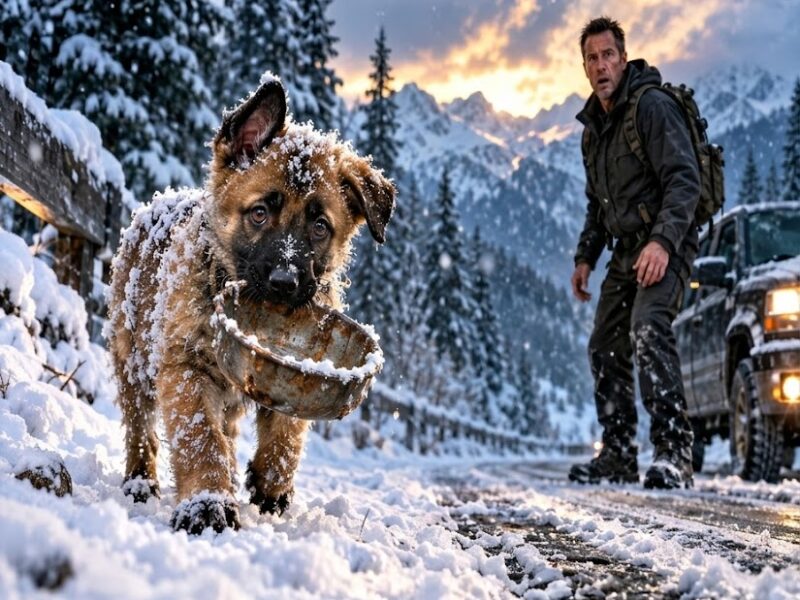
A K9 puppy wouldn’t let go of a rusty bowl—until a Navy SEAL learned why.
**Part 1**
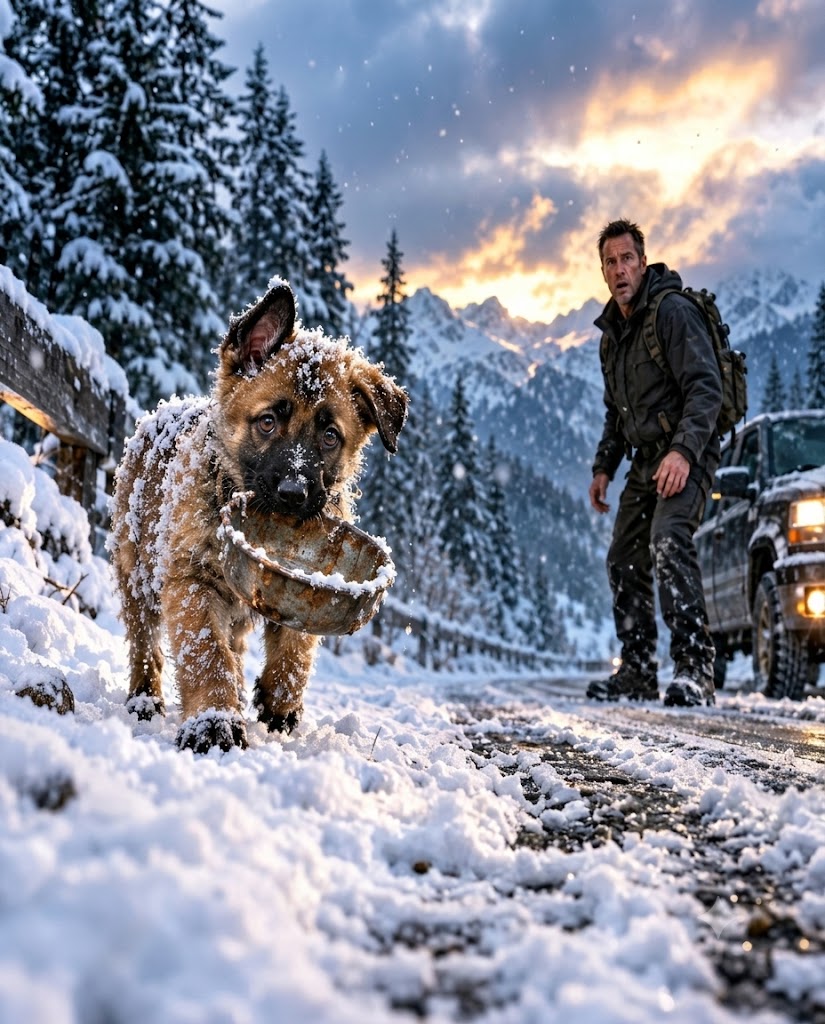
A tiny Belgian Malinois puppy stood trembling beside a snow-covered road in the mountains of Colorado, his little paws sinking into the freezing powder.
He was barely eight weeks old, cold, exhausted, and completely alone.
Yet somehow he refused to let go of a small, rusty iron bowl clamped between his teeth, as if it were the last precious thing he had left in the world.
The dashboard thermometer in the idling pickup read six degrees above zero, and the wind coming off the San Juan range pushed that number lower with every gust.
Below the guardrail, a county snowplow had carved a single gray lane out of two feet of fresh powder, and the plow’s yellow beacon was already disappearing around the bend.
Cyrus Larkin, fifty-two years old, a former Navy SEAL who had spent eight years hiding from the memories of his past, only intended to rescue the puppy for one night.
But then the little dog did something strange.
Every time Cyrus tapped the old bowl three times with his knuckle, the puppy would suddenly rush toward him, his tail wagging as though he recognized a voice from somewhere far away.
What Cyrus didn’t know was that those three simple sounds would lead him to an isolated mountain weather station, a retired schoolteacher no one could reach, and a winter rescue that would force him to confront the one mistake he had spent years trying to forget.
And by the end, that empty, rusty bowl would remind a broken veteran of something he never expected to believe again.
Sometimes God sends the smallest souls into our lives to lead us back home.
The first thing Cyrus Larkin noticed was the sound of metal scraping against frozen pavement.
The second was the tiny animal making it.
Beneath a weathered fence beside an abandoned storage shed, a Belgian Malinois puppy was struggling through the snow with a rusty iron bowl clamped between his teeth.
Every few steps, the bowl slipped from his mouth.
Every time, the puppy picked it up again.
Cyrus stopped his truck and stared through the windshield.
“Whatever that little dog is trying to accomplish,” he muttered, “he seems determined to finish it.”
January had buried Brier Summit, Colorado, beneath nearly two feet of snow.
The San Juan Mountains rose beyond the dark pine forests, their white peaks disappearing into low clouds, and the county road that ran past Cyrus’s property had been plowed exactly once since Sunday.
Cyrus had lived here for six years, long enough that the woman at the hardware store called him by name and long enough that nobody expected him to come to the Christmas potluck anymore.
He was a tall, broad-shouldered man with short dark chestnut hair, silver-gray temples, steel-blue eyes, and a square, clean-shaven jaw hardened by years of military discipline.
His charcoal winter jacket hung over a muscular frame that had grown leaner with age but had lost little of its strength.
He rarely smiled at strangers, spoke only when necessary, and preferred repairing broken radios to dealing with complicated human emotions.
Eight years earlier, during a joint rescue operation, Cyrus had trusted an incomplete radio report.
His decision contributed to a delay that left his teammate, Gideon Mercer, stranded for hours in difficult terrain above the tree line.
Gideon survived and recovered, and the investigation identified several contributing failures.
But Cyrus remembered only the decision he wished he had made differently.
He eventually left the service, stopped answering Gideon’s calls, and built a quiet existence where nobody depended on him for anything more important than a repaired machine.
Twenty-nine missed calls.
That was the number that lived in the back of his mind like a splinter he had stopped trying to remove, twenty-nine calls from a man he had once trusted with his life, and every one of them unanswered.
Now, standing beside his truck, he watched a puppy challenge that carefully arranged life.
“You’re going to freeze out here, little soldier,” Cyrus murmured.
The puppy looked up.
He couldn’t have been more than eight weeks old, with a short warm tan coat, a sharply defined black mask around his muzzle, dark brown eyes, and paws slightly too large for his narrow body.
His right ear was beginning to stand, the left folded sideways.
Snow clung to his belly, and his small legs trembled.
Yet when Cyrus approached, the puppy stepped protectively over the bowl.
Cyrus crouched, keeping his movements slow.
“I’m not stealing your treasure,” he said.
The puppy answered with a faint whimper.
Cyrus spread a clean towel over a patch of snow and offered a few pieces of plain cooked chicken from his lunch container.
Hunger eventually overcame suspicion.
The puppy released the bowl, stepped onto the towel, and accepted the food.
Cyrus gently wrapped him up.
When the little animal turned toward the abandoned bowl, Cyrus picked that up, too, holding it separately.
“All right,” he said. “Your ridiculous bowl is coming.”
Inside the heated truck, away from the wind, the puppy gradually stopped shaking so intensely.
Cyrus called a local veterinary clinic and described what he had found.
The veterinarian on duty advised him to provide gentle warmth, avoid bathing a dangerously chilled animal, and seek urgent attention if the puppy remained weak or unresponsive.
“Keep him dry, keep him warm, and keep him awake on the drive,” the tech said. “If he won’t lift his head, you skip the driveway and go straight to the ER in Durango.”
Cyrus watched the puppy carefully throughout the short drive home.
Halfway there, he noticed something unsettling.
The puppy had been resting quietly inside a towel-lined travel crate on the passenger seat, secured with the seat belt.
But whenever the truck passed a roadside turnoff leading toward the mountains, he lifted his head and whined softly.
When the road straightened, he settled again.
Cyrus knew it could mean nothing more than unfamiliar sounds or movement.
Still, the puppy’s repeated glances toward the snowy hills made him wonder whether the little animal was remembering somewhere he desperately wanted to return.
The cabin stood beneath towering pines with a narrow porch, a stone chimney, and a workshop attached to its eastern wall.
Everything inside was orderly.
Tools hung on labeled hooks.
Boots stood neatly beside the door, and an old military photograph remained face down inside a desk drawer.
Cyrus rarely had visitors.
He had stopped expecting them.
He placed the puppy on a thick blanket near the guarded wood stove and offered small amounts of water.
Gradually, the little dog became more alert.
After another conversation with the veterinarian, Cyrus carefully cleaned the muddy fur with warm, damp cloths, avoiding a full bath until the puppy was completely stable.
The puppy strongly disagreed with having his feet wiped.
He wriggled against Cyrus’s forearm, attempted to climb his sweater, and planted a wet paw directly against his chin.
“That’s not how we negotiate, soldier,” Cyrus said.
The puppy sneezed.
Cyrus blinked, then laughed, a brief unexpected sound that seemed almost foreign inside the silent cabin.
Once the puppy was clean and dry, Cyrus settled him on fresh bedding and offered a small portion of suitable puppy food.
Following the veterinarian’s guidance, the little dog ate eagerly before curling into a warm, exhausted bundle.
Cyrus sat beside him longer than he intended.
“Rusk,” he finally said, studying the puppy’s toasted gold fur. “That’s what I’m calling you.”
Temporarily, one brown eye opened, then closed again.
Later, Cyrus examined the object that had caused so much trouble.
The shallow iron bowl measured barely five inches across.
Patches of reddish rust covered its exterior, and three small dents marked one section of the rim.
Underneath was a faded engraving, a mountain beneath a four-pointed star.
It looked old, personal, and oddly out of place beside an abandoned storage shed.
“Three dents,” Cyrus said quietly, turning it in the lamplight. “Somebody dropped you hard.”
He put it on a high shelf where Rusk couldn’t reach it, then placed a clean water bowl near the puppy’s blanket.
Whatever memories the old object carried, Cyrus wasn’t about to let a young dog chew rusty metal.
That evening, after arranging a veterinary examination for the following morning and beginning a found dog report, Cyrus ate dinner alone.
Or rather, he tried to.
Every few minutes, Rusk raised his head to see whether the man was still there.
Cyrus found himself explaining ordinary things aloud, why the stove made clicking sounds, why boots belonged by the door, and why the puppy couldn’t sleep on the dining table.
He hadn’t spoken so much inside that cabin in years.
“Your bowl is safe,” he told the puppy. “It’s on a shelf. Nothing in this house is going to hurt it.”
Rusk yawned, unconvinced.
After midnight, an old dream returned.
Broken radio transmissions, cold terrain, Gideon’s voice disappearing beneath static.
Cyrus woke with his heart pounding and sat in the dark, struggling to separate memory from the quiet room around him.
Soft paws tapped against the floor.
Rusk appeared beside the chair, unsteady with sleep.
He pressed his small body against Cyrus’s boot and rested his chin across the leather.
Cyrus looked down for a long moment before reaching out.
“You’re supposed to be sleeping,” he said.
Rusk sighed.
The steady warmth beneath Cyrus’s hand helped him focus on the room again.
Eventually, he carried the puppy back to bed and sat beside him until both had settled.
Morning brought pale sunlight across the snow.
Cyrus dressed, prepared coffee, and retrieved the old iron bowl to take along to the veterinarian.
While slipping it into a cloth bag, he accidentally tapped its rim three times with a wooden handle.
Rusk’s head shot up.
The puppy scrambled from his blanket, hurried across the floor, and sat directly in front of Cyrus, staring upward with unmistakable anticipation.
Cyrus frowned.
He gently repeated the three taps.
Rusk’s tail began wagging.
For several seconds, the former Navy SEAL stood motionless, looking between the puppy and the battered bowl.
Then he spoke quietly.
“Someone taught you that.”
Outside, snow shimmered beneath the morning sun.
Inside, Cyrus realized the strange little dog might have a past worth finding.
And for the first time in years, he wanted to follow a question whose answer he couldn’t predict.
By eight o’clock the following morning, Cyrus Larkin had discovered that caring for an eight-week-old puppy required more planning than most of his repair jobs.
Rusk had already inspected both boots by the front door, attempted to drag a dish towel across the kitchen, and fallen asleep halfway through an enthusiastic investigation of a rubber chew toy.
Now he sat inside his secured travel crate, watching snow-covered pine trees pass the truck windows.
Cyrus glanced at him.
“We’re going to the veterinarian,” he said. “That doesn’t mean you get to negotiate your way out of it.”
Rusk tilted his head, his right ear rising slightly while the left remained folded.
Cyrus almost smiled.
Yesterday, the little Belgian Malinois had been shivering beside an abandoned storage shed.
Today, he behaved as though the truck, the cabin, and possibly Cyrus himself had always belonged to him.
Northridge Veterinary Clinic occupied a modest brick building near the center of Brier Summit, between a hardware store and a bakery that closed at noon.
Dr. Erin Whitcomb greeted them wearing teal scrubs beneath a navy fleece jacket.
At forty-four, she was a slender woman of average height with dark blonde hair gathered into a low ponytail, green hazel eyes, and fair skin lightly marked by freckles.
She possessed the unhurried confidence of someone accustomed to frightened animals and worried owners.
Years of treating working dogs from remote ranches had taught her that calm hands usually accomplished more than a commanding voice.
“So this is our mysterious traveler,” she said, lifting Rusk carefully onto a padded examination table.
“Temporary traveler,” Cyrus corrected.
Erin glanced at him.
“Of course,” she said.
She checked the puppy’s eyes, ears, teeth, heartbeat, and joints.
Rusk tolerated the examination until he discovered the zipper on Cyrus’s jacket.
He immediately tried to investigate it with his teeth.
“He’s very interested in personal property,” Cyrus observed.
“He’s eight weeks old. Everything is a scientific experiment.”
The examination confirmed a young male Belgian Malinois, slightly underweight but recovering well from his exposure to the cold.
His paw pads showed mild irritation, though there were no signs of serious injury.
No microchip.
Erin discussed vaccinations, appropriate feeding, safe socialization, and why the puppy needed plenty of rest between short periods of activity.
Cyrus produced photographs of the old iron bowl.
“He reacts whenever I tap it three times,” he said. “Every time. Like a switch.”
Erin studied the images.
“Someone probably taught him to associate that sound with something pleasant,” she said. “Food, attention, maybe a familiar routine.”
“That’s all?”
“Isn’t that enough?”
Cyrus looked at Rusk, who had abandoned the zipper and fallen asleep against his forearm.
Perhaps it was.
Erin helped Cyrus complete the found dog report and contacted the local animal welfare network.
Under Colorado procedure, the puppy would be listed with the county and the regional rescue organization, and Cyrus could continue providing temporary care under its instructions until the responsible organization was identified.
He listened carefully, asking more questions about feeding schedules and puppy-proofing than Erin usually heard from someone insisting he wasn’t keeping a dog.
She hid a smile behind the clipboard.
“One more thing,” she said. “If nobody claims him, you’ll have a decision to make. Belgian Malinois aren’t lap dogs. They’re a full-time job with opinions.”
“I’m aware,” Cyrus said.
“Are you?”
He looked at her.
“I was a SEAL for sixteen years,” he said. “I’ve handled worse than a dog with opinions.”
Erin nodded slowly.
“Then you know the difference between handling something and caring for it.”
Cyrus said nothing.
But on the drive home, he caught himself checking the rearview mirror every thirty seconds, as though the crate in the back seat held something fragile and irreplaceable.
Back at the cabin, Rusk began dismantling Cyrus’s assumptions about a quiet household.
The puppy needed regular bathroom trips, supervision, and patient redirection away from unsafe objects.
Cyrus moved loose cables above floor level, secured his tool cabinets, and placed a washable mat near the stove.
During their first training session, Cyrus offered a treat whenever Rusk approached a soft cloth toy.
Rusk studied the toy, considered the treat, then walked over and sat directly on Cyrus’s left boot.
“That wasn’t the assignment,” Cyrus said.
Rusk wagged his tail.
Cyrus rewarded him for settling calmly anyway.
By Tuesday evening, the puppy had learned very little about obedience.
But Cyrus had learned something unexpected about patience.
He could repeat a simple instruction without becoming irritated.
He could accept an imperfect result, and he could laugh when a tiny animal misunderstood him completely.
The following afternoon, Cyrus stopped at Mercer and Pine Antiques with photographs of the iron bowl.
The store belonged to a quiet widower named Harold Fenwick, a thin man in his seventies with wispy white hair, round spectacles, and hands permanently stained by decades of restoring old furniture.
Harold studied the photograph under a desk lamp.
At first, his expression revealed nothing.
Then he turned the phone sideways and enlarged the faint engraving beneath the bowl.
“Where did you find this?”
“With a lost puppy.”
Harold removed his spectacles.
“That mountain and four-pointed star belonged to Pine Glass Station,” he said. “They used to mark equipment up there before the county stopped operating the place.”
Cyrus felt a small tightening in his chest.
The bowl suddenly had a location.
And somewhere beyond the snowy ridge line, there might be someone who recognized the puppy.
Harold suggested speaking with a boy named Kit Roan, who had visited Pine Glass regularly for science activities.
Cyrus found Kit helping his mother organize boxes outside the town’s small grocery store.
The thirteen-year-old was slender, with tousled dark brown hair, a scattering of freckles across his nose, curious brown eyes, and a blue knitted cap pulled over his ears.
His navy winter jacket looked slightly too large, as though he had grown taller faster than anyone expected.
Kit loved weather maps, radios, and the satisfaction of understanding how things worked.
When Cyrus showed him the bowl, Kit’s face brightened.
“That’s Mrs. Vale’s,” he said.
“You’re certain?”
“She used to make three little taps before feeding the puppies.”
Cyrus went still.
Kit pointed toward Rusk, who was watching from his travel crate.
“Wait, is that the little soldier?”
“The what?”
“That’s what I called him. He always looked so serious. Even when he was falling over his own feet.”
Kit leaned closer.
“And that crooked ear. It has to be him.”
Cyrus opened the crate once they reached a sheltered area away from traffic, keeping Rusk securely leashed.
The puppy sniffed Kit’s offered hand before pressing his small nose against the boy’s glove.
Kit laughed.
“He remembers me. Or maybe he remembers that I used to bring treats.”
Cyrus watched the puppy’s enthusiastic tail.
For the first time, the mysterious bowl seemed less like an odd possession and more like a surviving piece of an ordinary, loving life.
Kit explained that Odessa Vale, a retired science teacher, lived near the old Pine Glass weather station.
She had helped foster a rescued German Shepherd mother and her litter before a group of Belgian Malinois puppies, including Rusk, arrived through the same animal welfare program.
The dogs were kept in a heated annex separate from the main station rooms.
Odessa used the little bowl as a familiar sound cue, not as their drinking dish.
Cyrus called the regional rescue organization using the information Kit provided.
A volunteer confirmed that a young male Malinois had gone missing during Monday’s transfer from Pine Glass to a lower-elevation foster facility.
The puppy had slipped through an unsecured storage room doorway at a roadside supply stop.
A small metal bowl had disappeared from the same container of belongings.
The organization had reported him missing and searched the area before worsening weather forced them to suspend the search.
Photographs and intake records matched Rusk’s markings.
They were relieved he was safe, and arrangements could be made for Cyrus to continue fostering him while the organization completed its placement review.
“That’s a relief,” the volunteer said. “We’ve been worried sick. Fourteen dogs in that transfer, and he was the only one we couldn’t account for.”
Cyrus wrote the number down for reasons he couldn’t explain.
That evening, Cyrus returned home with a packet of puppy supplies and a strange sense of accomplishment.
Rusk slept through most of the drive, one paw resting against the side of his crate.
Cyrus had spent years avoiding responsibilities that involved another living creature.
Yet he now found himself looking forward to the sound of small paws crossing his kitchen floor.
He was unpacking food when Kit called.
His voice lacked its earlier excitement.
“Mr. Larkin, have you heard anything from Mrs. Vale?”
“No. Why?”
“She hasn’t answered since last night. Mom checked with the people who usually call her. Somebody already reported it.”
Cyrus straightened.
Kit explained that fallen trees and heavy snow had blocked access to Pine Glass.
The station’s telephone service had also failed.
Nobody had confirmed whether Odessa remained inside.
Cyrus contacted Blair Serrano, a thirty-nine-year-old search and rescue coordinator he knew from previous equipment repairs.
Blair had dark curly hair, usually tied back, warm brown eyes, an olive complexion, and a practical manner that left little room for unnecessary drama.
She confirmed that the sheriff’s office was coordinating a welfare check.
There was no evidence Odessa was injured, but the weather made the uncertainty serious.
“Someone mentioned you still repair emergency radios,” Blair said.
“That’s what I do.”
“Some of our older equipment needs checking before the next storm. Would you be willing to help?”
Cyrus looked toward the fireplace.
Rusk lay asleep on his blanket, his small chest rising and falling peacefully.
Above him, the old iron bowl rested safely on its shelf.
Yesterday, it had been nothing but a strange object in the snow.
Now it belonged to a place, a woman, and a story he had barely begun to understand.
He hesitated, remembering the last time people had depended on his judgment.
Then he answered.
“Tell me what you need checked.”
—
**Part 2**
By Wednesday morning, Cyrus Larkin was standing outside the Brier Summit Emergency Operations Center, wondering why he had agreed to come.
Snow drifted across the parking lot beneath a pale Colorado sky, and the distant San Juan Mountains stood like enormous white walls beyond the town.
He had spent eight years building a life where nobody asked him to make decisions that might affect another person’s safety.
Now, because of an eight-week-old Belgian Malinois puppy and a battered iron bowl, he was about to walk back into a room filled with emergency radios, maps, and people waiting for answers.
Inside, the center smelled of coffee, damp winter coats, and warm electronic equipment.
Blair Serrano greeted him beside a large mountain map.
Her dark curly hair was tied back, and her forest-green rescue jacket was marked with a county volunteer emblem.
Her expression was practical but welcoming.
“You came,” she said.
Cyrus removed his gloves.
“You said the radios needed work.”
She smiled slightly.
“They do. And that’s all I’m asking.”
A broad-shouldered man approached from the communications desk.
Deputy Sheriff Evan Rohr was forty-seven, with short light brown hair, steady brown eyes, a clean-shaven angular face, and the reserved confidence of someone accustomed to making decisions under pressure.
His navy winter uniform carried the county sheriff’s insignia.
Evan had worked with Cyrus during an earlier winter communications repair project and knew the veteran disliked unnecessary praise.
“Good to see you, Larkin,” Evan said, offering his hand. “You’re here as a technician, not a rescue commander. We’ll handle field decisions.”
Cyrus shook it.
“That arrangement works for me.”
Evan pointed toward several older radio units.
“We need to know which equipment is reliable, what requires servicing, and what limitations our team should understand before the weather changes.”
Cyrus appreciated the clarity.
Machines could be evaluated.
Their weaknesses could be documented.
He could do that.
For the next hour, he examined equipment and reviewed maintenance records while Blair coordinated updates from road crews.
Outside, snowplows moved along the lower roads, but access to Pine Glass Station remained uncertain.
A fallen tree had blocked part of the mountain route, and nobody had confirmed whether Odessa Vale was still inside the building.
Cyrus asked about her.
“We’re treating it as a welfare check,” Blair answered. “Her emergency contact notified us when she missed her regular call. We have a team assessing access, but nobody’s going up an unsafe road just because we’re impatient.”
Cyrus nodded.
He understood the reasoning.
What troubled him was how familiar the waiting felt.
Near midday, Kit Roan arrived with his mother, who was volunteering to deliver supplies.
Kit carried a folder almost as wide as his chest.
His dark tousled hair escaped beneath his blue knitted hat, and his freckled face wore the determined expression of a boy bringing something important to adults who might underestimate him.
“Mrs. Vale gave us a copy of her winter contact list,” he explained. “Mom thought it could help.”
The folder contained telephone numbers, backup contacts, and notes for households scattered across the northern valleys.
Odessa had organized a volunteer network for residents who lived alone or struggled to travel during heavy snow.
Most entries had two contacts, but several recent changes had not yet been recorded in the shared list.
Cyrus helped Blair compare the information with the county’s existing welfare check records.
One name caught his attention.
Amos Deler, 79, North Hollow Road, lives alone.
Check heating and medication during prolonged storms.
Beside the name was a small handwritten star.
“Why the star?” Cyrus asked.
Kit leaned over the table.
“Mrs. Vale always worried about Mr. Deler. His wife died a few years ago. He doesn’t like asking anyone for anything.”
Blair checked the current contact sheet.
Amos’s former backup volunteer had moved away, and the replacement arrangement hadn’t been confirmed.
She immediately passed the information to the team handling resident welfare checks.
Cyrus looked at the name again.
A man living alone, insisting he needed nothing.
He understood that kind of pride more than he wanted to admit.
As Kit gathered the papers, a small folded card slipped from the back of the folder.
Cyrus picked it up.
On the front was a child’s drawing of a mountain beneath a four-pointed star, the same symbol engraved beneath Rusk’s iron bowl.
Underneath, in uneven handwriting, were six words.
Someone should always know you’re missing.
Cyrus turned the card over.
Kit looked embarrassed.
“I made that at Pine Glass last fall. Mrs. Vale asked us to write down one person we’d check on if a storm came.”
“Who did you choose?”
“My grandma.”
Kit hesitated.
“She always says she’s fine, even when she’s not.”
Cyrus studied the drawing.
For years, he had told everyone who contacted him that he was fine.
Eventually, they had stopped asking.
He had considered that a success.
Now, looking at the little card, he wasn’t so certain.
He handed it back carefully.
“Keep that,” he said.
Kit nodded.
“Mrs. Vale said remembering somebody is the first part of helping them.”
The words stayed with Cyrus long after the boy returned to his mother.
That afternoon, Cyrus worked on a radio that occasionally lost reception when its controls were adjusted.
Static crackled through the speaker.
His fingers stopped moving.
For an instant, he remembered another radio, another winter, and Gideon Mercer’s voice breaking apart beneath interference.
Eight years earlier, Cyrus had been supporting communications during a joint rescue operation.
A report indicated that one route remained usable, but the message was incomplete.
Believing the information reliable, Cyrus had recommended proceeding without requesting another confirmation.
Conditions changed, communication deteriorated, and Gideon’s team became stranded in difficult terrain for several hours.
They were rescued.
Gideon recovered.
The investigation later identified several contributing problems, including weather, unreliable communications, and incomplete reporting.
But Cyrus had never stopped replaying his own decision.
He remembered Gideon before the incident.
A strong, square-faced man with close-cropped graying hair, clear blue eyes, and a dry sense of humor that could ease the tension of the worst days.
Gideon was older, steadier, and rarely wasted words.
After the incident, he had repeatedly tried to contact Cyrus.
Cyrus had ignored every call.
He told himself Gideon deserved distance from the man who had made the mistake.
Deep down, Cyrus feared hearing something worse than anger.
Disappointment.
“Cyrus.”
Blair’s voice brought him back.
He looked up.
The radio sat harmlessly on the workbench.
Sunlight touched the edge of a clipboard.
Someone was laughing softly near the coffee machine.
“Everything all right?” she asked.
He considered giving his usual answer.
Instead, he said, “That sound caught me off guard. Give me a minute.”
Blair nodded.
“Take what you need. No questions. No pressure.”
After stepping outside and breathing the cold mountain air, Cyrus returned and finished documenting the equipment’s limitations.
He recommended additional checks before the unit was used for important field communications.
Evan accepted the recommendation without argument.
By late afternoon, Cyrus drove home beneath a sky turning silver with approaching clouds.
Erin Whitcomb had watched Rusk at her clinic during his hours away.
When Cyrus collected him, the little Malinois greeted him with a furiously wagging tail and an enthusiastic attempt to climb into his arms.
His tan coat was clean, his black facial mask sharply defined, and his left ear still leaned sideways as though refusing to cooperate with the right.
“You’ve been behaving?” Cyrus asked.
Erin smiled.
“Mostly. He has strong opinions about nap schedules.”
At home, Rusk settled on his blanket while Cyrus warmed leftover stew.
The cabin seemed different now, not louder exactly, but occupied.
A water bowl stood near the kitchen wall.
A soft toy rested beneath a chair.
Small details had begun appearing in places that once held nothing unnecessary.
After dinner, Cyrus opened his phone and found Gideon’s number.
He typed, “Gideon, I think we need to talk.”
He read the sentence twice.
His thumb hovered above Send.
Then Rusk pattered over and rested his chin against Cyrus’s boot.
Cyrus looked down.
“You don’t make difficult decisions any easier.”
The puppy wagged once.
Cyrus saved the message without sending it.
He wasn’t ready, but he hadn’t deleted it either.
Early Thursday morning, Blair called with an update.
A survey team had reached a safe observation point overlooking Pine Glass Station.
The building appeared intact, but its exterior antenna was damaged, and the upper access road remained obstructed.
Nobody had confirmed Odessa’s condition.
“Another storm band is expected,” Blair said. “We’re reviewing every route before moving farther.”
Cyrus returned to the operations center that afternoon.
While examining the communication summary, he noticed that one report describing possible road access had not been independently confirmed.
He circled the entry in red.
Years earlier, he might have assumed the information was sufficient because everybody needed an answer quickly.
This time, he walked to Blair.
“Before anyone relies on this,” he said, “we need confirmation.”
She studied the report and nodded.
“Agreed.”
That evening, snow began falling harder as Cyrus returned to his cabin.
Rusk slept peacefully near the stove, his small paws twitching occasionally in dreams.
The old iron bowl remained safely on the high shelf.
Cyrus unfolded the mountain map across his table and prepared his notes for the next morning.
His phone vibrated.
A message from Blair appeared.
Storm warning upgraded. Northern road access may be lost by morning.
Cyrus looked toward the darkening windows.
Then at the map.
For the first time in eight years, he did not put the problem away simply because other people were involved.
He sharpened his pencil, checked the notes again, and left the map open.
By 5:30 Friday morning, the road outside Cyrus Larkin’s cabin had disappeared beneath a fresh blanket of snow.
Wind swept through the pine trees, shaking white powder from their branches, while the San Juan Mountains remained hidden behind thick clouds.
Inside, Cyrus stood at the kitchen counter, reading an updated weather warning.
At fifty-two, the former Navy SEAL still carried himself with military precision, his broad shoulders straight beneath a charcoal-gray winter jacket, his short chestnut hair silvered at the temples.
But this morning, something weighed on him more heavily than the coming storm.
Somewhere above Brier Summit, Odessa Vale remained unreachable, and several isolated residents were waiting for someone to remember them.
Rusk sat beside the door, watching Cyrus fasten his boots.
The eight-week-old Belgian Malinois had warm fawn fur, a deep black facial mask, oversized puppy paws, and one ear that stood higher than the other.
He seemed convinced that putting on boots meant another adventure together.
“Not today, little soldier,” Cyrus said.
He crouched and scratched beneath the puppy’s right ear.
Rusk leaned into his hand, then tried to climb onto his knee.
Erin Whitcomb had agreed to supervise Rusk at her veterinary clinic, where a backup power system and staff would keep the animals warm if electricity failed.
After dropping him off, Cyrus drove toward the county emergency operations center.
Inside, Blair was coordinating welfare checks while Deputy Sheriff Evan Rohr reviewed road conditions.
Several mountain neighborhoods had reported outages.
Coffee cups, maps, and handwritten notes covered the tables.
“We’ve got another storm band moving in,” Blair said. “Pine Glass remains a priority, but we’re not sending anyone beyond a route we haven’t verified.”
Cyrus nodded and began checking the radio equipment assigned to field teams.
He documented reception problems, reviewed backup batteries, and made sure technical concerns were communicated clearly to the people responsible for deployment.
He had performed demanding work throughout his military career.
Yet the hardest part today was accepting that he could not control what happened beyond the walls of the operations center.
Near ten o’clock, a volunteer brought Evan an encouraging report.
A road crew had cleared snow along the lower Pine Glass access road.
“We might be able to get a team up there sooner,” the volunteer said.
Cyrus examined the report.
His eyes stopped at one sentence.
Lower section accessible. Upper switchback not assessed.
The volunteer pointed toward the map.
“If the bottom’s open, maybe the rest isn’t too bad.”
Cyrus felt his chest tighten.
Eight years earlier, he had made a recommendation based on information that sounded reassuring but remained incomplete.
Gideon Mercer and his team had paid for that uncertainty with hours of waiting in difficult terrain.
The memory came back with uncomfortable clarity: a radio crackling, a hurried report, his own voice making a decision.
This time, Cyrus spoke before the room could move on.
“The upper section hasn’t been confirmed.”
The volunteer looked at him.
“But the road crew cleared the lower section,” Cyrus said evenly. “That’s all the report establishes.”
Evan read the document again.
“He’s right. We wait for the route assessment.”
Nobody argued.
The decision simply became part of the plan.
Cyrus returned to his desk, but his hands remained tense.
He had expected the familiar feeling of shame.
Instead, he felt something unfamiliar.
Relief that he had spoken before uncertainty became somebody else’s problem.
Twenty minutes later, another message arrived from the road team.
The upper switchback was still obstructed, and a section beyond it had not been assessed for safe travel.
The route would remain closed until conditions allowed further inspection.
Blair set the report beside Cyrus.
“Your concern was justified.”
Cyrus stared at the page.
He had spent eight years believing his greatest failure was not knowing enough.
Now he understood that the more dangerous mistake had been pretending the available information was sufficient.
For the first time, remembering that day did not make him want to disappear.
It made him want to be more careful.
By early afternoon, wind conditions improved enough for the authorized mountain rescue team to continue along an independently verified route.
Cyrus remained at the communications desk, monitoring equipment status and passing technical information to Evan at 2:17.
A clear message arrived.
Pine Glass team to command. We have contact with the resident. She’s conscious and speaking. Requesting routine medical assessment.
Blair closed her eyes briefly.
Cyrus lowered his pencil.
Odessa Vale was alive.
The team reported that the sixty-eight-year-old retired science teacher had been sheltering inside a heated room at the station.
She was a slender woman with silver-gray hair braided loosely down her back, kind hazel eyes, and a face marked by years of mountain weather.
Her burgundy quilted jacket hung over a cream sweater.
Even exhausted, she had greeted the rescuers by asking whether they needed something warm to drink.
The building’s exterior antenna and telephone service had failed during the storm.
Odessa had rationed fuel and stayed inside rather than risk traveling along the blocked road.
After checking her condition, the rescue team arranged to bring her safely to town.
When Blair received confirmation, she called Kit Roan’s family and the animal rescue organization.
Then another message came from the team accompanying Odessa.
Resident is asking about Amos. Deler says he missed a scheduled contact before communications failed.
Blair looked toward the welfare checkboard.
Amos’s name was still marked unresolved.
A local deputy had already tried calling him.
His telephone remained unanswered.
The office contacted a neighbor who lived closer to North Hollow Road.
With guidance from the county’s welfare team, and after the route was confirmed safe, the neighbor helped responders locate Amos at his home.
Amos Deler was seventy-nine, thin and slightly stooped, with thinning white hair, pale gray eyes, and weathered cheeks.
He wore a brown cardigan beneath an old winter coat, along with several layers of clothing.
Since losing his wife three years earlier, he had become fiercely independent, sometimes refusing assistance even when accepting it would make life easier.
His electricity had failed, and his telephone was dead.
Although tired and cold, he was alert and able to speak with the responders.
They arranged for him to receive a medical check and warm accommodation until conditions improved.
When Blair relayed the news, Cyrus sat quietly for a moment.
Two people had been found safe.
Not because one person had solved everything, but because neighbors, rescue workers, technicians, and volunteers had shared responsibility.
That evening, Cyrus collected Rusk and returned to his cabin.
The puppy greeted him with an enthusiastic wag, pressing his small black muzzle against Cyrus’s hand.
Later, while Rusk rested beside the stove, Cyrus opened the unfinished message to Gideon.
He stared at it.
Then he pressed Call instead.
Gideon answered after the third ring.
“Hello.”
Cyrus swallowed.
“Gideon. It’s Cyrus.”
Silence followed.
Then the familiar voice returned, older but unmistakable.
“Well,” Gideon said softly. “I wondered if I’d ever hear from you again.”
Cyrus looked down at Rusk.
“I should have called years ago.”
“Yes,” Gideon replied. “You should have.”
Cyrus explained that he still remembered the rescue operation, the incomplete information, and the hours Gideon’s team had spent waiting.
“I thought you’d never want to hear from me.”
Gideon’s voice remained steady.
“I was angry about what happened, Cyrus. But I wasn’t waiting for you to punish yourself for the rest of your life.”
Cyrus closed his eyes.
“We all had decisions to answer for,” Gideon continued. “That doesn’t mean one man had to carry the whole thing.”
They talked about ordinary things afterward.
The weather, Gideon’s home in New Mexico, and a fishing boat that apparently required more repairs than fishing.
When the conversation ended, Cyrus felt no sudden miracle of forgiveness.
The past remained.
But the silence between them had finally broken.
On Saturday afternoon, after the roads reopened sufficiently for local travel, Cyrus brought Rusk to visit Odessa at the community recovery center.
She was sitting beside a window when they entered.
Her silver braid rested over one shoulder, and she held a cup of tea between both hands.
Rusk lifted his head at the sound of her voice.
“Well, hello there, little traveler.”
His tail began moving immediately.
Cyrus set him down on his leash.
The puppy hurried toward Odessa, stumbling slightly on his oversized paws.
She bent carefully, and he pressed his small body against her knees, sniffing her hands and sleeves as though confirming something he had feared losing.
Odessa laughed, her eyes shining.
“There you are, Rusk. I’ve been wondering where you’ve been.”
Cyrus watched quietly.
The woman and the puppy shared a familiarity that needed no explanation.
After a while, Odessa looked up at him.
“Has he been good for you?”
Cyrus glanced at the little Malinois now resting against his boot.
“Better than I expected.”
She smiled gently.
“And have you been good for him?”
Cyrus looked down again.
The puppy’s dark brown eyes were half closed, his small body relaxed against the familiar leather.
For the first time, Cyrus realized that finding Rusk’s past might mean deciding what place he wanted in the puppy’s future.
He had no answer yet.
But he knew he didn’t want their time together to end.
—
**Part 3**
By the final week of February, winter had begun loosening its grip on Brier Summit.
Snow still covered the San Juan Mountains, but the afternoon sunlight had grown warmer, revealing narrow strips of earth along the lower roads.
Inside Cyrus Larkin’s cabin, a small Belgian Malinois puppy was attempting to drag his blanket across the living room.
Rusk was nearly twelve weeks old now, still small and awkward, with short golden-tan fur, a distinct black facial mask, dark brown eyes, and a left ear that refused to stand as proudly as the right.
He pulled the blanket three feet, became tangled in one corner, and sat down looking deeply offended.
Cyrus watched from his chair.
“That’s what happens when you move furniture without permission.”
The puppy sneezed.
Cyrus laughed, and the sound came easily now.
The fifty-two-year-old former Navy SEAL was still a broad-shouldered, serious-looking man with short chestnut hair turning silver at the temples, steel gray-blue eyes, and a clean-shaven jaw that rarely revealed his feelings to strangers.
He still preferred quiet mornings and orderly workbenches.
But his cabin had changed.
A puppy bed stood beside the guarded stove.
Training treats occupied a kitchen cupboard, and a washable mat covered the entryway.
Cyrus had begun measuring his days not only by completed repairs, but also by Rusk’s meals, naps, and small victories.
That afternoon, Odessa Vale arrived with Erin Whitcomb.
Odessa’s silver braid rested over the shoulder of her burgundy winter coat, and her hazel eyes brightened when Rusk hurried toward her.
She was sixty-eight, slender and gently weathered by years of mountain living, with the patient manner of a teacher who had spent a lifetime explaining complicated things without making anyone feel foolish.
Erin, the forty-four-year-old veterinarian, wore her dark blonde hair in a low ponytail and carried a folder of veterinary records beneath her navy jacket.
Odessa brought a small photo album.
After tea, she opened it to a faded photograph of a lean, gray-haired man standing beside Pine Glass Station.
His face was narrow, his smile crooked, and his brown work jacket looked as though it had survived more winters than anyone cared to count.
“My husband,” Odessa said. “Silas. He maintained the station for nearly thirty years. He could repair almost anything except his own habit of keeping things nobody else wanted.”
Cyrus noticed an iron bowl hanging from Silas’s workbench in the photograph.
“That’s the one?”
Odessa nodded.
“He dropped it on the stone steps one winter. Left three dents in the rim. After that, he started tapping it three times whenever he came back from working outside. It became our little joke. I could be anywhere inside, hear those taps, and know he was home.”
Her fingers rested on the photograph.
“After he passed away, I kept it. Years later, when I began helping foster rescued animals, I used the same three taps to call the puppies at feeding time. Rusk was always the first one running.”
Cyrus glanced toward the old bowl, still resting on the high shelf.
“He carried it through the snow,” he said. “He wouldn’t let it go.”
“He probably associated it with food and familiar people,” Odessa answered. “I doubt he understood anything more complicated.”
She smiled at the sleeping puppy.
“But sometimes a small memory can carry us farther than we expect.”
Cyrus looked around his cabin.
The bowl had led him to Odessa, to the volunteer network, and eventually back to Gideon Mercer.
Yet none of that had been planned.
A frightened puppy had simply held on to something familiar, and Cyrus had cared enough to ask why.
Odessa turned another album page.
There was a photograph of Silas beside a much younger Odessa, both standing outside Pine Glass after a heavy snowfall.
Beneath it, in Silas’s handwriting, were five simple words.
Always leave a light on.
Cyrus stared at the message.
“My husband wrote that during our first winter up there,” Odessa explained. “A neighbor once lost his bearings after dark. He reached our porch because he could see the light through the trees. Silas kept the lamp burning every evening after that.”
Cyrus thought of the lamp beside his own front door, which he had once switched off the moment he returned home.
Since Rusk arrived, he had begun leaving it on during their short evening outings.
It was such a small change that he had never considered what it meant.
For years, his home had been somewhere he could disappear.
Now, without quite realizing it, he had begun making it a place worth returning to.
Erin waited until Odessa closed the album before setting the folder on the table.
“We should talk about Rusk’s future.”
Cyrus’s shoulders tightened.
The rescue organization had completed the necessary found-animal review and confirmed it could proceed with an adoption placement.
Odessa had helped care for the puppy but was not his legal owner.
She also knew that raising an energetic Belgian Malinois through adulthood would demand more daily activity than she could reasonably provide.
“Cyrus,” Erin said gently, “you’ve done a good job so far, but he’s going to grow. He’ll need structured exercise, patient training, veterinary care, and someone who understands this breed for the next twelve or fifteen years. Potentially longer.”
“I know,” Cyrus said.
“Knowing isn’t quite the same as committing.”
Cyrus looked at the puppy.
Rusk had rolled onto his side, one oversized paw resting across his muzzle.
For eight years, Cyrus had avoided promises that might leave someone depending on him.
He repaired equipment, paid his bills, and kept his distance.
Those were obligations with clear beginnings and endings.
A dog was different.
There would be difficult days, unexpected expenses, mistakes, and moments when Cyrus needed help.
He couldn’t guarantee that everything would go perfectly.
But he could guarantee that he would keep trying.
Over the following days, Cyrus completed the rescue organization’s home review, discussed a training plan with Erin, and arranged for trusted people to help care for Rusk when necessary.
He secured the workshop, purchased appropriate equipment, and registered for a reward-based puppy training class.
When the adoption paperwork was ready, Cyrus read every page.
Near the end was a question asking whether he understood the lifelong responsibility involved in owning the animal.
He rested his pen against the paper.
Rusk approached, placed his small chin on Cyrus’s boot, and looked up.
Cyrus smiled.
“All right, little soldier. I suppose we’ve both made our decision.”
He signed.
Rusk officially became Rusk Larkin.
The change did not transform Cyrus overnight.
Some mornings, old memories still returned.
Sometimes a burst of radio static tightened his shoulders before he could remind himself where he was.
But he no longer treated those moments as proof that he should live alone.
By late February, he had begun helping Blair Serrano organize the town’s winter communication network.
He checked backup equipment, updated maintenance schedules, and helped ensure that every isolated household had more than one reliable contact.
Blair handled rescue coordination.
Deputy Evan Rohr oversaw official procedures, and volunteers supported residents according to their assigned responsibilities.
Cyrus contributed what he knew without pretending he needed to know everything.
The county, for its part, did something it had never done before.
After the storm, Blair’s team reviewed the shared contact list and found eleven entries with only one confirmed number or no confirmed backup at all.
By the first week of March, the county had adopted a two-contact rule for every household registered in the winter welfare program, and a volunteer was assigned to verify each entry by phone before the next season.
Eleven names.
Cyrus thought about that number more than he wanted to admit.
Eleven doors that would have stayed closed if a retired schoolteacher had not kept a folder no one asked her to keep.
Kit Roan became a familiar visitor to the workshop.
The thirteen-year-old arrived one Saturday wearing his oversized navy jacket and blue knitted cap, carrying a broken weather receiver he hoped Cyrus could repair.
His freckles stood out whenever he smiled, and his curiosity seemed endless.
“Mr. Larkin?” Kit asked while Cyrus examined the receiver. “Were you ever scared when you were a Navy SEAL?”
Cyrus considered the question.
“Of course.”
Kit looked surprised.
“Really?”
“More times than I can count.”
“Then how did you keep going?”
Cyrus watched Rusk sleeping safely beneath the desk.
“I learned to do my job even when I was afraid,” he said. “But it took me a lot longer to learn that asking for help is part of doing it well.”
Kit seemed to think about that for a while.
Then he nodded and returned to the receiver.
That evening, Gideon called from New Mexico.
His gray beard had grown longer, he reported, and the fishing boat he had been repairing still refused to cooperate.
Cyrus sent him a photograph of Rusk asleep beside the stove.
Gideon’s reply arrived almost immediately.
Looks like you found yourself a commanding officer.
Cyrus laughed and typed back.
He ignores every order and expects breakfast on time.
Sounds familiar, Gideon answered.
They made plans to meet during the summer.
Nothing elaborate.
Just two old friends finally willing to share the same afternoon again.
Before the month ended, Cyrus built a small glass-fronted wooden display case for the iron bowl.
He left the three dents and weathered finish visible, keeping the rusty metal safely beyond Rusk’s reach.
Beside it, he placed a photograph taken on the day he found the puppy, his uneven ears and solemn brown eyes looking straight into the camera.
Kit made a little wooden plaque for the bottom.
Everyone deserves a way home.
One bright morning, Cyrus stood on his porch, watching sunlight settle over the snow.
Rusk trotted outside with a soft cloth toy in his mouth, set it beside Cyrus’s boot, and waited proudly for praise.
“Good boy,” Cyrus said.
The puppy’s tail wagged.
Behind them, the old iron bowl rested quietly in its display case.
It no longer needed to be carried anywhere.
Its journey had ended, though the lives it had touched were still changing.
Cyrus looked down the road toward town.
There were radios waiting to be repaired, neighbors who might need assistance, and a young dog who would require years of patience and love.
He had no way of knowing what difficulties those years might bring.
For once, that uncertainty did not make him want to retreat.
“Come on,” Cyrus said. “Let’s go see who needs us today.”
The puppy hurried ahead, then turned and waited for him.
For a long time, Cyrus had believed that protecting himself meant never needing anyone again.
But a little dog had arrived carrying an empty iron bowl, searching for the comfort of a place he remembered.
And by helping Rusk find his way home, Cyrus had discovered that belonging was never about finding a life without mistakes.
It was about finding people worth returning to, even after the hardest days.
Sometimes healing doesn’t announce itself with a miracle.
Sometimes it begins with four tiny paws in the snow, a familiar sound, and the quiet realization that someone is waiting for you to come home.
Sometimes God’s greatest miracles don’t arrive with thunder, bright lights, or extraordinary signs.
Sometimes they come quietly on four tiny paws, carrying an old empty bowl through the snow.
Cyrus thought he was rescuing a helpless puppy, but perhaps God had placed Rusk in his path for a reason neither of them could understand.
One small act of kindness became the beginning of forgiveness, renewed friendships, and a heart learning to love again.
And isn’t that how life often works?
We all carry invisible burdens.
We all have moments when we feel lost, forgotten, or afraid to begin again.
But sometimes God sends us exactly what we need, not in the form we expect, but through a stranger’s kindness, a loyal animal, an unexpected friendship, or a simple reason to get out of bed tomorrow.
So if you’re going through a difficult season, remember this.
Your story isn’t over.
You are not forgotten.
And it’s never too late for love, hope, and healing to find their way back into your life.
Perhaps the miracle you’re praying for is already making its way toward you, one small step at a time.
If Cyrus and Rusk’s journey touched your heart, share this story with someone who might need a little hope today.
Tell us in the comments: do you believe God sometimes sends animals into our lives for a special purpose?
We’d love to hear your story.
And if you believe in kindness, loyalty, second chances, and the quiet miracles that bring us together, please like this video and subscribe to our channel for more heartfelt stories.
May God bless you and your family, protect those you love, bring comfort to every lonely heart, and guide your steps toward peace, healing, and unexpected blessings.
May your home always be filled with warmth, your heart with faith, and your life with love.
Thank you for watching, and may God remind you every day that even the smallest act of kindness can become the beginning of a beautiful miracle.









