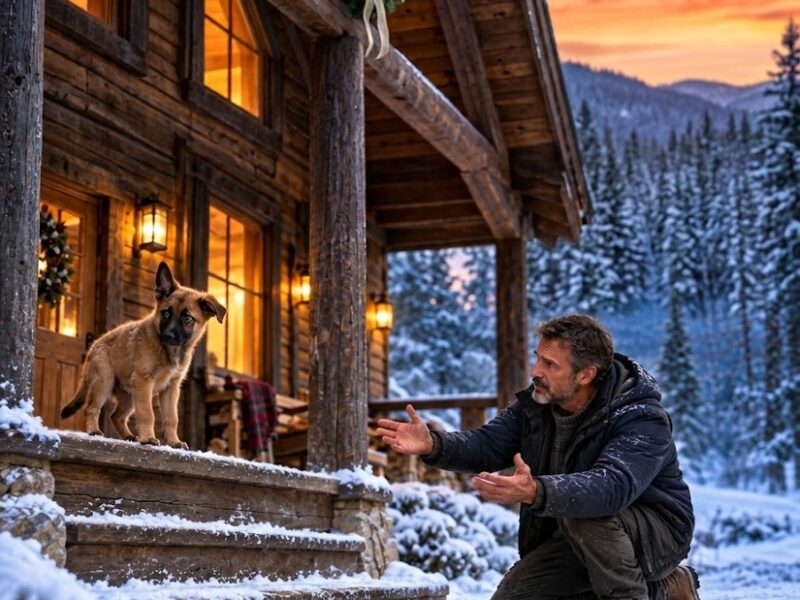
A K9 puppy refused to leave a Navy SEAL’s side—then the 55-year-old opened a mysterious box, and everything changed.
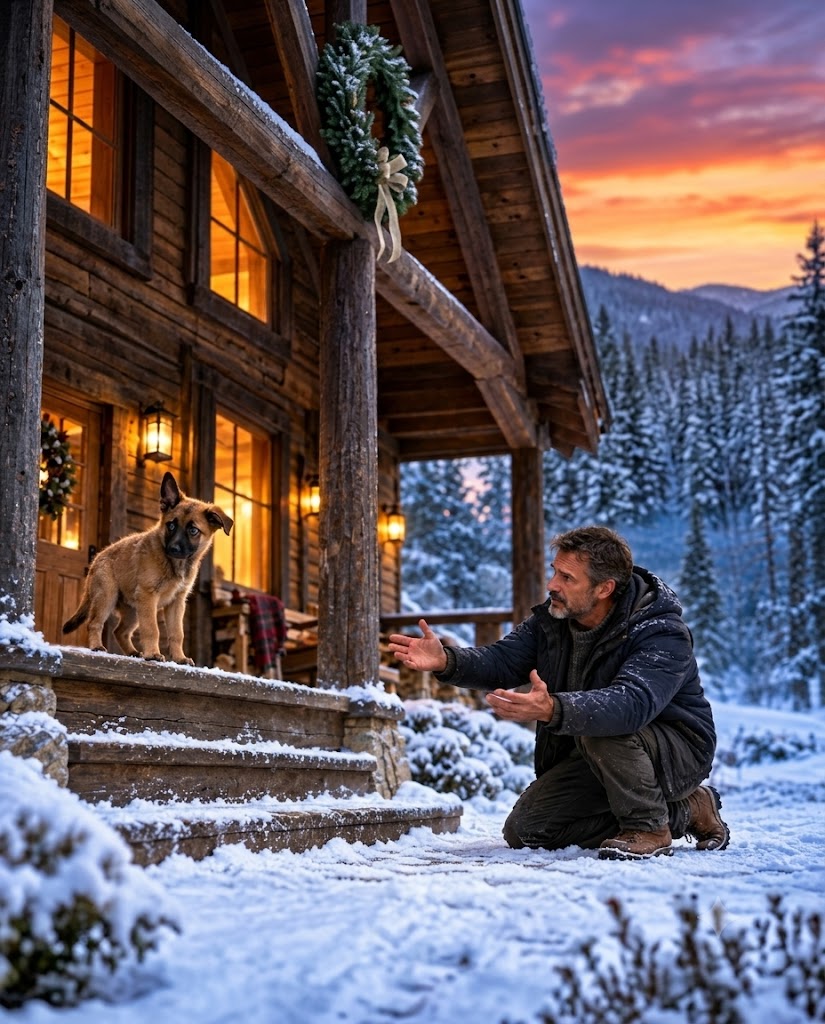
The snow had been falling over Ryeford, Vermont, since before dawn, burying the narrow streets and pine trees in a thick blanket of white.
By 8:00 AM, wind pushed loose snow across the parking lot of the animal rescue center in pale, restless waves.
Inside, Delia Frost studied the latest weather advisory with growing concern.
At 58, Delia was a practical woman with short silver hair and thin-framed glasses that constantly slipped down her nose.
Her burgundy cardigan made her easy to spot among the shelter staff, and she had managed the center long enough to know that winter storms rarely respected anyone’s plans.
Today, she was especially worried about one adoption appointment.
A 13-week-old Belgian Malinois puppy named Micah was supposed to leave with a man who lived several miles up a mountain road.
That man arrived at 8:15.
Thayer Whitlock stepped out of an old charcoal gray pickup truck, his brown leather boots sinking into the fresh snow.
He was 55, tall and broad-shouldered with the lean, disciplined build of someone who had spent much of his life demanding more from his body than most people ever would.
His angular face carried deep lines around steel-blue eyes, and his short dark brown hair had turned silver at the temples.
A neatly trimmed salt-and-pepper beard framed his jaw.
Beneath his dark navy winter jacket, he wore a charcoal wool sweater.
Thayer had retired from the Navy SEALs six years earlier after reaching the rank of senior chief.
He had learned to remain calm when plans collapsed.
Yet the thought of bringing a small puppy into his silent house made him nervous in a way he was reluctant to admit.
Delia greeted him at the entrance.
“You’re early.”
Thayer brushed snow from his shoulders.
“Roads were clear enough when I left. Thought I’d use the good part of the morning.”
Delia glanced toward the windows.
“That might be the only good part we get.”
She explained that the afternoon storm could make the mountain roads unsafe.
Thayer nodded.
He had already checked the forecast twice and arranged somewhere in town to stay if necessary.
He had no intention of putting a puppy at risk simply to complete a schedule.
Delia appreciated that answer.
Some adopters expected everything to happen according to their wishes.
Thayer had spent four weeks asking questions, accepting advice, and preparing for responsibilities he knew would last for years.
In the examination room, Dr. Simone Heller was completing Micah’s final health check.
Simone was 46 with dark brown hair tied into a low ponytail, attentive green eyes, and a composed expression that rarely changed without good reason.
She wore a white medical coat over a pale blue sweater.
Beside her stood Ellis Boone, the center’s 32-year-old animal care technician, a friendly man with short light brown hair, faint stubble, and an olive green fleece jacket.
Ellis had spent more time with Micah than anyone else at the shelter.
The little Belgian Malinois stood on a rubber examination mat watching him with dark brown almond-shaped eyes.
His short coat was warm fawn tan with a distinct black mask covering his muzzle and much of his face.
One triangular ear stood nearly straight while the other folded slightly at the tip, giving him a permanently questioning expression.
Micah was healthy, curious, and unusually observant for such a young puppy.
He liked investigating new objects, especially when he could approach them at his own pace.
Sudden unfamiliar sounds sometimes made him hesitate, but he usually recovered when given space and reassurance.
Simone finished her examination and looked toward Thayer.
“He’s ready from a medical standpoint. Just remember, he’s still a baby.”
Thayer glanced down at the small puppy whose paws seemed almost too large for his slender legs.
“I know,” he said. “We’ll figure things out together.”
Ellis smiled.
“He’s been looking for you every time someone comes through the care room door.”
Thayer crouched without reaching forward.
Micah approached, sniffed his gloved hand, and briefly rested his little chin against it.
For a moment, everything seemed simple.
The paperwork was prepared.
The travel crate had been fitted securely in Thayer’s truck, and the familiar blue-gray blanket Micah had used during their supervised visits was waiting nearby.
Marin Quill, the center’s 41-year-old canine behavior specialist, arrived to help with the transition.
She was a lean, athletic woman with dark blond hair tied back, hazel eyes, and a forest green fleece jacket.
She spoke softly and watched animals closely before deciding what they needed.
“Let’s give him time to choose his way through,” she said.
Ellis clipped on Micah’s lightweight leash and guided him toward the hallway.
The puppy followed willingly until they reached the doorway separating the quiet care rooms from the reception area.
Then a metal cart struck the wall outside.
The sudden clang echoed through the corridor.
At almost the same instant, the automatic entrance doors slid open, admitting a blast of cold air and the distant grinding of a snowplow.
Micah stopped.
His ears tilted forward.
His tail lowered and his paws seemed fixed to the floor.
Ellis immediately loosened the leash.
“Easy, little guy.”
Micah looked toward the hallway, took one uncertain step backward, and sat down.
Marin raised her hand to stop everyone from approaching.
“Don’t pull him. There’s too much happening at once.”
The cart was moved away, and someone adjusted the entrance doors to reduce unnecessary movement.
Ellis placed a non-slip mat across the threshold.
Still, Micah refused to move forward.
Then something unexpected happened.
Micah stood up and walked straight toward Thayer, ignoring the little treat Ellis had placed on the mat.
For one hopeful moment, everyone thought he had overcome his hesitation.
But instead of crossing the doorway, the puppy pressed his black muzzle against Thayer’s knee, remained there for several seconds, and then sat beside his boot.
The hallway was still only a few feet away.
Thayer looked down at him, feeling a quiet ache he could not explain.
Micah trusted him enough to come close, but not enough to follow him into that unfamiliar noise.
It reminded Thayer of something he had spent three years trying not to remember.
How helpless love could feel when someone was afraid of a place that others insisted was perfectly safe.
He remained seated, letting Micah stay beside him.
Marin studied the puppy’s breathing and posture.
“He’s not rejecting you,” she said. “He’s telling us this particular space is too much right now.”
Thayer nodded slowly.
He had spent much of his military career learning the difference between hesitation and disobedience.
They were not the same thing, although impatient people often treated them as if they were.
He gently rested one hand on his knee, allowing Micah to decide whether to approach again.
Beyond the reception windows, the falling snow thickened.
A plow passed the parking lot, its amber warning lights sweeping across the white walls.
Micah watched the moving reflection, then tucked himself closer to Thayer’s boots.
Delia returned carrying an updated weather report.
“The advisory has been upgraded. We may need to postpone the trip altogether.”
Thayer looked up.
“That’s fine. He doesn’t need to get home today.”
Delia seemed relieved.
“We can keep him here if necessary.”
Thayer considered the little puppy at his feet.
“I understand, but I’d still like him to have a better experience with that doorway before we finish.”
His phone vibrated inside his jacket.
The message was from Callum, his 29-year-old son, a dark-haired civil engineer living in Burlington.
Callum had inherited his mother’s hazel eyes and his father’s stubbornness, though Thayer rarely admitted the resemblance.
The message read: “Dad, check the mountain road before you leave, and please don’t forget we need to discuss the house.”
Thayer read it twice.
Three years after losing his wife, he still struggled to explain why selling their home felt like abandoning something unfinished.
Ellis brought Micah’s blue-gray blanket closer, and Marin suggested another quiet interval before attempting anything else.
Thayer watched the puppy lower his nose to the fabric and take a few cautious sniffs.
That small movement brought back the memory of their earlier visits.
The quiet room, the wooden platform, and a particular sound Micah had heard while resting peacefully.
Thayer had almost forgotten about it in the confusion of the morning.
Not because it was unimportant, but because he had never expected to need it here.
He looked toward Marin.
“There’s something in my truck, a sound he’s heard before. I recorded it during our visits, with your permission.”
Marin considered this.
“We can discuss using it, but only quietly, and only if he’s comfortable. No forcing anything.”
Thayer nodded.
“I wouldn’t ask for that.”
He rose slowly, careful not to startle Micah.
The puppy watched him walk away but remained beside Ellis.
Outside, cold wind pushed against Thayer’s jacket as he crossed the parking lot.
He opened the truck’s passenger door and reached into the storage compartment.
Beneath a folded road map lay a small rectangular tin box.
Its faded blue paint was scratched along the edges.
Thayer held it in both hands.
For a long moment, he simply stood there while snow gathered on his shoulders.
Then he opened the lid.
Inside, wrapped in a piece of soft cloth, lay an old brass wind chime and a photograph of a woman with shoulder-length chestnut hair, a few silver strands near her temples, warm hazel eyes, and a gentle smile.
She wore a cream-colored cardigan and stood on the porch of a wooden house surrounded by winter snow.
Thayer touched the edge of the photograph with his thumb.
His breathing slowed.
He had carried this box for years.
Yet opening it still seemed to require more courage than he expected.
He carefully closed the lid and looked toward the rescue center, where a little puppy was waiting beside a doorway.
The winter wind moved through the parking lot.
Thayer held the box close against his coat and started walking back.
—
As Thayer Whitlock crossed the snow-covered parking lot with the faded blue tin held close to his chest, he could still picture the first time he had seen Micah.
Four weeks earlier, there had been no adoption paperwork waiting for his signature, no winter storm threatening to close the mountain roads, and certainly no reason for him to believe that a small Belgian Malinois puppy would change the rhythm of his life.
He had gone to the Ryeford Animal Rescue Center to repair a damaged wooden partition.
That was all.
At least, that was what he had told himself.
But standing outside the shelter now with the old brass wind chime inside the box, Thayer understood that some of the most important changes in a person’s life began without announcing themselves.
Sometimes they started with a simple favor, an ordinary winter morning, and a pair of dark eyes watching from the other side of a fence.
In early January, Thayer’s house had been as orderly as a place could be.
The two-story timber cabin stood several miles outside Ryeford, Vermont, surrounded by sugar maples, tall pines, and fields that disappeared beneath heavy winter snow.
A covered porch stretched across the front, its dark wooden railings carefully maintained, while warm amber light shone through the kitchen windows each evening.
Inside, however, the warmth seemed to stop at the walls.
Thayer lived alone.
At 55, the retired Navy SEAL senior chief still carried himself with the quiet discipline of a man accustomed to responsibility.
His broad shoulders remained strong beneath his charcoal gray sweater.
His silver-streaked hair was always neatly trimmed, and his steel blue eyes rarely revealed more than he intended.
He rose before sunrise, cleared the walkway, checked the generator, and ate breakfast at the same kitchen table where his wife Lenora had once sat.
Three years had passed since her death.
He had learned to manage the silence, but he had never learned to enjoy it.
The music room downstairs remained closed most days, and the second coffee mug in the cupboard had not been used in years.
The call from Delia Frost came on a Tuesday morning.
A wooden partition inside the rescue center had warped after moisture seeped beneath a window, and the staff needed someone who could repair it without disrupting the animals.
Thayer had volunteered there occasionally before, usually fixing gates or carrying supplies, so Delia thought of him immediately.
He agreed without much discussion.
By noon, he was kneeling on the shelter floor with a measuring tape, a screwdriver, and several lengths of smooth replacement timber.
The building smelled faintly of disinfectant, clean bedding, and dog food.
Somewhere behind him, a small puppy gave a short questioning whine.
Thayer turned and found a young Belgian Malinois watching from a neighboring care area.
The puppy was barely nine weeks old with a short warm fawn-colored coat, a sharply defined black muzzle, dark brown eyes, and one ear that stood straighter than the other.
His narrow little legs looked almost too delicate for his oversized paws.
He did not bark or rush forward.
He simply watched the man’s hands.
Ellis Boone, the animal care technician, noticed Thayer looking.
“That’s Micah,” he said. “Little fellow came in last week.”
Ellis explained that Micah had been transferred from a family who could no longer manage the entire litter.
There had been no dramatic rescue, no injury, and no cruelty involved.
The family had simply recognized that they could not provide every puppy with the attention and long-term care it needed.
Micah was healthy, but he was taking longer than some of his littermates to become comfortable with unfamiliar surroundings.
“He likes figuring things out before he gets involved,” Ellis added with a smile.
Thayer watched as Micah sniffed the air, tilted his head toward the sound of a wooden board being moved, and took two cautious steps closer to the barrier.
“Nothing wrong with thinking first,” Thayer replied.
He returned to his work, but from that moment onward he found himself moving the tools a little more quietly.
Over the next several days, Thayer returned to complete the repairs and help replace a loose gate latch.
Each time Micah seemed interested in his presence.
The puppy would approach the edge of his enclosure, watch him for several moments, and then return to his blanket.
Thayer never reached through the barrier or tried to force an interaction.
When Delia mentioned that Micah would eventually need an adoptive home, he asked about the requirements almost before he realized what he was doing.
That led to a conversation with Dr. Simone Heller and Marin Quill, the center’s canine behavior specialist.
They explained the considerable commitment involved in raising a Belgian Malinois.
Intelligence and athletic ability made the breed rewarding, but neither replaced patient training, appropriate exercise, socialization, and daily companionship.
Thayer listened without interruption.
He had once raised an aging family dog named Otis with Lenora, but he understood that a young Malinois would require a different kind of attention.
“I’m not looking for a military dog,” he told Marin. “I’m looking for someone I can give a good home to.”
She studied him for a moment before answering.
“Then we should start by finding out whether you and Micah are right for each other.”
On Thayer’s third supervised visit, something happened that neither man had expected.
Near the end of their quiet play session, Thayer stood to speak with Delia outside the room.
He folded his navy jacket over a low chair and stepped through the gate.
Micah had been occupied with a soft rubber toy, but the moment Thayer disappeared, the puppy abandoned it.
He crossed the mat, sniffed the sleeve hanging from the chair, and settled down directly beneath the jacket.
Ellis called his name gently.
Micah looked up, gave one small wag of his tail, and lowered his head again.
When Thayer returned, he found the puppy sleeping beside his coat.
“Well,” Ellis murmured, watching the older man’s expression, “I think somebody’s getting used to you.”
Thayer said nothing.
He simply sat down nearby and waited for Micah to wake.
For reasons he could not explain, the sight of that small sleeping animal beside an old winter jacket made his throat tighten.
He had spent years coming home to an empty house.
Now a creature he barely knew had chosen to rest beside something that smelled like him.
After that afternoon, Thayer began taking the possibility of adoption seriously.
He attended scheduled visits under Marin’s supervision, learning how Micah responded to new objects, unfamiliar surfaces, and ordinary household sounds.
They practiced calm approaches, brief periods of separation, and comfortable time near an open travel crate.
Thayer brought a soft blue-gray blanket that could later accompany Micah home, allowing it to become familiar during their sessions.
One afternoon, he asked Marin whether he could introduce a short recording of sounds from his cabin.
It contained the creak of a wooden door and a faint, gentle chime.
Marin listened first, checked the volume, and agreed to try it briefly while Micah was relaxed.
The puppy paused when the sound played, turned one uneven ear toward the phone, and then returned to investigating his toy.
Nothing remarkable happened, but over subsequent visits, the recording became another ordinary part of his surroundings.
Thayer never explained where the chime came from.
He only said it was a sound from home.
Meanwhile, the cabin began changing in ways Thayer had not anticipated.
He cleared a small room near the kitchen, removed loose electrical cords, secured cleaning supplies, and placed non-slip rugs across the polished wooden floor.
He measured the fence behind the house twice and arranged to repair a section where winter frost had shifted a post.
He bought puppy-safe toys, researched training classes, and wrote a feeding and veterinary schedule in the same careful handwriting he once used for military checklists.
The work gave structure to his evenings, but something else was happening beneath the practical details.
He began opening doors that had remained closed for months.
He turned on lights in rooms he had stopped using.
One evening, while carrying a box of old blankets downstairs, he stood outside Lenora’s music room longer than usual.
He did not enter.
Not yet.
But for the first time in three years, he found himself thinking about what the house might sound like with life moving through it again.
His son noticed the changes during a Saturday visit.
Callum Whitlock was 29, a civil engineer living in Burlington, with short dark brown hair, thoughtful hazel eyes inherited from his mother, and a lean build that made him appear slightly taller than his father when standing in boots.
Clean-shaven and practical in a forest green flannel shirt beneath a brown winter coat, Callum had developed the habit of checking on Thayer without making it sound like a checkup.
Losing Lenora had made him protective of his remaining parent, sometimes more protective than Thayer could comfortably accept.
He arrived carrying groceries and stopped when he saw the puppy gate leaning against the kitchen wall.
“Dad, what’s all this?”
Thayer explained that he was considering adopting Micah.
Callum looked around at the rearranged furniture, the training manuals, and the new dog bed.
“A Belgian Malinois? Up here? In winter?”
His voice was not angry, only worried.
“You know how much work that is, right?”
Thayer showed him the plan.
But Callum remained uneasy.
“I’m not saying you can’t do it. I’m asking whether this is what you really want or whether you’re trying to make this house feel less empty.”
The question landed harder than Callum intended.
Thayer set the papers down.
“Maybe both,” he admitted. “But that doesn’t mean I haven’t thought it through.”
Callum softened.
He had expected his father to dismiss the concern.
Instead, they discussed veterinary appointments, snow removal, emergency help, and the training schedule.
Callum offered to review the fence and help arrange backup care.
They still disagreed about selling the house, but for once the conversation ended without either of them walking away in frustration.
As Callum prepared to leave, he noticed a faded blue tin resting on the kitchen table beside a framed photograph.
His expression changed.
He recognized the box immediately.
He had seen it many times as a boy, usually near the window where his mother liked to sit.
“Dad?” he asked quietly.
Thayer followed his gaze.
For several seconds he seemed to be listening to something Callum could not hear.
Then he nodded.
“I do.”
Callum waited, sensing there was more.
But his father only closed the lid with a careful hand.
Outside, the winter wind moved beneath the porch roof.
Somewhere in the quiet house a floorboard settled with a faint creak.
Thayer looked toward the empty hallway, then back at the little blue tin.
He had begun preparing a home for Micah, but there was still one room in his own heart he had not found the courage to open.
—
After Callum’s truck disappeared beyond the snow-covered bend, Thayer Whitlock remained at the kitchen table staring at the small blue tin his son had recognized.
Outside, the wind moved gently through the bare maple branches brushing loose snow from the porch roof.
The house was warm, the lights were on, and every mechanical system worked exactly as it should.
Yet the silence felt heavier than the winter air.
Thayer ran his thumb along the scratched edge of the tin before opening it.
Inside lay a small brass wind chime.
Its metal tubes darkened with age, wrapped carefully in soft cloth.
He lifted it without letting the pieces strike together.
Three years had passed since Lenora’s death, but some memories still arrived with the sharpness of things that had happened yesterday.
He could remember the smallest details of her voice, the way she folded the corners of a newspaper, and the little smile she gave him whenever he came inside carrying snow on his shoulders.
What troubled him most was not that he remembered so much.
It was that he had spent three years afraid of making new memories that might eventually take their place.
Lenora Whitlock had been a woman who made ordinary places feel welcoming.
In her early fifties, she had shoulder-length chestnut hair threaded with a few silver strands, warm hazel eyes, and a gentle oval face that seemed to brighten whenever someone entered the room.
She usually wore soft cream cardigans and simple trousers, preferring comfort over appearance.
As a music teacher, she had a patient way of speaking that made even nervous children believe they could learn something difficult.
She never raised her voice when a student played a wrong note.
Instead, she would smile, move her chair closer, and ask them to try again.
Thayer had always admired that about her.
During his years in the SEALs, he had learned to identify problems quickly and solve them with discipline.
Lenora approached people differently.
She listened first, often noticing what they were afraid to say.
On snowy afternoons, while she practiced piano in the downstairs music room, Thayer would repair furniture or prepare firewood nearby.
Every time the wind crossed the porch, the little brass chime beside the kitchen door rang with three uneven notes.
Lenora called it the house’s way of announcing that someone was coming home.
The chime had been Thayer’s anniversary gift to her many years earlier.
It was inexpensive, purchased from a small craft shop during a weekend trip, but Lenora treasured it.
She said the notes were imperfect, which made them sound honest.
When Callum was young, he sometimes stood beneath it, waiting for the wind to make it ring before running inside for dinner.
Their home had never been particularly grand.
The porch creaked during cold weather, the kitchen floor needed refinishing, and the windows rattled whenever a storm came down from the mountains.
But it had been filled with conversation, music, and the familiar disorder of family life.
Thayer rarely considered how much those sounds meant to him until they began disappearing.
Lenora’s illness changed their routine slowly at first, then all at once.
There were appointments, difficult conversations, and days when she simply did not have the strength to play the piano.
Eventually, her medical team recommended specialized residential care in Burlington.
Lenora agreed after discussing the decision with Thayer and Callum.
The facility was well maintained with attentive nurses, comfortable rooms, and large windows overlooking a courtyard.
Nobody had treated her carelessly.
Nobody had made a cruel decision.
Still, moving away from the house she had loved for decades was painful.
Thayer did everything he could to make her new room comfortable.
He brought framed photographs, her favorite blanket, a music stand, and several books filled with handwritten notes from former students.
He arranged the furniture so she could see the morning light.
Whenever she mentioned something missing, he tried to bring it on his next visit.
He believed that if he could make the room familiar enough, she might feel less homesick.
One afternoon, while Thayer was adjusting a photograph beside her bed, Lenora asked about the brass chime on their porch.
“Is it still hanging beside the kitchen door?” she asked.
He nodded.
“Of course.”
She smiled faintly.
“Would you bring it next time? I’d like to hear it again.”
Thayer promised he would.
But that week, freezing rain damaged part of the porch roof, and he spent two days arranging repairs before driving back to Burlington.
On his next visit, he brought fresh clothes and several things she needed, but not the chime.
Lenora did not complain.
She simply asked whether it was still there.
“I’ll bring it soon,” he told her.
He meant every word.
Yet there were more appointments, more repairs, and more nights when he returned home too exhausted to think clearly.
The small request kept slipping behind tasks that seemed more urgent.
Thayer had spent much of his life believing responsibility meant handling the most pressing problem first.
He had not yet understood that something emotionally important could be easy to postpone precisely because it seemed so small.
Then, during an evening visit, Lenora asked him to sit beside her instead of straightening the room.
She reached for his hand and gently tapped three beats against his palm, leaving the fourth beat silent.
Thayer looked at her, confused.
“What’s that?” he asked.
Lenora gave him a tired smile.
“A little exercise I used to teach my students. Three notes, then a rest.”
She waited before continuing.
“The rest matters, too, Thayer, but you can’t stay inside it forever. The music has to go on.”
He wanted to answer, but the words would not come.
She squeezed his hand and looked toward the darkening window.
“When I’m not there to fill that house with noise anymore, promise me you won’t spend the rest of your life keeping everything exactly the way I left it.”
Thayer lowered his eyes.
He had faced difficult decisions without hesitation, yet this was one promise he could not make easily.
Finally, he nodded.
Lenora smiled as though she understood that a nod was all he could offer.
Thayer brought the brass chime on his next visit.
He had carefully removed it from the porch, cleaned the metal, and wrapped it in soft cloth to protect it during the drive.
By then, Lenora was much weaker.
He held it near her bed and allowed the little tubes to touch, producing the familiar uneven notes.
She opened her eyes and listened.
For a few moments, her expression softened.
“That’s our porch,” she whispered.
Thayer sat beside her, holding the chime between his hands.
He wanted to explain why it had taken so long.
He wanted to tell her about the roof, the appointments, and every reasonable circumstance that had delayed him.
But the explanation suddenly felt unnecessary.
Instead, he simply said, “I’m sorry I didn’t bring it sooner.”
Lenora rested her hand over his.
“You’re here now,” she answered.
She did not speak much afterward.
When she passed away sometime later, Thayer returned to Ryeford with the chime wrapped in the same cloth.
For three years, he kept it inside the blue tin.
He did not hang it back on the porch because hearing those notes without Lenora seemed unbearable.
He maintained the cabin, cleared the snow, repaired its aging woodwork, and kept everything orderly.
The house remained beautiful from the outside, but inside the rooms gradually lost their purpose.
Thayer told himself he was respecting her memory.
Deep down, he knew he was also protecting himself from change.
Every suggestion from Callum about moving closer to Burlington felt like a threat to the life he had shared with Lenora.
He feared that leaving the cabin would make their years together seem farther away.
Yet staying had begun to feel less like living and more like standing guard over something he could never bring back.
Then Micah entered his life.
The little Belgian Malinois had not performed some extraordinary rescue or shown a mysterious ability to understand human grief.
He had simply watched Thayer work, approached him carefully, and eventually chosen to rest beside his jacket.
But that small act had awakened something the older man had almost forgotten.
Someone might need him tomorrow.
There would be meals to prepare, walks to plan, lessons to practice, and mistakes to handle with patience.
For the first time in years, Thayer found himself thinking about the future without immediately feeling guilty.
During his visits to the rescue center, he noticed how much more confident Micah became when familiar objects and calm routines were available.
That observation reminded him of Lenora.
Though he understood a puppy and a person facing serious illness were not the same, what connected the experiences was his growing realization that feeling safe often depended on things other people overlooked.
He began preparing the cabin with that lesson in mind.
The blue-gray blanket Micah used during their visits would accompany him home.
The puppy had also been introduced gradually to the travel crate and ordinary sounds of the household, including a short recording Thayer had made of the wooden kitchen door and the old brass chime.
Marin had approved the recording at a low volume during calm sessions.
Thayer did not believe it could magically remove fear, but he hoped a few familiar details might make the transition gentler.
Meanwhile, he continued attending training sessions and checking his plans with the rescue staff.
He wanted to give Micah a stable home, not turn the puppy into a replacement for the family life he had lost.
Two evenings before the adoption appointment, Callum called again.
This time, their conversation was quieter.
He asked about the fencing, the emergency generator, and what would happen if a storm closed the road while Thayer needed help.
Instead of dismissing the questions, Thayer answered them carefully.
He even admitted that his son had been right to worry about the responsibilities of raising an energetic young dog.
Callum offered to help arrange backup care and inspect a section of the yard when the weather improved.
They still disagreed about selling the cabin, but the argument no longer felt impossible to resolve.
Before hanging up, Callum said, “I just want you to have a life you’re happy in, Dad.”
Thayer looked toward the empty music room.
“I know,” he replied.
After the call ended, he stood in the hallway for several minutes, then reached for the door handle.
He opened Lenora’s music room just enough to let the warm light from the hallway spill across the piano keys.
The night before Micah’s adoption, Thayer placed the puppy supplies beside the kitchen door.
Outside, the first light snowfall of the coming storm drifted past the windows.
He checked the weather forecast, confirmed his backup lodging arrangement, and set the small blue tin on the table.
For a while, he sat without moving.
Then he opened it and lifted the brass chime into the light.
Its aged surface reflected the soft yellow glow above the kitchen.
He let the metal pieces touch once, producing three delicate uneven notes.
In the silence that followed, he remembered Lenora tapping against his palm and leaving room for the fourth beat.
Thayer looked toward her photograph.
“I don’t know if I’m ready, Lenora,” he whispered, “but I think it’s time I tried.”
He wrapped the chime carefully, returned it to the tin, and placed the box beside his truck keys.
By morning, the winter sky over Ryeford would be gray and heavy, and a small puppy would be waiting for him behind a shelter door.
Thayer believed he was bringing Micah home.
He did not yet understand how much that journey would ask him to change.
—
The blue tin felt colder than Thayer Whitlock remembered as he carried it back through the snow toward the Ryeford Animal Rescue Center.
Wind pushed against his dark navy jacket, and small flakes settled in the silver strands of his short hair and neatly trimmed beard.
Through the reception windows, he could see Ellis Boone kneeling beside Micah, the 13-week-old Belgian Malinois who had refused to cross the hallway threshold.
The puppy’s warm fawn-colored body looked impossibly small against the polished floor, his black muzzle resting near Ellis’s knee.
Thayer stopped just inside the entrance and watched for a moment.
He had spent 27 years serving in the Navy, much of that time in the SEAL teams, where preparation and decisive action could mean everything.
Yet standing there with a frightened puppy and an old brass wind chime, he realized how little those habits mattered unless he also knew when to be still.
Marin Quill approached him quietly.
Her hazel eyes moved from the tin to his face.
“Is that the sound you told me about?” she asked.
Thayer nodded.
“The same one from the recording.”
She studied him briefly.
“Then let’s make sure we’re doing this for Micah, not because we’re running out of time.”
That question stayed with him as they returned to the quieter care area.
Ellis had moved the metal cart farther away, and the entrance doors were being opened only when necessary.
A non-slip mat now covered the narrow stretch of floor that had troubled Micah earlier.
Dr. Simone Heller stood nearby with the puppy’s medical paperwork while Delia Frost monitored the worsening weather from the reception desk.
Everyone understood that the adoption could be postponed if Micah remained uncomfortable.
Thayer placed the tin on a low table and opened it.
The small brass chime lay wrapped in pale cloth, its aged metal carrying the faint marks of years spent outside a family home.
Beside it was a photograph of Lenora smiling beneath the porch roof of their cabin.
Ellis glanced at the picture but said nothing.
Marin gently asked how Thayer had introduced the sound during their earlier sessions.
He explained that he had recorded the chime at home, then played it softly while Micah was relaxed and occupied with familiar activities.
“He heard it plenty of times,” Thayer said. “But I don’t know whether it means anything to him.”
Marin nodded.
“That’s important. Familiar doesn’t always mean comforting, especially when something else has frightened him.”
Thayer looked toward Micah.
The puppy was sitting beside the blue-gray blanket watching the hallway with one ear standing upright and the other folding slightly forward.
He seemed interested but uncertain, shifting his weight whenever a distant sound reached him.
Thayer lowered himself onto a chair several feet away.
For a moment his attention drifted to Lenora’s photograph.
“That bell belonged to my wife,” he said quietly. “She was a music teacher. She used to hang it outside our kitchen door.”
Simone lowered her clipboard.
The others listened without interrupting.
Thayer explained that Lenora had spent her final months receiving specialized care away from their home.
He did not describe every detail of her illness.
Instead, he spoke about the ordinary things she missed, the creaking porch boards, the sound of their kitchen door, and the little brass chime she had once asked him to bring.
He paused before admitting that he had taken longer than he should have.
“I kept taking care of what seemed urgent,” he said. “And I almost forgot something that mattered to her.”
Ellis looked down at Micah, who had begun investigating the edge of his blanket.
Thayer continued in a voice barely above a murmur.
“When I started visiting him, I kept thinking about what it feels like to be taken somewhere unfamiliar. I know a puppy isn’t the same as a person who’s ill, but I wanted him to have a few things he recognized before he came home. A blanket, a crate he’d already used, some ordinary sounds.”
Marin watched him thoughtfully.
“You gave him a chance to learn those things while he felt safe,” she said. “That’s useful, but right now, he still needs to decide whether this doorway is safe.”
Thayer accepted the distinction.
He had not brought the chime to prove that his plan had been right.
He had brought it because it was one possibility worth considering, provided Micah remained comfortable.
Marin asked him to stay seated and use the sound only once, very gently, while everyone watched the puppy’s response.
Thayer lifted the brass chime from the cloth.
The metal pieces touched, producing three soft, uneven notes.
Micah immediately raised his head.
His dark brown eyes moved toward Thayer, and his ears shifted forward.
For one suspended moment, nobody breathed loudly enough to disturb the room.
Then the puppy stood, looked toward the open doorway, and backed away.
Thayer felt disappointment tighten across his chest.
He had recognized that sound instantly as belonging to home, but Micah still saw an unfamiliar hallway.
Thayer lowered the chime without trying again.
And then he remembered something Lenora had told him during one of their last quiet evenings together.
A pause was not the end of the music.
It was simply the space before the next note.
Looking at Micah, Thayer understood that he had been waiting for the sound to change the puppy’s mind.
Perhaps what Micah needed most was permission not to move until he was ready.
“Let’s leave it there,” Thayer whispered, wrapping the chime again.
Marin gave a small approving nod.
Ellis settled beside the open doorway, placing the blue-gray blanket partly across the mat so that Micah could approach it without being drawn toward the busier reception area.
He scattered two small treats near the fabric, then moved his hand away.
Micah sniffed the first treat but did not take it immediately.
He glanced at the hallway, then back toward Thayer.
No one called him.
No one tugged the leash.
Snow tapped lightly against the windows, and somewhere in another room a dog shifted against its bedding.
After nearly a minute, Micah lowered his nose, took the treat, and placed one paw onto the mat.
He stopped again.
Thayer felt the familiar urge to encourage him but kept his hands resting on his knees.
Ellis remained beside the puppy, quietly ready to support him if needed.
A second paw followed.
Then Micah stretched forward, sniffed the blanket, and stepped completely onto the textured surface.
The distance he crossed was less than six feet.
To everyone watching, it felt considerably longer.
Micah paused at the far edge of the mat, looked toward the reception area, and then turned back to Thayer.
The older man remained seated, his steel blue eyes softening.
“There you go, little buddy,” he murmured.
Micah approached him voluntarily, sniffed his brown leather boot, and rested briefly against his leg.
Thayer did not reach down immediately.
He waited until the puppy looked up, then gently touched the side of his neck.
Marin smiled, but her tone remained practical.
“He made that choice himself. That’s what we wanted.”
Ellis brought forward the travel crate Micah had already practiced entering during earlier visits.
The familiar blanket was placed inside, and a few treats were offered near the entrance.
Micah investigated, stepped halfway in, withdrew once, then returned.
On his next attempt, he went fully inside and turned around to look at Thayer.
The door remained open until the puppy was calm.
Only then did Ellis close it gently, following the routine they had practiced.
A quiet sense of relief settled over the room.
Delia returned with the final paperwork, though her expression carried fresh concern.
“The weather advisory has been upgraded again,” she said. “The higher roads are getting worse.”
Thayer looked through the window at the blowing snow.
He had prepared for this possibility, and the decision no longer seemed difficult.
“Then we’re not driving up the mountain today.”
He confirmed that the pet-friendly lodging he had arranged in town was still available, and Delia helped him complete the remaining adoption documents.
Simone reviewed Micah’s feeding instructions, veterinary records, and the importance of keeping the puppy’s first days calm and predictable.
Marin reminded Thayer that one successful doorway did not mean every unfamiliar situation would suddenly become easy.
“He’ll need more practice,” she said, “and you’ll need patience.”
Thayer glanced at the travel crate.
“I’ve got time,” he answered.
For once, he meant those words without thinking about all the time he could never recover.
By late afternoon, Thayer and Micah were safely settled in a quiet ground-floor room at a small pet-friendly inn near the center of Ryeford.
The crate stood securely beside the bed, away from the heater, with the blue-gray blanket inside.
Thayer had given the puppy a meal, fresh water, and an opportunity to relieve himself in a sheltered outdoor area before the wind strengthened.
Micah had spent several minutes exploring the room under supervision, sniffing the carpet and examining the legs of a wooden chair before returning to the familiar crate to rest.
Thayer sat nearby with a cup of coffee growing cold between his hands.
Outside, snow gathered against the lower window pane, turning the parking lot into a quiet white landscape.
His phone rang.
Callum’s name appeared on the screen, and Thayer answered before the second ring.
“Dad, tell me you didn’t try to drive up that road.”
Callum’s voice carried the unmistakable concern Thayer knew so well.
“I’m staying in town,” he replied. “Micah is here with me. We’re safe.”
Callum exhaled audibly.
“Good. How did it go?”
Thayer looked toward the small sleeping puppy.
He told his son about the hallway, the sudden noise, the long wait, and the moment Micah finally stepped across the threshold.
Then, unexpectedly, he told him about the brass chime.
About how he had brought it to the rescue center, and why he had wanted Micah to hear familiar sounds before leaving the only place he knew.
Callum listened without interrupting.
When Thayer finished, the line remained quiet for several seconds.
“I remember that bell,” Callum finally said. “When I was little, I’d hear it from the driveway and know Mom was probably in the kitchen.”
Thayer closed his eyes briefly.
He had never realized that the sound belonged to his son’s memories, too.
“Do you think Mom would have liked him?” Callum asked.
Thayer looked at Micah, curled comfortably inside the crate, his black muzzle resting on the edge of the blanket.
A faint smile appeared beneath the older man’s gray beard.
“I think your mother would tell me to stop staring at him and check whether he has enough water.”
Callum laughed, and Thayer found himself laughing, too.
The sound surprised him.
It was not loud, but it came easily, without the effort that had accompanied so many conversations since Lenora’s death.
They talked a little longer about the weather, the cabin, and Callum’s plans to visit when the roads cleared.
They did not settle the question of selling the house.
For the first time, that could wait without feeling like another argument was approaching.
After the call, Thayer checked Micah’s water bowl and settled into the chair beside the bed.
The blue tin rested on the small table, its lid closed.
He did not open it again.
The storm continued beyond the window, but the room was warm and still.
Micah stirred, lifted his head, and looked toward him with sleepy brown eyes.
Thayer lowered his hand beside the crate, close enough for the puppy to sniff without disturbing his rest.
Micah touched his nose briefly to Thayer’s fingers, then curled back against the blanket.
The older man watched him for another moment before switching off the bedside lamp.
He had once believed that protecting someone meant finding a way to remove every danger before it arrived.
That night, with a winter storm outside and a small puppy resting nearby, he began to understand a quieter kind of responsibility.
Sometimes love meant recognizing when the road ahead was unsafe, choosing not to travel it, and giving someone the peace of knowing they did not have to face the unknown alone.
—
The storm passed over Ryeford two days after Thayer Whitlock brought Micah to the little inn.
By the following morning, snow plows had cleared the main roads, and the county’s road condition updates showed that the route toward his mountain cabin was safe for travel.
Thayer checked the forecast once more before loading the puppy’s supplies into his charcoal gray pickup truck.
Micah, still only 13 weeks old, watched from his familiar travel crate, his dark brown eyes following every movement.
His short fawn-colored coat gleamed beneath the morning light, and the black mask around his muzzle made his small, curious face look unusually serious.
One ear stood upright while the other bent slightly at the tip.
Thayer secured the crate, checked the ventilation, and climbed behind the wheel.
For three years, he had driven this road knowing that nobody would be waiting inside his house.
Today, he was bringing someone home with him.
The thought made his chest tighten, but this time the feeling was not entirely sadness.
The cabin appeared beyond a stand of snow-covered maples, its dark timber walls rising against the white hillside.
Icicles hung from the porch roof, and pale winter sunlight reflected from the windows.
Thayer parked near the cleared walkway and carried Micah inside, keeping him secure in his crate until they reached the quiet room prepared near the kitchen.
He opened the crate door and sat on the floor several feet away.
Micah remained inside for a moment, studying the unfamiliar furniture.
Then his small black nose appeared, followed by one cautious paw.
He sniffed the blue-gray blanket, investigated the edge of a nearby rug, and turned back toward Thayer.
Nothing about the cabin was familiar yet, except the man sitting patiently beside him.
“No hurry, little buddy,” Thayer whispered. “We’ve got plenty of time.”
Micah eventually stepped out and began exploring, stopping frequently to look over his shoulder.
Thayer understood that arriving at a house and feeling at home were two different things.
The first night was not the peaceful beginning Thayer had imagined.
Micah woke several times, uncertain about the unfamiliar sounds of the heating system and the wind brushing against the siding.
Thayer kept his sleeping area close enough to monitor him and followed the nighttime routine recommended by Marin Quill.
Twice, he pulled on his boots and winter coat to take the puppy to a sheltered cleared area outside.
Before sunrise, Micah had a small accident near the kitchen rug.
Thayer stared at the puddle, then at the puppy watching him with an expression of innocent curiosity.
A tired laugh escaped his throat.
During his years as a Navy SEAL, he had endured exhausting nights in difficult conditions.
Yet somehow this little creature had reduced him to negotiating with a mop before breakfast.
He cleaned the floor without scolding Micah, adjusted the schedule, and made another pot of coffee.
The house already felt less predictable.
Strangely, he liked that.
Over the following days, their lives settled into a rhythm neither had known before.
Micah learned where his food appeared, where his favorite blanket belonged, and which door led to his outdoor toilet area.
He also discovered that shoelaces were fascinating, that a loose glove could be carried triumphantly across a room, and that Thayer’s slippers were apparently worth investigating every morning.
Thayer redirected him toward appropriate toys, rewarded calm behavior, and continued the short training exercises Marin had recommended.
Because Micah was a growing Belgian Malinois, Thayer focused on gentle exploration, brief training sessions, adequate rest, and positive experiences rather than demanding physical exercise.
Some days went smoothly; others ended with scattered toys, interrupted phone calls, and a tired puppy asleep beneath a chair.
Thayer began recording Micah’s progress in a small notebook.
At first, the entries were practical: meals, rest periods, training, and veterinary appointments.
Gradually, little observations appeared between them.
Carried his blanket into the kitchen.
Sat beside me during breakfast.
First quiet nap while the furnace was running.
The changes inside Thayer were harder to measure.
He began using the kitchen table again instead of eating beside the counter.
He opened curtains that had remained closed for months and called an old friend to arrange coffee the following week.
One afternoon, while Micah slept after a short play session, Thayer stopped outside Lenora’s music room.
The door had been left slightly open since the night before the adoption.
Sunlight crossed the polished floor, illuminating the upright piano and the wooden bench where his wife had once sat teaching children their first melodies.
Thayer stepped inside.
Dust had gathered along the edges of the music stand, but the room was otherwise exactly as Lenora had left it.
He placed his hand against the piano, feeling the smooth wood beneath his fingers.
For years, entering this room had seemed like admitting she was truly gone.
Now he wondered whether keeping it closed had also kept part of their happiest life hidden away.
A week later, Thayer took the small brass wind chime from its faded blue tin.
He cleaned the metal carefully, replaced the worn hanging cord, and returned it to its old position beneath the covered porch roof, well beyond Micah’s reach.
When the wind moved through the trees, three soft uneven notes drifted toward the kitchen.
Micah paused over his rubber toy and raised his head, his ears turned toward the sound.
After a moment, he returned to playing.
Thayer stood by the window, listening.
The notes were exactly as he remembered, but something inside him responded differently.
They still reminded him of Lenora, of course.
They always would.
Yet he no longer heard only the promise he had fulfilled too late.
He remembered her laughter, her patient voice, and the way she used to greet him when he came inside covered in snow.
For the first time, remembering her brought him more warmth than regret.
By early March, Micah was approaching 16 weeks old, his legs a little longer and his once uncertain movements growing more confident.
The snow still covered much of the property, but sunlight had begun loosening the icy edges along the porch.
Callum Whitlock arrived on a clear Saturday morning, driving up from Burlington with a wooden box secured on his passenger seat.
At 29, Callum had his father’s dark hair and strong features, though his warm hazel eyes belonged unmistakably to Lenora.
His lean frame was covered by a brown winter jacket over a forest green flannel shirt, and he carried himself with the careful practicality of a civil engineer who preferred fixing problems to discussing feelings.
He had inherited more of Thayer’s nature than either of them liked to admit, but seeing his father step onto the porch with a small Belgian Malinois beside him made Callum stop halfway up the walkway.
Thayer was smiling—not politely, not because someone expected him to.
He was genuinely smiling as Micah investigated the visitor’s boots.
Callum spent the morning helping repair a loose section of fencing and checking the outdoor area Thayer used with Micah.
After lunch, he opened the wooden box he had brought.
Inside was a small handcrafted plaque with “Micah” carved carefully into the surface.
Beneath the name were two sturdy hooks, one for the leash and another for the little winter jacket Micah would eventually outgrow.
Thayer turned the plaque over in his hands, studying the smooth edges and careful lettering.
“You made this?” he asked.
Callum nodded.
“Figured every member of the family should have a place for their things.”
Thayer looked up, surprised by the quiet certainty in his son’s voice.
They chose a position beside the kitchen door and began marking where the plaque would hang.
Micah watched their work from a safe distance, occasionally tilting his head when the tools made an unfamiliar sound.
While Callum searched for a pencil, Micah wandered toward the open music room.
Thayer followed, expecting to guide him back toward the kitchen, but the puppy merely sniffed the doorway and stepped inside.
He explored the edge of the rug, circled the piano bench, and finally curled up beneath it, resting his black muzzle on his front paws.
Callum appeared behind his father and stopped abruptly.
“Dad,” he whispered, “look where he’s lying.”
Thayer stared at the small fawn-colored puppy.
Beneath that same bench, their old family dog, Otis, had spent countless afternoons sleeping while Lenora practiced piano.
Otis had passed away peacefully from old age years before, long before Micah was born.
There was no reason the little puppy could know anything about him.
The space beneath the bench was simply quiet, sheltered, and comfortable.
But Callum remembered it instantly.
“Mom used to complain she couldn’t move her feet without waking Otis,” he said softly.
Thayer let out a small breath, then smiled through eyes that had unexpectedly filled with tears.
“She never really complained,” he answered. “She liked having him there.”
For several moments, father and son stood together without speaking.
Micah slept peacefully beneath the piano, unaware that he had awakened a memory neither man had mentioned in years.
Then Callum stepped closer to the instrument and gently pressed a single key.
The soft note drifted through the room.
Micah opened one eye, decided nothing important was happening, and went back to sleep.
Thayer laughed quietly.
Callum smiled.
“I think Mom would have liked him.”
Thayer rested a hand on the back of the piano bench.
“I think she would have spoiled him terribly.”
The room no longer felt like a place they had to avoid.
Later that afternoon, they returned to the unfinished conversation about the house.
Callum admitted that he had been pushing Thayer to move because the thought of his father growing older alone on the mountain frightened him.
“I kept thinking if I could get you closer, I’d stop worrying,” he said.
Thayer listened carefully before answering.
“I know, and I kept thinking if I left this place, I’d be leaving your mother behind.”
He looked toward Micah sleeping in the doorway.
“But I don’t think that’s true anymore.”
They agreed to postpone the sale and review the situation again toward the end of the year.
Callum would help maintain an emergency plan, and Thayer would continue arranging appropriate training and care for Micah.
Neither man promised that the cabin would remain Thayer’s home forever.
They simply agreed that the decision should come from readiness rather than fear.
Callum extended his hand.
Thayer looked at it, then pulled his son into an embrace that lasted longer than either expected.
As the afternoon light turned golden, Callum finished mounting Micah’s plaque beside the kitchen door.
The brass wind chimes sounded softly above the porch, and Thayer stood outside watching the last sunlight move across the snowy yard.
Callum asked whether his father thought he might eventually move to Burlington.
Thayer considered the question.
“Maybe someday,” he said, “but if I go, I want it to be because I’m ready for something new, not because I’m running away from something old.”
Callum nodded, accepting the answer.
Inside, Micah had woken from his nap and was investigating the edge of his blue-gray blanket.
Thayer opened the kitchen door and stepped inside to prepare coffee.
The puppy rose and approached the threshold.
For a brief moment, he paused, looking into the warmly lit room.
No one called him.
No one offered a treat or urged him forward.
He simply looked at Thayer, recognized the familiar surroundings, and walked through the doorway on his own.
Thayer watched the little dog cross the floor and settle beside the kitchen table.
He remembered another doorway weeks earlier, when Micah had been too uncertain to take even one step into an unfamiliar hallway.
Now the puppy moved comfortably through a home he had gradually learned to trust.
Thayer understood that the change had not happened because of one sound, one moment, or one person’s perfect decision.
It had happened through patience, ordinary routines, and the quiet accumulation of safe experiences.
Looking around the kitchen, he realized something similar had happened to him.
He had spent three years believing that making room for something new would somehow diminish everything he had loved before.
But Lenora’s memory had not faded.
It was still there in the piano, the porch, the brass chime, and his son’s familiar smile.
There was simply room for more now.
Callum came inside and hung his coat beside the new plaque.
Thayer poured two cups of coffee while Micah slept peacefully at their feet.
Beyond the windows, the Vermont mountains remained white beneath the fading winter sky.
The wind moved across the porch, and the little brass chime rang its three uneven notes.
Thayer listened without reaching to silence it.
For years, he had lived in a house full of memories, afraid that opening his heart again might mean leaving something precious behind.
But a little Belgian Malinois had helped him understand what Lenora had been trying to tell him all along.
Home was not the place where time stood still.
It was the place where love was still allowed to grow.
Sometimes God’s greatest miracles don’t arrive with thunder, bright lights, or extraordinary signs.
Sometimes they arrive quietly on four little paws, with innocent eyes and a heart full of trust.
Thayer Whitlock thought he was opening his home to a frightened puppy.
But perhaps God, in His infinite wisdom, was also opening a door in Thayer’s heart that grief had kept closed for years.
Micah didn’t erase the pain of losing Lenora.
He didn’t replace the love they had shared.
Instead, he reminded Thayer that love never truly disappears.
It lives on in the memories we cherish, the kindness we give, and the courage we find to begin again.
And maybe that’s the miracle we all need to remember.
In our everyday lives, we all face moments when the road ahead feels uncertain.
We lose people we love.
We carry regrets.
We sometimes close our hearts because we’re afraid of being hurt again.
But God has a beautiful way of reminding us that even after the longest winter, spring can still return.
Sometimes He sends that reminder through a stranger’s kindness, a child’s embrace, an unexpected friendship, or the unconditional love of an animal.
So if you’re going through a difficult season right now, please don’t lose hope.
Your story isn’t finished.
There may still be beautiful chapters waiting for you.
And sometimes the smallest blessings bring the greatest changes.
If this story touched your heart, please share it with someone who needs a little hope today.
You never know whose life might be brightened by a simple act of kindness.
And I’d love to hear from you in the comments.
Have you ever felt that God sent a person or an animal into your life at exactly the moment you needed them most?
Share your story with us.
Your words might give someone else the strength to keep going.
If you believe in second chances, unconditional love, and the quiet miracles that make life beautiful, please give this video a like and subscribe to our channel for more heartfelt stories about courage, loyalty, faith, and the extraordinary bond between humans and animals.
And wherever you are watching from today, may God bless you, protect your family, bring peace to your heart, and fill your home with love, warmth, and hope.
May He comfort those who are grieving, strengthen those who are struggling, and remind every lonely heart that they are never truly forgotten.
Because sometimes the miracle isn’t that God opens a new door for us.
It’s that He gives us the courage to walk through it.
God bless you, and thank you for being part of our family.









