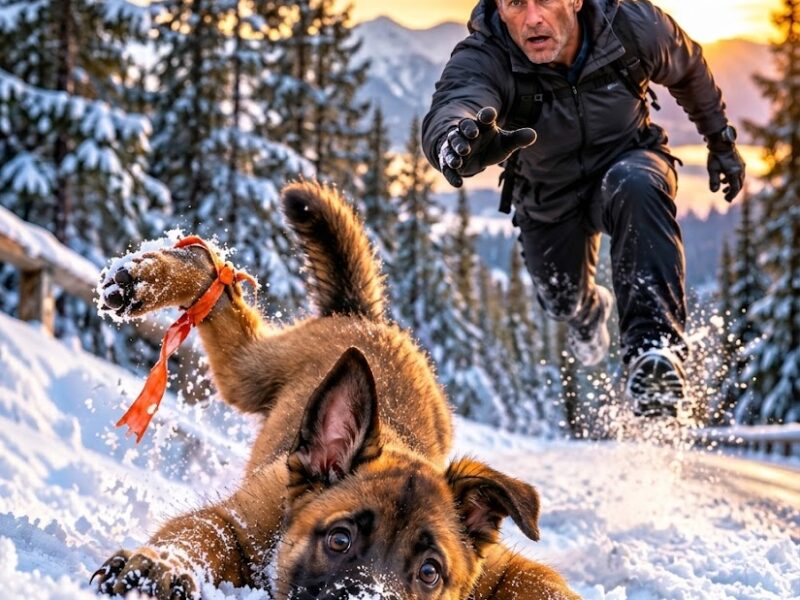
A K9 puppy copied a Navy SEAL’s sprint—then helped save a missing woman.
**Part 1**
At 5:12 on a freezing January morning, the forest road outside Grayfair, Maine, lay beneath a darkness so deep the snow seemed to glow on its own.
Towering pines lined both sides of the narrow pavement, their branches sagging under fresh powder.
There were no passing cars, no distant voices—only the occasional whisper of wind through frozen needles.
Along a short stretch of plowed road, a tall man ran alone.
His name was Dashel Prier, a 51-year-old retired U.S. Navy SEAL who had spent nearly three decades serving his country.
He stood six-foot-one with broad shoulders, a powerful but naturally aging athletic build, and short dark brown hair touched with silver at both temples.
His square jaw, clean-shaven face, and pale blue-gray eyes gave him the stern look of a man who rarely smiled.
He wore a charcoal winter running jacket, dark navy athletic pants, black running shoes with winter traction, and a small headlamp that cut a narrow beam through the dark.
Six years after leaving the military, Dashel still moved with a soldier’s precision.
But the discipline that once kept him alive had become something else entirely—a way to survive the hours when his own memories refused to leave him alone.
He had awakened at 3:40 that morning, heart racing after another dream about a mission he had spent years trying to forget.
In the dream, he heard a familiar voice calling through a radio, asking for help he could never reach in time.
Then came silence.
Dashel knew the war was over.
He knew he was safe inside his modest wooden house on the outskirts of town.
Yet some nights, knowing the truth did little to quiet his mind.
The loss of a close teammate during his final years of service had changed something inside him.
It left him uncomfortable with crowds, unexpected noises, and the helpless feeling that came with sleep.
He had moved to Grayfair for its isolation.
He repaired wooden furniture for a handful of local customers, kept his house meticulously organized, and avoided conversations that might lead to questions about his past.
On difficult mornings, he ran until his breathing steadied and the memories loosened their grip.
He never called those runs therapy.
To him, they were simply necessary.
After covering nearly two miles, Dashel returned to a familiar straightaway near the small turnout where he had parked his truck.
The road had been cleared recently, leaving a firm surface suitable for a few controlled bursts of speed.
He checked the traction beneath his shoes, rolled his shoulders, and prepared for three short sprints.
Just as he lowered himself toward the starting position, a faint rustling sound came from the brush beside the road.
He turned his head.
Beneath the drooping branches of a young pine, something small was moving through a pile of dry leaves.
A tiny puppy emerged into the beam of his headlamp, blinking at the sudden light.
It was a male Belgian Malinois, barely ten weeks old, with a short, deep fawn coat shaded warm mahogany, a distinct black facial mask, a little black nose, and expressive amber-brown eyes.
His right ear stood only halfway upright, while the left remained soft and folded.
His slender body looked slightly underweight, and a few pine needles clung to his fur.
He trembled in the cold, but his expression was remarkably curious.
Dashel straightened.
The puppy looked up at him and tilted his head left, then right, as though studying a particularly confusing stranger.
He approached the man’s boots, sniffed the snowy pavement, and walked in a tiny circle.
Dashel glanced toward the road behind him, remembering a few scattered cabins farther south.
Perhaps the little fellow had wandered away from one of them.
“You picked a terrible morning for a walk,” he muttered.
He watched for a moment, hoping the puppy would return toward the houses, but the animal remained beside him.
Dashel hesitated.
He was not accustomed to taking responsibility for anything beyond his own quiet routines.
Eventually, he pointed gently down the road.
“Go home, little guy.”
Then he stepped back onto the clear pavement, lowered into his starting stance, and launched into his first short sprint.
When he returned, the puppy was still watching, its small tail moving slowly from side to side.
What Dashel saw next stopped him for a moment.
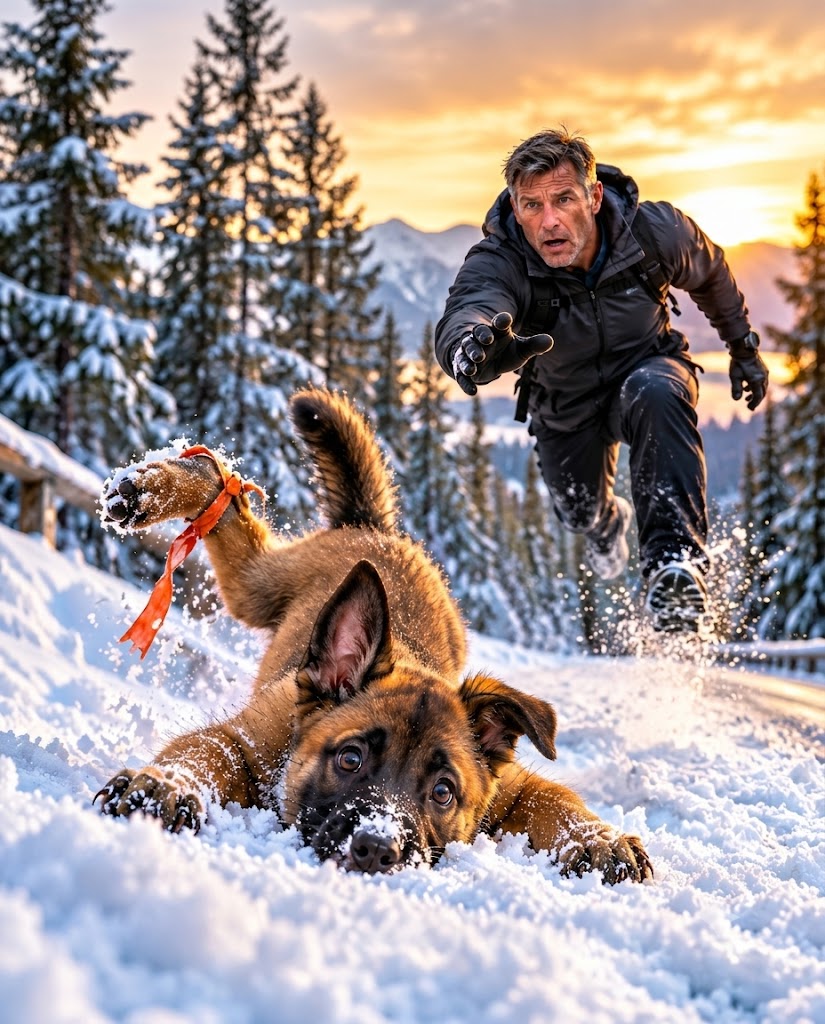
As he placed both hands near the ground for his second start, the puppy lowered its own front legs, stretched them forward, and raised its little hindquarters.
Its ears shifted as it looked from Dashel’s hands to his face.
It was an ordinary playful posture for a young dog, but the timing made it seem as though this tiny creature was trying to copy a Navy SEAL.
Dashel blinked.
For an instant, the heaviness behind his eyes softened.
“You planning to race me?” he asked.
The puppy answered with a small, eager bounce.
Dashel shook his head, almost smiling.
He looked down the road again, unaware that this ridiculous little moment was about to lead him into something far more important than his morning exercise.
Three.
Two.
One.
Dashel pushed forward into his second sprint.
Behind him came a quick patter of tiny paws.
The puppy had launched itself after him, bounding across the pavement with clumsy determination.
Its little ears bounced, its tail swung wildly, and for three or four steps it seemed delighted simply to be moving in the same direction as the man.
Then something went wrong.
A thin strip of orange fabric trailing from the puppy’s left hind leg caught against a low branch at the snowy roadside.
The sudden resistance disrupted its stride.
Its front paws slipped onto the soft snow, and it tumbled forward, landing nose first before rolling onto its side.
Dashel heard the soft impact and glanced over his shoulder.
The sight was so unexpected that a brief laugh escaped him.
It surprised him almost as much as the puppy’s attempt to race.
He could not remember the last time laughter had come so naturally, but the sound died when he noticed the puppy struggling to regain its footing.
Dashel immediately turned around and hurried back.
The puppy had pushed itself upright on its front paws, but its left hind leg remained awkwardly positioned.
“Hey, easy there,” Dashel said, dropping to one knee.
He removed a glove and slowly extended his hand.
The puppy sniffed his fingers, then rested its cold little nose against his palm.
Beneath the fur around its hind leg, Dashel noticed a narrow orange synthetic strap marked with white reflective stitching.
It had twisted tightly around the leg, while its loose end had snagged the branch during the attempted sprint.
Whatever the strap had once belonged to, it clearly was not an ordinary leash.
Dashel carefully freed the loose portion from the branch without pulling at the material around the leg.
The puppy gave a quiet whimper.
Dashel inspected the area as gently as possible and saw slight swelling where the fabric pressed against the fur.
He decided not to attempt removing the tight section himself.
A veterinarian would need to examine it safely.
For several seconds, Dashel remained kneeling in the snow, looking into those trusting amber eyes.
There was something painfully familiar about such helpless determination.
He remembered men who had kept moving despite exhaustion because they believed someone was waiting for them.
The thought tightened his throat.
“You shouldn’t be out here alone,” he whispered.
He glanced toward the trees, searching for a house, a parked vehicle, or any sign of someone calling for a missing pet.
There was nothing.
The puppy followed his gaze toward a narrow opening between the pines.
Its ears shifted forward, and it released a faint, uneasy sound.
Dashel looked in the same direction, but the forest revealed only shadows and snow-covered branches.
Perhaps the animal was frightened by the unfamiliar surroundings.
Perhaps it had wandered farther than its small legs could manage.
Either way, leaving it there was no longer an option.
Dashel retrieved the spare insulated towel from his running pack and gently wrapped the puppy, carefully supporting its body and avoiding pressure on the injured leg.
Almost immediately, the little animal settled against his chest, its trembling gradually easing beneath the warmth of his jacket.
Dashel carried it toward his truck, his footsteps crunching across the frozen turnout.
Before leaving, he marked the exact location on his phone, thinking it might help locate the puppy’s owner.
He then placed the bundled animal securely in a padded equipment bin in the rear passenger footwell and checked that it could rest without moving around.
The puppy blinked sleepily at him.
Dashel leaned closer.
“Hang in there, little soldier. We’re getting you some help.”
He started the engine, turned the heater to a comfortable setting, and carefully pulled onto the quiet road toward Grayfair.
For the first time in months, the memories that had driven him from bed before dawn were no longer at the center of his thoughts.
His only concern was the small life depending on him.
Neither of them knew that beyond the trees, less than half a mile away, a silver SUV lay concealed below an old service road.
Inside, a missing woman was still waiting for someone to find her.
—
By the time Dashel Prier reached the veterinary clinic in Grayfair, the first pale light of morning had begun to spread across the snow-covered rooftops.
It was nearly 7:30, and the little Belgian Malinois lay quietly inside the insulated towel that had kept him warm during the drive.
Every few minutes, Dashel glanced toward the rear passenger footwell, where he had secured the puppy as comfortably as possible.
The small animal had stopped trembling so violently, but its amber eyes still followed every movement the older man made.
Dashel had called ahead, explaining that he had found a young dog with something wrapped tightly around its hind leg.
The woman who answered had told him to come directly to the clinic.
Now, carrying the puppy carefully against his chest, he stepped through the glass entrance into a room filled with warm air, soft lighting, and the faint scent of disinfectant.
For a man who had spent years avoiding unnecessary human contact, walking into a busy medical office should have been uncomfortable.
But this morning, he barely noticed the surroundings.
His attention remained fixed on the little creature in his arms.
Dr. Simone Harrow met him near the examination room.
She was a 44-year-old veterinarian with a slender build, warm brown eyes, and dark brown shoulder-length hair tied neatly behind her head.
She wore teal medical scrubs beneath a white coat, and her calm expression suggested a woman accustomed to frightened animals and worried owners.
Years of veterinary work had taught Simone to speak gently without making promises she could not keep.
She examined the puppy while Dashel stood beside the stainless steel table, one large hand resting near its head.
The Belgian Malinois looked even smaller beneath the bright examination light.
His deep fawn coat was marked with pine needles and dried leaves, and his left hind leg remained slightly swollen where the thin orange strap had tightened around it.
Simone checked his temperature, heartbeat, hydration, and movement before carefully removing the remaining material.
The puppy whimpered once, then pressed his black nose against Dashel’s fingers.
“Easy, little fellow,” Dashel whispered. “You’re doing fine.”
After completing her initial examination, Simone looked up.
“He’s cold, a little underweight, and that leg has some mild swelling. Fortunately, I’m not finding obvious signs of a broken bone or serious damage, though we’ll need to monitor him.”
Dashel nodded, his jaw tightening slightly.
“Will he walk normally?”
Simone gently watched the puppy reposition his hind leg.
“That’s what I expect if his recovery continues well, but no running for now. He needs warmth, rest, appropriate food, and another examination if anything changes.”
Dashel absorbed every instruction with the seriousness of a man receiving an important assignment.
When Simone asked how long he had owned the dog, he answered, “About two hours.”
She raised an eyebrow.
Dashel explained how the puppy had emerged from beneath a pine tree while he was exercising, watched him perform a sprinting start, and then tried to imitate the movement.
Simone laughed softly.
“He tried to race you.”
Dashel glanced at the puppy.
“For about four steps. Then he discovered he wasn’t built for my training schedule.”
A faint smile appeared on his face, surprising him almost as much as the laughter earlier that morning.
Simone retrieved a microchip scanner and passed it carefully over the puppy’s neck and shoulders.
A small electronic beep broke the quiet.
A registered number appeared on the screen.
She entered the information into the identification registry and found contact details for a local animal rescue organization called Grayfair Animal Rescue.
“Well,” she said, “someone has been looking after you.”
She reached for the telephone and called the registered organization.
Dashel remained beside the examination table, watching the puppy settle onto a folded blanket.
A few minutes later, a woman answered.
Her voice sounded tired but immediately attentive when Simone mentioned a young Belgian Malinois.
The veterinarian described the black facial mask, the amber-brown eyes, and the uneven ears.
The woman interrupted politely.
“Is his right ear halfway up while the left still folds over?”
Simone confirmed it.
The voice on the telephone suddenly filled with relief.
“Oh, thank goodness. That’s Tumble.”
At the sound of the name, the puppy lifted his head.
His small tail moved once against the blanket, and he looked toward the telephone as though the familiar word had awakened something inside him.
Dashel stared.
Until that moment, the animal had been a nameless stranger he happened to rescue from the cold.
Now, the puppy belonged to a story that had started long before their meeting.
Simone smiled.
“Tumble. That certainly suits him.”
But the relief on the other end of the telephone lasted only a moment.
“Doctor,” the woman said, her voice suddenly trembling, “I need to know exactly where that puppy was found. The woman caring for him disappeared yesterday evening. Nobody has been able to find her.”
Dashel straightened.
The smile vanished from his face.
Outside the window, the quiet winter town continued waking up, completely unaware that a missing-person case had just reached into this small examination room.
The woman introduced herself as Ria Montrose, the 48-year-old director of Grayfair Animal Rescue.
Within twenty minutes, she arrived at the clinic in a navy fleece jacket, dark jeans, and winter boots dusted with snow.
She had a practical, sturdy build, chin-length blonde hair, and gray-green eyes that looked as though they had seen too many frightened animals arrive through shelter doors.
Her normally reassuring manner was strained by worry.
She knelt beside the examination table and spoke softly.
“Hey, Tumble. There you are, sweetheart.”
The puppy recognized her voice and gave a small, sleepy wag.
Ria explained that Tumble had entered the rescue program underweight and nervous around unfamiliar surroundings.
Five days earlier, Mara Oaks had agreed to care for him temporarily.
Mara was a 42-year-old conservation field worker with a capable, outdoorsy build, pale skin marked by faint freckles, hazel-green eyes, and reddish-brown hair usually tied into a low ponytail.
Ria showed Dashel a photograph of Mara kneeling beside Tumble outside a wooden ranger station.
The woman in the picture had a warm, unguarded smile.
The puppy appeared to be trying to climb into her lap.
“Mara never missed a check-in,” Ria explained. “She was inspecting service roads near the northern conservation property yesterday. She took Tumble with her in a secured travel carrier because she was bringing him home after finishing her work.”
Mara had been expected to confirm the end of her shift at 6:00 that evening.
When she failed to respond, her co-workers made several calls and checked the places she normally visited.
By 7:30, they had reported her missing.
Search personnel began checking the accessible roads that night, but snow, darkness, and uncertainty about her return route had prevented them from locating her.
Dashel listened without interrupting.
Then he reached into his jacket pocket and showed Ria a photograph of the orange strap that Simone had removed.
The material was narrow, strong, and stitched with white reflective threads.
Ria leaned closer.
“That’s from her carrier,” she said. “One of the donated straps had been repaired with that exact stitching.”
She took out another photograph showing Tumble sitting inside a small orange travel carrier.
The resemblance was unmistakable.
Dashel looked at the puppy, who was now resting with his chin between his front paws.
A quiet realization settled over him.
The little dog hadn’t simply wandered away from some nearby cabin.
Somehow, he had become separated from the woman responsible for him, carrying a piece of his damaged carrier into the winter forest.
Dashel thought about the narrow opening between the pine trees and the faint sound the puppy had made while looking back toward it.
Had he been frightened?
Was he searching for Mara?
Or had he simply followed the easiest route through the snow?
Dashel could not know.
He had spent enough years making decisions under uncertainty to understand how dangerous assumptions could be.
But one thing was certain.
The location where he found Tumble now mattered.
He unlocked his phone and showed Ria the saved map marker.
“This is the exact spot. I marked it before leaving.”
Ria immediately contacted the authorities handling Mara’s disappearance.
Shortly afterward, Deputy Kara Northam arrived at the clinic.
She was 37, athletic and medium height, with sharp brown eyes and dark hair pulled into a practical ponytail.
Her navy winter uniform and measured manner reflected a deputy who preferred careful questions to dramatic conclusions.
She listened as Dashel described the forest road, the pine-covered slope, and the direction from which the puppy had emerged.
Simone provided the veterinary findings while Ria confirmed the identification records and the matching carrier strap.
Kara examined the map on Dashel’s phone, then compared it with the service road information available to the search team.
Her expression changed.
“That position is close to an older access road,” she said. “It’s not one of the routes we’ve been able to check thoroughly.”
She called the search coordinator and relayed the new information, requesting that the location receive immediate attention.
Dashel remained quiet while Kara finished the call.
Beside him, Tumble stirred and rested a tiny paw against the edge of the blanket.
Dashel gently touched it with one finger.
He remembered how irritated he had felt when the puppy first interrupted his morning routine.
He had wanted nothing more than to finish his run and return to the safe silence of his house.
Now he found himself wishing he had noticed the animal sooner.
Kara closed her notebook and turned toward him.
“Mr. Prier, we may need you to show us precisely where you found him.”
Dashel looked from the deputy to the exhausted puppy.
Years ago, he would have answered without hesitation whenever someone needed help.
Somewhere along the way, he had stopped believing he had anything useful left to offer.
But this morning, a ten-week-old dog had reminded him otherwise.
“Tell me where to meet you,” he replied.
Kara nodded.
“That puppy may have just given us our first solid lead.”
And as Dashel looked down at Tumble, he understood that the smallest life he had rescued might be the reason another life could still be saved.
—
By 9:00 that morning, the winter sky above Grayfair, Maine, had turned a pale, lifeless gray.
Dashel Prier stood outside the veterinary clinic, pulling on his dark charcoal jacket while the cold wind moved through the nearly empty parking lot.
Behind the clinic window, the tiny Belgian Malinois he had rescued was resting on a folded blanket, his little black muzzle tucked between his front paws.
Dr. Simone Harrow had assured Dashel that Tumble would remain warm and comfortable while his swollen hind leg was monitored.
Still, leaving him behind felt strangely difficult.
The puppy had been part of his life for barely four hours.
Yet Dashel had already grown accustomed to those curious amber eyes following him.
Before leaving, he had leaned close to the examination table and whispered, “No more racing until I get back, little soldier.”
Tumble had lifted his partially upright right ear and given one sleepy wag of his tail.
Now, as Dashel climbed into his old truck, he could not stop thinking about the orange strap removed from the puppy’s leg.
Somewhere beyond the snow-covered trees, a woman named Mara Oaks had vanished, and the smallest creature Dashel had ever tried to protect might hold the only clue to where she had gone.
The search command post had been established near a maintenance turnout along the northern forest road.
Two emergency vehicles, a utility truck, and several members of the search team occupied the narrow clearing.
Deputy Kara Northam greeted Dashel beside a folding table covered with maps.
Standing next to her was Hollis Penfield, a 60-year-old Maine game warden with a lean, weather-hardened build, broad working shoulders, and a face marked by deep lines around his steel-gray eyes.
His short silver hair disappeared beneath a dark green wool cap, and a neatly trimmed gray mustache softened an otherwise stern expression.
He wore a forest-green winter field jacket, tan work trousers, and heavy brown boots.
Hollis had spent more than thirty years working in Maine’s forests, helping lost hikers, stranded families, and injured travelers.
Early in his career, one rushed assumption had sent his team down the wrong trail during a difficult search.
The missing traveler had eventually been found, but the experience had taught Hollis a lesson he never forgot.
Confidence was useful, but evidence mattered more.
He greeted Dashel with a firm handshake.
“Deputy Northam says you found the puppy.”
Dashel nodded.
“He found me first.”
Hollis spread a detailed topographic map across the table.
Red marks indicated areas already searched overnight, while several narrow service roads disappeared into a heavily wooded section north of town.
Mara’s expected route was marked in blue.
“Her co-workers reported her missing around 7:30 last night,” Hollis explained. “We checked the main access roads and the places she normally stops. So far, nothing.”
Dashel studied the map carefully.
Years of military service had taught him to notice the relationship between roads, slopes, and natural obstacles.
But he knew the local warden understood this terrain better than he did.
He unlocked his phone and showed Hollis the saved location from that morning.
“Right here. I was exercising on the plowed section. The puppy came out of the trees on the eastern side.”
Hollis compared the marker with an older forestry map.
His finger stopped beside a faded line branching away from the main road.
“That’s interesting.”
Kara leaned closer.
Hollis explained that the line represented an abandoned service route once used to reach a maintenance area deeper in the forest.
Recent maps barely showed it because the route had not been regularly maintained.
Dashel looked toward the surrounding trees.
What had seemed like an ordinary patch of woodland before sunrise was beginning to take on an entirely different meaning.
The team drove a short distance to the turnout where Dashel had parked earlier.
In daylight, he could finally see details that had been hidden beneath his headlamp’s narrow beam.
The pine branches were heavy with snow, and the ground beyond the roadside dropped gradually into a darker stretch of forest.
He showed Hollis the exact place where Tumble had emerged, then pointed toward the low branch that had caught the orange strap.
A search team member examined the area and noticed several short threads of bright material still clinging to the rough bark.
Hollis photographed them and recorded their position.
He did not announce that they had found Mara’s route.
Instead, he crouched beside the branch, studying the nearby ground.
“A puppy that young wouldn’t deliberately choose the hardest path,” he said. “He may have followed an opening through the trees.”
Dashel remembered how Tumble had looked back toward the forest while being carried to the truck.
At the time, he had dismissed the movement as fear.
Now he wondered whether the puppy had been looking toward the place he had come from.
Hollis followed the narrow opening with his eyes.
“Let’s see where it leads.”
Just beyond the first row of pines, Dashel noticed something that made him stop.
A narrow reflector post stood crooked beside a nearly invisible track.
Its upper section bent toward the snow.
Around its base, the white surface appeared uneven, as though something heavy had disturbed it before fresh snowfall covered the marks.
Hollis approached and brushed loose snow from the post with his glove.
Beneath it was a shallow groove extending toward the descending road.
Dashel felt a cold weight settle in his stomach.
The orange strap, the frightened puppy, the forgotten road—each detail seemed to belong to the same unfinished story.
Hollis looked down the slope, then toward Dashel.
“We still don’t know what happened,” he said quietly. “But I think we have a direction worth checking.”
For the first time that morning, Dashel understood how close he might have been to someone who desperately needed help without ever realizing it.
The search team moved carefully along the old service road, with Hollis directing their progress and Kara maintaining contact with the command post.
Dashel remained with the group at Hollis’s invitation, helping identify landmarks without venturing ahead.
The road was narrow, bordered by frozen brush and young evergreens.
In places, fresh powder concealed its edges.
A few hundred yards in, Hollis found shallow, compressed tracks beneath the newer snow.
Their width suggested a vehicle rather than a person walking.
Nearby, several small branches were bent in the direction of the descending slope.
None of the marks proved that Mara had passed through, but together they justified a more thorough search while the team documented the area.
Kara received a message from Mara’s co-workers.
Earlier the previous afternoon, Mara had sent a short update reporting disturbed boundary markers and unusual heavy vehicle activity near the northern conservation property.
She had planned to inspect one final location before returning to Grayfair.
The message had been sent well before her disappearance.
Dashel listened as Kara read it aloud.
“She was paying attention to something out here,” he said.
Hollis nodded.
“Maybe. But finding Mara comes first. Everything else can be examined afterward.”
Kara explained that a local timber company operated on land bordering the conservation property.
Its owner, Levi Rusk, held permits for work in designated areas, but recent reports raised questions about whether some vehicles had crossed into restricted sections.
Dashel considered the information carefully.
It would have been easy to imagine a confrontation or assume that somebody had deliberately harmed Mara, but there was no evidence supporting that conclusion.
The winter roads themselves were dangerous enough.
He had seen how quickly a vehicle could lose traction on ice.
As they continued, a sudden burst of static crackled through a team radio.
Dashel’s shoulders tightened before he could stop them.
For an instant, the forest around him seemed to disappear, replaced by another cold landscape and a voice calling through military communications.
His breathing shortened.
He looked down at the snow beneath his boots, then at the dark green sleeve of Hollis’s jacket.
He reminded himself where he was.
Maine. A forest road. A search team. The present.
Slowly, the tension began to ease.
Hollis had noticed the change but did not embarrass him by drawing attention to it.
Instead, he stepped closer and pointed toward a bend in the road.
“There’s an old drainage channel down there. Vehicles sometimes slide toward it when the surface freezes.”
Dashel studied the terrain.
The road curved sharply around a wooded slope, and the snowbank on the outer edge looked unusually low.
Hollis continued, “One thing I’ve learned in this job is that nobody finds a missing person by trying to be a hero alone.”
Dashel looked at him.
The older warden spoke without judgment.
“We rely on each other. Somebody notices a clue. Somebody else knows the terrain. Another person has the equipment. That’s how people get home.”
Dashel said nothing for a moment.
He had spent years believing that accepting help meant admitting weakness.
Yet the man beside him sounded very much like the best leaders Dashel had known.
“I understand,” he finally replied, and he realized that perhaps for the first time in six years, he truly meant it.
Near the bend, one of the searchers called out.
A section of weathered wooden barrier had been disturbed, and several branches below it appeared freshly broken.
Hollis ordered the group to stop while two qualified team members examined the steep embankment from a safer position.
Beneath the trees lay a drainage ditch, its bottom concealed by accumulated snow and thick pine branches.
From the road, almost nothing could be seen.
Dashel stared into the shadows, thinking about how easily a vehicle might disappear there after sliding from the icy surface.
A searcher moved to another vantage point and raised binoculars.
After a long silence, the man spoke over the radio.
“I’ve got something reflective below the tree line.”
Hollis asked him to describe it.
“Small piece of silver-colored material. Could be vehicle trim. Hard to tell from here.”
Hollis immediately requested additional rescue personnel and instructed the searchers to avoid disturbing the slope until a safe approach had been established.
Dashel stood beside Kara as the first searchers carefully approached the lower observation point.
The sky had darkened, and fine snowflakes began drifting through the branches.
He thought of Mara’s photograph at the veterinary clinic—the reddish-brown hair, the freckled face, the bright expression of a woman holding a puppy that trusted her.
He thought of Tumble, now resting somewhere warm, unaware of the people following the fragile trail his escape had revealed.
Dashel silently hoped the woman was still alive.
Then a voice came through Hollis’s radio.
“Hold on, everybody. Quiet.”
The entire group fell silent.
For several seconds, only the wind moved through the pines.
A faint metallic tapping sound rose from somewhere beneath the slope.
Three short knocks, then nothing.
Dashel stopped breathing for a moment.
Another few seconds passed.
The sound came again—weak, but unmistakable.
Hollis raised his radio and spoke with controlled urgency.
“Confirm the direction.”
The answer arrived almost immediately.
“Below us, sir. Somewhere under those trees. It sounds like someone is inside a vehicle.”
Dashel stared toward the hidden drainage ditch as a realization settled over him.
The little puppy he had nearly ignored that morning might have led them to a life still waiting to be saved.
**Part 2**
The third series of faint knocks came from somewhere beneath the snow-covered slope, and for a moment, nobody moved.
Hollis Penfield stood beside the narrow forest road, holding his radio close to his mouth as the winter wind whispered through the towering pines.
“Confirm what you’re hearing,” he instructed.
A searcher positioned farther down the embankment answered almost immediately.
“Three short knocks, sir. There’s definitely something below us.”
Dashel Prier stared into the dark space between the trees.
Less than seven hours earlier, he had been running along this same stretch of road, believing the forest around him was completely empty.
Now, somewhere beneath those branches, a human life might be waiting.
Hollis directed the rescue team to approach carefully while another group prepared equipment near the roadside.
The snow had hidden the edge of the drainage ditch, and nobody wanted a second accident.
Dashel remained beside Deputy Kara Northam, his blue-gray eyes following every movement below.
His military instincts urged him forward, but he understood that the trained rescuers needed room to work.
A few minutes later, a voice crackled over the radio.
“We’ve located a vehicle. Silver SUV, down in the drainage channel. It’s partially covered by branches.”
Dashel felt his chest tighten.
Through a narrow opening between two pine trees, he could finally distinguish a dull silver shape beneath the snow.
The vehicle had come to rest at an angle against a thick tree trunk, far enough below the road to be almost invisible from above.
Its rear section was partly concealed beneath broken branches, while the driver’s side was pressed close to the tree.
Hollis immediately requested medical support and instructed the team to stabilize the situation before attempting to open the doors.
Then another message arrived.
“We have movement inside. One adult female. She’s conscious.”
Kara released a breath she seemed to have been holding for several minutes.
Dashel closed his eyes briefly.
After years of remembering the people he had been unable to reach, hearing that someone was still alive felt almost overwhelming.
The woman inside was Mara Oaks—42 years old, a conservation field worker known around Grayfair for her dedication to protecting the surrounding forests.
Even after a night in the cold, her appearance reflected the capable outdoorswoman her colleagues had described.
She had a medium-height athletic frame, pale skin scattered with faint freckles, and hazel-green eyes beneath tired reddish-brown hair that had partly escaped its low ponytail.
Her forest-green winter jacket was wrapped tightly around her, and a thermal blanket covered her shoulders.
Mara was naturally independent, the kind of woman who fixed problems before asking others to help.
But the long night had tested even her stubborn optimism.
Her left leg was trapped beneath part of the damaged dashboard, and the driver’s door could not open against the tree.
She had tried calling for help, but the narrow valley offered no reliable phone signal.
When she finally heard distant voices above the slope, she had used a small metal flashlight to tap against the interior door frame, hoping somebody would recognize the sound.
As a rescuer spoke to Mara through the damaged vehicle, her first question was not about her injured leg, the freezing night, or how soon she could get out.
Her voice trembled as she asked, “Did anyone find my puppy?”
The rescuer hesitated, then relayed the question to Hollis.
Dashel heard it over the radio.
Suddenly, he understood something that made his throat tighten.
All night, while Mara struggled to stay warm inside the stranded SUV, she had been worrying about a tiny Belgian Malinois somewhere in the winter forest.
Dashel stepped closer to Hollis.
“Tell her Tumble’s safe,” he said quietly. “He’s at the veterinary clinic. He’s warm, and they’re taking care of him.”
Hollis passed the message down.
A few seconds later, the radio carried Mara’s faint reply.
“Thank God.”
Then she began to cry—not because of her own fear, but because the smallest life she had been trying to protect had survived.
The rescue continued carefully.
Trained personnel checked the stability of the SUV while medical responders monitored Mara’s condition.
She was tired and chilled but alert enough to follow their instructions.
Dashel remained on the road with Kara, watching the coordinated effort.
At one point, a sudden metallic sound rose from below as equipment was repositioned.
His shoulders stiffened, and an old memory flashed through his mind—a distant radio call, bitter mountain air, and the terrible uncertainty of waiting for news about a teammate.
He felt his breathing quicken.
Then Hollis spoke beside him.
“They’re doing exactly what they need to do.”
Dashel looked toward the rescuers and concentrated on the present.
This was Maine, not the mountains of his past.
These were people working together, not soldiers separated by an impossible distance.
For once, he did not have to carry the entire weight of a rescue alone.
After the rescuers freed the trapped space around Mara’s leg and created a safe exit, they carefully helped her from the SUV.
She was supported onto a rescue stretcher and wrapped in additional insulation against the cold.
The entire operation had taken patience, teamwork, and calm judgment rather than force.
When Mara reached the road, Dashel saw her clearly for the first time.
Her face was pale with exhaustion, but her eyes were bright with relief.
She recognized him only as the stranger standing near Hollis.
“Are you the man who found Tumble?” she asked.
Dashel nodded.
“He found me first.”
A weak smile crossed her face.
“That sounds like him.”
Dashel told her how the puppy had appeared during his morning exercise and attempted to imitate his sprinting stance.
Mara gave a quiet, disbelieving laugh.
“He always did that,” she whispered. “He wanted to copy everything I did.”
As the medical team prepared to transport her, Mara briefly explained what had happened.
The previous afternoon, she had finished checking boundary markers near the conservation property.
She had photographed several unusual vehicle tracks and signs that heavy equipment might have entered land where timber operations were restricted.
Tumble had been traveling safely inside his orange carrier in the back of her SUV.
On the return journey, headlights from a large truck appeared around a narrow bend.
Mara slowed to give the vehicle room, but her tires lost traction on the icy surface.
The SUV slid sideways and dropped into the drainage channel without striking the truck.
She could not tell whether its driver had noticed the accident.
During the slide, Tumble’s carrier shifted, and its fastening was damaged.
The little puppy remained inside the vehicle for much of the night, frightened but close enough to hear Mara’s voice.
Just before dawn, he got out.
Mara continued softly.
She explained that the damaged carrier had left an opening, and the SUV’s rear hatch had been forced slightly ajar during the accident.
Tumble had squeezed through the narrow space and disappeared between the trees.
Mara had called after him, but her voice could not bring him back.
She had spent the following hours imagining the puppy wandering through the freezing forest, alone and frightened.
Dashel thought about the orange strap wrapped around Tumble’s left hind leg.
Everything finally made sense.
The damaged carrier, the narrow woodland opening, and the puppy’s desperate little journey were all connected.
Mara looked at Dashel with tears gathering in her eyes.
“If you hadn’t stopped for him—” She couldn’t finish.
Dashel shook his head gently.
“He made it pretty difficult to ignore him.”
Mara smiled through her tears.
“Then I guess he saved both of us.”
Before the ambulance departed, Kara assured Mara that her photographs and observations would be reviewed by the appropriate authorities.
The suspected misuse of forest access roads and the nearby timber operations required proper investigation, not immediate accusations.
Levi Rusk’s company operated on neighboring land, but nothing established that its owner had deliberately caused the accident or even knew it had occurred.
Hollis reminded everyone that the investigation could continue after Mara received medical care.
Dashel respected that decision.
Years earlier, he might have measured success through the defeat of an enemy.
Today, success meant something much simpler.
A woman was alive, a puppy was safe, and everyone involved in the search would be returning home.
—
By late afternoon, Dashel was back at Dr. Simone Harrow’s veterinary clinic.
Outside, fresh snow drifted against the windows, but the examination room was warm and quiet.
Tumble lay on a soft blanket, his tiny body curled comfortably, his injured left hind leg resting without the orange strap that had caused so much trouble.
When Dashel entered, the puppy lifted his black muzzle.
His right ear rose halfway while the left remained folded, and his little tail began tapping against the blanket.
Dashel knelt beside him, letting those small amber eyes study his face.
“You have no idea what you did today, do you, buddy?” he whispered.
Tumble pressed his nose into Dashel’s palm and settled against his hand.
The former Navy SEAL felt an unfamiliar warmth in his chest.
That morning, he had believed he was simply rescuing a helpless animal.
Instead, the puppy’s unexpected appearance had helped save a missing woman and reminded a lonely veteran what it felt like to be part of something meaningful again.
As Dashel prepared to leave, Ria Montrose, the director of Grayfair Animal Rescue, approached him.
Her gray-green eyes moved from the resting puppy to the man who had carried him out of the forest.
“Mara will need some time to recover,” she said. “And Tumble needs a quiet, warm place where someone can watch over him.”
Dashel looked down at the little dog.
He thought of his silent wooden house, the empty space beside the fireplace, and the long nights he usually faced alone.
Ria hesitated before asking, “Would you consider looking after him temporarily once the veterinarian says he’s ready to go home?”
Dashel had spent six years convincing himself that responsibility for another life was something he could no longer bear.
But Tumble was watching him with complete, uncomplicated trust.
For the first time in years, the thought of someone waiting for him at home did not feel frightening.
It felt like the beginning of something he had almost forgotten how to hope for.
Dashel Prier had spent six years believing that the safest life was one in which nobody depended on him.
Yet, as he stood inside the warm veterinary clinic, looking down at a ten-week-old Belgian Malinois sleeping peacefully on a folded blanket, that belief no longer felt quite so certain.
Ria Montrose, the director of Grayfair Animal Rescue, had just asked whether he would consider caring for Tumble while Mara Oaks recovered from her accident.
Dashel looked toward the window, where fresh snow drifted beneath the streetlights.
He thought of his quiet wooden house, the empty chair beside the fireplace, and the long nights when memories of war seemed louder than anything happening around him.
Taking responsibility for another living creature frightened him in ways he could not easily explain.
But when Tumble lifted his little black muzzle and looked at him with trusting amber-brown eyes, Dashel felt something inside him soften.
“I don’t know much about raising puppies,” he admitted.
Ria smiled gently.
“Then you’ll learn. Nobody becomes good at caring for someone without starting somewhere.”
Dashel looked down again.
The puppy’s right ear stood halfway upright while the left remained folded, giving him the permanently puzzled expression that had already become strangely familiar.
After a long moment, Dashel nodded.
“All right. I’ll take care of him.”
Before Tumble could leave, Dr. Simone Harrow completed another examination.
His temperature had returned to normal.
The swelling around his left hind leg had begun improving, and he was eating and drinking comfortably.
Simone explained that the puppy still needed rest, short supervised outdoor breaks, appropriate nutrition, and a follow-up appointment.
Running, jumping, and rough play were out of the question until his leg had healed.
Dashel listened carefully, asking questions about feeding schedules, sleeping arrangements, and how to recognize signs of discomfort.
Ria arranged the temporary foster agreement through Grayfair Animal Rescue, confirming that the organization would remain responsible for the puppy’s ownership and adoption decisions.
By the time Dashel finally carried Tumble outside, he had a bag of puppy food, a soft blanket, basic care instructions, and more responsibility than he had expected when he left home before sunrise.
He drove through the snowy streets with an unfamiliar feeling growing in his chest.
For once, returning home did not mean returning to silence.
His house stood at the end of a narrow gravel driveway surrounded by tall pines.
Inside, everything had always been arranged with almost military precision.
His boots stood beside the door, his books lined a single shelf, and an old photograph of his former SEAL team rested on the mantelpiece.
Dashel placed a small puppy bed beside the fireplace, safely away from the heat, and set a water bowl nearby.
Tumble explored slowly, sniffing the wooden floor, the legs of the kitchen table, and the edge of Dashel’s boots.
When the puppy discovered a loose shoelace, he gently tugged it with his tiny teeth.
“Negative, soldier,” Dashel said, lifting the boot onto a shelf.
Tumble sat back on his haunches and tilted his head first left, then right.
Dashel tried to maintain his stern expression but failed.
A quiet laugh escaped him.
Later, as he prepared dinner, he caught himself explaining what he was doing to the little dog watching from the doorway.
It was such an ordinary moment that he almost missed its importance.
For the first time in years, he was talking simply because there was someone there to listen.
The following days brought changes Dashel had never anticipated.
He woke early, but instead of immediately leaving for a punishing run, he checked on Tumble, refreshed his water, prepared breakfast, and followed the veterinarian’s instructions.
The puppy was curious about everything.
He watched Dashel fold laundry, tried to carry a small cloth across the living room, and occasionally fell asleep with his nose resting against a toy.
His growing confidence delighted Dashel, although the older man remained careful about his recovering leg.
One afternoon, while Dashel stretched on a mat beside the fireplace, Tumble lowered his front paws and raised his little hindquarters, looking remarkably like the puppy who had tried to copy a sprinting start on the forest road.
Dashel shook his head affectionately.
“Not another race, buddy. You’re supposed to be resting.”
Tumble wagged his tail as though the warning were an invitation to play.
Dashel gently redirected him toward his blanket.
He was discovering that caring for a puppy required something different from military discipline.
It demanded patience, kindness, and the willingness to repeat a lesson without becoming frustrated.
But on the fourth night, something happened that made Dashel realize how deeply his life had already begun to change.
Shortly after 2:00 in the morning, he awakened from another nightmare, sitting upright with his heart pounding and his hands trembling.
For several seconds, he struggled to separate the silence of his bedroom from the memories that had followed him home from military service.
He walked into the living room and sat heavily beside the fireplace.
Tumble stirred in his bed.
The little puppy raised his head, blinked sleepily, and watched Dashel without fear.
Then he carefully stood, walked a few steps toward the older man, and settled against his slipper.
There was no miraculous understanding in the puppy’s expression, no extraordinary ability to erase painful memories.
He was simply a small animal seeking warmth and companionship.
Yet Dashel looked down at him and felt tears gather unexpectedly in his eyes.
“I spent so long thinking everyone was better off without me,” he whispered.
Tumble rested his chin on the man’s foot.
Dashel slowly bent down and touched the soft fur between his ears.
For years, he had believed the past had taken away his ability to care for anyone again.
Now, sitting in the quiet with a puppy who trusted him, he began to question whether that belief had ever been true.
The next morning, Dashel opened an old contact card he had kept tucked inside a drawer.
It belonged to a mental health professional who had helped him after his retirement.
He had ignored the number for more than two years, convinced that keeping busy and maintaining discipline would eventually be enough.
This time he made the call and arranged an appointment to discuss his nightmares, sleep difficulties, and the memories he had never fully learned to carry.
Nothing changed instantly.
Some nights remained difficult, and certain sounds still startled him.
But Dashel began to understand that strength did not always mean enduring everything alone.
Meanwhile, caring for Tumble created small opportunities to reconnect with other people.
He spoke with Simone during the puppy’s follow-up examination, exchanged updates with Ria, and even found himself smiling at neighbors who stopped to ask about the little Malinois.
His world, once carefully reduced to a handful of predictable routines, was slowly becoming larger.
A week after Mara’s rescue, Dashel visited her while she continued recovering at home.
She greeted him from a comfortable chair near the window, her reddish-brown hair tied loosely behind her head and the familiar freckles across her pale face visible in the afternoon sunlight.
Her injured leg was improving, although she still needed rest and follow-up care.
Tumble, whom Dashel had brought for a short, carefully supervised visit after consulting Simone, recognized Mara’s voice immediately.
His little tail moved eagerly as she reached down to stroke his black muzzle.
“There’s my brave little troublemaker,” she whispered.
Mara told Dashel how Tumble had behaved during his first days with her.
He had been timid at first but soon became fascinated by human movement.
Whenever she crouched to tie her boots or pick up a dropped glove, he lowered himself into a similar position as though he wanted to participate in whatever she was doing.
“That’s why I named him Tumble,” Mara explained with a laugh. “He kept trying to do things his legs weren’t ready for.”
Dashel smiled, remembering their first encounter.
Then Mara grew quiet.
“I kept thinking about him while I was trapped in that car,” she said. “I was terrified he wouldn’t survive the cold.”
Dashel looked at the puppy sitting beside his chair.
“He gave us a reason to search exactly where we did.”
Mara nodded.
“And you gave him a reason to trust someone.”
Over the following days, the investigation into unusual activity near the conservation property continued.
Mara’s photographs, the disturbed boundary markers, and records of vehicle movements were reviewed by the appropriate authorities.
Certain disputed access routes remained restricted during the inspection, but no final conclusion had been reached about the responsibility of Levi Rusk’s timber company.
Dashel was content to let the investigation proceed properly.
The important thing was that Mara was alive and recovering.
Nearly two weeks after Tumble first appeared on the forest road, Ria visited Dashel’s home to discuss the puppy’s future.
The little Malinois had gained some healthy weight.
His left hind leg had recovered well, and Simone had approved gentle walks appropriate for his age.
Ria reviewed the adoption requirements and the care arrangements Dashel had established.
Mara, who had only been Tumble’s temporary foster caregiver, had already expressed her happiness at the possibility of the puppy staying with him.
When the necessary paperwork was completed, Ria placed the adoption documents on the kitchen table.
“He’s officially yours now,” she said.
Dashel looked at Tumble, who was curled beside his chair.
“I think he made that decision before I did.”
The following morning, Dashel returned to the forest road where everything had begun.
A gentle snowfall drifted through the pines, and pale winter sunlight touched the trees beyond the narrow pavement.
He wore the same charcoal running jacket, dark navy pants, and black winter shoes he had worn on the morning he first encountered the puppy.
Beside him walked Tumble, now nearly twelve weeks old, wearing a simple olive-green collar and a lightweight leash.
His warm fawn-to-mahogany coat was clean, his black facial mask sharply defined, and his right ear still stood a little higher than the soft left one.
Dashel kept their walk short and unhurried.
When they reached the familiar straightaway, he stopped to retie his shoe.
Tumble immediately looked up, tilted his head to one side, and lowered his front paws toward the ground, raising his little hindquarters in that same playful posture.
Dashel stared for a moment, then laughed openly.
“You still think we’re racing, don’t you?”
The puppy wagged his tail.
Dashel stood and looked down the quiet road.
Sixteen days earlier, he had come here trying to outrun memories he could not escape.
Now he understood that he did not need to keep running from his past to have a future.
He took a slow step forward, and Tumble followed beside him.
Their footprints stretched together along the snowy roadside—one set large and steady, the other small and uneven with puppy enthusiasm.
Dashel looked toward the trees and offered a silent prayer of gratitude for the lives that had crossed his path.
Then he turned toward home.
“Come on, buddy. Let’s go home.”
And for the first time in many years, home no longer meant an empty house.
It meant warmth, responsibility, laughter, and a small, faithful heart that had somehow taught a weary soldier how to hope again.
Sometimes God’s greatest miracles don’t arrive with thunder, bright lights, or extraordinary signs.
Sometimes they come quietly on four tiny paws in the middle of a cold winter morning.
Dashel thought he was simply saving a helpless puppy from the snow.
But perhaps God had placed Tumble on that lonely road for a reason.
One small act of kindness helped save a woman’s life, brought hope back to a wounded heart, and reminded a man who had lost his way that he still had a purpose in this world.
And maybe there’s a lesson here for all of us.
In our everyday lives, we often become so busy carrying our worries, regrets, and struggles that we overlook the small blessings God places along our path.
A stranger who needs our kindness, an animal waiting to be rescued, or someone who simply needs to hear, “You’re not alone.”
Never underestimate the power of a small act of love.
What seems insignificant to us may become the miracle someone else has been praying for.
If this story touched your heart, please share it with someone who needs a little hope today.
And tell us in the comments: Have you ever experienced a moment when you felt God placed someone—or even an animal—in your life for a special reason?
If you believe in kindness, loyalty, second chances, and the quiet miracles God brings into our lives, please subscribe to our channel and help our family reach 1,000 subscribers.
Your support allows us to continue sharing stories that remind the world that love and hope are never truly lost.
Before we say goodbye, let us offer a small prayer.
Heavenly Father, please bless every person watching this story today.
For those who are lonely, bring companionship.
For those carrying painful memories, bring peace and healing.
For those struggling in silence, give them strength to face another day.
Protect their families, guide their steps, and remind them that even in their darkest moments, your love has not abandoned them.
Lord, please watch over the innocent animals who depend on human kindness and bless the compassionate hearts that open their homes to creatures in need.
May God fill your home with peace, your heart with hope, and your days with unexpected blessings.
In Jesus’s name, Amen.
Thank you for being here.
Stay kind, keep your faith, and remember: sometimes the smallest footsteps lead us toward God’s greatest blessings.
God bless you and your family, wherever you are.









