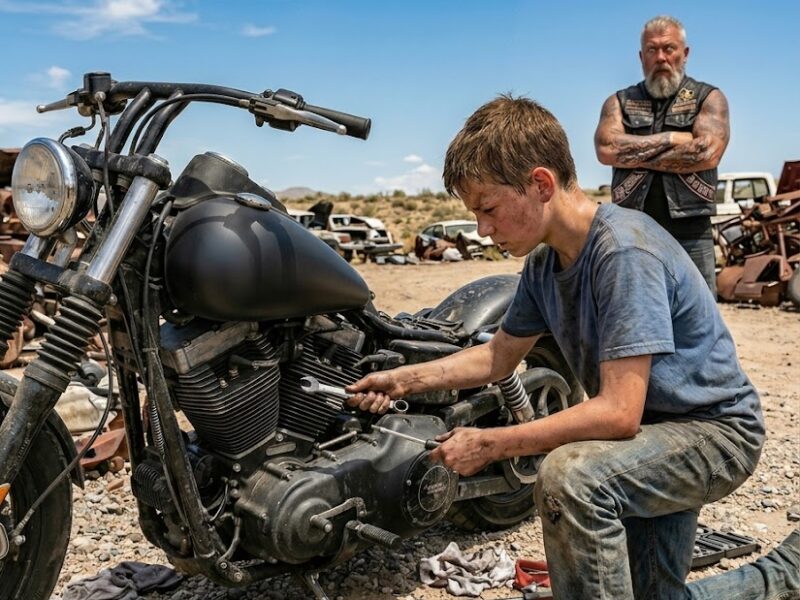
A Junkyard Kid Rebuilt a Motorcycle Everyone Called Worthless—Then 305 Hells Angels Thundered Into Town
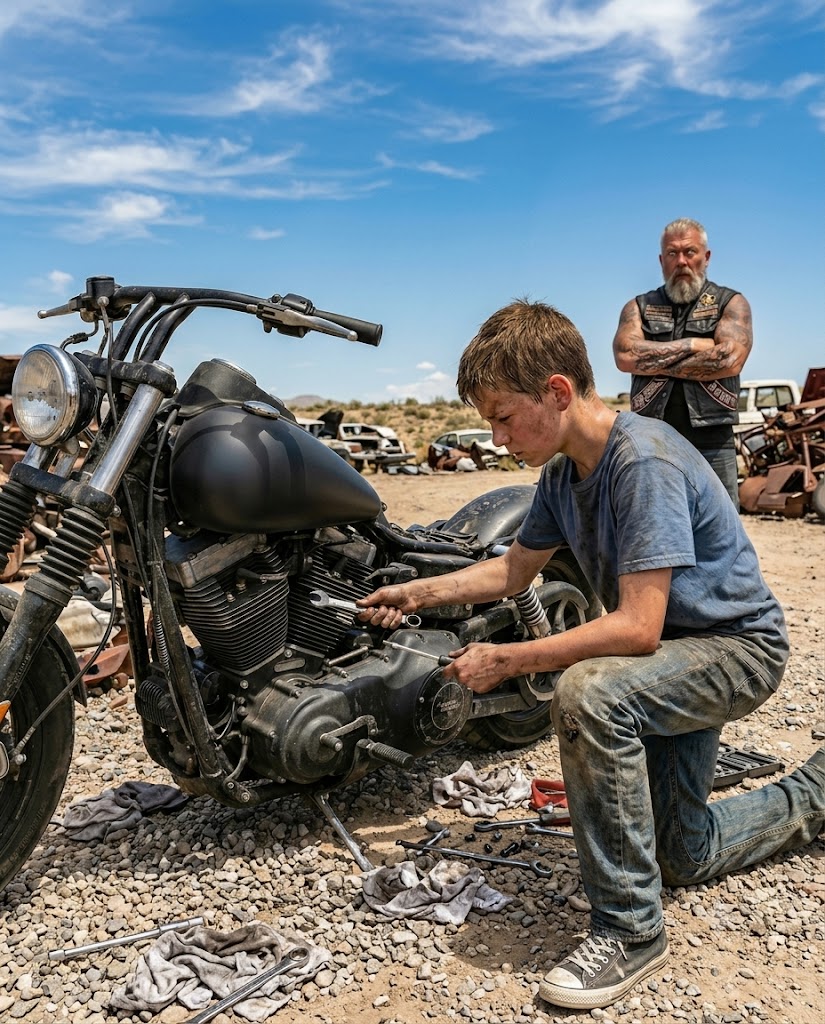
The desert wind didn’t carry the scent of rain.
It carried the metallic tang of rust, gasoline, and impending chaos.
When a 14-year-old grease monkey resurrected a shattered Harley from the dirt, he didn’t just wake a dead engine—he summoned 305 Hells Angels right to his doorstep.
Barstow, California, was a town that seemed to exist purely as a monument to things left behind.
Heat radiated off the cracked asphalt in shimmering waves, and the air always tasted faintly of dry earth and exhaust.
At the very edge of town sat O’Malley’s Scrap and Salvage, a sprawling graveyard of twisted steel, shattered glass, and forgotten histories.
For most, it was an eyesore.
For 14-year-old Leo Rossi, it was a sanctuary.
Leo was a kid built of sharp angles and nervous energy, his hands permanently stained with grease that no amount of industrial soap could scrub away.
He didn’t have the luxury of a normal adolescence.
With his father long gone and his mother, Sarah, working double shifts at a diner just to keep the lights on and pay for her expensive asthma medication, Leo had dropped out of middle school to haul scrap.
Frank O’Malley, the grizzled chain-smoking owner of the yard, paid the boy beneath the table—$5 an hour and the right to take home any junk he could carry.
It was mid-July when Leo found the tomb.
He had been tasked with clearing out Section G, an overgrown corner of the yard untouched for nearly a decade.
Rattlesnakes nested there among the rusted hulls of 1970s muscle cars.
As Leo dragged a heavy chain away from a crushed Ford Bronco, the ground shifted.
Beneath a pile of corrugated tin roofing and decades of accumulated tumbleweeds, sunlight caught the dull, scratched surface of chrome.
Curiosity overriding caution, Leo spent the next three hours excavating the mound.
What he unearthed took his breath away.
It was a motorcycle—or at least the skeleton of one.
It was a 1998 Harley-Davidson Dyna Super Glide, though it took Leo’s trained eye to recognize the battered silhouette.
The front forks were bent inward like broken arms.
The gas tank was deeply dented and scorched black by fire.
The leather seat had been chewed to pieces by coyotes and rats.
The engine block was caked in a thick, concrete-like layer of oil and desert dust.
But when Leo brushed his gloved hand over the engine, he felt a strange, lingering pulse of life.
It wasn’t dead.
It was just waiting.
“You found a ghost, kid,” Frank O’Malley said, walking up behind him, a half-smoked cigarette dangling from his lips.
He squinted through the harsh sun at the wrecked machine.
“That heap was towed in by the state troopers 12 years ago. Nasty wreck out on Route 66. Rider didn’t make it. Nobody ever came to claim the bike, so it got buried.”
“Can I have it?” Leo asked, his voice cracking.
Frank let out a raspy laugh.
“Have it? Kid, that engine is seized tighter than a bank vault. The frame is probably bent. It’s a paperweight. But if you want to waste your time busting your knuckles on it, be my guest. Just don’t let it cut into your sorting time.”
For the next eight months, the broken Harley became Leo’s obsession.
He built a makeshift tarp tent over it in the back of the yard.
Every spare dime he earned went toward buying cheap tools at pawn shops.
He scavenged parts from wrecked motorcycles that came through the gates—a carburetor from a trashed Sportster, a clutch cable from an old Honda, brake lines from a Yamaha.
He learned the anatomy of the machine through sheer, stubborn trial and error.
He bled over the engine, his knuckles perpetually raw and scarred.
There were nights when the frustration brought him to tears, sitting alone in the cold desert darkness, swearing at the seized bolts.
But there was also a mystery woven into the steel.
As Leo stripped the bike down, he noticed details that didn’t belong on a standard factory model.
The exhaust pipes were custom welded, thick and heavy.
Beneath the scorched paint of the gas tank, faintly visible, was a meticulously airbrushed design of a winged death’s head.
And hidden inside the hollowed-out center of the heavy custom bar, Leo found a small, tightly sealed PVC pipe.
Inside the pipe was a pair of military dog tags and a heavy silver ring.
The tags read Arthur Dutch Holland.
The ring bore the words Hells Angels MC.
Leo knew enough about the world to know the weight of that name.
The Hells Angels were a mythic force in the Mojave, a brotherhood bound by blood, asphalt, and fierce loyalty.
But Leo was just a kid.
He didn’t understand the severe, unbending politics of the motorcycle club world.
He didn’t know that a dead member’s bike was considered sacred ground—and that altering it, or even possessing it without permission, was an offense that could bring down unimaginable wrath.
To Leo, it was just a machine that needed to be saved.
In late March, exactly eight months after he dug it out of the dirt, Leo hooked up a scavenged battery, poured fresh gasoline into the patched tank, and kicked the starter.
The engine didn’t turn.
He kicked it again.
Nothing.
Sweat stinging his eyes, Leo put his entire meager body weight into a third violent kick.
The engine coughed.
A puff of black smoke shot out of the exhaust.
And then, with an earth-shaking, thunderous roar that rattled the corrugated tin fences of the junkyard, the Harley-Davidson screamed to life.
It didn’t purr—it snarled, a violent, uneven rhythm that sounded like a heartbeat returning from the grave.
Leo dropped to his knees in the dirt, his face covered in oil and tears, listening to the sweetest music he had ever heard.
By April, the bike wasn’t just running—it was rolling.
Leo had hammered out the dents, straightened the forks using Frank’s hydraulic press when the old man was asleep, and painted the entire bike in a flat primer black to cover the mismatched scavenged parts.
It was an ugly Frankenstein’s monster of a motorcycle, but it was fast, and it was loud.
Leo began taking it out at twilight, riding through the dry, empty riverbeds and abandoned dirt roads behind the junkyard.
For the first time in his life, he felt a sense of freedom.
The crushing weight of his mother’s medical bills, the endless piles of rusty scrap, the bleakness of Barstow—all of it vanished when he twisted the throttle.
But a machine that loud can’t be kept a secret forever.
The fatal mistake happened on a Tuesday.
Leo had run out of gas two miles from the junkyard and had to push the heavy beast to a desolate Shell station on the edge of the highway.
As he was filling the tank, counting out crumpled dollar bills, a beat-up pickup truck pulled into the adjacent pump.
The driver was a man known locally as Greasy Pete, a low-level meth dealer and a hanger-on to various criminal elements in the high desert.
Pete stepped out of his truck, his eyes instantly locking onto the matte black Harley.
He walked over, his gaze sweeping over the custom exhaust, the distinct angle of the frame, and the faint, raised outline of the death’s head beneath the cheap primer paint on the tank.
“Where does a scrawny rat like you get a bike like this?” Pete sneered, stepping too close.
“Built it,” Leo muttered, keeping his eyes down as he screwed the gas cap back on.
Pete laughed, a wet, hacking sound.
“Bullshit. You didn’t build this frame. That’s custom geometry. And those pipes—”
Pete pulled out a cracked smartphone and blatantly snapped three photos of the bike, catching Leo’s frightened face in the frame of one.
“That looks awfully familiar, kid. I know people who pay good money for info on missing hardware.”
“Leave me alone,” Leo said, his heart hammering against his ribs.
He kicked the bike to life, the roar making Pete step back, and peeled out of the gas station, tearing back toward the safety of the junkyard.
He thought he had escaped.
He didn’t know that within 20 minutes, Pete had sent the photos to a contact in San Bernardino.
From there, the images were forwarded to a clubhouse in Oakland.
By midnight, the photos were projected onto a wall in a smoke-filled room where the highest-ranking officers of the Hells Angels Motorcycle Club sat in dead silence.
The club had been looking for Dutch Holland’s bike for 12 years.
Dutch hadn’t just been a member.
He had been a legendary enforcer, a brother who had saved the lives of three chapter presidents.
When he died in the wreck on Route 66, the police had claimed the bike burned to ashes and the wreckage was disposed of.
The club never believed it.
They had scoured salvage yards for years, but the trail had gone cold.
Now, staring at the photo, Big Jim Callahan, the Nomad president—a man built like a freight train with a thick gray beard and eyes like chipped flint—leaned forward.
He recognized the weld marks on the exhaust.
He recognized the frame.
And he saw the 14-year-old kid sitting on their sacred, stolen history.
“Mount up,” Big Jim rumbled, his voice leaving no room for debate.
“We’re going to Barstow.”
—
Three days later, the town of Barstow stopped breathing.
It started as a low vibration, a trembling in the asphalt that made coffee spill over the rims of cups in the local diners.
Then came the sound—a deep, synchronized, terrifying drone that sounded like a squadron of heavy bombers descending from the sky.
Leo was in the junkyard organizing a pile of copper wiring when he felt the ground shake.
He looked toward the chain-link fence.
They came down the main desert highway in a staggered, perfect formation.
They didn’t stop at the red lights.
Local law enforcement cruisers sat parked on the shoulders, their officers watching in tense, paralyzed silence as the river of leather and chrome flooded the town.
There were 305 of them.
The armada of Hells Angels completely surrounded O’Malley’s Scrap and Salvage.
The air turned thick with dust and the suffocating heat of 300 idling Harley-Davidson engines.
The sheer spectacle was terrifying.
It was an invading army claiming a patch of dirt.
Frank O’Malley rushed out of his corrugated tin office, dropping his clipboard, his face entirely drained of color.
“Lord almighty,” he whispered.
The engines cut off almost simultaneously, leaving a ringing, heavy silence in their wake.
From the front of the pack, Big Jim Callahan kicked down his kickstand.
He dismounted, followed by four massive, stone-faced bikers wearing the coveted Filthy Few patches.
Big Jim walked slowly to the chained gate of the junkyard.
He didn’t shout.
He didn’t posture.
He simply wrapped one massive, leather-gloved hand around the chain and looked at Frank.
“Open it,” Big Jim said.
Frank’s hands shook violently as he fumbled with the padlock keys.
He swung the gate open, stepping back.
“We don’t want any trouble, gentlemen. Whatever you need.”
Big Jim ignored him, his eyes scanning the yard until they locked onto the makeshift tarp tent in the back.
And then, he saw Leo.
Leo was standing frozen, clutching a heavy iron wrench in his right hand.
He was terrified, but he refused to run.
He stepped out from beneath the tarp, putting himself between the giant biker and the matte black Harley he had bled for.
Big Jim stopped 10 feet from the boy.
The 300 men outside watched in absolute silence.
“That’s not your bike, kid,” Big Jim said, his voice a low, dangerous rumble.
“That belongs to a ghost, and you’re going to step away from it right now.”
Leo swallowed hard, his grip tightening on the wrench.
He knew he was about to die, but he looked the president of the Hells Angels dead in the eye.
“No,” Leo said, his voice trembling but defiant.
“I brought it back to life. It’s mine.”
A collective murmur rippled through the bikers at the fence.
The four enforcers behind Big Jim shifted their weight, their hands moving instinctively toward their belts.
Big Jim just stared at the skinny, grease-stained boy, his expression unreadable as the desert wind howled through the graveyard of metal.
The silence in O’Malley’s Scrap and Salvage was absolute, broken only by the rhythmic tink, tink, tink of cooling exhaust pipes from 300 motorcycles outside the gates.
Big Jim Callahan did not blink.
He stared down at the 14-year-old boy holding a rusted iron wrench.
Beside the Nomad president, an enforcer named Bobby Chains Higgins—a man whose face was a map of knife scars and bad decisions—took a deliberate half step forward, his heavy boots crunching on the gravel.
“Hold your water, Bobby,” Jim rumbled, raising a single leather-clad hand.
His voice was gravelly, carrying the quiet authority of a man who had survived decades of highway warfare.
He didn’t take his eyes off Leo.
“You got a lot of sand, kid. I’ll give you that. But you’re standing on holy ground, and you don’t even know it.”
Leo’s hands were shaking so hard the wrench rattled against his grease-stained jeans.
“I found it in the dirt,” he said, his voice cracking, betraying his youth.
“It was dead. The engine was a solid block of rust. The forks were crushed. I bled over this machine for eight months. I brought it back.”
Jim slowly closed the distance, stopping just inches from the front tire of the matte black Harley.
He crouched down, his knees popping like dry twigs.
He ignored Leo’s defensive posture and reached out, running a bare, calloused hand over the cold engine block.
He traced the lines of the cylinder heads, his fingers lingering on the custom-welded exhaust pipes.
“Dutch welded these himself,” Jim murmured, almost to himself.
“Back in ’96, Oakland charter. He used a TIG welder he bartered off a Navy shipbuilder. Said he wanted pipes that sounded like the end of the world.”
Jim stood up, towering over Leo.
The sheer physical presence of the man was suffocating.
“How did you unseize the pistons, boy? State police let this thing sit in the weather for a decade before they dumped it. The block should have been fused solid.”
Leo swallowed hard, his mechanical pride momentarily overriding his terror.
“I soaked the cylinders in a mixture of diesel fuel and automatic transmission fluid for three weeks,” he explained, his words tumbling out in a nervous rush.
“Then I used a breaker bar on the crankshaft nut. Rocked it back and forth, millimeters at a time, every single night after my shift. I had to rebuild the carburetor using parts from a trashed ’90s Sportster, and I remachined the brake rotors on Mr. O’Malley’s lathe.”
A ripple of low, impressed murmurs moved through the front line of bikers standing by the fence.
These were men who worshipped at the altar of the internal combustion engine.
They knew exactly how grueling and meticulous that process was.
To hear that a scrawny teenager had done it alone in the dirt using scavenged junk bordered on miraculous.
Jim’s hardened expression softened just a fraction.
“You got the hands of a surgeon and the stubbornness of a mule, kid.”
He paused, his dark eyes locking onto Leo’s.
“But you’re missing something. There was a cavity in the bar—a custom hollow.”
Leo felt a cold sweat break out on his neck.
He knew exactly what the giant biker was talking about.
Slowly, agonizingly, Leo lowered the iron wrench.
He backed away from the motorcycle, moved to a dented red toolbox sitting on a cracked cinder block, and pulled open the bottom drawer.
From beneath a pile of greasy rags, he retrieved the sealed PVC pipe.
He walked back and placed it into Big Jim’s outstretched, scarred palm.
Jim twisted the cap off the pipe.
He tipped it over, and the heavy silver ring and the metal military dog tags spilled into his hand.
The midday sun caught the unmistakable winged death’s head engraved on the silver.
It was a ring that had been forged in the fires of the club’s brutal history, a symbol of absolute, unbreakable brotherhood.
For a long moment, the Nomad president just stared at the ring.
The intimidating, terrifying aura of the biker seemed to evaporate, replaced by a profound, heavy grief.
“Arthur Holland,” Jim said softly, his thumb tracing the embossed letters on the dog tags.
“We called him Dutch. He was my sponsor when I prospected for the Berdoo charter back in the ’80s. He was the man who taught me how to ride in a pack, how to fight, how to survive. When he went down on Route 66, they told us there was nothing left. No bike, no colors, no ring. They told us he burned up into nothing.”
Jim looked up, and for the first time Leo saw that the giant man’s eyes were glassy.
“For 12 years his widow hasn’t had his ring, his brothers haven’t had his colors. You didn’t just dig up a motorcycle, kid. You dug up a ghost that we desperately needed to put to rest.”
Leo’s chest tightened.
He looked at the motorcycle—his sanctuary, his ticket to freedom, his only prized possession in a life filled with rust and poverty.
“So, you’re taking it.”
Jim slipped the ring and the tags into the breast pocket of his leather cut directly over his heart.
He looked at the bike, then at Leo.
“Club law is club law,” Jim stated, his voice returning to its authoritative rumble.
“A civilian cannot possess a patch member’s death bike. It’s sacred. It belongs to the Hells Angels. It goes back to the Oakland clubhouse to sit in the center of the table. I’m sorry, son, but this machine doesn’t belong to you.”
Tears, hot and humiliated, pricked the corners of Leo’s eyes.
He didn’t care about the 300 dangerous men watching him.
He only cared about the injustice of it all.
“It’s not fair,” Leo shouted, his voice echoing off the corrugated tin walls.
“You didn’t fix it. You didn’t bleed for it. I need this bike. I need it to get to work. I need to sell it so I can pay for my mom’s asthma medication. She’s drowning in debt and this was the only valuable thing I’ve ever had.”
The silence returned, heavier this time.
Bobby Chains Higgins scoffed quietly, but Jim shot him a look so venomous it could have peeled paint.
Jim turned his back on Leo and faced the sea of leather and denim outside the gates.
He raised his right fist into the air.
“Officers,” Jim roared.
“Front and center. We’re having church.”
Right there, in the middle of the dusty Barstow junkyard, the Hells Angels held a club meeting.
Fifty of the highest-ranking members—presidents, vice presidents, and sergeants-at-arms from chapters spanning from San Bernardino—unlocked the gate and marched into the yard.
They formed a massive, tight circle around Big Jim, the resurrected Harley, and the bewildered Leo.
Frank O’Malley, the junkyard owner, had locked himself inside his office, watching through the blinds in sheer terror.
“We have a situation,” Jim addressed the circle, his voice booming.
“This boy found Dutch’s iron. He resurrected a dead block. He found the ring and he kept it safe. He didn’t pawn it. He didn’t melt it down. He treated the machine with respect.”
“The bike comes with us, Jim,” said a heavily tattooed man with a San Francisco rocker on his back.
“That’s not up for debate. Sonny’s old rules dictate it. Dutch’s bike sits in the clubhouse.”
“I know the damn rules, Mike,” Jim snapped back.
“The bike goes to Oakland. But the Hells Angels don’t steal from civilians who do us a service. This kid gave us our brother back and he put eight months of hard labor into a machine that by all rights should be scrap metal. The boy says his mother is sick. He says he built this bike to save her.”
Jim turned around in the center of the circle, making eye contact with the hardened men of his club.
“We talk about respect. We talk about honor. What’s the price of a brother’s soul?”
The circle went completely quiet.
The officers looked at the bike, recognizing the flawless mechanical work beneath the ugly primer paint.
Then they looked at Leo—skinny, covered in grease, shivering despite the desert heat, standing his ground.
Mike, the San Francisco president, slowly reached inside his leather vest.
He pulled out a thick wad of hundred-dollar bills bound in a rubber band and tossed it onto the seat of the Harley.
“Dutch saved my life in a bar fight in Reno,” Mike said simply.
“That’s for the kid’s labor.”
Another biker stepped forward, pulling a gold money clip from his pocket.
He peeled off several large bills and dropped them onto the pile.
“Dutch rode 200 miles in the rain to help me bury my father. Pay the boy.”
It happened like a chain reaction.
One by one, the most feared men on the West Coast stepped forward in the blistering Barstow heat.
They emptied their wallets, tossing cash onto the leather seat of the motorcycle—hundreds, fifties, twenties.
They were paying a debt they felt in their bones, honoring a fallen brother by honoring the boy who had brought his memory back to the surface.
Leo watched in absolute shock as the pile of green paper grew into a small mountain.
When the last man had stepped back, Big Jim walked over to the bike.
He scooped up the massive pile of cash—easily over $20,000—and walked over to Leo.
He shoved the money into the boy’s greasy, trembling hands.
“Club business pays its debts,” Jim said, his voice softer now.
“This covers your labor, your storage fees, and your mother’s medical bills. You take this to her today. You understand me?”
Leo looked down at the fortune in his hands, completely overwhelmed.
“I don’t know what to say.”
“You don’t say anything,” Jim replied.
“But we’re taking the bike.”
Jim gave a nod and two massive prospects ran into the yard, pushing a custom-built, low-riding trailer behind a heavy-duty pickup truck.
With reverent, careful movements, they loaded the matte black Harley onto the trailer, strapping it down securely.
Leo watched it go, a dull ache in his chest, but the crushing weight of his reality had been lifted by the cash in his hands.
As the prospects secured the trailer, Jim whistled sharply.
Bobby Chains Higgins rode his own massive Road King into the yard, but he wasn’t alone.
He was ponying a second motorcycle beside him, steering it with one hand.
It was a 2004 Harley-Davidson Sportster 1200.
It wasn’t pretty.
The paint was chipped, the chrome was dull, and the exhaust was stock—but it was entirely whole, fully functional, and legally clean.
Bobby kicked down the stand and walked away, leaving the bike sitting in the dirt next to Leo.
“It’s a starter bike,” Jim said, looking at Leo’s stunned expression.
“Clean title. Keys are in the ignition. It belonged to a prospect who decided the life wasn’t for him. It needs a lot of love—a carburetor rebuild, a new paint job—but from what I’ve seen today, you’re exactly the man for the job.”
Leo looked from the Sportster to Big Jim, his jaw slack.
“For me?”
“A mechanic without a bike is a tragedy,” Jim said, a faint, grim smile touching his lips.
“And kid, when you turn 18, if you ever get tired of hauling scrap for O’Malley, you ride that Sportster out to San Bernardino. Ask for the Berdoo charter. Tell them Big Jim sent you. We always have room in the shop for a surgeon.”
Jim turned his back, striding toward his own motorcycle.
The 50 officers fell in behind him, marching out of the junkyard like a retreating military regiment.
Jim mounted his bike, the engine roaring to life with a twist of his wrist.
Three hundred four other engines answered the call, the sheer volume shaking the dust from the corrugated tin roofs of Barstow.
Leo stood in the dirt, clutching the life-changing wad of cash to his chest, the keys to his new motorcycle gleaming in the ignition.
He watched as the sea of leather, chrome, and roaring thunder rolled out of town—a massive black serpent winding its way back onto the desert highway, taking the ghost of Dutch Holland home.
The storm passed as quickly as it had arrived, leaving the junkyard in an eerie, ringing silence.
But the air felt different now.
The scent of rust and hopelessness was gone, replaced by the lingering smell of high-octane gasoline and the undeniable promise of a wide-open road.
—
The Barstow dust eventually settled, but the legend of the junkyard kid forever altered the town’s quiet history.
Leo Rossi didn’t just rebuild a shattered engine.
He bridged a gap between a forgotten ghost and a fierce brotherhood.
With his mother’s health secured and a Sportster waiting in the wings, Leo learned that sometimes true freedom isn’t just found on the open road.
It’s forged in the fires of respect, grease, and unexpected grace.
—
The first thing Leo did was count the money.
He spread the bills out on his mother’s kitchen table—a wobbly Formica relic from the 1970s—and stared at the pile until his vision blurred.
Twenty-three thousand, four hundred dollars.
He had never seen that much cash in his entire life.
His hands were still shaking, not from fear anymore, but from the sheer, impossible weight of what had just happened.
His mother, Sarah, came home from her double shift at the diner at 11:47 p.m., her uniform smelling of stale coffee and fryer grease.
She stopped dead in the doorway when she saw the money.
“Leo,” she whispered, her voice thin and reedy from the asthma that had been slowly stealing her breath for years.
“What did you do?”
He told her everything.
The bike in the dirt.
The eight months of bleeding knuckles and frozen nights.
The 305 motorcycles that had shaken the foundations of Barstow.
The circle of hardened men who had emptied their wallets onto a leather seat.
Sarah Rossi sat down heavily on a kitchen chair, her face pale, her hands pressed flat against the table.
She didn’t speak for a long time.
Then she started to cry.
Not the quiet, dignified tears of a woman who had learned to suffer in silence, but great, heaving sobs that seemed to tear themselves from somewhere deep in her chest.
Leo had never seen his mother cry before.
Not when his father left.
Not when the electric company shut off the power for three days in August.
Not when the landlord threatened eviction for the fourth time in a single year.
She had always been the strong one, the immovable object in a world that kept throwing force at her.
But now, staring at $23,400 in crumpled bills, she finally let go.
“We’re going to be okay,” Leo said, his voice cracking.
“We’re going to be okay, Mom.”
The next morning, they paid off the back rent.
They paid off the medical bills—all $11,700 of them—and set up a payment plan for the remaining balance with the hospital’s financial aid office.
Sarah Rossi got her prescriptions filled that same day, the inhalers and steroid treatments she had been rationing for months.
For the first time in years, she could breathe.
Leo, meanwhile, threw himself into the Sportster.
The 2004 Harley-Davidson Sportster 1200 was a far cry from the custom Dyna he had resurrected, but it was his.
Legally, officially, undeniably his.
He rebuilt the carburetor first, using the same painstaking methodology he had developed over eight months in the junkyard.
Then he replaced the spark plugs, flushed the fuel lines, and reupholstered the seat with a kit he ordered online for $47.
He painted the tank a deep, glossy black—no primer this time, no shortcuts.
He polished the chrome until it gleamed like a mirror.
By the end of April, the Sportster wasn’t just running.
It was beautiful.
Leo rode it to the diner where his mother worked, parking it in the employee lot.
Sarah came outside on her break, her eyes widening when she saw her son sitting on the gleaming black motorcycle.
“You did this?” she asked.
“All by myself,” Leo said, grinning.
His mother walked over and ran her hand along the tank, her fingers tracing the smooth, flawless paint.
“You’re your father’s son,” she said quietly.
Leo didn’t know what that meant—his father had left when he was three, and he had no memories of the man—but he took it as a compliment.
—
Word spread fast in a town like Barstow.
The story of the junkyard kid who had summoned 305 Hells Angels and walked away with $23,400 and a free motorcycle became local legend.
People who had ignored Leo for years suddenly wanted to talk to him.
The owner of the auto parts store offered him a part-time job at $15 an hour—more than triple what Frank O’Malley had been paying him.
A local mechanic named Rosa Delgado, who ran a small shop on Main Street, offered to teach him advanced engine diagnostics for free.
“You’ve got talent, kid,” she said.
“Talent like that shouldn’t go to waste.”
Even Frank O’Malley, who had spent years treating Leo as cheap labor, seemed to view him differently.
The old man called Leo into his office one afternoon in early May, a rare expression of something like respect on his weathered face.
“You did good, kid,” Frank said, stubbing out his cigarette in a coffee can.
“I never thought you’d get that heap running. Figured you’d give up after a week.”
“Guess I’m stubborn,” Leo replied.
Frank laughed, that same raspy, wheezing laugh.
“Stubborn don’t even begin to cover it.”
He reached into his desk drawer and pulled out a small, tarnished metal box.
“This came in with a load of scrap about six years back,” Frank said, sliding the box across the desk.
“Never knew what to do with it. Figured you might.”
Leo opened the box.
Inside was a vintage Harley-Davidson belt buckle, circa 1970s, with the classic bar-and-shield logo.
It was worn and scratched, but it was real.
“Thanks, Frank,” Leo said, his voice thick.
“Don’t thank me,” Frank said, waving a hand.
“Just don’t forget where you came from when you’re a big-shot mechanic in San Bernardino.”
—
The summer passed in a blur of grease and gasoline.
Leo worked mornings at the auto parts store, afternoons at Rosa Delgado’s shop, and evenings in the junkyard, restoring old motorcycles that Frank let him keep in exchange for labor.
He rebuilt a 1985 Honda Rebel and sold it for $1,800.
He restored a 1992 Kawasaki Ninja and sold it for $3,200.
He saved every penny, stashing the cash in a coffee can hidden under his bed.
By August, he had $7,400 saved toward his future.
But the Sportster remained his pride and joy.
He rode it every chance he got, cruising through the desert at twilight, the wind whipping through his hair, the engine purring like a contented cat.
For the first time in his life, Leo Rossi felt like he belonged somewhere.
Not to a place—Barstow would always be a dusty, forgotten town at the edge of nowhere—but to a purpose.
He was a builder.
A fixer.
A kid who could take broken things and make them whole again.
—
The letter arrived on a Tuesday in late September.
It was addressed to Leo Rossi, in care of O’Malley’s Scrap and Salvage, and it bore a return address in San Bernardino.
Leo’s heart hammered in his chest as he tore it open.
Inside was a single sheet of paper, typed on official Hells Angels letterhead.
It read:
*Dear Leo,*
*The Berdoo charter has been following your progress.*
*Word travels fast in the desert, and we’ve heard good things about the kid who brought Dutch Holland’s bike back from the dead.*
*When you turn 18, the door is open.*
*Until then, keep your nose clean, keep your hands dirty, and keep riding.*
*You’ve earned a place in our story.*
*—Big Jim Callahan, Nomad President*
Leo read the letter three times, his hands trembling.
He folded it carefully and tucked it into the inside pocket of his jacket, right over his heart.
—
The years passed.
Leo turned 16, got his driver’s license, and upgraded to a used pickup truck—a beat-up 2001 Ford F-150 that he rebuilt from the frame up.
He turned 17, graduated from a GED program with honors, and started taking community college courses in automotive technology.
He turned 18 on a blistering hot day in July, and he celebrated by riding his Sportster out to San Bernardino.
The Berdoo charter clubhouse was a nondescript building on the outskirts of town, surrounded by a chain-link fence and a parking lot full of motorcycles.
Leo parked his Sportster next to a row of gleaming Harleys and walked up to the front gate.
A massive, bearded man in a leather cut stood guard.
“Help you?” the man grunted.
“I’m here to see Big Jim Callahan,” Leo said, his voice steady.
“Tell him Leo Rossi is here.”
The guard’s eyebrows shot up.
“The junkyard kid?”
“That’s me.”
The guard disappeared inside.
Five minutes later, the gate swung open, and Big Jim Callahan himself stepped out.
The old biker was grayer now, his beard thicker, his face more lined—but his eyes were the same chipped flint, and his presence was just as overwhelming.
He looked at Leo—tall now, broad-shouldered, his hands still stained with grease—and a slow smile spread across his weathered face.
“You made it,” Jim said.
“I told you I would,” Leo replied.
Jim walked over and clapped Leo on the shoulder with a hand the size of a dinner plate.
“Come on inside, kid. We’ve got a lot to talk about.”
—
Leo spent the next three years working at the Berdoo charter’s custom shop, learning from some of the best motorcycle mechanics in the country.
He rebuilt engines, fabricated custom frames, and painted tanks with intricate, airbrushed designs that made grown men stop and stare.
He earned his patch at 21, becoming the youngest full member in the charter’s history.
And on the day he was patched in, Big Jim Callahan presented him with a gift.
It was a small, tarnished metal box—the same box Frank O’Malley had given him years ago.
Leo opened it.
Inside was the vintage Harley-Davidson belt buckle, polished to a gleaming shine.
“Where did you get this?” Leo asked.
“Frank O’Malley sent it,” Jim said.
“Said you left it behind when you moved to San Bernardino. Figured you’d want it back.”
Leo fastened the buckle to his belt, his eyes stinging.
“Thank you,” he said.
“Don’t thank me,” Jim replied, echoing Frank’s words from years ago.
“Just don’t forget where you came from.”
—
The legend of the junkyard kid spread far beyond Barstow.
Magazines wrote articles about him.
Documentary filmmakers called, wanting to tell his story.
A major motorcycle manufacturer offered him a job designing custom bikes for their elite division.
Leo turned them all down.
He stayed in San Bernardino, working at the Berdoo charter’s shop, building motorcycles that people would talk about for decades.
He bought his mother a house—a small, tidy bungalow with a garden and a porch swing and central air conditioning that kept her breathing easy through the hot desert summers.
Sarah Rossi lived to see her son become a man, a legend, a brother.
She died peacefully in her sleep at the age of 67, her hand resting on a photograph of Leo sitting on his first Sportster, grinning like he had just won the lottery.
And in a way, he had.
—
Years later, on a warm summer evening, Leo Rossi sat on the porch of his own house—a modest adobe-style home on the outskirts of San Bernardino—and stared out at the desert.
The sun was setting, painting the sky in shades of orange and purple and gold.
In the driveway sat a 1998 Harley-Davidson Dyna Super Glide, fully restored, gleaming like new.
It had taken him 12 years, but he had finally bought it back from the club.
Big Jim Callahan had arranged the sale himself, on the condition that Leo never sell it to anyone else.
“It belongs with you,” Jim had said.
“You’re the one who brought it back.”
Leo walked over to the bike and ran his hand along the tank—the same tank he had excavated from the dirt when he was 14 years old.
The winged death’s head was still there, carefully preserved beneath layers of clear coat.
He swung his leg over the seat and kicked the starter.
The engine roared to life, a deep, thunderous sound that echoed off the desert hills.
For a moment, Leo closed his eyes and remembered.
The dust.
The heat.
The fear.
The 305 motorcycles that had surrounded the junkyard like a storm.
And the moment when a 14-year-old boy had stood his ground and said, “No.”
He opened his eyes and twisted the throttle, pulling out of the driveway and onto the open road.
The desert wind didn’t carry the scent of rain.
It carried the metallic tang of rust, gasoline, and the promise of a wide-open future.
And Leo Rossi—the junkyard kid, the grease monkey, the brother—rode into the sunset, the ghost of Dutch Holland riding shotgun all the way home.
—
**THE END**









