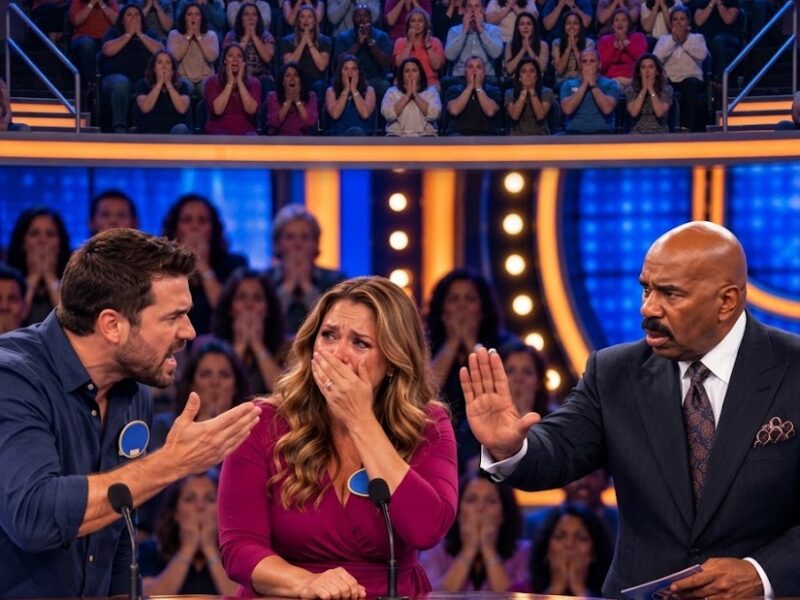
A husband told his wife to “shut up” on the Family Feud stage. Steve Harvey didn’t laugh. He didn’t make a joke. He ended the game right there.

The studio lights were hot enough to make the air shimmer above the contestants’ heads, and Steve Harvey had been doing this long enough to feel the exact moment a taping lost its rhythm.
It wasn’t the jokes or the expensive suits or the smile that never wavered—it was momentum, the invisible current that kept two hundred people leaning forward in their seats.
He could feel when it slipped, the way a fisherman feels a line go slack.
And on a Thursday afternoon in January 2025, in a soundstage in Atlanta, Georgia, the line went completely slack the moment a man named Carl Hutchins said two words to his wife.
“Shut up.”
The production team in the booth sat frozen for four full seconds before anyone moved.
Steve Harvey stopped the game—not paused it, not redirected it—stopped it with the finality of a man who had made a decision and was not interested in discussing it.
The Hutchins family had arrived that morning from Columbus, Ohio, in two separate cars because they couldn’t all fit in one.
Carl and his wife Marlene drove together in a silver Ford F-150 that Carl had washed that morning, because Carl believed in arriving clean.
Carl’s brother Wayne and Wayne’s wife Deb followed in a Honda CR-V, and Carl and Marlene’s daughter Patrice, twenty-nine years old, had driven alone from her apartment across town.
Patrice had learned, over twenty-nine years, the value of having her own transportation when her family was involved in something.
Carl Hutchins was sixty-one years old, broad through the shoulders, heavy in the way of a man who had once been athletic and had stopped being athletic gradually and without noticing.
He had been a union pipefitter for thirty years in Columbus, Ohio, and he had the hands to prove it and the opinions that came from three decades of working with the same people in the same union.
He was not a cruel man—this is important to say—but he had been the loudest person in most of the rooms he had inhabited for sixty-one years, and he had arranged his understanding of the world around that fact.
Marlene Hutchins was fifty-eight, married to Carl for thirty-four years, and she had spent those years doing the invisible work that marriages require.
The scheduling and the remembering and the managing of the space between what Carl said and what Carl meant and what other people heard.
She was a medical billing specialist who had worked from home for eight years, which meant eight years in close proximity to a retired man with a great deal of energy and a great many opinions about how things should be done.
She loved him—that was not in question—but she had arrived at this taping with something that was not quite at the surface but was close to it.
A tiredness that was not about sleep.
Patrice had noticed it for a while, the way adult daughters notice things about their mothers that the mothers themselves have stopped noticing because they have been managing them for too long.
Patrice was the one who had applied for the show, without telling her parents, the same way a person books a vacation for someone who would never book it themselves.
When she told them they had been selected, Carl had been enthusiastic immediately because Carl was enthusiastic about things he could win.
Marlene had been quieter—she had smiled and said it sounded like fun, and Patrice had heard underneath the smile something that was not quite as simple as fun.
The pre-show walk-through was fine.
Carl held court as Carl always held court, and the producers smiled at his stories because his stories were genuinely entertaining.
Wayne played the role of appreciative audience that he had been playing for his brother for fifty-seven years.
Marlene sat beside Carl and added details when the details were wrong and kept her voice pleasant about it.
Carl accepted the corrections without acknowledging them, which was a dynamic so practiced it had become invisible to everyone in the room except Patrice and Deb.
Steve Harvey met them and liked Carl’s energy immediately, the way you like a strong flavor—enjoyably in limited quantities.
He met Marlene and saw something he had been seeing for thirty years of interviewing families: a woman who had learned to exist in the margins of her own life.
Not broken, not defeated—something subtler than either of those—just very, very practiced at not taking up space.
He noted it, kept moving, because there was a show to run.
The main game started well.
The Hutchins family brought a combination of speed and confidence that worked in their favor early.
Carl and Wayne on the buzzer, both aggressive, both certain, feeding off each other the way brothers feed off each other when they are competing.
They scored well in the first two rounds.
The third round was where things began to show their shape.
Steve asked a question about things people argue about on family road trips.
Carl hit the buzzer first, which he had been hitting first on most questions, and answered immediately.
His answer did not make the board.
The family went through two more wrong answers before they were looking at the possibility of a steal, and Steve turned to the competing family, and Carl turned to Marlene.
“What were you going to say?” he asked her.
His voice was not harsh—it was the voice of a man who wanted information.
“I was going to say radio station,” Marlene said.
Carl made a sound, a brief, dismissive exhalation, the kind that is not quite a word but communicates a complete sentence.
The sentence it communicated was: That would never have been on the board.
Marlene pressed her lips together in the way she pressed them together when she was absorbing something she had decided not to respond to.
The competing family failed to steal, and the Hutchins family moved on.
Radio station, it turned out, was the fourth answer on the survey.
Carl did not acknowledge this.
He was already thinking about the next round.
Steve Harvey had watched all of it from eight feet away.
He said nothing.
He kept the game moving.
But the thing that had noted Marlene’s quality in the pre-show walk-through had updated itself with this new information and was running quietly in the background.
The fourth round was close and fast, and the Hutchins family won it on a buzzer question that Wayne answered so quickly the audience wasn’t sure it had happened until the board lit up.
The score was good.
The family was ahead.
Carl was in the full flight of a man who believed he was about to win something and had begun to experience this belief as certainty.
And then came the fifth round.
Steve read the question.
It was about things people buy on impulse that they regret later.
Marlene’s hand went to the buzzer.
She hit it.
For the first time all game, she hit it first—a full half second before anyone else in her family.
Her finger on the button before Carl’s had even moved.
“Clothes you’ll never wear,” she said.
The board lit up.
Third answer, fourteen points.
The family cheered.
Patrice cheered loudest, and Marlene smiled—a different smile than the one she had been wearing all afternoon.
Something in it that was about more than the fourteen points on the board.
She had answered.
She had buzzed in first and answered and been right.
And for a moment, there was something in her face that was simply, straightforwardly glad.
Carl put his hand on her back.
It looked like congratulation.
It probably was, partly.
But then he leaned toward her and said, still in the voice of a man providing information rather than attacking, “You should have said electronics. That was the number one.”
Marlene’s smile changed—not disappeared, she was too practiced for that—but it changed in the way a light changes when something passes in front of it.
Still there.
Less warm.
Patrice, standing on the other side of her mother, saw it.
Her jaw tightened slightly.
The game continued through two more answers, and the Hutchins family held their lead going into the next round.
Carl was buzzing fast, almost impatient now, with the energy of a man who could see the finish line and wanted to get there.
He hit the buzzer on the next question before Steve had finished reading it and answered with total confidence.
The answer was wrong.
Not on the board.
Not even close to the board.
The kind of wrong answer that the audience reacts to with a collective sound that is not quite laughter and not quite sympathy, but somewhere between them.
Carl made the dismissive exhalation again, this time directed at himself, which was the honest version of it.
Wayne stepped up and answered, and was also wrong.
Deb tried and was wrong.
Patrice answered and got the second slot on the board, which temporarily steadied things.
One more wrong answer would hand the round to the other family.
Carl looked at Marlene.
“Don’t overthink it,” he said. “Just say the first thing.”
Marlene nodded.
She was holding the buzzer.
She had been holding it all game, ready, and had used it exactly once.
She looked at the board.
Steve read the question again for the family’s benefit.
Marlene’s lips moved slightly.
She was thinking, working through it, doing the thing she did carefully and without performance.
The thinking that had given them fourteen points in the third answer slot twenty minutes ago.
Carl watched her think.
“Say it,” he said. “Come on.”
Marlene started to speak.
“Shut up,” Carl said.
It was not a shout.
That is important.
It was not explosive or violent or dramatic.
It was conversational—the shut up of a man telling someone to stop hesitating and just do the thing.
The shut up of impatience rather than anger.
He had probably said it to Wayne forty times over fifty years.
He had probably said it to the television during football games.
It was the verbal equivalent of the dismissive exhalation, just with more syllables.
Marlene’s mouth closed—not slowly, immediately, like something turned off.
She stopped thinking.
She stopped moving.
She stood there with her hand on the buzzer and her mouth closed and the expression of a woman who has just had the familiar, expected thing happen and whose body has responded to it in the way that bodies respond to things they have experienced many times.
Automatically, without drama, with the reflexive accommodation of long practice.
She did not answer the question.
The buzzer sounded.
The round ended.
Steve Harvey had not moved.
He was standing eight feet from the Hutchins family and he had heard every word of it and he had watched Marlene’s face do the thing it had done and he was standing very still in the way he stood very still when something had happened that required him to decide what kind of person he was going to be in the next thirty seconds.
The audience had heard it, too.
The two hundred people in the studio were quiet in a way that was different from the quiet of anticipation or the quiet of attention.
It was the quiet of people who have witnessed something they were not sure how to respond to, who were waiting to see what the person with the microphone was going to do.
The production team in the booth was waiting, too.
Steve Harvey looked at Carl.
Carl was not looking at Steve.
He was looking at the scoreboard, recalibrating, already moving on to the next thing with the ease of a man who had said what he said and experienced no reason to revisit it.
“Carl,” Steve said.
Carl looked at him.
Steve did not say anything immediately.
He held the eye contact for a moment—not aggressively, not with heat, but with the particular quality of a man who is going to say something and wants the other man to understand that what is about to be said is serious before it arrives.
“I need to stop the game for a minute,” Steve said.
Carl blinked.
“What?”
“We’re going to stop for a minute.”
Steve looked at the production team in his peripheral vision and gave the small, clear signal that meant hold.
Then he looked back at Carl.
“You told your wife to shut up,” Steve said.
Carl opened his mouth.
“I didn’t mean—”
“I know what you meant,” Steve said.
And his voice was not angry.
It was the most important thing about this moment.
It was not angry.
It was calm and clear and carried the full weight of a man who had decided what he was going to say and was saying it without heat, which made it land harder than anger would have.
“I’ve heard that tone my whole life. I know what it meant in the moment you said it. It meant stop talking. Stop thinking. You’re in the way. I know that tone.”
The studio was completely silent.
Carl looked at Steve.
Then he looked at his wife.
Marlene was looking at her hands.
“She had her hand on that buzzer,” Steve continued. “She was thinking. She was working through it. And you told her to shut up.”
He paused.
“Now she’s not answering and we lost the round.”
He let that sit for a moment.
“But that’s not why I stopped the game,” Steve said.
He turned slightly so that he was addressing not just Carl, but the room.
When Steve Harvey addressed a room, it was a physical act.
His whole body shifted toward it.
His voice opened up and two hundred people felt individually spoken to.
“I stopped the game because I looked at this woman right here.”
He indicated Marlene without pointing at her—a gesture that was more an acknowledgement than an identification.
“And I recognized something. I recognized a woman who has been making herself quiet for a long time, who has been standing in the margins of her own life and calling it fine. Who hit that buzzer once this game, got it right, and instead of hearing that she got it right, heard what she should have said instead.”
He paused.
“I know that woman,” he said. “I’ve watched that woman my whole life. I’ve been in rooms where that woman was there, and I did not say anything, and I have regretted it. So today I’m saying something.”
He turned back to Carl.
Carl Hutchins was not the same man he had been ninety seconds ago.
The ease was gone from him—not replaced by defensiveness, not replaced by anger, replaced by something that was much harder to look at and much more valuable.
He looked like a man who had been shown something about himself that he was going to have to sit with.
“Carl,” Steve said, “I’m going to ask you something, and I want you to actually think about it before you answer. Not the quick answer—the real one.”
Carl nodded once.
“When’s the last time you let your wife finish a sentence without deciding in advance that you knew what she was going to say?”
The silence lasted a long time—long enough for Wayne to look at the floor, long enough for Deb to close her eyes briefly, long enough for Patrice to look at her father with an expression that was twenty-nine years of watching this and not knowing how to name it, and finding it named suddenly in public by a stranger with a microphone.
Long enough for Carl to look at Marlene.
Marlene was still looking at her hands.
“Marlene,” Steve said gently.
She looked up.
“What were you going to say when he told you to stop? What was the answer you were working toward?”
A pause.
“Gym equipment,” she said. “People buy it thinking they’ll use it, and then they don’t.”
Steve turned to the board operator with a look.
The category was still up.
Marlene’s answer was checked against the survey.
Number one answer, forty-one points.
The audience did not erupt the way it erupted for a correct fast money answer.
It made a different sound—the sound of something settling, of a room receiving information that was about more than the points on a board.
Carl Hutchins looked at the board.
He looked at the forty-one points.
He looked at his wife.
He was a man who had spent sixty-one years being the loudest person in the room, and he was standing in a room where the loudest person was not him.
And what the loudest person was saying was true, and the proof of it was on the board in forty-one points.
“Marlene,” he said.
His voice was different.
The volume was the same, but the quality was different—slower, without the ease, carrying something.
Marlene looked at him.
“I’m sorry,” he said.
Not for the show, not for the cameras.
It was possible to tell the difference, and this was not for the cameras.
This was a man saying something to his wife in a room full of people, because the room full of people had made it impossible to say it later in private and pretend the moment had not occurred.
Marlene held his gaze for a moment, then she nodded.
Not accepting and moving on—the deliberate nod of a woman who was receiving an apology she was going to need some time to fully process, and was acknowledging it without resolving it, which was the honest thing to do.
Steve Harvey watched this.
Then he said, “We’re going to finish this game, but I want to do something first.”
He looked at Marlene.
“The round we just lost, the question was about impulse buys. You had the number one answer. Your family gets those points.”
The production team in the booth made sounds.
Steve held up a hand—not asking, stating.
“We’re giving them the points,” he said, “not because we have to, because she earned them, and she should have had them, and the only reason she didn’t is because someone told her to be quiet.”
He paused.
“Put the points up.”
The points went up.
The audience gave Marlene Hutchins a standing ovation.
Not a polite one—the real kind, the kind that starts in one section and spreads because the people in the other sections can see what’s happening and want to be part of it.
Marlene stood in the middle of it with an expression that was slowly, carefully, allowing itself to become something other than managed.
Patrice was crying.
She had been not crying for several minutes with the focused determination of a woman who had made a decision about it, and she stopped not crying and just cried, and did not apologize for it.
Deb reached over and found Patrice’s hand.
Wayne looked at his brother.
Carl was looking at Marlene.
He was still looking at Marlene when the standing ovation finished, and Steve told them they were going to restart the round.
The Hutchins family finished the main game.
They won it.
The points from Marlene’s restored answer pushed them over, and the symmetry of that was not lost on anyone in the room.
They went into fast money with a lead and a different quality in the air around them—something that was not quite resolved and not quite unresolved, something in the middle space where real things live.
Fast money.
Carl looked at his wife.
“You should go,” he said. “You should do both rounds.”
Marlene looked at him.
“I’ll go first,” she said. “Patrice can go second.”
Carl nodded.
He stepped back.
He stepped all the way back to the edge of the family group, and he stood there and watched his wife walk to the fast money podium, and he did not say anything.
Marlene placed her hands on the surface.
She stood up straight.
She looked at the board with the expression of a woman who has been given back something she had not realized she’d set down, and is holding it carefully, testing its weight.
Steve came to stand beside her.
“How are you feeling?” he asked.
Marlene looked at him.
“Like I have something to say,” she said, “and like I’m going to say it.”
Steve Harvey smiled.
He set the clock.
Marlene Hutchins answered five questions in twenty seconds with the quiet, devastating accuracy of a woman who had been thinking about answers her entire life and had not always been allowed to give them.
She was not flashy.
She was not dramatic.
She answered each question in the tone of voice she used to describe her work—clear, precise, without wasted words.
She hit the board four times: two number one answers, one second, one third, one that missed but came close.
When the buzzer sounded and she stepped back, she had contributed 142 points toward a Fast Money round that Patrice would finish with sixty-one more, bringing the total to 203.
The Hutchins family won $50,000.
But the production team, reviewing the tape that evening, noted something that did not show up in the score.
They noted the moment, eight seconds into Marlene’s Fast Money round, after her first answer lit up the board as number one, when Carl Hutchins, standing at the edge of the stage, brought his hands together and began to applaud his wife.
Quietly.
By himself.
Before anyone else in the room had reacted.
Not for the camera, not for the audience—just a man clapping for his wife.
The episode aired three weeks later.
It became the most discussed episode the show had aired in four years.
Not the highest-rated—that distinction belonged to a different episode with a different kind of drama—but the most discussed, in the particular way that things get discussed when they touch something that a lot of people have been living with quietly and are glad, finally, to see named.
Women watched it and sent it to their sisters.
Daughters watched it and sent it to their mothers with no caption, and their mothers understood exactly why.
Men watched it and were quiet afterward, in the specific way of people who are sitting with something true about themselves that they had not previously seen from the outside.
A domestic relations therapist in Cincinnati was quoted in a piece that circulated widely.
She said the clip was the most accurate depiction of low-level chronic dismissal she had seen represented in mainstream media.
She said it was valuable precisely because Carl was not a villain—because his behavior was recognizable, ordinary, the thing that happens in a thousand households and is never named because it never rises to the level of anything dramatic enough to demand naming.
She said the clip made it namable.
That was the gift.
Steve Harvey was asked, in multiple interviews, about the decision to stop the game.
He always answered the same way.
“It was not a complicated decision,” he said. “The complicated decision would have been to keep going, to tell myself it wasn’t my business, to let the moment pass because that’s what we do. We let moments pass because stopping them is uncomfortable.”
He paused.
“I was not willing to keep going past that. I’ve been in too many rooms where I kept going past that. I’m done keeping going past that.”
He was asked if he thought Carl Hutchins was a bad man.
“No,” he said. “Carl Hutchins is a man who had a habit he didn’t know he had because nobody had ever held a mirror up to it. That’s most of us. That is most of us.”
He paused.
“The question is not whether you have the habit. The question is what you do when you see it.”
He paused again.
“Carl clapped for his wife,” he said. “That’s what he did when he saw it. He stood at the edge of the stage and he clapped for his wife. That tells you what you need to know about who Carl Hutchins actually is.”
Carl and Marlene Hutchins went back to Columbus, Ohio, and their life resumed its shape, which was the same shape it had always had and different in the ways that matter—quieter in some places, louder in others.
Carl found himself in the months after the taping doing something unfamiliar.
He found himself pausing in conversations, at the dinner table, in the middle of sentences when Marlene had not finished her own.
He found himself pausing and waiting and hearing what she said and finding that what she said was often not what he had anticipated, which meant he had been anticipating wrong, which meant he had been missing things.
He started telling her this—not dramatically, in the small daily way that people repair things that have been slightly off-level for a long time, one conversation at a time, one pause at a time, one moment of clapping for her in the quiet of their kitchen when she said something true.
Marlene noticed.
She did not make it a bigger deal than it was because she was a woman who did not make things bigger deals than they were, but she noticed and she held it the way she had held the moment on the stage—as something real, something earned, something that required some time to fully believe but was in the process of being believed.
Patrice came to dinner more often.
She said it was because she liked her mother’s cooking, which was true, and because she wanted to see what they were like now, which was also true, and because she had spent twenty-nine years watching her parents and was now watching them differently, and it was good to see.
On the wall of the Hutchins family kitchen—not the living room, not somewhere public, the kitchen where they ate and talked and moved around each other in the ordinary choreography of shared life—Marlene hung a photograph from the Family Feud taping.
It was a photo that Patrice had taken on her phone, slightly blurry at the edges, the way phone photos are when something is happening fast.
In the photo, Marlene is standing at the Fast Money podium.
Her hands are flat on the surface.
She is looking at the board.
She looks exactly like what she is: a woman who has something to say and is saying it.
Beside it, Marlene taped a piece of paper.
On it, in her own handwriting, she had written the number 41.
Carl asked her once why she’d put the number there.
She looked at him.
“Because that’s what I was worth,” she said, “when somebody let me answer.”
Carl looked at the paper for a moment, then he nodded.
He nodded the way a man nods when he understands something he should have understood a long time ago and has decided that the lateness of the understanding is not a reason to reject it, but simply a reason to make better use of the time that remains.
He has not told his wife to be quiet since.
Not once.
And on the occasions when he starts to—when the old reflex rises in him, when the impatience gathers and the dismissal forms at the back of his throat—he thinks about a number on a piece of paper in his kitchen and he stops.
He waits.
He listens to what she says.
And almost every time, she is right.









