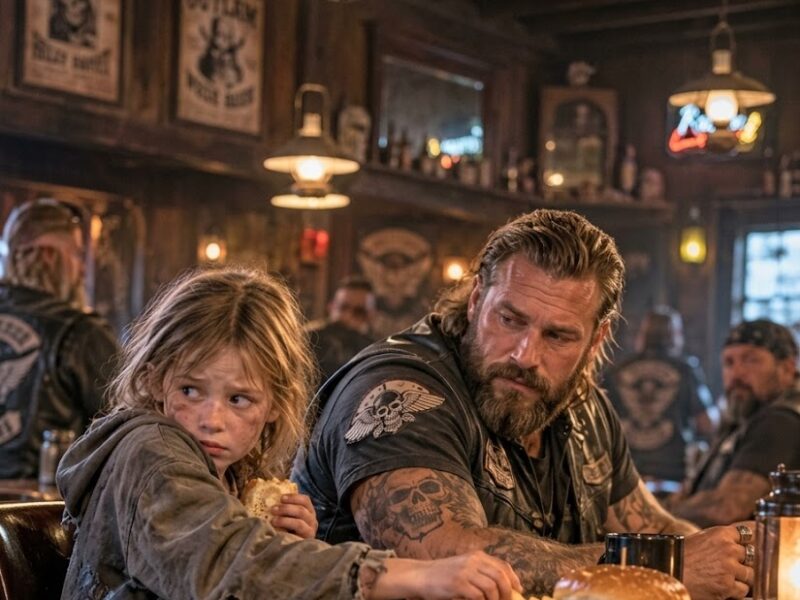
A Hungry Young Girl Stole Food From a Biker’s Table—His Unexpected Response Changed Her Future
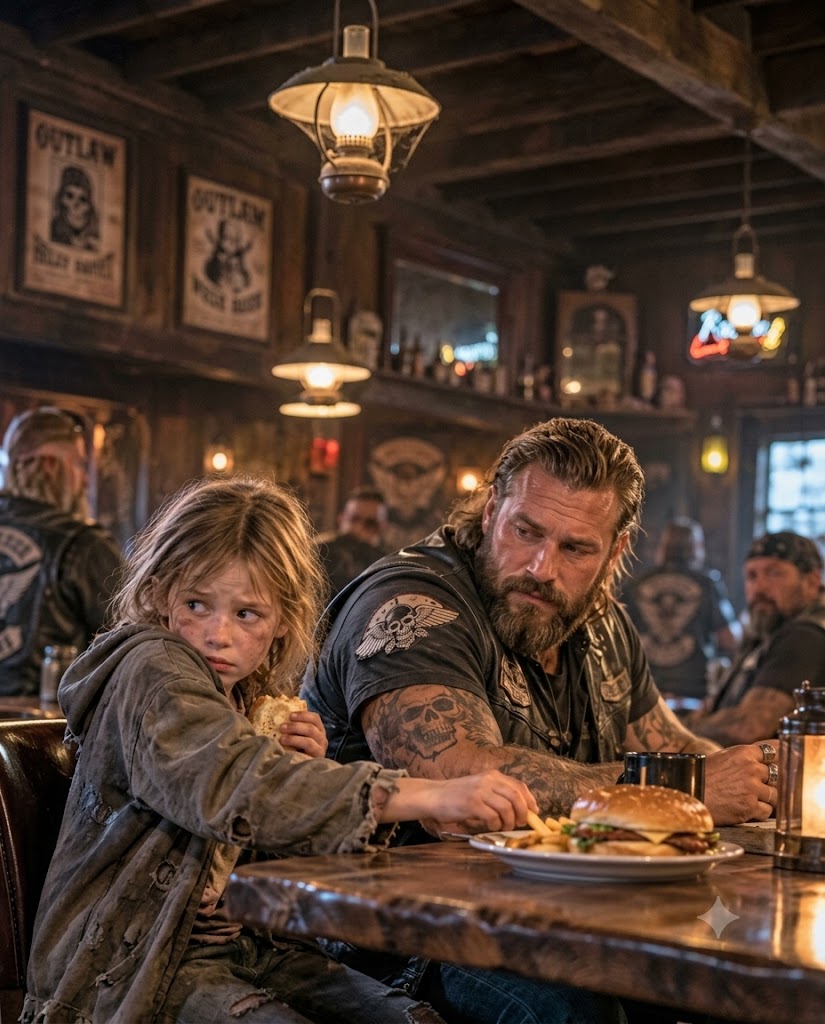
The little girl didn’t look like a thief.
That was the first thing Ray Mercer noticed. She looked hungry. There was a difference.
Rain tapped against the windows of the roadside biker bar that night, turning the neon signs outside into blurred streaks of red and blue. Inside, leather jackets filled the booths. Boots rested against wooden chairs. The smell of grilled meat hung thick in the air.
Ray sat alone at his usual table. Black coffee, a half-eaten burger, a plate of fries. Nothing about him invited conversation. At fifty-two, with gray threaded through his beard, tattoos covering both arms, and an old scar cutting across his eyebrow, Ray had the kind of face that made strangers think twice before asking for directions.
Then he saw her.
A small white girl, maybe eleven years old, standing near the doorway. Her jacket was two sizes too big. Her hair was tangled from the rain, and she kept looking at the tables—not at the people, at the food.
Ray watched her take one step forward, then another. She waited until a waitress turned away. The girl slipped between two chairs, crossed the narrow space beside Ray’s table, and reached for his plate. Her fingers closed around the sandwich.
She froze.
Ray looked directly at her. She looked back. For three long seconds, neither of them moved.
Then she whispered, “I’m sorry,” and ran.
Ray should have shouted. He should have grabbed her. He should have called someone. Instead, he noticed something that made him slowly push his chair back.
The girl wasn’t eating the sandwich. She was holding it against her chest with both hands, like it was something fragile, like it was worth protecting.
Ray followed her into the rain. He expected her to disappear down an alley. He expected fear. He expected tears. What he didn’t expect was for the girl to stop beneath a broken street lamp and turn around.
Her eyes met his. She wasn’t crying. She was terrified, but she was standing her ground.
“Please,” she said quietly. “If you’re going to call the police—” She swallowed. “Can you wait until she eats?”
Ray stopped. “She?”
The girl nodded.
And for the first time in twenty years, the toughest man in the bar suddenly had no idea what to say.
—
Lily’s hand closed around Ray Mercer’s sandwich just as his eyes locked onto hers.
The little girl froze beside his table, one sneaker half lifted from the worn wooden floor. The warm smell of grilled onions hung in the air while rain tapped against the dark window behind her.
Ray said nothing. His black coffee sat untouched beside the plate, steam curling beneath the amber light, while Lily slowly pulled the sandwich toward her oversized jacket. She was small enough that the sleeves swallowed her hands and the frayed cuffs were dark with rain.
Ray watched her glance toward the bar, then toward the front door, calculating the distance like someone who had done this before.
“Hey,” he said.
Lily flinched. The sandwich nearly slipped from her fingers. Around them, leather jackets shifted against vinyl booths and low conversations rolled beneath the hum of an old refrigerator.
Ray leaned back instead of reaching for her. “You hungry?”
Lily stared at him. Her eyes moved from his scarred knuckles to the faded biker patch on his vest, then back to the sandwich. She gave the smallest nod.
“Then you could have asked.”
Her mouth tightened. “Would you have said yes?”
Ray had no answer ready.
Lily took one step backward, then another.
“Wait—”
She turned and ran. The bell above the door rattled as she disappeared into the wet darkness.
Ray pushed away from the table. His chair legs scraped hard across the floor. He left the coffee, the half-eaten fries, everything, and stepped outside. Cold air struck his face. Rainwater ran from the brim of his cap onto his leather vest.
And somewhere behind the building, a motorcycle engine coughed to life before settling into a low metallic rumble.
He spotted Lily at the end of the alley, clutching the sandwich against her chest.
“Lily.”
She stopped. Ray hadn’t known her name. The girl turned slowly. For a second, the only sound was water dripping from a fire escape and the distant hiss of tires on wet pavement.
Ray stopped several yards away. “I’m not calling anybody,” he said.
Lily didn’t move. “Then why are you following me?”
“Because you stole my food.”
Her fingers tightened around the wrapper. “I’m sorry.”
“You already said that.”
“I mean it.”
“I believe you.” Ray looked at the sandwich. “But you haven’t taken one bite.”
Lily glanced down. She had been holding it so tightly that the paper wrapper had gone soft from the rain.
Ray took another step, careful not to crowd her. “You don’t want it.”
Lily shook her head. “Not for me.”
Something in the way she said it made Ray stop again. “Who is it for?”
Lily looked past him toward the glowing windows of the bar. Her voice dropped almost to a whisper. “Someone who hasn’t eaten since yesterday.”
Ray followed her gaze, then looked back at the child standing alone in the alley. “Your dad?”
Lily shook her head.
“Your brother?”
Another shake.
Ray waited.
Lily swallowed and pulled the sandwich closer. “My mom.”
The answer landed quietly, but it changed the shape of the entire moment. Ray looked at the small hands wrapped around food she had risked being caught stealing. Then he noticed something else. There were two sets of footprints in the mud near the alley entrance—one small and one adult—but only Lily stood there now.
She followed his eyes and immediately stepped backward. “Please don’t make me take it back.”
Ray looked at the sandwich, then at her soaked sneakers. He could have taken it. He could have sent her away. Instead, he reached into his jacket, pulled out his phone, and held it loosely at his side.
“I’m not taking anything from you,” he said. “But you’re going to show me where your mother is.”
Lily stared at him for a long second. Then she turned toward the alley and started walking.
Ray followed, leaving the bright bar behind them. He still didn’t know why she had chosen his table, why she knew he would leave half his food, or why an eleven-year-old girl had learned to steal quietly instead of asking for help.
But as Lily disappeared around the corner with his sandwich pressed against her chest, Ray realized he was no longer chasing a thief. He was following the only person who might lead him to the reason she had stolen from him.
—
Lily did not run far.
By the time Ray caught up with her, the rain had soaked through the shoulders of her oversized jacket, and the sandwich was still pressed carefully against her chest beneath both arms. She stopped beside the dark side wall of the biker bar, breathing hard, but she did not drop the food or beg him to let her go.
Ray stood several feet away, watching her. “You could have asked,” he said.
Lily looked down at the sandwich. “I know.”
“Then why didn’t you?”
She was quiet for a moment. Water dripped from the end of her tangled hair. “Because people say no when you ask.”
The answer was so simple that Ray almost didn’t know what to do with it. He had expected excuses, maybe a lie. Instead, she had given him something worse. A truth she had learned too young.
Ray glanced toward the sandwich. “You hungry?”
Lily nodded.
“Then eat it.”
She shook her head immediately. “It’s not for me.”
That stopped him. “Who is it for?”
Lily tightened her arms around the food. “My mom.”
Ray looked at the girl again. Eleven years old. Soaked through, shivering. Standing in an alley behind a biker bar with a stolen sandwich. She was too proud to eat herself.
“Where does she live?” he asked.
Lily hesitated. “Why?”
“Because if you’re carrying my dinner through the rain for somebody else, I want to know they’re getting it.”
Lily studied his face, searching for the trap. Ray could almost see the calculation behind her eyes. Adults had taught her that kindness usually came with a question attached.
Finally, she gave him the name of the old apartment building where she lived, only a few blocks away.
Ray nodded. He didn’t move toward her. “Go home.”
Lily blinked. “You’re not calling the police.”
“No.”
“You’re not taking it back.”
Ray looked at the sandwich. “Looks like you need it more than I do.”
Lily swallowed. “Thank you.”
Then she turned and disappeared into the rain.
Ray stayed where he was, listening to the motorcycle engines rumbling faintly inside the bar and the rain ticking against the metal dumpster beside him. Something about the girl bothered him. Not the stealing. The fact that she had never asked for anything.
The next morning, Ray arrived at the bar before sunrise. The place smelled of coffee, bacon, and yesterday’s smoke. He sat at his usual table and ordered breakfast. Then he ordered another.
The waitress raised an eyebrow. “You expecting company?”
Ray looked at the empty chair across from him. “Maybe.”
When the plate arrived, he pushed it toward the empty seat. He waited. Ten minutes passed. Then twenty.
The door opened and Lily appeared again. Same oversized jacket. Same careful eyes. She stopped when she saw the second plate.
Ray lifted his coffee. “This one’s yours.”
Lily didn’t move. “Why?”
“Because you shouldn’t have to steal it.”
She stared at the food as if it were a test. “What do you want me to do?”
Ray leaned back. “Eat. That’s it.”
“That’s it?”
Lily slowly walked to the table and sat down. She picked up a piece of toast, but before taking a bite, she looked at Ray. “How much?”
Ray frowned. “How much what?”
“How much do I owe you?”
Ray shook his head. “Nothing.”
Lily lowered the toast. “Everybody wants something.”
Ray looked at her for a long second. “Maybe everybody you’ve met.” He pushed the plate a little closer. “Not me.”
Lily finally took a bite. Ray watched her shoulders relax by a fraction. Then she quietly wrapped half the food in a napkin.
Ray noticed. “Taking that home?”
Lily nodded. “For Mom.”
Ray said nothing. But when she stood to leave, he noticed she had carefully folded the napkin around the food instead of stuffing it into her pocket. She was still protecting it, still protecting her mother.
And as Lily reached the door, Ray realized something that made him set down his coffee. If she had been stealing because she wanted food, this would have been simple. But Lily wasn’t stealing for herself. She was building a survival system around someone she loved, and Ray had just become part of it.
—
The next afternoon, Ray rode his motorcycle through the cold drizzle and parked across from the old apartment building Lily had described the night before.
The building stood behind a row of tired storefronts, its brick walls darkened by years of rain and its narrow windows glowing weakly against the gray sky. Ray killed the engine and sat there for a moment, watching people come and go through the front entrance.
He wasn’t sure why he had come. He told himself he was only checking that Lily and her mother had enough to eat. But the truth was harder to admit. He had spent years avoiding other people’s problems because every time he let someone get close, he remembered the person he had failed before.
Ray crossed the street and waited near the entrance. A few minutes later, Lily appeared carrying a small grocery bag. She saw him immediately and stopped.
“What are you doing here?” she asked.
Ray lifted one hand. “Relax. I’m not here to collect anything.”
Lily looked suspiciously at the paper bag beside him. “What’s that?”
“Food.”
“We have food.”
Ray glanced at the nearly empty grocery bag in her hand. “Looks like you’re running low.”
Lily didn’t answer. Instead, she walked toward the stairs. Ray followed only as far as the doorway.
“You don’t have to come upstairs,” Lily said.
“I know.”
She hesitated, then looked back at him. “But Mom’s home.”
Ray nodded. “Then I’ll wait here.”
Lily disappeared up the stairs. Ray stood beneath the flickering hallway light, listening to footsteps overhead and the distant hum of traffic outside. A few minutes later, Lily returned.
“She says you can come in.”
The apartment was small and cold. The radiator clicked without producing much heat. A thin blanket covered the couch and a single lamp cast a yellow circle across the kitchen table. Lily’s mother sat near the window trying to smile despite the exhaustion written across her face.
Ray set the groceries on the counter. “Just food,” he said. “Nothing else.”
Lily’s mother looked at the bags, then at him. “You didn’t have to do this.”
“I know.”
Ray opened one bag and took out bread, soup, eggs, milk, and fruit. Lily watched every item carefully.
“Where did you get all that?” she asked.
Ray shrugged. “Grocery store.”
She almost smiled. “Very mysterious.”
For the first time, Ray saw the girl relax around him. Then Lily picked up the sandwich he had brought from the bar the previous night. It was wrapped in a clean paper napkin. She carried it to the kitchen table and carefully cut it in half with a small knife.
Ray watched her slide one half onto a plate. The other half stayed in her hand.
“You eating?” he asked.
“Later.”
She walked toward the empty chair beside the window and placed the plate there.
Ray frowned. “Who’s that for?”
Lily looked at him as if the answer should have been obvious. “Mom will be hungry when she gets home.”
Ray looked at Lily’s mother. The woman lowered her eyes.
“She thinks I haven’t noticed,” Lily whispered.
“Noticed what?” Ray asked.
Her mother answered before Lily could. “That we don’t have enough.”
The room went silent. Rain tapped softly against the glass. Lily stood beside the empty chair, suddenly looking much younger than eleven.
Ray understood. The stolen sandwich had never been about a hungry child sneaking food because she wanted something. Lily had been carrying half of every meal back to this apartment, trying to make one plate become two.
Ray looked at the empty chair again. It was just an old wooden chair beneath a weak lamp. But somehow it felt like the most important thing in the room.
He reached into his jacket, took out his old business card, and placed it on the table.
“If you need food again,” he said, “you come to me.”
Lily stared at the card.
“And if I don’t?”
Ray met her eyes. “Then I’ll still know where to find you.”
Lily slowly picked up the card. For the first time, she didn’t look like someone preparing to run. She looked like someone considering whether it was finally safe to stay.
—
The key turned, the door opened, and a woman stopped beneath the weak orange lamp with one hand still wrapped around the brass knob.
Ray stood immediately, the folding chair scraping across the bare floor while Lily moved between them and quietly lowered the paper bag onto the table.
“Mom, this is Ray.”
The woman looked at the biker vest, then at the half-eaten sandwich, then at Lily’s wet jacket. Her eyes stopped on the groceries filling the refrigerator.
“Ray,” she asked, “he bought the food?”
Lily nodded.
The woman’s fingers tightened around the strap of her worn canvas bag. “You bought all this?”
Ray nodded.
“She needed it.”
“We can’t pay you back.”
“I didn’t ask you to.”
The apartment went quiet, except for the refrigerator humming in the corner and the faint rattle of pipes inside the wall. The woman set her bag down.
“Then why?”
Ray looked at Lily. The girl had lowered her head, rubbing a thumb across the damp edge of the sandwich wrapper.
“Because she shouldn’t have to steal dinner.”
The woman opened her mouth, but no answer came.
Ray stepped toward the door. “I’ll leave you two alone.”
Lily suddenly looked up. “Wait.”
Ray stopped.
“What?”
“You said I didn’t have to steal from you tomorrow.”
“You don’t.”
“What if I still need food?”
Ray looked at her for a long second. “Then you come to me.”
Her mother immediately shook her head. “Lily, we don’t know this man.”
Ray nodded. “She’s right.”
He reached into his jacket, pulled out a business card, and placed it on the chipped table.
“My bike shop is three blocks from here. If she needs food, she can come there with you. No money, no work, nothing.” He turned again. “Just food.”
Lily picked up the card before it could slide off the table. “Okay.”
Ray left. The hallway smelled of dust and old paint, and the cold concrete beneath his boots carried every step back toward the street. Outside, the night had gone quiet.
He sat on his motorcycle without starting it, rubbing his thumb across a scratch in the black handlebar. Then Lily’s voice drifted back through the open window above him.
“Mom, he wasn’t scary.”
Ray looked up. The light in the apartment flickered once, then steadied.
He stared at the dark sky for several seconds before reaching into his jacket and finding an old photograph folded behind his wallet. He didn’t unfold it. His thumb rested against the worn edge.
Twenty years earlier, his younger brother had called him from a pay phone after losing his job and missing two nights of rent. Ray had been twenty-nine, already riding with a crew, already convinced that needing someone was a weakness he could never afford.
His brother had asked him to come. Ray had said he was busy.
He remembered the exact sound of the receiver clicking back into its cradle. He remembered the next call. What he never forgot was the empty chair at the kitchen table.
Afterward, Ray folded the photograph tighter and put it away. He started the motorcycle, but instead of riding home, he turned the handlebars toward his shop.
The fluorescent lights inside the garage came alive one row at a time as he unlocked the door. Ray walked to the small storage room behind the workbench, pulled the dusty chain off its latch, and opened it for the first time in years.
There was an old cot inside, a space heater, two clean blankets, and enough room for a family to breathe. Ray stood in the doorway, staring at the empty room.
Then he picked up the phone and made one decision. This time, when someone needed a place to go, he wasn’t going to wait for them to ask twice.
—
The next morning, Lily stood outside Ray’s motorcycle shop with the same oversized jacket zipped to her chin, her fingers wrapped tightly around the old business card he had given her.
The metal garage door rattled upward, sunlight cutting through the dusty air while the smell of motor oil and fresh coffee drifted across the concrete floor. Ray looked up from a workbench and saw her standing alone.
“Where’s your mom?” he asked.
“At home.”
“Then why are you here?”
Lily stepped inside, her sneakers squeaking against the smooth shop floor. “I came to pay you back.”
Ray set down his wrench. “For what?”
She placed a folded dollar bill and three quarters on the workbench. “The food.”
Ray looked at the money, then at her. “Where’d you get that?”
“I saved it.”
“For how long?”
Lily shrugged. “A while.”
Ray pushed the coins back toward her. “Keep it.”
She immediately pushed them forward again. “No.”
“Lily, I don’t want charity.”
The word hung beneath the fluorescent lights. A compressor clicked on somewhere behind them, followed by the metallic hiss of air filling a tank.
Ray folded his arms. “Who told you this was charity?”
“Nobody.” She pointed at the money. “That’s what it is.”
“No, it’s food.”
“Food costs money.”
“Usually.”
Lily looked at him carefully. “Then let me work for it.”
Ray’s expression changed. He pulled a shop rag from his pocket and wiped grease from his fingers. “Work?”
“I can clean.”
“No.”
“Sweep.”
“No.”
“Wash dishes.”
“No.”
“I can—”
“Lily.” His voice was firm enough to stop her. He leaned against the bench so they were closer to eye level. “You’re eleven.”
She looked away. “I know.”
“Then be eleven.”
Lily stared at him. Ray pointed toward the money. “Put that in your pocket.”
She didn’t move.
“Food isn’t something a kid has to earn.”
Her fingers slowly closed around the coins. “Then what am I supposed to do?”
“Eat.”
“And my mom?”
Ray glanced toward the front office where a stack of flyers sat beside the coffee machine. He picked one up and placed it on the counter.
“Your mom can decide what she wants to do.”
Lily read the paper. It listed a community employment center, food assistance hours, and a local clinic.
“You called them?” she asked.
“This morning.”
“Why?”
“Because you’re not the adult in this situation.”
Lily looked at him sharply. “I take care of her.”
“I know.” Ray pushed the flyer closer. “But that doesn’t mean you should have to.”
Lily picked it up, folded it once, then again, fitting it neatly into her jacket pocket. “She won’t go.”
“Then don’t force her.” Ray turned back to his motorcycle. “Just give her the information.”
Lily stood there, watching him tighten a bolt on the chrome frame. “Why are you doing this?”
Ray kept working. “Because you stole my sandwich.”
Lily blinked. “That’s why?”
“Partly.” He tightened the bolt until the wrench clicked. “Mostly because you were willing to go hungry yourself before you asked anybody for something.”
Lily looked down at the floor. “I wasn’t going hungry.”
Ray raised an eyebrow. “You hadn’t eaten.”
She didn’t answer.
He opened a cabinet, pulled out a brown paper bag, and placed it on the counter. “Breakfast.”
Lily stared at it. “For me?”
“No,” Ray said dryly. “For the motorcycle.”
A tiny smile appeared before she could hide it. She picked up the bag. This time, she didn’t ask how much. She simply held it against her chest.
Then Ray locked the shop side door and handed her another key.
“Tomorrow morning,” he said, “bring your mom.”
Lily looked at the key, then at him. “Why?”
Ray pointed toward the building behind the garage. “Because there’s a room back there she needs to see.”
Lily closed her fingers around the key, and for the first time, she wasn’t holding food she had stolen. She was holding a door that Ray had decided to open.
—
Lily brought her mother to Ray’s garage the next morning, but before Ray could unlock the back room, the woman stopped beside the motorcycle lift and pressed one hand against the workbench.
The fluorescent lights buzzed overhead. Chrome tools reflected thin white streaks across the concrete, and the sharp smell of motor oil mixed with the coffee Ray had left steaming on the counter.
“You have a room,” her mother said.
Ray nodded. “I do.”
“And you expect what in return?”
“Nothing.”
She gave a short shake of her head. “People don’t give away rooms for nothing.”
Lily stepped between them. “He isn’t.”
Ray looked at her. “Let your mom speak.”
Lily lowered her eyes. Her mother noticed.
“How much food did you take from this man?”
“One sandwich.”
“Lily.”
“And a bag.”
Her mother closed her eyes for a second. “We don’t take things.”
Ray opened the side door and held out the key. “You don’t have to take it. You can look.”
The woman didn’t move.
Lily reached for her hand. “Mom, please.”
They walked behind the garage into the small room Ray had prepared. Morning sunlight came through the dusty window, falling across the clean cot and two folded blankets. A small space heater sat beside the wall, and the wooden floor smelled faintly of pine cleaner.
Lily walked straight to the cot and touched the blanket. “You said this was for us.”
“It is.”
Her mother stood in the doorway. “For how long?”
“Until you don’t need it.”
“That’s not an answer.”
Ray leaned against the door frame. “It’s the only one I have.”
The woman looked at Lily. “You didn’t tell me about this.”
Lily picked at a loose thread on her sleeve. “You were sleeping.”
“You could have woken me.”
“You were coughing.”
Silence filled the room. Ray looked from mother to daughter. The woman finally sat on the cot slowly as though her knees had stopped cooperating.
“I lost my job two weeks ago,” she said. “I haven’t found another one.”
Lily’s fingers stopped moving. “You said you were still working.”
“I know.”
“Why?”
Her mother looked toward the floor. “Because you already do too much.”
Lily shook her head. “I don’t.”
“You do.” The woman reached for her daughter’s sleeve and rubbed the damp fabric between her fingers. “You stopped asking for things. You stopped asking for lunch money. You started saying you weren’t hungry.”
Lily pulled her sleeve gently free. “I was hungry.”
Her mother looked at her. “I know.”
The words came quietly. “I knew.”
Ray turned toward the garage, giving them space. Behind him, he heard the refrigerator door open, then the rustle of the grocery bag he had packed that morning.
“Mom,” Lily said. “I didn’t steal because I wanted something.”
Her mother looked at her. “Then why?”
Lily swallowed. “Because I wanted you to eat without knowing how scared I was.”
Ray stopped near the workbench. He didn’t turn around. The air compressor clicked on, filling the garage with a low mechanical hum.
Her mother pulled Lily into her arms, and Lily stood stiffly for a moment before letting her forehead rest against her mother’s shoulder.
“You don’t have to protect me like that,” her mother whispered.
“You’re my kid,” Lily nodded against her jacket. “I know.”
Ray picked up the grocery bag and carried it into the room. He placed bread, soup, milk, apples, and peanut butter on the small table. No speech, no promise, just food where they could reach it.
Then he placed the key beside the plate.
Lily looked at him. “What do we owe you?”
Ray answered immediately. “Nothing.”
Her mother started to object, but Ray raised one hand. “Let me finish.”
He pointed at Lily. “She doesn’t owe me.”
Then he pointed toward the door. “You don’t owe me.”
He looked at the food. “And neither of you has to pretend you’re fine.”
Lily picked up the key. This time, she didn’t hide it in her pocket. She placed it in her mother’s hand.
“Then we stay.”
And with that single decision, the empty room behind Ray’s garage stopped being an offer and became their first real place to begin again.
—
Lily stopped trying to pay Ray back after he made one thing clear. The food, the room, and every quiet favor came without a debt attached.
One bright Saturday morning, she stood behind the garage counter with a broom in her hands. Sunlight cut through the dusty windows while the sharp smell of motor oil mixed with coffee and toasted bread.
Ray was tightening a mirror on an old motorcycle when she finished sweeping the concrete and leaned the broom against the wall.
“I cleaned the floor,” she said.
Ray glanced over. “I noticed.”
“So now we’re even.”
He shook his head. “No.”
Lily frowned. “Why not?”
Ray set down the wrench. “Because you’re not paying me back.”
She folded her arms. “Then what am I supposed to do?”
Ray looked toward the food shelves near the open garage door. “Do what you want.”
Lily followed his gaze. The shelves were full now. Bread, cereal, peanut butter, canned soup, apples, milk. Nothing expensive, nothing fancy, but nobody had to hide food inside a jacket anymore.
Lily walked over and straightened a box of crackers. “What if I help anyway?”
Ray wiped his hands on a dark shop towel. “Helping is different from earning.”
“How?”
“If you stop helping tomorrow, nothing happens.”
Lily thought about that. Then she nodded. “Okay.”
She picked up a cardboard box and began sorting the food by type. Ray returned to the motorcycle, the soft clink of tools filling the garage.
After a few minutes, Lily placed a can of soup on the workbench. “Ray?”
“Yeah.”
“Do you think people feel bad taking food?”
He looked at her. “Some probably do.”
“I did.”
“I know.”
She rubbed her thumb over the cardboard edge. “I thought if I took something, I’d owe someone forever.”
Ray leaned against the motorcycle. “That’s why the chair matters.”
Lily looked toward the wooden chair near the garage entrance.
“Because nobody has to ask.”
“Exactly.”
She walked over and moved the chair closer to the food table. Its legs scraped across the concrete with a rough squeal. Then she took a marker from the counter and crossed out the old sentence on a piece of cardboard.
She wrote slowly. Take what you need. Give when you can.
She stepped back. “Better?”
Ray nodded. “Much better.”
That afternoon, Lily placed the sign above the shelves while Ray rolled another motorcycle into the garage. The engine clicked as it cooled and sunlight flashed across the chrome handlebars.
Lily stood beneath the sign, staring at the food table. “What happens if someone takes something and gives nothing back?”
Ray shrugged. “Nothing.”
“Really?”
“Really. Even if they can, especially then, giving has to be a choice.”
Lily looked at the shelves again. “What if they want to give?”
Ray pointed toward an empty box beside the chair. “Then they leave something when they’re able.”
Lily picked up the box and placed it directly beneath the sign so nobody keeps score. Nobody.
She smiled and carried a loaf of bread from the counter to the box. “Then I’ll start.”
Ray watched her put it down. A few minutes later, his own hand reached into the grocery bag he had brought that morning. He placed a gallon of milk beside the bread.
Lily looked at him.
“You too?”
Ray shrugged. “I’m able.”
She laughed softly.
By sunset, the empty box was no longer empty. Someone had left canned beans. Someone else had brought apples. A folded five-dollar bill rested beneath a loaf of bread.
Lily stood beside Ray at the garage entrance, watching the small collection grow under the orange glow of the setting sun.
“You know what,” she said. “This is better than stealing.”
Ray looked down at her. “Much better.”
Lily picked up the old dollar she had once tried to give him and placed it beneath the sign.
“Then let’s make sure nobody has to steal from your table again.”
Ray looked at the dollar, then at the girl who had once run away with his sandwich, and he knew she had just changed what that table meant.
—
By the following Saturday, Ray’s garage looked less like a motorcycle shop and more like a place where people had quietly decided nobody should go hungry.
Morning light spilled across the concrete floor, catching the chrome on the parked bikes while the smell of coffee and fresh bread mixed with the familiar scent of engine oil.
Ray stood beside his motorcycle, tightening a mirror, when the low rumble of three bikes rolled into the lot.
Lily looked through the open garage door. Three leather-vested riders parked near the curb, engines ticking as they cooled. One rider carried a grocery bag. Another had a cardboard box filled with canned food. The third walked in holding a gallon of milk.
Lily looked at Ray. “Did you ask them to come?”
Ray shook his head. “No.”
The first rider placed his bag beneath the wooden sign. “Heard about the table.”
Ray nodded toward it. “Then you know the rule.”
The rider glanced at Lily. “Take what you need. Give when you can.”
Lily smiled. “Exactly.”
By noon, the small food shelf had nearly doubled. Someone brought peanut butter. Someone else left apples, cereal, and two loaves of bread. A folded twenty-dollar bill appeared beneath a can of soup.
Nobody wrote down names. Nobody asked who had given what.
Lily moved between the shelves with a marker and cardboard labels while Ray kept the garage door open and worked on motorcycles nearby. The sound of wrenches clicking against metal mixed with the scrape of cardboard boxes and the quiet hum of conversation.
Then Lily noticed the chair was empty. She pulled it toward the entrance and set it beside the food table.
“It needs to stay here,” she said.
Ray wiped his hands on a shop towel. “Why?”
“Because someone might be standing outside and not know they’re allowed in.” She placed the chair beneath the sign. “The chair tells them.”
Ray looked at the little wooden seat, its surface still carrying scratches from years of use. “Good thinking.”
A few minutes later, a middle-aged man stopped outside the garage. He stared at the shelves, then at the chair, but kept his hands in his jacket pockets.
Lily walked over. “You can sit.”
The man looked at Ray first. Ray simply nodded toward the chair.
The man sat down slowly. The wooden legs creaked against the concrete. Lily brought him a sandwich and a bottle of water.
“You don’t have to explain anything,” she said.
The man lowered his head and accepted the food. Ray returned to his motorcycle without asking questions.
When the man finished, he wrapped the remaining half in a napkin. Before leaving, he placed a small bag of oranges on the table.
Lily tried to stop him. “You don’t have to.”
He shook his head. “I know.” He set the bag down anyway. “I want to.”
After he left, Lily picked up one orange and turned it in her hands. The skin was cool and slightly rough beneath her fingers.
“He gave something back.”
Ray nodded. “Because he wanted to.”
Lily placed the orange back in the bag. “That’s the whole point.”
The following days changed the garage in small ways. The food table stayed full. The chair was almost never empty. Some people took one meal. Some took groceries for a family. Others returned later carrying whatever they could spare.
Ray never turned it into a business. Never put up his name. Never asked anyone to prove they needed help. He simply kept the door open.
One evening, Lily sat in the chair holding a sandwich. The orange glow of the setting sun stretched across the floor, and the warm bread smelled faintly of mustard and roasted turkey.
She cut the sandwich down the middle just as she had the night she first came to Ray.
He looked over. “You hungry?”
“A little.”
She picked up one half and stood.
“Then why are you cutting it?”
She walked to the table and placed the other half beside the bread and fruit. “Because somebody else might be hungry tomorrow.”
Ray watched her return to the chair. The girl who once had to steal food from his table had built another table where nobody needed to steal it at all.
And this time, Ray understood that the thing she had taken from him that night was never really the sandwich. It was the chance to turn one small act of kindness into something that could keep feeding people long after she no longer needed it herself.
—
Years later, the old garage still opened at the same hour, and Ray still took the same chair near the food table every Saturday morning.
The place smelled of fresh coffee, toasted bread, and motor oil, while sunlight poured through the high windows and flashed across rows of polished chrome.
Ray was fifty-two when Lily first walked into his life. Now his beard was almost completely gray, and the leather vest hanging from his shoulders had softened with years of wear.
He was halfway through his coffee when the garage door rolled open.
Lily stepped inside carrying two paper grocery bags and a sandwich wrapped in wax paper. She set the groceries on the food table, then walked straight toward him.
“I brought you lunch.”
Ray looked at the sandwich. “You sure you didn’t steal it?”
Lily smiled. “I paid for it.”
She sat across from him. The wooden chair gave a familiar creak beneath her weight. For a few seconds, neither spoke.
Then Lily unwrapped the sandwich, took a small knife from her bag, and cut it neatly in half. Ray watched the blade pass through the bread.
“You still do that every time.”
She pushed one half toward him.
Ray looked down at it. “Why?”
Lily rested her hands on the table. “Because I remember the first time I took food from you.”
Ray leaned back. “You mean stole?”
“I was eleven.”
“You were still stealing.”
She laughed. “Fair enough.”
Ray picked up his half. The sandwich was simple. Turkey, cheese, mustard, lettuce. But the wrapper crackled loudly in the quiet space between them.
Lily looked toward the food shelves. They were larger now, with rows of cereal, canned soup, peanut butter, fruit, bread, and milk. The old wooden chair still stood beneath the sign.
Take what you need. Give when you can.
“Mom bought her own house,” Lily said.
Ray looked up.
“She did. Three bedrooms.”
“That’s a lot of house.”
“She says you helped her believe she could start over.”
Ray shook his head. “She did that herself.”
Lily reached into her bag and pulled out a folded piece of paper. She placed it on the table.
Ray opened it carefully. It was his old business card, faded at the edges and soft from years of being carried around. His name was still visible.
“You kept that?”
“Since the night you gave it to me.”
Ray ran his thumb across the worn paper. “Why?”
Lily looked toward the empty chair. “Because it was the first thing someone gave me without asking what I could give back.”
Ray lowered the card. “You never owed me anything.”
“I know that now.” She looked at him. “But I didn’t know it then.”
Ray glanced toward the food table. A young mother had come earlier that morning and taken a bag of groceries. Before leaving, she had placed a loaf of bread beside the chair. Someone else had added apples. A biker had left a gallon of milk.
The table kept filling because people kept choosing to give.
Lily stood and carried her half of the sandwich toward it.
“What are you doing?” Ray asked.
“Saving it.”
She placed the sandwich beneath the sign for whoever comes next.
Ray watched her return. “You know,” he said, “you don’t have to do that anymore.”
Lily sat beside him. “I know.” She paused. “I want to.”
The garage fell quiet except for the ticking of a cooling engine and the low hum of the refrigerator. Ray looked at the girl who had once held his stolen sandwich like it was something precious. Then he looked at the table she had helped build.
“You changed this place,” he said.
Lily shook her head. “You gave me room to change.”
Ray smiled and raised his coffee. Lily lifted hers.
Neither made a speech. They simply sat there sharing a table that had started with one stolen meal and become a place where people could ask for nothing and still receive enough to begin again.
—
Maybe that was the lesson Lily had carried all those years. Sometimes kindness isn’t about rescuing someone forever. It’s about giving them enough dignity, safety, and space to rescue themselves.
And sometimes the smallest thing you share—a meal, a chair, a little room at the table—can become the beginning of a completely different life.
Ray never knew, when he pushed that second plate across the table the morning after Lily stole his sandwich, that he was starting something that would outlast him. He only knew that a little girl had run into the rain with food she wouldn’t eat herself, and something about that had made him remember the empty chair at his own kitchen table twenty years before.
He couldn’t go back and fill that chair. But he could make sure another chair stayed open.
The wooden chair beneath the sign became a symbol for everyone who passed through the garage. It said what the sign said and what Ray had learned from Lily. You don’t need to earn a place here. You don’t need to prove anything. You just need to know that if you sit down, someone will hand you something to eat.
Lily grew up. She graduated high school, then community college. She got a job at a clinic downtown, helping families who had lost their housing or couldn’t afford groceries. She never forgot what it felt like to hold a stolen sandwich against her chest, afraid that someone would take it back before her mother could eat.
Every Saturday, she still came to the garage. Sometimes she brought food. Sometimes she just sat in the chair. Sometimes she talked to the people who came in, the ones who looked embarrassed or scared or too tired to explain anything.
She never asked them to explain.
She just handed them a sandwich.
And Ray watched from his workbench, older now, slower, but still opening the garage door every morning. He watched Lily become the kind of person who could turn one act of kindness into a hundred more.
One cold December morning, a little boy walked into the garage. His shoes were too big. His coat was ripped at the sleeve. He stood near the food table, staring at the shelves without touching anything.
Lily walked over. She didn’t ask if he was hungry. She didn’t ask why he was alone. She simply pulled out the wooden chair and set it beside the table.
“You can sit,” she said.
The boy looked at her, then at Ray, then at the chair. He sat down slowly.
Lily brought him a sandwich and a bottle of water. She cut the sandwich in half without thinking, the way she always did, and placed one half on a napkin beside him.
“For later,” she said.
The boy stared at the half sandwich. “Why?”
Lily smiled. “Because somebody else might need it tomorrow. But right now, this half is for you.”
The boy took a bite. Then another. His shoulders relaxed by a fraction, the same way Lily’s had all those years ago.
Ray watched from across the garage. He saw Lily kneel beside the boy and speak quietly, her voice calm and certain. He saw the boy nod. He saw her point toward the sign above the shelves.
Take what you need. Give when you can.
Then Ray looked at the old business card still tucked behind the register. He thought about the night a little girl had stolen his sandwich. He thought about the empty chair at his brother’s table, the one he never filled.
He thought about all the chairs that had stayed open since then.
And he knew, with a certainty that had settled into his bones over the years, that Lily had been right all along. The thing she took from him that night wasn’t really the sandwich. It was the chance to build something that would keep feeding people long after he was gone.
The garage stayed open every Saturday. The chair stayed beside the table. The sign stayed above the shelves.
And somewhere, in a town where nobody had to steal dinner anymore, a little girl grew up knowing that kindness was not a debt. It was a door.
All you had to do was walk through it.
—









