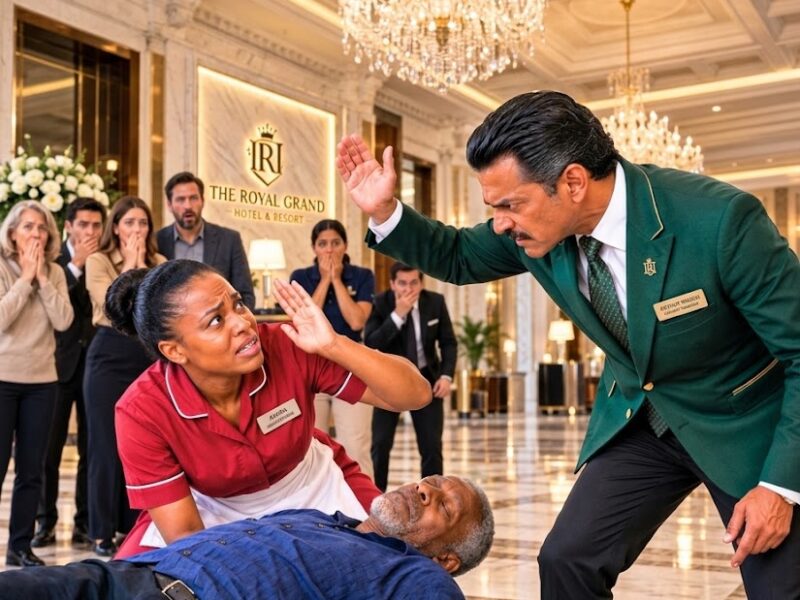
A Hotel Maid Was Fired for Helping a Collapsed Guest—Hours Later, the Staff Learned He Owned the Entire Hotel
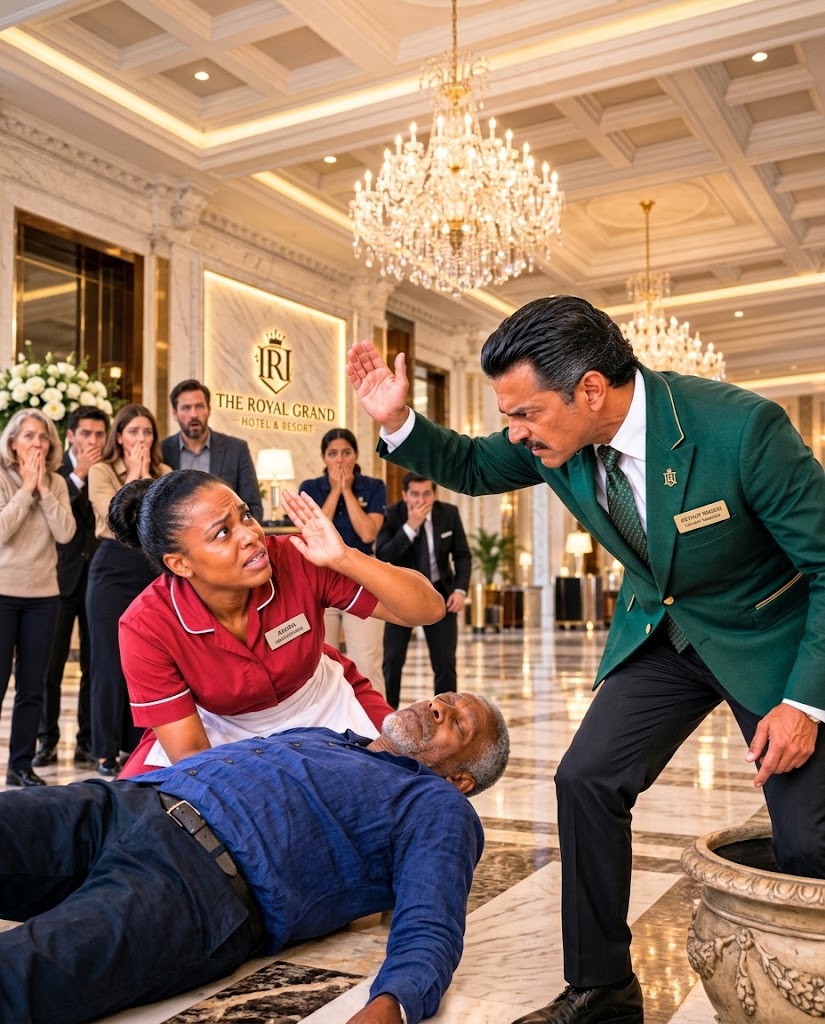
The hallway smelled like lemon polish and fresh vacuum lines.
Amara adjusted her name tag, checked the cart one more time, and told herself she’d be done by 3:30.
Room 214.
Just one more room, then she could clock out, catch the bus, and get to the pharmacy before they closed.
Her mother’s prescription had been waiting for three days.
She knocked twice.
“Housekeeping.”
Nothing.
She knocked again, louder this time, and pressed her ear to the door.
That’s when she heard it.
A low, wet sound.
Like someone trying to breathe through a straw that was already full of water.
Amara’s hand moved before her brain caught up.
She swiped the master key, shoved the door open, and stepped inside.
The curtains were half drawn, and the TV was still on, some cable news channel talking about interest rates and a storm moving up the coast.
And there, on the floor between the bed and the bathroom door, was a man in a navy suit.
He was on his side, one arm twisted under him, his face gray as old concrete.
His lips were moving, but no words came out.
Amara dropped to her knees beside him and grabbed her radio.
“Front desk, I need 911 right now. Room 214. Guest is unresponsive, possible cardiac event.”
She didn’t wait for permission.
She didn’t check the policy manual.
She just started counting compressions the way she’d learned in a community CPR class two summers ago.
One.
Two.
Three.
The man’s eyes fluttered.
“Stay with me,” she said.
“Stay right here.”
The paramedics arrived in six minutes.
Amara rode the elevator down with them, her uniform damp with sweat, her hands shaking so bad she couldn’t hold her own water bottle.
The lobby was chaos.
Guests were whispering.
The manager, Mr. Harrell, was already on his phone.
And Amara was already in trouble.
“You broke protocol,” Mr. Harrell said, pulling her into the back office.
“You entered a guest room without authorization. You used a master key outside your assigned sequence.”
“He was dying,” Amara said.
“What was I supposed to do? Stand here and watch?”
“That is not your decision to make.”
Mr. Harrell’s voice was flat, like he was reading from a script he’d memorized years ago.
“Get out now. You are finished in this hotel.”
“Please, sir, let me explain.”
“You are fired.”
Amara grabbed her bag from the break room.
She didn’t cry until she hit the parking lot.
And when she did, she said it out loud, to nobody, to the sky, to the empty bus stop bench.
“I’ll do it again. Every single time.”
The bus ride home took forty minutes.
Her mother was sitting at the kitchen table with a cup of tea and a stack of bills.
“You’re home early,” Mama said.
“What happened?”
Amara sat down.
She told her everything.
The man on the floor.
The 911 call.
The six minutes.
The firing.
Her mother was quiet for a long time.
Then she reached across the table and took Amara’s hand.
“Then that job did not deserve you.”
The next morning, Amara put on her only other uniform, a plain black polo and khakis, and started walking.
She tried the hotel two blocks over.
Then the one near the airport.
Then the one downtown with the marble fountain out front.
Every application got the same answer.
“We’ll call you.”
Nobody called.
The third day, she stood outside a diner with a Help Wanted sign in the window.
She was about to walk in when her phone buzzed.
It was an unknown number.
She almost let it go to voicemail.
Then she answered.
“Amara?”
The voice was male, older, a little hoarse.
“This is Daniel Bello.”
She didn’t recognize the name.
“I’m the man you saved.”
Amara leaned against the diner wall.
“You’re awake.”
“I’m awake,” he said.
“And I need to know your name.”
“Amara Okafor.”
“Amara,” he repeated, like he was writing it down.
“I need to know the truth about what happened after I was taken to the hospital.”
She told him.
She told him about Mr. Harrell.
About the protocol.
About the firing.
She told him she’d do it again.
Daniel Bello was silent for so long she thought the call had dropped.
Then he said, “Where are you right now?”
“Standing outside a diner.”
“Stay there. I’m sending someone.”
Twenty minutes later, a black sedan pulled up.
A woman in a gray suit stepped out.
“Mrs. Ekwueme Derim,” she said, extending her hand.
“I work with Mr. Bello. He wants to see you.”
“At the hotel?”
“No,” Mrs. Derim said.
“At his home. He’s still recovering.”
Amara hesitated.
“I don’t have anything to wear.”
“You’re fine,” Mrs. Derim said.
“You’re the one who saved his life. He doesn’t care about your clothes.”
The house was a brick colonial on a quiet street with oak trees and a long driveway.
Daniel Bello was sitting in a recliner by the window, a blanket over his legs, an oxygen tank beside him.
He looked older than she expected.
Seventies, maybe.
But his eyes were sharp.
“There she is,” he said.
“The woman who wouldn’t let me die on that floor.”
“You look so much better,” Amara said.
“I didn’t know if you’d made it.”
“Because of you, I made it.”
He gestured to a chair.
“Please. Sit. We have a lot to talk about.”
Amara sat.
“I’ve thought about this since I woke up in that hospital bed,” Mr. Bello said.
“I’ve thought about the fact that a housekeeper was fired for saving my life. I’ve thought about the fact that nobody called me. Nobody asked me what I wanted.”
“Sir, I don’t want to cause trouble.”
“You’re not causing trouble,” he said.
“I am.”
He reached for a folder on the side table.
“I own the Crestline Hotel. And the two others on the coast.”
Amara’s mouth went dry.
“You own them?”
“I do.”
“I didn’t know,” she said.
“I didn’t know who you were.”
“You didn’t need to know who I was to treat me fairly,” Mr. Bello said.
“That’s the point.”
He opened the folder.
“Your job back, of course. But not the one you had.”
Amara blinked.
“I want you managing housekeeping across all three of my properties.”
She laughed, just once, out of pure disbelief.
“Sir, I’m a housekeeper. I don’t know the first thing about managing three hotels.”
“You broke a rule to save a life without knowing who I was,” Mr. Bello said.
“That’s exactly the judgment I need running my properties. I trust you with this, Amara.”
He closed the folder.
“I know you will do the right thing.”
Amara looked at her hands.
The same hands that had counted compressions on a stranger’s chest.
“Then I accept,” she said.
“Thank you, Mr. Bello.”
The next week, there was a meeting at the Crestline.
Mr. Harrell was there.
So was the regional director.
And a lawyer from the corporate office.
Mr. Bello joined by video call, his face projected on the conference room screen.
“Sit down,” Mr. Bello said.
“I want to understand your decision that day.”
Mr. Harrell straightened his tie.
“Sir, our policy is clear. Staff cannot enter guest rooms without authorization. It’s for the safety of our guests and our employees.”
“And if she had followed that policy,” Mr. Bello said, “I would be dead right now.”
The room went quiet.
“I don’t need you to apologize to me,” Mr. Bello said.
“I just need you to understand why she did it.”
Mr. Harrell looked at the table.
“I was so focused on the rule,” he said, “I never once asked if he was alive.”
“Starting today,” Mr. Bello said, “that policy changes. No employee will ever be punished for saving a life in this hotel again.”
The lawyer nodded.
“We’ll draft the new language this week.”
Amara sat in the back of the room, her hands folded in her lap.
She didn’t say a word.
She didn’t have to.
The first month was hard.
Amara had to learn the scheduling software, the budget sheets, the vendor contracts.
She had to learn how to fire people.
She had to learn how to hire them.
But she also learned that the housekeeping staff had been quietly cutting corners for years because nobody had ever asked them what they needed.
So she asked.
She ordered new carts with better wheels.
She got the laundry room air-conditioned.
She started a shift-swap board so mothers could pick up their kids from school.
And she kept a laminated card in her pocket with a single sentence on it.
“The right choice will always cost you something.”
She showed it to her mother one Sunday afternoon.
Mama read it twice.
“Where did you get this?”
“Mr. Bello said it. The day he gave me the job.”
Mama handed it back.
“Then you keep it,” she said.
“I always knew your heart would carry you further than any job title.”
Three months later, the Crestline won a regional hospitality award.
Amara accepted it on behalf of the housekeeping team.
She gave a short speech.
She thanked Mr. Bello.
She thanked her mother.
She thanked the paramedics who had arrived in six minutes.
And then she said something she hadn’t planned.
“I was fired for breaking a rule,” she said.
“But the rule was wrong. And I’d break it again.”
The audience applauded.
Mr. Bello, watching from the front row, nodded once.
After the ceremony, Amara found him by the exit.
“I meant what I said,” she told him.
“I know,” he said.
“That’s why I hired you.”
He reached into his pocket and pulled out a small velvet box.
“This was my wife’s,” he said.
“She passed five years ago. She was a nurse.”
Amara opened the box.
Inside was a silver pin shaped like a pair of hands.
“I want you to have it,” Mr. Bello said.
“She would have liked you.”
Amara pinned it to her lapel.
She wore it every day.
And every time she walked past Room 214, she touched it, just once, like a prayer.
Six months later, the hotel chain announced a new policy.
It was called the Amara Protocol.
Any employee who intervened in a medical emergency would be protected from disciplinary action.
The story made the local news.
Then the state news.
Then a national morning show called.
Amara declined the interview.
But she did agree to one thing.
A training video.
She stood in front of a camera in an empty hotel room and said the words she’d said a hundred times since that day.
“Check for breathing. Call 911. Start compressions. Don’t stop until help arrives.”
“And if anyone tells you you broke a rule?”
She looked straight into the lens.
“Tell them you saved a life.”
The video was shown at every new employee orientation.
It was translated into Spanish and Mandarin.
It was posted online.
And one day, a woman in Ohio watched it on her phone while her husband was choking on a piece of steak.
She did what Amara said.
Her husband lived.
She wrote a letter to the Crestline Hotel.
“I don’t know who you are,” she wrote, “but thank you.”
Amara framed the letter and hung it in her office.
It was the first thing she saw every morning.
The second thing she saw was the silver pin on her jacket.
The third thing was the laminated card in her drawer.
“The right choice will always cost you something.”
She had paid the cost.
And she had been paid back.
Not in money.
Not in title.
But in the knowledge that a single moment of courage could echo for years.
Room 214 was booked solid for the next six months.
Amara made sure of it.
She also made sure the guest in that room got a handwritten note and a fruit basket.
Every single time.
Because she knew something the policy manual didn’t.
A hotel is not just a building.
It is a place where people fall down.
And it is a place where people get back up.
One night, after everyone else had gone home, Amara stood in the hallway outside 214.
She touched the pin on her lapel.
She thought about the man on the floor.
She thought about the six minutes.
She thought about her mother’s words.
“Then that job did not deserve you.”
She smiled.
“Neither did the rule,” she said out loud.
Then she turned off the lights and went home.









