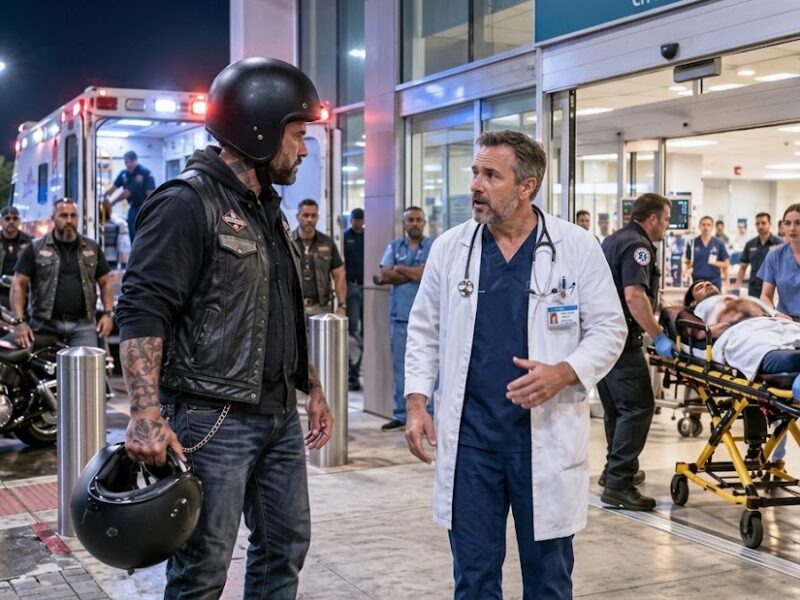
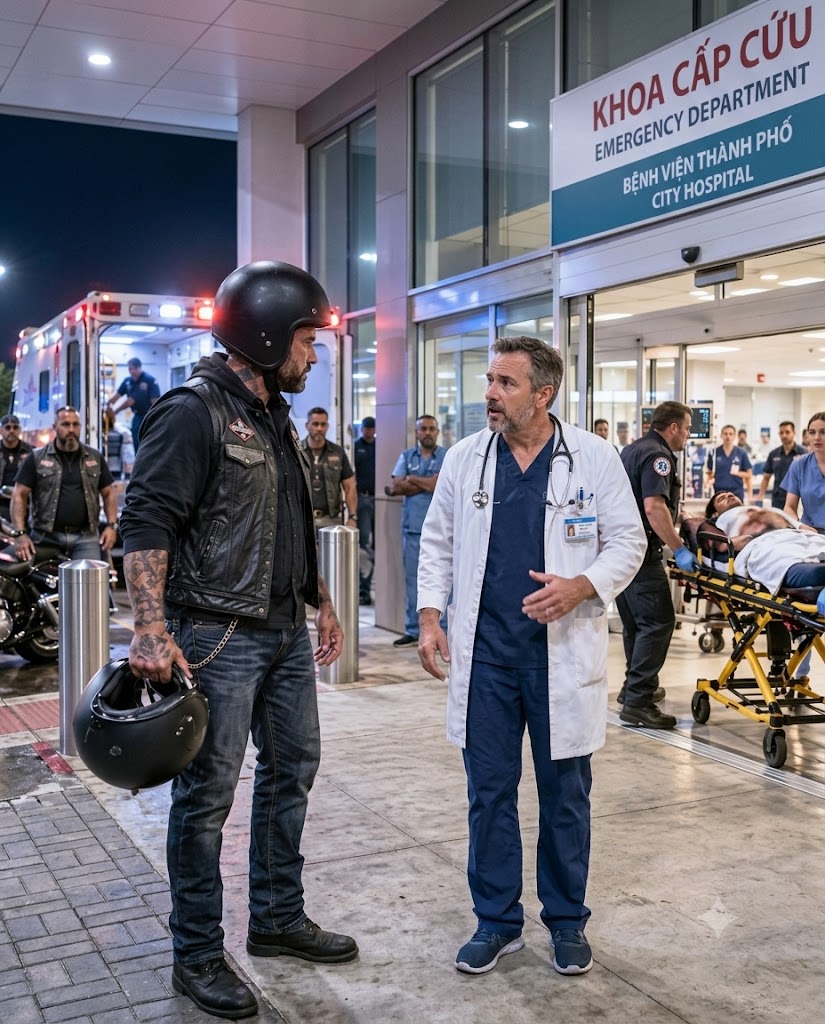
A hospital made one desperate phone call: “We need you.” Then 217 Hell’s Angels showed up without warning.
The heart monitor was flatlining and the trauma blood bank was completely empty.
Desperate, a chief surgeon dialed a classified number he swore he’d never use, reaching the heavily guarded clubhouse of the Hells Angels.
He expected a dial tone.
Instead, he triggered a chain of events nobody predicted.
The fluorescent lights of Providence Memorial Hospital buzzed with a sickening, sterile hum.
It was 2:14 a.m. on a rain-slicked Tuesday, and the emergency room looked like a war zone.
A massive 10-car pileup on Interstate 95 had drained the hospital’s resources to the absolute limit.
Every available surgeon was knee-deep in trauma, and the linoleum floors were strewn with the chaotic evidence of a mass casualty event.
But for Dr. Harrison Cole, the chief of trauma surgery, the real nightmare was unfolding in Operating Room 4.
On the table lay 7-year-old Toby Reed.
He wasn’t part of the highway pileup.
Toby had been the victim of a brutal hit-and-run just blocks from his home.
His small, fragile body was failing, the internal hemorrhaging too severe to patch without a massive and immediate blood transfusion.
But Toby had a problem that money, prayers, and modern medicine couldn’t easily solve.
He possessed an incredibly rare blood phenotype.
He was O negative, but with a missing Rh antigen—a combination so statistically rare that the hospital blood bank only kept two units on hand at any given time.
Those two units were already in Toby’s veins, and he was bleeding out faster than they could stabilize him.
“Pressure is dropping, doctor. 60 over 40 and falling,” the anesthesiologist, Dr. Gregory Lynn, warned, his voice tight with rising panic.
“If we don’t push more whole blood in the next 20 minutes, he’s going to code.”
“We’ve tapped the tri-state registry. There’s nothing on the shelves.”
Harrison stepped back from the table, his gloved hands trembling slightly.
Through the observation window, he could see Toby’s mother, Sarah, pressing her tear-streaked face against the glass, her hands clasped in desperate, silent prayer.
Harrison had promised her he would save her boy.
Now he was watching the child slip away.
“There has to be someone,” Harrison muttered, tearing off his bloody gloves and sprinting toward the scrub room computer.
“Access the deep archive donor files—the private ones.”
“Dr. Cole, those files are heavily restricted,” a nurse started to protest.
“I don’t care,” Harrison barked, his usual calm demeanor shattering.
He typed furiously, bypassing hospital protocols to access the state’s master blood registry, filtering for the exact ultra-rare phenotype Toby required.
The screen blinked, searching through millions of medical records.
Zero matches in Boston.
Zero in New Haven.
Zero in Hartford.
Then a single name flashed onto the screen.
Caleb Davies.
Harrison stared at the name, his blood running cold.
He knew that name.
Five years ago, Harrison had operated on Caleb Davies when he was brought in with three gunshot wounds to the chest.
Caleb had survived against all odds, and before he discharged himself against medical advice, he had gripped Harrison’s hand and told him, “You ever need anything in this life, doc, you call the angels. We owe you a life.”
Caleb “Brick” Davies wasn’t just a former patient.
He was the reigning president of the Rhode Island charter of the Hells Angels Motorcycle Club.
Harrison looked at the clock.
2:21 a.m.
Toby had maybe 15 minutes before his organs started shutting down permanently.
Without hesitating, Harrison pulled his personal cell phone from his locker and dialed the private emergency number Caleb had written on a scrap of paper half a decade ago.
Fifteen miles away on the industrial outskirts of Providence, the Hells Angels clubhouse was bathed in a haze of cigar smoke and the low rumble of a heavy bassline from the jukebox.
Caleb Davies sat at the head of a battered oak table, a scarred monolith of a man with arms covered in dense, faded ink.
The death head patch on his leather cut was worn—a testament to decades on the road and in the life.
Beside him sat his sergeant-at-arms, a giant of a man known only as Dexter, sorting through a pile of club logistics.
When the burner phone locked in the clubhouse safe began to ring, the room went dead silent.
That phone hadn’t rung in five years.
Caleb stood up slowly, the leather of his boots creaking against the wooden floorboards.
He unlocked the safe, picked up the archaic flip phone, and pressed it to his ear.
“Yeah.”
“Caleb, it’s Dr. Harrison Cole from Providence Memorial.”
Caleb’s eyes narrowed.
He held up a hand, and Dexter immediately killed the jukebox music.
“I remember, Doc. It’s late. What’s wrong?”
“I need your help. I need your blood,” Harrison said, the desperation bleeding through the speaker.
“I have a 7-year-old boy dying on my table right now. Hit-and-run. He has your exact blood type, Caleb. The Rh-null antigen. We are completely out. And if he doesn’t get a transfusion in the next 20 minutes, he’s going to die.”
“Please. We need you.”
Caleb stood perfectly still.
The world of the Hells Angels was built on loyalty, on blood in and blood out.
They lived outside the lines of polite society, branded as outlaws, menaces, and criminals by the very police who were currently swarming the hospital due to the highway pileup.
Going to Providence Memorial right now meant riding straight into a hornet’s nest of state troopers and local cops.
But Caleb remembered the cold, terrifying feeling of bleeding out on an operating table.
He remembered the calm, steady hands of Dr. Cole pulling him back from the abyss.
“A kid, you said.” Caleb’s voice was gravelly, low.
“Seven years old. His name is Toby.”
Caleb looked around the room.
Twenty of his hardest, most fiercely loyal brothers were staring back at him, waiting for the word.
“I’m on my way, Doc. Have the needles ready.”
Caleb hung up the phone.
He looked at Dexter.
“Fire up the bikes. We’re riding to Providence Memorial.”
Dexter frowned, crossing his massive arms.
“Brick, the police scanner has been screaming all night. The cops have the hospital locked down tighter than a drum because of that I-95 crash. Half the state police are sitting in that parking lot. We roll up there, they’re going to think we’re looking for a war.”
Caleb grabbed his helmet from the table.
“I don’t give a damn if the National Guard is sitting in that parking lot. A kid is dying and he needs my blood.”
“But one pint ain’t going to be enough to stabilize a severe trauma. If he’s got my phenotype, there’s a chance some of our blood brothers in the extended network carry it, too.”
Caleb pulled out his main phone and opened the club’s encrypted network.
He didn’t just send a message to the Rhode Island charter.
He sent a priority flash to the Nomads, the Boston Charter, and the Connecticut chapters.
Emergency. Providence Memorial. Need blood. Ride now.
Back at the hospital, the situation was spiraling from a medical crisis into a security nightmare.
Captain Arthur Mitchell of the Providence Police Department stood in the emergency room lobby, a walkie-talkie barking relentlessly from his tactical vest.
Mitchell was a hard-lined, zero-tolerance cop who despised the Hells Angels with every fiber of his being.
To him, they weren’t a motorcycle club.
They were an organized crime syndicate, a plague on his city.
“Captain Mitchell,” a panicked security guard yelled, running into the lobby.
“We’ve got a situation. The state police dispatch just reported a massive convoy of motorcycles blowing through the tolls on I-95 South. They’re heading straight for the hospital.”
Mitchell’s face turned scarlet.
“How many?”
“Dispatch says, sir, they’re saying over 200 bikes. Hells Angels.”
Mitchell slammed his fist onto the reception desk.
“Lock it down. I want every door barricaded. I want the SWAT unit pulled from the highway crash and redirected here immediately.”
“They’re using this mass casualty chaos as a cover to hit the hospital. We’ve got three rival gang members recovering in the ICU from last week’s shootout. Davies is making a move to finish them off.”
Dr. Harrison Cole, having just stepped out of the OR to await Caleb’s arrival, overheard the order.
He sprinted across the lobby, placing himself between Mitchell and the sliding glass doors.
“Captain, stop! You can’t lock down the hospital. They aren’t here for a gang war!” Harrison shouted, his scrubs stained with Toby’s blood.
Mitchell glared at the surgeon.
“Step aside, doctor. You don’t know these men. Two hundred bikers don’t ride in the middle of the night for their health.”
“They’re coming for me,” Harrison yelled, grabbing Mitchell’s arm—a grave breach of protocol that made the nearby officers place their hands on their holstered weapons.
“I called Caleb Davies. I have a 7-year-old boy dying upstairs. Davies is the only donor match in the state. If you lock those doors, Toby Reed dies. I guarantee it.”
Mitchell laughed, a harsh, humorless sound.
“You expect me to believe the Hells Angels are mobilizing a 200-man army to donate blood. You’re being played, Cole. They’re using you to get inside. Fall back. That’s an order.”
“I am the chief of surgery, and this is my hospital. You will leave those doors open.”
Before Mitchell could order Harrison’s arrest, the ground began to tremble.
It started as a low, guttural hum, a vibration that rattled the loose medical equipment on the metal trays.
The half-empty cups of coffee on the nurses’ station rippled like a scene out of a disaster movie.
Then the hum escalated into a deafening, thunderous roar that swallowed the wail of the ambulance sirens.
Through the towering glass windows of the emergency room lobby, the terrified hospital staff and the heavily armed police officers witnessed a sight that would be burned into their memories forever.
Tearing down the rain-slicked avenue, cutting through the thick New England fog, came a sea of heavy chrome, blazing headlights, and roaring V-twin engines.
It wasn’t just Caleb and his local crew.
The call had echoed through the underworld.
Two hundred and seventeen Hells Angels, clad in heavy black leather, wet denim, and full patches, converged on Providence Memorial Hospital.
The sheer volume of the engines was paralyzing—a mechanical symphony of raw, unbridled power.
They swarmed the parking lot, completely ignoring the frantic directions of the hospital security and the state troopers who were raising their batons.
The bikers moved with military precision, forming a massive, impenetrable wall of iron and leather around the emergency entrance, effectively cutting off the police cruisers from advancing.
Inside, nurses screamed.
Patients in the waiting room dove under chairs.
Captain Mitchell drew his service weapon, clicking the safety off.
“All units, draw weapons. Hold the line. Nobody gets through those doors.”
The roar of the engines suddenly cut out, falling into an eerie, heavy silence, broken only by the hiss of cooling exhaust pipes and the steady patter of rain.
At the front of the pack, Caleb “Brick” Davies kicked his kickstand down.
He killed the engine of his custom Harley-Davidson Road Glide.
He didn’t look at the dozen police officers aiming Glock 19s at his chest.
He looked straight through the glass, his eyes locking onto Dr. Harrison Cole.
“Davies, put your hands where I can see them and get on the ground!” Captain Mitchell screamed through a bullhorn, stepping out through the sliding doors into the cold night air, his gun leveled directly at Caleb’s head.
“You take one step toward this hospital, and we will open fire. This is your only warning.”
The 200 bikers behind Caleb shifted.
The tension in the air was so thick it could choke a man.
Chains clinked.
Leather creaked.
The Angels were ready to tear the police line apart with their bare hands if Caleb gave the word.
A single wrong move, a single twitch of a trigger finger, would turn the hospital entrance into a bloodbath.
Caleb slowly reached his massive, scarred hands up to his helmet.
The police officers gripped their weapons tighter, laser sights dancing across Caleb’s chest.
With agonizing slowness, Caleb unclasped his helmet and pulled it off, revealing his heavily bearded face and eyes that held absolutely zero fear.
He handed the helmet to Dexter.
Then he unzipped his heavy leather jacket, letting it drop to the wet pavement.
He took a step forward.
“I said freeze, Davies!” Mitchell roared, his finger tightening on the trigger.
Caleb ignored him.
He took another step, walking until his chest was inches away from the barrel of Mitchell’s gun.
The giant biker looked down at the police captain with chilling indifference.
“Shoot me if you want, Arthur,” Caleb growled, his voice carrying over the silent, stunned crowd.
“But right now, I’ve got a date with a needle, and there’s a little boy upstairs who needs my blood.”
“So unless you’re going to pull that trigger, get your damn gun out of my face and point me to the pediatric ICU.”
Before Mitchell could react, Dr. Harrison Cole burst through the police line, grabbing Caleb by the arm.
“We don’t have time for this,” Harrison yelled, pulling the massive biker toward the sliding doors.
“Toby is coding. Come with me now.”
Mitchell stood frozen, his weapon still raised, completely and utterly dumbfounded as the president of the Hells Angels strode past him, rolling up his flannel sleeve, while 216 heavily armed, terrifying bikers stood completely still in the rain, standing guard over a hospital they had just commandeered to save a 7-year-old child’s life.
The automatic doors to the trauma wing hissed shut, sealing Dr. Harrison Cole and Caleb Davies inside a world of antiseptic white and glaring fluorescent lights.
Behind them, the chaotic sounds of the emergency room lobby and the frantic shouting of Captain Arthur Mitchell were instantly muffled.
Caleb did not flinch, nor did he look back at the heavily armed police officers who were still pointing their weapons at the glass.
He simply rolled up the sleeve of his heavy, oil-stained flannel shirt, exposing a thick forearm covered in faded prison tattoos and scars from decades of brutal road miles.
His face was a mask of absolute, unyielding determination.
“Where is the kid, Doc?” Caleb asked, his gravelly voice echoing in the sterile hallway.
“Stop wasting time. Tell me where I need to sit and start draining.”
Harrison did not hesitate.
He led the massive biker through the labyrinth of hospital corridors, moving with a frantic urgency that bordered on panic.
When they finally burst through the doors of Operating Room 4, the situation had deteriorated into a waking nightmare.
The heart monitor attached to 7-year-old Toby Reed was shrieking a frantic, irregular rhythm.
The boy’s skin was the color of old parchment, completely devoid of life, and the surgical team was frantically trying to clamp a ruptured hepatic artery that had suddenly given way.
“He’s crashing, Harrison,” Dr. Gregory Lynn yelled from the head of the surgical table, his hands flying over the anesthesia controls.
“Systolic is down to 50. The compensatory mechanisms are completely failing. If we don’t get volume into his central line in the next 3 minutes, we are going to lose him to hypovolemic shock. His organs are beginning to starve.”
Caleb took one look at the tiny, fragile body lying on the massive surgical table, surrounded by a terrifying array of bloody gauze and humming machinery.
The biker’s hardened expression softened for a fraction of a second—a flicker of raw, unspoken emotion passing through his dark eyes.
Without waiting for instructions, Caleb strode over to the adjacent blood draw station, threw his heavy leather boots up onto the footrest, and extended his thick, heavily veined arm toward the nearest terrified pediatric nurse.
“Do it,” Caleb commanded, his voice leaving absolutely no room for debate.
“Use the largest gauge needle you have. I want that bag filling up as fast as physically possible.”
The young nurse, her hands visibly shaking at the sight of the notorious gang president sitting in her chair, swabbed his arm with iodine and expertly slid a massive 14-gauge needle into his median cubital vein.
The dark, rich blood immediately shot through the clear plastic tubing, flooding into the collection bag.
Because Toby required whole blood immediately, Harrison bypassed the standard centrifuge protocols.
He established a direct rapid infusion line, taking the warm blood straight from Caleb’s donation bag and pushing it directly into Toby’s failing circulatory system.
For 10 agonizing minutes, the operating room was suffocated by a tense, terrifying silence, broken only by the rhythmic mechanical wheeze of the ventilator and the slow, agonizing drip of the blood rushing through the plastic tubes.
Outside the hospital, a completely different kind of tension was boiling over.
Captain Arthur Mitchell was pacing the wet pavement like a caged tiger.
The local news vans had started to arrive, their massive satellite dishes extending into the stormy night sky.
Floodlights illuminated the surreal, terrifying spectacle in the parking lot.
Two hundred and seventeen heavily armed, patch-wearing Hells Angels stood in a perfect, impenetrable semicircle around the emergency room entrance.
They did not speak.
They did not smoke.
They did not move a single muscle.
The discipline was deeply unsettling.
They were practicing absolute nonviolent resistance, forming a wall of silent intimidation that completely paralyzed the police force.
Mitchell, desperate to regain control of his hospital, marched right up to Dexter, the giant sergeant-at-arms holding Caleb’s helmet.
“You listen to me, you piece of garbage,” Mitchell spat, his face inches from Dexter’s leather-clad chest.
“The second Davies steps out of those doors, I am arresting him for inciting a riot, reckless endangerment, and terroristic threatening.”
“And if any of you so much as twitch, I will have the SWAT team open fire and wipe this charter off the face of the earth. Do you understand me?”
Dexter looked down at the furious police captain with cold, dead eyes.
He didn’t blink.
He didn’t acknowledge the threat.
He just stood there, a silent sentinel in the pouring rain, driving Mitchell to the absolute edge of insanity.
The bikers knew the law of the street better than the cops did.
As long as they didn’t strike first, as long as they remained a peaceful assembly on public access property, Mitchell’s hands were completely tied in front of the rolling news cameras.
Back in Operating Room 4, a devastating twist was unfolding.
The heart monitor’s pitch began to change, but not in the direction Harrison desperately wanted.
The bag of blood Caleb had donated was nearly empty, but Toby’s vitals were plateauing.
The hepatic artery tear was far worse than Harrison had initially assessed.
Toby was losing blood almost as fast as Caleb was replacing it.
“It’s not enough, Harrison,” Dr. Lynn said, panic creeping back into his voice.
“The central venous pressure is still dangerously low. We need at least two more units of whole blood to stabilize his hemodynamics and carry him through the remainder of the vascular repair. If we stop the transfusion now, he’ll code.”
Harrison looked at the empty bag, then looked at Caleb.
“I’m sorry, Caleb. We need another donor. You’ve already given a full pint. If I take any more from you, you’ll go into hypovolemic shock yourself.”
“I don’t care,” Caleb growled, gripping the armrests of the chair until his knuckles turned completely white.
“Take another pint. Take two. Just keep the kid breathing.”
“I can’t do that, Caleb. It violates every medical ethic in the book. You could suffer massive cardiac arrest,” Harrison shouted, stepping away from the transfusion machine.
“I said take it, Doc,” Caleb roared, half rising from the chair, the needle tearing dangerously at his vein.
“I owe you my life. You take whatever you need from me right now to save that boy, or I swear to God, I will rip this needle out and bleed all over your damn floor.”
Before Harrison could answer, the heavy steel doors of the operating room swung violently open.
Standing in the doorway was a man who looked like he had ridden through hell itself.
He was completely soaked to the bone, his long gray hair plastered to his skull, breathing heavily.
He wore the three-piece patch of the Hells Angels Nomads—the elite, terrifying drifters of the club, who answered to no specific local charter.
“You ain’t bleeding out on my watch, Brick,” the Nomad grunted, wiping a mixture of rain and engine grease from his forehead.
He looked at Dr. Cole.
“Name’s Griff. I was riding through Hartford when Brick’s priority flash came across the encrypted network. I got the same freak blood type as him. O negative, missing the Rh antigen. Tested and verified by the military back in Desert Storm.”
“Hook me up, doc. Let’s finish this.”
Harrison was completely speechless.
The network Caleb had activated wasn’t just a local call to arms.
It was a nationwide biological dragnet.
Within seconds, Griff was strapped into the second chair, a massive needle plunging into his heavily tattooed arm.
The golden, life-saving fluid began to flow once again.
For the next two hours, Dr. Harrison Cole fought the most intense, grueling surgical battle of his entire medical career with a continuous, steady supply of the incredibly rare blood flowing directly from the arms of two hardened outlaws into the veins of the fragile 7-year-old boy.
The tide finally began to turn.
The terrifying shrieks of the heart monitor gradually settled into a strong, rhythmic, and incredibly beautiful beep.
The pale, deathly gray color of Toby’s skin slowly flushed with the warm pink hue of returning life.
Harrison expertly sutured the final tear in the hepatic artery, applied the hemostatic clamps, and finally stepped back from the table.
He was drenched in sweat, his muscles aching with a profound exhaustion.
But a massive wave of overwhelming relief crashed over him.
“Vitals are strong and completely stable,” Dr. Lynn announced, a massive, exhausted smile breaking across his surgical mask.
“Blood pressure is 110 over 70. Heart rate is 95. He’s going to make it, Harrison. You did it. We did it.”
Harrison ripped off his surgical mask and looked over at the donation station.
Caleb and Griff were sitting there, pale and visibly exhausted from the rapid blood loss, holding small paper cups of orange juice a terrified nurse had hesitantly handed them.
Caleb looked up, his dark eyes locking onto Harrison’s.
“He’s stable, Caleb,” Harrison whispered, his voice cracking with intense emotion.
“Toby is going to live because of you. Because of both of you.”
Caleb didn’t smile.
He just gave a single, slow nod, finishing his juice in one gulp.
“Good. Now, let’s get out of this damn hospital before I catch something.”
The transition from the sterile operating room to the pediatric recovery ward was a blur.
They wheeled Toby out, his small chest rising and falling with strong, steady breaths.
Waiting in the hallway, completely oblivious to the massive biker gang standoff happening in the parking lot below, was Sarah Reed.
When she saw her son’s stretcher roll through the double doors, she collapsed against the wall, sobbing uncontrollably.
Harrison caught her by the shoulders, assuring her over and over that her beautiful boy was safe.
Then Sarah looked down the hallway.
Walking slowly behind the stretcher were Caleb and Griff, their leather cuts draped over their shoulders, bandages wrapped tightly around their arms.
They looked terrifying, completely out of place in the pastel-colored pediatric ward.
“Who—who are they?” Sarah asked, wiping her tear-streaked face.
Harrison smiled softly.
“Sarah, I want you to meet the men who saved Toby’s life. When the blood bank was completely empty, they rode through the storm to give him theirs.”
Sarah Reed, a diminutive, quiet school teacher, walked slowly up to the towering, scarred president of the Hells Angels.
Caleb stiffened slightly, clearly uncomfortable with the emotional display.
He was a man used to striking fear into the hearts of everyone he met, a man who commanded absolute respect through violence and intimidation.
But Sarah didn’t see an outlaw.
She saw an angel.
Without a word, Sarah wrapped her arms around Caleb’s massive waist, burying her face into his chest, weeping with a profound, earth-shattering gratitude.
Caleb froze.
For a long, silent moment, his hands hovered awkwardly in the air.
Then, very slowly, the hardened biker rested his heavy, tattooed hand on the back of the weeping mother’s head, patting her gently.
“It’s okay, Mom,” Caleb muttered gruffly, his voice remarkably soft.
“Kid’s a fighter. He’s got our blood in him now. He ain’t going nowhere.”
By the time Caleb and Griff made their way down the elevator and back into the emergency room lobby, the sun was just beginning to rise over Providence, casting a brilliant golden light over the rain-soaked pavement.
Captain Mitchell and his heavily armed police force were still waiting, their weapons lowered, but their stances hostile.
The media cameras immediately flashed as the hospital doors slid open.
Caleb walked out into the cool morning air.
He didn’t look at Mitchell.
He walked straight up to Dexter, who handed him his helmet and his heavy leather jacket.
“Davies,” Mitchell called out, his voice lacking the venom it had hours ago, realizing the absolute PR nightmare he would face if he arrested a man who had just saved a child’s life on live television.
“You got lucky tonight, but this doesn’t change anything between us. Next time I see you on the street, it won’t be in a hospital.”
Caleb zipped his jacket, the death head patch gleaming in the morning sun.
He finally turned and looked the furious police captain dead in the eyes.
“Next time you see me on the street, Arthur, you better hope you don’t need a blood transfusion,” Caleb replied coldly.
Caleb swung his massive leg over his Harley-Davidson.
With a heavy kick, the engine roared to life, shattering the morning silence.
As if controlled by a single, invisible mind, the 216 bikers behind him ignited their engines simultaneously.
The deafening, thunderous roar echoed off the hospital walls, shaking the glass and vibrating the pavement.
Dr. Harrison Cole stood in the doorway, watching as the massive, intimidating convoy of outlaws slowly pulled out of the parking lot, rolling in a perfect, disciplined formation down the avenue, disappearing into the golden morning mist.
They had arrived like a terrifying nightmare, uninvited and deeply feared.
But they were leaving as undeniable saviors, bound by a completely different kind of oath.
—
The story spread like wildfire.
Within hours, the footage of 217 Hells Angels standing silent guard in the rain outside Providence Memorial Hospital had gone viral.
News anchors, initially poised to report on a potential gang siege, found themselves struggling to explain the surreal image of hardened outlaws forming a protective perimeter around a children’s hospital.
The narrative flipped entirely when the hospital released a brief statement confirming that a massive blood donation from the Hells Angels Motorcycle Club had saved the life of a 7-year-old boy.
Captain Arthur Mitchell held a press conference that afternoon, his jaw tight and his words carefully measured.
He refused to apologize for his actions, citing “standard protocol for a potential threat,” but he also refused to answer any questions about Caleb Davies or the Hells Angels.
The silence spoke volumes.
Behind the scenes, however, the consequences were already rippling outward.
The Providence Police Department’s internal affairs division opened an inquiry into Mitchell’s handling of the situation, specifically his decision to draw his weapon on an unarmed man in front of rolling cameras.
The state’s attorney general, a pragmatic woman named Elena Vasquez, quietly declined to press any charges against the bikers, stating that “no laws were broken by the peaceful assembly of citizens donating blood.”
It was a political masterstroke.
She had effectively neutralized Mitchell’s authority while avoiding a public confrontation with the Hells Angels—a group she had no desire to antagonize after they had just saved a child’s life.
But the real consequences unfolded far from the cameras.
Three days after the standoff, Dr. Harrison Cole received a hand-delivered envelope at his office.
Inside was a single piece of paper, typed on plain white stock.
It read: “Doc, you ever need us again, you call. No questions. No hesitation. —C.B.D.”
Tucked inside the envelope was a small, worn patch—the Hells Angels death head, the same one Caleb wore on his cut.
Harrison tucked it into the breast pocket of his white coat, right next to his hospital ID badge.
He didn’t know why he kept it there.
Maybe it was a reminder.
Maybe it was insurance.
Maybe it was something else entirely.
Two weeks later, Sarah Reed brought Toby home from the hospital.
He was weak but alive, his small body slowly rebuilding itself with the help of the blood that now flowed through his veins—blood that carried the DNA of two hardened outlaws who had ridden through a storm to save him.
Sarah wrote a letter to the Hells Angels Rhode Island charter, expressing a gratitude she couldn’t put into words.
She included a crayon drawing Toby had made in his hospital bed: a stick figure with a big beard, a motorcycle, and a red heart.
Caleb tacked the drawing to the wall of the clubhouse, right next to the charter’s original founding photo.
It stayed there for years, a small, colorful reminder of the night the outlaws became angels.
The story didn’t end there, of course.
It never does.
Six months after the standoff, a young woman named Maria Alvarez was rushed into Providence Memorial with a rare blood disorder that required a specific, hard-to-find antibody.
The hospital’s blood bank was, once again, critically low.
Dr. Harrison Cole didn’t hesitate.
He walked to his office, opened his desk drawer, and pulled out the Hells Angels patch.
He dialed the number on the back of the worn leather.
Caleb answered on the first ring.
“Doc. What do you need?”
“I need your help again,” Harrison said quietly.
“How many can you bring?”
There was a pause on the line, then a low, rumbling laugh.
“How many do you need?”
Within two hours, 47 Hells Angels were parked outside Providence Memorial, rolling up their sleeves.
They didn’t ask for recognition.
They didn’t ask for compensation.
They simply gave what was needed, then rode off into the night.
The hospital staff, once terrified of the leather-clad bikers, now greeted them with coffee and donuts.
Nurses smiled.
Doctors nodded.
Security guards waved them through.
The fear had been replaced by something else entirely—a strange, unlikely respect.
Captain Arthur Mitchell retired early, citing “personal reasons.”
His replacement, a younger, more pragmatic officer named James Okafor, took a different approach to the Hells Angels.
He didn’t like them.
He didn’t trust them.
But he understood them.
He understood that in a city plagued by violence and poverty, sometimes the people you least expect were the ones who showed up when it mattered most.
The Hells Angels Rhode Island charter became unofficial blood donors for Providence Memorial, a standing reserve of rare phenotypes and willing veins.
They never asked for credit.
They never asked for publicity.
They just showed up, bled, and left.
It became a quiet tradition, a secret handshake between the hospital and the club.
Dr. Harrison Cole never forgot the night his hospital was surrounded by 217 bikers.
He never forgot the look in Caleb’s eyes when he walked through the police line, unarmed, unafraid, and utterly determined to save a child he had never met.
He never forgot the sound of 217 engines roaring to life at dawn, a thunderous symphony of power and purpose.
And he never forgot the words Caleb had spoken five years earlier, when he had been the one bleeding out on the table.
“You ever need anything in this life, doc, you call the angels. We owe you a life.”
The debt had been paid.
But the bond remained.
Toby Reed grew up healthy and strong, a bright-eyed kid with a mischievous grin and a love for motorcycles.
His mother never told him the full story of the night he almost died—not until he was old enough to understand.
When he turned 18, she finally sat him down and told him everything.
Toby listened in silence, his eyes wide.
When she finished, he asked only one question.
“Can I meet them?”
Sarah smiled, tears in her eyes.
“I think they’d like that.”
A week later, Toby stood outside the Hells Angels Rhode Island clubhouse, his heart pounding in his chest.
The door opened, and there stood Caleb Davies—older now, grayer, but still a monolith of a man.
Caleb looked at Toby for a long moment, his eyes scanning the young man’s face.
Then he smiled—a rare, genuine smile.
“You’re the kid,” Caleb said quietly.
“I’m the kid,” Toby replied, his voice thick with emotion.
“I’m alive because of you.”
Caleb shook his head.
“You’re alive because you’re a fighter. We just gave you a little help.”
Toby stepped forward, extending his hand.
Caleb took it, his grip firm but warm.
“Thank you,” Toby said.
“For everything.”
Caleb nodded, then pulled Toby into a rough, one-armed hug.
“Welcome to the family, kid.”
And in that moment, the circle was complete.
The night the heart monitor flatlined, the night the trauma blood bank was empty, the night a chief surgeon dialed a classified number and triggered a chain of events nobody predicted—it had all led to this.
A boy, now a man.
A debt, now a bond.
A story that would be told for generations, in hospital hallways and clubhouse bars, in whispered prayers and roaring engines.
The heart monitor was flatlining.
The blood bank was empty.
But the angels came.
And they saved a life.
—
Did this incredible true story of unlikely heroes leave you speechless?
Sometimes the absolute biggest hearts beat under the absolute toughest leather.
If you were deeply moved by Caleb and his massive brotherhood, risking their own freedom just to save a dying little boy’s life, please hit that like button right now.
Share this exciting video with your family to spread this wild inspiration.
Subscribe to our amazing channel for more unbelievable true-to-life dramas and always hit the notification bell.









