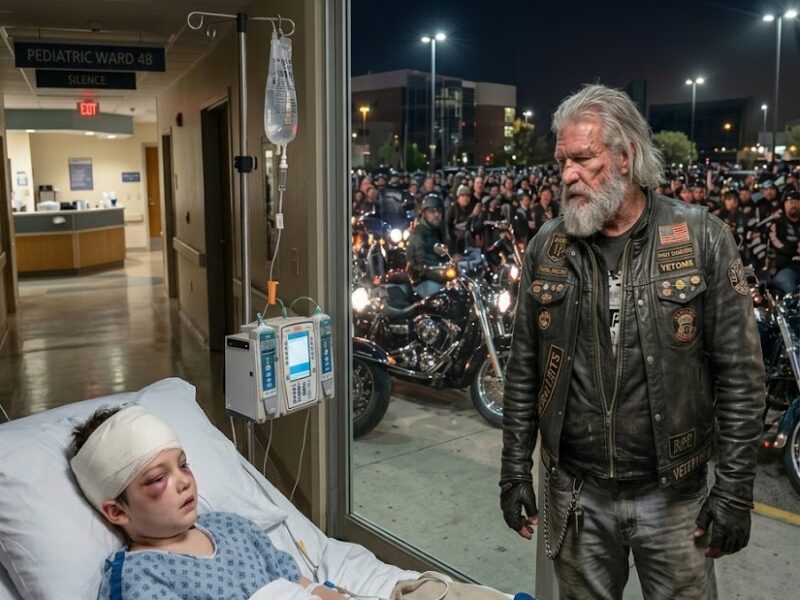
“‘A Hospital Begged a Hells Angel to Come Now’ — 300 Bikers Changed Everything in an Instant!”
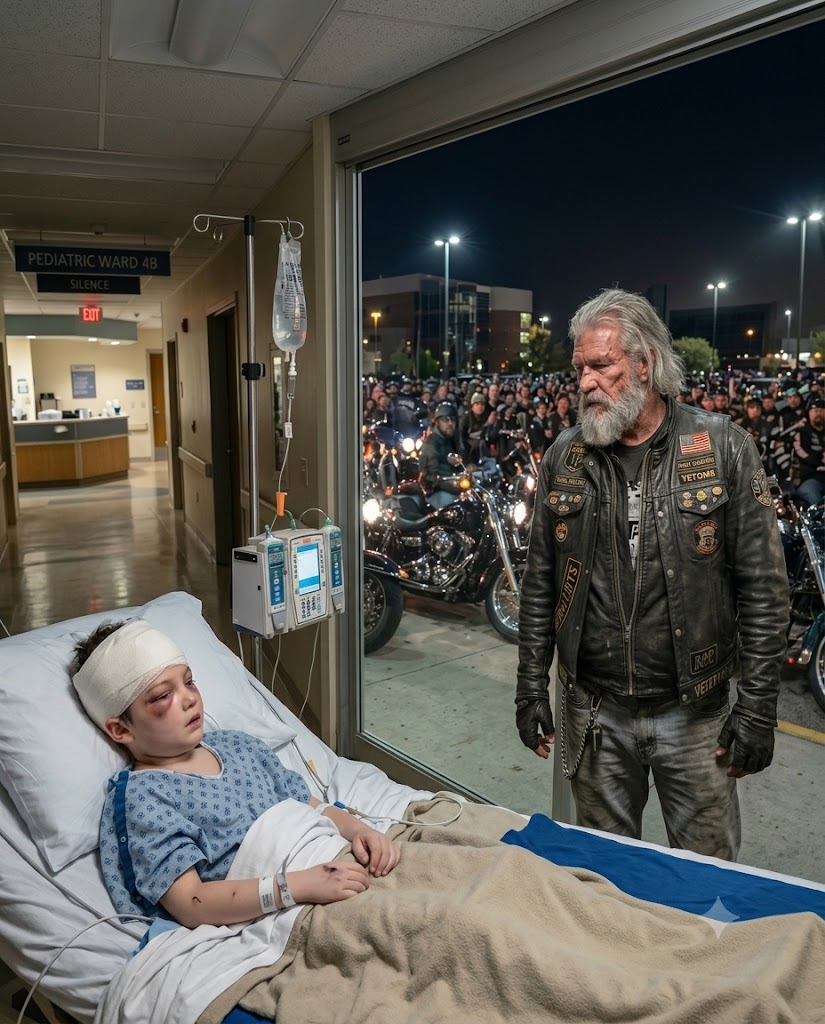
Fluorescent lights hummed over pale linoleum, smelling of bleach and quiet desperation.
Dr. Harrison held the phone with trembling fingers, the plastic slick against his palm.
On the other end of the line wasn’t a surgeon or a specialist.
It was a man with a rap sheet longer than a CVS receipt wearing a leather cut patched with a winged skull.
Hospitals don’t call the Hells Angels unless heaven has already hung up.
But tonight, a broken kid needed a miracle, and angels of a different breed were the only ones equipped to deliver.
—
Dean sat heavily on a cracked vinyl stool that sighed under his weight.
The clubhouse smelled the way it always did on a Tuesday night, a stale cocktail of spilled draft beer, cheap pine cleaner, and the heavy unwashed musk of damp leather.
Rain beat a chaotic rhythm against the corrugated tin roof, a sound Dean usually found comforting.
Tonight it just made his bad knee throb.
He dragged a thumb over his jaw, feeling the graying stubble snag against a crescent-shaped scar near his chin.
At 54, his body was a road map of poor decisions and pavement burns.
He wasn’t a savior.
He was a tired man, nursing a lukewarm whiskey, trying to ignore the dull ache in his lower back.
Across the room, a pair of pool balls cracked together with a sharp clack, followed by the low, rumbling laughter of men who communicated entirely in insults and grunts.
When his cell phone vibrated against his thigh, Dean ignored it.
He took a sip of his drink.
The whiskey tasted like copper and oak burning pleasantly down his throat.
The phone buzzed again, an angry, persistent vibration that rattled the loose change in his pocket.
He pulled it out, squinting at the cracked screen.
The caller ID was a sterile, generic string of numbers, a landline.
“Yeah,” Dean barked into the receiver, his voice like grinding gravel.
“Dean, it’s Harrison.”
Dean froze.
The ambient noise of the bar seemed to dial back a fraction.
He knew that voice.
Doctor David Harrison.
Four years ago, Harrison had spent six hours pulling fragments of a shattered collarbone out of Dean’s shoulder after a semi-truck clipped his bike on Interstate 90.
Harrison hadn’t asked questions about the unregistered firearm in Dean’s saddle bag or the erratic nature of the crash.
He just did his job, saved Dean’s arm, and kept his mouth shut.
In Dean’s world, a man who kept his mouth shut was a man you owed your life to.
“Doc,” Dean said, leaning forward, resting his heavy forearms on the sticky wood of the bar.
“It’s past midnight. You don’t call me for medical advice.”
“I need a favor,” Harrison said.
His voice was entirely wrong.
It lacked the steady clinical detachment Dean remembered.
Harrison sounded breathless, frayed at the edges.
“A massive one, and I need it right now.”
Dean sighed, rubbing his forehead.
“Doc, I don’t do collections. If you’re in hock to someone, it’s not me.”
Harrison interrupted.
In the background, Dean could hear the frantic beeping of monitors and the squeak of rubber soles on tile.
“It’s a kid. Nine years old. Name is Toby. He was brought in three hours ago.”
Dean stared at the amber liquid in his glass.
“I ain’t a pediatrician.”
“Listen to me.” Harrison’s voice cracked, and that tiny imperfect sound made Dean sit up straighter.
“Toby was beaten badly. A group of older kids. They caught him walking home. Threw him into a concrete drainage ditch. He’s in a coma. We’ve stabilized his vitals, but his brain activity is dropping. He’s slipping away, Dean. He’s just giving up.”
“And what the hell am I supposed to do about that?” Dean asked, frustration bleeding into his tone.
He hated feeling helpless.
He preferred problems he could punch, intimidate, or outride.
“You want me to find the kids who did it?”
“No,” Harrison said sharply.
“The police have them. What I need is you, Toby. His walls are covered in motorcycle posters. Harleys. He used to sit on the overpass just to watch you guys ride out on the weekends. His mother said it was the only time he ever smiled. Dean, there’s a study. Intense localized sensory stimulation, specifically low-frequency vibrations, can sometimes pull a severely traumatized brain back from the brink of a deep dissociative coma. It’s a massive long shot, but his brain waves are flatlining. If we don’t stimulate his nervous system in the next hour, he’s not waking up.”
Dean squeezed his eyes shut.
The smell of the bar, the nicotine, the sweat suddenly felt suffocating.
“Doc, you want me to bring a bike into the ICU?”
“I want you to bring the whole damn chapter to the parking lot,” Harrison said, a desperate edge of hysteria creeping in.
“Bring every bike you can find. Park them right under the second-floor windows of the pediatric wing. I need noise, Dean. I need vibration. I need him to feel it in his bones.”
Dean looked at the phone.
It was insane.
It was a logistical nightmare.
The police would be called.
There would be arrests, noise violations.
“Please,” Harrison whispered.
“I stitched you back together. Help me hold this kid together.”
Dean didn’t say goodbye.
He hung up, shoved the phone back into his denim pocket, and stood.
His bad knee popped loudly.
He walked over to the pool table, reached out a heavy, calloused hand, and caught the cue ball right before it hit the eight.
The players looked up instantly furious, but the anger died in their throats when they saw Dean’s eyes.
“Kickstands up in ten,” Dean said softly, though the grit in his voice carried across the room.
“Call the prospects. Call the nomads. Call anyone with an engine over a thousand cc within a twenty-mile radius. We’re going to the hospital.”
—
The lot behind the clubhouse was a graveyard of crushed gravel, rusted car parts, and stubborn weeds.
Stepping out into the damp night air, Dean felt the chill instantly bite through his leather cut and thin cotton t-shirt.
The rain had stopped, leaving behind a thick, suffocating humidity that carried the metallic scent of wet asphalt and unburned hydrocarbons.
Within minutes, the quiet night was shattered.
It started as a singular guttural cough, a 1,340 cubic centimeter Evolution engine kicking into life, spitting a puff of blue smoke into the damp air.
Then another joined in, then five, then twenty.
Dean straddled his own Road King, the leather seat cold and damp against his jeans.
He twisted the throttle, feeling the heavy rhythmic thud of the engine vibrate up through his boots, up his spine, settling deep in his chest.
It was a familiar, violent comfort.
He watched his brothers assemble.
These weren’t men who belonged in sterile hospital corridors.
They were bouncers, mechanics, ex-convicts, and drifters.
They wore scuffed boots, faded denim, and heavy silver rings that doubled as brass knuckles.
They smelled of motor oil, cheap tobacco, and defiance.
They didn’t ask questions.
Dean said, “Ride,” so they rode.
As they pulled out of the lot, a chaotic symphony of roaring pipes and rattling chrome, Dean checked his mirrors.
The line of headlights stretched back further than he expected.
Word had spread fast on the encrypted channels.
Guys from rival chapters, independent riders who just hung around the fringes.
If they had a bike and heard the call, they showed up.
By the time they hit the main stretch of the highway, the pack had swelled.
Fifty became one hundred.
One hundred became two hundred.
Three hundred motorcycles riding in tight formation is not a procession.
It is a localized weather event.
The sound was absolute.
It swallowed the hum of city traffic, drowning out sirens and street noise.
The air itself seemed to ripple with the concussive force of three hundred open exhaust pipes.
Commuters in sedans instinctively pulled over, their faces pale behind rain-streaked windows, eyes wide with a mixture of awe and fear.
Dean caught the gaze of a man in a Toyota Camry.
The man looked terrified, locking his doors as Dean rumbled past.
Dean felt a bitter smirk tug at the corner of his mouth.
“Yeah, lock your doors,” he thought.
“We’re the monsters.”
The internal contradiction sat heavy in his gut.
They were riding to save a life, yet every instinct, every piece of their outward identity screamed violence and intimidation.
Dean gripped the clutch, his knuckles white and aching.
He didn’t feel like a good man.
He felt like a blunt instrument being wielded by a desperate doctor.
The city flashed by in streaks of neon and amber street lights.
The bitter wind whipped at Dean’s face, forcing tears from the corners of his eyes, though he’d never admit it was anything but the wind.
The smell of exhaust was thick, choking, a mechanical perfume that bonded them together as a single moving organism.
They weren’t riding with a police escort.
They were blowing through red lights, prospects blocking the intersections to keep the massive steel snake moving unbroken.
It was illegal.
It was dangerous.
It was exactly what was needed.
As they neared the downtown medical district, the brutalist architecture of St. Jude’s Memorial Hospital loomed into view.
It was a massive slab of concrete and glass, aggressively sterile and entirely devoid of warmth.
It looked like a place where things went to be forgotten.
Dean raised his left hand, holding up a single leather-clad finger.
The signal rippled back through the sea of riders.
Prepare to stop.
They didn’t park in the visitor structure.
They swarmed the main courtyard.
Heavy boots kicked down kickstands onto manicured flower beds.
Wide tires left deep, muddy trenches in the pristine sodden lawns.
Three hundred bikes packed tightly into the horseshoe driveway, filling every inch of concrete directly beneath the second-floor pediatric wing.
When the engines were cut, the silence that followed was jarring, ringing in Dean’s ears like a physical pressure.
The only sound was the sharp ping of cooling exhaust pipes and the heavy breathing of the riders.
Dean dismounted, his boots crunching loudly on the wet pavement.
He looked up at the second-floor windows.
Behind the reinforced glass, he could see the pale, terrified faces of nurses and orderlies peering down at the sea of leather and metal that had just invaded their sanctuary.
“Hold here,” Dean grunted to the men nearest him.
“Don’t start until I give the word.”
He walked toward the sliding glass doors of the main entrance.
The automatic doors parted and a blast of overly air-conditioned, aggressively sanitized air hit him in the face.
The smell was instantly nauseating, a mix of iodine, harsh floor wax, and the metallic tang of fear.
It was the smell of death trying to be masked by chemicals.
A security guard, a kid no older than twenty with a patchy mustache and a uniform slightly too big for him, stepped nervously into Dean’s path.
His hand hovered over his radio.
“Sir, you—you can’t have those vehicles parked there. This is a fire zone. I’ve already called the police.”
Dean didn’t break stride.
He just looked at the kid.
It wasn’t a glare.
It was the flat, dead-eyed stare of a man who had seen the inside of more jail cells than the kid had seen movies.
The guard swallowed hard and stepped backward, pressing his spine against the reception desk.
“Where is Harrison?” Dean asked, his voice low, scraping the bottom of his throat.
“I’m here.”
Dean turned.
Dr. Harrison stood at the end of the corridor.
He looked like hell.
His green scrubs were wrinkled, and a dark smear of dried blood stained the knee of his pants.
Dark circles hung under his eyes like bruised fruit.
“You brought them,” Harrison breathed, walking toward Dean.
He looked past Dean’s shoulder, out through the glass doors at the idling army in the courtyard.
“You asked,” Dean said simply.
He crossed his arms, acutely aware of how much space he took up in the narrow white hallway.
He felt filthy.
The grime of the road, the sweat, the oil, it all felt magnified under the harsh fluorescent lights.
“Tell me this isn’t a waste of time, Doc.”
“I don’t know,” Harrison admitted, running a shaking hand through his thinning hair.
“Toby’s bradycardic. His heart rate is dropping. His core temp is dropping. The neurologist says his brain waves are flattening out into delta sleep and he’s not cycling back up. He’s letting go.”
Dean clenched his jaw.
He thought about a nine-year-old kid in a concrete ditch.
He thought about his own son, a kid he hadn’t spoken to in six years, and the hollow ache that thought always brought with it.
“Which room?” Dean asked.
“214. Directly above the main doors.” Harrison pointed up.
“The windows are double-paned, but if you guys—”
“We’ll break the glass if we have to,” Dean said.
He turned on his heel and walked back out the sliding doors.
The damp air wrapped around him again.
Three hundred pairs of eyes watched him.
They were waiting.
They didn’t care about the cops that were inevitably on their way.
They didn’t care about the noise ordinance.
They were waiting for their president to tell them what to destroy.
Dean walked to the center of the driveway.
He looked up at the window of room 214.
The blinds were drawn.
A pale yellow rectangle against the dark brick of the hospital.
He didn’t give a speech.
He didn’t yell.
Dean just climbed onto his Road King, gripped the handlebars, and kicked it hard into neutral.
He looked at the rider to his left, a scarred giant named Bear, and nodded.
Dean twisted his throttle, pinning it wide open.
The engine screamed, a deafening, violent roar that tore through the quiet night.
A split second later, Bear did the same.
Then the rest followed.
Three hundred massive engines redlined simultaneously.
It wasn’t just noise.
It was a physical force.
The sound waves hit the hospital building like a kinetic strike.
The ground beneath Dean’s boots trembled violently.
The manicured bushes shook, shedding wet leaves.
The air in the courtyard compressed and expanded, vibrating with an intensity that rattled the teeth in Dean’s skull.
Through the chaos, Dean kept his eyes fixed on the window of room 214.
The thick glass of the hospital panes actually blurred, vibrating furiously against their frames.
The smell of burning rubber and rich unspent fuel filled the courtyard as a few guys locked their front brakes and let their rear tires spin, kicking up plumes of thick white smoke that drifted up toward the second floor.
It was ugly.
It was aggressive.
It was a massive, unapologetic display of raw mechanical power.
Dean held the throttle open until his hand cramped, his engine running so hot he could feel the heat baking his right thigh.
He didn’t look away from the window.
“Wake up, kid,” he thought, the words buried under the apocalyptic roar of the machines.
“Don’t let the bastards win. Wake up.”
—
Vibration is not just a sound.
It is a physical entity.
It possesses weight, mass, and an aggressive tactile presence.
As three hundred heavyweight motorcycle engines redlined in the tight concrete amphitheater of the hospital courtyard, the air itself turned into a solid object.
It battered against the brickwork.
It hammered at the reinforced glass of the second-floor windows.
It crept through the foundational pylons of St. Jude’s Memorial, traveling up the steel rebar like an electrical current.
Dean felt his teeth rattling.
The heat radiating off his Road King’s V-twin engine was becoming unbearable, baking his inner thighs through his thick denim jeans.
The smell of the courtyard had shifted entirely.
The sterile iodine-laced exhaust from the hospital’s vents was completely obliterated, replaced by a choking toxic cloud of unspent high-octane fuel, atomized motor oil, and the sharp acrid sting of melting rubber.
To his left, Bear sat stoically on his heavily modified Shovelhead, one massive grease-stained hand clamped tight on the throttle.
Bear’s eyes were shut, his bearded face locked in a grimace as the deafening mechanical scream washed over them.
Behind them, rows and rows of men held the line.
Nobody let up.
Nobody checked their watches.
They were an orchestra of blunt force trauma, and they were playing until the conductor told them to stop.
Up in room 214, the sterile sanctuary of the intensive care unit was falling apart.
Sarah, Toby’s mother, sat shivering in a hard plastic chair beside the bed.
She had spent the last three hours locked in a state of numb paralysis, staring at the translucent bruised skin of her nine-year-old son.
His head was wrapped in thick white gauze, a stark contrast to the deep purple and yellow contusions painting his jaw and orbital bones.
He looked impossibly small amidst the tangle of corrugated plastic ventilator tubes and IV lines.
The monitors beside him had been softly, steadily chiming a rhythm of defeat, a slow, lethargic pulse that the neurologist warned was the precursor to brain death.
When the noise hit, it didn’t arrive as a sound.
It arrived as an earthquake.
The heavy oak door of the hospital room rattled violently in its metal frame.
The half-empty plastic cup of water on Toby’s bedside table began to vibrate, concentric rings rippling outward until the water physically leaped over the rim, splashing onto the linoleum.
Sarah gasped, throwing her hands over her ears, her eyes darting to the window in sheer terror.
The double-paned glass was bowing inward, vibrating with a frantic, humming intensity.
The floor under her sneakers buzzed.
It was a deep, guttural frequency that completely bypassed the eardrums and settled directly into the marrow of her bones.
Dr. Harrison stood at the foot of the bed, his hands gripping the metal railing so tightly his knuckles were white.
The noise inside the room was deafening, a localized hurricane of low-end frequency.
He couldn’t hear the heart monitor anymore.
He couldn’t hear the hiss of the ventilator.
He could only feel the chaotic rhythmic pounding of three hundred combustion engines directly beneath them.
“What is happening?” Sarah screamed, though her voice was entirely swallowed by the roar.
She grabbed Harrison’s scrub top, her eyes wide, manic.
“Make them stop. They’re going to kill him.”
Harrison didn’t look at her.
He didn’t blink.
He kept his bloodshot eyes locked entirely on the digital displays of the life support machinery.
The metal bed frame was vibrating.
The mattress was vibrating.
Toby’s small broken body was physically trembling under the sheer kinetic force of the sound waves.
Harrison had read the case studies.
Deep traumatic comas sometimes locked the brain into an impenetrable fortress of delta waves.
The nervous system shut the doors and pulled the blinds to protect itself from the agony of the physical trauma.
To break the siege, you couldn’t just knock.
You had to blow the gates off their hinges.
You needed extreme sensory overload.
He watched the EEG monitor.
The jagged green lines tracking Toby’s brain waves had been flat, rolling hills of nothingness for hours.
“Come on,” Harrison whispered, the words vibrating against his own teeth.
“Feel it, Toby. Feel the road. Wake up.”
Down in the courtyard, Dean’s right hand was cramping violently.
The lactic acid burned through his forearm.
Air-cooled engines were not designed to sit stationary at maximum RPMs.
They needed wind.
They needed momentum.
Without it, they were just heavy metal ovens cooking themselves to death.
The engine block between his legs was ticking furiously, the metal expanding under the extreme heat.
A plume of white smoke erupted from a bike three rows back, a blown head gasket.
The rider cursed, cutting the engine, but the roar of the remaining 299 swallowed the failure instantly.
Dean swallowed the dry, foul-tasting air.
His eyes stung from the exhaust fumes.
“If this doesn’t work,” he thought, staring up at the vibrating window, “I’m just an old fool ruining hospital equipment.”
Then the flashing red and blue lights painted the damp brick wall of the courtyard.
The police did not arrive quietly, though their sirens were entirely useless against the sonic wall the bikers had erected.
Ten black and white cruisers jumped the curb, their heavy tires tearing through the wet grass, forming a staggered barricade across the exit of the hospital courtyard.
Doors flew open.
Uniformed officers stepped out, the strobing emergency lights reflecting off the chrome and black leather of the assembled horde.
They unholstered their weapons immediately, using the heavy steel doors of their cruisers for cover.
The air was instantly thick with a new kind of tension, a sharp, lethal electrical charge that cut right through the exhaust smoke.
Dean saw them in his rearview mirror.
He didn’t turn his head.
He didn’t ease off the throttle.
He just locked eyes with Bear.
Bear gave a slow, barely perceptible nod.
The prospect riders on the outer edges of the formation shifted their weight, angling their heavy bikes slightly to form an impenetrable wall of hot steel between the core of the group and the police line.
Captain Davis, a twenty-year veteran of the precinct with a thick graying mustache and a face like beaten leather, marched forward.
He was screaming, his face purple with rage, but the sound of his voice died before it moved three feet from his mouth.
He walked directly up to the front line, stepping over the trampled flower beds, stopping mere inches from Dean’s front tire.
Davis pulled a heavy black maglite from his belt and slammed it down hard on the chrome headlight housing of Dean’s Road King.
Clang.
Dean glared down at the captain.
Slowly, agonizingly, Dean rolled the throttle back.
The RPMs dropped, the deafening scream lowering into a heavy, thunderous idle.
Seeing their president back down, the rest of the pack followed suit.
The transition from an apocalyptic roar to a rumbling collective idle left a ringing vacuum in the air.
“Cut the engine, Dean,” Davis roared, his voice cracking from the effort.
He kept his hand resting heavily on the butt of his service weapon.
“Cut the damn engine and get off the bike.”
Dean looked at the cop.
He looked at the drawn guns forming a semicircle behind him.
Then he looked up at the window of room 214.
The yellow light was still on.
“Can’t do that, Captain,” Dean said.
His voice was calm, a low, gravelly rasp that barely carried over the idling V-twins.
“We got a job to do.”
“You are creating a public hazard,” Davis shouted, pointing a thick finger at Dean’s chest.
“You are blocking an emergency lane, violating a dozen noise ordinances, and disturbing a hospital. I will arrest every single one of you filthy bastards and impound these bikes. Shut it down now.”
Dean leaned back in his saddle.
His bad knee throbbed, a dull spike of pain shooting up his thigh.
He felt exhausted.
He felt older than his fifty-four years.
He looked at Davis, a man he had clashed with over bar fights, illegal rallies, and highway blockades for over a decade.
“There’s a kid up there, Davis,” Dean said slowly, resting his heavy forearms on his handlebars.
“Nine years old. Beaten half to death. Doc Harrison says the kid’s slipping away. Says he needs the vibration. Needs the noise to wake up his brain.”
Davis stared at him, his face twisting in disbelief.
“Are you out of your mind? That is the most unscientific, reckless garbage I’ve ever heard. You are terrifying a hospital full of sick people.”
“Maybe,” Dean admitted.
He ran a thumb over the scar on his jaw.
“But Harrison cut me open and put me back together when I was bleeding out on the asphalt. If he says the kid needs thunder, I bring thunder. I owe the man.”
“I don’t care about your twisted sense of honor, Dean.” Davis snarled, taking a step closer.
The heat radiating off the motorcycle engine forced him to squint.
“You have sixty seconds to disperse. After that, we start making arrests. We start breaking heads. Don’t test me tonight.”
Dean looked around.
He looked at the tired, hard faces of the men who had followed him here.
Some of them had warrants.
Some of them were carrying unregistered iron.
If the cops moved in, it wouldn’t be a peaceful surrender.
It would be a bloodbath on the hospital lawn.
Batons against heavy chains, bullets against leather.
It was exactly the kind of chaotic violence Dean usually thrived on.
But tonight, looking at the blinking red and blue lights, Dean felt a strange hollow ache in his chest.
He thought about his own kid.
He remembered sitting in a hospital waiting room twenty years ago, smelling this exact same chemical stench of bleach and fear, waiting for a doctor to tell him if his boy was going to survive a fever.
He remembered the utter crushing helplessness.
He wasn’t going to let that mother in room 214 feel that.
Not if he could help it.
“Davis,” Dean said, his voice dropping an octave, carrying a dangerous absolute finality.
“You haven’t got enough cuffs to arrest three hundred men, and you haven’t got enough tow trucks to move this much iron. You want a riot? You’ll get one. It’ll make the national news. Cops beat up bikers trying to save a dying nine-year-old.”
Davis froze.
His eyes darted across the sea of idling motorcycles.
He did the math.
The tactical disadvantage was staggering.
“You’re holding a hospital hostage,” Davis hissed, though the venom in his voice had lost its confidence.
“We’re keeping a kid tethered to the earth,” Dean corrected.
He reached down and gripped the throttle.
“Give us five more minutes. If the doc says it’s a bust, we roll out peacefully. No trouble. But until then, we ride the red line.”
Before Davis could object, Dean twisted his wrist.
The Evolution engine exploded back into a deafening roar.
Davis flinched, taking a quick step back as the sheer kinetic force of the exhaust hit him.
He looked at Dean, a mixture of absolute hatred and begrudging respect warring in his eyes.
He didn’t order his men to lower their weapons, but he didn’t order them to advance either.
He just stood there in the toxic, vibrating heat, trapped in the standoff.
Dean locked his elbows, holding the throttle wide open.
His ears were ringing so hard he tasted copper.
The engine block was practically glowing, radiating a terrifying amount of heat.
“Five minutes,” he thought, staring relentlessly at the second-floor window.
“Come on, kid. I’m cooking my engine for you. Wake the hell up.”
—
The mechanical strain was reaching its absolute limit.
The air in the courtyard was unbreathable.
Ash and tiny specks of burnt rubber drifted down like dirty snow in the harsh glare of the police floodlights.
The noise had moved past deafening and into a state of sensory obliteration.
It felt as though gravity itself was failing under the immense pressure of the sound waves.
Inside room 214, the world was shaking apart.
A plastic tray of surgical instruments rattled off a side table, clattering against the vibrating linoleum.
Sarah was on her knees, her hands pressed desperately against her son’s motionless legs.
She was crying, but the tears were shaken from her cheeks by the tremor in the floor.
Dr. Harrison was sweating through his scrubs, the monitors were glitching, the digital displays flickering under the intense vibrational stress.
It was a mad, desperate gamble.
He was subjecting a severely traumatized brain to the equivalent of a sonic boom.
“Look!” Sarah suddenly shrieked, pointing a trembling finger.
Harrison snapped his gaze to the EEG monitor.
The flat rolling green hills of delta sleep were suddenly spiking.
Sharp, frantic peaks of beta waves jagged across the screen.
Toby’s heart rate monitor, which had been a sluggish, fading forty beats per minute, suddenly jumped.
Sixty.
Eighty-five.
One hundred ten.
The alarm began to blare, a shrill, piercing electronic scream that cut through the low-end rumble of the motorcycles outside.
Harrison rushed to the bedside.
He grabbed his pen light from his breast pocket.
He peeled back Toby’s bruised eyelid and flashed the harsh light across the pupil.
The pupil constricted.
It was sluggish, resisting the light, but it moved.
Toby’s jaw, slack and bruised, suddenly tightened.
His fingers, lying limp against the sterile white sheets, twitched.
It wasn’t a grand cinematic awakening.
He didn’t sit up and gasp for air.
He just groaned, a weak, breathless sound of profound pain and confusion.
It was the most beautiful sound Harrison had ever heard.
“He’s crossing over!” Harrison shouted over the noise, tears suddenly springing to his exhausted eyes.
“He’s coming up. The sympathetic nervous system is firing.”
Harrison spun around, abandoning the bedside.
He sprinted toward the window, his rubber-soled shoes slipping on the spilled water.
He grabbed the heavy plastic blinds and ripped them upward, exposing the glass.
Down in the courtyard, Dean’s vision was blurring.
His arms were numb from the elbow down.
The heat rising from his engine was scorching his chin.
Several bikes around him had already died, their engines seizing from the sheer thermal overload.
Bear’s Shovelhead was spewing thick black smoke, but the giant man refused to let up, coughing violently through the fumes.
Suddenly, the yellow rectangle of the window flashed.
Dr. Harrison stood pressed against the vibrating glass.
He was waving his arms frantically, giving a sharp, desperate thumbs up, then slashing his hand across his throat in a universally understood gesture.
Cut it.
Dean didn’t hesitate.
He slammed his palm against the kill switch.
He raised his left fist high into the smoky air.
Instantly, the roar began to die.
It didn’t happen all at once, but rather in a rapid cascading sequence of dying engines.
Pop, pop, silence.
Within ten seconds, the final engine choked out.
The silence that rushed into the courtyard was violent.
It felt heavy, oppressive, and utterly disorienting.
After twenty minutes of absolute sonic assault, the quiet was a physical pressure against the eardrums.
All Dean could hear was a high-pitched, incessant ringing in his own head, and the loud, frantic tink-tink-tink of three hundred incredibly hot engines rapidly cooling in the damp night air.
Dean slowly uncurled his stiff fingers from the grips.
His hands were shaking uncontrollably, trembling with phantom vibrations.
He swung his heavy leg over the saddle, his bad knee buckling slightly as his boot hit the pavement.
He leaned his weight against the hot leather of the seat, gasping for breath, the taste of gasoline thick on his tongue.
Around him, men were coughing, spitting onto the grass, rubbing their ringing ears.
Nobody cheered.
Nobody high-fived.
They looked like soldiers who had just survived an artillery barrage.
They were filthy, exhausted, and covered in a fine layer of soot.
Captain Davis lowered his hand from his gun.
He stood in the silence, looking at the bikers, then looking up at the window.
The hostility hadn’t vanished, but the immediate threat of violence had evaporated, replaced by a strange shared exhaustion.
The heavy automatic sliding doors of the hospital entrance hissed open.
Dr. Harrison walked out.
He looked completely unhinged.
His hair was plastered to his forehead with sweat.
His scrubs were clinging to his chest, and he was trembling.
He walked slowly through the maze of parked motorcycles, stepping over oil puddles and crushed grass until he reached Dean.
The entire courtyard held its breath.
The police officers stood frozen.
Three hundred bikers watched the doctor.
Harrison stopped in front of Dean.
He looked at the massive scarred biker, taking in the leather, the grime, the aggressive patches sewn onto his cut.
“He opened his eyes,” Harrison said.
His voice was a hoarse, broken whisper, barely carrying in the quiet night.
“His brain activity spiked. He’s—he’s out of the coma, Dean. He’s going to be in a hell of a lot of pain, and he’s got a long road, but he’s awake. He’s holding his mother’s hand.”
Dean stared at the doctor.
He didn’t smile.
He just let out a long, slow breath through his nose, his broad shoulders dropping a fraction of an inch.
“Good,” Dean grunted.
The word felt like sandpaper in his throat.
He reached into his leather vest, pulled out a crushed pack of cigarettes, and put one between his lips.
He didn’t light it.
He just needed something to bite down on to stop his jaw from trembling.
He looked past Harrison, making eye contact with Captain Davis.
“We’re done here,” Dean said, his voice loud enough to carry across the pavement.
He turned to Bear.
“Tell the boys to fire ’em up. Keep it quiet. We roll out in twos. Don’t give the uniforms an excuse.”
Dean didn’t wait for a response.
He climbed back onto his Road King.
It fought him, the starter whining sluggishly against the heat-swollen engine block, but it finally caught with a low, exhausted rumble.
He didn’t look up at the window again.
He didn’t need to.
He kicked the bike into gear and slowly let out the clutch, rolling past the police barricade and melting back into the dark, damp streets of the city, leaving nothing behind but the smell of burnt rubber and a kid who finally remembered how to wake up.
—
Cold wind howled through the empty canyon of the downtown financial district, biting at the sweat soaking through Dean’s cotton t-shirt.
He rode at the head of a shattered column.
The ride back to the clubhouse wasn’t a victory lap.
It was a limping retreat.
Out of the three hundred bikes that had swarmed St. Jude’s, at least forty had to be left behind in the hospital parking lot, their engines seized or gaskets blown from the sheer thermal stress of the prolonged redline.
Dean’s Road King sounded awful.
The normally rhythmic, heavy thump of the V-twin was completely out of time, gasping and sputtering with a metallic clatter that meant the pushrods were screaming for mercy.
The intense heat had baked the oil into a thin, useless sludge.
Every time he pulled the clutch lever, his left forearm cramped so violently his fingers curled into stiff hooks.
He didn’t care.
He just wanted the dark.
They crossed the steel grate bridge leading back into the industrial district, the tires humming a low droning note against the wet metal.
The city was asleep, oblivious to the fact that a war had just been fought and won on a patch of manicured grass twenty blocks away.
When they finally pulled into the gravel lot of the clubhouse, there was no celebratory revving.
Men killed their engines the second their kickstands hit the dirt.
The silence returned, heavy and absolute, broken only by the chorus of cooling metal.
Hundreds of exhaust pipes pinging and ticking as they shed the massive heat they had generated.
Dean swung his leg over the saddle and his bad knee simply gave out.
He caught himself against the leather saddle bag, his boots sliding in the damp gravel.
Pain, sharp and blinding, shot up his femur, settling deep in his hip socket.
He stood there for a long moment, his forehead resting against the cold, dew-slicked paint of his gas tank.
He smelled of unspent hydrocarbons, stale sweat, and cheap tobacco.
He felt completely hollowed out.
“You good, boss?”
Dean didn’t lift his head immediately.
He recognized the heavy rumbling voice.
Bear stood a few feet away.
The giant man’s leather cut was streaked with black soot, his thick beard smelling strongly of burnt rubber.
“Just old, Bear,” Dean grunted, finally pushing himself upright.
He tested his weight on the knee.
It held, but it protested violently.
“My bike’s chewing on its own valves. Sounded like a coffee can full of loose bolts coming over the bridge.”
“Yeah.” Bear chuckled, a dry, rasping sound.
“My Shovelhead is dead. Left it by the ER doors. Piston rings melted straight to the cylinder walls. Going to cost me two grand just to crack the block.”
Dean reached into his vest, pulling out the crushed pack of cigarettes.
He offered one to Bear, who took it with thick, grease-stained fingers.
Dean took one for himself, striking a match against the zipper of his jacket.
The sulfur flared, illuminating their exhausted, soot-stained faces in the dark lot.
They smoked in silence.
Around them, the rest of the club was slowly dispersing.
Some guys were piling into pickup trucks to go back for their stranded bikes.
Others were just sitting on the damp ground, staring blankly at the brick wall of the clubhouse, their nervous systems crashing hard after the massive adrenaline dump.
“You think the kid actually remembers any of it?” Bear asked quietly, exhaling a thick plume of gray smoke into the humid air.
Dean stared at the glowing cherry of his cigarette.
He thought about the yellow light of room 214.
He thought about the absolute terror on the faces of the nurses, the rage in Captain Davis’s eyes, and the desperate, unhinged look of Dr. Harrison.
“No,” Dean said flatly.
“Brain doesn’t work like that. He’s going to wake up hurting. He’s going to be looking at a hospital ceiling, smelling bleach, and throwing up from the painkillers. He ain’t going to remember a choir of angels outside his window. He’s just going to know he survived.”
“Ain’t that enough?”
“Has to be,” Dean muttered.
He dropped the cigarette butt onto the wet gravel and ground it out beneath his heavy steel-toed boot.
“Go home, Bear. Tell the prospects to lock the gate. We’re closed tomorrow.”
Dean didn’t go inside the clubhouse to drink.
He walked past the heavy steel door, down the dark alley, and unlocked the side entrance to his personal garage.
It smelled of sawdust, old oil, and the sharp tang of metal shavings.
It was cold, damp, and utterly isolated.
He stripped off his leather cut, dropping the heavy patch-covered vest onto a stained workbench.
It hit the wood with a heavy thud, the silver pins and chains clinking together.
He sat down on a mechanic’s stool in the dark.
His ears were still ringing, a high, persistent whine that burrowed deep into his skull.
He stared at his hands.
The knuckles were white, permanently swollen with arthritis, covered in tiny, jagged white scars from decades of using his fists to solve problems his brain couldn’t process.
He wasn’t a hero.
He ran illegal poker games.
He moved untaxed liquor.
He broke jaws when men didn’t pay their debts.
He had spent six years of his life in a concrete cell, eating terrible food and missing his son’s birthdays.
The world didn’t need men like him until the rules stopped working, when the polite, sterile machinery of society failed.
Then they called the monsters.
Dean rubbed his face with his calloused palms.
He was tired of being a monster, but he was too damn old to figure out how to be anything else.
—
Two weeks passed.
The humidity broke, giving way to a dry, bitter chill that stripped the leaves from the oaks and turned the city skyline into a sharp, unforgiving silhouette of gray and brown.
The fallout from the hospital was exactly what Dean expected, and yet entirely surprising.
The morning news had a field day.
“Biker gang terrorizes pediatric ward” was the headline on the local broadcast, accompanied by shaky smartphone footage of the massive crowd of leather-clad men sitting in the exhaust-choked courtyard.
The hospital administration issued a stern public condemnation of the reckless and dangerous stunt.
They talked about the cracked windows in the ICU, the ruined landscaping, and the terror inflicted upon the patients.
Dr. Harrison was quietly suspended, pending an internal review.
Dean didn’t care about the news.
He cared about the stack of citations sitting on the wooden bar of the clubhouse.
It was a Tuesday afternoon.
The bar was empty except for Dean, who was slowly stripping down a carburetor on a rag, smelling the sharp chemical tang of carb cleaner.
The front door creaked open, letting in a blinding shaft of pale autumn sunlight.
Captain Davis walked in.
He wasn’t in uniform.
He wore a faded canvas jacket and blue jeans, though he still walked with the stiff, authoritative spine of a cop.
He looked around the dim, stale-smelling room, his nose wrinkling slightly at the lingering scent of stale beer and old smoke.
Dean didn’t reach for a weapon.
He didn’t even look up from the small brass jets he was cleaning with a wire brush.
“We’re closed, Captain,” Dean said, his voice a low, scratching rumble.
“Unless you brought a warrant, the door’s behind you.”
Davis walked slowly toward the bar.
He pulled out a wooden stool, the legs scraping harshly against the linoleum floor, and sat down.
He placed a thick manila folder on the sticky wood.
“I’m not on the clock, Dean,” Davis said.
His voice lacked the booming, aggressive authority it had in the hospital courtyard.
He sounded just as tired as Dean felt.
Dean finally stopped wiping the brass jet.
He tossed the rag aside and looked at the cop.
Without a word, he reached under the bar, pulled out two heavy glass tumblers, and grabbed a bottle of cheap bottom-shelf whiskey.
He poured two neat fingers into each glass, sliding one across the wood toward Davis.
Davis stared at the amber liquid for a long time.
Then he picked it up and threw it back in one harsh swallow.
He winced, coughing slightly as the cheap alcohol burned a trail down his throat.
“I got thirty-four noise complaints,” Davis said, wiping his mustache with the back of his hand.
“Seventeen calls about a riot. Twelve calls about suspected gang violence. The hospital board wants to press charges for property damage, criminal trespassing, and reckless endangerment.”
Dean picked up his own glass, swirling the liquor slowly.
“So arrest me.”
“I pulled the dispatch logs,” Davis continued, ignoring the challenge.
He tapped the manila folder.
“I also pulled the kid’s medical file. Had a buddy in narcotics call a favor in with the records department.”
Dean took a slow sip of his whiskey.
It tasted like iodine and bad decisions.
“Thought you didn’t believe in unscientific garbage.”
“I don’t,” Davis said.
He leaned his forearms on the bar, looking directly into Dean’s eyes.
The animosity was still there, a foundational layer of their relationship, but it was muted by a begrudging, reluctant respect.
“Toby’s off the ventilator. Brain swelling went down. They moved him out of the ICU three days ago. Kid’s got physical therapy ahead of him, learning how to walk right again, but his cognitive function is intact.”
Dean felt a strange sudden tightness in his chest.
It wasn’t relief.
It was something heavier.
It was the crushing weight of a consequence he actually cared about.
He looked down at his dirty, scarred hands.
“Good,” Dean grunted.
“The hospital board was pushing hard for warrants,” Davis said, his tone entirely conversational, as if he were discussing the weather.
“But it’s funny. When my detectives went to interview the head nurse of the pediatric wing to get her statement on the terror you caused, she suddenly developed amnesia. Couldn’t identify a single patch. Couldn’t describe a single bike. Said it was too dark.”
Dean looked up, his brow furrowing.
“And the security cameras in the courtyard?”
Davis smirked, a small, cynical twist of his lips.
“Strangely, the digital files from that night were corrupted. A system error, the IT guy said. Completely unrecoverable.”
Dean stared at the cop.
The silence in the bar stretched out, filled only by the low hum of the beer cooler in the corner.
“So,” Davis stood up, pushing the stool back.
“Without witness testimony and without video evidence, the district attorney isn’t going to authorize a raid on three hundred bikers over some trampled sod and a few cracked windows. It’s a waste of taxpayer money.”
Davis turned and walked toward the door.
Just before he pushed it open, he stopped and looked back over his shoulder.
“Harrison gets his job back next week,” Davis said quietly.
“Board decided they didn’t want the PR nightmare of firing a doctor right after a miraculous recovery.”
The heavy wooden door clicked shut, leaving Dean alone in the dim light.
He looked at the manila folder left on the bar.
He reached out and flipped it open.
Inside was a single piece of paper.
It wasn’t a citation.
It was a crude crayon drawing on cheap construction paper.
It was a drawing of a motorcycle.
It was entirely disproportionate, drawn with heavy, aggressive lines of black and silver crayon.
The wheels were massive, the engine practically taking up the entire page.
And standing next to the bike was a stick figure wearing a black vest.
At the bottom, written in the shaky, uneven handwriting of a child whose motor skills were still rebooting, were two words: “Loud Angels.”
Dean stared at the drawing for a long time.
The smell of the carb cleaner burned his nostrils.
He carefully picked up the piece of paper, holding it by the very edges so he wouldn’t get grease on it.
He walked over to the dirty, cluttered corkboard behind the bar, pinned between unpaid liquor invoices and faded Polaroids of dead brothers.
He pinned the drawing right in the center.
—
Six months dragged by, pulling the city out of a bitter, bone-chilling winter and shoving it directly into a wet, suffocating spring.
Spring did not arrive quietly in this part of town.
It bled through the cracked asphalt in the form of stubborn, ugly weeds and hung in the air as a thick humidity that tasted of hot trash and damp exhaust.
Dean spent most of February and March in his cold, isolated garage, bleeding his knuckles against the engine block of his Road King.
The hospital run had nearly killed the machine.
It had cost him over three thousand dollars in parts.
Heavier pistons, bored-out cylinders, a reinforced clutch basket, and a new set of valves to replace the ones that had warped under the sheer thermal overload of that night.
Rebuilding the engine gave him something to do with his hands.
It kept him away from the clubhouse bar and the endless redundant conversations about territory and debt collection.
He needed the sharp chemical smell of parts cleaner and the heavy undeniable truth of torque specs.
A stripped bolt was a stripped bolt.
There was no ambiguity, no moral gray area.
When he finally fired the rebuilt engine in late April, it didn’t sound like the old bike.
It was deeper, angrier.
The heavy throb of the V-twin was resonant and flawless, a faultless mechanical heartbeat that vibrated up through the soles of his boots and settled directly into the marrow of his shins.
Sunday morning broke clear and painfully bright.
The air was unseasonably hot, baking the residual moisture out of the pavement and creating shimmering mirages over the blacktop.
Dean rode alone.
He had explicitly told Bear and the prospects he didn’t want company.
He wore a faded, oil-stained gray t-shirt under his heavy leather cut, the thick cowhide acting as a harsh oven in the morning sun.
The wind whipped at his collar, violently snapping the loose fabric of his sleeves against his forearms.
He took the long route out of the industrial district, pointing his front tire south toward the interstate, actively avoiding the grid of stoplights and the claustrophobic crush of commuter traffic.
Out here, the city thinned out into wide, sweeping arcs of elevated concrete and rusted steel guardrails.
Dean’s body hurt.
It always hurt, but the damp heat made the arthritis in his hands flare with a dull, throbbing intensity.
His right knee, shattered years ago and held together by surgical steel, ground miserably with every shift of his weight.
He was a fifty-four-year-old criminal riding a violently loud motorcycle, carrying a rap sheet that would make a judge weep.
The events at St. Jude’s Memorial hadn’t sparked some miraculous moral pivot.
He hadn’t found God.
He hadn’t quit the club.
Just last week, he had pinned a man against a brick wall by his throat over a missing shipment of untaxed cigarettes.
He was still a blunt instrument.
But sometimes, when the wind hit him just right and the engine hummed perfectly beneath him, the heavy, suffocating weight of his own life lifted just a fraction of an inch.
Ahead of him, the Route 9 overpass loomed.
It was a massive, brutalist slab of sun-baked concrete that aggressively spanned six lanes of highway.
The support pylons were thick and gray, heavily tattooed with layers of faded, illegible graffiti and choked at the base by rusted rebar and blown-out tire treads.
It was an ugly, functional piece of civic engineering, smelling eternally of ozone, hot tar, and pulverized brake dust.
Dean rolled off the throttle as he approached the long shadow cast by the bridge.
He downshifted, letting the engine braking slow his momentum.
The heavy pistons protested with a deep guttural popping sound that echoed sharply off the retaining walls.
He glanced up.
Standing dead center on the pedestrian walkway above, pressed hard against the heavy galvanized chain-link of the suicide fence, was a kid.
Dean’s right hand twitched instinctively on the grip.
The boy was small, swallowed up in an oversized red hoodie that looked far too warm for the humid morning.
He was heavily reliant on a pair of thick aluminum forearm crutches.
His left leg was entirely encased in a rigid black polymer brace that strapped around his thigh and ankle, forcing his posture into an unnatural listing lean.
The kid’s face was pale, drawn tight with the unmistakable, exhausting strain of chronic pain.
Faint yellowish shadows still lingered around his jawline and orbital bones, ghosts of the severe trauma that had nearly buried him six months ago.
But the boy’s eyes were sharp.
They tracked the approaching black motorcycle with absolute unbroken predatory focus.
Standing a few feet behind him, keeping a careful, anxious distance, was Sarah.
She wore a faded denim jacket, gripping a paper coffee cup with both hands as if it were an anchor keeping her tethered to the concrete.
She looked tired, the kind of deep cellular exhaustion that comes from spending half a year sleeping in hospital chairs and fighting insurance companies.
But there was a quiet, profound relief sitting comfortably on her shoulders.
Dean didn’t wave.
He didn’t tap his brakes.
He didn’t pull over onto the narrow gravel-strewn shoulder to march up the concrete embankment and offer the kid a tearful cinematic embrace.
That wasn’t who he was, and more importantly, it wasn’t what the kid needed.
Toby didn’t need a surrogate father, and he certainly didn’t need a violent felon inserting himself into his fragile, hard-won recovery.
They existed in two entirely different, deeply incompatible worlds.
Their orbits had violently collided for one chaotic night out of desperate necessity, and now they were drifting back to their natural trajectories.
But Dean understood the assignment.
As the Road King crossed the threshold of the overpass, plunging from the harsh, blinding sunlight into the cool, dark tunnel of the bridge’s shadow, Dean reached down, gripped the thick rubber of the throttle, and twisted his wrist hard.
He cracked it wide open.
The heavy rebuilt V-twin engine absolutely exploded.
In the confined acoustic chamber of the concrete underpass, the sudden mechanical roar was apocalyptic.
It wasn’t just loud.
It was a violent, concussive wave of kinetic energy.
The sound waves slammed aggressively against the low concrete ceiling, ricocheting down onto the asphalt and bouncing violently between the massive support columns.
The sheer volume pushed past the eardrums, vibrating the air so intensely it felt like a heavy physical blow to the sternum.
It was thunder captured in a bottle and suddenly uncorked.
Dean held the throttle pinned, feeling the intense, terrifying heat immediately radiating off the heavy engine block, baking his inner thighs through his denim jeans.
The vibration traveled up the front forks, numbing his hands instantly, shaking the handlebars with a chaotic, violent fury.
He briefly flicked his eyes up to his circular chrome rearview mirror.
Through the vibrating, distorted haze of the heat and blue exhaust smoke, he saw the boy.
Toby had dropped one of his aluminum crutches.
It clattered uselessly against the concrete walkway.
The kid was leaning his entire body weight against the heavy chain-link fence, gripping the galvanized steel wire with his bare hands.
He was soaking in the massive low-end frequency traveling up the pylons, through the concrete floor, and directly into his broken, healing bones.
The boy wasn’t smiling a soft, sweet, grateful smile.
He was grinning.
It was a fierce, feral, completely unrestrained expression of pure, unadulterated adrenaline.
It was the face of a kid who had been to the absolute edge of the abyss, looked down into the dark, and somehow clawed his way back up.
It was a raw, aggressive acknowledgment of survival.
Dean hit the other side of the tunnel, rocketing back out into the bright, suffocating spring sunshine.
He immediately rolled the throttle back, upshifting smoothly into fifth gear.
The apocalyptic roar instantly dialed back into a steady, rhythmic, heavy hum.
The sound quickly snatched away by the wind and the open highway.
He didn’t look in the mirror again.
Dean settled his weight deeper into the worn leather saddle.
He stared straight ahead at the shimmering heat waves rising off the blacktop.
His bad knee still ached, his knuckles still throbbed.
He was still a monster in the eyes of polite society, a man who moved in the dark and answered to no one but his brothers.
But as the heavy, reliable throb of the engine vibrated steadily through his chest, regulating his heartbeat to its mechanical rhythm, Dean let out a long, slow breath.
The bitter, cynical knot that constantly sat heavy in his gut loosened just for a moment.
He didn’t feel like a savior, but for the first time in a very long time, he didn’t hate the man in the mirror.
He just felt the wind, the heat of the engine, and the endless unforgiving stretch of the road ahead.
—
The Route 9 overpass faded in his mirrors, a gray slab swallowed by distance and heat shimmer.
Dean rode south for another twenty minutes before he pulled off at a truck stop that smelled of diesel and old coffee.
He killed the engine and sat there, letting the silence settle into his bones.
The rebuilt V-twin ticked as it cooled, a sound he knew better than his own heartbeat.
He thought about the kid’s grin.
Not the crutches, not the brace, not the pale bruised face.
The grin.
It was the same grin Dean had seen on young prospects the first time they cracked a hundred on a straightaway.
The same grin he’d worn himself, decades ago, before the scars and the jail time and the endless grinding weight of running a club.
For a moment, he let himself feel something that wasn’t quite pride and wasn’t quite relief.
It was closer to recognition.
He pulled out his phone, stared at the cracked screen, and scrolled through his contacts.
He stopped on a number he hadn’t called in six years.
His thumb hovered.
The screen dimmed, then went black.
Dean shoved the phone back into his pocket and stared out at the highway.
Some bridges, he figured, you don’t cross in a day.
Some you just keep riding toward, one mile at a time, until the road runs out or you do.
He fired the engine back up, pulled onto the interstate, and let the thunder carry him home.
If this story made your pulse pound or brought a sudden lump to your throat, you know what to do.
Hit that like button to show some respect for the Loud Angels.
Share this video with someone who needs a reminder that miracles don’t always wear white coats.
Sometimes they wear black leather and ride on two wheels.
Subscribe to the channel and ring that bell, because we drop gritty, real, and raw stories like this every single week.
Don’t just listen to the thunder.
Ride with it.
Drop a comment below.









