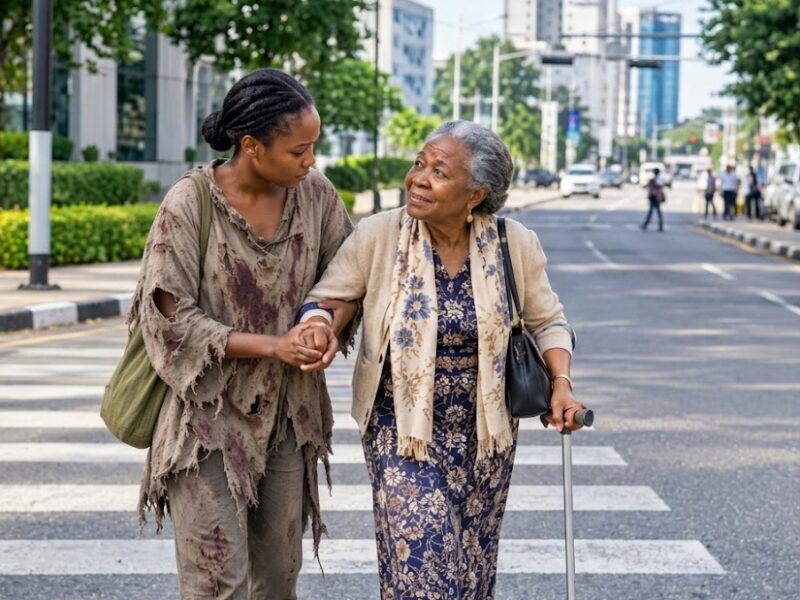
A Homeless Young Woman Helped an Elderly Stranger Cross the Street—Then a Family Pendant Revealed the Impossible
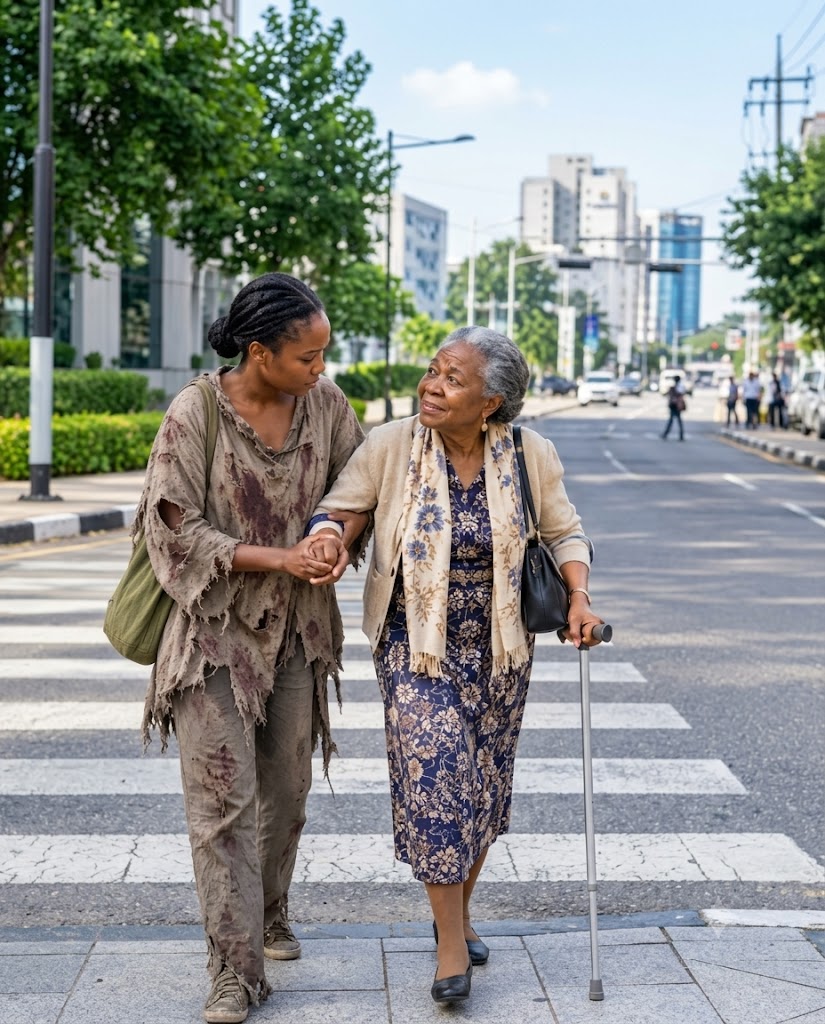
The traffic light on Canal Street had been stuck on red for three full minutes, and Priscilla was beginning to think the universe was testing her patience.
She stood at the corner with her cardboard sign pressed against her chest, the words NEED HELP ANYTHING COUNTS written in fading marker that had bled through from the other side.
Her shoes had holes in both soles, and the November wind coming off the river cut through her thin jacket like it was made of paper.
Across the intersection, an elderly woman stood frozen at the curb, her cane trembling in her grip as cars whipped past without slowing.
Priscilla watched her for a long moment, the way the woman’s white-knuckled hands gripped that cane, the way her expensive coat hung loose on shoulders that seemed too fragile to carry it.
Then without thinking, Priscilla tucked her sign under her arm and crossed the street.
“Ma’am, can I help you?” she asked, keeping her voice soft.
The woman turned to look at her, and Priscilla saw something in her eyes that she recognized—that particular exhaustion of someone who had been strong for too long and was running out of places to put the weight.
“Oh, my dear,” the woman said, her voice carrying the faintest accent, something African, maybe Nigerian. “I just need to get to the other side.”
Priscilla offered her arm, and the woman took it without hesitation, her grip surprisingly firm for someone who looked so frail.
They crossed together slowly, the woman’s cane clicking against the asphalt with each careful step.
“Take your time,” Priscilla said. “Easy now. Easy.”
“You don’t have to trouble yourself, my dear,” the woman said.
“It’s all right, ma. It’s all right. Just hold on to me.”
When they reached the other side, the woman didn’t let go right away.
She stood there on the sidewalk, looking at Priscilla with an intensity that made her want to look away.
“Thank you very much, my dear,” the woman said.
“Wait, ma,” Priscilla said, something making her bold. “What’s your name?”
“Priscilla,” the woman said. “And where is your family?”
The question hit like a physical blow, and Priscilla felt her throat tighten.
“I don’t have one, ma. Not anymore.”
“How long have you been on this street?”
“Some time now, ma.”
“By yourself?”
“Yes, ma’am.”
The woman reached into her purse—a designer bag that probably cost more than everything Priscilla owned combined—and pulled out a crisp hundred-dollar bill.
“Take this.”
“Ma, I can’t.”
“Please take it. Come and see me tomorrow.”
“Tomorrow?”
“Yes. If you can.”
She pressed a business card into Priscilla’s hand, the paper thick and embossed with gold lettering.
“Chief Mrs. Eno Adawi Ferguson.”
Priscilla stared at the name, something cold running down her spine.
“You’re… you’re that woman.”
“You know me.”
“I’ve heard your name before, ma.”
“Then you know where to find me. Ma, why? Why do you want me to come to your house?”
The woman—Mrs. Ferguson—studied her face for a long moment, and something in her expression shifted, became almost painful to witness.
“I don’t know how to explain it.”
“Explain what?”
“I just need you to come.”
“Madam—”
“Tomorrow, Priscilla.”
“All right, ma.”
Priscilla stood on the corner for a long time after the woman’s black car pulled away, the business card clutched in her hand like it might dissolve if she loosened her grip.
—
**Priscilla stood outside the tall black gate for almost ten minutes before she found the courage to press the intercom.**
The compound behind it looked like something from television—not real life, not anything that could possibly be connected to someone like her.
A long driveway lined with hibiscus bushes stretched toward a house that seemed to have too many windows to count, and in the center of the circular drive, a fountain actually worked, water arcing gracefully into the air.
Two luxury cars sat parked under a carport built specifically for cars, and Priscilla found herself wondering what it would feel like to ride in something that probably cost more than a house.
A gateman studied her for a long moment before letting her through, his eyes moving over her worn clothes the way people’s eyes always did—that particular look that said *you don’t belong here* without words.
She almost turned back three times before she reached the front door.
Inside, Mrs. Ferguson received her in a sitting room with cream-colored furniture and family photographs on every wall.
The woman had changed out of her street clothes into something simpler—a flowing house dress in deep blue—and without her scarf and jewelry, she looked smaller, older, more tired than she had on the street.
She also looked like she hadn’t slept.
“Sit, sit,” Mrs. Ferguson said, gesturing to the seat across from her. “Have you eaten today?”
“Not yet, ma.”
She called for the housekeeper to bring food, and within minutes there was jollof rice and fried plantains on the table—more food than Priscilla had eaten in one sitting in months.
She ate carefully, aware of every sound her fork made against the plate, aware that Mrs. Ferguson was watching her the entire time without pretending not to.
“Tell me about your parents,” Mrs. Ferguson said. “The ones who raised you.”
Priscilla told her about the tailor who had taken her in as an infant, who used to let her sit under his sewing table and play with fabric scraps while he worked.
She talked about his death, about the stepfather who came after, about being told there was no longer room for her in that house.
Mrs. Ferguson listened without interrupting, one hand resting against her chest as if it hurt to keep still.
“You have his patience,” she said quietly, though Priscilla didn’t understand who she meant.
The moment was interrupted by the sound of heels on tile.
A woman entered the room dressed sharply in an Ankara wrapper, gold bangles moving on her wrist as she walked.
“Eno, you didn’t tell me we had a visitor,” the woman said, smiling in a way that didn’t reach her eyes.
“This is Priscilla,” Mrs. Ferguson said. “My sister-in-law, Nkechi.”
Nkechi’s gaze moved over Priscilla slowly, taking in the torn sleeve, the dust still on her sandals.
“How generous of you to bring her inside,” she said to Mrs. Ferguson, though something in her tone suggested otherwise. “Let me have the girl freshen up while you rest. You get tired so easily these days.”
Mrs. Ferguson hesitated, then agreed, and Nkechi led Priscilla out through a side door toward the staff quarters, her hand light but firm on Priscilla’s shoulder the entire way.
“Wait here,” Nkechi said once they reached the back corridor. “Someone will bring you a change of clothes.”
She disappeared, and Priscilla waited alone for nearly twenty minutes before a security guard appeared with her bag in his hands—the one she’d left in the sitting room.
“Madam say make I check,” he said, avoiding her eyes as he opened it.
He pulled out a gold bracelet Priscilla had never seen before and held it up.
“Madam Nkechi, don’t call Oga. She say na her bracelet.”
The guard’s hand closed around Priscilla’s wrist before she could speak.
“I didn’t take anything,” she said. “I don’t even know what that bracelet is.”
“Now for your bag,” he said, not unkindly, but firm. “I no get choice.”
“Oh God, don’t call for gate.”
Two more staff appeared in the corridor, and word moved through the compound the way it always does in a house full of people who depend on each other’s good favor to keep their jobs.
By the time Mrs. Ferguson came out from the sitting room, drawn by the noise, a small crowd had gathered near the staff entrance, and Nkechi was already standing at the center of it, her voice raised just enough to be heard without seeming to perform.
“I only wanted to give the child new clothes,” Nkechi said. “And I find my bracelet sitting inside her bag. I don’t want to accuse anybody wrongly, but somebody should explain this to me.”
“I never touched it,” Priscilla said. Her voice came out smaller than she wanted.
Mrs. Ferguson looked between the two of them, and for a moment, something passed across her face.
Not quite doubt, but the exhaustion of a woman who had been disappointed by strangers claiming to be family before.
Priscilla saw it, and something in her chest went cold.
“Nkechi, are you certain?” Mrs. Ferguson asked.
“Am I in the habit of lying to you?” Nkechi said, and pressed her palm to her chest as if the question wounded her.
Mrs. Ferguson turned to the guard. “Let her go. I’ll handle it myself.”
She led Priscilla into a smaller room off the corridor, away from the staff, away from Nkechi, and shut the door.
For a long moment, she didn’t say anything, just studied Priscilla’s face the way she had studied it on the street, searching for something.
“I believe you,” Mrs. Ferguson said finally.
Relief moved through Priscilla, but Mrs. Ferguson wasn’t finished.
“But I need you to understand something. I have been fooled before. Women have come to my door claiming to be my blood, carrying stories that broke my heart. And every one of them wanted something from me before I could even confirm who they were.”
She paused.
“I am not accusing you. I am telling you why I cannot simply take you into this house tonight.”
“So what happens now?”
“You will go back to where you were. I will arrange a place for you to stay somewhere safe, somewhere clean, and I will do the test properly through my own doctor, not through anybody in this family.”
Her eyes moved briefly toward the door, toward the corridor where Nkechi’s voice could still be heard instructing the staff.
“Some people in this house will not want that test to happen.”
—
**She wrote an address on a piece of paper and pressed it into Priscilla’s hand along with enough money for a taxi.**
“Come Thursday,” Mrs. Ferguson said. “Tell no one where you’re going, not even the driver who takes you there.”
The guest house Mrs. Ferguson arranged sat behind a produce market in Surulere, small but clean, with a woman named Mama Chidinma who ran it and asked no questions beyond whether Priscilla wanted her rice with stew or without.
Priscilla spent the days before Thursday doing what she always did when she had time and nothing to fill it with.
She walked the market, watched people haggle over tomatoes and peppers, and tried not to let herself hope too much.
Hope had cost her before.
She remembered being eleven, told by a woman at the shelter that a family wanted to foster her, only for the paperwork to fall through because the family decided a boy would be easier to place in school.
She remembered the look on the social worker’s face when she’d had to deliver the news—that particular mixture of pity and relief that adults wore when they were glad a difficult problem was no longer theirs to solve.
On Wednesday evening, a knock came at the guest house door.
It wasn’t Mrs. Ferguson’s driver.
It was Nkechi, dressed down this time—no gold, no Ankara wrapper, just an ordinary blouse and skirt that made her look like anyone’s auntie from church.
“How did you find me?” Priscilla asked, not opening the door fully.
“I have my ways,” Nkechi said, smiling. “I came to apologize about the bracelet. I was wrong to accuse you, and I have told Eno so.”
Priscilla said nothing, waiting.
“You must understand my position,” Nkechi continued. “My brother, God rest him, was everything to this family. When he died, we buried a piece of ourselves with him. And now, suddenly, a daughter appears twenty-two years later from nowhere.”
She said it gently, but the words carried weight like stones wrapped in cloth.
“I only want to protect Eno. She has a weak heart. Did you know that? The doctors have told her to avoid shock, avoid stress. If this test comes back and you are not who you hope you are, it could kill her.”
“I never asked to be anybody’s daughter,” Priscilla said. “She’s the one who called me.”
“I know, I know.”
Nkechi reached into her bag and pulled out an envelope.
“This is not a bribe. Consider it help—enough to get yourself a room, start something small. A food stall, tailoring, whatever you like. And you go your way quietly, without putting an old woman’s heart through more than it can carry.”
Priscilla looked at the envelope for a long moment.
It was thick—thicker than anything she’d ever held.
It was more money than she had held in her entire life.
“No,” she said, and shut the door before she could change her mind.
—
**Thursday morning, Mrs. Ferguson’s driver came as promised.**
They went to a private clinic far from the family’s usual hospital, where a doctor Priscilla had never met took swabs from both of them without ceremony.
Mrs. Ferguson held her hand the entire time, her grip tighter than her frail wrist suggested it could be.
“Two weeks,” the doctor said. “Sometimes ten days if I push it.”
Mrs. Ferguson thanked him and turned to Priscilla in the car afterward, her face lighter than Priscilla had seen it.
“Ten days,” Mrs. Ferguson said. “I have waited twenty-two years. I can wait ten more days.”
Priscilla’s phone rang that evening—an unfamiliar number.
She almost didn’t answer.
“Priscilla,” the voice said.
It was her stepfather, Bassie—someone she hadn’t heard from since the night he told her to pack her things.
“I heard where you’ve been staying. I heard whose house you’ve been going in and out of.”
He paused, and she could hear him smiling through the phone.
“We need to talk. Family first, after all.”
—
**Bassie wanted to meet at a buka near the old family house.**
The kind of place with plastic chairs and a generator running loud enough that no one two tables away could hear a conversation.
He was thinner than Priscilla remembered, and there was a nervousness in him that hadn’t been there the night he sent her away.
“You look well,” he said, though his eyes kept sliding toward the plate of food between them, more interested in it than in her.
“What do you want, Bassie?”
He wiped his mouth before answering.
“I raised you for years. Fed you, put a roof over your head when I owed you nothing.”
“You put me on the street.”
“That is not why I called you.”
He leaned forward, lowering his voice.
“Your foster father, before he died—he kept a box. Papers. Old letters. Your mother, the one who raised you, she wanted to burn it after he passed. But I kept it. I don’t know why. Maybe God kept it for me to hold on to.”
Priscilla’s hands went still on the table.
“There is a letter in there,” Bassie continued, “from a woman. She never gave her name. She wrote to your father thanking him for taking you in. And she said something I never understood until I heard whose house you’ve been visiting.”
He paused, letting the words settle.
“She wrote that the arrangement must never be spoken of. That certain people in Lagos would pay well to make sure it stayed that way.”
“Show me,” Priscilla said.
“I will. For a price.”
He named a figure that made her stomach turn—more than what Nkechi had offered, though he framed it differently, as if this were owed to him rather than extorted.
“You are about to become a rich man’s daughter. This is nothing to you soon.”
She left without agreeing, without the letter, her mind circling the same question over and over.
If the surrender had been ordinary, there would be no woman writing in secret.
No warning about people in Lagos who would pay for silence.
—
**Mrs. Ferguson called that night, her voice different from anything Priscilla had heard from her before.**
Thin and shaking.
“The doctor called me,” Mrs. Ferguson said. “He says the sample was compromised. Contaminated, he called it. He wants to run it again.”
“Contaminated how?”
“He didn’t explain properly. He sounded frightened. Priscilla, a man like that—who has run a private clinic for twenty years—does not sound frightened over a simple mistake.”
A pause stretched between them, filled only with static.
“Nkechi visited him two days ago. His assistant told my driver, not knowing it would reach me.”
Priscilla thought of the envelope Nkechi had tried to give her.
The gentleness in her voice about Mrs. Ferguson’s weak heart.
The warmth that had felt even then like something worn on purpose.
“What do we do?” Priscilla asked.
“We do it again. Somewhere she doesn’t know, somewhere no one in this family can reach.”
Mrs. Ferguson’s voice steadied slightly, the fear giving way to something harder underneath it.
“But Priscilla, I need you to be honest with me about something. And I need the truth—not what you think I want to hear.”
“Ask me anything.”
“Did anyone approach you? Offer you money to disappear, to stop this?”
Priscilla opened her mouth to answer, and in that half second of hesitation before a single word left her, she understood that the hesitation itself had already told Mrs. Ferguson everything.
“Yes,” Priscilla said finally. “Nkechi came to the guest house. She offered me money to leave quietly. Bassie, my stepfather—he has a letter, something my foster father kept, and he wants money to give it to me.”
The line went silent for so long that Priscilla thought the call had dropped.
“Say it again,” Mrs. Ferguson said. “The letter—what does it say?”
“I haven’t seen it. He only described it. A woman wrote to my foster father thanking him, warning him never to speak of the arrangement because people in Lagos would pay to keep it quiet.”
Mrs. Ferguson’s breathing changed, became audible, uneven.
“I need to sit down,” she said, and Priscilla heard the phone shift, heard fabric, a chair.
“Mrs. Ferguson, are you all right?”
There was no answer.
Then a crash—distant, but unmistakable.
Something falling, and the line went dead.
—
**Priscilla called back three times with no answer before she ran out into the street.**
She flagged the first taxi she could find, giving the driver an address she’d only been to twice before, praying the whole way that she was wrong about what she’d heard.
The gate at the compound was already open when she arrived.
Staff ran between the house and a car in the driveway, and in the middle of it, Nkechi stood directing everyone with the calm efficiency of someone who had done this before—or who wanted very badly to appear as though she had.
“She collapsed,” Nkechi said, seeing Priscilla approach. “Her heart. I told her—I told her this stress would be too much. And now look.”
They took Mrs. Ferguson to a private hospital across town.
Priscilla was made to wait in a corridor with hard plastic chairs while family filtered in and out, none of them acknowledging her.
Some of them looked at her the way people look at something that doesn’t belong in a room.
A doctor eventually came out and spoke only to Nkechi, who nodded gravely and then walked toward Priscilla with an expression arranged into something that resembled sympathy.
“She is stable,” Nkechi said, “for now. But the doctor has said clearly—no more stress, no more strangers making claims on this family, or next time her heart will not recover.”
She reached out and touched Priscilla’s arm, gentle as a mother might.
“You should go home, my dear. Let her heal. If you truly care for her the way you say you do, you will let this rest.”
Priscilla looked past her toward the ward doors, toward the room where Mrs. Ferguson lay connected to machines, and felt something in her chest crack open.
Not sorrow exactly, but the particular helplessness of standing in a hospital corridor with no legal right to walk through those doors, no name that meant anything to the people guarding them.
She left before visiting hours ended.
Walked most of the way back to the guest house because she didn’t have money left for another taxi, and found Mama Chidinma waiting up for her with a plate covered by another plate—the way mothers do for children who come home late.
“Someone came for you,” Mama Chidinma said, “while you were out.”
“A man?”
“He didn’t leave his name, but he left this.”
She held out an envelope thinner than the one Nkechi had offered, and inside it was a single photograph.
Bassie, standing outside a private clinic Priscilla didn’t recognize, shaking hands with a man in a white coat.
A man she’d seen only once before, briefly, on the day of the first test.
—
**Priscilla sat with the photograph long after Mama Chidinma had gone to bed.**
She turned it over in her hands as if the back might explain what the front refused to.
She recognized the doctor’s coat—the same clinic entrance from the day of the first test.
Though the building behind him in the photograph wasn’t the clinic Mrs. Ferguson’s driver had taken them to.
It was somewhere else entirely, older, with a signboard half hidden by a motorcycle parked in front of it.
By morning, she had made a decision that frightened her a little.
She was tired of being the one things happened to.
She went back to the buka, but Bassie wasn’t there.
The woman who ran the food stand said he came only in the evenings now, since he’d started doing well for himself.
Priscilla waited until dusk, and when he arrived—thinner still, wearing a new pair of shoes that didn’t match anything else he owned—she didn’t sit down.
“Where is this place?” she said, showing him the photograph. “The one behind you?”
Bassie’s face changed, the confidence draining out of it in a way that told her more than any answer could.
“Someone gave you that,” he said, not a question.
“Whose clinic is it? Why did Nkechi’s doctor meet you there?”
“I don’t know what you’re talking about.”
“You have a letter,” Priscilla said, keeping her voice low, aware of the other customers nearby. “I don’t care about the money anymore. Bassie, I will bring the police here if I have to. To this buka, in front of everybody who knows you.”
It wasn’t a threat she had the means to carry out—not really.
Not with no money and no standing.
But Bassie didn’t know that.
And something in her tone must have convinced him she meant it.
“Eruku,” he muttered. “The clinic is in Eruku. A small place. That doctor does side work there. Tests for people who don’t want their results going through proper channels.”
He wouldn’t meet her eyes.
“I only wanted money. Priscilla, I didn’t know what I was walking into. That doctor—when I mentioned your name to arrange this meeting—his hand was shaking so badly he could barely hold his pen.”
“The letter.”
He reached into his jacket, and for a moment, Priscilla thought he might refuse again.
But instead, he handed it over—the paper soft with age, the ink faded but legible.
She didn’t read it there.
She folded it into her bag and walked until she found a quiet stretch of road, sat on the curb under a street lamp, and opened it with hands that wouldn’t stay still.
The handwriting was careful, deliberate—the kind used by someone who had rehearsed every word before committing it to paper.
It named no names, but it mentioned a hospital, a date that matched Priscilla’s own birthday almost exactly, and a line that stopped her breath entirely.
*Tell the child if she ever asks.*
—
**Mrs. Ferguson’s number, but the voice on the other end wasn’t hers.**
“Priscilla,” Nkechi said, pleasant as ever. “We need to talk alone tonight, if you don’t mind.”
She named a church hall in Yaba—not the compound, not anywhere Mrs. Ferguson could reach on short notice.
Priscilla almost refused.
Instead, she asked Mama Chidinma’s son—a broad-shouldered mechanic named Tunde, who had grown fond of her over the weeks—to wait outside in his car.
And she went in with the letter folded inside her bra, against her skin, where no one could take it from her without a fight.
The hall was empty except for Nkechi, seated at a plastic table with two cups of Fanta already poured, condensation sliding down the glass.
“You look unwell,” Nkechi said, sliding a cup toward her. “Sit.”
“I know about Eruku.”
Nkechi’s hand paused over her own glass—only for a second, but Priscilla had learned to watch for seconds like that.
“I don’t know what you mean.”
“The clinic. The one where your doctor met my stepfather. Where he arranged for my sample to come back however you needed it to come back.”
Priscilla kept her voice steady, though her hands were not.
“I also have a letter written before I was a week old. It doesn’t have your name on it, but it doesn’t need to. It says the truth was taken from both of us.”
For the first time since Priscilla had met her, Nkechi’s composure slipped entirely.
And what was underneath it wasn’t cruelty so much as exhaustion.
The face of a woman who had spent over two decades holding a lie together with her bare hands.
“You don’t understand what that family did to me,” Nkechi said, quieter now. “I built that company beside my brother from the day he started it. I sat in meetings men refused to acknowledge because I was only the sister. And the moment he married that woman—the moment there was any hope of an heir—I was to be pushed aside for a child who hadn’t even been born yet.”
She wrapped both hands around her glass.
“Eno refused every match the family brought him. Refused as if loyalty to a woman who couldn’t give him children for eleven years mattered more than the family’s future.”
“So you took me from her.”
“I gave you a home. A good one. Until that man threw you out of it—which was never part of my arrangement.”
Something like genuine anger crossed her face at that, directed strangely at Bassie rather than herself.
“I paid that family well to raise you properly.”
“You let her believe I died.”
“I let her live,” Nkechi said sharply. “Because the truth would have destroyed her. And because if Amecha’s child was found alive, everything I built after his death would have been undone in a single court filing.”
Priscilla’s phone buzzed—a message from an unknown number.
A photograph attached.
An elderly woman in a hospital records office holding up a worn ledger, its cover faded but its date visible.
The year of Priscilla’s birth.
The message beneath it read: *Your mother’s lawyer found me. I kept this because I never trusted what I was told to write on the original file. Bring it to court.*
She looked up at Nkechi, who hadn’t seen the message, who was still speaking, still explaining herself, as if explanation might still change the outcome.
“There’s a discharge ledger,” Priscilla said. “A clerk kept it. It has my birth recorded the way it actually happened—not the way your doctor wrote it afterward.”
Nkechi went still.
“Mrs. Ferguson’s lawyer already has it.”
—
**The door at the back of the hall opened before Nkechi could respond.**
And Mrs. Ferguson walked through it—thinner than the last time Priscilla had seen her, leaning on a cane she hadn’t needed before the hospital, flanked by a lawyer Priscilla didn’t recognize and Tunde, who must have called someone the moment he saw the direction this meeting was heading.
“Twenty-two years,” Mrs. Ferguson said to Nkechi, her voice carrying the particular calm of someone who had already cried every tear she had left to cry over this.
“You let me bury an empty coffin, Nkechi. You stood beside me at the funeral.”
Nkechi didn’t answer immediately.
She looked past Mrs. Ferguson to the door, to Tunde standing there with his arms crossed, and something in her expression shifted from defensiveness to a colder kind of calculation.
“Ask your driver’s boy why he was so eager to help her,” Nkechi said. “Ask him why a mechanic from Mushin took such an interest in a homeless girl he’d known for a few weeks.”
All eyes turned to Tunde.
He shifted his weight, uncomfortable with the attention, but he didn’t look away.
“My father worked for your husband,” he said to Mrs. Ferguson. “Before I was born, he drove for him for six years.”
He glanced at Priscilla, as if seeking permission to continue, though he’d clearly been carrying this for some time.
“He was let go suddenly around the time you had your daughter. Paid a large settlement—more than a driver’s severance should ever be—on the condition that he take the family and leave Lagos immediately. He moved us to Ibadan. He never told us why, not even on his deathbed.”
“I only made the connection when Priscilla told me the name Adawi Ferguson.”
Mrs. Ferguson’s hand went to her chest.
Though this time it wasn’t her heart failing her.
It was memory.
“Gabriel,” she said quietly. “Your father was Gabriel.”
“Yes, ma.”
“He drove me to the hospital the night I went into labor.”
Her eyes filled quickly, the way grief arrives when it’s least prepared for.
“I never understood why he disappeared afterward. I thought he’d simply found better work.”
Nkechi’s composure cracked further, seeing the pieces assemble themselves in front of her without her permission.
“He knew too much,” she admitted, quiet now. “He saw the nurse leave with the child. I paid him to forget what he saw—and to make sure he was far enough away that no one would ever ask him.”
“You didn’t do this alone,” Priscilla said. “The Eruku clinic—someone has been protecting that doctor for over twenty years. A woman on a board, no matter how sharp, does not fund a private clinic’s silence by herself for two decades without anyone in the family noticing the money moving.”
The lawyer beside Mrs. Ferguson stepped forward and set a folder on the plastic table, sliding out several sheets before Nkechi could object.
“Wire transfers,” the lawyer said, “traced through a shell account tied to Chief Obina Adawi Ferguson—Amecha’s younger brother.”
The name landed in the room like a door slamming somewhere out of sight.
Obina—who still sat at every family gathering, who had held Priscilla’s chair for her at a dinner Mrs. Ferguson hosted only two weeks ago, smiling the whole evening as though he had nothing at stake in any of it.
“He benefited more than I did,” Nkechi said, and for the first time there was something almost like relief in her voice—the relief of a woman finally allowed to stop carrying a weight alone.
“Every year the estate stayed divided among the siblings. His shipping contracts stayed protected. He never wanted you found any more than I did.”
Mrs. Ferguson sat down slowly in the chair across from her sister-in-law.
And it was only then, watching her lower herself with such visible effort, that Priscilla noticed how much weaker she had become since the hospital.
The doctor’s warning replayed in her mind: *No more stress, or next time her heart will not recover.*
And Priscilla understood, watching Mrs. Ferguson’s hand tremble around her cane, that this wasn’t a courtroom drama anymore.
It was a woman running out of time to know her own daughter.
“We move quickly,” Mrs. Ferguson said to her lawyer. “Whatever needs to be filed, file it this week. Not next month.”
—
**The court hearing, when it came, wasn’t the clean victory Priscilla expected.**
The family’s lawyers were prepared, and their first target wasn’t Nkechi or Obina.
It was the retired records clerk who had surfaced the ledger.
“This woman worked in that hospital’s archive for thirty years,” the opposing lawyer said, addressing the judge without looking at the clerk directly. “She retired under a cloud of suspicion regarding missing files. Her memory of a single ledger from over two decades ago should carry no more weight than convenient recollection.”
The clerk—an elderly woman named Mrs. Alange—looked stricken, unprepared for her own honesty to be treated as a liability.
Priscilla watched her falter, watched the room begin to lean toward doubt, and understood that if she said nothing, the ledger alone would not be enough.
She stood before her lawyer could stop her.
“I’m not asking you to trust a document,” Priscilla said to the judge. “I’m asking you to look at me—and then look at photographs of Chief Amecha Adawi Ferguson as a young man, which the family itself has never disputed. I’m asking you to explain how a birthmark behind my ear, in the exact position my mother described from memory before she ever saw the ledger—before any lawyer was involved—matches what she has described in sworn testimony for over twenty years. To friends. To her pastor. To anyone who would listen to a grieving woman.”
Her voice shook, but she didn’t stop.
“I grew up not knowing why I was given away. I have spent my whole life believing I was unwanted. I am done letting other people’s paperwork decide who I am.”
The room was silent long enough that Priscilla could hear the ceiling fan turning overhead.
—
**That evening, before the judge’s ruling was expected, a knock came at the guest house door.**
Priscilla opened it to find her foster mother standing there—older than she remembered, her hands wringing the edge of her wrapper.
“I heard what’s happening,” the woman said. “I should have come sooner.”
She wouldn’t meet Priscilla’s eyes at first.
“I always knew that surrender paper was wrong. The ink on the date didn’t match anything else in the file, and the nurse who brought you to us cried the whole time—like she was doing something she’d regret. I told myself it wasn’t my business. I told myself the money didn’t matter, but it did. It kept us fed for years.”
Her voice broke.
“I let my husband raise you as our own, and I said nothing because I was afraid of losing what we’d been given. And afraid—God forgive me—of losing you.”
Priscilla stood in the doorway with her foster mother’s confession still hanging in the air, and for a moment, neither of them said anything else.
The older woman reached into the fold of her wrapper and brought out a small cloth bundle, worn soft at the edges from years of handling.
“This came with you,” she said. “Your father—before he died—he told me to give it to you when you were old enough to understand. Then he got sick and I forgot. Or maybe I chose to forget, because giving it to you would have meant admitting I always knew you weren’t fully ours to keep.”
Inside the cloth was a small gold pendant—oval-shaped, the chain thin and delicate, with a tiny engraved symbol worn nearly smooth from handling.
Priscilla had seen it before.
In the bottom of her bag, for years, where she’d always assumed it was costume jewelry—something not worth selling, even on her hungriest nights.
She brought it to Mrs. Ferguson the next morning, more out of habit than expectation—the way she’d started bringing her every strange fragment of the past few weeks.
Mrs. Ferguson took one look at it and went very still.
“Where did you get this?” she said, though her voice already knew the answer.
“My foster mother says it came with me. That my father wanted me to have it when I was old enough.”
Mrs. Ferguson turned the pendant over in her palm, her thumb finding the worn engraving without needing to look for it.
“I put this around your neck myself,” she said. “The night you were born. Before they sedated me, I remember thinking: *If anything happens to me, let her have something of mine.*”
She looked up, and there were tears now—but they weren’t the tears of the funeral kind of grief.
“You have been carrying me with you for twenty-two years, and you didn’t know it.”
Priscilla sat down slowly beside her, the pendant between them on the table, and for the first time since the street corner—since the card and the money and everything that came after—it felt less like a legal matter being untangled and more like two people finding pieces of the same broken thing.
“I need to tell you something,” Mrs. Ferguson said after a while. “And I have never said this to anyone. Not even my pastor.”
Priscilla waited.
“The night you were born, I was already weak. I had lost too much blood, and they gave me something to calm me before I understood what was happening. I remember hearing you cry—just once, far away, as if through water. I asked, ‘Is she safe?’ Someone said, ‘Yes.'”
Her hands tightened around each other in her lap.
“I believed that yes for two days—until they told me you had died. And for twenty-two years, Priscilla, I have punished myself for believing it. I have asked myself every year of my life why I didn’t fight harder in that moment. Why I let myself be sedated. Why I trusted a yes from a voice I couldn’t even place.”
She finally looked at Priscilla directly.
“You are not only meeting a mother who was robbed of you. You are meeting a mother who has spent two decades wondering if she failed you in that room before any of this began.”
“You didn’t fail me,” Priscilla said. “You were unconscious. You didn’t choose that.”
“I know that in my mind. I have never known it anywhere else.”
—
**That evening, back at the guest house, Priscilla mentioned the pendant to Mama Chidinma’s son almost as an afterthought.**
And Tunde went quiet in a way that made her stop talking.
“My father kept a notebook,” he said, “from his driving days. I found it after he died, but I never read past the first few pages. It upset me too much to see his handwriting.”
He left and came back an hour later with a small leather book, its pages soft and yellowed, and turned to an entry near the middle.
*Baby girl delivered safely. Took her away before madam could see her.*
Beneath it, a name—faded but legible.
Priscilla didn’t recognize it.
Mrs. Ferguson did, when Tunde brought the notebook to her the next day.
Her face went through something complicated—grief and anger and a strange kind of relief all at once.
“That was the nurse on duty that night,” Mrs. Ferguson said. “She left the hospital shortly after. I always assumed she’d simply been transferred.”
She looked at Tunde, who was holding his father’s notebook like it might dissolve in his hands.
“Your father spent his whole life carrying this.”
“He never told us why we moved to Ibadan,” Tunde said. “I used to think he was just restless. Now I know he was running from what he’d seen—and couldn’t undo.”
—
**Bassie came to the guest house uninvited two days later.**
Priscilla almost didn’t let him in—until she saw that he’d come without asking for anything, his hands empty, his shoulders lower than she’d ever seen them.
“I owe you the whole truth,” he said, sitting across from her without being offered a seat.
“I didn’t take you directly from that hospital. There was a woman before me—a middleman of sorts—who collected the money and arranged the placement. I only came into it later, when your foster father was already struggling to manage a toddler alone after his wife’s first health troubles. I was brought in to help maintain the story, not to build it.”
“Why keep the letter all these years, then? Why not destroy it, if all you wanted was money eventually?”
He was quiet for a long moment.
“Because somewhere in me—even when I was cruel to you, even when I put you out into the street with no thought for where you’d sleep—I knew you had been wronged before any of it started. I told myself, *One day I will tell her.* I kept saying it every year. And every year I chose the money instead. And the fear of what admitting it would cost me.”
His voice cracked slightly.
“That is not forgiveness I am asking for. I only wanted you to know the shape of my cowardice. Since you deserve at least that much honesty.”
He left without asking for anything else.
And Priscilla sat with the strangeness of it—a man who had wronged her badly, and yet in his own broken way had also been the one holding a piece of her history safe, however selfishly, for years.
—
**It was Nkechi, oddly, who gave her the last piece.**
During a follow-up meeting arranged by the lawyers to finalize testimony, she said it almost carelessly—as though it no longer mattered what she gave away.
“Your father named you before you were born. Amecha said he was certain you would be a girl. He used to say it with such confidence it annoyed the rest of us. He told Eno, ‘If we have a daughter, we will call her Priscilla—after his mother’s younger sister, the one who raised him when their own mother died young.'”
She looked at Priscilla with something almost like respect, buried under everything else.
“He also told her, ‘If we ever have a daughter, she will inherit the shipping division outright. And she will be raised outside this family’s influence—away from all of us.’ That promise alone was worth more to some people than you can imagine.”
Priscilla turned the name over in her mind that night, the way she’d turned over the pendant.
Understanding, for the first time, that even the one thing about herself she’d never questioned—the name printed on every form she’d ever filled out—had been chosen for her by a father she never met.
Before she had taken a single breath.
—
**Mrs. Ferguson’s decline came quietly after that.**
Not in one dramatic collapse, but in small refusals her body made day by day.
A hand too unsteady to hold a teacup.
A walk to the garden that now required Tunde’s arm as well as her cane.
The cardiologist used words like *irreversible* and *manage* rather than *cure*, and Mrs. Ferguson received them with the same calm she seemed to reserve for every hard thing life had given her.
“I need to say something to you,” Mrs. Ferguson told Priscilla one evening on the veranda, the two of them watching the gate as if something might still arrive through it.
“And I need you to hear it as freedom, not as rejection.”
“All right.”
“If you don’t want this family—this house, this name—you do not have to take it. I have watched everyone in your life try to own you. Nkechi. That man Bassie. Even the courts, with their papers and their tests. I refuse to be one more person deciding what you must become simply because I am your mother.”
Her voice wavered, but she held it steady.
“If you walk away from all of this the day the ruling comes down, I will understand. I will love you regardless—from whatever distance you need.”
Priscilla didn’t answer right away.
She thought of the compound with its fountain and its family photographs—the same family whose politics had cost her a childhood, the same wealth that had made her a target before she was old enough to speak.
She thought about what it might mean to walk through that gate every day for the rest of her life, carrying a name chosen by a father she’d never met, in a house full of people who had spent two decades deciding who she was without ever asking her.
“I found out who I am,” she said finally. “But I don’t know if I want to become one of them.”
Mrs. Ferguson didn’t flinch, didn’t argue, didn’t reach for her the way Priscilla half expected her to.
“Then don’t become one of them,” she said. “Just become my daughter.”
—
**The lawyer found it two days before the hearing.**
Buried in a codicil attached to Amecha’s original will—a clause his own lawyer at the time had apparently been instructed to keep separate from the main estate documents.
“Chief Adawi Ferguson added this six months before his death,” the lawyer said, laying the page in front of Mrs. Ferguson and Priscilla. “It’s specific. *My daughter is not to inherit merely my wealth. She is to inherit control of the shipping division—provided she chooses to accept it.*”
He turned the page toward them, pointing to a second paragraph beneath it.
“And this: he barred his siblings from inheriting any controlling stake in that division while his daughter remained alive—whether she had been located or not.”
Mrs. Ferguson read it twice, her hand pressed flat against the table as though to steady herself against something.
“He knew,” she said quietly. “Even before you were born, he already understood what his own family might do.”
Priscilla thought of Obina at the dinner table two weeks earlier, holding her chair for her, smiling through an entire evening while knowing exactly what her existence cost him.
It settled something in her that had been circling since the church hall—since Nkechi’s confession about wire transfers and shell accounts.
“They weren’t only afraid of who I was,” she said. “They were afraid of what would happen the day I was found.”
Mrs. Ferguson didn’t answer.
She simply reached across the table and took her daughter’s hand, the pendant catching the light between them.
—
**Priscilla almost didn’t go.**
The morning of the final hearing, she sat on the edge of her bed at the guest house with her one good dress laid out beside her, Mrs. Ferguson’s words from the veranda still turning over in her mind.
*Then don’t become one of them. Just become my daughter.*
She thought about the compound.
The fountain.
Obina smiling at that dinner table.
And she thought about what it might cost her to walk into a courtroom and let a judge hand her a name she wasn’t certain she wanted to carry.
She went anyway.
Not for the shipping division.
Not for the house with its cream furniture.
But because a truth that had been buried for twenty-two years deserved to be spoken somewhere official—somewhere it couldn’t be quietly unsaid again by anyone with money enough to try.
—
**The courtroom was smaller than she expected.**
Wood-paneled and warm from too many bodies in too little space.
Nkechi sat with her own lawyer—no gold today, no Ankara wrapper, just a plain blue dress and eyes that no longer met anyone’s.
Obina sat two rows back, his composure holding, though his hands stayed folded a little too tightly in his lap.
Tunde sat beside Mama Chidinma near the back.
Mrs. Alange, the retired clerk, sat close to the front, her ledger resting in her hands like something she’d carried a long way to finally set down.
The judge moved through the evidence methodically.
The birthmark testimony.
The pendant.
The discharge ledger.
Tunde’s father’s notebook.
Bassie’s statement.
The traced wire transfers.
And finally, the completed DNA results—run this time through a laboratory neither family had chosen, the results delivered directly to the court.
“The evidence before this court,” the judge said, “establishes beyond reasonable dispute that the petitioner, Priscilla, is the biological daughter of the late Chief Amecha Adawi Ferguson and Mrs. Eno Adawi Ferguson, and was unlawfully removed from her mother’s care shortly after birth.”
He looked up—first at Nkechi, then briefly toward Obina.
“This court further finds sufficient evidence to refer matters of conspiracy and fraud in this case to the appropriate authorities for criminal proceedings.”
Nkechi didn’t react.
Obina’s jaw tightened, and he was already leaning toward his lawyer before the judge finished speaking.
“Regarding the estate of the late Chief Adawi Ferguson,” the judge continued, “this court recognizes Priscilla as his legitimate heir—entitled to the provisions specified in his will, including full control of the shipping division as stipulated in the codicil dated eleven months before his death.”
There was a small stir in the room.
Quiet words exchanged.
A pen scratching somewhere behind her.
Mrs. Ferguson reached over and took Priscilla’s hand, her grip steady despite everything her body had been through in the past weeks.
Priscilla didn’t smile.
She sat very still, waiting for the relief she thought she was supposed to feel—and found instead a strange, quiet heaviness.
The weight of finally being handed everything the world had denied her for twenty-two years.
All at once.
In a wood-paneled room full of strangers and family she barely knew how to name.
—
**Outside on the courthouse steps, reporters had already gathered.**
Someone having leaked word of the hearing to the papers.
Mrs. Ferguson guided her past them without stopping, into the waiting car, and it was only once the door closed—once the noise of the street fell away—that Priscilla finally turned to her.
“What happens now?” she asked.
Mrs. Ferguson studied her for a long moment.
Not the searching look from the street corner this time, but something softer—something that had nothing left to verify.
“Now you decide,” she said.
—
**Priscilla didn’t answer that first night, or the next.**
She spent three days back at the guest house, walking the market the way she had before any of this began.
Letting Mama Chidinma feed her without asking questions.
Sitting with Tunde while he fixed a neighbor’s generator.
Saying nothing about the courtroom at all.
On the fourth day, she went to Mrs. Ferguson’s compound—not through the front gate this time, but through the side entrance the staff used—and found her mother in the garden, resting on a bench near the hibiscus, weaker than she’d been even a week before.
“I don’t want the shipping division,” Priscilla said, sitting beside her. “Obina and the others can fight over papers and companies. I don’t want a house with cream furniture and a fountain either, if I’m honest. Not yet. Maybe not ever.”
Mrs. Ferguson waited, her hands folded in her lap.
“But I want to know my mother,” Priscilla said. “I want to learn what my father sounded like when he laughed. And I want to sit with you on Sunday mornings, and I want you to teach me the songs you used to sing before you knew if I was even alive.”
Her voice caught.
“I don’t want to inherit anything. I want to belong somewhere.”
Mrs. Ferguson pulled her close, and for a long moment, neither of them spoke.
The fountain ran somewhere behind them—ordinary and constant.
—
**Obina’s shipping contracts were seized within the month.**
His criminal trial was set to begin the following year, alongside Nkechi’s—though Nkechi, against the urging of her own lawyers, asked the court for leniency in her sentencing.
A decision Priscilla didn’t fully understand, but chose to respect.
Bassie disappeared from Lagos entirely, though a letter arrived at the guest house months later—an apology with no return address.
Mrs. Alange was given a formal commendation by the hospital board that had once employed her, quietly correcting a record that had followed her into retirement.
Priscilla accepted a smaller trust from her father’s estate—enough to open a tailoring shop in Mama Chidinma’s neighborhood, using the skills her foster father had once taught her under his sewing table.
Tunde helped her fit the shopfront’s wiring himself, refusing payment, though he came around often enough afterward that payment stopped being the point.
And she kept the pendant close—not hidden in the bottom of a bag anymore, but around her own neck, where her mother had once placed it.
—
**If you’ve stayed with Priscilla’s story this far, tell us in the comments: what would you have chosen in her place?**
The fortune, or the freedom to choose?
Like this video, subscribe to Twist Tales, and share this story with someone who needs to believe that the truth always finds its way.









