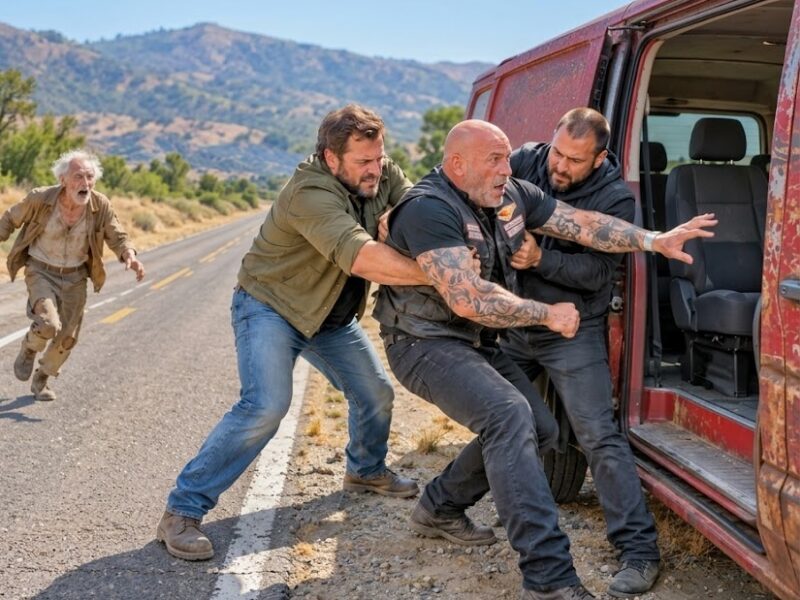
A Homeless Veteran Saw a Hells Angel Forced Into a Van—Seconds Later, His Military Instincts Took Over
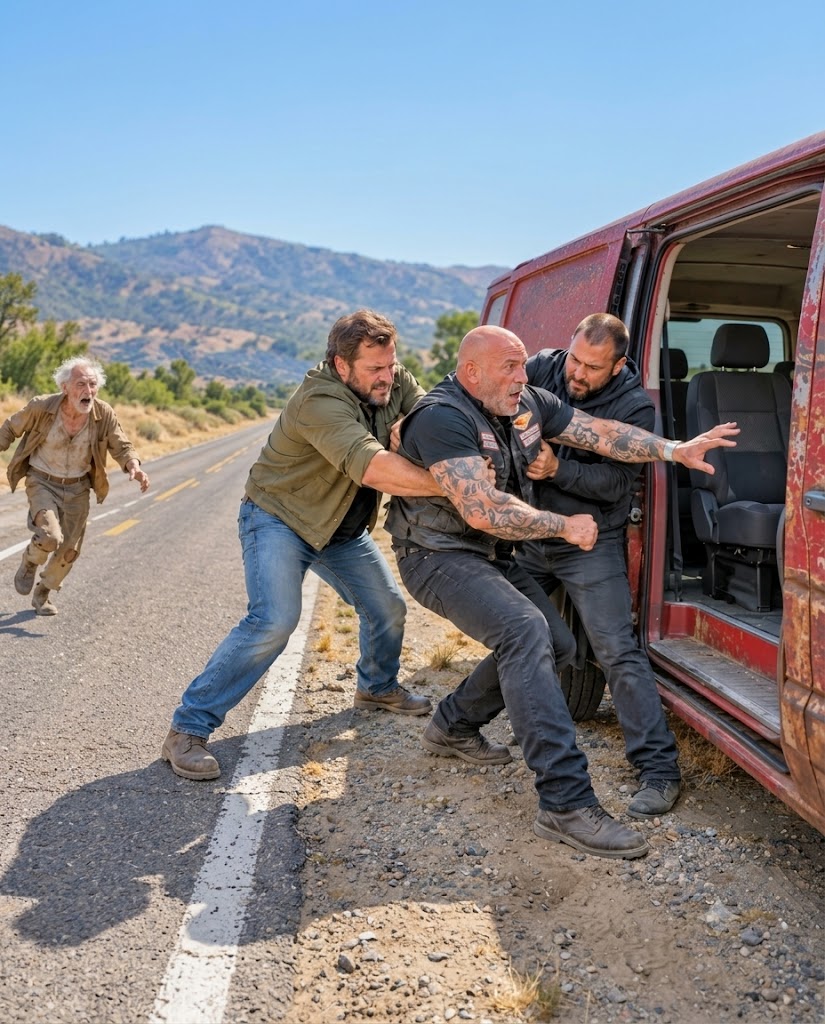
A crowbar cracked against the back of a man’s skull.
He dropped to one knee on the cold asphalt.
Two hands grabbed his leather jacket and hauled him up before he could fall.
A third man drove a fist into his ribs.
Nobody at the gas pumps moved.
Nobody shouted.
Drivers kept their eyes on their nozzles and their hands in their pockets, pretending the parking lot was empty.
But under the loading dock, a pair of eyes watched every second of it.
The man watching had slept out there for two winters.
His name was Elias Mercer, and the people who knew him just called him Doc.
His dog growled low beside him.
Four men were dragging a biker toward a windowless van, and only one witness refused to look away.
What Doc did in the next ninety seconds, no one would forget.
Stay with me on this one.
Let me take you back about twenty minutes before any of that happened.
The truck stop sat off Route 9 out in the flat part of Ohio where the fields run gray in winter and the wind never stops.
It wasn’t much.
A diner that smelled like burnt coffee.
Twelve pumps, four of them broken.
A loading dock around back where the delivery trucks came in at dawn.
That was where Doc slept.
He had a tarp, a sleeping bag the church ladies gave him, and a cardboard windbreak he rebuilt every night.
And he had Gunner.
Gunner was a mutt, one eye, gray muzzle, ribs you could count.
Somebody had dumped him in the ditch two years back and left him to die.
And Doc had carried him to the dock and fed him half his own sandwich.
Since then, the dog never left.
He was the only soul at that truck stop who never walked past Doc like he was a stain on the pavement.
Everybody else looked right through him.
The dog looked right at him.
Doc had a routine, and the routine was the only thing holding him together.
Up before the sun, fold the bag.
Walk the dog along the fence line.
Sweep the dock with a broom the night manager let him keep.
Because Doc believed a man who stopped doing the small things right was a man who’d stopped entirely.
He knew the regulars by their trucks before their faces.
He knew which driver tipped the waitress and which one stiffed her.
He knew the sound of every engine that pulled off the highway.
And he knew the way you know your own heartbeat when something didn’t belong.
Now here’s the thing about Doc.
People saw a homeless man and filled in the rest themselves.
Lazy, drunk, broken.
They weren’t even close.
Elias Mercer spent eleven years in the army as a combat medic.
He’d pulled men out of burning vehicles with his bare hands.
He’d kept a nineteen-year-old breathing for forty minutes in the back of a Humvee while the convoy took fire.
He’d held more dying men than most people meet in a lifetime.
He came home with a duffel bag, a folded flag that wasn’t his to keep, and a head full of things that wouldn’t go quiet.
The marriage didn’t last.
The job didn’t last.
The apartment didn’t last.
And one cold October, the only thing Doc had left was a dog and a loading dock.
He didn’t fall all at once.
Nobody does.
First the nightmares and the drinking he started to quiet them.
Then the mornings he couldn’t get off the floor.
Then the warnings at work, the last paycheck, the notice taped to the door.
He sold the truck.
He sold the tools.
He sold the watch his father left him.
By the time the money ran out, the only people still calling were bill collectors.
And one by one, he stopped answering.
But the training never left him.
That’s the part nobody understood.
You can take the roof away from a man.
You can take his money and his bed and his name.
You cannot take eleven years of reading a scene for threats.
Doc still woke up every morning and counted exits without meaning to.
He still clocked every car in that lot.
He read people the way other men read the sports page.
So that cold morning when the gray cargo van rolled in and parked wrong, Doc noticed.
It parked wrong.
That’s the only way to say it.
A regular driver pulls up to a pump or a space.
This van backed into the far corner, nose out, away from the cameras, engine running.
Four men sat inside and didn’t get out for gas.
They didn’t get out for coffee.
They just sat watching the diner door.
Doc sat up slow.
He put a hand on Gunner’s neck.
“Easy,” he whispered.
The dog had gone stiff, ears forward, that low sound starting in his chest.
Dogs know.
They know before we do.
And Doc knew, too.
He’d seen vehicles sit like that before in another country on another kind of road.
A vehicle parked that way isn’t waiting.
It’s hunting.
He felt the old cold settle into his chest.
The one that used to come right before everything went loud.
His mouth went dry.
His hands got very still.
He didn’t know yet who they were hunting.
He was about to find out.
The diner door swung open and a big man stepped out into the cold.
Leather vest, patches on the back, boots that had covered a lot of miles, coffee in one hand, keys in the other, walking toward a motorcycle by the ice machine like a man who owned the morning.
He didn’t look at the van.
Why would he?
He didn’t know it had been waiting for him for forty minutes.
Doc watched the four doors open at the same time.
That’s the detail that turned his stomach cold.
Not one door.
Four.
All at once.
Coordinated.
These weren’t drunks picking a fight.
This was a plan.
He wanted to shout.
Every nerve told him to.
But eleven years had taught Doc something the movies never teach you.
You don’t warn the target when you can’t reach the target.
You just watch the target die faster.
So he did the hardest thing a good man can do.
He stayed quiet.
He stayed low.
And he started counting.
The four moved fast.
Two came from the sides, one from behind, and the biker, big as he was, never had a chance because the fourth man was already behind the ice machine with the crowbar.
The first blow caught him across the back of the skull.
That’s where this story started.
That flat crack of steel on bone and Doc’s whole body remembered a hundred sounds just like it.
The biker went down.
His coffee hit the pavement and burst.
Hands grabbed him.
A fist hammered his ribs.
And twelve, maybe fifteen people at those pumps turned their heads and studied the horizon like it owed them money.
A man at pump six hung up the nozzle real slow, got in his car, and drove off without once looking at the thing happening forty feet from his windshield.
A woman loading groceries froze, then pushed her cart faster.
People don’t decide to do nothing.
They just decide over and over in little pieces that it isn’t theirs to carry.
Doc has told this part since, and he always says the same thing.
“It wasn’t the four men that broke my heart. It was the fifteen who watched and did nothing.”
Now understand, Doc was one unarmed man.
Fifty-four years old.
Bad knee, bad back.
No weapon but a pocketknife he used for cutting rope and apples.
Four younger men with a crowbar.
If he ran in swinging, he’d be a second body in that van inside a minute and Gunner would be left alone in the ditch all over again.
He did the math in two seconds flat.
So he didn’t run in swinging.
He did something smarter.
First, the plate.
The rear tag was smeared with mud, but Doc had clocked the front one when it rolled in, and he burned those letters and numbers into his head and said them under his breath like a prayer.
Three letters, four numbers.
He said them again.
Your memory is the one thing nobody can take off you at gunpoint.
Then he looked at the trucks along the far fence and he saw what he needed.
A blue Peterbilt, engine idling, and that little black box mounted inside the windshield.
A dash cam pointed right at the corner of the lot, running.
The driver was inside eating eggs.
The camera didn’t care.
It was already recording everything.
Doc crept along the back of the dock, down the blind side where the crew couldn’t see him, Gunner tight against his leg.
The men were arguing now.
The biker was in the van, but something had gone wrong.
One of them shouted that this wasn’t the right spot, that they needed to move, that there were too many trucks.
Another wrestled with the rear doors.
They were rattled.
Amateurs under pressure make noise, and these men were making a lot of it.
That gave Doc his window.
He came up on the driver’s side from behind the dumpster, down on his belly like he was nineteen again.
His bad knee screamed.
He ignored it the way he’d ignored a lot of worse things.
He didn’t touch a door.
He didn’t touch a man.
He reached up under the front wheel well, found the brake line with fingers that knew exactly what they were feeling for, and cut it clean with that little pocketknife.
Fluid dripped onto the asphalt, slow and steady, pooling under the tire where nobody would look.
Then he backed away just as quiet as he’d come.
See, Doc understood something the four men didn’t.
They thought the danger was being seen.
It wasn’t.
The danger was getting away.
A van that can’t stop is a van that gets caught.
He just made sure that wherever they ran, they wouldn’t run far.
But he needed them to not run yet.
He needed thirty more seconds to make the camera catch their faces.
So Doc reached down, looked his one-eyed dog dead in the good eye, and said one word.
“Gunner, go.”
And the dog went.
Gunner shot out from behind the dumpster, barking like the devil himself, straight into the path of the driver, snapping at his boots, circling, snarling, a gray blur of teeth and noise.
The driver stumbled back and swore.
The others spun around.
For a full twenty seconds, every one of those four men was out in the open, faces up, turned straight toward the blue Peterbilt’s windshield, kicking at a dog while a camera wrote it all down in perfect daylight.
Then the driver pulled a gun.
Doc’s heart stopped, but Gunner was already gone, zigzagging back under the dock, the way Doc trained him, and the shot went wide and buried itself in the dumpster.
The men had had enough.
They piled into the van, slammed the doors, and tore out of the lot in a cloud of blue exhaust.
Doc came out from behind the dumpster.
His hands were shaking.
Gunner trotted back, tail going, proud as anything.
And Doc went down on both knees and wrapped his arms around that dog and just held on.
The van was gone.
The plate was in his head.
The camera had it all.
And somewhere down Route 9, brake fluid was dripping onto the road one drop at a time.
He sat back against the dock.
He let out a long breath.
Fifteen people were still pumping gas like nothing had happened.
A woman walked her kid into the diner.
The sun came up a little higher.
It was over.
The worst of it was over.
Doc patted Gunner and he actually smiled and he thought to himself, “I did everything I could. Let the police take it from here.”
He reached into his coat for the half sandwich he’d saved and broke it in two.
One piece for him, one for the dog.
That was the quiet.
That little pocket of quiet where a man lets himself believe the hard part is behind him.
It lasted about ninety seconds because down the road around the first bend, the van’s brakes gave out exactly like Doc knew they would.
It couldn’t make the turn.
It went off the shoulder and buried its nose in a drainage ditch.
Nobody inside was hurt bad, but now they were stuck.
Four men, a stolen van going nowhere, a hostage in the back, and a dawning sick understanding that somebody at that truck stop had cut their line.
Somebody had seen them.
Somebody had planned against them.
And that somebody was still standing in the lot behind them.
The driver climbed out of the ditch, wiped the blood off his lip, and started walking back toward the truck stop on foot.
The others followed.
They weren’t leaving a witness.
Not now.
This wasn’t about grabbing a biker anymore.
This was about the one man who’d beaten them and making sure he never told a soul.
Doc was still sitting against the dock, sharing a sandwich with his dog when Gunner’s head came up and that low growl started all over again.
Doc looked up.
Four men were walking back into the lot.
And this time they were looking straight at him.
Here’s where the whole thing changed.
And I want you to feel the change because it matters.
A minute ago, this was a story about Doc saving a stranger.
Now, it was a story about Doc surviving.
The men didn’t care about the biker anymore.
He was just bait in a ditch.
The real target now was the witness who could put four faces in a courtroom.
And the only thing standing between Doc and that van was an old dog with one eye.
The driver was in front.
Big man, shaved head.
And now Doc could see the gun tucked in his waistband.
Not hidden anymore.
Just there, a promise.
He crossed the lot slow.
The other three fanned out behind him.
And there it was again.
That coordination, that plan, except this time the plan was Doc.
Four, one armed that he could see.
Twenty yards and closing.
No cover but a dumpster and a dog.
“You the one with the knife,” the driver said.
His voice was calm.
That’s what scared Doc most.
Calm.
Doc stood up.
Fifty-four years old, bad knee and all.
He got to his feet and stood up straight the way the army taught him a long time ago.
Gunner planted himself in front, hackles up, teeth bared.
“I didn’t see anything,” Doc said.
“No,” the driver said, almost gentle. “No, you saw it all. That’s the problem.”
And that’s the moment that tells you who Elias Mercer really was.
Any sane man in his spot runs.
No weapon, no backup, no roof, no money, no reason on God’s green earth to stay.
He could have walked off into the fields and let the whole thing go.
Nobody would have blamed him.
Nobody even knew his name.
But Doc had spent eleven years refusing to leave people behind.
It was carved into him deeper than fear.
There was a man tied up in a ditch down the road.
And Doc was not going to let these four finish what they started.
Not while he was still breathing.
You do not leave your wounded.
Not ever.
If you’re still with me this far, do me one favor.
Hit that subscribe button because what happens next is the whole reason I had to tell you this story.
Trust me, you’re going to want to see how this one ends.
Now, here’s where it turns.
Doc didn’t run.
He talked because talking was the one weapon he had left.
And a combat medic learns to buy time better than anybody alive.
“You boys are in a real bad spot,” Doc said loud enough for all four to hear.
“Your van’s in a ditch. You fired a gun in a public lot with fifteen witnesses. And that blue truck right there.”
He nodded toward the Peterbilt.
“That camera’s been running the whole time. Got your faces. Got your plate. Got the shot you took at my dog.”
He let that sit.
“You kill me, you got one more body and a whole lot more attention. You walk away right now, maybe you’re just four fools who got stuck in a ditch.”
The driver’s jaw tightened.
His eyes flicked to the blue truck just for a second and Doc saw the doubt land.
The man wasn’t sure, and an unsure man with a gun is a man who hesitates, and hesitation was all Doc wanted.
One of the men behind him spoke up, low and nervous.
“He’s bluffing. There’s no camera.”
But he didn’t sound like he believed it, and he kept glancing at the Peterbilt anyway.
That’s the thing about a lie built on truth.
You can’t unsee the part that’s real.
Because Doc had done one more thing he hadn’t told anybody.
When Gunner ran at the van, when all eyes were on the dog, Doc hadn’t just been counting.
He’d been dialing.
He’d found a cracked phone in the diner’s lost and found a week back.
No service plan, but everybody knows a phone with no plan can still call one number.
911.
He’d called it from his coat pocket while he talked and left the line open.
And a dispatcher two towns over had been listening to every word spoken in that lot for the last four minutes, including the driver saying, “No, you saw it all. That’s the problem.”
The sirens, faint at first, way off down Route 9, then louder.
The driver heard them.
His whole body changed.
He pulled the gun and leveled it at Doc’s chest.
And his hand was shaking now.
And he said, “Where’s the phone? Where is it?”
And Doc, God help him, smiled.
“Little late for that, son.”
What happened next happened fast, so stay with me.
The driver’s finger tightened on that trigger, but he never got the shot because the diner door slammed open and the blue Peterbilt’s driver came out at a dead run.
A big Ohio farm boy of a trucker who’d finally looked up from his eggs and seen a man pointing a gun at the homeless fella who fed the dog every morning.
He was yelling.
Two other truckers came out behind him.
All of a sudden, it wasn’t four against one anymore.
It was four against a parking lot that had finally, finally decided to see.
And then came the sound that changed everything.
Not sirens.
Engines.
Deep rolling thunder in the ground.
Engines.
A whole line of them coming up Route 9 from the other direction.
And over the ridge they came.
Motorcycles.
Fifteen of them.
Twenty more.
Headlights in the gray morning.
Leather and chrome.
Patches on every back.
Because here’s what those four men never knew.
Here’s what nobody in that lot knew.
The biker in the ditch wasn’t just some rider passing through.
His name was Rook Delaney, and he was a road captain of the local Hells Angels charter.
And when a brother misses his morning check-in, the whole club comes looking.
They’d been tracking his phone since he went quiet.
And Rook, bleeding in the back of that van in the ditch, had worked a hand free and sent his brothers a single pin drop before the signal died.
They came for one of their own.
What they found was a van in a ditch, their brother alive, and four strangers in a parking lot pointing a gun at a homeless man and his dog.
The four men ran.
Of course they ran, but you cannot outrun thirty motorcycles on foot in an open field, and you cannot outrun the county sheriff coming the other way.
And within four minutes, all four of them were facedown on the cold asphalt, zip-tied, done.
The driver, the big calm one, he was the last and he went down hard and he never got his shot off.
And that’s the truth of it.
He never got his shot.
Doc stood there in the middle of all of it, in the noise and the chrome and the sirens, with Gunner pressed against his leg, and he didn’t move.
He didn’t know what to do with his hands.
He’d saved the man.
He’d saved himself.
And now the whole world had come roaring into his quiet little lot.
And he was just standing in the eye of it.
An old soldier who’d done his job and didn’t know how to be thanked.
They pulled Rook Delaney out of that ditch and walked him up to the lot holding his ribs.
Blood dried down the side of his face.
He was alive because a van couldn’t make a turn.
He was alive because somebody cut a brake line and sent a one-eyed dog to buy twenty seconds.
The club president, a silver-bearded man they called Tank, got off his bike and met Rook halfway, and the two of them held each other up for a second, forehead to forehead, the way brothers do.
Then Rook lifted his head and asked the only question that mattered.
“Who did this? Who stopped them?”
And the big farm boy trucker, still breathing hard, pointed one thick finger across the lot at the homeless man by the dock.
“Him. The vet. He cut their line and called the cops and put his dog in front of a gun. That man right there.”
Thirty bikers turned and looked at Doc.
Now you’ve got to understand what Doc expected.
He expected nothing.
He’d spent two years learning that the world looks away from a man like him.
He braced for them to nod maybe and climb back on their bikes and roar off and forget his face by lunch.
That’s what the world had taught him to expect.
A thank you if he was lucky, and then the long walk back to invisible.
That is not what happened.
Rook Delaney let go of his president and he walked across that lot slow, holding his side, straight to Doc.
He stopped right in front of him.
Up close, he was younger than Doc thought, maybe forty, with tired eyes and a hard face gone soft.
He looked at Doc.
He looked at the tarp, the cardboard, the sleeping bag, the one-eyed dog.
He understood in one second exactly what he was looking at.
A man who had nothing, who’d risked the only thing he had left for a total stranger.
And Rook Delaney, road captain, hard man, got down.
He got down on one knee on the cold asphalt in front of a homeless veteran, and he took Doc’s hand in both of his, and his voice cracked when he spoke.
“You don’t know me,” Rook said. “You had no reason. Fifteen people watched them crack my skull and not one of them moved. You had nothing and you gave everything. Brother, you saved my life.”
Doc didn’t know what to say.
His eyes were wet and he hated that, old soldier that he was.
“I just did what anybody should have done,” he said.
“No,” Rook said. “You did what nobody else would. That’s different.”
He stood up, still holding Doc’s hand, and he turned to the thirty men and women behind him, and he raised his voice so the whole lot could hear it over the idling engines.
“This man is a veteran. He served this country, and he’s been sleeping on this concrete while this whole town stepped over him like trash. Not anymore. Not one more night. You hear me? Not one more night.”
And that’s where this story stops being about one cold morning and starts being about everything that came after.
Stay with me because the part that made the whole truck stop talk for years, that part’s still coming.
The four men went to prison.
Turned out they were part of a crew that had been grabbing people up and down the interstate corridor for ransom and worse.
And the dash cam from that blue Peterbilt, plus the open 911 line, plus thirty eyewitnesses in leather, sewed the case shut tighter than anything the prosecutor had seen in twenty years.
The driver got the longest sentence.
He never did get his shot, and he never will.
But that’s not the part people remember.
The part people remember started three days later when the rumble came back up Route 9.
The whole charter, and they didn’t come for revenge because that was already handled.
They came for Doc.
They’d found out his full name.
Sergeant Elias Mercer, United States Army, two-tour combat medic.
A chest full of medals in a box in a storage unit he could no longer afford.
They’d made some calls.
Bikers know people, and some of those people wear suits.
There was a veterans housing program two counties over with a waiting list a mile long.
And somehow, someway, Doc’s name went straight to the top of it.
A clean one-bedroom apartment.
Ground floor so his bad knee wouldn’t fight the stairs.
A yard out back.
A yard because the first thing Rook had asked the housing people was whether the place allowed dogs.
The club paid his deposit.
They paid his first six months.
Tank, the president, owned a motorcycle repair shop, and he offered Doc a job on the spot because a combat medic has the steadiest hands you’ve ever seen.
And there’s more to fixing a bike than most people think.
Doc said yes.
Doc, who hadn’t had a reason to get up in the morning besides a hungry dog, had a job and a key and an address.
But I’ll tell you the moment that broke the whole lot wide open.
The moment people really still talk about.
It was the day they moved him in.
The bikers showed up to help carrying his two boxes of belongings, which took about four seconds because a man who’s been homeless two years doesn’t own much.
And Rook Delaney showed up last, and he was carrying something in his arms wrapped in a cloth.
He walked up to Doc on the little front step of that apartment, and Gunner was already asleep in a patch of sun in his own yard for the first time in his whole hard life.
And Rook unwrapped the cloth.
It was a vest.
A leather vest, cut and stitched.
And on the back, instead of the club’s colors, they’d had it made special.
It read Doc.
And under that, Friend of the Club.
And under that, smaller, He Did Not Look Away.
“You’re not a member,” Rook said. “You never asked to be, and we’d never put that on you. But every man in this charter owes you a brother. You wear this anywhere in three states and you will never want for a meal, a bed, or a man at your back again. That’s not a promise. That’s a fact.”
Doc held that vest in his two steady hands, the hands that had held so many dying men, and for the first time in longer than he could remember, Elias Mercer put his face down and wept.
And nobody looked away.
Thirty hard people stood in that little yard and let him.
And when he was done, Tank put a hand on his shoulder and just said, “Welcome home, Sergeant.”
Now, here’s the thing.
I keep coming back to the thing about this whole story.
Fifteen people watched a man get beaten in broad daylight, and not one of them moved because they decided it wasn’t their problem.
And one man who had nothing, no house, no money, no reason, decided that it was.
He didn’t have strength on his side.
He didn’t have numbers.
He had attention.
He had the one thing those fifteen people threw away.
He refused to look away.
And because he refused, a father went home to his kids.
And four predators went to prison.
And a whole chapter of men learned that the toughest person in that parking lot was the one sleeping on the concrete.
Doc still works at Tank’s shop.
Gunner’s gotten fat and lazy and sleeps under the workbench.
And every rider who comes in knows to step over him careful because that dog is family.
On cold mornings, sometimes Doc stands in the open bay door with his coffee and looks out at the road.
And the quiet doesn’t scare him anymore.
It’s just quiet now.
The good kind.
And on the hook by his door hangs a leather vest that says he did not look away.
That’s the whole story.
A fist cracked against a man’s skull in a parking lot and everybody turned away but one.
Remember that the next time you’re the one who sees something nobody else wants to see.
You don’t have to be strong.
You don’t have to be anybody at all.
You just have to not look away.
Thanks for staying with me on this.









