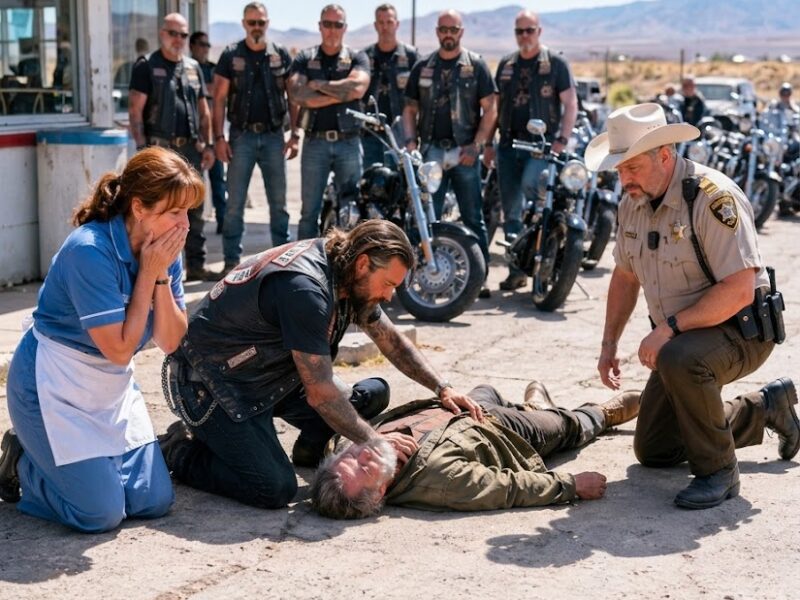
A homeless veteran collapsed outside a diner. No one stopped. Then 200 Hells Angels quietly took action.
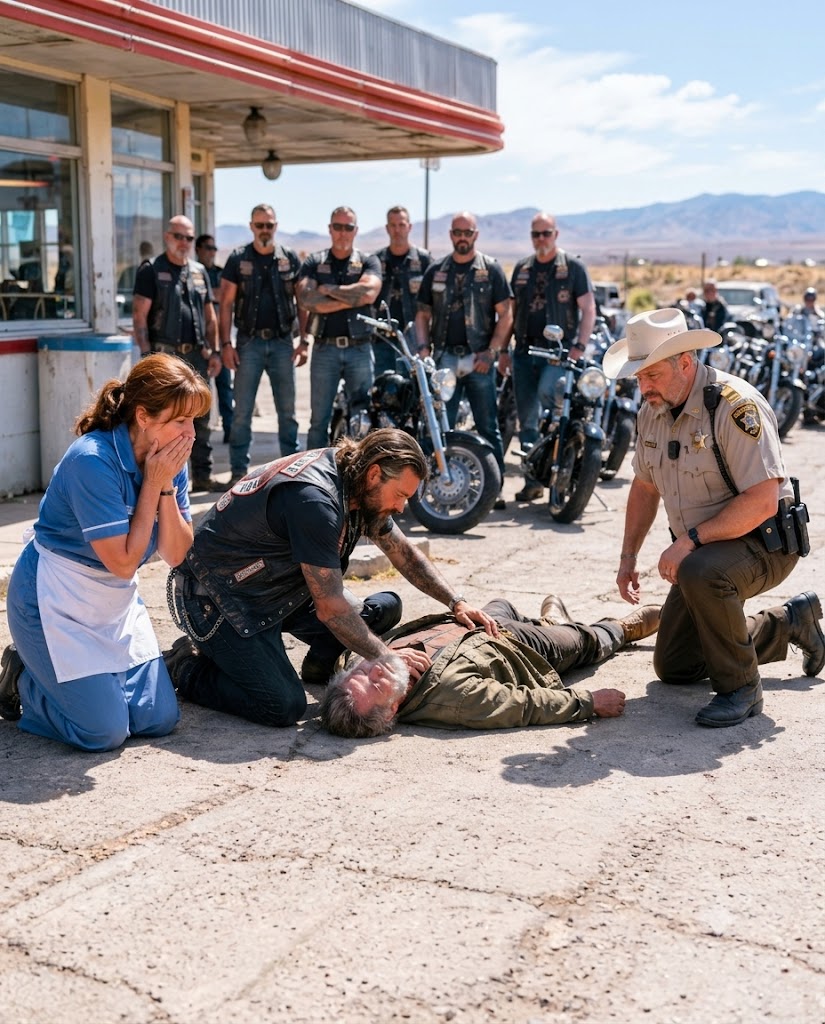
The pavement outside Maggie’s Diner was baking at 110 degrees when a homeless man hit the concrete.
People walked past him.
Cars ignored him.
But the low, thunderous roar of 200 Harley-Davidsons echoing down the highway was about to turn this local tragedy into a legend.
The Mojave Desert sun didn’t just beat down on Kingman, Arizona.
It suffocated the town in a relentless dry chokehold.
It was a Tuesday afternoon and the air above the asphalt rippled with heat waves.
Outside of Maggie’s Route 66 diner, the world was unforgiving, especially for a man who had already given the world everything he had.
Hank Donovan was 58 years old, though the deep weathered crevices around his eyes made him look closer to 70.
He wore a faded olive drab jacket despite the sweltering heat, the fabric worn thin at the elbows, concealing a frame that had been slowly starved by poverty and pride.
Hank was a ghost to the tourists stopping for a quick burger and a malt.
He was just another piece of urban blight, a cautionary tale to ignore.
But 20 years ago, Staff Sergeant Hank Donovan had been a combat medic in the First Infantry Division.
He had pulled bleeding men out of the suffocating dust of Fallujah.
He had held the hands of dying boys and promised them they would see their mothers again.
Now he couldn’t even afford a cup of black coffee.
Hank dragged his battered combat boots across the gravel parking lot, his breath coming in shallow, ragged gasps.
His heart had been fluttering all morning.
A strange arrhythmic drum beat in his chest that made his left arm feel like it was filled with lead.
He clutched his side, leaning heavily against the rusted fender of an abandoned pickup truck near the diner’s entrance.
Inside the diner, Maggie Sullivan wiped down the Formica counter, her eyes darting to the window.
Maggie was a tough, no-nonsense woman in her mid-40s who had inherited the struggling diner from her father.
She knew Hank.
She knew he never asked for a dime, only ever offering to sweep the porch or take out the heavy trash bags in exchange for a plate of leftover meatloaf.
“He doesn’t look right,” Maggie muttered to herself, tossing the wet rag into the sink.
Sitting in the corner booth, nursing his third cup of free coffee, was Sheriff Broady.
The sheriff was a heavy-set man who treated Kingman like his own personal kingdom, and he had made it his personal mission to scrub the town of its undesirables before the upcoming tourist festival.
“Leave him be, Maggie,” Brody grunted, not even looking up from his newspaper.
“Mayor Higgins already told you. You keep feeding the strays. They’re just going to keep coming back. I’ll have a deputy come run him off in a minute.”
“He’s not a stray, Broady. He’s a veteran,” Maggie snapped, pouring a glass of ice water.
“And he looks like he’s about to pass out.”
Before Maggie could push her way through the glass door, it happened.
Hank’s knees buckled.
It wasn’t a dramatic flailing fall.
It was the silent, devastating collapse of a man whose body had finally surrendered.
He hit the boiling concrete hard, his cheek scraping against the rough pavement.
His faded green canvas duffel bag slipped from his grasp, spilling a few meager possessions onto the ground, a tattered woolen blanket, a canteen, and a small wooden box.
“Hank!” Maggie screamed, shoving the diner door open.
The bell above the door jingled wildly.
She dropped to her knees on the scorching asphalt, ignoring the heat burning through her jeans.
She grabbed his shoulders, turning him over.
Hank’s face was ashen, his lips tinted a terrifying shade of blue.
His eyes were half open, glazed and unseeing.
“Call 911,” Maggie yelled back at the diner.
Sheriff Broady ambled out, a toothpick hanging lazily from the corner of his mouth.
He looked down at the gasping veteran with mild annoyance.
“All right, keep your shirt on, Maggie. Dispatch, this is Brody,” he said into his shoulder mic.
“Got a vagrant down at the diner. Heat exhaustion, probably. Send a bus when one frees up.”
“When one frees up?” Maggie glared at him, her hands trembling as she felt for Hank’s pulse.
It was erratic, terrifyingly weak.
“Brody, he’s having a heart attack. He needs help right now.”
“County hospital is backed up with a multi-car pileup on the interstate. Maggie, he’s going to have to wait,” Brody said callously, taking a step back so his polished boots wouldn’t get scuffed by the dirt.
He looked down the highway, annoyed by the scene.
Ten minutes passed.
To Maggie, it felt like ten hours.
Hank’s breathing grew shallower.
A small crowd of onlookers had gathered, pointing and whispering, but nobody stepped forward to help.
The oppressive heat was suffocating, and Hank was slipping away.
Then the ground began to tremble.
It started as a low, guttural vibration that rattled the diner’s plate glass windows and sent tremors through the soles of Maggie’s shoes.
The town’s folk turned their heads towards the west.
The sound grew, swelling into a deafening mechanical roar.
Cresting the hill on Route 66 was a massive wave of gleaming chrome, matte black steel, and heavy leather.
It wasn’t just a few riders.
It was an army.
200 motorcycles rode in tight, disciplined formation, taking up both lanes of the highway.
At the center of the pack, the unmistakable red and white death head logo of the Hells Angels motorcycle club was emblazoned across their leather cuts.
Sheriff Broady swallowed hard, his hand instinctively dropping to rest on the butt of his service weapon.
The Hells Angels didn’t usually stop in Kingman.
They usually just rode through.
But today, the lead rider raised a single heavily tattooed fist into the air in perfect unison.
200 massive engines geared down.
The sheer sound of it was enough to make the onlookers instinctively take a step back.
The bikes swarmed the diner’s parking lot, filling every empty space, lining the shoulders of the road, effectively blocking off the entire street.
The engines were killed simultaneously.
The sudden silence that fell over the parking lot was heavier and far more intimidating than the noise had been.
The lead rider kicked his kickstand down and stepped off his custom Harley.
His name was Jackson “Grizzly” Monroe, the president of the California Nomads Charter.
Grizzly was a mountain of a man, standing 6’4″ with a thick graying beard and eyes that had seen more violence and brotherhood than most men could fathom in a dozen lifetimes.
Grizzly didn’t look at the sheriff.
He didn’t look at the terrified tourists.
His sharp eyes were locked entirely on the scene on the ground.
A woman desperately fanning a dying man on the hot asphalt.
The rest of the club dismounted in eerie silence.
There was no shouting, no revving of engines, no chaotic posturing.
Just 200 heavily patched men forming a solid, impenetrable wall of leather and denim around the diner’s perimeter.
Sheriff Broady stepped forward, trying to project an authority he clearly didn’t feel.
“All right, you’re blocking a public roadway. You need to gas up and move along. We got a medical situation here.”
Grizzly ignored him completely.
He walked forward, his heavy boots crunching on the gravel, followed closely by two other patched members, a wiry man named Jimmy “Wrench” Kowalski and a towering bald biker known as Doc Collins.
“Hey, I’m talking to you,” Brody barked, taking another step.
Wrench stepped smoothly into the sheriff’s path, invading his personal space just enough to make Broady freeze.
Wrench didn’t say a word.
He just stared at the sheriff with cold, dead eyes, crossing his arms over his chest.
Brody stopped talking.
Grizzly knelt down on the blistering concrete opposite Maggie.
He looked at Hank’s pale, sweaty face.
Then his eyes drifted down to the items that had spilled from the canvas bag.
He saw the wooden box.
It had popped open when it had hit the ground.
Inside was a Silver Star of Valor, a Purple Heart, and a heavily tarnished silver Zippo lighter.
Grizzly slowly reached out with a massive calloused hand and picked up the lighter.
Engraved on the metal, barely legible through the scratches, were the words: To Doc Donovan for keeping us breathing. Fallujah, 2004.
Grizzly’s breath caught in his throat.
The hardened biker, a man who commanded fear and respect across the West Coast, felt a violent shudder rack his chest.
He looked closely at the dying man’s face.
The lines of age and despair had masked it, but the bone structure was there.
It was him.
“Jesus Christ,” Grizzly whispered, his voice thick with a sudden, overwhelming emotion.
“Hank?”
Maggie looked up, her eyes wide with shock.
“You… You know him?”
“He was my medic,” Grizzly said, his voice dropping to a gravelly, intense rasp.
“Twenty years ago, I caught shrapnel in my neck in an ambush. I was bleeding out in the dirt. This man, this man put his fingers into my neck and pinched my artery shut for 45 minutes while under heavy fire until the medevac arrived. He gave me my life.”
Grizzly snapped his head back, his demeanor instantly shifting from shock to absolute commanding authority.
“Doc,” Grizzly roared, shattering the quiet.
Doc Collins, who wasn’t just a biker, but a former military trauma nurse who now worked in an ER in Oakland, pushed past Maggie and dropped to his knees.
He immediately checked Hank’s airway and pulse.
“He’s in V-fib, Grizzly, his heart’s failing. We don’t have much time,” Doc Collins said, ripping open Hank’s tattered jacket.
“Where is the ambulance?” Grizzly demanded, turning his terrifying gaze onto Sheriff Brody.
Brody stammered, the color draining from his face.
“They’re tied up. Wreck on the interstate. Dispatch said it could be another 30 minutes.”
“Unacceptable,” Grizzly said.
The word dropped like an anvil.
He didn’t yell.
He didn’t threaten the sheriff.
He simply turned to his men.
Grizzly raised two fingers and made a sharp circling motion in the air.
The Hells Angels went to work.
It was a display of sheer, terrifying organization.
Fifty bikers instantly broke from the pack, jogging to their motorcycles.
Engines roared back to life, and they peeled out of the parking lot, heading straight down Route 66 toward the interstate.
They weren’t leaving.
They were forming an unauthorized high-speed blockade to clear the traffic, creating an open corridor straight to the county hospital.
Ten more bikers grabbed heavy canvas tarps from their saddlebags.
Within 60 seconds, they had strung the tarps up between the diner’s awning and two of the larger touring bikes, creating a canopy of deep shade over Hank to block the murderous sun.
Another biker sprinted into the diner, returning seconds later with buckets of ice from the fountain machine.
Doc Collins immediately began packing the ice around Hank’s neck, armpits, and groin to shock his core temperature down.
“I need an AED now,” Doc shouted.
“Brody,” Grizzly barked.
“You have a defibrillator in your cruiser.”
The sheriff hesitated.
“It’s county property. I can’t just—”
Grizzly took two massive steps, closing the distance between them.
He leaned down, his face inches from the sheriff’s.
“You are going to open your trunk and you are going to hand me that machine, or I am going to tear the trunk off the hinges and then I am going to tear you apart. Nod if you understand the law of this parking lot.”
Brody swallowed, terrified, and nodded.
He fumbled for his keys, rushed to his cruiser, and pulled out the bright yellow AED case.
Wrench snatched it out of his hands before he could even offer it.
Doc Collins ripped the pads out of the plastic and slapped them onto Hank’s bare, sunken chest.
“Clear!” Doc shouted.
Maggie scrambled backward.
Grizzly stood perfectly still, his fists clenched at his sides.
The machine delivered the shock.
Hank’s frail body arched off the pavement with a violent spasm, then collapsed back down.
Doc watched the small monitor on the AED.
The silence in the parking lot was absolute.
200 rough, violent men held their breath, their eyes glued to the homeless man on the ground.
“Come on, Hank,” Grizzly whispered.
“Don’t you quit on me. Not in the dirt. Not like this.”
Doc checked the pulse.
He shook his head.
“Still V-fib, charging again.”
The machine whined.
“Clear.”
Hank’s body jolted a second time.
For three agonizing seconds, nothing happened.
Then Hank Donovan gasped.
It was a wet, choking sound, but it was air.
His chest began to rise and fall on its own.
“Got a rhythm,” Doc said, wiping sweat from his bald head.
“It’s weak, but he’s pumping. We need to move him now.”
At that exact moment, the wail of sirens pierced the desert air.
But it wasn’t the local ambulance.
Down the highway, a massive custom-built transport van painted matte black, the club’s private chase vehicle used for hauling broken-down bikes and medical gear on long runs, barreled into the parking lot.
The back doors swung open.
Inside was a fully equipped makeshift medical bay.
The bikers didn’t wait for permission.
Six heavily muscled men gently lifted Hank Donovan onto a rigid backboard.
They pulled him from the van, sliding him inside with absolute precision.
Doc Collins jumped in the back with him, hooking up an IV bag to Hank’s arm.
Grizzly turned to Maggie.
He reached into his leather vest, pulled out a thick wad of $100 bills, and pressed it into her hand.
“For the coffee he drank, and the kindness you showed,” Grizzly said softly.
“Where are you taking him?” Maggie asked, tears streaming down her face.
“To the best cardiac surgeon in Phoenix,” Grizzly replied.
“He’s not a ghost anymore. He’s with his brothers.”
Grizzly swung his heavy leg over his motorcycle.
The remaining 150 bikes roared to life, a deafening symphony of horsepower.
They didn’t just drive away.
They formed a massive diamond-shaped escort around the black van, taking up the entire road.
Sheriff Broady stood on the sidewalk, completely powerless as the army of Hells Angels rolled out of Kingman, taking the forgotten veteran with them.
But the story didn’t end there.
Because while Grizzly was focused on saving Hank’s life, his men had found something else inside Hank’s duffel bag, a stack of documents that proved why Hank had been living on the streets of Kingman in the first place.
And the Hells Angels were about to come back to deal with the men who put him there.
A homeless veteran lay dying on the burning asphalt, ignored by the world.
But when 200 Hells Angels rolled into town, everything changed.
They didn’t just save his life.
They uncovered a sick, twisted conspiracy, and the men who ruined him were about to face absolute, terrifying justice.
The tires of the black transport van chewed up the miles on Interstate 93, guarded by a massive, roaring diamond of 150 Harley-Davidsons.
Inside the mobile medical unit, Doc Collins worked furiously.
The air conditioning blasted on high, cutting through the oppressive desert heat.
But Doc was still drenched in sweat.
He pushed Amiodarone into Hank’s IV line, watching the portable monitor with eagle eyes.
The erratic flutter of the veteran’s heart slowly settled into a weak but steady sinus rhythm.
Doc wiped his brow with the back of a sterile glove, exhaling a long, ragged breath.
He had seen a lot of trauma in the emergency rooms of Oakland, but saving a brother’s savior carried a weight that made his hands tremble.
In the passenger seat of the van, Jimmy “Wrench” Kowalski was hunched over Hank’s canvas duffel bag.
Grizzly had ordered him to inventory the man’s meager possessions to find an emergency contact.
Instead, Wrench found a nightmare wrapped in a rubber band.
“Grizzly, you need to pull over,” Wrench barked into his helmet coms system.
Grizzly’s voice crackled back, thick with tension.
“We are not stopping until we hit the Phoenix hospital, Wrench. We lose him if we stop.”
“Hank’s not just a stray, Grizzly,” Wrench replied, his voice dropping to a dark, dangerous octave.
“He didn’t lose his money to the bottle or the ponies. He was robbed by the town. I got the paperwork right here.”
Five hours later, the roar of the engines finally settled outside the emergency bay of Phoenix General.
A trauma team, already alerted by Doc, rushed out with a gurney, rushing Hank into the brightly lit corridors for immediate bypass surgery.
Grizzly stood in the waiting room, his leather cut stained with the dust of the road.
His massive arms were crossed over his chest, his jaw set in stone.
Around him, 30 patched members of the Nomads Charter sat in stony silence, terrifying the hospital administration into complete submission.
Wrench slapped Manila folders onto the waiting room table.
“I made some calls to our guys back in Oakland. We had a forensic accountant in the club look into these deeds,” Wrench said, pointing a greased finger at a heavy piece of parchment.
Grizzly leaned over.
“Talk to me.”
“Hank owned a 150-acre ranch just north of Kingman,” Wrench explained, his eyes narrowing.
“Been in his family for three generations, paid off in full. But two years ago, Hank was diagnosed with severe PTSD and early-stage lymphoma. He spent eight months at the VA hospital in Tucson getting chemo.”
Grizzly felt a cold fury building in his gut.
“And while he was gone, a local development firm called Apex Holdings swooped in. They claimed Hank had unpaid property taxes totaling less than five grand. But they didn’t just auction it off. They forged his signature on a quitclaim deed, transferring the entire estate to the firm.”
“Who owns Apex Holdings?” Grizzly asked, his voice deathly quiet.
“A guy named Preston Albright,” Wrench said, dropping a printed photograph on the table.
It showed a slick, smiling man in a tailored suit standing next to a familiar, heavy-set lawman.
“He’s the town’s wealthiest developer. And guess who his brother-in-law is? Sheriff Broady. Brody signed the eviction order himself while Hank was undergoing chemotherapy. When Hank got out of the hospital, he went home to find his house bulldozed and a luxury resort being built on his family’s dirt. Brody threatened to arrest him for trespassing if he ever stepped foot on the property again.”
“They broke him, Grizzly. They took his home, his dignity, and left him to die in the dirt outside that diner.”
Grizzly stared at the photograph of the grinning developer and the corrupt sheriff.
The image burned into his mind.
He reached into his pocket and pulled out the heavy silver Zippo lighter Hank had used to save his life in Fallujah.
He flipped the top open.
The flame ignited with a sharp click, reflecting in his cold, calculating eyes.
“Wrench,” Grizzly said, closing the lighter.
“Call the chapters in Nevada and Southern California. Tell them we are having a mandatory church meeting right here, right now.”
The Hells Angels were not a street gang.
They were a highly organized, heavily insulated brotherhood with resources that rivaled small corporations.
They had lawyers, private investigators, and men who specialized in making problems disappear.
But Grizzly didn’t want Preston Albright to disappear.
Death was too quick, too merciful.
He wanted Albright to feel the exact same terror, helplessness, and total ruin that he had inflicted on an American hero.
Four days later, Preston Albright sat in his plush corner office in downtown Kingman.
The air conditioning hummed a soft, luxurious tune.
Albright was sipping a glass of expensive scotch, admiring the blueprints for his new resort on the wall.
Life was incredibly good.
Then the floor began to vibrate.
Albright frowned, setting his glass on the mahogany desk.
The vibration grew into a violent shudder, rattling the expensive art on his walls.
He walked to the window and pulled back the blinds.
His jaw dropped.
The scotch glass slipped from his fingers, shattering on the hardwood floor.
Outside, Kingman’s Main Street was completely paralyzed.
But it wasn’t 200 bikers this time.
It was 500.
Chapters from California, Nevada, and Oregon had converged on the small desert town.
A sea of leather, denim, and chrome stretched for three blocks in every direction, boxing in the Apex Holdings building completely.
No one was yelling.
No one was rioting.
500 patched members simply stood next to their idling motorcycles, staring up at Albright’s window.
The heavy oak doors of his office suddenly burst open.
Albright spun around in terror.
Sheriff Broady was shoved violently into the room, stumbling over the shattered glass.
Behind him walked Jackson “Grizzly” Monroe, followed by Wrench, Doc, and a man in a sharp gray suit carrying a leather briefcase.
The man in the suit was Jonathan Hayes, a high-powered defense attorney on retainer for the Hells Angels.
“What the hell is this?” Albright stammered, backing away until his spine hit the glass window.
“Broady! Brody! Arrest them! They’re trespassing!”
Brody looked up, his face the color of wet ash.
“I can’t, Preston. The whole department is outside. The mayor is hiding in his basement. They’ve locked down the whole town.”
Grizzly stepped forward.
He didn’t raise his voice.
He didn’t have to.
The sheer gravity of his presence sucked the oxygen out of the room.
“Sit down, Preston,” Grizzly commanded.
Albright didn’t argue.
He collapsed into his heavy leather desk chair, his hands trembling uncontrollably.
Hayes, the attorney, opened his briefcase and laid three documents on the desk.
“Mr. Albright,” Hayes began smoothly, adjusting his glasses.
“My clients have spent the last 72 hours looking into your finances. We found the offshore accounts in the Cayman Islands. We found the fraudulent tax assessments, and most importantly, we found the original quitclaim deed for the Donovan ranch. The signature is a forgery. We have two independent forensic graphologists ready to testify in federal court, along with an FBI contact in Los Angeles who is very interested in your brother-in-law’s misuse of municipal authority.”
Albright looked at Brody, panicked.
“You told me the paper trail was clean.”
“It was,” Brody squeaked.
“These guys, they hacked the county mainframe.”
“We prefer the term ‘audited,'” Wrench said with a dark smirk.
Grizzly slammed both of his massive hands onto the desk, leaning in until his nose was inches from Albright’s face.
“You stole from a man who bled for this country, a man who saved my life. You took his home, his health, and left him on the street to rot. Now I am taking it all back.”
Hayes tapped a silver pen against the documents.
“This is a transfer of ownership, Mr. Albright. You are signing the entire resort property, fully developed, back into the name of Henry Donovan. You are also signing over a cashier’s check for $2 million in punitive damages. If you sign this right now, we walk out that door and the FBI never receives the flash drive detailing your 20 counts of wire fraud.”
Albright was sweating profusely.
“Two million? That will bankrupt my firm.”
“That’s the point,” Grizzly whispered.
“Sign it, or you don’t go to federal prison. You go into the desert with us.”
Albright looked at the 500 heavily armed bikers standing silently outside his window.
He snatched the pen and signed his name so hard the paper tore.
Brody was forced to resign his badge on the spot, handing it over to Grizzly, who tossed it into the trash can.
Two weeks later, Hank Donovan woke up in a private recovery suite in Phoenix.
The heart monitor beeped with a strong, healthy rhythm.
Sunlight streamed through the window.
Hank slowly opened his eyes, confused by the clean sheets.
The sterile smell of the hospital was masked by the scent of lilacs in a vase by the window.
His chest ached with a dull, throbbing pain from the surgery, but for the first time in years, he felt the profound, unmistakable sensation of hope.
Sitting in a chair next to his bed was Grizzly, reading a worn paperback.
Maggie Sullivan was sitting on the other side, holding Hank’s hand, tears of joy in her eyes.
Hank blinked, trying to speak through a dry throat.
“Grizzly, is that… is that you?”
Grizzly smiled, a genuine, warm expression that rarely crossed his hardened face.
He stood up and placed the silver Zippo lighter on Hank’s chest, right next to a heavy manila envelope containing the deeds to a multi-million dollar estate.
“It’s me, Doc,” Grizzly said softly.
“You got a lot of brothers waiting outside to welcome you home.”
Hank Donovan was invisible to society, but to his brothers in arms, he was a hero who deserved his dignity.
Sometimes justice doesn’t wear a badge.
Sometimes it wears heavy leather and rides a Harley.
If this story of true brotherhood and fierce loyalty moved you, hit that like button.
Share this video so Hank’s story is never forgotten.
And subscribe to our channel for more incredible real-life stories.
Leave a comment below with your thoughts.









