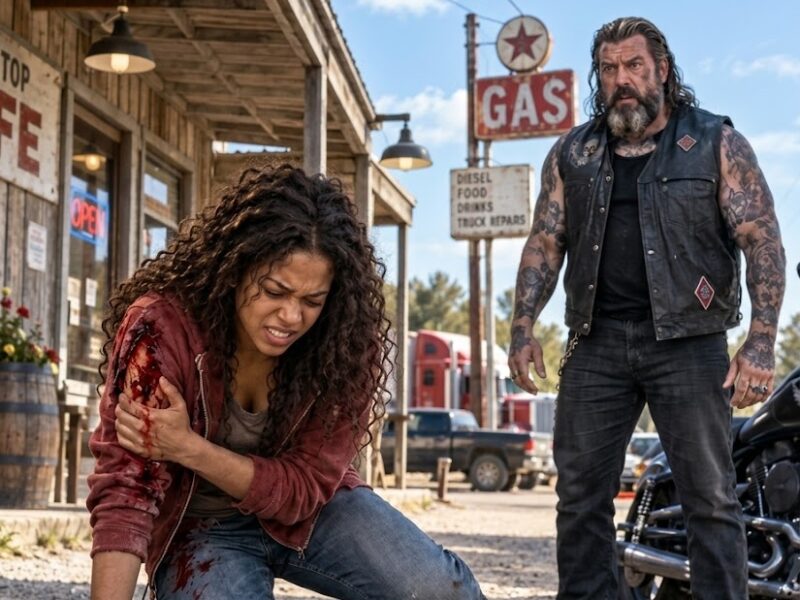
A homeless girl threw herself in front of a car to save a biker’s daughter — and what her Hell’s Angels father did next left everyone speechless.
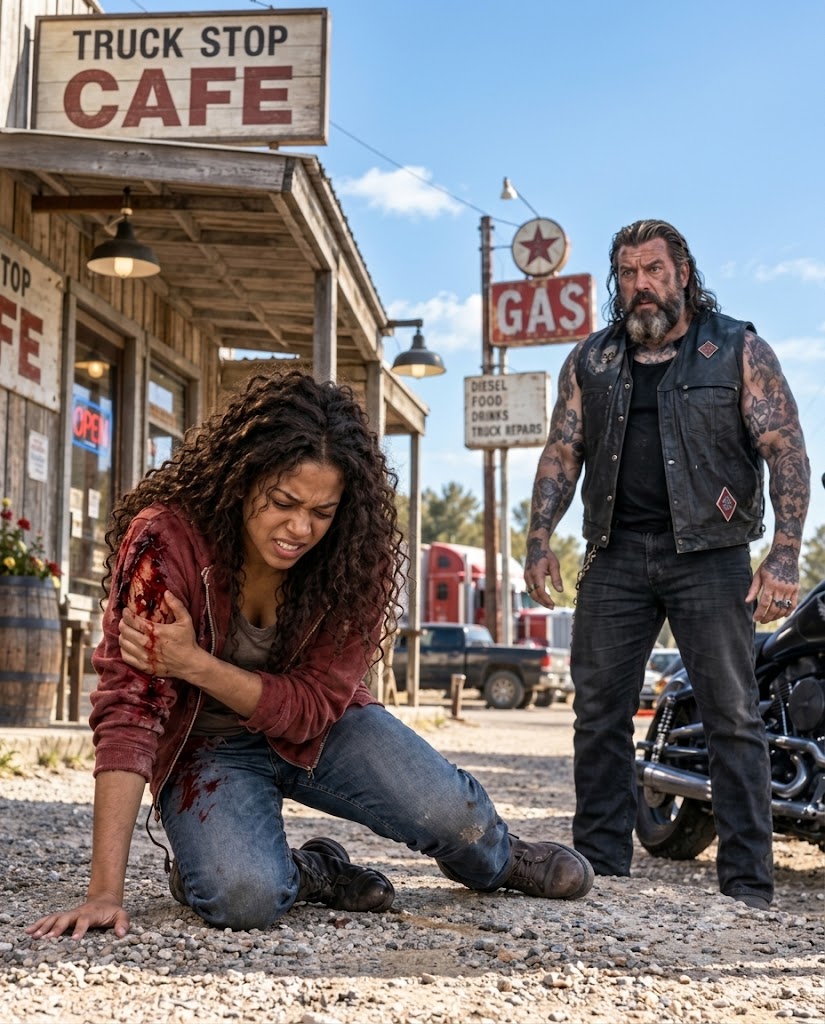
The rain had stopped an hour ago, but the pavement still held its shine, slick and dark under the fluorescent glow of the QuickStop sign. Lucy Callahan was eleven years old and believed, with the unshakable faith of a child, that cherry slushies tasted better when the ice was just slightly too crunchy. She stood beside a dented shopping cart, laughing at the way her tongue had turned a shade of red that matched her sweatshirt. Her father, Mike Callahan, was inside paying for gas and a pack of gum he did not need, and for three perfect seconds, the world was small and warm and exactly where it was supposed to be. Then the pickup truck began to reverse.
The driver later said he checked both mirrors. He said the lot was empty. He said a lot of things, but none of them changed the fact that Lucy had stepped into the blind spot behind a vehicle that weighed four thousand pounds more than she did. She did not hear the engine over her own laughter. She did not see the reverse lights flash. She only felt, suddenly, two hands pressing hard against her shoulders, shoving her sideways with a force that sent her stumbling into the shopping cart and then to the ground. The slushie flew from her hand in a red arc. The truck kept coming. And the woman who had pushed her did not move fast enough to save herself.
Mike Callahan heard his daughter scream his name, and something inside him that had been dormant for years—something older than the Hells Angels patch on his vest, older than the tattoos, older than the man he had taught himself to be—woke up and ran. He dropped the paper bag.
The glass bottle inside shattered against the asphalt. His boots slapped hard against the wet pavement, and people turned, and someone shouted for the driver to stop, and the pickup did stop, but not before its rear bumper had caught the woman who had thrown herself between it and Lucy. She went down beneath the driver’s blind spot like a stone dropped into dark water. Mike reached Lucy first. No blood.
No broken bones. Just wide eyes, shaking hands, and a sweatshirt stained with cherry syrup. “You okay? Look at me.” She nodded barely, then pointed. Ten feet away, a young Black woman sat on the pavement, one hand braced behind her, the other pressed against her side. Her old backpack had fallen open. A clean work shirt. A notebook. A pair of worn sneakers. Everything she owned seemed to have spilled out in front of strangers.
Mike recognized her. He had walked past her less than five minutes earlier. She had been sitting beneath the store awning with a cold cup of coffee between her hands. He had noticed the backpack, the tired face, the way she kept herself small while customers passed. Then he had done what nearly everyone else did. He looked away. Now that same woman had seen what Mike had missed. “Ma’am, don’t move,” he said, kneeling a few feet away.
“Paramedics are coming.” Her breathing was quick, but she shook her head. “The girl?” Mike glanced back. Lucy was still staring at her. “She’s okay.” The woman closed her eyes for half a second. Relief, not fear. Relief. “Good.” Mike had spent most of his adult life around loud engines, hard men, and people who liked to make assumptions about the Hells Angels patch on his vest. He was used to strangers watching him carefully. He was not used to feeling ashamed because he had failed to watch someone else closely enough. The driver climbed out, pale and rattled, apologizing over and over. He said he had checked one mirror, then the other. Lucy had stepped into the blind spot. He never saw her. The woman had.
Sirens grew louder in the distance. Lucy slipped away from Mike and crouched near the stranger. “What’s your name?” The woman opened her eyes. “Dani.” “I’m Lucy.” A tiny smile crossed Dani’s face. “Yeah, I heard your dad yelling it about twelve times.” Lucy almost laughed. Mike didn’t. His hands were still trembling. The ambulance pulled in. As the paramedics helped Dani up, Mike grabbed her backpack and gathered the things that had fallen out. “I’ll bring this to the hospital.” Dani hesitated. “You don’t have to.” Mike looked at his daughter, then back at her. “Yeah, I do.” An hour later, inside the emergency room, Mike finally learned the detail that changed everything.
A nurse asked Dani for her current address. Dani went quiet. The nurse asked again, softer this time. Dani stared at the floor. “I don’t really have one right now.” Mike looked down at the backpack in his hands. The woman who had just saved his daughter had nowhere to go when the hospital released her. And for the first time that night, Mike realized paying her back would not be as simple as writing a check.
The nurse did not press Dani for an answer right away. She simply nodded, entered something into the computer, and asked for an emergency contact instead. Dani gave the same quiet look. “There’s nobody I can call,” she said. Mike stood beside Lucy near the curtain, holding Dani’s backpack against his chest. He had expected embarrassment from her. What he saw instead was something harder to read. Control.
Dani was choosing every word carefully, as if one wrong answer might give someone permission to decide who she was. A doctor came in a few minutes later and explained that Dani had been lucky. She had a sprained wrist, bruised ribs, and a mild concussion. Nothing required surgery, but she needed rest, pain management, and someone checking on her for the next day or two. “Do you have somewhere safe to stay tonight?” the doctor asked. Dani looked toward the ceiling. “I can figure something out.” Mike heard the answer and immediately stepped forward. “I’ll take care of it.” Dani turned her head toward him. Her expression changed just slightly. Not gratitude, not relief.
Something closer to caution. Mike noticed it, but before he could say more, Lucy walked to the bed. “Does it hurt?” she asked. Dani looked at the bandage around her wrist. “Not as much as your dad probably thinks it does.” Lucy glanced at Mike. “He thinks everything is worse than it is.” Dani smiled. “That sounds like a dad.” The room softened for a moment. Then Lucy reached out and rested her hand beside Dani’s. “I’m sorry.” Dani frowned. “For what?” “You got hurt because of me.” Dani shook her head. “No, you didn’t do anything wrong.
The driver didn’t see you. I did. That’s all.” Lucy swallowed. “Why did you do it?” That question stopped everyone. Dani looked at her for a long second. “Because you were there.” No speech, no dramatic explanation. Just that. Mike felt something tighten in his chest. He had spent years around men who talked constantly about loyalty, brotherhood, standing up for your own. Dani had moved before she knew Lucy’s name. She had not seen his motorcycle club colors. She had not known who he was. She had simply seen a kid in danger.
Later, while Lucy sat with a nurse, Mike walked to the vending machines and stared at his phone. He could call someone from the club. He could get a motel room. He could put cash in Dani’s hand. Those were problems he understood. Problems with clean solutions. But when he returned, Dani was speaking quietly with a hospital case worker. Mike stayed near the doorway and listened. Dani was not asking for money.
She was asking where she could replace a lost identification card. She asked which office opened earliest. She asked whether a temporary document would be enough for a job interview. “When is the interview?” the case worker asked. Dani hesitated. “Three days from now.” Mike looked down at the backpack he was still carrying. Suddenly, the notebook inside it made sense. The phone numbers, the business names, the neatly written times. Dani was not waiting for someone to rescue her. She was trying to get back into a life that had slipped just out of reach. And for the first time, Mike understood that helping her might require something much harder than generosity. It might require him to stop deciding what help should look like.
Mike waited until the case worker left before setting Dani’s backpack on the chair beside her bed. “I found everything that fell out,” he said. “I didn’t go through it.” Dani looked at him for a moment, then nodded. “Thank you.” Lucy had finally fallen asleep in the recliner by the window, curled under a thin hospital blanket. The room was quiet enough for Mike to hear the air vent humming above them. Dani reached for the backpack with her good hand and slowly checked the front pocket. Her fingers stopped on a plastic badge.
The picture showed her with shorter hair, standing against a gray wall, wearing a navy polo shirt. Danielle Carter. Inventory Control. Mike noticed the company logo. “You worked warehouse.” Dani gave him a tired look. “Parts distribution. Three years.” “That explains the notebook.” She glanced down. “What notebook?” “The one with all the company names and interview times.” Her eyes narrowed. Mike lifted both hands. “It fell open in the parking lot. I saw a page. That’s all.” Dani relaxed slightly. “I keep track of every place I call, every application, every person who says try again next week.” Mike sat in the chair across from her. “What happened to your old job?” Dani did not answer right away. She rubbed her thumb along the cracked edge of the badge. “My mother got sick.” Mike stayed quiet. “Cancer,” she continued. “I cut my hours to take her to appointments. Then I missed more days, then more. My manager tried to work with me, but there’s only so much a company can do.” Her voice remained steady, but something behind it had gone distant. “After she died, I was already two months behind on rent.”
Mike looked at the floor. “No family?” “Not nearby. My father left when I was little. My mother was it.” She took a breath. “I sold what I could. Stayed in a motel for a while, then a shelter, then another shelter.” She tapped the backpack. “One night, somebody took my wallet. Driver’s license, Social Security card, bank card. Everything that made proving I’m me a whole lot easier.” Mike understood pieces now, but not the whole shape. “So the interview in three days. Inventory coordinator. Full-time, benefits after ninety days.” For the first time, her voice changed. Hope slipped through. Small, careful hope. “I already passed the phone interview. They want to meet me in person, and they need identification eventually.” “Yes.” “The bigger problem is getting through the next three days looking like someone they should trust with a job.” Mike glanced at her bandaged wrist. “You just left an emergency room after getting hit by a truck.” Dani gave him a dry smile. “That’s not going on the resume.” He almost laughed, then caught himself. She did laugh, just once, then winced and pressed a hand to her ribs.
Mike leaned forward. “Listen, I know you don’t want charity.” Dani’s expression hardened again. “I didn’t say that.” “You didn’t have to.” He paused. “But there’s a difference between charity and a bridge.” She studied him. “And who decides where the bridge goes?” That question landed harder than Mike expected. Before he could answer, Lucy stirred in the recliner and whispered Dani’s name in her sleep. Dani looked over at her, and the tension in her face softened. Mike followed her gaze. Three days. One interview. Missing identification. No stable place to recover. It was the kind of problem that made his instincts scream to take control. Instead, he asked, “What’s the first thing you need?” Dani looked back at him. “A ride to the records office when it opens.” Mike nodded. “What time?” “Eight. I’ll be downstairs at seven-thirty.” Dani hesitated. “Just a ride?” “Just a ride.” She held his eyes for another second, then nodded. Mike thought that was the agreement. He was wrong. Because before sunrise, one phone call from his motorcycle club would give him an option far bigger than a ride, and he would have to decide whether helping Dani meant using every connection he had or refusing to use them at all.
At 7:28 the next morning, Mike was already waiting outside the hospital when Dani came through the sliding doors. She wore the same clean work shirt from her backpack, now slightly wrinkled, and carried everything she owned over one shoulder. Her injured wrist was wrapped. She moved carefully, but when Mike reached for the bag, she shook her head. “I can carry it.” Mike stopped himself from arguing. “Okay.” The drive to the county records office took twenty minutes. Dani spent most of it studying a folded sheet the hospital case worker had given her. Birth certificate request. Replacement identification requirements. Proof of residency. Mike watched her checking each line like she was preparing for an exam. At the office, they learned the first problem. Without enough supporting documents, replacing everything would take time. Dani could start the process that morning, but no clerk could promise she would have what she needed before the interview. Three days had already become less than seventy-two hours. When they stepped outside, Dani sat on a concrete bench and stared at the receipt in her hand. Mike recognized that look. It was not surrender. It was someone calculating how many more obstacles she could afford. “Come eat something,” he said. She almost refused, then nodded.
They found a small diner two blocks away. Mike ordered coffee. Dani ordered eggs and toast, choosing the cheapest thing on the menu without opening it twice. While she ate, Mike reached into his jacket and placed a white envelope beside her plate. Dani looked at it. “What’s that?” “Enough for a motel for a couple weeks. Food, clothes for the interview. Whatever you need.” Her fork stopped. “Mike, you saved Lucy. Let me do this.” Dani opened the envelope just enough to see the cash, then closed it and slid it back across the table. Mike pushed it toward her again. She did not touch it. “I’m not saying I don’t need help.” “Then take it.” “That’s not what I said.” Mike leaned back. “I don’t understand.” Dani looked around the diner before meeting his eyes. “People see someone without a home and suddenly they think every decision belongs to them. Where you should sleep, what you should eat, what job you should take, what you must have done wrong to get there.” Mike said nothing. “You’re trying to be kind. I know that. But I don’t want to become the thing you fix because you feel guilty about Lucy.” That landed. Mike looked down at the envelope between them. “So what do you want me to do?” “Help me get my identification. Help me find somewhere safe to recover for a few days. Get me to that interview.” She paused. “Then let me do the rest.” Mike slowly picked up the envelope. “All right.”
That evening, after dropping Lucy at her grandmother’s house, he rode to the clubhouse. He told the men what had happened. Before he finished, chairs scraped back. One member offered money. Another knew a motel owner. Someone suggested a fundraiser. Then Ray Mercer, an older rider with thirty years in the club, slapped the table. “Tomorrow morning, we put fifty bikes outside that shelter. Let her know she has people now.” For a moment, Mike pictured it. Fifty motorcycles. Fifty leather vests. Cameras coming out. Dani’s story spreading across social media before she ever had a chance to tell it herself. It would look powerful. Generous. Unforgettable. Then he remembered her words. Let me do the rest. Mike raised his hand, and the room went quiet. “Nobody rides anywhere tomorrow.” The men stared at him. Ray frowned. “She saved your daughter.” Mike nodded. “Exactly. Which means we’re going to help her the way she asked. Not the way that makes us feel important.” And in that silence, Mike made a decision no one in the clubhouse expected. One that would change what happened next. Far more than fifty motorcycles ever could.
Mike did not sleep much that night. By six in the morning, he had already made three calls, but none of them were about money. The first was to Elena Brooks, the wife of one of the older club members who had worked in housing outreach for years. The second was to a county assistance office that helped people replace identification documents. The third was to a small medical respite program on the west side that sometimes had short-term beds for patients who needed a few quiet days to recover. Mike gave only the facts Dani had agreed to share. No photographs. No dramatic story. No mention of the parking lot. He did not even use Lucy’s name. By 8:30, he met Dani outside the shelter where the hospital had arranged for her to spend the night. She looked surprised when she saw only his truck at the curb. “Where is everybody?” she asked. Mike leaned against the door. “Everybody who?” Dani studied him. “You have a motorcycle club. I noticed. I thought there would be ten people here trying to help me.” “There were about fifty volunteers last night.” Dani blinked. Mike opened the passenger door. “I told them no.” For the first time since they met, she looked genuinely confused. “Why?” Mike waited until she was seated before answering. “Because you didn’t ask for fifty people.”
Dani looked down at her hands. “So what did you do?” “I asked three people three questions.” He told her about the assistance office, the respite program, and Elena. He made one thing clear. “Nobody is making decisions for you. Elena can explain the options. You choose.” Dani was quiet for several seconds. Then she nodded. “That sounds fair.” The next few hours were not dramatic. That was exactly why they mattered. Forms. Numbers. Waiting rooms. A case worker checking records twice. Dani answering the same questions again and again without losing her patience. At noon, they learned that her birth certificate request could be expedited, but her replacement identification would still depend on supporting documents and processing time. The interview was now less than forty-eight hours away. The respite program had one open bed for three nights. Dani accepted it—not because Mike told her to, but because the nurse explained that rest would help her heal before the interview. On the drive there, Mike’s phone kept buzzing in the cup holder. Club members. Friends. People offering cash, clothes, hotel points, even a used car. Dani glanced at the screen. “You really told all of them to stay home?” “Yes.” “Was that hard?” Mike thought about it. “Harder than I expected.” Dani gave a small smile. “Why?” “Because doing something big feels useful. Standing back does not.” Dani looked out the window. “Sometimes standing back is useful.” Mike nodded. He was beginning to understand that.
That evening, Lucy called. She wanted to visit, but Dani said she needed sleep. Lucy did not argue. She only said, “Tell her I still owe her a slushie.” Dani laughed when Mike passed along the message. The next morning, Mike arrived at the respite center at 7:30, ready to take Dani to finish the paperwork. The receptionist looked up from her desk. “She already left.” Mike froze. “Left where?” The woman checked the note Dani had signed. “Bus stop on Madison Avenue. She said she had something she needed to do by herself.” Mike looked at the clock. Her interview was the next morning. Her identification was still unresolved. And for the first time since this began, Dani had stepped forward without telling him where she was going. Mike found Dani twenty minutes later at the Madison Avenue bus stop, sitting beneath a scratched plastic shelter with her folder balanced across her knees. She looked up when his truck pulled over, and the first thing on her face was not relief. It was frustration. “The receptionist called you?” she asked. “She told me where you went.” Mike stepped out but did not come closer. “I thought we were going to the county office.” “We are.” Dani lifted a document from the folder. “But first, I need something from my old employer. They still have a copy of my personnel records. The caseworker said one of those documents might support the replacement application.” Mike glanced toward the road. The next bus was not due for another thirty minutes. “Why didn’t you tell me?” Dani’s jaw tightened. “Because yesterday, everyone spent the whole day moving things for me, calling people, opening doors. I needed to know I could still handle one thing myself.”
Mike almost said that she did not have anything to prove. The words reached his mouth and stopped. That would have been another decision made for her. So he asked something else. “Do you want a ride?” Dani looked at him. Really looked at him. Then she nodded. “Yes.” Her old workplace sat eleven miles across town, a low warehouse behind a row of loading docks. Dani went inside alone. Mike stayed in the truck. Fifteen minutes passed. Then thirty. When she finally returned, she held a sealed envelope in her good hand. “Got it.” Mike smiled. “Good.” “You didn’t come inside.” “You said you needed to do it yourself.” Dani climbed into the passenger seat. “I noticed.” At the county office, the new document helped. A clerk added it to Dani’s file, verified several records, and told her the replacement process was moving forward, but there was still no guarantee the physical identification would arrive in time. The next morning, Mike picked her up for the interview. Dani wore the navy blouse she had carefully pressed at the respite center. Her wrist was still wrapped, but her shoulders were straight. During the drive, she barely spoke. At the office building, Mike reached for his door handle. Dani stopped him. “I have this part.” He let go. “I know.”
She disappeared through the glass doors. Mike waited in the parking lot for nearly an hour. When Dani came back, her expression gave nothing away. She opened the truck door and sat down without speaking. Mike waited. Finally, she held up a sheet of paper. “They want me.” Mike broke into a grin. “You got it.” “Almost.” The smile faded from her face. “Human Resources needs valid identification before they can complete the hiring paperwork. They said they can hold the position for two business days.” Two days. Mike looked at the county receipt in Dani’s folder. The timeline on it was longer than that. “There has to be another way.” “There might not be.” “I know people.” Dani turned toward him. Mike already had his phone in his hand. He knew a business owner who knew the company’s regional manager. One call might make the problem disappear. His thumb hovered over the contact. Dani watched him. “Who are you calling?” Mike looked at the screen, then at her. Everything in him wanted to fix this before hope slipped away again. But Dani’s question from the diner came back clearly. Who decides where the bridge goes? Mike lowered the phone. “No one yet.” Dani studied him. “Good.” Then she took a breath. “Because if we’re going to solve this, I need you to hear what I’m actually asking for before you decide what happens next.” Mike set the phone face down in the cup holder. “All right,” he said. “I’m listening.”
Dani looked through the windshield for a long moment before speaking. Cars moved past them. People crossed the lot carrying coffee, folders, lunch bags. Ordinary people heading into ordinary days. “I don’t want you calling somebody to make an exception for me,” she said. “If that company hires me, I want it to be because I earned the job.” Mike nodded once. “Then tell me what help looks like.” Dani turned toward him. “Help me understand what documents they can legally accept while the replacement card is processing. Help me talk to the case worker. Help me get where I need to go. But do not turn one phone call into a favor I spend the next five years feeling like I owe.” Mike leaned back against the seat. “You think that’s what I’m doing?” “Sometimes.” He looked at her. “I’m trying to help.” Dani’s voice stayed calm. “No. Sometimes you’re trying to make this stop hurting you.” Mike went still. Dani continued before he could answer. “You almost lost Lucy. I know that scared you. And I know helping me makes you feel like you’re doing something with that fear. But my life cannot become the place where you fix what happened to yours.” The words sat between them. Mike looked toward the building where Dani had just earned a job offer on her own. He thought about the envelope, the motel, the club, the fifty motorcycles he had almost allowed to appear outside a shelter because it would have felt powerful. He thought about how often he had mistaken action for understanding. “You’re right,” he said quietly. Dani seemed almost surprised.
Mike picked up his phone, but this time he did not open his contacts. He called the county case worker assigned to Dani’s documents. He put the phone on speaker so Dani could hear every word. No secret favor. No private arrangement. They asked what temporary documents could be issued while the replacement identification was being processed. The case worker explained that Dani already had a certified birth record request underway and that another office could provide a temporary verification letter after reviewing the supporting record she had gathered. It would not guarantee anything. The employer would still decide whether it satisfied their hiring requirements. “Where do we go?” Dani asked. The case worker gave them the address. It was across town. The office closed in two hours. Mike looked at the clock. “We can make it.” Dani gave him a tired smile. “Then drive.” They reached the office with twenty-six minutes left. Dani went inside with her folder. Mike stayed in the lobby this time—not because she asked him to, but because he finally understood when to step back. Nearly forty minutes later, Dani came out holding a stamped verification letter and a receipt showing her replacement identification was in process. “This might be enough,” she said. “Might?” Mike asked. “Human Resources still has to accept it.”
The next morning, they returned to the company. Dani carried the documents inside alone. Mike waited in the truck. Ten minutes passed. Twenty. Thirty-five. Then the glass doors opened. Dani walked out slowly, holding a white envelope. Her face was unreadable. Mike stepped from the truck but did not ask. Dani crossed the parking lot, stopped in front of him, and handed him the envelope. Inside was a start date for the following Monday. Mike looked up. Dani was smiling now, but her eyes were wet. “They accepted it.” For a second, Mike forgot every careful lesson he had learned and nearly reached for his phone to call the entire club. Then he stopped. “Who do you want to tell first?” Dani looked at him. And this time, the smile became real. “Lucy.” Mike called his daughter. When Lucy answered, Dani took the phone. “Hey, kid. Remember that slushie you owe me?” Lucy laughed. “Yeah.” Dani looked down at the employment letter in her hand. “I think I finally have somewhere to go before you buy it.” And while Mike watched her talk, he realized the next challenge would be even harder than getting Dani hired. A job gave her income. It did not give her a home. And on Monday morning, Dani would have to leave the respite program with nowhere permanent to sleep.
By Sunday afternoon, Dani had packed her backpack again. The respite program had helped her recover, but her stay ended the next morning—the same day she was supposed to start work. Mike knew the timing was brutal. A new job. A healing wrist. No permanent address. No room for mistakes. His first instinct was immediate. “You can stay at my place.” Dani looked up from folding her work shirt. “Mike.” “Spare room. No rent. No questions.” She gave him the look he had learned to recognize. Not anger. A warning. He stopped. “Right. I’m doing it again.” Dani almost smiled. “A little.” Mike pulled a chair closer but did not sit until she nodded. “Then what do you want?” Dani opened a folder the housing worker had given her. “There’s a transitional housing program about four miles from the warehouse. They have one room opening tomorrow.” Mike leaned forward. “That sounds good.” “It’s not free.” “Even better.” She glanced at him. “You really are learning.” The room cost less than a motel but more than Dani could pay before her first paycheck. The program allowed short-term assistance through a local nonprofit, but Dani had to complete an intake appointment, prove employment, and agree to contribute once her check started. Mike did not call anyone important. He did not offer cash under the table. He drove Dani to the appointment and waited outside while she handled the paperwork herself. Two hours later, she came through the door holding a small packet. “I got the room.” Mike smiled. “For how long?” “Six weeks to start. Longer if I meet the program requirements.” “And after that?” Dani tapped the folder. “Then I save. I work. I look for something permanent.” Mike nodded. No promises. No grand rescue. Just the next step.
The following morning, he picked her up before sunrise. Dani wore the navy blouse, black pants, and the clean work shoes from her backpack. Her wrist was still tender, but she moved with purpose. When they reached the warehouse, Mike parked near the entrance. “Want me to wait?” he asked. Dani looked at the building, then at him. “No.” Mike nodded. “Call if you need a ride.” “I will.” She opened the door, then paused. “Mike?” “Yeah.” “Thank you for not walking me inside.” He smiled. “Go earn your paycheck.” Dani did. The first week was exhausting. New systems, new names, long hours standing. But she learned fast. By Friday, her supervisor had already trusted her with inventory corrections most new employees did not touch for a month. Lucy heard every update. On Saturday, she insisted on seeing Dani. They met at a small diner near the transitional housing building—the same kind of place where nobody cared how long you sat over coffee. Lucy arrived carrying a paper bag. “I brought something.” Dani opened it and pulled out a simple metal keychain stamped with one word. Home. Dani stared at it, then laughed softly. “I don’t have a permanent key yet.” Lucy shrugged. “Save it.” Dani closed her fingers around the keychain. “All right. I will.”
Mike watched the two of them and said nothing. He had spent years believing strength meant stepping in, fixing the problem, taking control before someone else could. Dani had taught him something harder. Sometimes helping meant staying close enough to catch someone if they fell, but far enough back to let them walk on their own. That night, Dani hung the keychain from the zipper of her backpack. Monday would begin her second week at work. Her first paycheck was still days away. Permanent housing was still only a goal on a piece of paper. But for the first time since losing her mother, Dani had a job to wake up for, a safe room to return to, and people who finally understood that caring about her did not mean owning her choices. Six months later, that small metal keychain would finally hold something Lucy had hoped for from the beginning. A key that belonged only to Dani.
Six months later, Dani stood in the middle of a small second-floor apartment with a set of keys pressed into her palm. The place was not impressive. One bedroom. A narrow kitchen. Beige walls that had been painted more times than anyone could count. The living room window faced a parking lot instead of a skyline. But Dani kept looking around as if she had walked into something impossible. On the counter beside her sat the lease with her name printed across the top. Danielle Carter, Tenant. She had saved the security deposit herself. She had paid the first month of rent from her own paycheck. No fundraiser. No secret gift from Mike. No special deal arranged behind her back. Six months of early shifts, careful budgeting, transitional housing meetings, and putting away money every Friday had brought her here. Mike carried a battered wooden table through the doorway with Ray helping from the other end. “This thing weighs more than my motorcycle,” Ray complained. Dani laughed. “Then you should have brought a smaller table.” Lucy came in behind them carrying a little green plant with both hands. “Window,” she announced. “Every apartment needs something alive in the window.” “That sounds suspiciously like something your grandmother would say,” Mike told her. “It is exactly what Grandma said.”
They spent the next hour making the empty apartment feel slightly less empty. A lamp beside the couch. Two mismatched chairs. A box of dishes donated by Elena. Mike placed a red metal toolbox on the kitchen counter. Dani raised an eyebrow. “What is this?” “Every home needs one.” “And you’re finally giving me something without trying to reorganize my entire life.” Mike smiled. “Six months of personal growth.” Dani laughed. “I’m proud of you.” By late afternoon, everyone began leaving. Ray shook Dani’s hand. Elena hugged her. Lucy lingered at the door until Mike reminded her they had promised Dani one quiet evening alone in her new place. “Wait,” Lucy said suddenly. “The keychain.” Dani stopped. She had almost forgotten. She opened her backpack—the same backpack she had carried the night Mike first met her, though now it held work schedules, grocery receipts, and a paperback novel instead of everything she owned. From a small pocket, she pulled the metal keychain Lucy had given her months earlier. Home. Dani looked at the apartment key resting in her palm. Slowly, she slid it onto the ring. Lucy beamed. “It finally has a job.” Dani smiled. “Yeah. I guess it does.” Mike stood in the doorway watching her. Months earlier, he would have wanted to say something big, something memorable. Now he understood that some moments did not need to be filled. He simply nodded. Dani nodded back.
A few weeks later, she walked into the same nonprofit office that had once helped her replace her documents. This time, she was not there for herself. A young woman sat across from a caseworker, overwhelmed by a stack of forms, whispering that she did not know where to begin. Dani recognized that look immediately. She pulled a chair closer. “It looks like a lot,” she said gently. “But you don’t have to solve everything today. Start with one thing.” The woman looked at her. “How do you know?” Dani smiled. “Because somebody finally taught me that getting help and losing control of your life are not the same thing.” That may be the most important lesson in Dani and Mike’s story. Respect is not deciding what another person needs because we believe we know better. Real kindness listens first. It protects dignity. It offers a hand without taking away someone’s right to choose their own direction. Dani saved Lucy in seconds. But Mike learned that helping Dani required patience, humility, and the courage to step back. And maybe that is worth asking ourselves. When we help someone, are we truly seeing them, or only seeing the problem we want to fix?









