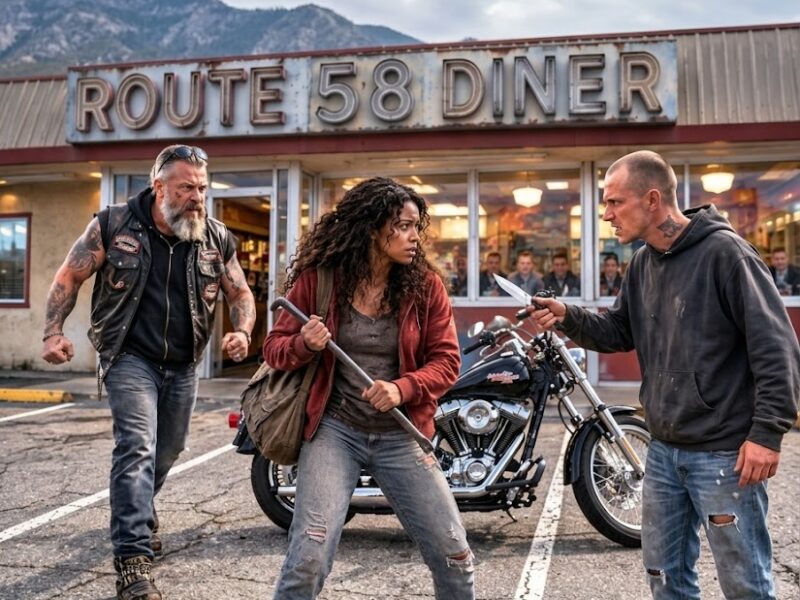
A homeless girl risked everything to save a Hell’s Angel’s motorcycle from thieves — and the reward he gave her changed her life forever.
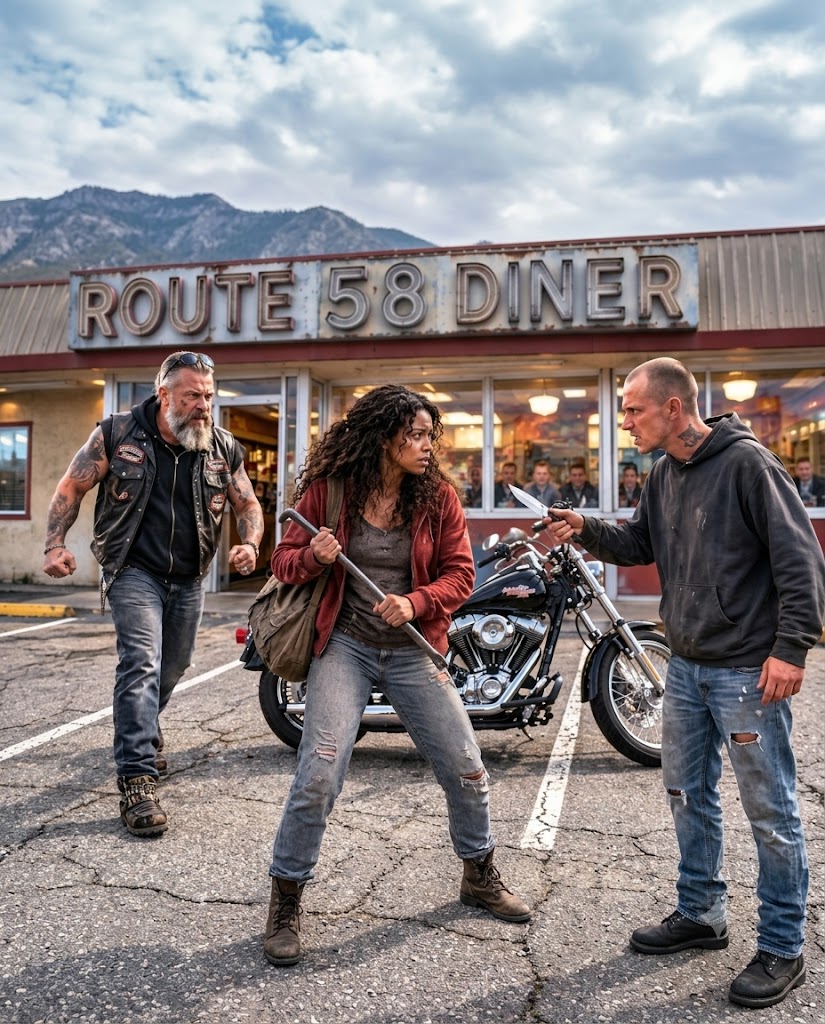
The rain had stopped an hour ago, but the pavement outside Miller’s Diner still held a slick, oily shine under the yellow security lights.
Naomi sat beneath the narrow awning with her faded backpack tucked between her boots, watching the white cargo van back into the far corner of the parking lot.
At first, she barely looked up.
People came and went at all hours in this part of town, and she had learned to mind her own business the way you learn to breathe through a cold—slowly, carefully, without expecting anyone to notice.
But these two men never entered the diner.
One walked straight to the black Harley Road Glide parked beneath the security light, and the other opened the van’s rear doors and pulled out a small loading ramp.
Naomi watched him place it carefully against the pavement.
No panic. No wasted movement.
They had done this before.
One man reached beneath the handlebars while the other positioned a wheel dolly under the front tire, and Naomi felt her stomach tighten into a hard knot.
She knew enough about motorcycles to recognize what they were doing, and she knew exactly how little time she had.
She grabbed her backpack, crossed the lot at a dead run, and pushed through the diner door so fast the bell above it snapped against the glass.
Conversation stopped.
Coffee cups paused halfway to mouths.
Naomi scanned the room and spotted the leather vest at the end of the counter—a broad-shouldered white man in his late forties sitting beside another biker, a plate of eggs untouched in front of him.
She pointed toward the window.
“That black Road Glide yours?”
The man turned slowly.
“Yeah.”
Naomi didn’t explain.
“Then move. They’re taking it.”
His chair scraped backward before the last word left her mouth, and he was already heading for the door.
The second biker followed.
Naomi went with them.
Outside, the men beside the van saw them coming and abandoned the motorcycle.
One jumped behind the wheel, the other pulled the ramp inside, and the van rolled toward the exit.
Luke Hayes stopped beside his Harley, checking that it hadn’t fallen.
Naomi didn’t.
She stood near the curb, staring at the van’s rear plate as it passed beneath the parking lot light.
“Kilo 74,” she said.
Luke looked at her.
“What?”
“Last three. K74. Pennsylvania plate, red inspection sticker on the left rear door, dent under the right taillight.”
The van disappeared onto Route 22.
Luke stared after it, then back at Naomi.
Minutes later, an officer took her statement while Luke inspected the Road Glide.
The steering lock had been released, but the bike was still there.
Nothing appeared damaged.
The officer glanced at his notes.
“You got a better description than the security camera probably did.”
Naomi shrugged and pulled her damp jacket tighter around herself.
“I was close.”
Luke studied her now.
Really studied her.
The worn sneakers, the backpack that seemed to contain everything she owned, the old grease caught along the edges of her fingernails.
Most people would have seen a homeless young woman standing beneath a parking lot light.
Luke saw the person who had just saved a motorcycle worth more than twenty thousand dollars.
He walked over and held out his hand.
“Luke Hayes.”
Naomi hesitated, then shook it.
“Naomi Carter.”
His eyes moved toward the Harley, then back to her.
“How did you know what they were doing before anyone else noticed?”
Naomi looked past him at the bike for the first time all night.
She smiled.
Just a little.
“Because they released the steering lock wrong.”
Luke’s expression changed.
“You know motorcycles.”
Naomi picked up her backpack.
“More than people usually assume.”
She started toward the sidewalk, but behind her, Luke looked at the bike, then at the young woman walking away, and realized saving his Harley might not have been the most surprising thing Naomi Carter could do.
Naomi had made it halfway to the sidewalk when Luke called after her.
“Wait.”
She stopped but didn’t turn around right away.
Luke walked over with his wallet already in his hand and pulled out a hundred-dollar bill.
“For saving me a very expensive problem.”
Naomi looked at the money, then at him.
“Keep it.”
Luke frowned.
“You earned it.”
“No, I didn’t.”
She adjusted the strap of her backpack.
“I stopped them because it was wrong.”
For a moment, Luke didn’t know what to say.
Most people he met around motorcycles wanted something—a favor, a connection, a story.
Naomi seemed to want distance.
He tried again.
“At least let me buy you breakfast.”
That made her pause.
Her eyes flicked toward the diner windows, where steam curled from coffee cups and plates were still moving across the counter.
“Coffee?” she said. “And something hot?”
Luke nodded.
“Done.”
Inside, Naomi chose the booth closest to the door.
She kept her backpack beside her leg, one hand resting on the strap as if she had trained herself never to lose contact with it.
Luke ordered eggs, toast, bacon, and coffee.
Naomi said she was fine with just toast.
When the plate arrived, she stared at it for half a second too long before picking up her fork.
Luke noticed but said nothing.
He had learned that helping someone was different from making them feel watched.
Across the table, he asked, “You from around here?”
Naomi took a sip of coffee.
“That means yes. That means I’ve been around here long enough.”
Luke let the answer sit, then his eyes dropped to her hands.
There was old black grease in the lines around her nails.
Not fresh dirt.
Shop grease.
The kind that stayed after soap.
“You work on cars?”
Naomi kept eating.
“Used to. Motorcycles, too?”
She glanced up.
“A little.”
Luke smiled.
“A little enough to spot a theft setup from fifty feet away. They had the front wheel lifted before they even touched the ignition area. That’s not how somebody moves their own bike.”
Luke leaned back.
“Fair point.”
Naomi finished half the plate, then wrapped the rest in a napkin without asking.
Luke pretended not to notice that either.
Outside, the police had left.
His Road Glide waited beneath the security light, wet pavement reflecting the chrome.
Luke rolled it upright and started the engine.
Naomi had already turned toward the street when she froze.
The engine settled into a low idle.
She listened.
One second. Two.
Then she walked back.
“Shut it off.”
Luke looked at her.
“Why?”
“Because something’s wrong at the rear.”
His expression tightened.
“What kind of wrong?”
Naomi crouched near the back wheel without touching it.
“Bearing, maybe. Hard to tell from here. But I wouldn’t take it onto the interstate.”
Luke gave a quiet laugh, more surprised than amused.
“That bike was serviced last week.”
Naomi stood.
“Then somebody missed something.”
The confidence in her voice made him stop smiling.
Luke killed the engine.
The sudden silence seemed bigger than it should have.
Naomi picked up her backpack again.
“Get it checked before you ride fast.”
Then she walked away.
Luke watched her disappear past the gas station lights, looked down at the Harley, and wondered how a woman sleeping with everything she owned on her back had just heard a problem his own shop had not.
By eight the next morning, Luke had his Harley on a lift at Hayes Motorcycle Repair, twelve miles from the diner.
Ray Alvarez, his senior mechanic, spun the rear wheel once, stopped, then spun it again more slowly.
A faint grinding sound slipped through the quiet shop.
Ray looked at Luke.
“Rear wheel bearing’s starting to fail.”
Luke folded his arms.
“You’re sure?”
Ray gave him a flat look.
“You brought me out here before coffee. Yes, I’m sure.”
Luke stared at the wheel.
The problem wasn’t dramatic yet—no broken parts, no ruined tire.
But at highway speed, it could have become something far more expensive.
What bothered Luke wasn’t the bearing.
It was the fact that Naomi had heard it from several feet away after listening to the engine for only seconds.
By ten, Luke was back at Miller’s Diner.
Naomi was gone.
The waitress said she had left shortly after sunrise.
Luke checked the bus stop, the gas station, even the small park behind the grocery store.
Nothing.
Then he remembered seeing a public library card tucked beside Naomi’s old transit pass when she opened her backpack.
The county library opened at ten thirty.
He found her forty minutes later at a computer near the back wall.
Naomi was filling out an online job application, reading every question twice before answering.
Luke stopped beside the desk.
“You were right.”
She looked up.
“About what? The bearing?”
Something passed across her face.
Not surprise.
Relief.
“Good. You checked it?”
Luke pulled out the chair across from her.
“Where did you learn to hear something like that?”
Naomi looked back at the computer screen.
For several seconds, she said nothing.
Then she closed the job application.
“Community college.”
Luke waited.
“Automotive technology,” she added. “I finished almost a year.”
“Almost?”
Naomi leaned back.
“My mother got sick. I started missing classes because I was taking her to appointments. Then I cut my hours at school. Then I stopped going.”
Her voice stayed steady, but her fingers tightened around the edge of the table.
“After she died, I was behind on rent. I worked wherever I could—oil changes, warehouse shifts, a grocery store. Then the lease ended.”
Luke didn’t interrupt.
Naomi continued more quietly.
“I stayed with friends until I ran out of friends with couches. Then motels until I ran out of money for motels.”
Luke glanced at the job application on the screen.
Overnight stock associate, minimum wage, twenty-two miles away.
“When was the last time you worked on a motorcycle?”
“Almost two years.”
“Do you still know how?”
Naomi finally looked directly at him.
“Give me a service manual and decent tools.”
Luke almost smiled.
He reached into his vest and placed a business card beside the keyboard.
“Hayes Motorcycle Repair.”
Naomi read it, then looked up.
“What is this?”
“A chance to prove you weren’t guessing last night.”
Her expression hardened slightly.
“I’m not looking for charity.”
“Good. I’m not offering any.”
Luke stood.
“Eight tomorrow morning. One day. I pay you for every hour you work. If you know what you’re doing, we talk after that. If you don’t, we shake hands and move on.”
Naomi stared at the card after he walked away.
For months, every door in front of her had asked what she had lost.
This was the first one asking what she could still do.
Naomi arrived at Hayes Motorcycle Repair at 7:37 the next morning, twenty-three minutes early.
Luke was unlocking the front office when he saw her standing beside the garage door with the same faded backpack over one shoulder.
Her clothes were clean, her hair pulled back, and there was a nervous stiffness in the way she held herself.
“You’re early,” Luke said.
Naomi glanced at the clock above the office window.
“You said eight.”
“I did.”
He unlocked the tool room and pointed toward a faded red Honda parked on the first lift.
“That one needs an oil change, chain inspection, rear brake pads, and a full safety check. Start there.”
Naomi looked at the motorcycle, then at him.
“That’s it for now?”
Ray Alvarez appeared from behind the parts counter carrying two cups of coffee.
His eyes moved from Naomi to Luke.
“This the woman from the diner?”
Luke nodded.
“Naomi Carter. She’s working today.”
Ray handed Luke one cup.
“Working or trying out? Both.”
Ray didn’t argue.
He simply looked at Naomi and said, “If you’re not sure about something, ask. Guessing gets expensive in this business.”
Naomi nodded.
“Agreed.”
She set down her backpack, washed her hands, and started with the service manual.
Luke noticed that first.
She didn’t touch a wrench until she had checked the specifications.
She worked slowly, almost too slowly.
She measured the chain slack twice.
She organized every bolt she removed.
When she reached the rear brake caliper, she stopped and called Ray over instead of pretending she knew the torque specification from memory.
Ray pointed to the manual.
Naomi found the number, repeated it aloud, and finished the job.
By noon, Ray had stopped watching every move.
By two, he was asking her to hand him tools while he worked on another bike.
Then a customer named Dennis walked into the shop to check on his touring motorcycle.
He saw Naomi wiping down the Honda and frowned.
“She working on bikes now?”
Luke looked up from the counter.
“Her name is Naomi.”
Dennis shifted, suddenly aware of how the question had sounded.
“Right. Naomi. Sorry.”
Naomi gave him a small nod and went back to work.
Luke said nothing else.
He didn’t need to.
At five thirty, Naomi finished the Honda and rolled it off the lift.
Ray checked her work without rushing.
Oil level, chain tension, brake response, fasteners.
He looked at Luke.
“Clean job.”
Naomi exhaled so quietly Luke almost missed it.
Luke went into the office, wrote down her hours, and returned with cash in an envelope.
Exactly what he had promised.
Nothing extra.
Naomi counted it once.
“You do this every day?” Luke asked.
“Work. Show up early. Read the manual before guessing.”
Naomi slipped the money into her backpack.
“That’s how you keep from making expensive mistakes.”
Luke smiled.
“Come back tomorrow.”
Naomi looked at him, surprised.
“Another trial day?”
“No. Another workday.”
She nodded.
But before she could leave, Ray called from across the shop.
“Naomi, take a look at the blue touring bike before you go. Something about the front end feels off.”
Naomi set her backpack down again.
For the first time, someone in that garage wasn’t testing whether she belonged there.
They were asking for her judgment.
Naomi walked toward the blue touring bike.
Ray stood beside it with his arms folded, giving her room.
“Customer says the front end feels strange at low speed,” he said.
Naomi rolled the motorcycle forward a few feet, squeezed the front brake, then rocked the handlebars gently from side to side.
Nothing obvious.
She crouched, studied the tire, then ran her eyes along the brake lines and lower fork.
Luke watched from the office doorway.
Five minutes passed.
Naomi said nothing.
Ray finally asked, “Anything?”
“Not yet.”
She wiped a small patch near the right brake hose with a clean shop towel.
The metal looked dry.
Naomi waited.
A faint shine returned along the fitting.
She wiped it again.
“Same thing, Ray.”
He came closer.
Naomi pointed.
“That shouldn’t be wet.”
Ray leaned down.
“Could be cleaner.”
“I thought that, too.”
She pressed the brake lever twice.
A tiny bead appeared again.
Ray’s expression changed.
He grabbed a flashlight and inspected the hose more closely.
A worn section had been rubbing against a bracket, barely enough to leave a mark.
Luke stepped over.
“How bad?”
Ray stood.
“Not bad yet, but I wouldn’t send this bike on a long trip without replacing the line.”
The customer, a man named Walter Pierce, had planned to leave for Tennessee the next morning.
When he returned to pick up the motorcycle, Ray showed him the worn hose.
Walter stared at it, then at Naomi.
“You found that?”
Naomi nodded.
“It was easy to miss.”
Walter looked uncomfortable.
The day before, he had barely acknowledged her when he dropped off the bike.
Now he held out his hand.
“Good catch.”
Naomi shook it.
“Glad we caught it here.”
That was all.
No speech, no dramatic apology, but when Walter left, he knew her name.
Over the next two weeks, Naomi kept showing up before eight.
She learned the shop computer.
She organized parts nobody had touched in months.
She asked Ray questions until he stopped answering like a supervisor and started answering like a teacher.
Luke noticed something else.
Naomi never rushed a safety check.
Even when the shop got busy, she would rather lose five minutes than pretend she had seen something she had not.
One Friday afternoon, Luke called her into the office.
Naomi stood near the door instead of sitting.
“Did I mess something up?”
“No.”
Luke slid a paper across the desk.
“I want to bring you on as an apprentice. Regular hours, regular pay.”
Naomi stared at the page for several seconds.
She didn’t touch it.
“You mean officially?”
“That’s usually what paperwork means.”
A smile broke across her face before she could hide it.
She signed her name carefully.
Luke handed her a shop shirt with Naomi stitched above the pocket.
She ran her thumb across the letters.
For the first time in months, she had a steady job.
A place that expected her tomorrow.
A place where people noticed when she walked through the door.
Luke thought that was the hard part.
He thought a paycheck meant Naomi was finally on her way back.
Then three weeks later, she arrived forty-seven minutes late, wearing yesterday’s clothes, carrying no backpack, and looking like she had lost far more than a morning bus.
Luke looked at the clock, then at Naomi.
“Forty-seven minutes late. No backpack, no shop shirt.”
Her hair was still damp, and the sweater she wore was the same one from the day before.
“You were supposed to be here at eight,” he said.
Naomi stood just inside the garage door, breathing hard.
“I know. We had two appointments waiting. I know.”
Luke heard the edge in his own voice and stopped.
Naomi didn’t offer an excuse.
She simply looked at him and said, “If you’re firing me, just say it.”
Ray glanced over from the service bay.
Luke lowered his voice.
“What happened?”
Naomi stared at the concrete floor.
“My bag is gone.”
Luke waited.
“I stayed at the overflow shelter last night. When I woke up, it wasn’t where I left it.”
Everything she carried was inside—her work clothes, phone charger, bus pass, copies of her identification, the small envelope where she had been saving part of every paycheck.
Naomi had spent the morning walking nearly four miles because she didn’t have bus fare.
“Why didn’t you call?” Luke asked.
Naomi looked at him.
“With what phone?”
The answer landed harder than he expected.
Luke had spent weeks thinking the difficult part was giving Naomi a chance to work.
Now he saw the problem he had missed.
A job assumed you already had certain things—a safe place to sleep, a place to shower, clean clothes, a phone that stayed charged, transportation that worked tomorrow the same way it worked today, a drawer where important papers could sit overnight and still be there in the morning.
Things Luke had never considered advantages because he had never lived without them.
He looked toward the waiting motorcycles, then back at Naomi.
“You’re not fired.”
Her shoulders loosened slightly.
“But we need a better plan than hoping nothing goes wrong.”
That afternoon, Luke cleared an unused metal locker beside the employee room.
Ray found a spare combination lock.
Naomi now had somewhere to keep work clothes, documents, and a charger.
Luke contacted the community resource center he knew through a holiday toy drive.
The next morning, Naomi met Maya Benton, a caseworker who spoke to her without pity and without promises.
Maya helped replace the transit card, begin the process for replacement identification, and set up a mailing address through the center.
She also handed Naomi an application for transitional housing.
“This part can take time,” Maya warned.
Naomi nodded.
“I’ve had practice with waiting.”
She filled out every page herself.
Luke signed only the employment verification.
Ray wrote a short note confirming her apprenticeship.
Nobody called in favors.
Nobody moved her ahead of anyone else.
Naomi kept working.
Three weeks passed.
Then four.
Her first replacement identification arrived.
She opened a basic checking account.
She started setting aside money again.
Small steps, real ones.
Then one Tuesday afternoon, an envelope arrived at the garage with Naomi Carter printed across the front.
She opened it beside the parts counter while Luke and Ray watched from a distance.
Her eyes moved across the page once, then again.
The small hope on her face disappeared.
Luke walked closer.
“What is it?”
Naomi handed him the letter.
Her housing application had been denied.
Naomi read the denial letter three times before folding it along the same crease.
The reason was written in language that sounded almost harmless.
Prior eviction. Outstanding rental balance. Insufficient recent housing history.
Three short lines for eight months of sleeping wherever she could.
Maya called the next morning and explained that Naomi could appeal, but the process would require more documents, another statement, and more waiting.
Naomi thanked her, hung up, and stared at the shop floor for a long time.
That week brought another problem.
The deadline to reenroll in the automotive certification program was approaching, and Naomi needed a deposit.
She had only recently managed to save.
Housing or school.
Stability now or a better future later.
By Friday, she looked exhausted.
Luke noticed mistakes that weren’t really mistakes.
A wrench left on the wrong cart.
A service ticket read twice.
Coffee sitting untouched until it went cold.
Monday morning, Naomi came in carrying her clean shop shirt folded beneath one arm.
She placed it on Luke’s desk.
“What is this?” he asked.
“I think I should stop.”
Luke looked at the shirt, then at her.
“Stop what?”
“Making everybody rearrange things around me.”
“Nobody said that.”
Naomi shook her head.
“I finally get a job and I still can’t get an apartment. I finally save money and now I have to choose between school and having enough for whatever goes wrong next. Maybe this is just how it is.”
Luke leaned back in his chair.
He could have told her she was wrong.
He could have made promises he had no right to make.
Instead, he asked one question.
“Do you want to quit?”
Naomi opened her mouth, then closed it.
Through the office window, Luke’s black Road Glide sat beside the service bay—the same motorcycle Naomi had protected the night they met.
Luke nodded toward it.
“You could have walked past that bike.”
Naomi followed his eyes.
“That was different.”
“Was it?”
Luke asked.
“You saw something going wrong and you decided it was worth stopping.”
He pushed the folded shirt back across the desk.
“Don’t walk past yourself now.”
Naomi stared at him.
The room stayed quiet.
Then she picked up the shirt.
That afternoon, she called Maya and asked how to file the appeal.
Maya gave her a list.
Naomi gathered pay stubs.
Luke completed an employment verification letter.
Ray wrote that Naomi was an apprentice in good standing and had become dependable enough to assist with customer safety inspections.
Naomi wrote her own statement about the old eviction.
No excuses—just dates, circumstances, and what had changed since then.
She submitted everything herself.
Two days later, another call came to the garage.
This one was from the police officer who had taken her statement at Miller’s Diner.
The partial plate, the red sticker, and the dent Naomi had remembered helped investigators identify the white van connected to several motorcycle thefts.
Multiple stolen bikes had been recovered.
Luke watched Naomi listen quietly, then say, “I’m glad it helped.”
After she hung up, Ray smiled.
“You notice things other people miss.”
Naomi looked toward the service bays.
“Sometimes.”
Four more weeks passed.
She kept working.
She registered for one evening certification class instead of the full schedule—enough to keep moving without draining every dollar she had saved.
Then late on a Thursday afternoon, the shop phone rang.
Naomi answered.
It was Maya.
She listened for less than thirty seconds before gripping the counter with both hands.
Luke stepped closer.
Naomi slowly looked at him, disbelief spreading across her face.
“They reconsidered my housing application.”
Naomi didn’t speak for several seconds after the call ended.
She simply stood behind the counter with the receiver still in her hand, staring at nothing.
Luke finally said her name.
“Naomi.”
She blinked and placed the phone down carefully.
“They approved it.”
Ray looked up from the service bay.
“Approved what?”
Naomi let out a breath that sounded almost like a laugh.
“The housing appeal.”
Two days later, Maya met her outside a small brick apartment building about three miles from the garage.
The unit was part of a transitional housing program.
Nothing fancy.
Second floor, one room, a narrow kitchen, a bathroom with a stubborn faucet, and a single window facing the parking lot.
Naomi stepped inside and stopped.
Maya began explaining the lease terms, the reduced rent, the six-month review, and the program requirements.
Naomi heard almost none of it at first.
She walked to the center of the empty room and slowly set her backpack on the floor.
Not beneath a chair where she could watch it.
Not against her leg.
Not under her head.
Just on the floor.
Safe enough to leave there.
Maya handed her a small brass key.
Naomi closed her fingers around it.
For months, every night had ended with the same question.
Where would she sleep?
That question was gone.
She turned the lock once, then again.
The click sounded ordinary.
To Naomi, it sounded like something beginning.
On Saturday, Luke and Ray showed up in Luke’s old pickup truck with a folding table, two chairs, a lamp, and a mattress Ray’s sister had replaced the month before.
Naomi protested when she saw everything.
“I can’t pay you for all this right now.”
Ray lifted one end of the table.
“Good thing nobody asked.”
Luke carried in a battered red metal toolbox and placed it beside the kitchen wall.
Unlike the furniture, this one made Naomi stop.
The paint was scratched.
One corner was dented.
The handle had been polished smooth by years of use.
Luke opened it.
Inside were sockets, wrenches, pliers, gauges, and a torque wrench, all cleaned and organized.
Naomi stared at the tools.
“These are yours.”
“They were.”
Luke tapped the side of the box.
A small silver nameplate had been fixed beneath the handle.
Naomi Carter.
She looked at him sharply.
“Luke, I can’t take this.”
“Yes, you can.”
“That’s not cheap.”
“Neither was my first set.”
Naomi frowned.
Luke rested one hand on the toolbox.
“A mechanic named Frank gave me these when I was twenty-two. I had more confidence than money and not enough sense to know the difference. He told me tools were useless unless I became worthy of them.”
Naomi ran her fingers over the nameplate.
“Why give them to me?”
“Because they should keep working.”
Her eyes filled.
But Luke didn’t move closer or turn the moment into something larger than it needed to be.
“You don’t owe me for them,” he said. “Use them. Take care of them. Someday when you’re ready, give somebody else a start.”
Naomi looked around the small apartment.
A key in her pocket.
Her name on a toolbox.
A job waiting Monday morning.
An evening class waiting Tuesday night.
None of it had arrived as a miracle.
Every piece had come through work, paperwork, setbacks, and people who helped without taking control away from her.
She closed the toolbox carefully.
“I’m going to finish that certification.”
Luke nodded.
“I figured you would.”
Eighteen months later, that same toolbox would be sitting beneath a different nameplate at Hayes Motorcycle Repair, and Naomi would be the one deciding whether someone else deserved a first chance.
Naomi Carter stood beneath the bright shop lights at Hayes Motorcycle Repair, with her name stitched across a clean work shirt and a certification certificate framed on the wall behind her.
The battered red toolbox Luke had given her sat beneath her workbench—still scratched, still dented, but now every drawer held tools she knew how to use with confidence.
She had finished her automotive certification, one evening class at a time.
She had moved out of transitional housing and into a small apartment of her own.
Nothing about her life was luxurious.
Her car was twelve years old.
Her furniture didn’t match.
She still watched every dollar.
But the rent was paid.
There was food in the refrigerator.
And every night she unlocked a door that belonged to her.
At the garage, Ray no longer checked Naomi’s work unless the job required a second technician.
More often, he sent younger apprentices to her.
“Ask Naomi,” he would say.
Luke pretended not to notice how much that made her smile.
One Tuesday afternoon, a light rain tapped against the front windows when the door opened.
A young woman stepped inside carrying an old backpack.
She looked barely twenty.
Her jacket was damp, her shoes were worn, and she stayed close to the door as if she wasn’t sure she was allowed to be there.
“Are you hiring?” she asked.
Luke looked up from the counter.
“What kind of work are you looking for?”
The young woman swallowed.
“Anything. Cleaning, washing bikes, taking out trash. I’m staying at a shelter right now and I just need someone to give me a chance.”
She spoke quickly, almost apologizing for existing.
Naomi stopped tightening a mirror bracket.
For a second, the garage disappeared.
She remembered Miller’s Diner.
The backpack she never let out of reach.
The hundred-dollar bill she refused.
The first time Luke had asked what she could do instead of what had happened to her.
Luke glanced toward Naomi.
He said nothing.
He didn’t have to.
Naomi wiped her hands on a shop towel and walked to the front counter.
“What’s your name?”
“Erin.”
Naomi pulled out a chair.
“Sit down, Erin.”
The young woman looked nervous.
“I really don’t want charity.”
Naomi smiled.
“Good. Neither did I.”
She poured two cups of coffee and sat across from her.
“So let’s start somewhere better. What are you good at?”
Erin stared at her, surprised.
Then slowly, she began to answer.
Across the shop, Luke returned to his paperwork with the smallest smile on his face.
Outside, his black Road Glide sat beneath the awning—the same motorcycle that had brought their lives together.
Naomi had once protected something valuable that belonged to a stranger.
Luke had returned that kindness by opening a door.
But Naomi had done the walking, the learning, the failing, the trying again.
And now she was holding that door open for someone else.
Maybe that’s the real lesson here.
Respect is not pity.
And love is not taking control of someone else’s life.
Sometimes the most powerful thing we can do is see the ability in a person before their circumstances hide it completely.
Naomi changed because Luke offered opportunity without taking away her dignity.
The toolbox still sits beneath her workbench, scratched and dented, waiting for the day it belongs to someone else who needs a first chance.
And every time Naomi hears a motorcycle engine settle into an idle, she listens.
One second.
Two.
Because sometimes the smallest sound is the one that saves everything.









