
A homeless girl ran in screaming, “Wait, don’t start your bikes!” — and what the Hell’s Angels found after listening to her shocked everyone.
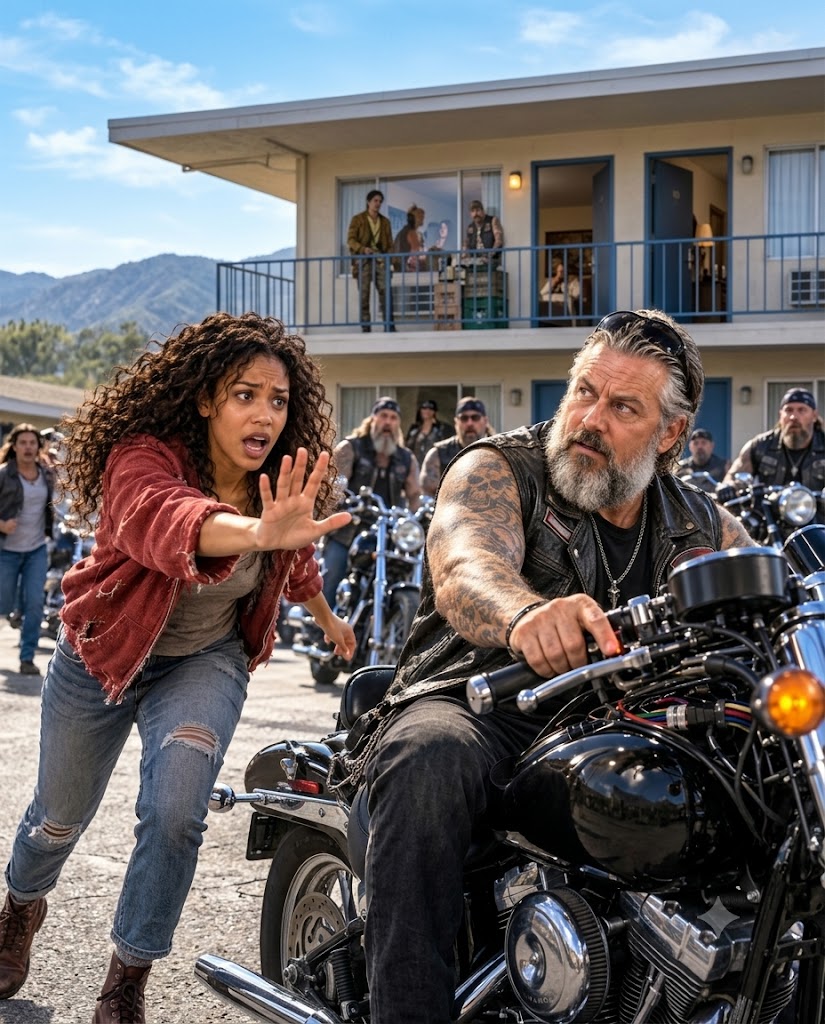
The morning air still carried the desert chill, and the sky over the motel parking lot was that pale, washed-out blue you only see just before the sun commits to another brutal day.
Mac’s thumb hovered over the starter, one second from waking the beast.
Then a voice cut through the quiet like a blade through canvas.
“Wait! Don’t start your bikes!”
Daniel M. Mercer—everyone called him Mac—froze with his hand wrapped around the right grip of his Harley, the leather warm beneath his palm, the engine still silent.
Six motorcycles waited beside him in the motel parking lot, packed for another long day on the road.
Helmets were on, gloves were tight, coffee was finished.
They had nearly 280 miles ahead of them before the next stop on their charity ride, and nobody expected the morning to begin with a stranger sprinting toward them.
“Wait!” she shouted again. “Please don’t start your bikes!”
Mac turned.
A young Black woman was running across the parking lot in worn sneakers, an oversized gray hoodie hanging from her narrow shoulders.
A faded backpack bounced against her back.
She looked exhausted—maybe twenty or twenty-one—but there was nothing uncertain about the way she was staring at Mac’s motorcycle.
Ray Collins stepped between her and the bikes.
“Easy,” he said. “What’s going on?”
“The bikes!” She struggled to catch her breath. “Don’t start them yet.”
The motel manager hurried outside behind her.
“Nia, I told you to stay off this property.”
Mac glanced from the manager to the girl.
Nia.
So they knew her here.
“She hangs around the laundromat across the street,” the manager said. “Sorry, gentlemen. I’ll handle this.”
Nia barely looked at him.
Her eyes stayed on Mac.
“Just check your bike first.”
Mac had spent enough years on the road to know when something felt wrong.
He also knew better than to accuse someone without a reason.
“Check what?” he asked.
Nia approached slowly, keeping both hands where everyone could see them.
Then she crouched beside his Harley.
She didn’t touch it.
She simply pointed beneath the frame.
“There.”
Ray knelt beside her.
He had worked on motorcycles for almost thirty years, and the joking expression disappeared from his face almost immediately.
“Mac.”
One word.
That was enough.
Mac stepped closer.
Ray traced the area with his eyes, careful not to disturb anything.
Something near the bike’s electrical system didn’t look the way it had the night before.
It was subtle—easy to miss unless you knew what you were looking for.
“Nobody starts anything,” Ray said.
The other riders went still.
The motel manager stopped talking.
Mac looked at Nia again.
“How did you know?”
She hesitated.
“Because I saw somebody near your bikes around four this morning.”
Mac’s eyes narrowed.
“You saw him touch this one?”
“I saw him crouching beside it. I tried telling the night clerk, but he wouldn’t let me inside.”
She nodded toward the laundromat across the street.
“I waited over there because I knew you’d come back out eventually.”
Ray was still examining the Harley.
Then he suddenly stood.
“Everybody step away from the bikes. Now.”
Even Mac felt the tension change.
Nia tightened both hands around the straps of her backpack.
She wasn’t asking for money.
She wasn’t asking for food.
She had apparently spent nearly two hours waiting for seven strangers she didn’t know—just to stop them from turning their keys.
Mac looked down the row of Harleys.
“Was he only near mine?”
Nia’s expression changed.
She slowly shook her head.
“No.”
Ray moved toward the second motorcycle.
Nia pointed farther down the line.
“Check that one, too.”
Ray crouched.
Ten seconds passed.
Then twenty.
When he finally looked up, his face had gone completely serious.
“Mac,” he said quietly. “She’s right.”
Nia stared at the remaining motorcycles.
“I told you not to start them.”
Mac followed her gaze.
Whatever had happened before sunrise hadn’t happened to just one bike.
Ray moved from one motorcycle to the next while the other riders stood back, watching his face instead of his hands.
By the third bike, nobody was talking anymore.
“Three,” Ray finally said. “Three have been messed with.”
Mac looked toward Nia.
She had backed away from the motorcycles and was standing beside a concrete parking stop, gripping both straps of her faded backpack.
The motel manager folded his arms.
“You realize how this looks, right?”
Nia stared at him.
“Yeah. I do.”
“You sleep across the street. You somehow know exactly where the problem is. Now you’re telling these guys you saw somebody else do it.”
Ray glanced at Mac.
The question was uncomfortable, but it was obvious.
How did Nia know where to look?
Mac walked toward her.
He kept his voice calm.
“I need you to tell me something.”
Nia nodded.
“How did you know what Ray was looking for?”
For the first time since she had run into the parking lot, Nia seemed guarded.
“Because I know bikes.”
“From where?”
She looked away.
“Does that matter right now?”
“It matters if we’re going to understand what happened.”
Nia took a slow breath.
“Then check the cameras.”
The motel manager gave a short laugh.
“Our cameras aren’t exactly Hollywood.”
Nia ignored him.
“Back corner of the lot. Around 4:17 this morning.”
Mac studied her face.
“4:17?”
“Yes.”
“You’re sure?”
“I was looking at the clock inside the laundromat when I saw him.”
That changed something.
A person inventing a story might say “around four.”
4:17 was different—specific, testable.
Mac turned to the manager.
“Can we see the footage?”
The man hesitated.
“Police should probably handle that.”
“Then call them,” Mac said. “We’re not touching the bikes until somebody figures this out.”
One of the riders was already making the call.
Mac looked back at Nia.
“Where were you when you saw him?”
She pointed across the street.
The laundromat windows were bright beneath a red OPEN sign.
“Over there doing laundry.”
Nia almost smiled, but it disappeared quickly.
“No.”
Mac waited.
“I was trying to stay somewhere with lights.”
Nobody said anything.
Nia shifted the backpack higher on her shoulder.
“I don’t really have anywhere to sleep.”
The manager looked uncomfortable now.
Mac did too.
Not because Nia had said it dramatically.
She hadn’t.
She had said it like someone giving directions—a fact she had repeated too many times to strangers.
Ten minutes later, a patrol officer arrived.
The manager finally agreed to pull up the security recording while everyone gathered near the small monitor behind the front desk.
The picture was grainy, but the parking lot was visible.
The timestamp moved past 4:16.
Nia leaned forward.
“There.”
At exactly 4:17, a figure entered the far edge of the screen—dark jacket, baseball cap, head lowered.
He walked past the first motorcycle, stopped beside Mac’s Harley, and crouched.
Mac felt every person in the room become still.
The figure remained there for several seconds, then moved to another bike.
Then another.
Nia had told the truth.
But before anyone could speak, she pointed at the screen again.
“Keep watching.”
The figure disappeared from view.
Thirty seconds passed.
Then Nia herself appeared on the recording, running toward the motel entrance.
She reached the locked lobby door and began knocking.
The night clerk came into view.
He looked at her through the glass.
Nia pointed desperately toward the parking lot.
The clerk shook his head and waved her away.
Mac slowly turned toward her.
“You tried to warn us then?”
Nia nodded.
“He wouldn’t let me inside.”
Ray stared at the screen, then at Nia.
“So you waited almost two hours.”
“I knew you’d come out eventually.”
Mac looked back at the frozen image of the stranger beside his Harley.
The question was no longer whether Nia was telling the truth.
Now there was another one.
“Have you ever seen that man before?”
Nia went completely still.
Her eyes stayed on the screen.
“Yes,” she said quietly. “Twice.”
Nobody spoke for a moment.
Mac watched Nia instead of the security screen.
“Twice where?” he asked.
Nia shook her head.
“Not here.”
The patrol officer stepped closer.
“You’re sure it was the same person? Same jacket? Same cap? Same way he moved around the bikes?”
The officer nodded but didn’t push her.
“We’ll get to that. First, I need to understand what happened this morning.”
Ray had returned to the parking lot, and Mac followed him outside with Nia a few steps behind.
The other riders stayed clear while Ray examined the motorcycles again.
“Whatever happened here, nobody rides until I finish checking every bike,” he said.
Nia stopped beside the third Harley.
“Look near the wiring harness.”
Ray glanced at her.
“Why?”
“Because if somebody was trying to make a problem hard to notice, that’s where I’d check next.”
Ray crouched.
A few seconds later, he looked over his shoulder.
“You were right.”
Mac turned toward Nia.
“You said you know bikes.”
She tightened her grip on the backpack strap.
“A little.”
Ray stood and wiped his hands on a shop towel.
“That’s more than a little.”
Nia said nothing.
Mac noticed the way her eyes moved over the motorcycles.
She wasn’t admiring chrome or paint.
She was studying connections, cables, wear points—the same way Ray did.
“Were you a mechanic?” Mac asked.
Nia gave a small shake of her head.
“Not exactly.”
“Then what?”
She hesitated long enough that Mac almost let the question go.
“Automotive technology program,” she finally said.
“Community college?” Ray raised his eyebrows.
“How far did you get?”
“Three semesters.”
“Why did you stop?”
Nia looked toward the laundromat.
“That’s a longer story.”
Mac could hear the boundary in her voice.
He respected it.
“Fair enough.”
Ray crouched beside another motorcycle.
Nia watched him work, then quietly said, “Check the connector before you move anything.”
Ray paused.
He checked.
Then he looked at her with a different expression.
Not suspicion anymore.
Professional curiosity.
“You remember all this after being out of school?”
Nia shrugged.
“I didn’t stop learning just because I stopped going.”
That sentence stayed with Mac.
The motel manager had described her as someone who hung around the property.
The night clerk had seen someone he didn’t want inside.
Mac himself had first seen a stranger rushing toward expensive motorcycles.
None of them had seen a student who knew enough to recognize something experienced riders had missed.
The officer came outside holding a small notebook.
“Nia, you said you’ve seen that person twice before.”
Her shoulder stiffened.
“Yes.”
“Tell me about the most recent time.”
Nia looked toward the road as if deciding how much to say.
“About two weeks ago, there’s a gas station a little over a mile from here. I was walking behind it early in the morning, and I saw a motorcycle parked near the side lot. I saw that same man crouched beside it.”
Ray stopped working.
Mac asked, “What did you do?”
“I told the security guard.”
“What happened?”
Nia gave a tired little smile.
“He told me to keep moving.”
The officer wrote something down.
“Do you know who owned the motorcycle?”
“No.” Nia looked back at the three Harleys. “But a few days later, I heard somebody at the shelter talking about a rider whose bike had developed a serious problem after leaving that area.”
Mac felt the story shift again.
It wasn’t proof.
Nia knew that too.
“I don’t know if those things were connected,” she said quickly. “I’m not saying they were.”
The officer nodded.
“That’s the right way to put it.”
Then Nia looked at the frozen security image through the lobby window.
“But there’s something else.”
Mac waited.
“The first time I saw him was almost a month ago.”
Her voice dropped.
“And that time, I saw his vehicle.”
The officer stopped writing.
“What kind of vehicle?”
Nia closed her eyes for a second, searching her memory.
“An older white pickup. Two doors. Dark toolbox behind the cab. The rear bumper had a dent on the passenger side.”
Mac glanced at Ray.
That was more detailed than either of them expected.
“License plate?” the officer asked.
“I couldn’t read all of it. I remember the first letter was K. There might have been a seven near the end.”
“Why do you remember the truck so clearly?”
Nia looked toward the road.
“Because I tried to remember everything nobody else cared about.”
The officer wrote it down.
He made no promises.
A white pickup with a partial plate wasn’t enough to identify anyone, but it was something they hadn’t had five minutes earlier.
Mac leaned against the motel railing.
“Tell us about the first time.”
Nia nodded slowly.
Almost a month earlier, she had been walking back from a 24-hour convenience store when she noticed the truck parked behind a closed strip mall.
A man stood beside a motorcycle near the far end of the lot.
At first, she assumed it was his.
Then a second man came out of a nearby building, and the stranger quickly returned to the pickup and drove away.
“You reported that too?” Mac asked.
Nia gave him a look that answered before she spoke.
“I tried. Nobody listened. They listened long enough to tell me it was probably nothing.”
Ray lowered his eyes.
Nia was careful with what she said next.
She didn’t claim the motorcycle had been damaged.
She didn’t claim the same man was responsible for anything beyond what she had personally seen.
“Maybe it was nothing,” she said. “But then I saw him again two weeks ago. And then this morning.”
The officer nodded.
“Three sightings, similar circumstances. That’s useful information. We still need evidence connecting them.”
Mac appreciated that nobody was turning a suspicion into a fact.
The officer radioed another unit and asked someone to check nearby businesses for exterior cameras.
Meanwhile, Ray finished inspecting all seven motorcycles.
Three required further examination before anyone should ride them.
The other four appeared untouched.
Their charity ride was officially on hold.
Strangely, Mac didn’t care anymore.
He looked across the street at the laundromat where Nia had spent the night.
“You could have walked away this morning,” he said. “Nobody would have blamed you.”
Nia stared at the pavement.
“I walked away the second time at the gas station.”
She nodded.
“The guard told me to leave, so I left. Then I heard about that rider having trouble later.”
She paused.
“I know that doesn’t mean I could have prevented anything. I know that.”
“But it stayed with you.”
“Yeah.” Her voice softened. “So when I saw him here, I thought, not again.”
Mac finally understood why she had waited nearly two hours.
It wasn’t about his Harley.
It was about refusing to carry another unanswered question.
The officer’s radio crackled.
He listened, then looked toward Nia.
“We may have something.”
A convenience store about half a mile away had an exterior camera facing the road.
At 4:23 that morning—six minutes after the motel footage—it recorded an older white pickup leaving the area.
The officer turned the screen of his phone toward them.
The image was blurry, but the dark toolbox was visible.
So was the dent on the rear bumper.
Nia leaned closer.
“That’s it.”
The officer enlarged the image.
This time, part of the license plate could be seen.
He read the characters twice, then looked at his partner.
“Run that plate.”
Less than a minute later, the response came back.
The officer’s expression changed.
Mac noticed immediately.
“What is it?”
The officer looked from the phone to the motel parking lot.
“The truck is registered locally.”
He paused.
“And according to this address, the owner lives less than two miles from here.”
The officer did not share the owner’s name.
He simply told Mac and the others to stay at the motel while another unit followed up on the address.
Nobody argued.
Whatever happened next belonged to the police, not seven bikers looking for someone to confront.
With the motorcycles still being checked, Mac glanced toward the diner attached to the motel.
“We’re going to be here a while,” he said.
Then he looked at Nia.
“We’re getting breakfast. You want to join us?”
Nia seemed surprised by the wording.
Not an offer of charity.
Not a plate handed to her outside.
Just a seat at the same table.
“Okay,” she said.
Inside, the waitress pushed two tables together.
Nia chose the chair closest to the aisle, still wearing her backpack.
She ordered eggs, toast, and coffee.
Nothing more.
For several minutes, nobody asked about the truck or the security footage.
Ray talked about the motorcycles.
Another rider complained about the terrible motel coffee.
Slowly, Nia’s shoulders relaxed.
Mac noticed grease beneath one of her fingernails.
“You really were studying automotive technology?” he asked.
Nia nodded.
“At the community college. Three semesters.”
“Almost finished with the third.”
Ray leaned forward.
“What were you best at?”
“Electrical diagnostics.”
Ray laughed softly.
“Of course you were.”
For the first time that morning, Nia smiled.
It disappeared when Mac asked the obvious question.
“What happened?”
Nia wrapped both hands around her coffee cup.
“My mom got sick.” Her voice stayed steady. “She was a nursing assistant. She worked a lot, but we were doing okay. Then she had to stop working.”
Nia picked up extra shifts while staying in school.
For months, she tried to hold everything together.
After her mother died, the bills didn’t disappear.
Neither did rent.
Then Nia’s car failed.
Without transportation, she started missing work.
Missing work meant losing hours.
Losing hours meant falling further behind.
“People think you become homeless in one big moment,” she said. “Sometimes it’s more like ten small doors closing one after another.”
Nobody interrupted.
“I left school because I thought I could go back once I got stable.”
She looked down at her coffee.
“Then stable kept moving farther away.”
Mac asked if she had family.
Nia’s expression tightened.
“Nobody I can stay with.”
He didn’t ask why.
Some questions were invitations.
Others were demands.
Mac was beginning to understand the difference.
“How long have you been sleeping around here?”
“Eight months, more or less. Shelters when there’s space. Laundromats when there’s not.”
Ray looked at her backpack.
“And you still remember electrical systems after eight months.”
Nia gave him a small smile.
“I didn’t stop learning.”
She pulled the backpack onto her lap.
“Libraries are free.”
She opened it to find something, and a thick notebook slipped onto the floor.
Mac bent down to pick it up.
Several loose pages slid free.
Wiring diagrams.
Handwritten diagnostic steps.
Engine notes.
Pages filled from top to bottom.
Nia quickly gathered them.
“You wrote all this?” Mac asked.
“Most of it.”
Ray picked up one page with her permission and stared at the detailed diagram.
“You’ve been studying this whole time.”
Nia nodded.
“I was afraid I would forget.”
She reached deeper into the backpack and removed a worn plastic folder.
For the first time all morning, her hands trembled slightly.
“Actually, that’s not what I was most afraid of.”
Mac looked at the folder.
“What’s in there?”
Nia held it against her chest for a moment.
Then she slowly opened it.
“Proof that I had a life before people started seeing me like this.”
Inside the folder were no photographs, no cash, and nothing that looked valuable to anyone else.
There were transcripts.
Three semesters of them.
Mac watched Nia place the pages on the table carefully, smoothing the worn corners with her fingertips.
Her grades were good.
Very good.
Electrical systems.
Engine performance.
Automotive electronics.
Diagnostic procedures.
Ray leaned closer but didn’t touch anything.
Behind the transcripts was a letter from a local repair shop offering Nia a paid internship.
The date was almost a year old.
“You got this before you left school?” Mac asked.
“Two weeks before my mom died.”
Nia looked at the letter.
“I was supposed to start that summer.”
“What happened?”
“Everything happened.”
She gave a small shrug, but Mac could hear the weight behind it.
She had missed the start date.
Then she lost her car.
Then her apartment.
By the time she thought about calling the shop again, months had passed and she no longer had a permanent address.
“So you kept the letter,” Ray said.
“I kept all of it.”
Nia tapped the notebook beside her.
“The notes, too.”
Mac looked at the pages filled with wiring diagrams and diagnostic steps.
“Why?”
Nia was quiet for several seconds.
The diner sounds seemed louder around them.
Silverware.
Coffee pouring.
A chair sliding across the floor.
Finally, she said, “Because if I threw this stuff away, then maybe this became who I was.”
She touched the strap of her backpack.
Mac understood what she meant.
The laundromat.
The shelters.
Being told to move along.
People seeing the backpack before they saw her face.
“This is where you are,” he said.
Nia looked up.
“It’s not who you are.”
She held his gaze, then looked down again.
No dramatic speech followed.
None was needed.
Ray gently pushed the transcript back toward her.
“For what it’s worth, you spotted something this morning that seven experienced riders missed.”
“You were about to notice it,” Nia said.
“Maybe.” Ray smiled. “But you noticed it first.”
Before Nia could answer, the patrol officer entered the diner.
Mac knew from his expression that something had changed.
The officer approached their table.
“We located the pickup.”
Nia sat straighter.
“Was it the same one?”
“It matches the vehicle from the convenience store camera. The investigation is continuing, and I can’t give you details about the owner yet.”
He looked directly at Nia.
“But your description helped us find it.”
Nia did not smile.
“What about the other places?”
“We’re checking cameras and reports from the areas you mentioned. We don’t know yet whether those incidents are connected.”
That mattered.
No guesses turned into facts.
No convenient ending.
Just evidence being followed one piece at a time.
The officer thanked her again and left.
For the first time that morning, Nia seemed to exhale completely.
Mac looked around the table.
Ray was already reaching for his wallet.
Another rider quietly said they could cover a motel room for a week.
Someone else suggested replacing Nia’s worn clothes.
Then one of the men pulled out his phone.
“We could post her story,” he said. “Seven of us share it. People will help. We could raise enough to get her back on her feet.”
Mac looked at Nia and thought it was a good idea.
Maybe the best idea anyone had offered all morning.
He was about to tell her they could take care of everything.
Then he noticed her expression.
The folder snapped shut.
Nia stood, pulled the backpack onto her shoulder, and stepped away from the table.
“No.”
The rider lowered his phone.
“We’re only trying to help.”
Nia looked at Mac.
There was no gratitude in her face now.
There was hurt.
“Then why has nobody asked me what I actually want?”
Mac felt the words land harder than he expected.
A few minutes earlier, he had been angry that the motel staff had looked at Nia and decided who she was before listening to her.
Now he realized he had done something uncomfortably similar.
His intentions were better, but he had still skipped the most important part.
He had never asked.
The rider holding the phone slowly set it face down on the table.
“You’re right,” Mac said.
Nia looked almost surprised.
“We got ahead of ourselves.”
He nodded toward the empty chair.
“Nobody is posting anything. Nobody is making decisions for you. Sit down if you want—or don’t—but tell me what you actually need.”
Nia remained standing for a moment.
Then she returned to the chair.
She kept her backpack on her shoulder.
“I don’t want strangers donating because they saw some sad picture of me.”
She said, “I don’t want to walk into a shop knowing everybody thinks I’m there because somebody felt sorry for me.”
Ray nodded slowly.
“Then what do you want?”
Nia looked at the notebook on the table.
“A chance to finish what I started.”
Mac leaned forward.
“School eventually. But school doesn’t solve tomorrow morning.”
She counted quietly on her fingers.
“I need steady work. I need somewhere safe enough that I can actually sleep. I need transportation that doesn’t disappear when a shelter changes its hours.”
She paused.
“And I need people to stop treating me like I can’t do anything for myself.”
Mac sat back.
That last part mattered most.
He pulled out his phone, but this time he did not open a camera or social media.
“I know somebody.”
Nia immediately stiffened.
“I’m not asking him to hire you.”
Mac held up a hand.
“His name is Tom Alvarez. He owns a repair shop about twelve miles from here. Motorcycles, cars, electrical diagnostics. I’ve known him for fifteen years.”
Nia watched him carefully.
“What are you asking him for?”
“An interview.”
That changed her expression.
“Nothing else.”
“Nothing else,” Mac repeated.
Ray smiled.
“And if you can’t do the work, Tom will tell you.”
Nia looked at him.
“Good.”
“You actually like that?”
“I want a job, not a favor.”
Mac called Tom.
He kept the conversation short.
He said he had met a young woman who had completed three semesters of automotive training and seemed sharp with electrical systems.
He did not mention homelessness until Nia nodded permission.
Even then, he gave no dramatic story, no rescue, no heroics—just facts.
When Mac ended the call, everyone waited.
“Tomorrow morning,” he said. “Nine o’clock.”
Nia blinked.
“He said yes. He said he’ll interview you. That’s all he promised.”
A real smile appeared on her face.
“That’s enough.”
One of the riders asked about a place for her to stay that night.
This time, nobody made a plan without her.
Nia explained that a transitional housing program nearby had a waiting list, but she had missed an intake appointment because she had no reliable ride.
Mac asked if she wanted help calling them.
She said yes.
Within twenty minutes, they had confirmed a new appointment for that afternoon.
It was not a miracle.
No apartment key appeared.
No pile of money solved everything.
There was simply an appointment today and an interview tomorrow.
Two doors that had been closed that morning were now open a few inches.
Then Ray returned from outside carrying Nia’s notebook.
“Before tomorrow,” he said, placing it in front of her. “You might want to look at this.”
He pointed to one of her old diagnostic diagrams.
“Tom likes practical tests.”
Nia looked at the page, then at Mac.
“What kind of test?”
Mac smiled.
“Knowing Tom, he’s not going to ask what you know.”
He tapped the notebook.
“He’s going to put a broken machine in front of you and make you prove it.”
At 8:50 the next morning, Nia stood outside Alvarez Auto and Cycle with her notebook tucked beneath one arm.
Mac had offered to wait inside.
She told him not to.
“If I get this, I want to know I got it myself.”
So Mac stayed near the front office while Tom Alvarez led her through the shop.
Tom was in his early sixties with gray hair, reading glasses, and the quiet manner of someone who had spent decades listening to engines before listening to people.
He asked about school.
He asked about electrical systems.
He asked what Nia would do when a customer described a problem that disappeared the moment the vehicle entered the shop.
Nia answered carefully.
She did not pretend to know everything.
When she did not know something, she said so.
Tom seemed to like that more than the answer she got right.
Then he stopped beside an older motorcycle parked near a workbench.
“Customer says it starts fine most mornings,” he said. “Then sometimes nothing. Shop already replaced one part. Problem came back.”
He handed her a basic diagnostic meter.
“Tell me where you would start.”
Nia stared at the motorcycle.
This was the moment she had wanted.
It was also the moment she had feared.
For eight months, most people had looked at her and seen someone who needed help.
Tom was looking at her like someone who might know something.
That was somehow more frightening.
She began with the obvious checks.
Battery condition.
Connections.
Ground points.
Nothing.
She tested again.
Still nothing unusual.
Tom said nothing.
Mac watched through the office window but stayed where he had promised.
Nia moved to another connection and made her first wrong call.
“I think it might be here.”
Tom shook his head.
“Show me.”
She tested it.
The reading proved her wrong.
Heat rose into her face.
Months earlier, that mistake might have made her panic.
Now she heard Ray’s voice from the diner.
Practical test.
Prove it.
Nia closed her eyes for one second.
Then she opened her notebook—not to find an answer, but to remind herself how she used to think.
Don’t chase the symptom.
Follow the circuit.
She started over slowly this time.
Battery.
Ground.
Relay.
Harness.
Connector.
Then she noticed something small.
A connection that looked clean from above but shifted when she applied gentle pressure.
“There.”
Tom stepped closer.
Nia tested it before saying anything else.
The reading changed.
She looked up.
“Intermittent connection. That’s why replacing the other part didn’t fix it.”
Tom checked her work himself.
For several seconds, his face revealed nothing.
Then he set the meter down.
“When can you start?”
Nia stared at him.
“You mean that?”
“I don’t ask questions I don’t mean.”
She swallowed.
“Tomorrow. Eight in the morning.”
“Work shirt is provided. Bring boots if you have them.”
“I don’t.”
“Then that’s the first problem we solve.”
Nia smiled.
“With my first paycheck.”
Tom almost smiled back.
“Fair enough.”
Outside, Mac did not ask whether she passed.
Her face told him.
He simply held out his fist.
Nia bumped it with hers.
That afternoon, the housing program completed her intake and arranged a temporary room while she started work.
The bikers helped with bus passes and basic tools—only after asking what she was comfortable accepting.
Everything else was hers to build.
Weeks passed.
Then months.
Nia worked, saved, returned to evening classes.
The police investigation continued separately, and Mac never turned it into a story about revenge.
What mattered to him was that Nia’s warning had been taken seriously and the evidence had been handed to the people responsible for investigating it.
Nearly six months later, Mac received a short message from Alvarez Auto and Cycle.
Tom had written only five words.
Bring your Harley in tomorrow.
Mac smiled, thinking it needed routine service.
Then a second message arrived.
Ask for Nia Carter.
Six months after the morning that changed everything, Mac rolled his Harley into Alvarez Auto and Cycle and saw a familiar name stitched above the pocket of a dark work shirt.
Nia Carter was standing beside a lift, tightening the final connection on a customer’s motorcycle.
Her hair was pulled back, her hands were marked with grease, and the old backpack was nowhere in sight.
She looked up and smiled.
“You’re three minutes early.”
Mac removed his helmet.
“Tom told me to ask for you.”
“He enjoys making things dramatic.”
Tom called from the office.
“Your bike is her problem today.”
Mac walked around the Harley with Nia, who held a tablet in one hand.
There was no special treatment in her voice.
She asked about mileage, recent service, and whether Mac had noticed anything unusual.
He answered every question seriously.
That mattered to her.
She was not the homeless girl he had met outside a motel anymore.
More importantly, she had never been only that.
Mac had simply needed time to understand it.
While Nia worked, she told him about the last six months.
The transitional housing program had given her enough stability to stop wondering where she would sleep each night.
Her paychecks had helped her rent a small room of her own.
Nothing fancy.
One window, a secondhand table, a mattress she had bought herself—but she had a key in her pocket that opened her own front door.
She had also returned to community college for evening classes twice a week.
“Electrical diagnostics?” Mac asked.
“Still my favorite.”
“I figured.”
The police had eventually told the riders that the information from the cameras and Nia’s statement had become part of a broader investigation into suspicious activity around several parking areas.
Mac never asked for details that were not his business.
For him, the important truth had already been established.
Nia had seen something wrong.
She had spoken up.
And eventually someone had listened.
Twenty minutes later, she finished inspecting his Harley and handed him the invoice.
Mac looked at the total and reached for his wallet.
Nia raised an eyebrow.
“I could give you the friends and family discount.”
“Absolutely not.”
“It’s ten percent.”
“Still no.”
Nia laughed.
“Why?”
Mac handed her his card.
“Because you’re my mechanic. Charge me like one.”
For a second, she said nothing.
Then she nodded.
“Fair enough.”
Outside the shop, Mac put on his helmet and settled onto the Harley.
His thumb moved toward the ignition, then stopped.
He looked through the open garage door.
Nia was standing there with her arms folded.
Mac smiled.
“Can I start it this time?”
Nia walked over, gave the motorcycle one final glance, and lightly tapped the fuel tank.
“Yeah,” she said. “Now you can.”
Mac pressed the starter.
The engine came alive with a deep, steady rumble.
Nia smiled as he pulled away, then turned back toward the garage.
Another customer had arrived.
Another machine needed diagnosing.
And this time, someone was waiting for her.
Maybe that is the lesson worth carrying from Nia’s story.
A person is bigger than the clothes they wear, the place they sleep, or the hardest season of their life.
Helping someone does not mean deciding what their life should become.
Sometimes respect means listening first, asking what they need, and giving them room to prove what they can do.
I think Nia saved more than a few motorcycles that morning.
She reminded everyone around her to look twice before judging another human being.
What would you have done in Mac’s place?
Share your thoughts in the comments.
And if stories about dignity, second chances, and everyday kindness matter to you, subscribe and stay with us for the next one.









