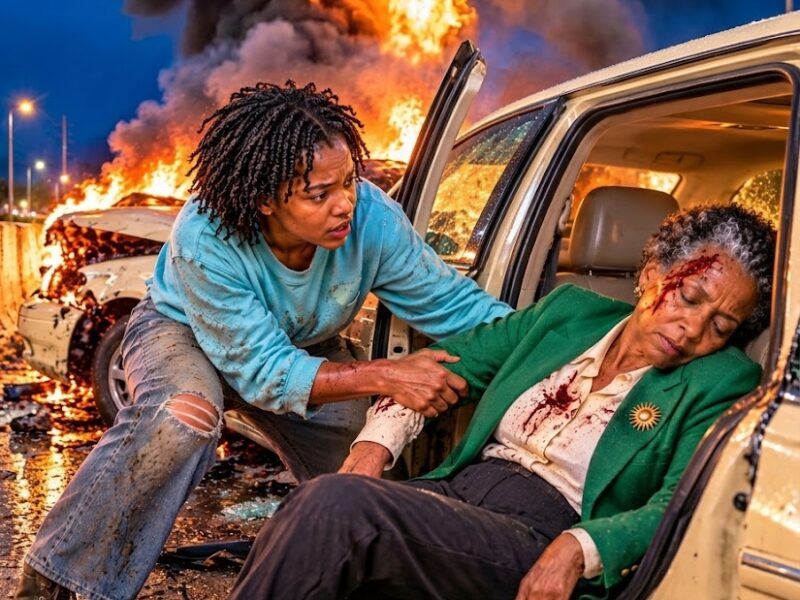
A homeless girl pulled a woman from a burning car at midnight. She had no idea who she was saving.
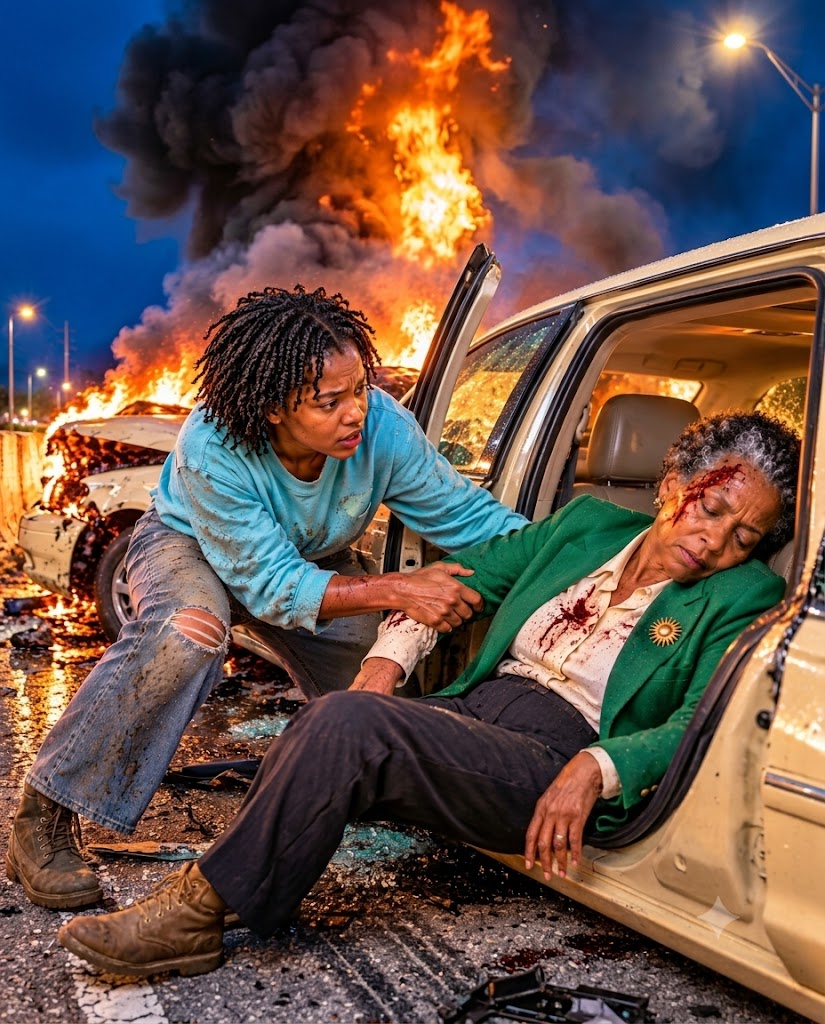
**PART 1**
The midnight air hung thick with the smell of smoke and burning rubber as flames licked hungrily at the overturned sedan.
Glass crunched under bare feet as a figure emerged from the shadows of the overpass, clutching a sack of empty bottles that clinked with each hurried step.
The girl froze.
Inside the wreckage, a woman’s voice cried out—weak, desperate, fading.
“Help! Please, I cannot open it!”
The girl dropped her sack.
Bottles scattered across the asphalt like fallen stars, but she didn’t look back. Her legs carried her forward before her mind could catch up, before fear could talk her out of it.
“Madam, stay calm. I am here. I have you.”
The woman’s face appeared through the shattered window, streaked with blood and soot. Her eyes were wild with terror, her breath coming in ragged gasps.
“Give me your arms.”
“I cannot—my leg—I cannot stand.”
“Then I will carry you.”
The flames grew bolder, reaching for the sky like angry fingers. The heat pressed against the girl’s face, but she didn’t flinch. She reached through the broken glass, ignoring how it bit into her palms, and grabbed the woman’s hands.
“Move that sack—please, sir, I am only passing—”
The woman’s words made no sense, delirium setting in. The girl pulled harder, her thin arms straining against the weight of a life that was slipping away.
“Out! This is not your bedroom, girl. Get out!”
“Sir, I only need tonight—”
“Every night is just tonight. Pack your rubbish. Out, or I call the police.”
The girl shook her head, clearing the memories that threatened to paralyze her. This was not the time to remember every door that had been slammed in her face, every voice that had told her she was nothing.
“Madam, focus on me. We are getting out of here.”
The woman’s seatbelt was jammed. The girl’s fingers worked frantically, slipping on blood and sweat, until finally—click—the buckle released.
“I am going, sir. I am going.”
“Jerry, leave that wet blanket, my child.”
The girl blinked. Jerry. That was her name. Jerry Wambui. And she was not going to let this woman die.
“Mama Akinyi, I must save my mother’s badge.”
The memory of her mother’s voice, her mother’s hands, her mother’s final breath—all of it surged through her like electricity. She grabbed the woman under her arms and pulled with everything she had.
“Badge or no badge, you will catch cold. It is all I have of her. Take my shawl. The night is cold.”
“Mama, you give too much already.”
“Kindness is the only thing I overspend. Eat slowly. Chapati is not running away.”
The woman’s body came free just as the engine exploded behind them. The shockwave threw them both forward, and Jerry landed hard on her shoulder, shielding the woman’s head with her own body.
“It is the best thing today, Mama.”
“And now her daughter will do the same. If God opens one small door.”
Jerry dragged the woman away from the burning car, her muscles screaming, her lungs filling with smoke. She didn’t stop until they were safe, until the heat was just a memory on her skin.
“Look, a poster.”
“They never choose girls from the street.”
“I have no certificate, only this badge.”
“Your hands are your certificate.”
“Keep dreaming.”
“Then I will dream loudly.”
The woman coughed, her eyes fluttering open. “Thank you, child. You are so brave.”
Jerry shook her head, still catching her breath. “Focus on your breathing. We are safe now. Look at me. Breathe out.”
“My mother was a nurse.”
“You are only a girl.”
“My mother was a nurse. She taught me.”
“Then hold it until I am well.”
Jerry nodded, reaching for the woman’s hand. “Stay with us, madam. You are safe.”
Sirens wailed in the distance, growing closer. Jerry looked down at her bloodied hands, at the woman’s pale face, and knew she couldn’t stay.
“Take care of her. I must go.”
“Wait. Who are you? Please stay.”
“No one important.”
“Just passing by.”
She turned and ran, disappearing into the shadows of the city before anyone could stop her. But as she fled, she didn’t notice that her fingers were still wrapped around something small and cold.
A gold brooch.
—
**PART 2**
Three blocks away, Jerry stopped running.
Her chest heaved, her bare feet throbbed against the cold pavement, and her hands—her mother’s hands—trembled with adrenaline.
She looked down.
The brooch glittered in the dim streetlight, a delicate thing of gold and pearls that seemed impossibly precious in her calloused palm.
“I held it for safekeeping,” she whispered to no one. “I swear.”
But who would believe a bottle girl?
She shoved the brooch into the pocket of her worn sweatshirt and kept walking. The night swallowed her whole, as it always did.
—
At the hospital, Madam Kamau lay in a private room, her leg wrapped in bandages, her eyes fixed on the ceiling.
“Chairwoman, Kamau Group. It is Madam Wanjiku.”
“Mwangi, where is the girl?”
The man at her bedside—loyal, gray-haired, worried—shifted uncomfortably. “The paramedics found only you.”
“She held my brooch. Find her.”
“I will find her, madam, I promise.”
The door opened, and a young man strode in, his suit perfectly pressed, his smile perfectly practiced. “Auntie, thank God you are alive.”
“You came quickly.”
“I rushed from the boardroom, auntie.”
“A girl saved me. Do you know her?”
“No, auntie. Rest. The doctors insist.”
Mwangi cleared his throat. “I will find her. Help her.”
“Auntie—”
“Dennis.” Madam Kamau’s voice was firm despite her weakness. “The brooch was not on me. She said the girl held it.”
Dennis’s expression flickered. “Exactly.”
“A street girl robbed her.”
“Robbed—or looted her while she was weak.”
“I do not believe that, Dennis.”
“Auntie, my brooch—is it missing?”
“The police found nothing, auntie.”
“She said she would hold it.”
“Holding is stealing, auntie.”
“No, she saved my life.”
“People change when they see gold, auntie.”
Madam Kamau closed her eyes, exhaustion pulling at her. “Madam, I do not believe Dennis.”
Mwangi leaned closer. “Nor do I.”
“Not fully. Not fully.”
“I will look into it quietly.”
—
**PART 3**
Across the city, in a cramped apartment filled with the smell of diesel and regret, two men sat in the dark.
“She survived, Otis.”
“You said the brake would fail.”
“It failed. A girl got her out.”
“What girl?”
“A bottle girl.”
“She saw me.”
“Saw you? What did she see?”
“My cup. And the car.”
“She has the brooch, yes?”
“She took it from madam’s coat.”
“Then she is a thief.”
“And if madam asks?”
“Madam is confused and ill.”
“We help her.”
“And the girl?”
“Find her. Give her nothing.”
—
The next morning, Jerry stood in line at Mama Akinyi’s stall, the smell of fresh chapati wrapping around her like a warm blanket.
“Child, what happened to you? You look like you fought a lion.”
Jerry touched her face, surprised to find dried blood on her cheek. “I helped someone, Mama.”
“Helped? Or saved?”
“I do not know the difference anymore.”
Mama Akinyi studied her for a long moment, then handed her a hot chapati wrapped in newspaper. “Eat. You look like you need it.”
“I have no money, Mama.”
“Did I ask for money?”
Jerry’s eyes filled with tears she refused to shed. “Why are you so kind to me?”
“Because someone was kind to me once.” Mama Akinyi smiled, her weathered face crinkling like old paper. “Now eat before it gets cold.”
Jerry ate. And for the first time in months, she felt almost human.
—
Later that day, at the police station, Jerry sat across from a detective who looked like he had seen too much and believed too little.
“Jerry Wambui, we need to discuss a missing brooch.”
“Missing? I stole nothing, sir.”
“A gold brooch is gone from the accident site.”
“I held it for safekeeping, I swear.”
“Please come with us to clarify.”
“I have nothing to hide.”
—
The interrogation room was small and cold. Jerry sat alone for hours, her hands folded in her lap, her mother’s badge hidden beneath her shirt.
When the door finally opened, it was not the detective who entered, but a man in a dark suit with eyes that calculated everything.
“So, the bottle girl who likes gold.”
“I already gave it to your man.”
“Good. Then perhaps we can reach an understanding.”
“What understanding, sir?”
Dennis slid a thick envelope across the table. “Take this. Go quietly.”
“I did nothing.”
“For silence. Say nothing about the car.”
Jerry looked at the envelope, then at the man. “I do not need your money, sir.”
“Everyone needs money, bottle girl.”
“Not money bought with silence. I will not lie for anyone.”
The door burst open. Mama Akinyi stood there, her eyes blazing with a fury that belied her age.
“Leave this girl alone. She is as honest as the day. She was trying to help, and you treat her like this. We are leaving. She has done nothing wrong.”
“Mama, they still have the brooch.”
“Let them. You have your dignity.”
—
**PART 4**
Outside, the sun was setting, painting the city in shades of orange and gold.
“I only wanted to help her,” Jerry whispered.
“And you did.” Mama Akinyi put an arm around her shoulders. “Now, let us go home.”
“I have no home, Mama.”
“Then you have my back room. It is small, but it is warm.”
“Mama, I cannot repay this. Why are you so kind to me?”
“Because someone was kind to me once.”
“Then I will be kind to someone.” Jerry paused, a thought striking her. “Mama, the lady may be in danger.”
“How do you know, child?”
“That man’s car.”
“The car?”
“You cannot prove a shadow.”
“But I saw him.”
“Then keep it safe like the badge. Tomorrow you work with me for wages.”
“Work? Me?”
“Chapati needs hands. Hands need wages.”
“Thank you, Mama. Truly.”
—
The days that followed blurred together.
Jerry woke before dawn, washed her hands—always clean hands—and helped Mama Akinyi prepare the chapati.
“Two chapati, extra soft.”
“I will bring my office friends tomorrow.”
“Then I will make extra.”
“Mama, let me wrap them with beans.”
“Beans inside chapati? Who does that?”
“Office workers. No plates, no waiting.”
Mama Akinyi’s eyes widened. “You may be onto something, child.”
“Try it, Mama.”
The first customer who tried it came back with three friends.
“My girl, you are a genius.”
“Count it.”
“Every shilling is yours. It is a day’s wage plus a bonus.”
“A bonus for what?”
“For the best idea this stall ever had.”
“Then tomorrow I will have to—”
“You are the new cleaner?”
Jerry looked up. A woman in a nurse’s uniform stood before her, clipboard in hand. “Name?”
“Jerry Wambui, madam.”
“Any relation to Nurse Mary Wambui?”
Jerry’s heart stopped. “She was my mother.”
The nurse’s expression softened. “She trained half my ward. I hope you do not disappoint her.”
“I will not. I promise.”
—
**PART 5**
Weeks passed.
Jerry cleaned floors, mopped corridors, and learned to read the faces of the sick.
One evening, an old man collapsed in the hallway.
“Child, I cannot breathe well.”
Jerry dropped her mop and rushed to his side. “Sit forward, mzee. Breathe with me.”
“It hurts here.”
“I am calling help. Stay with me.” She grabbed the wall phone and dialed 911. “Nurse, quickly, please.”
When the nurses arrived, they found Jerry holding the old man’s hand, her voice calm, her eyes steady.
“Thank you, child.”
“I only sat him up and called.”
“Quick hands.” The head nurse studied her. “Have you thought of nursing?”
“Every day, madam. I cannot afford it.”
“The Kamau Foundation offers nursing scholarships.”
“I saw the poster at the stall.”
“I will write your recommendation.”
“Madam, why would you help me?”
“Your mother helped me once.”
“Then I will honor her.”
—
The scholarship application sat on Mama Akinyi’s table like a promise.
“You will fill it out, child.”
“Mama, I do not have the grades.”
“Grades can be earned. Dreams must be claimed.”
Jerry filled it out. Every line, every blank, every hope she had buried for years.
And then she waited.
—
**PART 6**
The invitation arrived on a Tuesday.
“Madam Kamau invites her unknown rescuer to the foundation gala. A scholarship and a hospital wing await.”
Jerry stared at the golden envelope, her hands trembling.
“Mama, they want me to come to a gala. A gala? With chandeliers? I do not even own a dress.”
“Dreams first, child. Dreams first.” Mama Akinyi reached under her counter and pulled out a worn wooden box. “Here is the fine in full.”
“Njerĩ, that is your savings.”
“It is your kitchen, Mama. I cannot take it.”
“You took me in when nobody would.”
“You stubborn child.”
“I love you.”
“Close your eyes. Now open.”
Jerry opened her eyes and gasped. A dress—simple, blue, beautiful—lay before her.
“Wedding anniversary. I cannot take your treasure.”
“I will walk in like my mother.”
“Stand tall. Your mother’s badge goes here.”
“Mama, do I look like a nurse?”
“You look like a queen.”
“I am scared, Mama.”
“Scared and brave walk together.”
“Then I will bring them both.”
—
The gala was everything Jerry had imagined and nothing she was prepared for.
Chandeliers dripped from ceilings like frozen rain. Men in tuxedos and women in gowns swirled around her, their laughter echoing off marble floors.
“Look at the lights, child.”
“I slept under those lights.”
“Tonight they shine for you.”
“What if they see me and laugh?”
“Then let them laugh with open mouths.”
“Mama, it is so grand.”
“Grand is only stone and lights.”
“They will ask who I am.”
“Say your mother’s name, Jerry Wambui.”
—
**PART 7**
Inside, the stage was set.
A woman stood at the podium—Linda from Kasarani, hired to cry on cue—spinning a story about pulling Madam Kamau from a burning car.
“I pulled her from the fire,” Linda said, her voice trembling perfectly.
Jerry watched from the back of the room, her heart pounding.
“Mama, that is not me on stage. She’s lying about the fire.”
“Lies cannot stand in daylight.”
“Dennis. Wait for the right moment.”
“My knees are shaking.”
“Auntie, ladies and gentlemen—”
“Has she, Dennis?”
“Meet Linda from the fire.”
“Come closer, child.”
“She is shy, Auntie.”
“Shyness does not save lives. Linda, what color was my car?”
“White. No, cream, madam.”
“And what was I wearing?”
“Coat. A fine black coat.”
“Navy.”
“Your car keys, madam.”
“Sit down, child.”
“Auntie, she even returned your brooch.”
“The brooch I gave to my rescuer? Exactly. Here it is, safe.”
“Funny. Linda never carried it.”
The room fell silent.
Madam Kamau’s eyes swept the crowd, searching, knowing.
“Jerry?”
“In the blue dress.”
“Her hands, Mwangi. Look at her hands.”
“Small and steady, madam.”
“Bring her to me.”
—
**PART 8**
Jerry walked forward, her legs shaking, her chin high.
“You were told to stay away.”
“I was invited, Mr. Dennis.”
“Invited by whom?”
“By the woman I saved.”
“She is confused. Leave quietly.”
“I will leave when she says so.”
“Child, show me your hands.”
“Madam, they are only cleaners’ hands.”
“These are the hands that saved me.”
“I did what my mother taught.”
“A nurse’s daughter.”
“She would have done the same.”
“Ladies and gentlemen, this is my rescuer.”
“Madam, please, no applause.”
“Applause is the least I owe.”
“I only held your hand.”
“You held my life.”
“Auntie, she is a thief and a liar.”
“A thief returns nothing, Dennis.”
“She took your brooch.”
“I gave it to her to hold.”
“Who says so?”
“I say so, and you took it from the station.”
“Madam, the parking camera was not broken.”
“Show us, Mwangi.”
—
The screen flickered to life.
A man in an orange cap. Under the car. At night. Two hours before the crash.
“Who is that man, Dennis?”
“Madam, I saw him that night.”
“You saw him?”
“Under your car.”
“With a flashlight.”
“Why did you not tell me?”
“I was told to forget the road.”
“By whom?”
“By Otis, Dennis’s friend.”
“Gentlemen, bring him in.”
—
**PART 9**
The truth spilled out like blood from a wound.
“It was Dennis!”
“Say it clearly, Otis.”
“I cut the brake line. Ten thousand dollars.”
“Why?”
“He said you were in his way, and you obeyed.”
“Auntie, he is lying to save himself.”
“Then why did you hire Linda?”
“Linda? I never—”
“The invitation, the tears. From whom? The girl who saved me?”
“I—Auntie, please, I am your family.”
“Family does not cut brakes.”
“Let me explain everything.”
“The security team will escort you out now.”
“You cannot do this to me.”
“I just did.”
“You ruined me.”
“No, sir. Your choices did.”
“Everything I did was for the company.”
“I only told the truth.”
“Truth costs everyone.”
“Not me, sir. Only liars.”
—
**PART 10**
The gala ended in whispers and scandal.
Dennis was led away in handcuffs, his empire crumbling with each step.
Madam Kamau stood with Jerry and Mama Akinyi, her hand resting on Jerry’s shoulder.
“I am well now.”
“Keep it, child.”
“Madam, it is too precious.”
“Not as precious as you.”
“I only did what any person would do.”
“Not any person. You did.”
“Thank you, madam.”
“And who stands behind my rescuer?”
“Just a chapati woman, madam.”
“Then you raised her.”
“No, she raised herself.”
“Come, both of you. Stand with me.”
“My apron is not for galas.”
—
**PART 11**
The board met the next morning.
“You are removed, Dennis. All titles.”
“Auntie did this?”
“You did this, Dennis.”
“I have a lawyer.”
“You will need a good one.”
—
A week later, Jerry visited Dennis in prison.
“I did not come to gloat, sir.”
“Then why did you come?”
“To tell you I forgive you.”
“Forgive me? I tried to ruin you.”
“Hate is heavy. I will not carry it.”
“I do not deserve this.”
“But you can still change.”
—
**PART 12**
The scholarship letter arrived in January.
“Tuition, books, and a room at college? I do not know what to say.”
“Say yes, child.”
“Mama, I got the scholarship. I start in January.”
“And who will mop hospital floors?”
“Someone who loves it as I did.”
“Then I will celebrate with—”
“House.”
“On the house forever.”
—
**PART 13**
The Kamau Foundation built Mama Akinyi’s Kitchen six months later.
A proper restaurant, with proper tables and proper chairs, serving chapati and beans to anyone who walked through the door.
“They want to call it Mama Akinyi’s Kitchen.”
“A perfect name.”
“I wanted Jerry’s Kitchen.”
“Mama, it was always yours.”
“Then it will be ours.”
“Ours it is, Mama.”
—
**PART 14**
Student Nurse Wambui received her pin on a bright Sunday morning.
“Madam, my mother’s badge goes first.”
“Then Mary’s daughter is a nurse.”
“Thank you both with all my heart.”
“Nurse Wambui, ward three needs you.”
“Yes, doctor. Working now.”
“Same hands, new badge, same heart.”
“Your mother would smile.”
“She does, every morning.”
—
**PART 15**
The old man from the hospital—Mzee—found Jerry at the stall one afternoon.
“Student nurse.”
“Mzee, I read every page.”
“Of my wife’s handbook?”
“And underlined your favorite lines.”
“She would be proud, child.”
“So would my mother.”
—
**PART 16**
The underpass looked different in daylight.
Jerry stood there with Mama Akinyi, a cart full of chapati and hot tea beside them.
“Every Sunday, we feed the underpass. No one should sleep hungry. Not while we have flour—”
“And hot tea.”
“And stories.”
“And dignity.”
A man approached—the same man who had once kicked her sack.
“Girl, I saw you on television.”
“Hello, sir.”
“I kicked your sack. I am sorry.”
“I forgive you, sir.”
“Take chapati from my cart. Free.”
“No, sir. Pay it forward.”
—
**PART 17**
That night, Madam Kamau sat with Jerry on the balcony of her home, the lights of Nairobi spread before them.
“That night I drove to choose an heir.”
“And did you choose?”
“The road chose for me.”
“Jerry.”
“We have years, my friend.”
—
**PART 18**
Linda stood behind the counter at Mama Akinyi’s Kitchen, her apron dusted with flour.
“Linda, the rolls are burning.”
“Sorry, Mama. I am learning.”
“Honest work is slow work.”
“I do not mind. It feels clean.”
“Good. Now, flip, flip, flip.”
“Yes, Mama.”
—
**PART 19**
Sunday came, and with it, a journey.
“I never reached the old village that night.”
“Then let us go together.”
“My mother’s grave is there.”
“I will bring my mother’s badge.”
“She will love you.”
“Then we go on Sunday.”
—
**PART 20**
The grave was simple, a stone marker beneath an acacia tree.
Jerry knelt, placing her mother’s badge on the earth.
“I did it, Mama. I became a nurse.”
Madam Kamau stood behind her, silent.
“Child, what did the fire teach you?”
“That kindness is never wasted.”
“Even when nobody sees?”
“Especially then.”
“And truth?”
“Truth always finds its way home.”
—
The sun set over the old village, painting the sky in shades of gold and rose.
Jerry stood between two mothers—one living, one remembered—and knew that she had finally found her way home.
—
**THE END**









