
A homeless girl found a Hell’s Angel’s bag with $50,000 inside. She could have kept it. Nobody would have known. But she returned every dollar—and his unexpected reward changed her life forever.
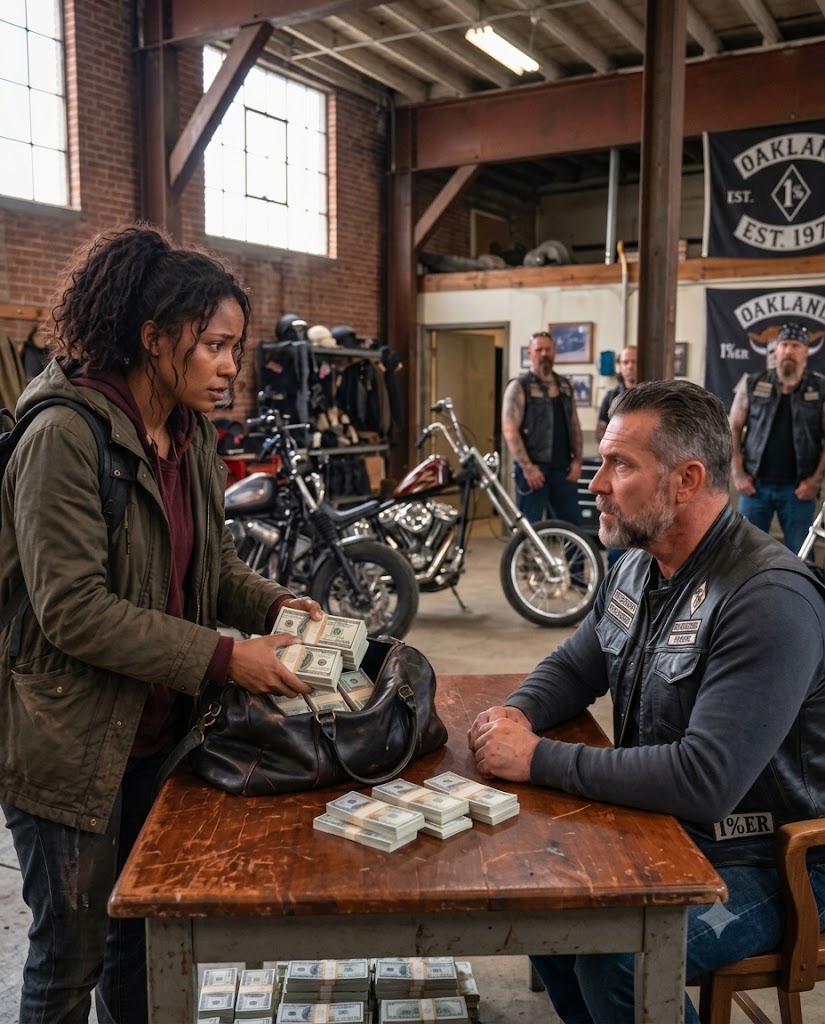
Oh my god, this is a lot of money.
No, this is not mine.
I am going to find him and give this back.
Maya Brooks found $50,000 in a black duffel bag while she had exactly $1,142 left to her name.
She stared at the stacks of cash, then counted them again because the number made no sense.
$50,000.
Maybe a little less.
More money than she had seen in one place in her entire life.
Her fingers rested on the zipper while the thought came quietly, almost reasonably.
Take 100.
Just one bill.
Nobody would know.
Maya looked down at her sneakers.
Gray canvas soaked through, one sole peeling away near the toe.
Across the street, a motel sign flashed vacancy in red letters.
$59 a night.
A hot shower.
A locked door.
A bed that belonged to her until morning.
She had spent the previous four nights moving between a shelter cot, a 24-hour laundromat, and wherever security guards did not ask her to leave.
She had once had an apartment, a job, a kitchen table covered with unopened mail she kept promising herself she would handle tomorrow.
Then her mother got sick.
Work became harder to keep.
Bills stacked faster than paychecks.
By the time Maya understood how far she had fallen, the apartment key in her pocket no longer opened anything.
Now she sat beneath the awning of a closed pharmacy with everything she owned packed into one backpack, holding enough cash to make half her problems disappear before breakfast.
She pulled out one bundle.
$20 bills.
Her stomach tightened.
She had skipped dinner to save money.
$1,142 would not last long, but the money in her hand was not hers.
Maya placed the bundle back inside.
—
Under the cash, she found a brown leather wallet.
Driver’s license.
Cole Brennan, 52.
Address across town.
Behind the license was a motorcycle registration for a Harley-Davidson, and a worn photograph of a broad-shouldered white man in a black leather vest kneeling beside a smiling little girl.
The man had one arm around her shoulders.
On the back, written in blue ink, were four words.
For dad, love, Emily.
Maya looked at the photograph longer than she meant to.
Whoever Cole Brennan was, somebody loved him enough to carry his picture until the edges went soft.
She checked the bag again and found a business card.
Brennan’s Cycle Works.
The address matched the license.
Three miles away.
Maya closed the wallet and pushed it beneath the cash.
Then she zipped the duffel shut.
Her hands were cold, but they had stopped shaking.
She stood, pulled the strap over her shoulder, and started walking.
Three miles with a bad shoe.
Three miles carrying $50,000 that could have changed her life if she simply turned the other way.
She made it half a block before stopping.
The motel sign blinked behind her.
Vacancy.
Maya looked back once.
Then she kept walking toward Brennan’s Cycle Works, unaware that Cole Brennan was already tearing his garage apart looking for the missing bag, and that when Maya finally placed it in front of him, the money would be the least surprising thing he discovered.
—
Maya reached Brennan’s Cycle Works just after 9 in the morning, tired enough that the three-mile walk felt twice as long.
The place was already open.
Three motorcycles stood near the entrance, chrome bright under the shop lights, and somewhere inside an air wrench snapped against metal in short, sharp bursts.
Maya adjusted the heavy duffel on her shoulder and stepped through the door.
The smell hit her first.
Motor oil.
Rubber.
Coffee that had been sitting too long.
A radio played softly behind the counter.
Four men were working around the garage, all wearing dark shirts or leather vests, and one by one, they noticed her.
Nobody said anything rude.
Nobody had to.
Maya knew that pause.
She had seen it at convenience stores, apartment offices, even job interviews.
Eyes moving from her worn backpack to her damp clothes, then to the expensive-looking duffel in her hand.
A gray-haired man behind the counter wiped his hands on a rag.
“Can I help you?”
Maya set the bag down carefully.
“I am looking for Cole Brennan.”
The man stopped wiping his hands.
His eyes dropped to the bag.
“Where did you get that?”
Maya felt the room change.
The radio suddenly seemed louder.
“I found it near a bus stop.”
Before the man could answer, a door at the back of the shop opened.
Cole Brennan stepped out quickly, his face tight with the kind of worry that had clearly been building for hours.
He was broad-shouldered with silver beginning to show in his beard, and there was grease across one sleeve of his work shirt.
He looked at Maya once.
Then he saw the duffel.
He froze.
“Where did you find that?” he asked.
“Outside a pharmacy on Madison Avenue.”
Cole crossed the garage and pulled the zipper open.
His hands moved through the contents fast at first, then slower.
Envelopes.
Bundles.
Receipts.
A small notebook.
He started counting.
Nobody spoke.
Maya stood beside the counter while every bill passed through his hands.
She could feel the ache in her feet now that she was no longer moving.
Finally, Cole checked the last envelope against the notebook.
$49,870.
Everything that was supposed to be there was there.
He looked up at Maya.
“You opened it?”
“Yes.”
“So you knew what was inside.”
“Yes.”
His eyes dropped to her shoes.
One sole had nearly separated from the front.
Then he noticed her backpack, so tightly packed the zipper strained at the seams.
“And you still brought it here?”
Maya met his eyes.
“Your name was in the wallet.”
Cole seemed to have an answer ready, but it disappeared before he spoke.
One of the men behind him let out a quiet breath.
Cole closed the bag.
“Do you know what this money is for?”
Maya shook her head.
“A family lost most of their house in an electrical fire. The father served with one of our members. We raised this over the last six months to help rebuild what insurance did not cover.”
Maya looked at the bag differently then, as if it had suddenly become heavier.
Cole studied her for another moment.
“Wait here.”
He walked into the office and returned with a thick envelope.
He opened it, counted several bills, and held them toward her.
“Take this.”
Maya looked at the money, but did not move.
“For what?”
“For bringing the bag back.”
“No.”
Cole blinked.
“It is $1,000.”
“I heard you.”
He added more bills.
“Then $3,000.”
Maya finally looked directly at him.
Her voice stayed calm.
“I do not want you to pay me for not stealing from you.”
The garage went completely silent, and for the first time that morning, Cole Brennan stopped thinking about the money he had almost lost and started wondering who the woman standing in front of him really was.
—
Cole kept the money in his hand for another second, then slowly lowered it to the counter.
Nobody in the garage moved.
Maya could feel four pairs of eyes on her, but she refused to look away.
Cole studied her face as if he were trying to find the catch.
There was always a catch.
At least that was what experience had taught him.
“$3,000 could help,” he said.
Maya gave a tired half smile.
“A lot of things could help.”
“Then let me help.”
“You are still deciding what help looks like before asking me.”
That landed harder than Cole expected.
He glanced at the bills in his hand, then put them back inside the envelope.
“All right,” he said. “What do you need?”
Maya almost answered nothing.
Pride had become a habit because sometimes it was the only thing she still owned.
Then she noticed the clock above the parts shelf.
9:23.
Her stomach tightened.
“What time is it?”
“9:23.”
She closed her eyes for half a second.
“I have an interview at 11:00.”
Cole looked at her clothes.
Not with judgment this time, just understanding.
Her sweatshirt was wrinkled from sleeping in it.
The cuffs were damp.
Her jeans were clean enough, but the knees had faded white from wear.
The backpack beside her held everything she owned, including the blouse she had planned to wear.
After last night, Maya already knew what condition it would be in.
Cole nodded toward a hallway behind the office.
“There is a restroom back there.”
Maya hesitated.
“It has a shower,” he added. “We keep it for long shifts. Clean towels are in the cabinet. Washer and dryer are in the utility room.”
She looked at him carefully.
“No money.”
“No money.”
“No questions.”
Cole thought about that.
“One question.”
Maya waited.
“Do you need coffee?”
For the first time since entering the shop, she laughed.
It was small and surprised, like the sound had escaped before she could stop it.
“Yes,” she said. “Coffee would be good.”
—
Twenty minutes later, warm water ran over Maya’s hands as she stood alone in the little tiled room behind the garage.
For a moment, she did not move.
She had forgotten how powerful privacy could feel.
A door that locked.
A clean towel.
Five minutes without keeping one ear open for footsteps.
She washed quickly, then opened her backpack.
The blouse inside was badly creased, but dry.
She smoothed it with wet hands and hung it near the heater while she cleaned the mud from her shoes with paper towels.
Outside, Cole poured coffee into a paper cup and glanced at the black duffel sitting on his desk.
He should have been thinking about the money.
Instead, he kept hearing Maya’s words.
You are still deciding what help looks like before asking me.
When she came out, her hair was pulled back neatly, her blouse tucked in, and the same damaged sneakers were on her feet.
She looked different, but not because of the clothes.
She looked focused.
Ready.
Cole handed her the coffee.
“Where is the interview?”
“Westbrook Medical Center.”
“That is almost five miles from here.”
“I know.”
“How are you planning to get there?”
“Bus.”
Cole glanced at the clock.
10:04.
The next bus will not get you there before 11.
Maya’s face changed just slightly.
But he saw it.
One misconnection.
One late arrival.
One more door closing.
Cole reached toward a row of keys, then stopped himself.
“Do you want a ride?” he asked.
Maya looked at him for a long moment.
This time, he had asked.
“Yes,” she said. “I do.”
Cole picked up his truck keys instead of the motorcycle keys.
As Maya followed him toward the door, he had no idea that the interview waiting across town would reveal how someone with experience, discipline, and a clean work record had ended up carrying her entire life in one backpack.
—
The ride to Westbrook Medical Center took twelve minutes, but Maya spent most of it watching the clock on the dashboard.
10:28.
10:34.
10:41.
Cole did not fill the silence with questions.
He kept both hands on the wheel and let her breathe.
When they pulled beneath the hospital entrance, Maya reached for the door handle.
“Thank you,” she said. “For the ride and the shower.”
Cole nodded.
“Good luck.”
She stepped out, then leaned back toward the open door.
“I mean it.”
“I know.”
Maya walked inside before nerves could change her mind.
The lobby smelled faintly of disinfectant and fresh coffee.
People moved quickly around her, carrying clipboards, pushing carts, checking watches.
For a second, she remembered how normal places like this used to feel.
She had spent four years working front desks in medical offices, scheduling appointments, calming anxious patients, fixing insurance errors, remembering birthdays.
She knew how to do this work.
She had been good at it.
At 10:56, a woman named Karen Mills called her into a small conference room.
The interview started well.
Maya answered every question without hesitation.
She knew patient privacy rules.
She understood scheduling software.
She explained how she handled frustrated families without losing patience.
Karen even smiled when Maya described solving a double-booked afternoon with three doctors and one broken printer.
“You have solid experience,” Karen said. “Why did you leave your last position?”
Maya paused.
There it was.
“My mother got sick.”
Karen waited.
“Cancer. I became her primary caregiver. I missed too much work, and eventually the office could not keep holding my position.”
“I am sorry.”
“Thank you.”
Maya kept her voice steady.
“She passed away eight months ago.”
For a moment, neither woman spoke.
Then Karen looked back at the application.
“And your current address?”
Maya felt the familiar pressure in her chest.
She could lie.
Give the address of her old apartment.
Hope nobody checked.
Instead, she said, “I am staying at Harbor House right now.”
Karen’s eyes lifted.
“The shelter?”
“Yes.”
The room did not become hostile.
That almost made the next few minutes harder.
Karen remained polite, professional, but something shifted.
The questions became more careful.
“Do you have reliable transportation?”
“I use public transit.”
“A working phone?”
Maya hesitated.
“My service was disconnected this morning. I expect to restore it soon.”
Karen wrote something down.
The scratch of the pen sounded louder than it should have.
Maya suddenly understood how homelessness followed a person into places where it was never invited.
You could shower, wash your clothes, prepare every answer, but eventually somebody asked where you lived.
At 11:43, the interview ended.
Karen shook her hand.
“We are meeting several candidates. We will be in touch.”
Maya smiled.
“Thank you for your time.”
She walked out with her shoulders straight.
Only when the elevator doors closed did she let the smile disappear.
Outside, Cole was gone.
Exactly as she had asked.
No biker waiting like a guardian.
No rescue scene.
Just buses moving through traffic and people going back to work.
Maya checked her phone out of habit.
No service.
One notification still showed from an earlier missed call made over wireless internet.
Brennan’s Cycle Works.
She stared at it, then put the phone away.
She did not want Cole fixing another problem simply because he could.
—
By evening, Maya was back at Harbor House, sitting across from Ruth Alvarez, the shelter manager, filling out paperwork for another job application when the front desk volunteer called her name.
“Maya, someone is here asking for Ruth.”
Maya glanced toward the entrance.
Cole stood there in the same work shirt, holding no envelope and no cash, just a small notebook.
He had finally figured out that helping Maya would require something harder than giving her money.
He would have to understand what kept closing the doors in front of her.
Cole did not walk toward Maya.
He went straight to Ruth.
That mattered more than Maya expected.
He did not announce that he had come to help.
He did not tell the room about the money she had returned.
He simply introduced himself and asked if they could talk somewhere private.
Ruth was in her late fifties with silver threaded through her dark hair and the calm expression of someone who had heard too many promises from people who meant well for one afternoon.
She led Cole into a small office near the front desk.
Maya stayed at the table pretending to focus on her application, but she could hear pieces of their conversation through the thin wall.
“I am not asking what is wrong with her,” Cole said.
Ruth answered quietly.
“Good, because that is usually the first mistake.”
There was a pause.
“Then what should I be asking?”
“What is in her way?”
Cole opened his notebook.
Ruth started listing things that sounded small until they were stacked together.
No permanent mailing address.
Limited phone service.
Transportation that could turn a ten-minute drive into a ninety-minute bus route.
Identification that had expired while Maya was caring for her mother.
Nowhere secure to leave work clothes.
No emergency savings if a shift ended after the last bus.
Each problem by itself had a solution.
Together they formed a wall.
“People think homelessness is one problem,” Ruth said. “Most of the time it is twenty small problems holding hands.”
Cole was quiet for a moment.
“What can I do?”
Ruth leaned back.
“First, do not do anything without asking Maya.”
That answer seemed to surprise him.
“Second, if you offer help, make it temporary and specific. A bridge, not a leash.”
When Cole came out of the office, Maya was waiting.
“You talked about me,” she said.
“I talked about obstacles,” he answered. “There is a difference.”
She studied him, then glanced toward Ruth.
“What are you planning?”
“Nothing yet.”
Cole sat across from her.
“I am asking.”
He pushed the notebook toward her.
On the page were four words.
Mail.
Identification.
Transportation.
Storage.
“Which one is hurting you most?”
Maya almost laughed at how ordinary the list looked.
No dramatic rescue.
No giant check.
Just four boring problems that had quietly taken control of her life.
“Phone,” she said. “It is not on the list.”
Cole nodded and wrote it down.
“Then phone.”
Ruth joined them.
Harbor House could let Maya use its address for employment mail.
She also knew a local nonprofit that helped replace expired identification for people seeking work.
Cole offered the garage as a secure place to keep one garment bag and receive calls during business hours if Maya listed the number as a temporary contact.
“Only if you want,” he added.
Maya noticed the difference.
Two days earlier, he had reached for cash before asking a single question.
Now he waited for her answer.
“Yes,” she said. “For sixty days.”
Cole nodded.
“Sixty days.”
—
The transportation problem took longer.
One of the mechanics, Ray Sullivan, overheard enough to mention that his wife had an old Honda Civic sitting unused while she worked from home.
It was not pretty.
The paint had faded.
The passenger window needed help going up.
But it ran.
Ray offered it for two weeks.
Maya shook her head immediately.
“I cannot accept a car.”
“You are not accepting a car,” Ray said. “You are borrowing one. Bring it back with the same amount of gas.”
That made her pause.
“I can do that.”
For the first time in months, help did not feel like charity.
It felt like an agreement.
By Friday morning, Maya had a temporary mailing address, an appointment to renew her identification, a working contact number, and two weeks of transportation.
None of it guaranteed anything.
That was the point.
She still had to fill out the applications.
Still had to show up.
Still had to hear no.
But when her phone connected to wireless internet that afternoon, a new email was waiting from another clinic across town.
They wanted to interview her Monday morning.
And this time, Maya would arrive with more than hope.
She would arrive with fewer doors already closed.
—
Monday morning, Maya arrived twenty minutes early.
The borrowed Honda Civic rattled when she turned off the engine, but it had gotten her there.
That was enough.
She checked her reflection in the rearview mirror, smoothed the collar of her blouse, and took one slow breath before walking into the clinic.
This interview felt different from the last one.
She had a working contact number now.
Her identification renewal was already in process.
She had transportation for two weeks.
Small things, but they changed the way she sat in the chair.
Her shoulders were straighter.
Her answers came easier.
The hiring manager asked about scheduling systems, patient intake, insurance verification, and how she handled people who were scared or frustrated.
Maya answered from experience.
She did not exaggerate.
She did not apologize for the gap in her work history.
When the question came, she told the truth.
Her mother had become seriously ill.
Maya became the primary caregiver.
After her mother died, the job was gone, the savings were gone, and eventually the apartment was gone too.
The manager listened carefully.
“You have been through a lot,” she said.
Maya shook her head.
“I have, but I am ready to work.”
When the interview ended, Maya walked back to the Honda feeling something she had not felt in months.
Confidence.
Not certainty.
Just the quiet belief that she had done everything she could.
Cole called that afternoon.
“How did it go?”
“Good. Good enough.”
Maya smiled.
“I said good. Do not ruin it.”
Cole laughed.
“Understood.”
Then he did something Maya appreciated even more.
He did not ask for every detail.
—
Two days passed.
Then three.
On Thursday morning, an email arrived.
Maya opened it while sitting at a small table inside Harbor House.
She read the first line once, then again.
Thank you for your time and interest.
Her stomach dropped before she reached the next sentence.
The clinic had chosen another candidate.
Maya closed the message.
Ruth was across the room sorting donated toiletries.
She saw Maya’s face and did not ask what happened.
She already knew.
“There is a job fair tomorrow,” Ruth said.
“No.”
“All right.”
Maya looked up.
“That is it?”
Ruth shrugged.
“You said no.”
Maya stared at her.
Ruth went back to sorting shampoo bottles.
“I will still wake you at seven.”
Maya almost smiled, but she was too tired.
That night, she lay awake longer than usual.
She had returned the bag.
She had accepted help without giving up control.
She had filled out applications, fixed her paperwork, shown up early, answered honestly, and still heard no.
For the first time, she understood why some people stopped trying.
Not because they did not care.
Because disappointment could become exhausting.
At seven the next morning, Ruth tapped the side of Maya’s bunk.
“Coffee is terrible today.”
Maya pulled the blanket over her face.
“That is not a convincing argument.”
“I know.”
Five minutes later, Maya sat up.
By 9:30, she was walking through a crowded community center with a folder of resumes under her arm.
No biker beside her.
No special introduction.
Just Maya moving from table to table, telling strangers who she was and what she could do.
Near the back of the room, a woman in a navy blazer looked down at Maya’s resume, then looked up sharply.
“Maya Brooks.”
Maya stopped.
“Yes.”
The woman studied her face for a second, and then recognition softened her expression.
“You probably do not remember me,” she said. “But I remember exactly how you treated my mother when nobody else had time for her.”
The woman extended her hand.
“Dr. Evelyn Hart.”
Maya searched her memory.
Then the name clicked.
“Your mother was Mrs. Hartman.”
Evelyn smiled.
“She hated filling out forms, loved peppermint candy, and refused to let anyone call her by her first name.”
Maya laughed softly.
“That sounds like her.”
Evelyn looked down at the resume again.
“You stayed almost two hours after closing one night because her transportation never showed up. You found another ride, called me, and sat with her until I arrived.”
Maya remembered the evening now.
She had not thought of it in years.
“She was scared.”
“Exactly.”
Evelyn tapped the resume with one finger.
“People remember how you treat them when they are scared.”
Maya did not know what to say.
She had spent months explaining gaps, addresses, bus routes, expired identification, and everything else that had gone wrong.
For the first time in a long time, someone was talking about something she had done right before her life fell apart.
Evelyn worked for a community health center on the east side.
They needed a patient coordinator.
Scheduling.
Intake.
Insurance questions.
Helping people who arrive confused, late, worried, or embarrassed.
Work Maya understood.
“I can introduce you to our hiring manager,” Evelyn said.
Maya felt hope rise too quickly and pushed it back down.
“I appreciate that, but I do not want anyone giving me a job because they feel sorry for me.”
Evelyn held her gaze.
“Good, because I was not offering that.”
She handed the resume back.
“I will recommend an interview. What happens after that is yours.”
—
Three days later, Maya sat across from two managers in a bright office with a window facing the parking lot.
This time, when they asked about her current situation, she did not lower her eyes.
“I am staying at Harbor House while I rebuild,” she said. “I have temporary transportation, a reliable contact number, and I am replacing my identification. I am also ready to work.”
One manager asked what she had learned from the last year.
Maya thought carefully.
“That losing stability is faster than people think. Getting it back takes longer. And being treated with respect can make the difference between trying again and giving up.”
Nobody wrote anything for a moment.
Then the interview continued.
Maya left without knowing the answer.
She returned the Honda to Ray with the gas tank slightly fuller than when she borrowed it.
She thanked Ruth.
She went back to filling out applications because she had learned not to build her future around one possibility.
A week later, the front desk at Harbor House called her over.
“Phone for you.”
Maya picked up.
“This is Maya Brooks.”
The hiring manager introduced herself, then said the words Maya had been afraid to hope for.
“We would like to offer you the patient coordinator position.”
Maya closed her eyes.
Her free hand gripped the counter.
“Yes,” she whispered, then cleared her throat. “Yes, I would like that very much.”
The job did not fix everything.
Her first paycheck was still two weeks away.
She still slept at Harbor House.
She still counted every dollar.
But each morning, she put on clean clothes, clipped on an identification badge, and walked into a place where people depended on her.
—
Three months passed.
Maya kept the job.
She arrived early, saved what she could, paid down old bills.
One Friday afternoon, Cole called and asked her to stop by Brennan’s Cycle Works after her shift.
When Maya arrived, the garage looked exactly as it had the morning she returned the duffel.
Same smell of oil.
Same old coffee pot.
Same counter.
Cole was waiting beside it with a plain white envelope in his hand.
“You told me you did not want to be paid for doing the right thing,” he said. “I finally understood.”
Maya looked at the envelope.
“Then what is that?”
Cole placed it between them.
“Not payment.”
He paused.
“A choice.”
“A choice?” Maya asked.
Cole nodded and slid the envelope across the counter.
“Open it.”
She did.
Inside were fifty crisp $100 bills.
$5,000.
Maya stared at them, then looked up.
“Cole—”
“Hear me out.”
He rested both hands on the counter.
“When you brought that bag back, I tried to hand you money because I thought money was the answer. You told me I was deciding what help looked like before asking you. You were right.”
Maya looked back at the envelope.
“So what changed?”
“You did not take shortcuts. You kept showing up. You got the job yourself. You kept it. This is not payment for returning my bag.”
He paused.
“It is me keeping my promise to recognize what you did without turning you into somebody I rescued.”
Maya ran one thumb along the edge of the envelope.
$5,000 could cover months of shelter fees, transportation, food, and old bills.
But another number had been sitting in her head for weeks.
$2,400.
First month’s rent, security deposit, utility deposit, and enough left for a mattress and basic groceries at a small studio apartment she had found twelve minutes from work.
She counted twenty-four bills from the envelope and pushed the rest back toward Cole.
He frowned.
“What are you doing?”
“Taking what I need.”
“The whole thing is yours.”
“I know.”
She placed her hand over the remaining money.
“That is why I get to decide what happens to it.”
Cole leaned back.
Maya told him about Harbor House.
About people missing interviews because they could not afford replacement identification.
About a woman who had lost a warehouse job because she did not have steel-toed shoes.
About a father who had been offered night work but could not start because the last bus stopped running before his shift ended.
None of those problems required thousands of dollars.
Sometimes $40 was enough.
Sometimes $80.
Sometimes $200.
“Put the rest somewhere Ruth can use it for things like that,” Maya said. “Not cash in somebody’s hand. Something specific. A bus pass, work shoes, a background check. Whatever gets them through the next door.”
Cole looked at the $3,600 between them.
“You sure?”
Maya smiled.
“Three months ago, I was sitting outside with more money than this in my lap, and I knew exactly what belonged to me.”
That ended the argument.
—
The next week, Cole met with Ruth.
Brennan’s Cycle Works added money of its own.
Several members of Cole’s motorcycle club contributed quietly without a rally or cameras.
Ruth insisted on simple rules.
Every dollar had to solve a specific barrier tied to housing or employment.
No speeches.
No photographs required.
No one had to prove they were a good person to deserve help.
Maya suggested the name.
Second Key.
Cole raised an eyebrow.
“Why that?”
“Because the first key opens a door,” she said. “The second one means you get another chance after the first door closes.”
Within a month, the fund paid for identification for three people, work boots for two, bus passes for four, and a security deposit for a nursing assistant leaving Harbor House.
Maya watched the numbers in Ruth’s notebook grow slowly.
Nothing dramatic.
Just people moving forward one step at a time.
And Maya was moving too.
She signed the lease on her studio, bought a used table for $25, and spent her first night there sitting on the floor eating takeout because she did not own a chair yet.
She did not care.
Before sleeping, she placed her new apartment key inside a blue ceramic bowl beside the door.
For several seconds, she simply looked at it.
A year earlier, Maya had lost the key to the life she knew.
Now she held another one.
—
But the story between her and Cole was not finished.
Almost one year after she walked into Brennan’s Cycle Works carrying his duffel bag, Maya returned to the same counter with an envelope of her own.
The garage looked almost the same.
Same oil-stained floor.
Same old coffee maker.
Same line of motorcycles near the wall.
Cole was bent over a workbench when he saw her.
“You look suspiciously organized,” he said.
Maya smiled.
“That is because I came prepared.”
She placed the envelope on the counter.
Cole wiped his hands on a rag and opened it.
Inside was a photograph.
Maya stood in front of her apartment door, smiling, one hand holding up a small brass key.
On the back, she had written a message.
You did not change my life by giving me money. You changed it when you stopped looking at me like someone who needed saving.
Cole read it twice.
For once, he had nothing ready to say.
Maya watched him carefully.
“You all right?”
He cleared his throat.
“I am fine.”
“You do not look fine.”
“I am fifty-three years old. I am allowed to have dust in my eyes.”
Maya laughed.
Cole looked at the photograph again.
“Your mother would be proud of you.”
Maya’s smile softened.
“I hope so.”
Cole set the picture down.
“She was right, you know.”
“About what?”
“Being broke never told anybody what kind of person you were.”
Maya looked away for a second.
That one reached deeper than she expected.
Then she reached into her purse and pulled out another envelope.
Cole immediately shook his head.
“No.”
“You do not even know what it is.”
“If it is money, no.”
“$200, Cole.”
“For Second Key,” he said, crossing his arms. “You just got stable.”
“Exactly.”
She slid the envelope toward him.
“I know what $200 can mean when you are one bus pass or one deposit away from getting back on your feet.”
Cole did not touch it.
“You do not owe anybody anything.”
Maya nodded.
“I know. That is why I want to do it.”
—
That afternoon, Maya stopped by Harbor House on her way home.
Ruth was at the front desk helping a young woman named Tasha fill out an employment form.
Tasha had an interview the next morning at a grocery distribution center across town, but she had no money for the bus.
Ruth reached into the Second Key folder and pulled out a prepaid transit card.
Maya recognized the handwriting on the approval form.
Hers.
Tasha accepted the card carefully.
“Why do people do this?” she asked.
Ruth nodded toward Maya.
“Ask her.”
Tasha looked over.
Maya thought about the duffel bag, the motel sign, the long walk to the garage, the first envelope Cole tried to hand her, the interview she lost, the job fair she almost skipped, the apartment key sitting in a blue bowl beside her front door.
“Because somebody helped me get to tomorrow once,” Maya said.
Tasha held the transit card a little tighter.
Maya smiled.
“Good luck in the morning.”
Then she walked outside, got into her own used car, and drove home.
—
Nothing about her life was perfect.
She still budgeted carefully.
She still had hard days.
She still missed her mother.
But she had a home, a job, people who respected her, and something she had not expected to recover so quickly.
Trust.
The kind that moved in both directions.
Maybe that is the real lesson here.
Respect is not seeing someone as weak and rushing in to take control.
It is seeing their dignity before their circumstances.
Love does not always look like a grand gesture.
Sometimes it looks like listening, asking, giving someone room to stand on their own, and staying close enough in case they stumble.
I think Maya changed Cole just as much as he changed her.
What would you have done if you found that bag when you had almost nothing left?
Share your thoughts in the comments.
And if stories about ordinary people choosing kindness still matter to you, subscribe and stay with us for the next one.









