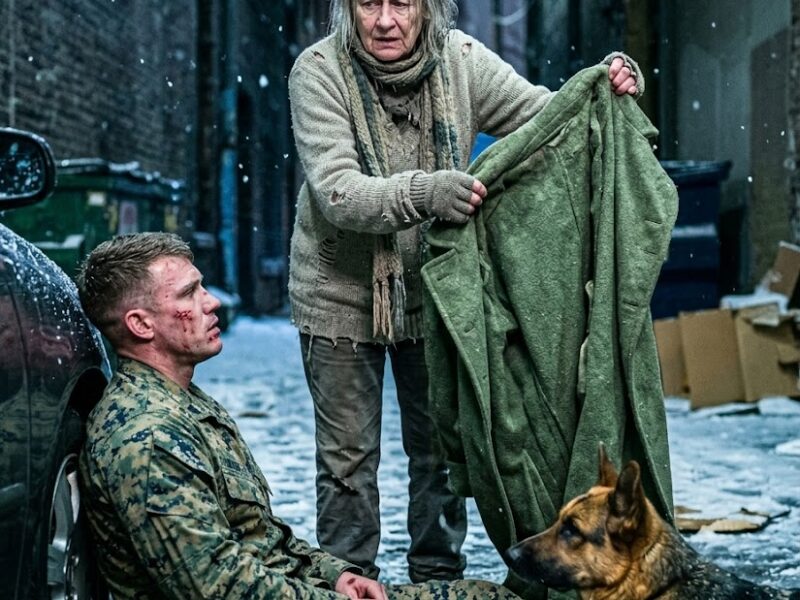
A homeless elderly woman saved a U.S. Marine and his K9 in a deadly blizzard. What followed changed everything.
The wind came off the Spokane River like a blade honed on ice, cutting through the industrial flats where the city’s forgotten corners huddled against the cold.
Evelyn Hart had stopped counting winters the way other people stopped counting birthdays—not because they didn’t matter, but because each one demanded more than the last, and she had learned to measure survival in hours instead of years.
At seventy-six, she was a small woman, the kind of small that came from a lifetime of making herself invisible, of taking up less space so the world wouldn’t notice her and decide she didn’t deserve even that.
Her gray hair escaped in uneven strands from a knot that had given up trying, and her eyes—muted blue, sharp as splintered glass—missed nothing.
She had found this spot three winters ago, a narrow strip beside an old warehouse where a ventilation pipe exhaled a whisper of warm air, barely enough to feel unless you knew exactly where to press your hands.
Evelyn knew.
She always knew where the heat was, where the wind cut least, where the night might be survived instead of merely endured.
—
The crash ripped through the darkness like something alive—metal screaming, glass shattering, the sound so close she felt it in her chest before her ears caught up.
Evelyn jerked upright, her breath catching, her heart suddenly racing against the stillness she had been clinging to.
The storm swallowed the echoes quickly, but not before she heard it—an engine accelerating, tires fighting for grip, then fading into the white noise of the blizzard.
Someone had left.
Too fast.
Too clean.
She stayed still, every instinct telling her to do exactly that, because on the streets you didn’t move toward violence—you let it pass, let it burn itself out somewhere else.
That was how you survived.
That was how she had survived this long.
—
Then she heard it—a sound that didn’t belong to machines or storms.
Low. Alive. A growl, but not aggressive.
Strained. Controlled. Like something holding itself back.
Evelyn’s throat tightened.
She turned her head slowly toward the slope beyond the warehouse, where the road dipped and disappeared behind stacked containers and broken concrete.
Snow blurred the world into shapes and shadows, but something had changed.
The air itself felt different.
She hesitated just for a second.
Then she pushed herself up.
—
Her joints protested immediately—a sharp reminder of her age—but she ignored it.
Each step into the wind felt like walking into resistance, the snow biting at her face, her coat doing little to stop the cold from finding its way through.
She followed the disturbed trail where tires had lost control, carving an uneven path down the slope.
At the bottom, she saw it.
The wreck.
The vehicle was mangled, its front crushed inward, metal bent like paper under too much pressure.
Steam hissed from beneath the hood, rising in thin, ghost-like strands into the freezing air.
The driver’s door hung open, twisted out of alignment, creaking faintly as the wind caught it.
Evelyn’s heartbeat quickened.
Then she saw the man.
—
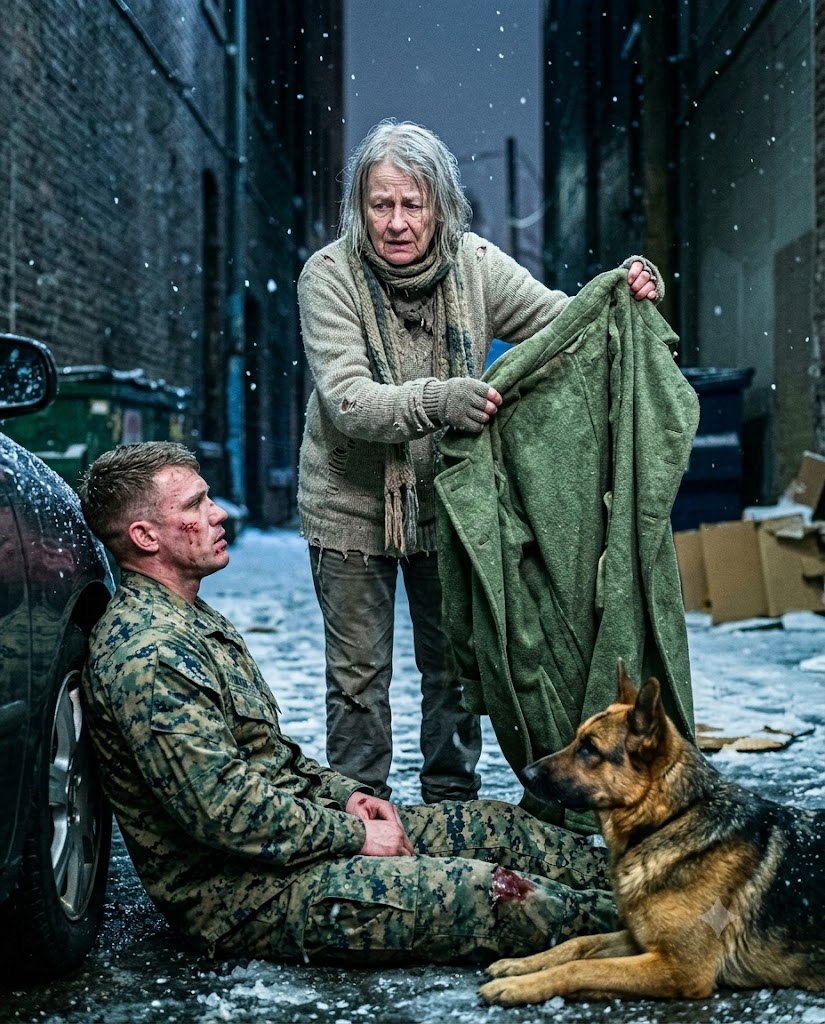
Staff Sergeant Caleb Drayton lay half out of the vehicle, his body angled awkwardly against the frame.
He was a large man, easily over six feet, broad-shouldered, built with the kind of solid, efficient strength that came from discipline, not vanity.
Even unconscious, there was tension in his form, like his body hadn’t quite accepted that it could stop fighting.
His face was sharply defined—strong jaw, straight nose, a few days’ worth of stubble lining his cheeks.
His dark hair was cut short in a military style, now damp with melted snow and streaked faintly with blood.
There were small scars along his temple and near his brow—old ones, not from this crash.
The kind you earned and kept.
His breathing was shallow.
Too shallow.
—
Evelyn took a step closer.
The growl stopped her.
Rex moved into full view, placing himself between her and the man in a single fluid motion.
He was powerful, every inch of him built for purpose.
His coat was thick, a rich mix of amber and black, his muscles defined beneath it.
His ears stood alert, his eyes sharp and unwavering, locked onto Evelyn with intense calculation.
This was not a stray dog.
This was a trained canine—disciplined, intelligent, and absolutely loyal.
His lips curled slightly, just enough to show teeth.
A warning.
—
Evelyn didn’t move.
She lowered her gaze slightly—not submissive, but non-threatening.
Her hands stayed visible, her posture relaxed as much as she could manage in the cold.
“I’m not here to hurt him,” she whispered, her voice soft, carried away almost immediately by the wind.
Rex didn’t respond, but he didn’t attack either.
That meant something.
The wind shifted again, and with it, a sound.
Faint, but unmistakable.
An engine.
—
Evelyn’s eyes flicked toward the road above.
Through the swirling snow, she could just make out a pair of headlights cutting through the storm, moving slower this time.
Searching.
Rex heard it, too.
His entire posture changed.
The growl deepened, no longer directed at Evelyn, but outward, toward the approaching threat.
He stepped back, closer to the unconscious Marine, positioning himself protectively.
Evelyn felt it then—the truth settling into place.
This hadn’t been an accident.
The man on the ground wasn’t just unlucky.
He had been hunted.
And whoever had done this was coming back to finish it.
—
Evelyn looked down at the man, at the blood, at the shallow rise and fall of his chest.
And something inside her tightened in a way she hadn’t felt in years.
She knew what happened to people left in the cold.
She had seen it.
She had buried it in memory.
Her gaze shifted to the approaching lights again.
Closer now. Slower. Deliberate.
She could walk away.
She should walk away.
But her feet didn’t move.
Not this time.
Not again.
—
The headlights crept closer through the storm, diffused into pale halos by the blowing snow.
Slow enough to feel intentional.
Evelyn Hart did not look at the road again after that first glance.
She knew better than to stare at danger.
It made fear grow larger, sharper, harder to ignore.
Instead, she focused on the dog in front of her, because right now, the animal was the only thing deciding whether she lived or died in the next few seconds.
Rex hadn’t moved from his position, his body still locked between her and the unconscious Marine.
His weight balanced forward, ready to spring if needed.
—
Up close, she could see the subtle details that made him different from any stray she had ever encountered.
The controlled tension in his shoulders.
The way his breathing stayed measured even in the cold.
The clarity in his eyes.
This was not just loyalty.
This was training layered over instinct, discipline layered over emotion.
A working dog.
A soldier in his own way.
Evelyn slowly lowered herself, bending her knees until she was closer to the ground, making her frame smaller, less threatening.
Her joints protested sharply, but she ignored it.
Pain had long ago lost its authority over her decisions.
—
She kept her hands visible, fingers slightly spread, palms empty.
The wind tugged at her coat, flapping it lightly, but she didn’t react.
Sudden movement would end this before it began.
“Easy now,” she murmured, her voice barely rising above the storm, soft and even—the tone she once used long ago when calming something fragile and frightened.
It wasn’t calculated.
It was remembered.
Rex’s growl didn’t stop, but it changed.
It lost a fraction of its edge, dropping lower, more uncertain than aggressive.
His ears twitched, catching not just her voice, but everything else.
The wind. The distant engine. The subtle shift of air pressure around them.
His gaze flicked from Evelyn to Caleb and back again, as if weighing something beyond simple threat.
—
Evelyn noticed the hesitation.
It wasn’t much, but it was enough.
She stayed still, her breathing slow, controlled, though inside her chest her heart pounded hard enough to make her ribs ache.
She had seen dogs make decisions before.
Once they chose, there was no undoing it.
The engine above grew louder.
Rex heard it again and reacted instantly, his head snapping toward the slope, his body angling slightly away from Evelyn now, attention divided.
That was the moment the balance shifted.
Not fully. Not safely. But enough.
—
Evelyn moved.
Not fast—never fast.
She shifted one knee forward, then another, her body angled sideways rather than directly at him.
She reached out slowly, stopping halfway, giving Rex every chance to object.
He tensed again, a low rumble rising in his chest, but he didn’t lunge.
His eyes stayed on her hand, tracking every inch of movement.
Snow clung to her sleeve, melting against the warmth of her skin beneath.
And for a second, she thought of how absurd this must look—an old woman negotiating with a trained war dog in the middle of a blizzard while death rolled slowly back toward them.
“I’m not your enemy,” she whispered again.
Rex exhaled sharply through his nose.
Then, almost imperceptibly, he stepped back half a pace.
It wasn’t surrender.
It wasn’t trust.
But it was permission.
—
Evelyn didn’t waste it.
She closed the distance quickly but carefully, her hands moving to Caleb’s shoulders.
Up close, the damage was worse than she had thought.
His jacket—thick, military-issued, reinforced at the seams—was torn along one side, dark with frozen blood.
His body felt heavy, dead weight without resistance.
And when she tried to shift him, pain shot through her back so sharply she nearly gasped.
He was far too large for her, too strong, too solid, even unconscious.
But leaving him wasn’t an option.
Not anymore.
—
The engine above paused.
Evelyn froze.
Rex’s head snapped up again, ears forward, eyes sharp, his entire body going rigid as he listened.
The sound didn’t disappear.
It idled. Waiting. Searching.
“They’re looking,” Evelyn murmured under her breath, more to herself than to anyone else.
She tightened her grip on Caleb’s coat and pulled.
At first, nothing happened.
Then his body shifted an inch, scraping against the packed snow.
It was enough.
She adjusted her stance, bracing one foot behind her, and pulled again—harder this time.
Her muscles trembled with the effort, her breath coming faster now, burning in her lungs from the cold air.
She dragged him away from the open slope, inch by inch, toward the narrow space beside the warehouse where the vent still breathed out its weak warmth.
—
Rex moved with them, never straying far, circling once, then twice, always positioning himself between the slope and the two of them.
His focus was no longer on Evelyn.
It had shifted entirely to the threat above.
The headlights swept briefly across the top of the slope, casting long, distorted shadows down toward them.
Evelyn lowered Caleb into the shallow alcove near the vent, propping him against the wall.
The heat was minimal, barely more than a whisper against the brutal cold, but she knew from experience that even a whisper could mean the difference between life and death.
She crouched beside him, her hands moving automatically now, rubbing his arms, trying to force circulation back into limbs that felt dangerously still.
His skin was cold.
Too cold.
—
She looked at her coat.
For a moment—just a moment—she hesitated.
That coat was survival.
It was the difference between making it through the night and becoming one of the bodies people stepped around in the morning.
She had lived long enough to understand the weight of that choice.
The engine above revved slightly.
Decision made.
Evelyn pulled the coat off her shoulders.
The cold hit her instantly—sharp and unforgiving, cutting through the layers beneath as if they weren’t there at all.
She ignored it, wrapping the coat tightly around Caleb’s torso, tucking it under his arms, pulling it close to trap whatever heat remained.
Her fingers were already beginning to stiffen, but she forced them to keep moving.
“Stay with me,” she whispered, though she wasn’t sure he could hear.
—
For a long moment, nothing changed.
Then Caleb moved.
It was small—barely a twitch—but it was enough to make Evelyn lean closer.
His eyelids fluttered, struggling against the weight of exhaustion and injury.
When they opened, even slightly, his gaze was unfocused, drifting, not fully aware of where he was.
His lips parted, breath shallow, uneven.
“They—” he rasped, the word catching in his throat.
Evelyn leaned in closer, her ear near his mouth.
“They saw me,” he managed, each word dragged out with effort. “Black truck.”
His head shifted weakly, as if trying to turn toward the sound above, toward the danger he hadn’t escaped.
Evelyn felt something cold settle in her chest that had nothing to do with the weather.
This wasn’t over.
Not even close.
—
Above them, the engine cut.
Silence followed.
The kind of silence that meant someone was listening.
And somewhere beyond the edge of the slope, unseen in the storm, a car door opened.
—
The cold deepened after midnight, the kind that didn’t just freeze the air but slowed time itself, stretching every second into something heavier than it should have been.
Evelyn Hart felt it first in her hands.
The stiffness crept in quietly, turning her fingers clumsy, dulling sensation until even the act of rubbing them together felt distant, as if her body no longer fully belonged to her.
She pressed her palms against Caleb Drayton’s arms anyway, forcing motion where there was none, dragging warmth out of friction, because there was nothing else left to give.
The thin stream of heat from the vent behind them barely held its ground against the wind that clawed its way into the narrow alcove, swirling snow in restless patterns that never settled.
She leaned closer to him, her shoulder pressed against his side, sharing what little body heat she had left.
Her breath uneven now, more from effort than fear.
“Stay awake,” she murmured, though she knew he wasn’t truly conscious. “You don’t get to leave yet.”
Her voice carried the faintest trace of something older than the night, something shaped by loss and refusal both at once.
—
Caleb’s head shifted slightly against the brick wall, his body responding in fragments rather than intention.
Up close, the severity of his condition was impossible to ignore.
His skin had taken on that pale, waxy tone that came when warmth abandoned the body too quickly.
His lips were faintly blue, his breathing shallow and inconsistent.
Each inhale delayed just enough to feel wrong.
He had been built to endure.
Years of Marine training had carved discipline into his muscles, into his posture, into the very way he held himself.
But the cold did not negotiate with strength.
It simply took what it wanted.
Somewhere beneath the surface of his fading awareness, memories flickered in disjointed flashes.
Heat. Movement. Purpose.
Contrasting violently with the stillness that now threatened to swallow him whole.
His fingers twitched once, then stilled again.
—
Rex did not sit.
He stood—rigid and alert—positioned just beyond the alcove, his body angled toward the slope where the road disappeared into the storm.
His ears were upright, catching every shift in sound, every subtle break in the rhythm of the wind.
The fur along his spine lifted slightly, a physical echo of the tension building inside him.
At five years old, Rex was in his prime—strong, intelligent, trained to respond before hesitation could form.
But there was something else in his behavior now, something beyond training.
Loyalty, sharpened by instinct.
He had been with Caleb long enough to understand more than commands.
He understood responsibility.
The man behind him was not just his handler.
He was his world.
—
The crunch of boots on snow cut through the night.
Rex’s head snapped toward the sound instantly, a low, controlled growl rising in his chest.
Evelyn felt it, too—not the sound itself at first, but the way the air shifted around them, tightening, as if the storm itself had begun to listen.
Then she heard it clearly.
Heavy steps. Measured. Not rushing.
Searching.
Flashlight beams followed—thin, slicing lines of white light that pierced through the blowing snow above the slope, sweeping slowly across the ground.
Methodical. Deliberate.
Whoever was out there wasn’t guessing.
They were checking.
—
Evelyn’s breath caught.
Two figures appeared at the top of the incline, partially obscured by the storm.
They moved with purpose, their silhouettes sharp even through the distortion of the snow.
The first man stepped forward slightly, his posture upright, confident, his movements controlled in a way that spoke of familiarity with violence.
He was tall, broad but not bulky, with a long dark coat pulled tight against the wind.
His face was partially shadowed beneath a hood, but what could be seen revealed sharp angles, a narrow jaw, and a short-trimmed beard that suggested precision rather than neglect.
His eyes, when the light caught them briefly, were cold, focused—the kind that didn’t linger on anything unnecessary.
This was not a man who second-guessed decisions.
Years of working in places where hesitation meant failure had shaped him into something efficient and dangerous.
—
Beside him stood the second man—shorter, but heavier, built thick through the shoulders.
His stance more grounded, less fluid.
His face was rougher, skin weathered, with a crooked nose that had likely been broken more than once and never properly set.
A deep scar cut across his left cheek, pale against the red burn of the cold.
He held his flashlight in a tighter grip, sweeping it more aggressively across the terrain, impatience leaking through his movements.
Where the first man was controlled, this one was reactive, his temper closer to the surface.
Together, they formed a balance that made them more effective than either alone.
—
“They went off here,” the taller man said, his voice low, barely raised above the wind, but clear enough to carry.
“Car didn’t roll far,” the second man spat into the snow. “Nobody walks away from that hit.”
“Maybe,” the first replied, scanning the slope slowly. “But we check anyway.”
Evelyn’s chest tightened.
They weren’t leaving.
Rex’s growl deepened, quieter now, held back, but more intense.
He shifted his weight slightly, positioning himself even more firmly between the alcove and the slope.
Evelyn placed a hand lightly against his side—not to restrain him, but to ground herself.
If he lunged, it would be over.
Two against one might have been survivable once, but not now.
Not like this.
She needed them gone.
Now.
—
Her eyes darted across the narrow space, searching for anything—anything she could use.
Snow. Debris. Broken metal. Discarded objects half-buried in ice.
Her gaze landed on a shattered bottle near the edge of the alcove, its jagged edges dulled by frost, but still intact enough to make noise.
That was enough.
Evelyn moved slowly at first, her body low, careful not to draw attention.
She reached for the bottle, her fingers clumsy, numb, nearly dropping it before she managed to grip it firmly.
The flashlight beam swept closer, brushing the edge of the slope now, light flickering across the snow just feet away from where they hid.
No more time.
She inhaled once, sharp and cold.
Then she threw it.
—
The bottle arced out of the alcove, disappearing into the storm before shattering loudly against a metal surface somewhere beyond the containers.
The sound cracked through the night—sharp and sudden, echoing unnaturally in the open space.
Both men turned instantly.
“There,” the heavier one snapped, already moving.
The taller man hesitated only a fraction of a second before following, his flashlight beam snapping toward the source of the noise.
“Check it.”
Their footsteps moved away, crunching faster now, less measured, drawn toward the disturbance.
Evelyn didn’t wait.
She pressed closer to Caleb, wrapping her arms around him as best she could, pulling his body against hers, trying to trap whatever heat remained between them.
The cold surged in immediately, seeping deeper now that her coat was gone, her body beginning to shake uncontrollably as the temperature continued to drop.
“Stay with me,” she whispered again, her voice weaker now, but still steady.
—
Minutes passed.
Then more.
The footsteps didn’t return.
Rex remained alert, scanning, listening, his body still tense, but the immediate threat had shifted.
For now.
The storm raged on, indifferent to what had almost happened, to what still could.
And slowly, painfully, the night stretched toward something that might resemble morning.
But survival came at a cost.
By the time the sky began to lighten faintly at the edges, neither Evelyn nor Caleb had anything left to give.
—
Morning came without warmth—a pale gray light pushing through the storm as if the sky itself was too exhausted to rise.
Evelyn Hart didn’t feel the moment night ended.
There was no clear line, no sudden shift, just a gradual thinning of darkness that revealed how close to the edge she had come.
Her body was no longer shaking.
That should have frightened her more than it did.
She knew what it meant.
She had seen it before, in others who didn’t make it through winters like this.
The cold stopped hurting when it started winning.
Her hands moved slower now, her fingers stiff, her breathing shallow, but she forced herself to keep going, pressing warmth into Caleb Drayton’s arms, his chest, any place she could reach.
His weight leaned heavily against her, unresponsive except for the faint, fragile rhythm of his breathing.
“You made it this far,” she whispered, though her voice barely carried. “Don’t stop now.”
—
Caleb didn’t answer.
His head rested loosely against the wall, his dark hair frozen in uneven strands, his face pale beneath the streaks of dried blood.
In the faint morning light, the sharp lines of his features seemed softer, less defined by tension, more vulnerable than before.
For a moment, he looked younger than he was, as if the years that had hardened him had been stripped away by the night.
But the damage was still there.
Evelyn could see it in the way his chest rose too slowly, in the stiffness of his limbs, in the unnatural stillness that lingered between breaths.
Rex stayed close, but something had shifted in him, too.
The rigid edge of immediate threat had faded, replaced by a quieter, deeper vigilance.
He moved in small, controlled steps, circling once before stopping near Caleb’s side, lowering his head briefly as if checking for something only he could sense.
His ears still reacted to every distant sound, but his posture was less aggressive now, more protective than defensive.
The night had passed, but whatever danger had followed them into it had not completely disappeared.
—
Evelyn looked toward the road above the slope.
The storm had eased slightly, though the wind still cut through the air with sharp persistence.
The tire tracks from the night before were partially buried, softened by fresh snowfall, but still visible if you knew how to read them.
She did.
That was the problem.
If someone came looking again, they would see them.
She couldn’t stay here.
She knew that with the same certainty she knew how cold could kill a man before he even realized it was happening.
The alcove had been enough to survive the night, but it would not protect them in daylight.
And Caleb needed more than survival now.
He needed help—real help.
A hospital. Heat. Hands that could do more than just keep him breathing.
—
Evelyn swallowed, her throat dry, her thoughts slower now, as if they had to push through resistance just to form.
She glanced at Rex, then back at Caleb.
“I can’t carry you,” she murmured, almost apologetically, “but I can move you.”
She shifted her position carefully, bracing herself against the wall before gripping Caleb’s coat again.
The fabric was stiff with frozen moisture, the weight of it dragging against her hands as she pulled.
Her body protested immediately.
Her back tightened, her legs trembled, but she leaned into the effort, using whatever strength she had left.
Caleb’s body moved in small increments, sliding across the snow, leaving a faint trail behind him.
Rex followed, staying close, his head low, occasionally glancing up toward the road as if expecting something to return at any moment.
—
The climb was the hardest part.
The slope that had carried Caleb down so easily now resisted every inch of movement.
Evelyn planted her feet, pushed, pulled, adjusted, then pulled again.
Her breathing became ragged, each inhale sharp against her chest, but she didn’t stop.
Not when she had already come this far.
Not when stopping meant leaving him to die.
At one point, her foot slipped.
She fell to one knee, pain flaring sharply through her leg.
For a second, she stayed there, her vision blurring slightly, the world tilting in a way that felt dangerously close to losing consciousness.
Rex moved immediately, stepping closer, his body pressing lightly against her side, grounding her, steadying her.
Evelyn blinked hard, forcing the world back into place.
“Not yet,” she whispered, more to herself than to him.
She pushed herself up again.
—
Step by step, inch by inch, she dragged Caleb to the edge of the road.
The snow there was thinner, packed down by passing vehicles, the surface more stable.
It wasn’t safety, but it was visibility.
Someone would come eventually.
A driver. A patrol. Anyone.
It had to be enough.
Evelyn lowered Caleb gently onto the ground, adjusting his position so he lay on his side rather than his back—something she had learned long ago without remembering where.
His breathing remained shallow, but it was still there.
Alive.
For now.
—
She looked at him for a long moment.
Then at Rex.
The dog met her gaze directly, his eyes sharp, searching, as if trying to understand what came next.
Evelyn’s chest tightened.
“If I stay,” she said quietly, “they’ll take me in.”
Papers. Questions. Places I don’t belong anymore.
Her voice wasn’t bitter—just certain.
She had lived outside those systems for too long.
Places with walls and rules and expectations—they didn’t fit her anymore.
They didn’t understand people like her, and she no longer had the strength to explain herself.
Rex didn’t move.
Evelyn hesitated, just for a second longer.
Then she reached out slowly, her hand hovering near his head before gently resting against his fur.
It was the first time she had touched him.
His coat was thick, warmer than anything she had felt in hours, solid with life.
He tensed at first, then held still, accepting it.
“Stay with him,” she murmured.
She pulled her hand away.
Then she stood.
—
Her legs felt unsteady, her body light in a way that wasn’t right, but she forced herself to turn away.
Each step felt heavier than the last—not because of the cold, but because of what she was leaving behind.
She didn’t look back.
Looking back would make it harder.
Rex watched her go.
He didn’t follow.
He stayed.
—
Minutes passed.
Then, in the distance, a sound began to grow.
Sirens—faint at first, then clear, cutting through the morning air with urgency.
Red and blue lights flickered against the snow as a rescue vehicle approached, slowing as it neared the wreckage.
Rex stepped closer to Caleb, standing over him as the vehicle came to a stop.
Two paramedics jumped out quickly.
The first—a woman in her early thirties with dark hair pulled tightly into a braid—moved with practiced efficiency, her expression focused, her hands already reaching for her equipment.
Her name tag read Lena Morales, and the calm intensity in her movements spoke of someone who had seen worse and learned not to hesitate.
The second—a taller man with a broad build and a shaved head—followed closely behind, carrying a medical bag.
His name was Grant Holloway, his face marked with quiet concentration rather than panic.
—
“Male, mid-thirties,” Lena said quickly, kneeling beside Caleb. “Severe hypothermia, possible trauma.”
Grant nodded, already working. “We got him.”
Rex stepped back slightly, watching but not interfering.
They worked fast.
Within moments, Caleb was lifted onto a stretcher, wrapped, secured, and moved toward the ambulance.
Rex jumped in after him without being told.
The doors slammed shut, and the vehicle pulled away, sirens rising once more.
—
Hours later, under the harsh white lights of a hospital room, Caleb Drayton woke slowly, his body heavy, his mind struggling to catch up with reality.
Everything felt distant, muted, as if he were still half buried in the cold.
He turned his head slightly, his vision focusing just enough to notice the unfamiliar ceiling, the steady rhythm of machines, the weight of blankets that actually held warmth.
Then he noticed the coat.
It wasn’t his.
Old. Worn. Too thin for a night like that.
And on the edge of his memory, something surfaced—a voice, soft, steady, refusing to let him disappear.
Caleb frowned slightly, his mind sharpening despite the fatigue.
Someone had been there.
Someone who didn’t stay.
He shifted weakly, his voice barely more than a breath.
“Find her,” he said.
And this time, he meant it.
—
By the time the storm loosened its grip on Spokane, it had already erased most of what had happened the night before—burying tracks, swallowing evidence, and leaving behind a quiet that felt heavier than the noise ever had.
Staff Sergeant Caleb Drayton didn’t wait for permission.
The hospital room still smelled faintly of antiseptic and heated air when he pushed himself upright, ignoring the sharp protest of his ribs and the dull ache spreading across his side.
He was not fully recovered—far from it—but Caleb had never been the kind of man who waited until he was ready.
Years in the Marine Corps had carved something rigid into him, something that refused to sit still when there was a mission unfinished.
His face, still marked by bruising and shallow cuts, had regained some of its structure, though exhaustion lingered in the slight tension around his eyes.
His dark stubble had thickened, giving his already sharp features a rougher edge, and his movements were slower than usual—controlled, measured, but deliberate.
—
“You’re not cleared to leave,” came a voice behind him.
Caleb turned his head slightly.
Lena Morales stood in the doorway, arms crossed, her posture firm but not confrontational.
Up close, her features were sharper than they had seemed the night before.
Olive-toned skin, dark eyes that missed little, and a calm that came from experience rather than personality.
She wasn’t tall, but she carried herself with quiet authority—the kind that didn’t need to be reinforced.
There was a faint scar along her jawline, nearly hidden unless the light caught it right—the kind of mark that suggested she had once been on the receiving end of chaos, not just responding to it.
People like her didn’t waste words.
Caleb met her gaze evenly. “Then don’t clear me.”
Lena exhaled slowly, not surprised. “You’re going to tear something open.”
“Already did,” Caleb replied, shifting his weight carefully as he reached for his jacket—his real one, the one issued, the one that belonged to him.
But his hand paused when his eyes caught something else.
The coat.
Evelyn’s coat.
—
It had been folded carefully over a chair, as if someone had recognized its importance without understanding its origin.
It looked smaller now—thinner, more fragile than it had in the storm, as if it had lost whatever strength it carried that night.
Caleb stared at it for a second longer than necessary.
Then he picked it up.
“Where did you find me?” he asked.
Lena watched him closely. “County road near the industrial yards. Why?”
Caleb slipped the coat over his arm instead of wearing it. “Because someone got me there.”
Lena didn’t answer.
She didn’t need to.
Caleb moved past her.
—
Rex was already waiting.
The German Shepherd stood near the exit, alert, focused, his body coiled with energy that hadn’t been spent.
He had recovered faster than Caleb, as dogs often did, but there was something different in him now—something more restless, more driven.
His ears flicked toward Caleb the moment he stepped into view, his tail giving a single controlled movement.
Not excitement.
Recognition.
“You remember,” Caleb said quietly.
Rex didn’t bark.
He turned and started walking.
—
Detective Aaron Pike wasn’t expecting a Marine.
He was standing near the edge of the industrial zone when Caleb and Rex approached, his coat pulled tight against the cold, his breath visible in short bursts as he spoke into a handheld radio.
Pike was in his early forties—tall but lean, with a face that had long since lost any softness.
His jaw was narrow, his cheekbones pronounced, his dark hair flecked with early gray at the temples.
There was a tiredness in his eyes—not from lack of sleep, but from years of seeing the same patterns repeat themselves.
Violence. Cover-ups. Things that didn’t get written down the way they happened.
He noticed details others ignored.
It had made him good at his job.
It had also made him cynical.
“You shouldn’t be out here,” Pike said when Caleb got close enough.
Caleb didn’t slow. “Someone tried to kill me out here.”
Pike studied him for a moment, then glanced at Rex. “Dog remember something?”
“Better than I do,” Caleb replied.
That was enough.
Pike stepped aside. “Go ahead.”
—
The snow had covered most of the ground, smoothing out the chaos of the night before, but Rex didn’t rely on sight.
He moved with certainty, nose low, tracing something invisible to everyone else.
His pace wasn’t fast, but it wasn’t hesitant, either.
He adjusted when needed, circling once, then correcting his path, pushing forward again.
Caleb followed closely, ignoring the pull in his side, his focus narrowing to the dog in front of him.
Pike kept pace a few steps behind.
“Tracks are gone,” he muttered.
“Not all of them,” Caleb said.
Rex stopped, then turned sharply toward a narrow alley between two abandoned buildings.
The entrance was half blocked by collapsed fencing and frozen debris—the kind of place people didn’t go unless they had a reason.
Rex moved through it without hesitation.
Caleb followed.
—
The deeper they went, the quieter it became.
The wind didn’t reach as strongly here, blocked by the surrounding structures, leaving behind a stillness that felt unnatural after the storm.
The snow lay undisturbed in places, thicker where it had drifted, thinner near the walls.
Rex slowed.
Then stopped.
He let out a low sound—not a growl this time, but something softer, sharper.
Caleb’s chest tightened.
He stepped forward.
And saw her.
—
Evelyn Hart lay against the far wall, her body curled slightly inward, her arms drawn close to her chest in an instinctive attempt to preserve warmth.
Without her coat, she looked impossibly small, her layers insufficient against the cold that had clearly taken hold of her.
Her skin had gone pale—almost translucent—her lips faintly blue, her breathing shallow to the point of being nearly invisible.
For a moment, Caleb didn’t move.
Then Rex did.
He crossed the distance quickly and lowered himself beside her, pressing his body against hers, his warmth immediate, deliberate.
He didn’t look back.
He didn’t wait for a command.
He simply stayed.
Caleb felt something shift inside him.
Not realization.
Recognition.
“This is her,” he said quietly.
Pike didn’t argue.
—
Caleb knelt down carefully, ignoring the pain that flared through his ribs.
Up close, he could see the lines on her face more clearly now—the subtle strength in her features, even in this state, the resilience that had carried her this far.
“She stayed,” he murmured, more to himself than anyone else.
Rex lifted his head slightly, eyes meeting Caleb’s.
That was confirmation.
Sirens followed minutes later.
This time, they were for her.
—
Evelyn woke to warmth.
Real warmth—the kind that didn’t have to be fought for.
Her eyes opened slowly, adjusting to the light, her mind struggling to piece together where she was.
The ceiling was unfamiliar.
The air was still.
For a moment, she thought she had imagined the entire night.
Then she saw him.
Caleb stood near the foot of the bed, his posture steadier now, though not fully recovered.
Rex sat beside him—calm, watchful, exactly where he belonged.
Evelyn frowned slightly. “You made it.”
Caleb stepped closer. “So did you.”
She glanced down at the blanket, then back at him. “You shouldn’t have come back.”
“I didn’t,” Caleb said. “He did.”
Rex’s tail moved once.
—
Evelyn looked at the dog, then back at Caleb, something unreadable passing through her expression.
“Why?” he asked gently.
Evelyn hesitated.
Then she sighed, the sound soft, tired.
“My husband,” she said. “He wore a uniform, too.”
Caleb didn’t interrupt.
“He didn’t come back one winter,” she continued, her voice steady despite the weight of the words. “Nobody found him in time.”
Silence settled between them.
Caleb nodded once.
That was enough.
—
She didn’t leave this time.
—
Sometimes miracles don’t arrive with thunder or light.
They come quietly, in the form of a stranger who refuses to walk away.
In the coldest moments of life, God doesn’t always remove the storm—but He sends someone to stand beside you in it.
Evelyn didn’t have wealth, power, or strength.
But she had compassion.
And that was enough for God to work through her.
Because sometimes being chosen doesn’t mean being strong.
It means being willing.
—
In our daily lives, we pass by people every day who are hurting, invisible, or forgotten.
A kind word. A small act. Simply stopping to care.
These are the moments where faith becomes real.
You never know whose miracle you might be.
—
If this story touched your heart, take a moment to share it with someone who needs hope today.
Leave a comment about where you’re watching from or what part moved you the most.
Don’t forget to subscribe to the channel so you don’t miss more stories of courage, faith, and humanity.
May God bless you, protect you, and guide you through every storm you face.









