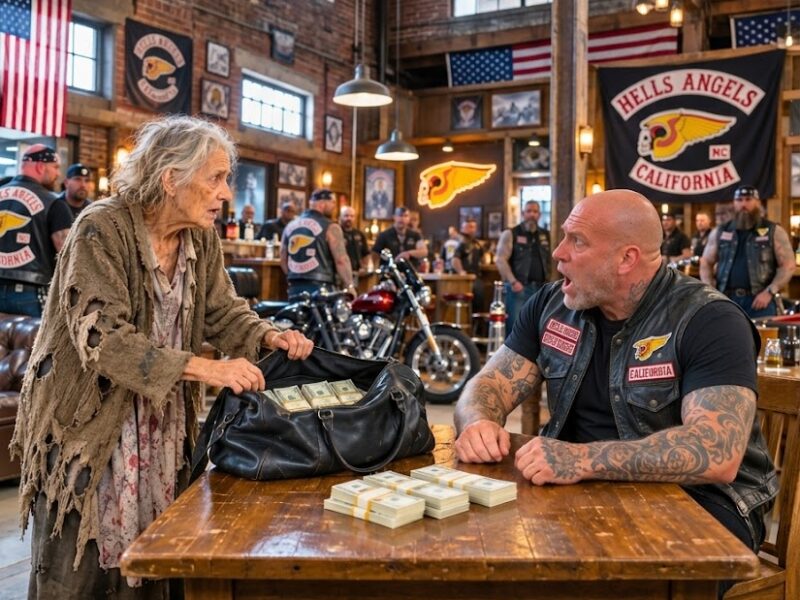
A Homeless Elderly Woman Returned a Hells Angel’s $50,000 Bag—His Unexpected Reward Changed Her Life
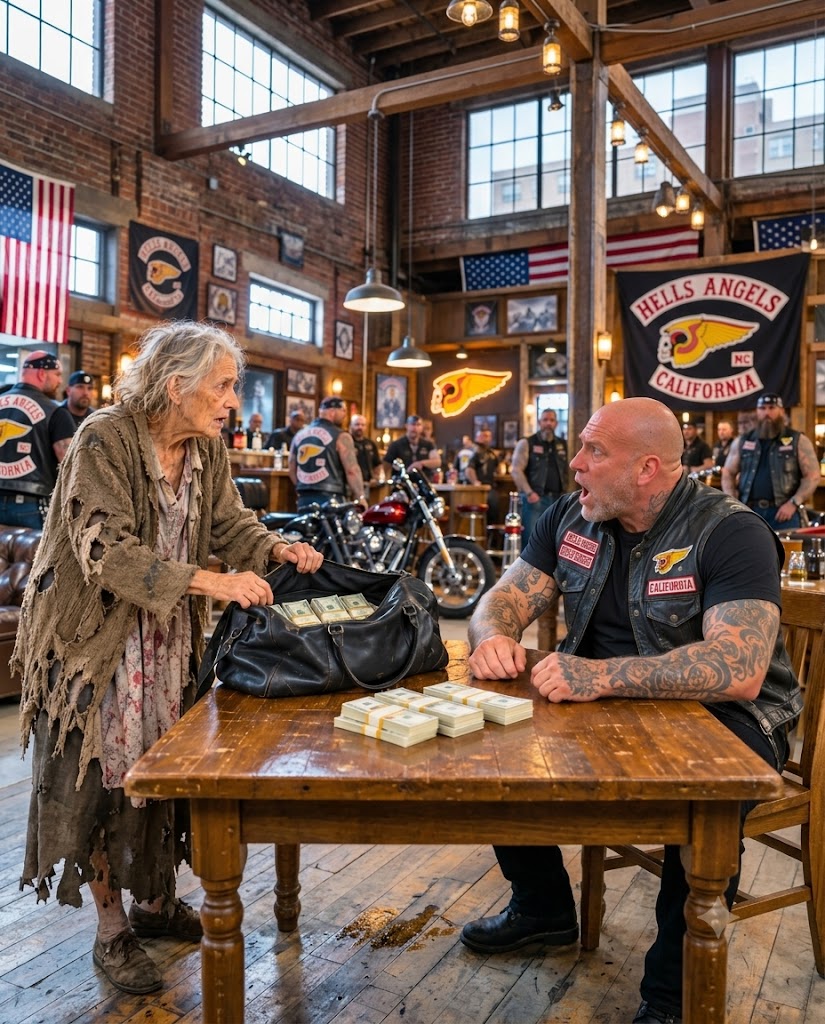
A worn leather saddlebag hit the gravel with a heavy thud.
The man who dropped it never looked down.
He swung a leg over his motorcycle, kicked it to life, and the engine screamed into the dark.
Gravel sprayed.
His taillight shrank to a red dot.
Gone.
The bag just sat there in the cold wind.
Nobody noticed it.
Nobody but a pair of tired eyes watching from a bus shelter across the empty parking lot.
A thin hand reached out and pulled the bag open.
Banded stacks of cash.
Hundreds.
Fifty thousand dollars sitting in the dirt.
Her name was Darlene Marsh.
Seventy years old.
She hadn’t eaten a real meal in four days.
One torn coat, one old cat, and now more money than she’d see in three lifetimes right there in her lap.
What she did next stopped a hardened biker cold.
—
Darlene had been living at that truck stop for three weeks.
It sat off Interstate 15 on the edge of Barstow, California, out where the desert wind never quit and the big rigs rolled through all night long.
She slept in the bus shelter because it had a roof, a bench, and one solid wall to block the worst of the cold.
That was all she asked of the world anymore.
A roof, a bench, a wall.
You learn to shrink your wants when you’ve got nothing left to spend.
Inside her coat, curled tight against her ribs, was a gray tabby cat named Biscuit.
He had one eye.
She’d found him behind a dumpster two winters back, half frozen and half starved, and she’d given him the last bite of bread she owned.
He never left her side after that.
Where she went, he went.
Two old souls keeping each other warm against a world that had stopped caring whether they lived or died.
Now, here’s the thing you have to understand about Darlene.
She hadn’t always been this.
Fifteen years earlier, she’d owned a little blue house two states over with a garden and a porch swing and a husband named Harlan who drove freight for the railroad.
They weren’t rich, but they were steady.
They paid their bills, kept their word, and went to bed each night with a clear conscience.
Harlan used to say a man’s name was the only thing he truly owned.
Everything else was just rented from time.
Then Harlan got sick.
The cancer took eleven months and everything they had.
The house went to pay the hospital.
The savings went next.
By the time he was gone, there was nothing left but a stack of bills and a widow nobody thought to check on.
They had no children.
Her people were dead or scattered.
And the pride that had kept her spine straight her whole life wouldn’t let her stand on a corner with her hand out.
So she drifted west, mostly chasing warmer winters.
She washed dishes at diners for a hot plate when they’d let her.
She swept floors.
She did honest work for whatever anyone would give.
And when there was no work, she went hungry and said nothing about it.
In the deep pocket of her coat, she still carried Harlan’s old railroad watch, the brass worn smooth from his thumb.
She’d gone hungry plenty of nights she could have sold it.
She never did.
Some things you don’t sell, no matter how empty your belly gets.
That was the woman sitting in the bus shelter the night the biker dropped his bag.
—
She’d watched him pull in two hours before dark.
Big man, leather vest, gray beard, arms like knotted rope.
The kind of man most people cross the street to avoid.
He’d gone inside for coffee, come back out, stood by his bike a long while smoking and staring at the mountains like he was arguing with somebody who wasn’t there.
Then he’d strapped his gear on wrong in the dark, dropped that saddlebag without hearing it fall, and thundered off into the night.
And now the bag was open in her lap.
Fifty thousand dollars.
She counted it twice because her hands were shaking too hard to trust the first count.
Banded stacks of hundreds, worn and soft, smelling of gasoline and leather.
She sat there in the cold and did the math a starving person does.
This was warm rooms for the rest of her life.
This was food every single day.
This was a real doctor for the cough that had been rattling in her chest since September.
This was never again digging through a dumpster behind a diner at two in the morning, praying nobody saw her do it.
Nobody knew she had it.
The man was long gone and never looked back.
He’d probably figure he lost it on the highway.
There was no camera out here, no witness, no way on God’s earth for it to come back on her.
She could be gone before sunrise, a bus ticket to anywhere, and live out her last years like a human being instead of a ghost.
Biscuit stirred against her chest and made a small sound.
She looked down at him.
Then she looked at the money.
Then she thought about Harlan and the watch in her pocket and the thing he always said about a name being the only thing you really own.
And she closed the bag.
She didn’t take a single bill.
Not one.
She pulled the straps tight, set the bag beside her on the bench, and wrapped both her arms around it the way you’d hold a sleeping child.
Because here was the truth she landed on, sitting in that freezing shelter with her stomach eating itself.
That money wasn’t hers.
And a woman who’d kept her husband’s watch through four days of hunger wasn’t about to lose her soul over somebody else’s saddlebag.
She just had to figure out how to give it back.
—
The first night was the hardest.
Not because of the hunger, though the hunger was always there, gnawing low and mean.
It was hard because she knew what she was choosing.
Every hour she sat there holding that bag, she was choosing hunger over comfort, cold over warmth, her word over her want.
And the man might never come back at all.
She might guard that fortune for a week and then watch some stranger walk off with it when she finally fell asleep.
She kept turning it over in her mind.
The simple arithmetic of it.
Keep the money and every cold night for the rest of her life was gone.
Give it back and she had nothing but a clear conscience and an empty belly.
She knew which one Harlan would have chosen.
That was the trouble with loving an honest man.
He ruins you for the easy way out, even fifteen years in the ground.
So she didn’t sleep.
She sat up straight on the bench with the bag against her belly and Biscuit tucked inside her coat, and she watched every car that pulled into that lot.
Watched the headlights sweep across the gravel.
Listened for the particular sound of a big engine, that deep rolling thunder, because she’d decided she would know it when she heard it again.
Around midnight, a man came toward the shelter.
Younger fellow, unsteady, reeking of whiskey.
He’d seen her counting earlier, maybe.
He leaned against the opening and grinned at her with half his teeth.
“What you got there, Grandma?” he said.
“Looks heavy.”
Darlene didn’t flinch.
Fifteen years on the street teaches you that fear is a smell, and men like this live off it.
So she looked him dead in the eye and said in a voice as flat and dry as the desert behind her:
“It’s mine and it isn’t worth dying over.
But I’ve got nothing left to lose, son, and you’ve got everything.
Think hard about which one of us walks away from a fight.”
He stood there a moment, swaying.
His eyes went to the bag, then to her face, then back to the bag.
And whatever he saw in that steady old stare made the math come out wrong for him.
Then he muttered something ugly and stumbled off toward the restrooms.
Her hands didn’t stop shaking for an hour.
But she kept the bag.
And when the sun finally came up gray over the mountains, she was still sitting there, upright, awake, both arms around a fortune she’d decided wasn’t hers.
—
Morning came gray and cold.
She bought a single cup of coffee inside with change scraped from the bottom of her coat, warmed her fingers around it, and gave Biscuit a lick of the cream.
The waitress, a tired woman named Rosa, who’d slipped Darlene a day-old biscuit more than once, leaned over the counter and nodded at the bag.
“You’ve been clutching that thing all night.
Somebody’s purse?”
“Somebody’s,” Darlene said.
“I’m waiting on him to come back for it.”
Rosa gave her a long look, the kind that says she knew more about the weight of that bag than Darlene thought she did.
She dried her hands on her apron and was quiet a moment.
“You know,” she said finally, “most folks come through here, they’re looking to take something.
Gas they don’t pay for.
Tips off the next table.
You’re the first one I ever saw sit all night guarding something to give it away.”
She topped off the coffee for free.
“Hope he’s worth the wait.”
—
The second night, the wind came up hard and the temperature dropped below freezing.
Darlene’s cough got worse.
It tore through her chest in long rattling fits and twice she had to spit into the dirt.
She was weak now.
Truly weak.
The kind of weak where your thoughts go slow and the cold starts to feel almost warm.
And she knew that feeling for the danger it was.
Old folks froze to death feeling warm.
Harlan had told her that once from some railroad winter up north, and she’d never forgotten it.
So when the warmth started creeping up her arms like a lie, she pinched the soft skin of her wrist hard enough to hurt and made herself stay in the pain because the pain meant she was still alive.
She held on.
She held the bag and she held the cat and she held herself upright on that bench through the longest, coldest night of her life because she had given her word to a man who didn’t even know she’d given it.
By the third day, she could barely stand.
And that was when she heard it.
—
Late afternoon, the sun going down red behind the mountains.
A sound rolling in off the highway, deep and heavy, getting louder.
That engine.
His engine.
She knew it the way you know a voice.
She pushed herself up off the bench, her legs nearly buckling, and she watched the big motorcycle swing off the interstate and roll slow across the gravel lot.
The rider scanning the ground on both sides like a man searching for something he’d already given up on finding.
He killed the engine near the pumps, climbed off, stood there with his hands on his hips, shaking his head at the dirt.
And Darlene Marsh, seventy years old and three days hungry, walked out of that bus shelter on legs that wouldn’t hold her, carried the bag across the lot with both arms, and set fifty thousand dollars down in the hands of a Hells Angel.
“I believe this is yours,” she said.
“I didn’t take any of it.
You can count it.”
—
The man went very still.
He looked at the bag.
He looked at her.
At the torn coat and the gray face and the cat’s one eye peering out from under her collar.
For a long moment, he didn’t say anything at all.
Then he opened the bag with hands that weren’t quite steady, and he looked at the money that was all still there, every band unbroken.
And when he looked back up at her, his jaw was working like a man trying to swallow something too big for his throat.
Darlene nodded once, like a thing was finished.
She turned and walked back toward her shelter, slow and careful, and she sat back down on her bench with Biscuit, and she figured that was the end of it.
She’d kept her word.
The bag was gone.
Her conscience was clear.
She pulled her coat tight, closed her eyes against the last of the sun, and let herself rest for the first time in three days.
It was over.
She’d done the right thing, and now she could sleep.
That’s what she thought, anyway.
She didn’t see the man still standing by the pumps, the open bag hanging from one hand, staring after her like the ground had shifted under his boots.
—
The next sound she heard was not one engine.
It was many.
They came in the morning, a line of them off the interstate.
Ten or twelve big motorcycles rolling into that truck stop in a long rumbling column that you could feel in your teeth before you ever saw it.
Leather and chrome and gray beards and hard faces pulling into the lot in a slow, wide arc that boxed the whole front of the building.
Truckers stopped mid-step to watch.
The man behind the fuel counter reached for his phone.
Darlene stood up in her shelter and for the first time in three cold days, she was afraid.
Because here is what went through her mind, and I want you to understand it, because it changes everything about this story.
She thought they had come for her.
She thought the big man had told the others about the old woman who’d seen his money, who knew his face, who could put him and fifty thousand dollars in cash in the same sentence to anyone who asked.
And she’d heard the stories everybody’s heard.
Men like this don’t leave loose ends.
A homeless woman with no family and no address was the loosest end there was.
Nobody would miss her.
Nobody would even look.
She counted them as they rolled in.
One, two, six, ten.
And the counting made it worse because every new rider was one more witness to whatever they’d come to do.
And not one of them was a witness who’d ever talked to a sheriff.
She wasn’t holding her word anymore.
Now she was holding her life.
—
But that wasn’t the worst of it.
Because that same morning, a county sheriff’s cruiser pulled in behind the motorcycles, and out of it stepped a man in a crisp tan uniform who did not look at the bikers at all.
He looked straight at Darlene.
His name was Deputy Carl Hollis.
And he ran this stretch of highway like it was his personal kingdom.
And he had been waiting three weeks for an excuse to clear that old woman off his truck stop for good.
“You,” he said, pointing at her across the lot.
“Stay right there.”
—
Hollis walked straight up to Darlene with his thumbs hooked in his belt, loud enough for the whole lot to hear.
He’d gotten a call, he said.
Report of a vagrant flashing around a large amount of cash.
Fifty thousand dollars, the caller said.
Now, where, he wanted to know, would a filthy old woman who slept in a bus shelter get fifty thousand dollars?
There was only one answer a man like Hollis was ever going to reach.
She’d stolen it.
“I didn’t steal anything,” Darlene said.
“I found a bag and I gave it back to the man who lost it.”
Hollis laughed, turning to play it for the gathered crowd.
“Sure you did.
Fifty grand just falls out of the sky into your lap and you, out of the goodness of your heart, hand it right back.
That the story?”
He stepped closer, crowding her against the shelter wall, and dropped his voice to something mean.
“Here’s the real story.
You’re trespassing.
You’re a vagrant.
And you’re going in the back of my car.
And that flea-bitten animal goes to the pound to be put down because I am done with you stinking up my highway.”
He reached out and grabbed the front of her coat.
Biscuit hissed.
Darlene clutched the cat and tried to pull back, and Hollis yanked her forward hard enough that she stumbled and went down on one knee in the gravel.
The breath knocked out of her, that cough tearing loose in her chest.
He stood over her, one hand already reaching for the cuffs on his belt, grinning like a man who’d finally gotten what he wanted.
And that’s when the big man got off his bike.
—
He hadn’t said a word the whole time.
He just sat there at the front of that line of motorcycles, the worn leather saddlebag resting across his gas tank, watching.
His name was Jack Caldwell, but every man in that lot who mattered knew him as Diesel, and he’d ridden thirty years and buried more friends than most men ever make.
He climbed off slow.
He walked across that gravel slow, and the whole parking lot went quiet the way a room goes quiet when the biggest animal in it finally stands up.
“Deputy,” Diesel said, “take your hand off her.”
Hollis straightened up fast, his grin flickering.
“This is county business.
You and your boys need to—”
“That woman,” Diesel said, and his voice was not loud, but it carried to every corner of that lot, “sat in that bus shelter for three days and three nights in the cold, hungry, with fifty thousand dollars of my money in her lap.
You hear me?
My money.
Dropped it myself like a damn fool and never knew it was gone.
She could have been on a bus to the ocean.
She could have eaten like a queen for the rest of her life.
Instead, she near froze to death guarding it so she could put it back in my hands and ask me for nothing.”
He took one step closer to Hollis.
“And you want to put her in a cage for being honest in a place where a man like you forgot what honest even looks like.”
Hollis’s face had gone a blotchy red.
“She’s a vagrant.
I’ve got every right—”
“She’s got more right to stand on this earth than you do,” Diesel said.
“And before you reach for those cuffs again, you ought to know the money in that bag is counted, banded, and accounted for.
And I’ve got twelve men who will swear in any courthouse you like exactly what this woman did.
So the only person committing a crime in this parking lot right now is the one with the badge, manhandling a seventy-year-old lady into the dirt over a story he made up because he didn’t like the way she smelled.”
—
You could have heard a pin drop on that gravel.
Hollis looked around.
At the twelve bikers.
At the truckers filming on their phones now, every one of them.
At the waitress Rosa standing in the diner doorway with her arms crossed and her chin up, who’d already told the fuel clerk exactly what she’d seen with her own eyes—that the old woman had been clutching that bag for three days, waiting to give it back.
He looked at all of it, and he felt the ground he’d been standing on his whole career tip sideways under his polished boots.
He let go of Darlene’s coat like it had burned him.
He stepped back.
He muttered something about following up, about paperwork.
And he walked to his cruiser with his spine curved like a man half his size.
And he drove off that lot and never set foot on it again.
Six weeks later, the video the truckers took got him put on leave.
And after that, let’s just say the county found itself in need of a new deputy for that stretch of highway.
But Darlene didn’t see any of that yet.
—
She was still down on one knee in the gravel, shaking, both arms around her cat, when a shadow fell over her.
She looked up, and the big man was crouching down in front of her, bringing his hard face level with hers.
“Ma’am,” Diesel said, and his voice had gone soft as worn leather.
“Can you stand?”
“I think so,” she said.
He took her by the elbow, gentle as you’d lift something made of glass, and he got her up on her feet and held her there until her legs stopped trembling.
“You hungry?” he asked.
And Darlene Marsh, who had not had a real meal in going on five days, who had just been thrown to the ground and nearly hauled off to a cell, looked up at this enormous, frightening stranger, and did the only honest thing she knew how to do.
She started to cry.
Not loud.
Just two tears cutting down through the dust on her face and a small broken voice that said:
“Yes.
I’m very hungry.
I’m so tired and I’m very hungry.”
—
Diesel stood up to his full height.
He looked at the men still sitting their bikes, and he jerked his head toward the diner.
And twelve Hells Angels dismounted in a clatter of boots and chrome.
Two of them went inside and told Rosa to fire up the grill and bring the old woman the biggest breakfast the place could make, and to keep it coming, and that the club was covering every tab in the building that morning.
One of them, a younger man, crouched down and very carefully coaxed Biscuit out from Darlene’s coat and held the one-eyed cat against his broad chest like he was carrying a kitten, scratching under its chin the whole way inside.
They sat her down in a booth by the window.
They put a plate in front of her—eggs and bacon and pancakes and hot coffee.
And they put a saucer of warm milk down on the table for the cat.
And Darlene ate with tears running down her face the entire time and her hands still shaking.
And not one of those hard men said a word about it.
They just sat around her in that booth, these big tattooed strangers, and made sure her coffee never ran dry.
One of them took off his own jacket and draped it over her shoulders when he saw her shivering, and left it there, and didn’t ask for it back.
—
Diesel slid in across from her.
He set the worn saddlebag on the table between them, and he told her the truth of it, quiet, just for her.
That money, he said, wasn’t drug money and it wasn’t dirty.
It was the club’s.
They’d spent two years raising it, running charity rides and raffles and poker runs, dollar by dollar, to rebuild a children’s burn ward three counties over that had lost its funding.
He’d been carrying the cash to the bank the night he dropped it.
And he’d stood in that lot at sundown arguing with himself about his brother, who died in a fire when they were boys, which was why the burn ward meant what it meant to him.
And he’d gotten so twisted up in the old grief that he’d strapped his gear wrong and ridden off blind.
When he got home and found the bag gone, he said he figured it was scattered across forty miles of interstate.
Two years of his brother’s work gone because of his carelessness.
“I came back to walk the shoulder with a flashlight,” he said.
“Didn’t expect to find it.
Sure as hell didn’t expect to find it whole in the hands of somebody who had every reason on God’s earth to keep it.”
He shook his head slow.
“You know what fifty thousand dollars means to a woman sleeping in a bus stop.”
“Yes,” Darlene said quietly.
“I know exactly what it means.”
“And you gave it back anyway.”
“It wasn’t mine,” she said.
Like it was the simplest thing in the world.
“My husband used to say your name’s the only thing you really own.
I’ve lost about everything else.
I wasn’t going to lose that, too.”
Diesel looked at her for a long moment.
Then this huge, weathered man who had buried more friends than he could count reached across the table and put his scarred hand over her trembling one.
“Harlan was a smart man,” he said.
She’d never told him her husband’s name.
But somehow it fit, so she let it be.
—
The club didn’t just buy her breakfast and ride away.
That’s the part people get wrong about men like these.
And it’s the part of this story I most want you to hear.
Diesel made some calls that same afternoon.
By nightfall, Darlene Marsh was not sleeping in a bus shelter.
She was in a warm room at a motel down the road.
A real bed, a hot shower, Biscuit asleep on the pillow beside her with his belly full.
A doctor came the next morning.
A real one.
And treated the pneumonia that had been filling up her chest.
The pneumonia that one more cold night in that shelter would almost certainly have finished.
But even that wasn’t the end of it.
—
There was an old man in the club named Walt, a founding member who had a small house on a quiet street at the edge of town with a garden gone to weeds and an empty room nobody used since his wife passed.
Walt was seventy-eight and lived alone and didn’t like to admit how much the loneliness had started to weigh on him.
Diesel brought the two of them together over a pot of coffee, and they talked for three hours about gardens and railroads and dead spouses, and the particular way grief sits down with you in an empty house and won’t leave.
And when Darlene moved into that spare room a week later with her cat and her husband’s brass watch and nothing else to her name, it wasn’t charity.
It was two lonely old people who’d found, at the very end of things, somebody to grow old beside.
—
She planted that garden back to life come spring.
Tomatoes and beans and a row of blue flowers the color of a house she used to own.
The club came by on Sundays—those big, frightening men—and they fixed Walt’s porch and ate Darlene’s cooking and called her ma’am and meant it.
And more than one of them over the years sat at her kitchen table late at night and told her things they’d never told another living soul, because there was something about the honest old woman that made a hard man want to be honest too.
They put a plaque up at the children’s burn ward that summer when the new wing opened.
It didn’t have Darlene’s name on it because she asked them not to.
It just said: Given by those who kept their word.
She went to the dedication in a new blue dress and cried the whole time, and Diesel stood beside her the whole time, and neither one of them said much because by then they didn’t need to.
—
Darlene Marsh lived nine more years in that little house with the garden and the cat and old Walt and the Sunday visits from the roughest, gentlest family she ever had.
She never went hungry again.
She never slept in the cold again.
And when she finally passed, quiet in her own bed with Biscuit curled against her ribs right where he’d always been, there were twelve motorcycles in the funeral procession, rolling slow, engines down to a low, respectful rumble, carrying an old woman to her rest the way you carry someone who mattered.
—
Diesel kept Harlan’s brass watch after that.
Carried it in his vest pocket on every ride, the way she’d carried it through all those hungry nights.
Somebody asked him once why a man like him would hang onto an old dead stranger’s watch.
He didn’t answer right away.
He just turned it over in his scarred fingers, the brass worn smooth by two people’s thumbs now, and he looked off toward the mountains the way he had that first evening in the lot.
“Because she was right,” he finally said.
“In the end, your name’s the only thing you really own.”
That woman had nothing.
Slept in the dirt.
Hungry down to her bones.
He closed his hand around the watch.
“And she was still the richest person I ever met.
Took me fifty years and fifty thousand dollars to figure out what that even meant.”
Then he put the watch back in his pocket, over his heart, swung a leg over his bike, and rode off slow into the desert evening.
And this time, he didn’t drop a thing.









