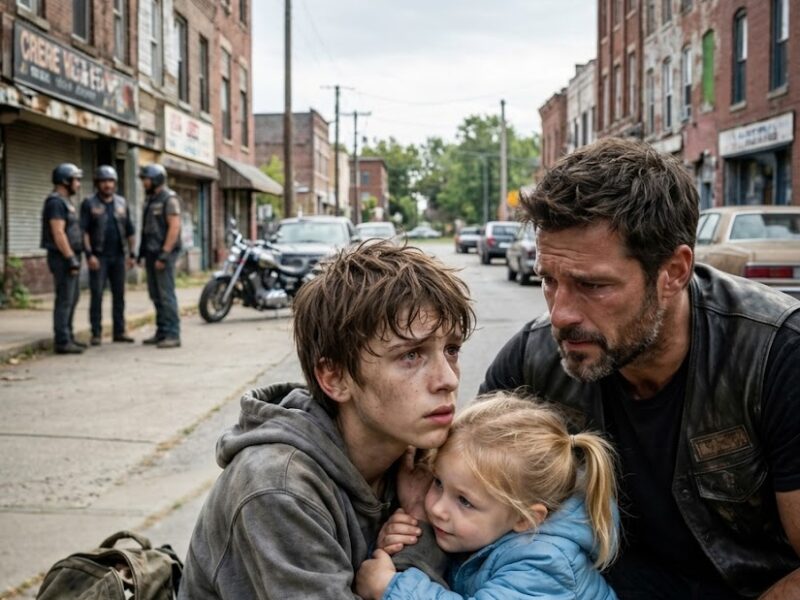
A homeless boy collapsed after saving a biker’s little girl—and 200 Hells Angels uncovered a 15-year secret.
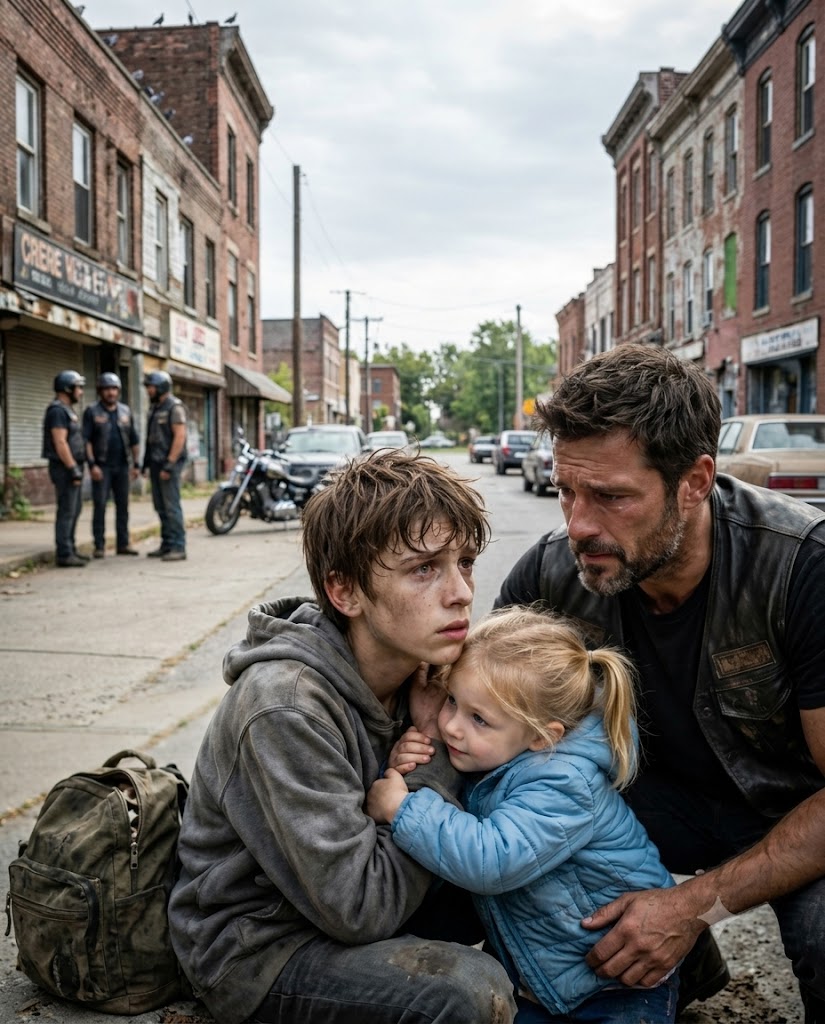
Rush hour in Millbrook, Pennsylvania, sounded like a factory spilled into the street. Buses sighed at the curb, trucks idled outside the diner, and steelworkers crossed with lunch pails in their hands beneath gray mill stacks and a cold October sky.
Elias Mercer stood outside the hardware store, his 7-year-old daughter’s hand firm in his. Broad-shouldered and quiet, he wore a black leather vest with generic worn patches, no club insignia, no logos, no text over faded flannel.
Mia, clutching a paper bag of candy, pressed close to his leg and watched the crowded crosswalk. Across the street, beside the soup kitchen doorway, stood a boy the crowd flowed around without seeing.
Noah was 15, thin enough that his worn gray hoodie hung from his shoulders. Its cuffs frayed and sleeves dark with rain. His backpack, holding almost everything he owned, rested against his ankle.
At night, he slept in the abandoned shed behind the kitchen. “Stay with me, sweetheart,” Elias told Mia. “Cars can’t always stop.”
Noah was counting his last coins when the horn began. Not one blast, but a long, broken scream from the top of the hill, where a delivery truck crested too fast and kept coming faster.
Someone shouted. Brakes shrieked on wet asphalt and found nothing. The truck swerved around a bus, clipped a mailbox, and cut across two lanes toward the crosswalk.
At that moment, Mia’s paper bag tore. Candy scattered, and she pulled free, chasing bright pieces toward the curb. Her shoes slipped on wet paint. Elias lunged, brushed her coat, and missed.
Mia. She froze in the middle of the road, too frightened to run, staring at the truck filling her whole world. Elias was three steps away, three steps too far.
Noah moved first. He did not shout or wait for anyone else. He dropped his coins, left his backpack on the concrete, and ran in a burst of speed no one expected from a boy who looked half-starved.
He reached Mia a breath before the truck, wrapped both arms around her, turned his own body toward the grill, and threw them sideways. They rolled hard across the asphalt, Noah’s shoulder taking the fall.
Mia held tight against his chest, stopping inches beyond the truck’s path as it thundered past and crashed into empty barriers down the block. For a second, nobody moved.
Then Mia cried, and Elias was on his knees, gathering her with shaking hands, checking her face and arms. Scrapes, terror, nothing broken. Beneath her, Noah lay still.
His eyes were half open and unfocused, his face drained, his breathing shallow, as if that run had spent strength he had been saving for days. Elias slid a hand beneath the boy’s head.
Noah’s lips barely moved. “Is she safe?” Then his eyes closed, and he collapsed unconscious on the road. Sirens rose from the next street.
Strangers brought a blanket. Someone held Mia while paramedics lifted Noah onto a stretcher, and Elias stayed beside him until the ambulance doors closed, his daughter clinging to his shirt, alive because a homeless boy had not hesitated.
As the ambulance pulled away, an older biker in a black leather vest with generic worn patches bent slowly near the curb. Something small and tarnished had fallen from Noah’s pocket during the roll.
He picked up the old badge, stared at it, and his face went completely pale.
The first thing Noah heard was the beep of a heart monitor, and the first thing he did was try to sit up. An arm tugged at his arm. A thin blanket covered his legs.
The hospital room smelled of disinfectant, nothing like the damp warehouse behind the soup kitchen where he had slept the night before, curled around his backpack. In the doorway, Elias Mercer stood with his arms folded.
Beside him, a doctor spoke quietly, but Noah caught every word. “He didn’t collapse because of the truck,” the doctor said. “Bruises from the fall, but no head injury, no broken bones. This was exhaustion and malnutrition.”
“His body is running on almost nothing. He has spent many nights sleeping outside.” Elias looked through the glass at the boy. 15, the nurses guessed, though he looked younger.
Hollow cheeks, wrists too thin, his worn hoodie folded on a chair as if he feared it would disappear. When Noah saw them watching, panic crossed his face.
“I have to go,” he said, pulling at the tape on his arm. “Please, I can’t stay here.” “Easy,” Elias said, stepping inside but stopping a few feet away, hands open.
“You’re safe. Nobody will hurt you.” “You don’t understand. They’ll ask questions, a name, an address, a guardian.” Noah’s breathing quickened. “Please don’t call child services. I’ll be gone in 5 minutes and you won’t see me again.”
Elias sat slowly beside the bed. “I’m not calling anyone right now. Just stay until that IV finishes. You passed out in the street.”
Noah stared at the door, counting exits. Then he turned sharply. “Wait, Mia. Is she safe? Did the truck—” “She’s safe,” Elias said. “Because of you. Not a scratch. She’s in the waiting room, asking for you.”
Some tension left Noah’s shoulders, but not the weariness. Elias placed several folded bills on the tray table. “Not payment. Just thank you. For food or a room, whatever you need.”
Noah looked at the money as if it burned and carefully pushed the tray away. “I don’t want it. I didn’t do it for money. Is she really okay? She was crying. Did a doctor check her?”
“Twice,” Elias said. “She’s really okay.” An hour later, when Noah’s color had returned a little, Elias brought Mia in. She held a crumpled drawing in both hands.
Her hair in two braids, one shoe still scuffed. “Thank you for catching me.” She whispered, setting the drawing on his blanket. A nurse had left Noah a tray, a turkey sandwich, apple slices, a carton of milk.
He had not touched it. Without a word, he held out the still wrapped sandwich to Mia. “You must be hungry.” he said. “You had a scary day.”
Mia looked at her father before taking it. Elias watched and something in his chest tightened. The boy who had not eaten properly—and who knew how long—had given away his only meal as if that were natural, as if he were used to no one ever asking him.
“Noah.” Elias said quietly. “Are you okay?” The boy looked genuinely startled by the question. He did not answer.
That night, the ward was quiet. At 2:17 a.m., a nurse found Noah’s bed empty. The floor removed, the curtain swaying. His hoodie was gone. His backpack was gone.
On the pillow, left behind in his rush or dropped without him knowing, was a dull, tarnished badge. Elias called back in the dark, turned it over in his palm, and felt his breath stop.
Engraved along its edge, worn but still legible, was a single name, Sarah.
Noah woke to the sharp smell of disinfectant and the steady beep of a monitor beside his bed. The bright light hurt his eyes. For a moment, he did not know where he was.
Then it all came back. The truck losing control, Mia frozen in the street, the hard pavement rushing toward him. He sat up too fast and the room tilted.
A nurse hurried in and tried to ease him back against the pillows, but Noah was already pulling at the blanket, searching for his worn shoes on the floor. “I need to go.” he said. “Please. I need to go before anyone starts asking about a guardian.”
Elias came an hour later carrying a bag of clean clothes and a hot meal from downstairs. Soup, a sandwich, and water. He wore his black leather vest over a plain shirt, but Noah barely looked at him.
His eyes stayed on the food. He ate slowly, as if he was afraid it might be taken away, thanked Elias quietly, and asked again, “Is Mia really safe? She didn’t get hurt?”
“She’s safe because of you,” Elias said. “Scared, but safe. She keeps asking about you.” Then Elias set folded money on the tray. Noah pushed it back at once.
“I didn’t do it for money. Please don’t.” Later, Elias mentioned a shelter across town, a real bed, a door that locked, help getting back into school. Noah listened, clutching the blanket.
“What would I have to tell them?” “Just your name, to start.” “And my mother’s name?” Elias hesitated, and that was enough.
Noah glanced at the door, measuring the distance the way he had clearly done in many rooms before. “If I give them her name, they’ll put me in the system,” he said. “Foster homes, strangers deciding where I sleep. I can’t.”
“No one is forcing you tonight,” Elias said. Noah smiled tiredly, as if he had heard that promise wear thin before. By evening, the hospital bed felt less like rest and more like a trap.
When the hallway finally quieted, Noah slipped out in the clean clothes Elias had brought, his old backpack over one shoulder, and disappeared into the cold. Elias found him hours later behind the soup kitchen, in the abandoned warehouse where broken pallets and damp cardboard marked the corner Noah called his own.
The boy was curled against the wall, knees pulled tight, arms wrapped around the backpack as if someone might take it even in his sleep. Inside, half hidden beneath a folded shirt, was an old badge Noah guarded more carefully than food.
Hearing footsteps, he woke instantly. “I told you I can’t go to a shelter,” he said, bracing for an argument. Elias stopped several feet away and sat down on an upturned crate, keeping the doorway clear.
He placed a wrapped sandwich on the floor between them and raised both hands, empty. “I’m not here to drag you anywhere,” he said. “No police. No forms tonight, no one deciding for you while you’re half asleep. You have my word.”
For a long time Noah said nothing. The warehouse was silent except for water dripping somewhere in the dark. His grip on the backpack slowly loosened, but he did not let go.
At last he whispered, so quietly Elias had to lean forward to hear him. “My mom told me not to trust free kindness. She said sooner or later somebody always makes you pay for it.”
Elias did not take Noah to get papers the next morning. He took him to breakfast first in a small diner two streets from the soup kitchen and waited until Noah had finished eating before he said anything.
“If we’re going to get you enrolled in school,” he said, “people will need your full name and some proof of who you are. I won’t sign anything for you and I won’t decide anything without you, but I can bring people who know how to do this the right way.”
Noah stared at the empty plate in front of him, his backpack tight against his feet, one hand resting on it like someone might take it while he was not looking. “Social workers?” He asked.
“One,” Elias said, “and a lawyer. Not to put you anywhere, just to search legally for records. If you say stop, we stop.” That afternoon they sat in an office at the community center where the blinds cut the daylight into thin, pale lines.
Claire, the social worker, kept her notebook closed. Daniel, the lawyer, set his pen down instead of picking it up. Both of them let Elias explain again in front of Noah that nothing would be filed, shared, or requested without Noah hearing it first.
Noah listened the way he had listened at the hospital, carefully and ready to run. “We don’t need everything today,” Claire said gently, “just a place to start. A parent’s name, if you’re willing to give it.”
The silence lasted so long that Mia, waiting with a coloring book in the hallway, looked up. Noah’s fingers worked at the frayed strap of his backpack. His worn hoodie hung loose around his shoulders and for the first time Elias did not try to fill the quiet for him.
“Sarah,” Noah said at last. The word came out barely above a whisper. “My mom’s name is Sarah. I haven’t—I don’t know where she is. We lost contact years ago. She’s the only family I ever really had.”
Daniel nodded, wrote only the name, and turned the notebook so Noah could see there was nothing else on the page. The legal search took 2 days. Elias spent them driving Mia to school, checking the warehouse road without telling Noah he had done it, and resisting every urge to ask questions Noah was not ready to answer.
On the third morning, Daniel called them back. Not with a birth certificate, and not with an address for Sarah, but with a record from 15 years earlier that made Claire go still as she read it.
“Sarah was listed as a witness,” Daniel said, sliding the page toward Noah first. “A supply truck carrying relief goods crashed outside town 15 years ago. She gave a statement that night. After that, the references stopped.”
“She left town while the case was still open, while a biker was facing charges, and came close to being convicted for causing the crash.” Noah reached slowly into his backpack and set the badge on the table, as if the record had pulled it out of him.
“She told me to keep this,” he said. “She never told me why.” At that moment, Walter entered with a folder Elias had left at the diner. The older biker stopped in the doorway, his black leather vest dark against the pale wall.
His eyes fell to the badge, and all the color drained from his face. Walter knew it. Noah saw that he knew it. But Walter set the folder down, shook his head, and walked out without saying a word.
That night, after Mia was asleep, Elias’s phone rang from an unknown number. A voice spoke before he could say hello. “Don’t dig into Sarah.” Then the line went dead.
The lawyer’s office smelled of old paper and rain against the windows. Elias Mercer sat beside Noah at a scarred wooden desk, his black leather vest folded over the back of his chair, trying not to stare at the boy’s shaking hands.
They had come for something simple, a birth record, a first step towards school, an identification card, proof that 15-year-old Noah existed beyond soup kitchen lines and cold warehouse floors.
Daniel Reyes, the lawyer, typed Noah’s date of birth, then paused at the question Noah dreaded most. “Your mother’s full name,” he said gently. Noah looked at Elias.
Elias nodded once, but said nothing, keeping the promise he had made. Noah would decide what to share. “Sarah,” Noah whispered. “Sarah Bennett.”
Daniel typed the name, waited, then frowned as the screen filled with archived results. He opened one file, then another, and his expression changed. “This is not only a birth record match,” he said slowly.
“A Sarah Bennett appears in the investigation into the relief truck crash 15 years ago. She was a key witness. After she gave her first statement, she disappeared from town, and no one could find her.”
The chair scraped as Noah stood too fast. “No, that’s not—You have to close that.” His breath came short and uneven. Elias rose with his palms open, speaking the way he did when Mia was frightened.
“Hey, look at me. Nobody is calling anyone. Nobody is taking you anywhere.” Noah shook his head. Tears he refused to let fall bright in his eyes.
“You don’t understand. She told me never to say her name here, not in this town, not to police, not to doctors, not to anyone who asked where I came from.” It was the first time he had admitted there had been a warning at all.
“When did she tell you that?” Daniel asked carefully. “Before she was gone,” Noah said. “She made me repeat it. If we ever came back here, I was supposed to use no name at all.”
Silence settled over the office. That afternoon, in the small temporary room Elias had arranged above a quiet rental office, Noah finally unzipped the hidden lining of his backpack.
Elias had asked Walter to come because Walter had worked the relief route that year, and Noah, after long hesitation, had agreed to one question. From beneath a folded seam, Noah pulled out the old badge and set it on the table without letting go.
Walter froze. The color left the older biker’s face. His hand hovered over the worn metal, then stopped as if touching it might force him to remember everything at once. “Where did you get that?” he asked, his voice barely steady.
“It was mom’s,” Noah said. “She sewed it in there herself. She said if anything happened, keep it, but don’t show it to anyone.” Walter stared at it for a long time.
“That badge was from the relief convoy,” he murmured. Elias leaned forward. “Walter, what are you not saying? Did Sarah do something wrong?”
Walter’s jaw tightened, and he looked away from both of them, toward the door, toward the street, anywhere except at Noah. “Walter,” Noah said, “please. Did she run away? Did she leave those people, too?”
Walter shook his head once, sharp and pained. “Your mother didn’t run away.” He stood, picked up his keys, and would answer nothing else. Not how he knew, not who Sarah had feared, not what had happened after her statement.
That night, Elias knocked with warm food and found the bed made, the backpack gone, and Noah’s temporary room empty. Elias found Noah just after midnight in the abandoned warehouse behind the soup kitchen.
Rain dripped through the broken roof onto wet concrete, and the cold air smelled of rust and old oil. Noah was sitting against the far wall, clutching his backpack to his chest, his knees drawn up and his thin shoulders shaking.
When Elias stepped toward the door, Noah pressed himself harder against the wall. “I’m not going back,” he said, “not to that room, and not anywhere near Mia.”
Elias stopped outside the threshold, close enough to be heard, but far enough not to trap him. “You disappeared without telling anyone where you were going.” “I told you enough,” Noah said.
“Trouble is already looking for me. If it finds me with your family, Mia could get hurt. She’s seven. I won’t be the reason for that.” Instead, he sat down on the cracked concrete outside the door, set a bottle of water and a wrapped sandwich beside the entrance, and waited.
Minutes stretched into an hour. Elias did not fill that silence with promises he could not keep. At last, Noah spoke again, more quietly this time.
“Every time someone helps me, they start asking what I can give back. I have nothing except what’s in this bag.” “I’m not asking for payment, Noah,” Elias said. “And I’m not deciding for you. That door stays open because you choose whether to walk through it.”
Before Noah could answer, headlights swept across the warehouse wall. An older motorcycle rolled to a stop beside Elias’s bike, and Walter climbed off slowly, his face pale beneath the gray in his beard.
He wore a black leather vest over a heavy jacket. “I heard you found him,” Walter said. “There’s something I should have said 15 years ago, and something I should have said the first time I saw that badge.”
Noah rose to his feet, still holding the backpack. “You knew my mother.” Walter nodded. “Sarah Bennett was no criminal, son. She was a witness who tried to protect an innocent man.”
“On the night of the relief truck crash, Sarah kept a copy of the trip log and a photograph. The log showed another driver took that truck out, and the photograph placed our friend at the depot loading supplies when the crash happened across town.”
“Together, they proved he didn’t cause it.” “Then what happened to her?” Noah asked. “The man who did cause it learned Sarah had both, and he threatened her until she believed leaving town was the only way to keep everyone around her safe.”
Walter’s hands trembled. “I knew she was frightened. I knew she wasn’t running from the truth. She was running because of it.” “Then why didn’t you tell anyone?” Noah asked.
“Because I had a wife, young children, and a job at the mill,” Walter said. “Men like me couldn’t be replaced. I told myself silence kept my family safe. The truth is I was a coward and Sarah and you paid for it.”
For a long time Noah said nothing. Then he lowered the backpack, took one careful step toward the doorway, and stopped beside Elias by his own choice.
As they headed toward the rear exit, past the sleeping corner where Noah kept his blanket, Elias raised a hand. The thin blanket had been torn from its place. His spare clothes scattered across the concrete and the flattened cardboard he slept on overturned.
Pinned beneath a broken crate was a folded sheet of paper. Walter unfolded it and all three of them read the single line, “Hand over the badge.”
Walter’s admission should have brought Noah relief, but the morning after the warehouse, the past seemed to walk one step behind him. At the soup kitchen, he ate standing near the exit, his backpack between his feet.
Twice he noticed the same stranger across the street. First beside a parked gray car, then in a window’s reflection, watching without ever joining the line. Tucked inside the paper bag a volunteer had given him was a folded note that had not come from the kitchen.
“Leave the badge where you used to sleep. Tonight, or we will take it.” Noah’s hands were shaking when he showed it to Elias outside the garage. Elias read it twice, his jaw tightening.
“You’re not sleeping out there tonight,” he said. He drove Noah to a small apartment above the lawyer’s office, where a trusted friend brought soup, clean blankets, and a door that locked from the inside.
For most people, it would have felt like safety. For Noah, every act of kindness had always carried a hidden price. Late that evening, he heard Elias speaking quietly in the hallway.
“Keep the place closed until morning. No one in or out until the lawyer gets here.” Noah heard only a locked place, a lawyer, and a decision being made without him.
In his mind, morning meant forms, questions about Sarah, and a system that would send him somewhere he could not leave. He waited until the apartment went quiet, forced open the bathroom window, and climbed onto the fire escape.
Halfway down, his backpack caught on the railing. The torn zipper opened, and the old badge slipped free, skidding across wet pavement toward a storm drain. Noah lunged after it and caught its edge with two fingers inches from the dark opening.
Losing it would have meant losing the only physical clue linking his mother to that night. Elias found him minutes later, kneeling in the alley, clutching the badge to his chest.
He stopped several feet away and raised both hands. “That door locks to keep them out, Noah. It was never meant to keep you in. If you walk, I won’t chase you. But you don’t have to run to be free here.”
Noah looked toward the street, then back at the apartment. For once, he returned by his own choice. While Noah slept behind a door he had chosen to close, Elias, Walter, and the lawyer followed the relief truck records connected to Sarah.
An old transport archive produced a faded route sheet, a vehicle number, and a delivery time matching the number stamped on Noah’s badge. The trail led to the small church where relief supplies had been loaded 15 years earlier.
In a basement storeroom, beneath donation ledgers the former pastor had kept, they found a sealed envelope hidden inside a hollowed hymn book. Inside were Sarah’s copy of the trip record and a photograph showing the real driver beside the truck that night.
The record carried one more name, Henry Lawson, the relief worker who had signed the truck out and, according to church records, was still alive two towns away. Elias went alone the next afternoon, so Lawson would not open his door to a crowd.
Through the chain door, the elderly man saw Noah’s photograph and went pale. “I won’t meet the boy,” he said. “If that record becomes public, my children will learn I stayed silent while a man’s life was ruined.”
“The truth won’t just reopen the past. It will break my family.” The memorial ground behind the community church was already full when Noah stepped out of Elias’s truck, and for a moment he could not breathe.
Nearly 200 bikers had ridden in from different chapters. Their motorcycles lined in quiet rows along the fence. No one revved an engine. No one shouted. Men and women stood in the pale morning light.
Noah pulled his worn hoodie tighter. “They’re all here because of me.” “No,” Elias said. “They’re here to remember the people this town lost, and to make sure no witness stands alone again.”
But Noah saw the way some people across the street watched, how phones lifted, how whispers moved. He had slept in an abandoned warehouse to stay invisible. Now every face seemed to turn toward him, waiting for anger he did not have.
“What if they want revenge?” He whispered. “What if I’m just the reason they finally get it?” Elias stepped onto the low church steps and waited for silence.
“Listen,” he said, his voice carrying across the ground. “We are not here to threaten anyone. We are not here for payback. If anyone came looking for that, leave now.”
No one moved. “We are here to protect the people who were too afraid to speak 15 years ago. Today they talk to lawyers and to police, freely or not at all. No one will be forced.”
After a short service, the crowd divided into small, calm groups. Noah watched a retired nurse from the relief convoy climb into her daughter’s car while four bikers rode far behind, stopping a full block from the lawyer’s office so she could walk in alone.
Another group waited outside the police station with an old truck driver, never blocking the door. One by one, doors opened, statements began, and no one was surrounded.
Inside the church hall, the lawyer laid out what Sarah had hidden, the copy dispatch log, the photograph, the names in her careful handwriting. An officer checked each page, photographed it, and watched the lawyer seal the packet, signing the log while Noah held his mother’s badge so tightly its edge marked his palm.
“That’s protected now,” the lawyer said. “Whatever you decide next is still yours.” Then she placed two forms before him. Sign the first and Sarah Bennett’s story would be filed publicly before the hearing.
Her name cleared in the open, but Noah’s life opened with it. Choose the second and the evidence would stay with investigators while he tried to return to school quietly, unnamed. Noah picked up the pen.
His hand shook. “If I sign, people will never stop looking at me.” “If you don’t,” Elias said gently, “that has to be your choice, too. Not theirs. Not mine.”
Noah stared at the blank line. “I need until tomorrow.” That night, a call came to the safe house. Walter Briggs was gone.
His house was dark, his truck missing, and on his kitchen table lay a single handwritten note, its letters uneven. “I’m sorry. I cannot walk into that hearing. Please do not let Noah carry what I was too afraid to carry for 15 years.”
Noah read it twice, the unsigned form still in his backpack. Tomorrow had arrived too soon, and their strongest witness was nowhere to be found. The hearing room was smaller than Noah expected, and that made it harder to breathe.
Rows of benches faced a long table where officials reviewed the sealed evidence. Outside, the Pennsylvania morning was gray. Inside, every paper shift and chair scrape sounded too loud.
Noah sat beside the lawyer in a borrowed shirt that did not quite fit, holding his mother’s old badge. Walter Briggs was still missing. At dawn, Elias had found only his note.
“I’m sorry. I can’t do this again.” No one knew whether Walter had fled or been frightened away. Then the questions began, not about the relief truck crash 15 years ago, but about Noah himself.
A lawyer for the man denying the old record stood. “Let’s be clear,” he said. “This claim comes from a 15-year-old with no permanent address, no school enrollment, and no identification when he entered the hospital.”
“He has slept in shelters and abandoned buildings. How can we rely on his account of events from when he was an infant?” Noah felt every head turn. Elias, beside Mia, started to rise, then stopped.
He had promised not to decide or speak for Noah again. Instead, he waited. Noah’s hands shook under the table. He thought of his mother teaching him to hide her name in this town, of cold warehouse floors, and the unsigned statement he had left the night before.
Then he stood. “You’re right,” he said, his voice cracking. “I don’t have an address or the papers other kids have. That doesn’t mean my mother didn’t exist.”
He placed the badge on the table, then laid out the copies Sarah had hidden in the church, the altered route log, the photograph of the second truck, and the page preserved after the original report disappeared.
“Her name was Sarah Bennett. She worked with the relief convoy. When a biker was blamed for a crash he didn’t cause, she kept proof that could clear him. Someone threatened her, so she left to protect me.”
“I’m not asking you to believe me because I saved Mia. Look at what she saved.” The hearing officer ordered the items entered into the record. The room was still silent when the doors opened.
Walter Briggs stood there, pale and leaning on a cane, his coat damp from rain. Two officers flanked him, not restraining him, protecting him. “I’m sorry I’m late,” he said. “I was afraid. I’ve been afraid for 15 years.”
Under oath, Walter confirmed he had been at the depot that night. He had seen Sarah copy the log, seen the man who later threatened her, and known the convicted biker could not have been driving the truck.
“Why didn’t you speak?” the officer asked. Walter looked at Noah. “I had a wife, young kids, and a job at the mill. The same men threatened me, warning that men with families learn to keep quiet.”
“I wasn’t the only one who knew. Others saw pieces of it. We told ourselves silence wasn’t the same as lying.” He wiped his eyes. “It was. Sarah carried the truth alone, and her boy paid for our fear. I won’t let him carry it alone, too.”
No one spoke. Even the lawyer who had challenged Noah lowered his eyes to the evidence. Proof that no longer rested on a homeless boy’s word alone.
The morning after the hearing, the decision came quietly, without cameras or cheering. In a plain courtroom in the Pennsylvania steel town, the record was finally corrected.
Sarah Bennett had not lied, had not fled a crime, and had not caused the relief truck crash 15 years earlier. She had preserved the dispatch copy and the photograph that proved the truth, and she had left because she was threatened for keeping them.
For Noah, hearing his mother’s name spoken without suspicion felt stranger than hearing it whispered. He sat beside Elias Mercer, his hands tight around the old badge, while the lawyer explained what the words meant.
The biker who had been wrongfully convicted would have his name cleared and his record restored. The man who had threatened witnesses to bury the evidence would face legal responsibility for what he had done.
And those who had known and chosen silence to protect their families and livelihoods would have to answer for that choice in their own ways. Some before the law, some before the people they had let down.
No one in the room pretended that made everyone innocent. No one pretended it gave back the lost years. Outside, nearly 200 bikers waited along the street, engines off.
Elias did not raise a fist or shout in victory. He simply nodded to the others, and they stepped aside to let Noah pass. There was no grand celebration that night, no parade.
Just hot meals delivered without fuss, a repaired door on a small apartment above the community kitchen, and a promise that help would still be there next month and the month after that. Respecting Noah’s choices mattered more than gratitude.
When Elias offered to pay his school fees outright, Noah shook his head. Instead, he accepted a weekend job washing dishes at the kitchen that had once fed him, and a used bicycle so he could get to class on time.
He chose the room he would stay in. He chose to keep his mother’s badge in a drawer, not on display. He chose, slowly, to believe that support did not always come with a price.
The first weeks were not easy. Noah flinched when teachers asked about his past. He struggled to catch up in math, stayed up late finishing assignments at a small borrowed desk, and sometimes still packed his backpack as if he might need to run.
But each morning, he unpacked it again. Each afternoon, Mia waited near the fence with her father, waving her small hand, reminding him that a life could become ordinary in the best possible way.
On a clear Monday, Noah walked toward the school gates with his backpack over one shoulder and his lunch tucked carefully inside. Students moved past him in noisy groups, complaining about homework and the cold.
It felt wonderfully normal. At the curb, Mia waved. “See you after school, Noah.” He waved back and smiled, not the guarded smile of a boy bracing for loss, but a real one.
Behind her, Elias rested a hand lightly on her shoulder and said nothing. He did not need to. Noah understood now what those 200 bikers had truly done.
They had not erased the past. They could not return his mother or restore the years Walter had spent silent or undo a wrongful conviction. But by standing together to protect the truth instead of seeking revenge, they had stopped one thing.
A child would no longer have to pay for the silence of adults. Noah pushed open the gate and walked in.









